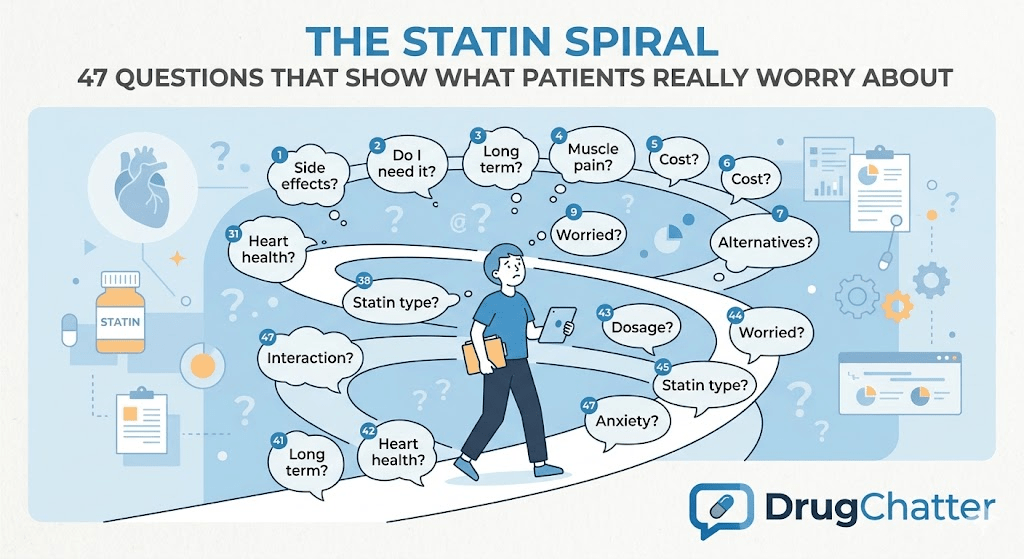
If you want to understand a drug, don’t start with the label—start with the questions people ask at 2 a.m.
For Lipitor and the broader statin class, those questions cluster around a few persistent anxieties: interactions, muscle effects, food rules, and the quiet suspicion that something fundamental—strength, flexibility, even identity—is being altered.
Below is a field guide to the most revealing statin anxieties, drawn from real user questions. Each links to a deeper answer.
1) “What else is this drug touching?”
Statins don’t exist in isolation—and patients know it.
- Can iron supplements influence Lipitor’s side effects?
- Can iron supplements affect Lipitor’s potency?
- Can plant-based iron sources affect Lipitor absorption?
- Can I take over-the-counter cold relief on Lipitor?
- What painkillers can be taken with Lipitor?
- Can I take ibuprofen while on Lipitor?
- Can Lipitor affect antihistamine effectiveness?
- Do Lipitor and Zyrtec interactions cause muscle pain?
Read-through: Patients assume interaction risk is the rule, not the exception. They’re not wrong—statins sit in a crowded metabolic pathway.
2) “Am I trading cholesterol for muscle?”
This is the dominant statin narrative: lipid control versus physical capability.
- How can Lipitor’s flexibility side effect be managed?
- How prevalent are flexibility issues with Lipitor?
- Is there a link between Lipitor and reduced hot yoga flexibility?
- Can Lipitor hinder range of motion?
- Does Lipitor negatively affect muscle growth?
- Are muscle cramps common with Lipitor in athletes?
- Can exercise help counteract Lipitor effects?
- Is there a way to alleviate Lipitor-induced muscle pain?
Read-through: This isn’t just about side effects. It’s about identity—athletes, yoga practitioners, and active patients asking whether the drug changes who they are.
3) “What happens when food gets involved?”
Food–drug interaction anxiety is persistent, often bordering on folklore.
- Does taking Lipitor with milk reduce effectiveness?
- Can Lipitor be taken with citrus juices?
- Can Lipitor’s effectiveness be affected by coffee with cream?
- Are there risks with plant milk and Lipitor?
- How do berries impact Lipitor’s benefits?
- Should Lipitor patients avoid red meat entirely?
- Is cheese safe with Lipitor use?
Read-through: The concern isn’t just efficacy—it’s loss of control. Food is daily, habitual, and personal. Any uncertainty there multiplies anxiety.
4) “Is this safe with my condition?”
Patients try to map population-level data onto individual risk.
- Are there heart ailments contraindicated with Lipitor use?
- Can Lipitor cause heart defects in adults?
- Does Lipitor frequently cause breathing difficulties?
- Are Lipitor liver tests necessary?
- Does Lipitor increase liver risk with alcohol?
Read-through: These are not abstract concerns—they’re attempts to reconcile statin therapy with pre-existing vulnerability.
5) “What if I just… stop?”
Discontinuation is a recurring theme, often framed cautiously.
- Can Lipitor be completely eliminated for yoga practitioners?
- How can I monitor safety when tapering Lipitor?
- What’s the recommended Lipitor taper duration?
- How long does Lipitor stay in the body after stopping?
Read-through: Patients rarely ask “should I stop?” directly. They ask everything around it.
6) “Can I replace it with something ‘natural’?”
The substitution impulse is strong—and risky.
- Are there natural alternatives to Lipitor for yoga practitioners?
- What are the risks of replacing Lipitor with homeopathy?
- Are Lipitor homeopathy interactions harmful?
- Can Lipitor’s potency be matched by OTC alternatives?
Read-through: This is less about efficacy than trust. “Natural” is standing in for “safer,” whether justified or not.
7) “Is it even working—and how much?”
Performance questions cut through the noise.
- What’s the average LDL decrease with Lipitor?
- How much can Lipitor lower cholesterol per dose?
- How long does it take for Lipitor to work?
- What’s the timeline for peak benefits?
Read-through: After all the anxiety, patients come back to first principles: does it work, and when?
8) “Am I combining risk on risk?”
Polypharmacy anxiety shows up clearly here.
- Can Lipitor interfere with blood thinners?
- Does Lipitor reduce aspirin’s effectiveness?
- What precautions should be taken with blood thinners?
- How can Lipitor and warfarin affect each other’s efficacy?
Read-through: Cardiovascular patients often stack therapies—statins, antiplatelets, anticoagulants. They know that stack cuts both ways.
The Bottom Line
The statin story isn’t just pharmacology—it’s psychology.
Patients aren’t asking about LDL targets. They’re asking:
- Will this change how my body feels?
- Can I still live normally?
- What else does this touch?
Those questions don’t show up in clinical trial endpoints—but they dominate real-world adherence.
Ignore them, and you don’t understand statins.
Related Posts: