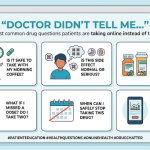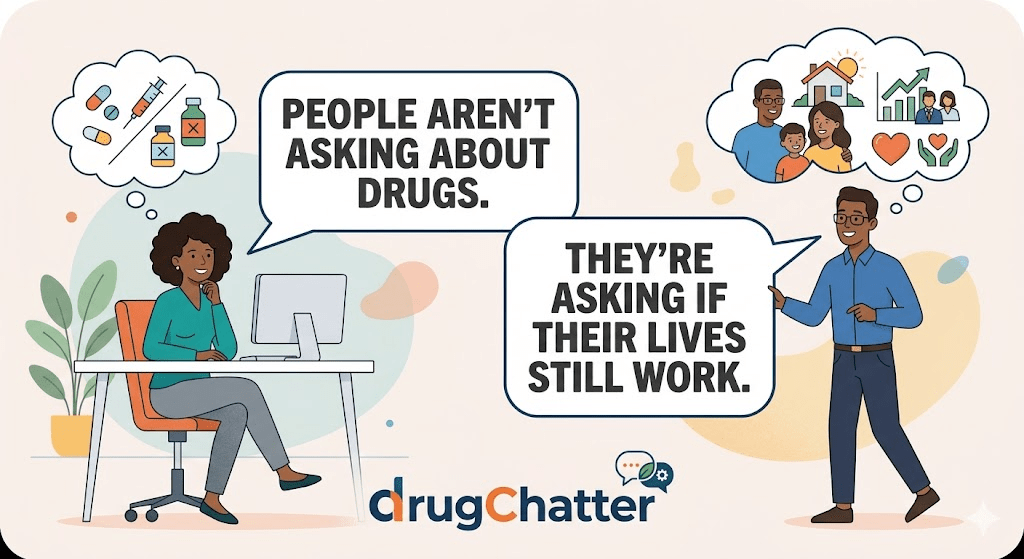
Spend enough time in the DrugChatter logs and a pattern emerges. It’s not pharmacology. It’s not even really medicine.
It’s negotiation.
Patients aren’t asking what a drug does. They’re asking what they’re still allowed to do around it.
1) The Compatibility Question: “Can I Still Live Normally?”
The single most common pattern is collision testing—drug vs. life.
Not drug vs. drug. Drug vs. everything else.
- Food:
- Alcohol and indulgences:
- Supplements and “natural” add-ons:
- Odd edge cases (where things get interesting):
User intent: “Where are the boundaries?”
This is not curiosity. It’s risk management at the level of daily behavior. Patients are mapping the edges of a constrained system: diet, habits, routines, identity.
2) The Substitution Question: “Can I Avoid This Drug Entirely?”
A close second: attempts to route around therapy.
- Lifestyle substitution:
- Alternative therapies:
- Optimization hybrids:
User intent: “Do I really need this?”
This is about control. Statins, GLP-1s, immunologics—these aren’t just treatments. They’re long-term commitments. Users probe for exit ramps early and often.
3) The Interaction Anxiety Loop
This is the dominant emotional tone of the dataset: combinatorial fear.
- Drug–drug interactions:
- Drug–supplement interactions:
- Drug–OTC stacking:
- Drug–environment interactions (where signal starts to degrade):
User intent: “Am I accidentally doing something dangerous?”
The key here is not just safety—it’s uncertainty. The modern patient stack includes prescriptions, OTCs, supplements, diets, and habits. The number of possible interactions explodes. Users are trying to collapse that uncertainty.
4) The Side Effect Surveillance System
Patients don’t just experience side effects. They monitor them like traders watching a volatile market.
- Muscle-related concerns (statins dominate):
- Organ-level concerns:
- Long-term unknowns:
- Reversibility questions:
User intent: “Is this normal, and is it permanent?”
This is pharmacovigilance from the ground up—distributed, anecdotal, and continuous.
5) The Timing and Optimization Problem
Once a patient accepts therapy, the next phase is tuning.
- Onset and expectations:
- Dosing nuance:
- Timing relative to behavior:
User intent: “How do I make this work better for me?”
This is where patients shift from passive recipients to active optimizers.
6) The Cost Layer: Quiet but Persistent
Less frequent, but highly pragmatic.
- Pricing variability:
- Access mechanics:
- Insurance reality:
User intent: “Can I afford to stay compliant?”
Notably, cost questions are more transactional and less exploratory. Users arrive here after deciding the drug matters.
7) The Mechanism Curiosity Spike (Outliers That Matter)
Then there’s a different class entirely—low frequency, high sophistication.
- Mechanistic biology:
- Clinical evidence:
- Regulatory/commercial edge:
User intent: “I want to understand, not just use.”
These are not typical patients. They’re informed users, professionals, or highly engaged individuals. They punch far above their weight in signaling.
8) The Signal Beneath the Noise
Put it together, and DrugChatter isn’t a Q&A site about drugs.
It’s a real-time map of:
- Behavioral constraints
- Risk perception
- Compliance friction
- Informational gaps
The repeated appearance of questions like:
- https://www.drugchatter.com/chat/57590/is-it-safe-to-take-lipitor-and-fish-oil
- https://www.drugchatter.com/chat/54721/are-there-any-potential-interactions-with-other-medications-while-on-lipitor
…isn’t redundancy. It’s reinforcement. The same uncertainty, expressed from slightly different angles.
Final Observation
If you were expecting questions about efficacy curves or trial endpoints, you won’t find many.
Instead, you get:
- “Can I eat this?”
- “Can I drink that?”
- “Can I stop this?”
- “Is this pain normal?”
That’s the real interface between drugs and patients.
Not the label. Not the mechanism.
The day-to-day negotiation of a life that has to continue, with the drug in it.
Related Posts: