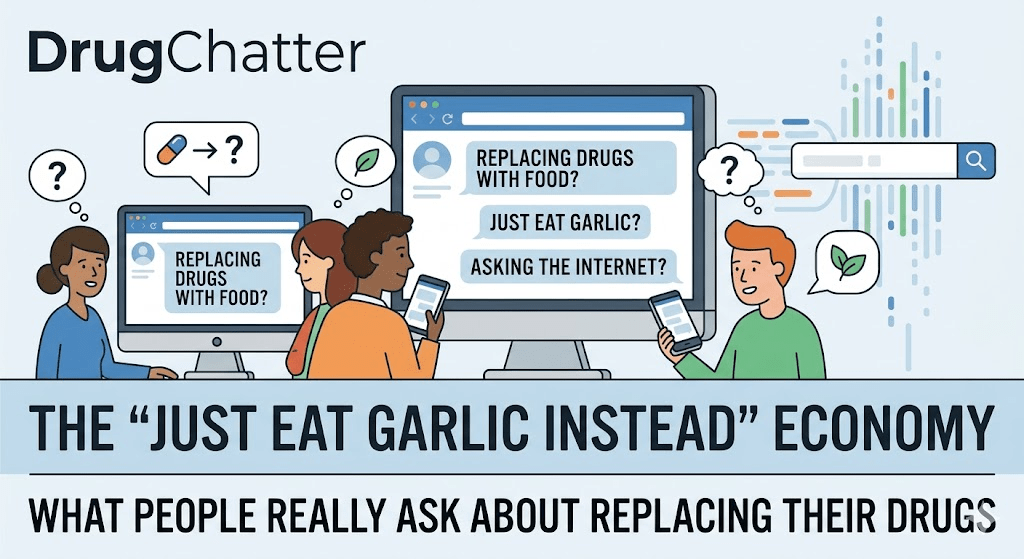
There’s a certain genre of drug question that never goes out of style. It sits somewhere between wishful thinking and genuine curiosity: Can I swap this prescription for something “natural”? Or at least blunt it, offset it, or outsmart it with diet, supplements, or lifestyle tweaks.
Scroll through DrugChatter and you see the pattern immediately. It’s not just skepticism about pharmaceuticals—it’s a persistent search for control. And in many cases, a search for an exit ramp.
Here’s a curated look at the most telling “natural alternative to…” questions—and what they reveal.
Statins vs. Salad: The Lipitor Substitution Fantasy
No drug attracts more substitution attempts than Lipitor. The questions aren’t subtle—they’re hopeful, sometimes defiant.
- Can diet and exercise replace Lipitor entirely?
- Can dietary changes serve as an alternative to Lipitor?
- Can herbal supplements replace Lipitor entirely?
The pattern here is familiar: statins work, but they come with baggage—real or perceived. Muscle pain, liver monitoring, vague unease about long-term use. So patients reach for the oldest intervention in medicine: changing what they eat.
The problem is scale. Diet and exercise can move cholesterol numbers—but not usually with the same magnitude or predictability as a statin. That gap is where most of these questions live.
Garlic, Fish Oil, and the Supplement Stack
If Lipitor can’t be replaced outright, maybe it can be “augmented” into irrelevance.
- Is taking Lipitor and CoQ10 together more effective?
- Can I take Lipitor immediately after eating garlic?
- What are the potential benefits of combining Lipitor and fish oil?
- What are the potential risks of combining Lipitor with herbal pain relief?
This is less about replacement and more about negotiation. Patients are trying to rebalance therapy—reduce side effects, enhance efficacy, or simply feel like they’re doing something beyond swallowing a pill.
Sometimes this instinct aligns with evidence (omega-3s have real effects). Sometimes it drifts into pharmacological noise.
The Painkiller Swap: “Is Turmeric Basically Advil?”
Analgesics are another hotspot for substitution thinking—probably because pain is immediate, subjective, and responsive to placebo effects.
- Is Advil stronger than turmeric?
- Can turmeric be safely combined with Advil?
- Are there safer pain relief options than Tylenol?
- Are there alternative pain relievers to acetaminophen for those taking Lipitor?
Here the substitution question is often framed as safety: “natural” equals “safer.” That’s not how pharmacology works, but it’s a powerful narrative.
Food as Medicine (and Sometimes as Drug Interaction)
Some questions blur the line between substitution and interaction. Food isn’t replacing the drug—it’s being recruited to modify it.
- Can specific diets enhance protein levels post-Lipitor?
- Can exercise help reduce Lipitor-related inflexibility?
- In low-fat diets, can Lipitor affect vitamin absorption?
- Should yogurt be avoided during Lipitor treatment?
These are attempts to fine-tune therapy using lifestyle levers. Not unreasonable—but often overestimating how precisely diet can modulate drug effects.
The “What Else Can I Take Instead?” Cluster
Then there are the direct substitution questions—less philosophical, more transactional.
- Are there alternative medications to Lipitor for cholesterol?
- What medications can replace Lipitor?
- Are there safe alternatives to Lipitor?
- Can OTC options match Lipitor’s efficacy?
These tend to converge on the same reality: yes, there are alternatives—but they’re usually other drugs, not kale smoothies.
The Outliers (and Why They Matter)
A few questions stand out for their creativity:
- What about low-dose aspirin substitutes?
- Can aspirin be taken with herbal supplements?
- Can Vascepa be safely combined with herbal supplements?
These reflect a broader trend: not just replacing drugs, but integrating them into a parallel ecosystem of supplements and “natural” interventions.
What This All Adds Up To
Across hundreds of questions, a few themes repeat:
- Replacement is the goal—but mitigation is the fallback.
Most users start by asking if they can ditch the drug. When the answer is “not really,” the question shifts to minimizing it. - “Natural” is doing a lot of work as a concept.
It stands in for safer, simpler, more controllable—even when the underlying biology doesn’t cooperate. - Lipitor is the center of gravity.
Not because it’s uniquely problematic, but because it’s widely prescribed, long-term, and tied to lifestyle in obvious ways. - Patients are trying to personalize therapy without tools.
These questions are crude attempts at precision medicine—using diet, supplements, and routines as adjustable knobs.
The Bottom Line
The “natural alternative” question isn’t going away. If anything, it’s expanding—fueled by supplement marketing, online health culture, and a general discomfort with chronic medication.
What DrugChatter shows, in raw form, is the gap between what people want medicine to be (flexible, intuitive, food-adjacent) and what it actually is (dose-dependent, mechanism-driven, and stubbornly biochemical).
That gap is where the questions live—and where most of the interesting ones will keep coming from.