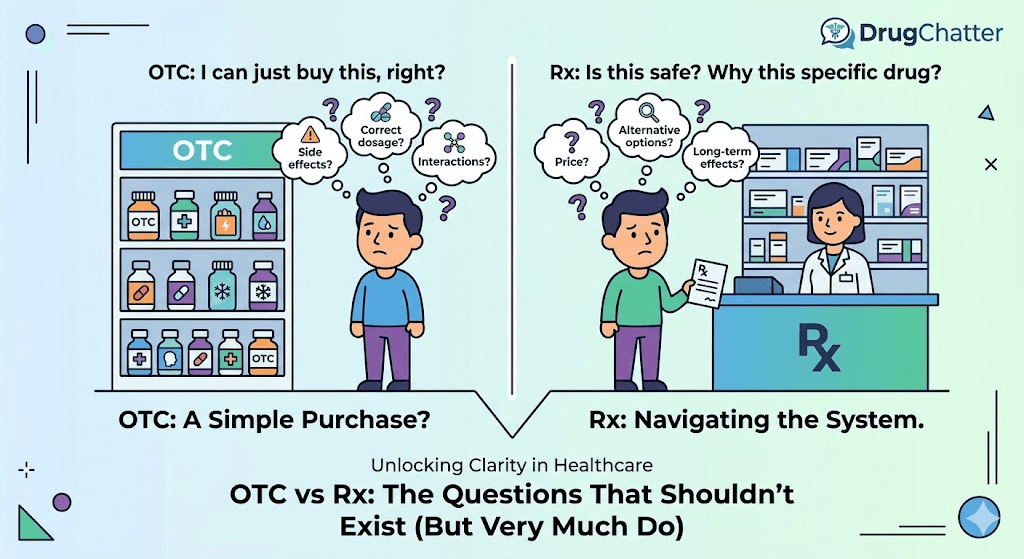
There’s a certain genre of drug question that keeps showing up: not about edge cases or rare adverse events, but about basic category errors. Patients (and plenty of otherwise well-informed people) routinely blur the line between over-the-counter and prescription drugs—what they can replace, what they can combine, and what they expect them to do.
Read enough of these, and a pattern emerges: this isn’t confusion about pharmacology. It’s confusion about roles.
Below is a curated tour through the most revealing examples.
1) “Can OTC options do what prescription drugs do?”
Start with the obvious—and most persistent—misunderstanding:
This question comes up in dozens of forms: supplements vs statins, diet vs drugs, “natural” vs “chemical.”
The underlying assumption: that OTC options are just weaker versions of prescription therapies.
They’re not.
OTC products are approved under a completely different evidentiary bar. Prescription drugs like Lipitor exist because lower-intensity interventions failed—or were never sufficient—for the indication.
Closely related:
- Can diet and exercise replace lipitor entirely
- Are there natural lipitor substitutes
- Can swimming replace lipitor s cholesterol lowering role
Same question, different packaging. The answer, almost always: sometimes partially, rarely fully, and not predictably.
2) “Can I swap one for the other?”
Another category error: substitutability across drug classes.
- Can lipitor replace other blood pressure medications
- Is lipitor a recommended substitute for aspirin in stroke prevention
This is where OTC vs Rx confusion turns into mechanism confusion.
Statins lower LDL. Antihypertensives reduce vascular resistance. Antiplatelets like aspirin reduce clot formation.
These are not interchangeable knobs. They are different systems entirely.
Even within OTC vs Rx:
- How effective are other medications compared to aspirin
- Is aspirin’s onset of headache relief faster or slower than new antiplatelets
Aspirin sits in a strange middle ground: OTC accessibility, prescription-level consequences.
3) “If it’s OTC, it must be safe to mix… right?”
This is where things get more concerning.
- Are there risks with mixing alcohol and advil?
- Can advil interactions increase antidepressant side effects
- Is advil safe to take with anticoagulants
The implicit model: OTC drugs are “lightweight,” so interactions must also be lightweight.
Reality: drugs like Advil and Aspirin have well-characterized, clinically meaningful risks—especially around bleeding, GI toxicity, and renal effects.
Which leads directly to:
- Can aspirin increase the risk of bleeding
- Are there any specific symptoms that indicate aspirin overdose
OTC status does not imply trivial pharmacology.
4) “Can I combine prescription drugs with ‘natural’ or OTC add-ons?”
A huge share of questions cluster here:
- Can lipitor and herbal remedies be used together
- What are the potential risks of mixing lipitor and fish oil
- What s the interaction between lipitor and vitamin c
- How might garlic supplements affect lipitor s efficacy
This is the “stacking” mindset: if one intervention is good, more must be better.
But supplements, OTCs, and prescription drugs all compete for the same metabolic pathways. The body does not recognize “natural” as a safety category.
5) “Prescription strength vs generic vs OTC: what actually changes?”
A more subtle confusion shows up in equivalence questions:
- How quickly does generic xanax alleviate anxiety compared to original
- Are tigecycline generics as effective as the brand name
Here, the OTC vs Rx confusion bleeds into brand vs generic.
Generics are bioequivalent by design. OTC vs Rx is a regulatory boundary, not a potency slider.
6) “What should I do when something goes wrong?”
Finally, the practical questions:
- What should i do if i experience ozempic side effects?
- Which side effects of keytruda require immediate medical attention
- How to treat lipitor toxicity
Notably, no one asks how to manage “chamomile tea toxicity.”
Because at some level, people do understand the difference. The confusion shows up earlier—in substitution, combination, and expectation.
The Throughline
Across all of these, the same mental model keeps appearing:
- OTC = mild, flexible, safe to mix
- Prescription = strong, targeted, but interchangeable with enough effort
Neither is true.
OTC drugs are simply those deemed safe enough for unsupervised use under defined conditions. Prescription drugs are those where variability, risk, or complexity requires oversight.
That’s a regulatory distinction—not a pharmacological hierarchy.
And judging by the volume of these questions, it’s one that still isn’t sticking.