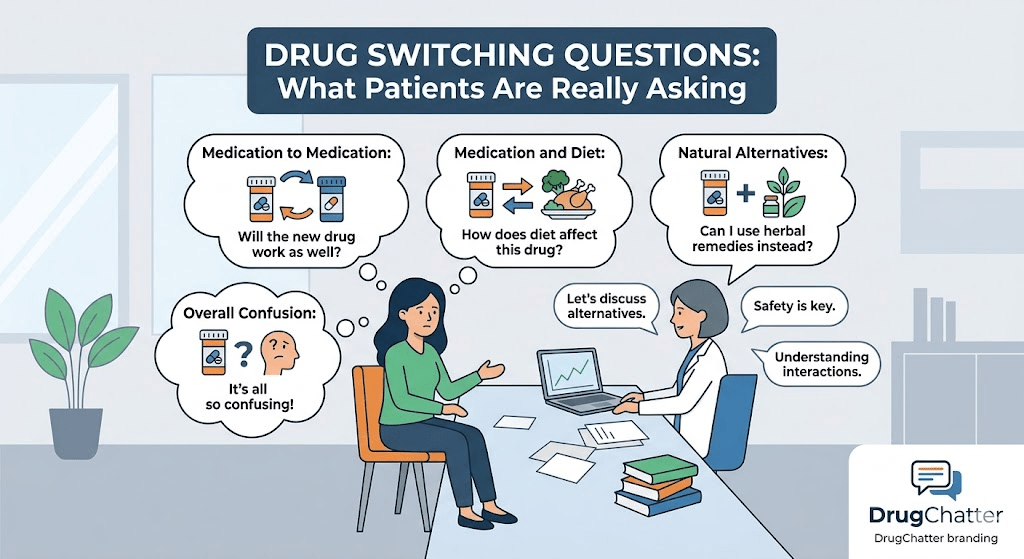
Across DrugChatter’s growing library of patient questions, a clear theme emerges: people are constantly trying to “switch” something in their therapy—whether that means swapping drugs, adding supplements, changing diet, or substituting OTC options. The result is a steady stream of uncertainty around safety, equivalence, and hidden interactions.
Here is a look at the most common drug-switching confusion trends shaping patient behavior today.
1. Switching statins: when “same drug” isn’t the same experience
Few categories generate more switching questions than cholesterol drugs, especially atorvastatin and its brand counterpart, Lipitor.
Patients frequently ask whether generics behave identically or whether lifestyle changes alter drug performance. One example highlights this uncertainty directly:
- How does atorvastatin’s effectiveness compare to Lipitor’s?
https://www.drugchatter.com/chat/3171/how-does-atorvastatin-s-effectiveness-compare-to-lipitor-s
Others explore switching within the same therapy based on perceived side effects:
- Does Lipitor contribute to flexibility issues in several patients?
https://www.drugchatter.com/chat/17124/does-lipitor-contribute-to-flexibility-issues-in-several-patients - Is muscle tiredness a typical side effect of taking Lipitor?
https://www.drugchatter.com/chat/40608/is-muscle-tiredness-a-typical-side-effect-of-taking-lipitor - How can I manage joint pain from Lipitor?
https://www.drugchatter.com/chat/2833/how-can-i-manage-joint-pain-from-lipitor
The underlying question isn’t just “does it work?”—it’s whether patients should switch, adjust, or endure.
2. Food-based switching: when diet becomes part of the drug decision
A surprising number of users treat food as something that can “swap in” or “optimize” drug effects.
For Lipitor, dietary questions dominate:
- Is it safe to eat grapefruit while on Lipitor?
https://www.drugchatter.com/chat/38965/is-it-safe-to-eat-grapefruit-while-on-lipitor - How much grapefruit juice is allowed with Lipitor?
https://www.drugchatter.com/chat/46810/how-much-grapefruit-juice-is-allowed-with-lipitor - Are there any specific snacks to avoid while on Lipitor?
https://www.drugchatter.com/chat/6873/are-there-any-specific-snacks-to-avoid-while-on-lipitor - Can soy milk impact Lipitor’s intended medical benefits?
https://www.drugchatter.com/chat/17336/can-soy-milk-impact-lipitor-s-intended-medical-benefits
Similar “diet substitution” logic appears in cardiovascular therapies like Vascepa:
- Does a high fat diet reduce Vascepa’s cardiovascular benefits?
https://www.drugchatter.com/chat/9522/does-a-high-fat-diet-reduce-vascepa-s-cardiovascular-benefits - Are there interactions between ezetimibe and Vascepa?
https://www.drugchatter.com/chat/6126/are-there-any-potential-interactions-between-ezetimibe-and-vascepa
Here, patients are effectively “switching inputs”—diet versus medication expectations.
3. OTC substitutions: swapping prescription expectations for common pain relief
Another major cluster involves patients trying to substitute or combine over-the-counter drugs.
With Advil and related NSAIDs, questions often center on safety stacking or replacing one product with another:
- Can aspirin and Advil be used together for stronger pain relief?
https://www.drugchatter.com/chat/56362/can-aspirin-and-advil-be-used-together-for-stronger-pain-relief - Is Tylenol safe to take with blood thinners?
https://www.drugchatter.com/chat/32677/is-tylenol-safe-to-take-with-blood-thinners - What are the risks of using expired Advil?
https://www.drugchatter.com/chat/52086/what-are-the-risks-of-using-expired-advil - Can ibuprofen increase blood thinner effects?
https://www.drugchatter.com/chat/48298/can-ibuprofen-increase-blood-thinner-effects
These reflect a broader behavioral pattern: patients trying to “switch up” pain control strategies without fully clear boundaries.
4. Biologics and immune therapies: switching under uncertainty
With immune-modulating therapies like Cosentyx, switching concerns are less about substitution—and more about system-wide effects.
Patients frequently ask:
- Can Cosentyx impact my body’s response to vaccines?
https://www.drugchatter.com/chat/49740/can-cosentyx-impact-my-body-s-response-to-vaccines - What precautions should I take with Cosentyx and vaccines?
https://www.drugchatter.com/chat/4822/what-precautions-should-i-take-with-cosentyx-and-vaccines - Is Cosentyx safe for breastfeeding mothers?
https://www.drugchatter.com/chat/18375/is-cosentyx-safe-for-breastfeeding-mothers
Here, “switching” is not just between drugs—it’s between immune states, life stages, and medical decisions.
5. Lifestyle switching: exercise, alcohol, and “behavioral substitutions”
Some of the most nuanced questions involve replacing habits rather than medications.
With Ozempic:
- How can Ozempic side effects be minimized?
https://www.drugchatter.com/chat/64808/how-can-ozempic-side-effects-be-minimized - Did you notice salt cravings change with Ozempic?
https://www.drugchatter.com/chat/24768/did-you-notice-any-salt-cravings-change-with-ozempic
With statins and alcohol or exercise:
- Can alcohol consumption impact Lipitor’s effectiveness?
https://www.drugchatter.com/chat/25686/can-alcohol-consumption-impact-lipitor-s-effectiveness - Can Lipitor affect muscle strength during running?
https://www.drugchatter.com/chat/57371/can-lipitor-affect-muscle-strength-during-running
These questions reflect a subtler kind of switching: adjusting lifestyle while staying on therapy, rather than replacing it outright.
The bigger pattern: patients are always “optimizing”
Taken together, these questions show that drug switching isn’t just about switching drugs.
It’s about:
- Substituting foods for perceived drug effects
- Replacing prescription expectations with OTC solutions
- Adjusting therapies based on lifestyle tolerance
- Testing boundaries between safety and personalization
In practice, patients are not just asking “Can I switch this drug?”
They are asking “What can I change without losing control of my treatment?”
And increasingly, that question spans prescriptions, diets, supplements, and daily habits—all at once.
Related Posts: