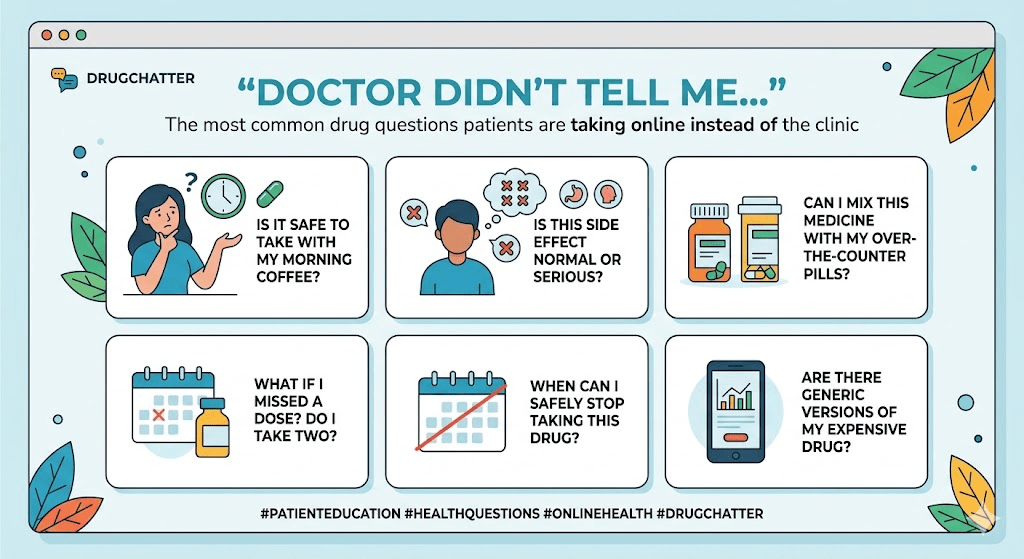
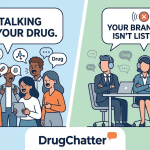
A growing share of medication questions aren’t being asked in exam rooms. They’re being typed into search bars and forums instead—often starting with some version of: “My doctor didn’t tell me this…”
Across DrugChatter’s Q&A archive, a pattern emerges. Patients aren’t just asking about side effects. They’re trying to reconcile prescriptions with daily life: exercise, food, supplements, cost, and uncertainty about what “normal” even means once a drug enters the picture.
Below is a snapshot of the most common “doctor didn’t tell me” themes—and what people are actually asking.
1. Statins and the everyday life problem (especially Lipitor)
A large cluster of questions centers on whether lifestyle choices silently change how cholesterol drugs work—or how people feel on them.
With Lipitor (atorvastatin), the concern isn’t just efficacy. It’s whether normal life interferes with treatment.
Even here, the issue is not access to information—it’s fragmentation. Patients receive dosing instructions, but not always the broader “what if something feels off” framework.
4. Neurological and psychiatric meds: withdrawal, mixing, and uncertainty
The questions suggest a gap: clinical prescribing often ends where financial reality begins.
6. The broader pattern: patients are building their own drug literacy layer
Across antibiotics, oncology drugs, and specialty therapies, the same behavior appears: patients triangulating safety, cost, and expectations outside the clinic.
These “doctor didn’t tell me” questions are not really about missing information in isolation. They reflect something broader: modern drug therapy is complex, but patient communication is still often linear—dose, prescription, brief warning.
Online, patients are reconstructing the missing layers themselves:
lifestyle interactions
financial constraints
polypharmacy risks
subjective symptom interpretation
and real-world variability
The result is a parallel information system—less formal than clinical guidance, but often more responsive to how drugs actually fit into daily life.