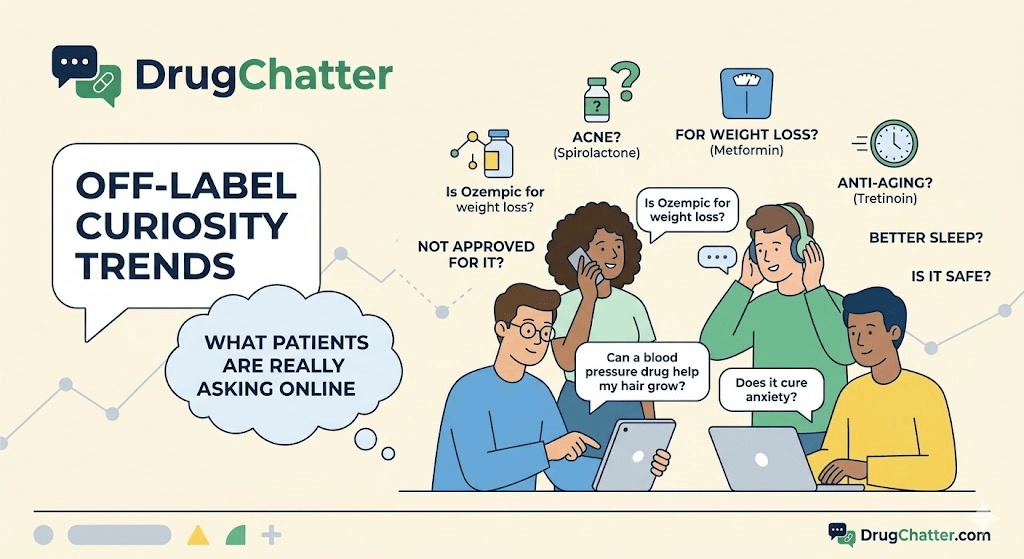
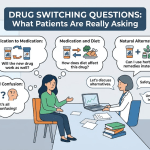
Across thousands of DrugChatter threads, a clear pattern emerges: patients are no longer just asking what a drug does—they’re increasingly exploring how it behaves outside the boundaries of its labeled use. The result is a growing stream of “off-label curiosity” questions that blur lines between clinical pharmacology, lifestyle experimentation, and everyday uncertainty.
Here is a snapshot of the most prominent themes shaping that curiosity.
1. The “can I bend it around my lifestyle?” wave
A large share of questions revolve around whether medications behave differently under real-world conditions—exercise, diet, and daily routines.
With cholesterol therapy in particular, users frequently test the boundaries of assumption:
In parallel, dietary experimentation is constant. Users ask whether everyday foods—from strawberries to dairy to fatty meats—change pharmacologic effect:
Trend takeaway: Patients increasingly treat chronic medications like performance inputs—testing whether lifestyle optimization can amplify or undermine drug response.
2. The supplement substitution hypothesis
A second major cluster centers on whether pharmaceuticals can be replaced—or at least meaningfully supplemented—by natural products.
This is especially visible in lipid management conversations:
Trend takeaway: Patients are increasingly thinking in systems pharmacology terms—often without clinical framing—leading to fragmented but highly specific safety queries.
5. Financial and access-driven “off-label thinking”
Not all off-label curiosity is clinical. Some of it is economic: users attempt to extend branded drug value through coupons, savings programs, or generics.
These questions reflect a broader expectation gap between clinical endpoints and patient-visible change.
Closing pattern: the rise of “DIY pharmacology curiosity”
Across categories—exercise, diet, supplements, safety, and cost—the same underlying behavior emerges: patients are increasingly trying to model drugs as adjustable systems rather than fixed prescriptions.
The result is not necessarily misuse, but something more subtle: a shift toward exploratory, user-driven pharmacology reasoning shaped by fragmented information environments.
If traditional drug labeling defines how a medication should be used, these questions reveal how patients increasingly try to understand how it might still work anyway.
Get sharp analysis on AI-generated drug information, off-label curiosity, pharmacovigilance blind spots, and the shifting intersection of pharma, search, and large language models. No fluff. Just the signals that matter.