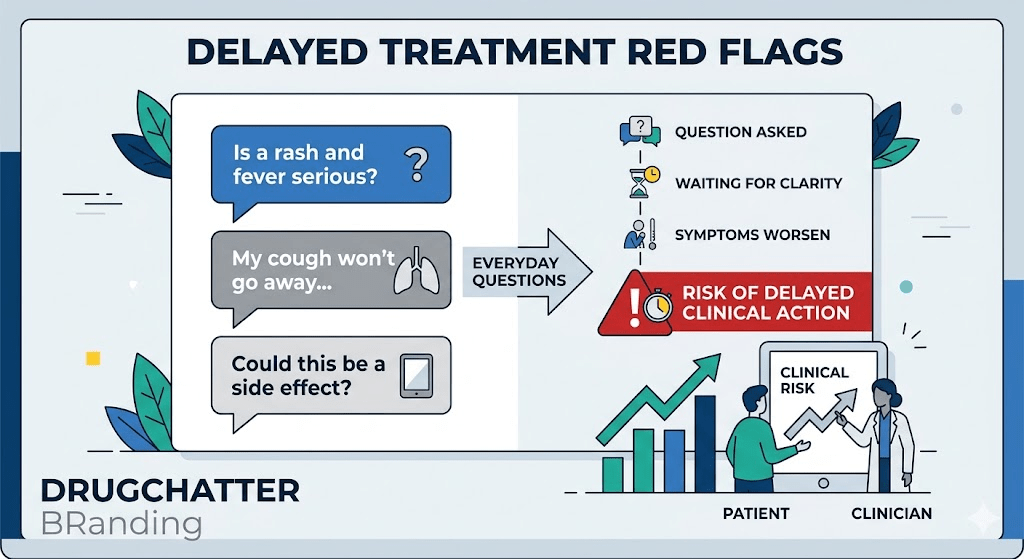
In online drug discussions, some of the most routine-sounding questions can mask a more serious issue: patients delaying appropriate medical attention while trying to self-interpret symptoms, adjust dosing, or “wait it out.”
A review of recent DrugChatter questions shows a consistent pattern. Patients often try to resolve uncertainty through lifestyle adjustments, supplements, or informal reassurance—sometimes postponing care that should be clinician-led.
Below are key “delayed treatment red flags” emerging from those conversations.
1. When lifestyle explanations replace medical evaluation
A recurring theme is attributing drug effects—or lack of effect—to exercise or daily habits, rather than seeking clinical guidance.
Examples include concerns about whether statins are affected by physical activity:
Individually, these are reasonable questions. Collectively, they reflect a pattern: patients substituting behavioral explanations for clinical assessment, potentially delaying evaluation of side effects or disease progression.
2. Normalizing symptoms that may require prompt attention
Some of the highest-risk delays occur when patients try to “monitor at home” symptoms that may warrant medical review.
These questions often reflect delayed escalation—where symptom persistence is treated as informational uncertainty rather than a signal for reassessment.
3. Overlooking drug interactions that compound risk
Another major red flag is delayed recognition of drug–drug or drug–supplement interactions.
These cases highlight a common issue: patients seeking confirmation online instead of urgent clinical evaluation when serious symptoms may already be present.
6. Delayed monitoring and follow-up
Finally, some delays arise from uncertainty about routine monitoring:
Without structured follow-up, small issues can persist unnoticed until they become clinically significant.
The broader pattern: uncertainty becomes delay
Across these categories, the underlying issue is not lack of information—it’s delayed escalation.
Patients frequently:
Attribute symptoms to lifestyle instead of medication effects
Wait for reassurance instead of seeking evaluation
Investigate interactions only after symptoms appear
Delay care due to cost or access concerns
Individually rational questions can collectively create a lag between symptom onset and clinical action.
Bottom line
Online drug discussions are increasingly sophisticated—but they also reveal a consistent risk pattern: uncertainty being managed informally rather than clinically.
In pharmacology, timing matters. Delayed treatment—whether for side effects, interactions, or dosing issues—can shift outcomes significantly.
The clearest red flag is not a single symptom, but persistence of symptoms without escalation to medical review.
Get sharp analysis on AI-generated drug information, off-label curiosity, pharmacovigilance blind spots, and the shifting intersection of pharma, search, and large language models. No fluff. Just the signals that matter.