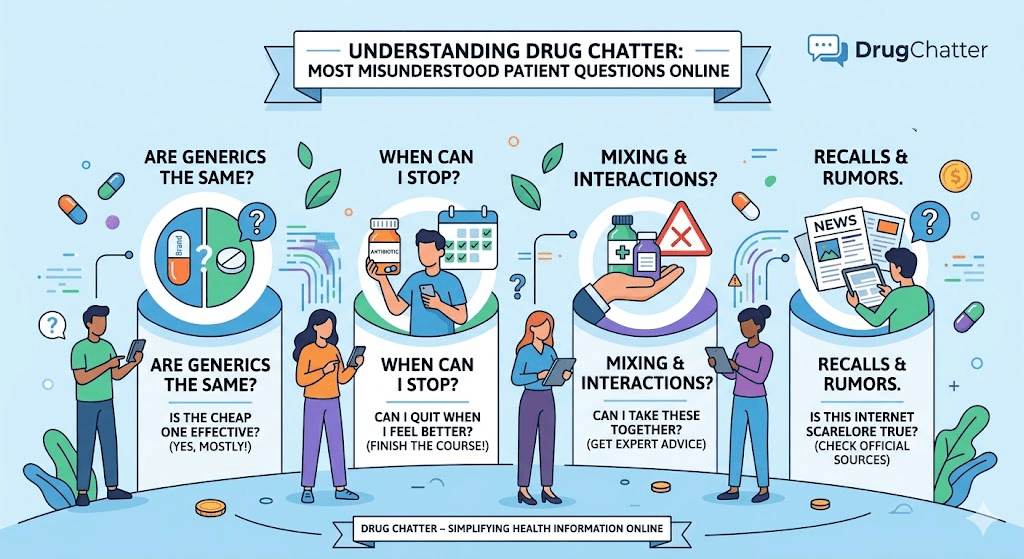
The Most Misunderstood Drug Questions Patients Are Asking Online

A scan of patient-generated questions reveals a striking pattern: confusion rarely centers on what drugs do—it centers on how they interact with everything else in real life. Food, exercise, supplements, vaccines, and even lifestyle habits routinely blur the line between clinical guidance and personal experimentation.

Below is a curated look at the most misunderstood drug questions circulating online—paired with direct links to answers—and what they reveal about persistent knowledge gaps.


1. Vaccines and Biologics: Timing, Safety, and Anxiety

Patients on immunomodulators consistently struggle with vaccine timing and safety—particularly with IL-17 inhibitors like Cosentyx.

What’s misunderstood:
Patients often assume all vaccines behave the same. In reality, live vaccines carry very different considerations than inactivated or mRNA vaccines, especially under immunosuppression.


2. Drug–Food Interactions: Beyond Grapefruit

The well-known grapefruit warning with Lipitor has evolved into widespread uncertainty about all foods.

What’s misunderstood:
Patients frequently generalize a specific metabolic interaction (CYP3A4 inhibition) into a blanket fear of all foods—most of which have no clinically meaningful impact.


3. “Stacking” Medications: Everyday Polypharmacy Risks

Combining common drugs—often over-the-counter—remains a major source of confusion.

What’s misunderstood:
Patients underestimate additive risks—particularly bleeding—when combining drugs with overlapping mechanisms.


4. Side Effects vs. Attribution Bias

Patients often struggle to determine whether a symptom is drug-related or coincidental.

What’s misunderstood:
Anecdotal clustering of symptoms (fatigue, muscle pain) can amplify perceived risk beyond what controlled data supports.


5. Lifestyle Interactions: Exercise, Alcohol, and Diet

Patients increasingly want to optimize therapy alongside lifestyle—but often misinterpret interactions.

What’s misunderstood:
Patients expect either synergy or conflict, when in most cases lifestyle factors operate independently but additively.


6. Supplements and “Natural” Interactions

The assumption that natural equals safe continues to drive uncertainty.

What’s misunderstood:
“Natural” compounds can still alter metabolism, absorption, or immune response—sometimes unpredictably.


7. Long-Term Risk and Organ Effects

Chronic therapies raise concerns about cumulative toxicity.

What’s misunderstood:
Patients often overestimate rare long-term risks while underestimating the benefits of sustained disease control.


8. Cost, Access, and Workarounds

Economic concerns drive a different category of misunderstanding—what’s permissible versus what’s possible.

What’s misunderstood:
Patients frequently conflate manufacturer programs, insurance rules, and legal constraints on drug sourcing.


9. Mechanism-Level Curiosity (Often Misapplied)

Some users dive deep into biochemical effects—but without clinical context.

What’s misunderstood:
Mechanistic plausibility is often mistaken for clinical relevance.


10. Substitution Myths: “Can I Replace This Drug?”

A recurring theme: replacing prescription therapies with lifestyle or alternatives.

What’s misunderstood:
Patients often compare therapies with fundamentally different evidence bases, endpoints, and magnitudes of effect.


The Bottom Line

Across hundreds of questions, a consistent insight emerges: patients are not just asking about drugs—they’re asking how drugs fit into real life. The disconnect lies in translating controlled clinical evidence into messy, individualized contexts.

For industry observers, these questions are more than noise. They are signals—highlighting where patient education, labeling clarity, and physician communication continue to fall short.
DrugChatter - Know what AI is saying about your drugs
Scroll to Top