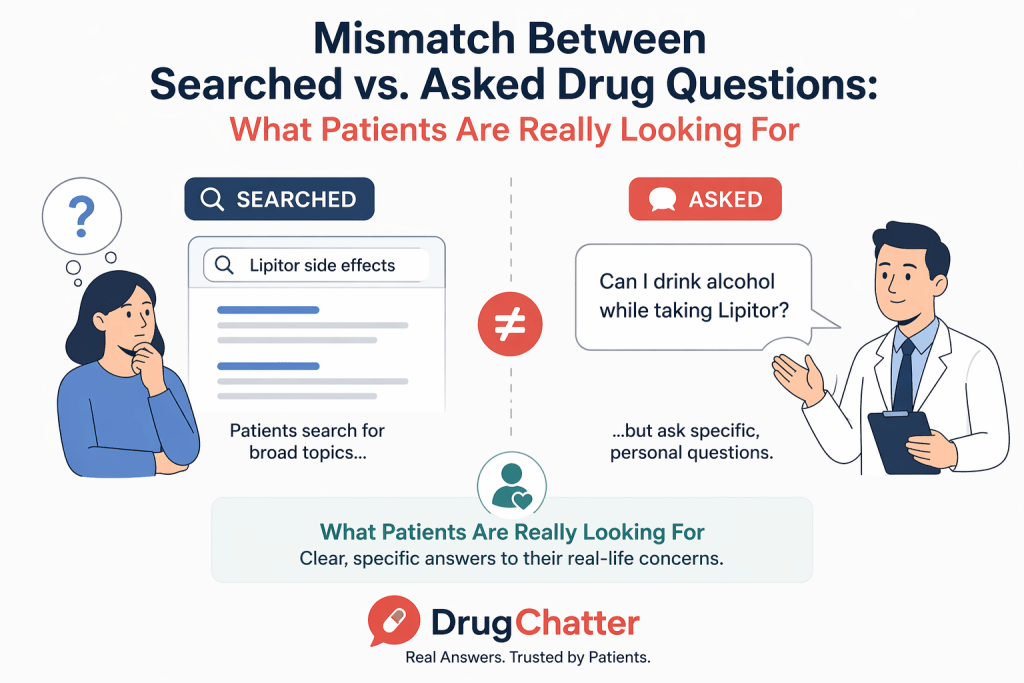
In theory, digital health queries should track clinical reality: drug–drug interactions, dosing guidance, adverse effects, and regulatory questions. In practice, patient-driven question logs suggest a more fragmented landscape—where curiosity, anxiety, and lifestyle concerns frequently outweigh formal pharmacological intent.
A review of DrugChatter user-submitted questions reveals a consistent mismatch between what users are expected to search for and what they actually ask. The result is a parallel taxonomy of drug information needs that blends clinical uncertainty with dietary folklore, financial friction, and everyday life experimentation.
1. Statins as lifestyle lenses, not just lipid-lowering agents
Few drugs illustrate the mismatch more clearly than atorvastatin (Lipitor). While clinicians focus on LDL reduction and cardiovascular risk, patients frequently frame the drug through food, movement, and identity-level concerns.
Questions range from dietary micro-adjustments to symbolic lifestyle integration:
The underlying pattern is not confusion about statin efficacy, but a desire to preserve normal life while on chronic therapy. Even exercise becomes pharmacologically reframed:
Here, pharmacology is filtered through lived experience rather than clinical endpoints.
2. Side effects: from incidence rates to narrative prediction
Search intent in medical systems often assumes users want probabilities. Actual queries show a stronger interest in timing, subjectivity, and pattern recognition.
Rather than asking what percentage of patients experience X, users ask “will this happen to me, and when?” The shift reflects an underlying uncertainty in translating population-level data into personal forecasting.
A large share of queries cluster around combination therapy—but often extend beyond clinically relevant risk thresholds into low-probability or lifestyle combinations.
What stands out is not lack of adherence knowledge, but the breadth of perceived interaction risk—spanning prescription drugs, OTC medications, and supplements.
Even dietary supplements are treated as quasi-pharmaceutical agents:
These are not standard pharmacodynamic questions. They reflect an emerging expectation that drugs interact with subjective experience as much as with biochemical pathways.
The takeaway: patients are not misinformed—they are misaligned with how drug knowledge is structured
The mismatch is not simply error or misunderstanding. Instead, it reflects a structural gap between:
Clinical framing (risk ratios, contraindications, trial data) and
Patient framing (food, behavior, timing, cost, identity, and lived variability)
DrugChatter’s dataset suggests that modern pharmaceutical discourse is increasingly hybrid: part clinical inquiry, part lifestyle negotiation, part financial planning, and part experiential forecasting.
For drug developers, payers, and health communicators, the implication is straightforward but often ignored: users are not primarily searching for drug facts. They are searching for what their life looks like while taking the drug.