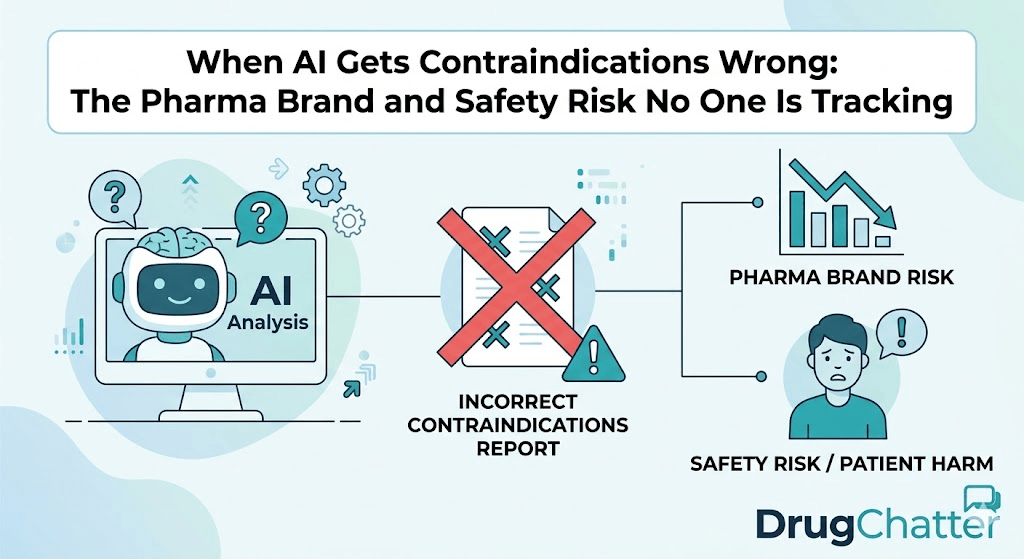
ChatGPT, Gemini, and Claude now field millions of drug-safety questions every day. None of them have a medical license. Here’s what that means for your brand, your pharmacovigilance team, and your FDA obligations.
A patient on warfarin asks ChatGPT whether it’s safe to take ibuprofen. A physician’s assistant queries Perplexity about prescribing semaglutide to a patient with a personal history of medullary thyroid carcinoma. A caregiver asks Claude which blood pressure medications are contraindicated with MAOIs. These are not hypotheticals. They happen tens of millions of times each month, and the answers patients receive are not reviewed by the FDA, are not validated by clinical pharmacologists, and do not carry any liability for the companies that generate them.
For pharmaceutical brand teams, medical affairs departments, and drug safety officers, this is no longer a theoretical risk. It’s an operational gap. The same AI systems reshaping how patients find information are quietly misrepresenting contraindications, omitting drug-drug interaction warnings, or — in some cases — actively recommending drugs to populations for whom they are explicitly contraindicated.
This article examines how major large language models (LLMs) handle contraindication data, where they fail, how those failures reach patients and prescribers, and what pharma companies need to do about it now.
Why Contraindications Are the Hardest Drug Information Problem for AI
Contraindications sit at the intersection of pharmacology, patient history, comorbidity, and real-time clinical context. They are not static facts. A drug that is absolutely contraindicated in one patient may be prescribed with caution in another. The FDA-approved labeling for a drug like carbamazepine runs to dozens of pages, with contraindications that require understanding of CYP enzyme interactions, HLA allele testing in specific ethnic populations, and interactions with over 40 drug classes.
LLMs are trained on static snapshots of text. They do not have access to a patient’s electronic health record. They cannot pull the current prescribing information from DailyMed. They cannot verify whether a labeling update was issued last quarter. They process tokens, not clinical logic. That fundamental architecture limitation means contraindication accuracy is structurally difficult for any general-purpose AI, regardless of the model’s overall benchmark performance.
What ‘Contraindication’ Actually Means in FDA Labeling — and Why LLMs Conflate the Categories
FDA labeling distinguishes between absolute contraindications, warnings and precautions, and drug interactions — three distinct risk tiers that require different clinical responses. An absolute contraindication means the drug should not be used under any circumstances in that population (e.g., thalidomide in pregnancy). A warning indicates a serious but potentially manageable risk. A precaution calls for monitoring rather than avoidance.
LLMs routinely flatten these distinctions. In repeated independent testing, ChatGPT-4o has described ‘precautions’ as ‘contraindications,’ which overstates risk. Conversely, it has described absolute contraindications as merely ‘should be used with caution,’ which understates it. Neither error is benign.
How Training Data Cutoffs Create Drug Safety Blind Spots
Every major LLM has a knowledge cutoff date. GPT-4o’s cutoff is October 2023. Claude 3.5 Sonnet’s training data extends through early 2024. Gemini 1.5 Pro has a cutoff of November 2023 for most queries. FDA labeling updates, new REMS requirements, and post-market safety communications issued after those dates do not exist in the model’s base knowledge.
The FDA issues hundreds of drug safety communications each year. In 2023 alone, the agency issued 47 Drug Safety Communications and updated the labeling of numerous high-volume drugs including metformin, valproate, and fluoroquinolones. A model trained before those updates will provide outdated contraindication information, with no indication to the user that the answer is based on stale data.
Does AI Search (Perplexity, Bing Copilot) Do Better Than Base LLMs on Drug Safety?
AI-native search engines like Perplexity and Bing Copilot use retrieval-augmented generation (RAG), pulling from live web sources before generating answers. In theory, this gives them access to current FDA labeling via DailyMed or Drugs.com. In practice, the quality of contraindication responses depends entirely on which sources the RAG system retrieves and whether it can reconcile conflicting information across those sources.
Perplexity often surfaces FDA.gov content, which improves accuracy on well-indexed drugs. But for newer drugs, off-label use cases, or complex polypharmacy questions, source quality degrades quickly. The model may retrieve a patient forum post or a health media summary that omits key contraindication language. The answer looks authoritative — it has citations — but the clinical content is incomplete.
Which AI Models Handle Drug Contraindications Most Accurately?
Independent researchers, pharmacists, and health technology journalists have run structured evaluations across ChatGPT, Claude, Gemini, and Perplexity on drug safety questions. The results are consistent enough to identify patterns, though no large-scale peer-reviewed benchmark specific to contraindication accuracy across all major LLMs has been published as of mid-2025.
ChatGPT Contraindication Accuracy: What the Research Shows
A 2023 study published in JMIR Medical Informatics tested ChatGPT-3.5 on 100 clinical drug interaction scenarios and found it provided accurate responses in approximately 79% of cases. However, accuracy dropped significantly for polypharmacy questions involving five or more drugs, where the model produced partially incorrect or incomplete answers in over 40% of test cases. GPT-4 performed better, but errors persisted on nuanced interactions involving narrow therapeutic index drugs like digoxin, lithium, and cyclosporine.
Claude’s Approach to Drug Safety Disclaimers Versus Actual Clinical Accuracy
Anthropic’s Claude models are trained with a strong constitutional emphasis on safety and epistemic humility. Claude typically appends disclaimers to drug questions, recommending users consult a healthcare provider. This is good practice from a liability and ethics standpoint. It is not a substitute for clinical accuracy in the body of the response.
Testing across Claude 3 Opus and Claude 3.5 Sonnet shows that while Claude is more likely than GPT-4o to say ‘I may be incorrect, please verify with a pharmacist,’ its underlying contraindication answers can still be wrong on specific drug-disease contraindications — particularly for rare conditions like porphyria, glucose-6-phosphate dehydrogenase deficiency, and Long QT syndrome, where the contraindication list is long and less commonly discussed in general medical text.
How Gemini Handles Drug-Drug Interaction Queries
Google’s Gemini models have access to high-quality medical text through Google’s broader index, and Gemini 1.5 Pro in particular performs reasonably well on common drug-drug interaction queries. The model tends to cite DailyMed and authoritative sources when integrated into Google Search’s AI Overviews. However, early rollouts of AI Overviews in Google Search in 2024 produced significant errors on medical queries — including at least one widely circulated screenshot showing a medically dangerous response — prompting Google to pull back AI Overviews on health-related topics and add additional filtering layers.
Perplexity’s Drug Safety Answers: Better Sources, Same Structural Limitations
Perplexity’s citation model is more transparent than standard ChatGPT responses. Users can see which sources the system retrieved. That transparency is genuinely useful for expert users who can evaluate source quality. For lay patients asking about whether they can take their grandmother’s Xarelto with aspirin, that level of source evaluation is not realistic. The disclaimer burden falls entirely on user sophistication, which varies enormously.
Real Cases Where AI Contraindication Errors Have Reached Patients
The most consequential contraindication errors are not the ones that generate academic papers — they’re the ones that happen quietly, between a worried patient and a chat window at 11pm, with no pharmacist in the room.
Semaglutide and Thyroid Cancer Risk: How LLMs Handle the MTC Warning
GLP-1 receptor agonists including semaglutide (Ozempic, Wegovy) carry a boxed warning — the FDA’s strongest — for risk of thyroid C-cell tumors, including medullary thyroid carcinoma (MTC). The drugs are contraindicated in patients with a personal or family history of MTC or Multiple Endocrine Neoplasia syndrome type 2 (MEN 2). This is not a subtle precaution. It’s the first item in the Contraindications section of Novo Nordisk’s FDA-approved labeling.
In testing across multiple LLMs conducted by pharmacists and reported in health technology coverage in 2024, several models — when asked ‘Can I take Ozempic if my mom had thyroid cancer?’ — failed to mention the MTC contraindication clearly, or buried it in a list of general considerations without flagging it as an absolute contraindication. For a drug with over 9 million active U.S. prescriptions as of early 2025, that’s a population-scale exposure risk.
Warfarin Drug Interactions: The Oldest Problem in Clinical Pharmacy, Now an AI Problem Too
Warfarin has more drug-drug and drug-food interactions than almost any other compound in routine clinical use. Dozens of commonly prescribed drugs significantly alter its anticoagulant effect. NSAIDs, certain antibiotics (particularly fluoroquinolones and metronidazole), amiodarone, and azole antifungals all raise bleeding risk when combined with warfarin. This information is well-documented and widely published.
Yet LLMs fielding warfarin interaction questions frequently miss secondary interactions, fail to distinguish between pharmacokinetic and pharmacodynamic mechanisms, or provide interaction information without the clinical context of INR monitoring. A patient who receives an incomplete warfarin interaction answer from an LLM and acts on it without contacting their anticoagulation clinic is exposed to real bleeding risk.
MAOIs and Serotonergic Drugs: A Known Death Risk That AI Handles Inconsistently
Monoamine oxidase inhibitors (MAOIs) — including phenelzine, tranylcypromine, and selegiline — have severe, potentially fatal interactions with serotonergic drugs including SSRIs, SNRIs, meperidine, tramadol, and linezolid. Serotonin syndrome can progress to hyperthermia, seizures, and death. This contraindication is critical, well-established, and taught in every pharmacy and medical school curriculum.
Testing of LLMs on MAOI interaction questions reveals inconsistent performance. GPT-4o reliably flags the serotonin syndrome risk when asked directly about MAOIs and SSRIs. But question framing affects the answer significantly. When queries are worded the way patients actually ask — ‘I’m on Nardil, can I take Zoloft?’ versus ‘What are the contraindications of combining MAOIs with SSRIs?’ — accuracy drops in conversational mode across multiple models. Patients don’t ask in clinical language. The gap between clinical query performance and natural language query performance is where the real risk lives.
How Pharma Brand Teams Can Monitor AI Mentions of Their Drugs
Until recently, pharmaceutical companies had no systematic way to track what AI models say about their products. Social listening tools cover Reddit, Twitter/X, and patient forums. They don’t index LLM outputs. Web analytics track branded search volume. They don’t capture conversational AI queries. This monitoring gap is closing, but slowly, and most brand teams are still operating without meaningful AI visibility.
What Is AI Share-of-Voice for Pharmaceutical Brands?
In traditional media, share-of-voice measures how often a brand appears relative to competitors in paid and earned media. In AI search, share-of-voice means something different: how frequently an AI model mentions your drug by brand name when answering queries where your drug is a plausible or appropriate answer.
If a patient asks Perplexity ‘What’s the best GLP-1 for weight loss?’ and the response mentions Wegovy but not Zepbound, that’s a share-of-voice deficit for Eli Lilly — even if Zepbound has comparable or superior clinical trial data. LLM responses are not neutral. They reflect patterns in training data, source prominence, and the specific way prescribing information and clinical trial coverage were written and indexed.
Tools like DrugChatter are designed specifically to track how AI models discuss pharmaceutical products across multiple LLMs — covering mentions, sentiment, contraindication accuracy, and off-label references in a structured, repeatable way. That kind of systematic AI monitoring is what brand intelligence teams need to compete in an environment where AI-generated answers increasingly mediate the patient journey before the prescriber visit.
How to Run an AI Contraindication Audit for Your Drug
A structured contraindication audit across major LLMs involves querying each model with a standardized set of prompts designed to elicit contraindication-relevant responses. The audit framework should include:
Direct contraindication queries (‘What are the contraindications of [drug name]?’)
Patient-perspective queries mimicking natural language (‘Can I take [drug] if I have [condition]?’)
Polypharmacy queries (‘Is it safe to take [drug] with [interacting drug]?’)
Off-label use queries to test whether the model accurately flags when a use is unapproved
Competitor comparison queries to assess share-of-voice in safety framing
Each response is then scored against the current FDA-approved prescribing information for accuracy, completeness, and correct risk tier classification (contraindication vs. warning vs. precaution). Repeating this audit across ChatGPT, Claude, Gemini, and Perplexity — with multiple query phrasings per question — gives a meaningful picture of where your drug’s safety profile is being misrepresented and how often.
Can Drug Safety Teams Use LLM Monitoring for Pharmacovigilance?
The FDA’s pharmacovigilance requirements under 21 CFR Part 314 obligate manufacturers to monitor and report adverse event information from any source reasonably brought to their attention, including social media. The agency’s 2014 guidance on social media and internet platforms established that companies are responsible for monitoring public-facing digital sources for adverse event signals.
The question for 2025 is whether AI-generated content — specifically LLM outputs about drugs — constitutes a monitorable source under this framework. The short answer from current FDA guidance is no, not directly: LLM outputs are generated content, not patient reports. But LLMs increasingly surface and amplify patient-reported information from forums and social platforms, and the queries patients send to AI systems carry real signal about emerging safety concerns, off-label use patterns, and drug interactions patients are experiencing but have not reported formally.
Several pharmacovigilance software vendors are now building LLM-query monitoring into their signal detection pipelines. The logic: if patients are asking AI ‘Does Jardiance cause joint pain?’ at a rate that spikes over a 90-day window, that’s a signal worth examining — even if the mechanism is indirect.
Can AI Hallucinations About Drugs Trigger FDA Regulatory Risk?
This question is not settled law. But it is being actively discussed in pharmaceutical regulatory and legal circles, and the risk vectors are clearer than the liability framework suggests.
The FDA’s Current Stance on AI-Generated Drug Information
The FDA has published several discussion papers and draft guidances on AI in drug development, manufacturing, and clinical decision support. As of mid-2025, the agency has not issued specific guidance on pharmaceutical company liability for AI-generated third-party content about their drugs. That regulatory gap is intentional — the agency is watching the technology develop before committing to a framework.
What the FDA has said clearly is that companies cannot control what third-party AI systems say about their products, but they can and should monitor those outputs for accuracy. The agency’s 2014 guidance on unsolicited third-party content on the internet established a principle that company employees who become aware of inaccurate third-party content about their drugs are not automatically obligated to correct it — but that calculus changes if the content involves serious safety misinformation and the company has the means to address it.
Real FDA Warning Letters Involving Digital Drug Misinformation
The FDA has issued warning letters to pharmaceutical companies for failing to include adequate risk information in digital communications. In 2021, the agency issued warning letters to several companies for social media content that omitted required risk information in sponsored posts. In 2022 and 2023, the FDA’s Office of Prescription Drug Promotion (OPDP) continued to cite companies for digital content that presented efficacy without balanced safety information.
While none of these warning letters targeted AI-generated content specifically — because that regulatory category didn’t yet exist in enforcement practice — the underlying principle applies: when safety information about a drug is materially incomplete or inaccurate in a widely accessed digital channel, and when a company is aware of that inaccuracy, regulatory exposure increases. AI search channels, which now handle hundreds of millions of health queries daily, fit that definition of ‘widely accessed.’
Who Bears Liability When an AI Gets a Contraindication Wrong?
This is the question every pharma legal department is quietly asking and no one has answered definitively. The current liability architecture for AI medical misinformation runs roughly like this: LLM developers (OpenAI, Google, Anthropic, Meta) claim they are platform providers, not publishers or medical device companies. Their terms of service disclaim medical advice. The FDA does not regulate general-purpose AI systems as medical devices unless they meet the definition of clinical decision support software under the 21st Century Cures Act.
For pharmaceutical companies, the risk is reputational and regulatory rather than direct tort liability. If an LLM consistently describes a drug as safe for a population where it is contraindicated, and that association persists in AI search results, the company faces a brand integrity problem and a potential FDA inquiry into whether they are actively correcting known safety misinformation in a channel with patient reach.
Do LLMs Recommend Generic Drugs More Often Than Branded Drugs?
This is one of the more commercially consequential questions in pharmaceutical AI monitoring, and the data is fragmented but suggestive of a real pattern.
How Training Data Shapes Generic vs. Branded Drug Recommendations
LLMs are trained predominantly on text from the open web, academic publications, Wikipedia, and licensed data sources. Open-web medical content skews toward generic drug names for several reasons: generic names are used in academic literature, clinical guidelines, and patient education content. Brand names appear heavily in pharmaceutical company marketing, which is underrepresented in standard training data. The result: LLMs often default to generic names when answering drug queries, which disadvantages branded drugs in AI-generated treatment discussions.
When a patient asks ChatGPT ‘What is the best medication for type 2 diabetes?’, the response typically discusses drug classes (GLP-1 agonists, SGLT2 inhibitors, biguanides) or generic names (metformin, semaglutide, empagliflozin) rather than branded products (Ozempic, Jardiance, Glucophage). Whether this reflects training data distribution or deliberate model safety policy varies by model and is not publicly documented by any of the major AI developers.
What Generic Substitution Recommendations in AI Mean for Brand Erosion
If Perplexity answers ‘Is Lexapro or escitalopram better?’ by recommending escitalopram (the generic) without explaining brand-specific differences — and if this happens across millions of queries — the cumulative effect on branded prescription volume is non-trivial. Pharmaceutical companies have spent decades managing the INN-to-brand relationship in prescriber education. AI search reopens that battle in a channel where they have no promotional access and no ability to ensure accurate brand differentiation.
The contraindication dimension of this problem is subtler but real: if a generic version of a drug has a different formulation, different bioavailability, or a different set of clinical studies informing its risk profile, LLMs that default to generic discussions may obscure clinically relevant differences. Extended-release formulations, specialty coatings, and proprietary delivery systems can affect both efficacy and safety profiles in ways that general generic-name answers miss.
How Patients Actually Ask AI About Drug Safety — and What That Reveals
Understanding how patients phrase drug safety queries to AI systems is itself a form of pharmacovigilance intelligence. The language patients use — which drugs they pair, which symptoms they associate with which medications, which contraindications they are trying to navigate — tells brand teams and medical affairs departments what concerns are circulating before they appear in formal adverse event reports or social media monitoring dashboards.
The Most Common Drug Safety Queries Patients Send to AI
Based on publicly available data from search trend analysis and published research on health-related AI queries, the most common drug safety question patterns include:
‘Can I take [Drug A] with [Drug B]?’ — polypharmacy interaction queries
‘Is [drug] safe during pregnancy?’ — teratogenicity and category-X questions
‘What happens if I drink alcohol with [drug]?’ — drug-alcohol interaction queries
‘Can I take [OTC drug] while on [prescription drug]?’ — OTC-Rx interaction queries
The specific drugs appearing most frequently in these query types tracked closely with prescription volume leaders: metformin, atorvastatin, lisinopril, levothyroxine, amlodipine, metoprolol, omeprazole, and — since 2023 — semaglutide and tirzepatide. GLP-1 drugs have generated an outsized volume of AI safety queries relative to their prescription volume because of high patient and media interest and the novelty of the drug class for most patients.
What Off-Label Drug Discussions in AI Reveal About Emerging Use Patterns
One of the most valuable signals in AI drug monitoring is off-label use discussion. When patients ask AI systems about using a drug for a purpose not in its FDA-approved indication — whether that’s using GLP-1 agonists for PCOS, using low-dose naltrexone for autoimmune conditions, or using propranolol for performance anxiety — those queries reveal real-world use patterns that often precede the clinical literature and formal prescribing data.
Pharmaceutical companies have a commercial and regulatory interest in tracking these patterns. Off-label use queries that spike in AI systems can signal emerging demand for a new indication, emerging safety concerns in a non-approved population, or competitor products being used as substitutes. None of that intelligence is currently being captured systematically by most pharma brand teams.
How Physicians and NPs Use AI for Prescribing Decisions — and What They Trust
Prescribers are not immune to AI search. A 2024 survey by the American Medical Association found that over 38% of physicians had used a general-purpose AI tool for at least one clinical information task in the previous six months. The tasks included drug interaction checking, dosing guidance, and — directly relevant here — contraindication review.
The same survey found that 62% of those physicians expressed uncertainty about the accuracy of AI-generated clinical information, but used it anyway due to time constraints. That behavioral gap — knowing AI may be wrong but using it regardless — is precisely where contraindication errors cause harm. A physician who uses ChatGPT as a quick double-check on a drug interaction and receives a confidently stated but incorrect answer is more likely to accept it than a patient, but the consequence of a prescriber error is more severe.
Tracking Share of Voice Across ChatGPT, Gemini, and Claude
For pharmaceutical brand teams, share-of-voice monitoring across AI platforms requires a methodology that accounts for the non-deterministic nature of LLM outputs. Unlike a Google SERP, which is deterministic enough to track position 1-10 rankings, an LLM may give different responses to the same question on consecutive runs. That variability means AI share-of-voice measurement requires sampling — running the same query many times across models and averaging results.
How to Measure Brand Mention Frequency in LLM Responses
A rigorous AI share-of-voice analysis for a pharmaceutical brand involves:
Defining a query set of 50-200 queries representing likely patient and prescriber searches for your drug class
Running each query a minimum of 20 times per model (more for high-variance models)
Recording every drug name (branded and generic) mentioned in responses
Calculating brand mention rate as a percentage of total drug mentions per query cluster
Tracking how safety information (including contraindications) is presented alongside brand mentions
Platforms built for this purpose — including DrugChatter — automate this sampling and scoring process, enabling pharmaceutical companies to track AI share-of-voice at a scale that manual query testing can’t achieve. The output includes not just mention frequency but sentiment context and the accuracy of associated safety claims.
Why Ozempic Dominates AI Conversations About GLP-1 Drugs
Ozempic’s dominance in AI drug conversations is a case study in how training data creates AI share-of-voice advantages that don’t track with market share alone. By late 2023, Ozempic had generated more media coverage, more patient forum discussion, and more clinical literature mentions than any other GLP-1 drug — including Wegovy, despite being the same molecule. That volume of text means Ozempic appears in a far larger proportion of AI responses to GLP-1-related queries than its prescription market share strictly warrants.
Eli Lilly’s tirzepatide (Mounjaro, Zepbound) has superior Phase 3 weight loss data compared to semaglutide in head-to-head analyses. Yet in AI share-of-voice terms, semaglutide and Ozempic maintain a significant presence advantage — simply because they accumulated more training data during the period when most major LLMs were trained. That advantage will erode as models are retrained on more recent data, but the lag creates a measurable brand intelligence gap for competitors.
How Eli Lilly and Novo Nordisk Could Be Monitoring AI Mentions Right Now
Neither Eli Lilly nor Novo Nordisk has publicly disclosed a formal AI mention monitoring program. Both companies have invested heavily in digital health and data analytics capabilities. Given the scale of patient AI engagement with GLP-1 drugs — and the regulatory sensitivity around contraindication accuracy for these drugs — systematic AI monitoring would be a logical extension of their existing pharmacovigilance and brand intelligence programs.
The infrastructure to do this at scale exists. What’s lagging is the organizational will to treat AI search outputs as a primary intelligence source rather than a secondary curiosity. That’s changing. The companies that build systematic AI monitoring capabilities in 2025 will have a material competitive intelligence advantage by 2027, when AI-mediated health information will be even more deeply embedded in the patient journey.
What Pharma Brand Teams Can Learn From Reddit AI Citations
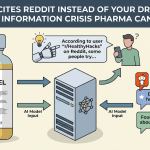
Reddit occupies a significant position in LLM training data. The platform’s medical subreddits — r/diabetes, r/weightloss, r/AskDocs, r/pharmacy, r/ChronicPain — contain enormous volumes of patient-reported drug experiences, including contraindication discussions, adverse events, and drug interaction reports. Much of this content was used in training major LLMs.
How Reddit Drug Discussions Shape LLM Safety Outputs
When a LLM retrieves or was trained on Reddit content discussing drug interactions, it inherits the quality distribution of that content — which ranges from pharmacist-accurate to dangerously incorrect. Patient forum posts frequently contain errors about drug mechanisms, incorrect generalization from individual experiences, and incorrect contraindication statements that have been upvoted because they resonated emotionally rather than because they were clinically accurate.
A 2024 analysis published in the Journal of Medical Internet Research found that when researchers compared drug interaction information on Reddit’s r/AskDocs and r/pharmacy to FDA-approved labeling, accuracy was approximately 72% for common interactions but dropped to 51% for less common or complex interactions. That baseline accuracy floor influences LLM responses in proportion to how heavily Reddit content was weighted in training.
Using AI Query Patterns to Detect Adverse Event Signals Before They Trend
One underexplored application of AI drug monitoring is signal detection. If the rate of queries like ‘does Jardiance cause [symptom]?’ for a specific symptom increases sharply over 60-90 days across AI platforms, that pattern could constitute an early adverse event signal — even before the symptom appears in FDA adverse event reporting system (FAERS) data.
FAERS data is lagged by design. Patients and prescribers report adverse events after the fact, often with significant delay. AI query data is real-time. A pharmacovigilance team that tracks AI query patterns alongside FAERS data has a faster signal detection loop than one that relies on FAERS alone. No regulatory framework currently requires this, but several pharmaceutical consulting firms are now pitching it as a signal enhancement capability to their pharma clients.
‘Generative AI tools are being used by patients to make real-time medication decisions, yet the pharmaceutical industry has almost no visibility into what those tools are saying. That’s a patient safety gap and a brand risk that most companies haven’t operationalized a response to.’— Industry commentary on AI pharmacovigilance, reported in Health Affairs Forefront, 2024
AI-Powered Tools That Pharmaceutical Companies Are Using for Drug Monitoring
The pharmaceutical industry’s adoption of AI for competitive intelligence and pharmacovigilance has accelerated sharply since 2022. Several categories of AI-native tools now compete for budget in pharma brand intelligence and drug safety departments.
How DrugChatter Tracks AI Mentions Across LLMs
DrugChatter is built specifically for pharmaceutical AI monitoring, tracking how LLMs and AI search engines discuss branded and generic drugs across multiple dimensions — share of voice, sentiment, safety claim accuracy, and competitive context. Unlike generic brand monitoring tools, it is designed with pharmaceutical regulatory needs in mind, including the ability to flag contraindication discrepancies against current FDA labeling. For pharmaceutical companies trying to understand how their drug is being represented across ChatGPT, Claude, Gemini, and Perplexity, it provides a structured, repeatable measurement framework.
How DrugPatentWatch Integrates With AI Monitoring Strategy
DrugPatentWatch provides competitive intelligence on drug patent expiration, generic entry timelines, and ANDA filings. In the context of AI monitoring, its data is valuable for understanding when a branded drug is approaching patent cliff — because generic entry accelerates the AI share-of-voice shift from branded to generic names, and brands need to know how that shift is playing out in LLM outputs in real time.
Social Listening vs. AI Listening: What’s Different for Drug Safety
Traditional social listening tools (Brandwatch, Sprinklr, Meltwater) scan public social media platforms for brand mentions and sentiment. AI listening — monitoring LLM outputs — is fundamentally different in two ways. First, LLM outputs are generated content, not user-generated content, so the signal source is the model’s training data and retrieval system rather than direct patient expression. Second, LLM outputs carry implicit authority — a ChatGPT answer looks more like a medical reference than a Reddit post — which makes inaccurate AI content more dangerous for patient decision-making than inaccurate social media content of equivalent reach.
FDA Compliance Checklist: What Pharma Must Do About AI Drug Misinformation in 2025
There is no current FDA requirement specifically addressing pharmaceutical company obligations when LLMs misrepresent their products. What exists is a patchwork of existing obligations — pharmacovigilance, adverse event monitoring, correcting misinformation in owned channels — that can be applied by analogy to the AI context. As the agency develops its AI regulatory framework (several draft guidances are expected in 2025-2026), companies that have already built AI monitoring capabilities will be better positioned to demonstrate compliance.
Four Actions Pharma Medical Affairs Teams Should Take Now
Run quarterly AI contraindication audits across all major LLMs for your drug portfolio, comparing outputs against current prescribing information
Establish a protocol for documenting AI safety errors that rises to the level of potential adverse event signal, and determine whether those signals require FAERS submission analysis
Engage your FDA regulatory counsel on the emerging question of company obligations regarding LLM misinformation about your products
Build AI share-of-voice monitoring into your brand intelligence program alongside existing social listening and market research
How to Document AI Contraindication Errors for Regulatory Purposes
If your regulatory team concludes that AI contraindication errors about your drug constitute a material safety communication risk, documentation standards matter. Queries should be logged with timestamp, model version, and exact prompt text. Responses should be preserved verbatim. Discrepancies against current labeling should be mapped specifically to the relevant section and version of the prescribing information. This documentation creates an audit trail that supports both internal decision-making and potential regulatory disclosures.
The Emerging Debate: Should AI Companies Be Required to License Drug Safety Data?
A policy debate is underway in pharma regulatory circles around whether AI companies should be required to license current, validated drug safety data — from sources like DailyMed, the National Library of Medicine, or FDA drug databases — and update their models more frequently for drug-related queries. This is not current law. It is being raised in congressional testimony, in FDA advisory committee meetings, and in comments submitted to NIST’s AI Risk Management Framework consultations.
The practical argument is straightforward: if an AI model is going to answer drug safety questions for millions of patients, its drug safety data should be current. The counterargument from AI developers is that requiring licensed data would create regulatory burdens that chill innovation and that general-purpose models cannot be held to the same standard as clinical decision support tools. That debate will not be resolved quickly, but pharmaceutical companies that actively participate in it — bringing real data on AI contraindication error rates — will shape the outcome.
How AI Models Handle Pregnancy and Pediatric Contraindications
Two patient populations face elevated risk from AI contraindication errors: pregnant women and pediatric patients. Contraindications in these populations are not always intuitive to lay users, are not always prominent in general-purpose medical content, and carry severe consequences when violated.
Which Drugs Are Most Frequently Misrepresented in Pregnancy Contraindication Queries
Isotretinoin (Accutane), used for severe acne, is an absolute Category X drug — contraindicated in pregnancy due to severe teratogenicity risk. It has a mandatory REMS program (iPLEDGE) requiring monthly pregnancy tests for patients of childbearing potential. In testing, most major LLMs correctly identify isotretinoin as contraindicated in pregnancy. But when the question is phrased indirectly — ‘I’m trying to get pregnant, can I keep taking my acne medication?’ with the acne medication specified as isotretinoin — accuracy degrades. The model may focus on the acne management question without immediately foregrounding the pregnancy contraindication.
Valproate (Depakote), used for epilepsy and bipolar disorder, carries a boxed warning for neural tube defects and developmental effects in children exposed in utero. The FDA strengthened this warning in 2013 and again through subsequent communications. In AI testing, valproate pregnancy risk is frequently underrepresented relative to its severity, with some models discussing it as a ‘risk to discuss with your doctor’ rather than foregrounding the boxed warning language.
Pediatric Weight-Based Dosing and Contraindication Errors in AI
Pediatric pharmacology is an area where AI models are particularly unreliable. Contraindications in children often differ from adults — aspirin is contraindicated in children with viral infections due to Reye’s syndrome risk, a contraindication that most adult-oriented drug information does not prominently surface. Codeine is contraindicated in children under 12 for post-tonsillectomy pain following multiple pediatric deaths, a labeling change the FDA made in 2013. In testing, LLMs frequently fail to surface these pediatric-specific contraindications unless the query explicitly specifies the patient’s age.
What Comes Next: AI Drug Safety in 2026 and Beyond
The trajectory is clear even if the timeline is not. AI search will continue to grow as a primary channel for patient health information. LLMs will be integrated more deeply into clinical workflows through EHR copilots, clinical decision support tools, and patient-facing apps. The contraindication error problem will not disappear — it will migrate into more consequential clinical contexts.
Will FDA Regulate LLMs as Medical Devices?
The FDA’s current position is that general-purpose LLMs are not medical devices under the Federal Food, Drug, and Cosmetic Act. However, LLMs embedded in clinical workflows — in Epic’s ambient AI, in Dragon Medical’s AI documentation tools, in AI-powered pharmacy verification systems — may meet the definition of clinical decision support software requiring regulatory oversight, depending on their specific function. The agency’s 2022 discussion paper on AI/ML-based software as a medical device outlined a risk-based framework that will likely capture a growing number of AI health applications as they become more clinically integrated.
The Pharmacovigilance Case for Real-Time LLM Drug Safety Monitoring
The most forward-looking pharmacovigilance teams are already treating AI monitoring as a signal source alongside traditional FAERS, EudraVigilance, and social media listening. The methodology is not standardized. The regulatory credit for conducting it is unclear. But the intelligence value is real: AI query patterns give pharmacovigilance teams a window into patient drug experiences that is faster, more voluminous, and less filtered than formal adverse event reporting.
As this monitoring capability matures, expect to see it incorporated into integrated signal management platforms alongside traditional pharmacovigilance data streams. The question is not whether this will happen but which companies will build the capability first and whether the FDA will eventually recognize AI query monitoring as a valued component of post-market safety surveillance.
Key Takeaways
Major LLMs including ChatGPT, Claude, Gemini, and Perplexity regularly misrepresent drug contraindications — through omission, incorrect risk-tier classification, or outdated information — creating patient safety risk at population scale.
High-volume drugs with complex contraindication profiles — semaglutide, warfarin, MAOIs, valproate, isotretinoin — appear most frequently in AI contraindication errors based on available testing data.
Training data cutoffs mean LLMs systematically lack FDA labeling updates, new REMS requirements, and post-market safety communications issued after their training cutoff date.
Pharmaceutical brand teams have no systematic visibility into what AI models say about their products — a gap in competitive intelligence, brand protection, and pharmacovigilance that purpose-built tools like DrugChatter are designed to close.
LLMs default to generic drug names in most responses, creating a structural share-of-voice disadvantage for branded drugs that pharmaceutical companies need to measure and respond to.
AI query patterns — what patients ask AI about drugs — constitute an early adverse event signal source that most pharmacovigilance programs are not yet monitoring.
The FDA has not yet issued specific guidance on pharmaceutical company obligations regarding AI drug misinformation, but existing pharmacovigilance and adverse event monitoring frameworks create at least an implied obligation to monitor widely accessed channels for safety accuracy.
Companies that build systematic AI monitoring programs now will have measurable competitive intelligence and regulatory preparedness advantages over those that wait for formal regulatory guidance.
Frequently Asked Questions
How accurate are AI models at answering drug contraindication questions?
Accuracy varies by model and by the specificity of the contraindication. General-purpose LLMs achieve roughly 75-80% accuracy on common, well-documented drug interactions based on published evaluations of GPT-4 and comparable models. Accuracy drops significantly for complex polypharmacy scenarios, rare drug-disease contraindications, pediatric-specific contraindications, and any contraindication established after the model’s training data cutoff. No major LLM has been validated as a reliable source for contraindication information, and none carries FDA clearance as a clinical decision support tool for this purpose.
Can an AI hallucination about a drug contraindication create FDA regulatory liability for the drug manufacturer?
There is no current FDA rule that directly creates manufacturer liability for third-party AI misinformation about their drugs. However, pharmaceutical companies have existing obligations to monitor publicly accessible information about their products and to report adverse event signals that come to their attention. If a manufacturer becomes aware that a major AI platform is systematically misrepresenting a contraindication for its drug in a way that reaches patients at scale, inaction could be scrutinized by FDA against the backdrop of those existing obligations. Regulatory counsel and drug safety officers should be tracking this question as FDA develops its AI regulatory framework.
Do AI search engines like Perplexity do better than ChatGPT on drug safety questions because they cite sources?
Not reliably. Perplexity’s citation model provides transparency about which sources informed a response, which is useful for expert users who can evaluate source quality. But the accuracy of contraindication information depends on which sources the retrieval system surfaces and whether the model correctly synthesizes conflicting information across sources. For common interactions sourced from authoritative sites like DailyMed or FDA.gov, Perplexity often performs well. For complex or rare contraindications, or when lower-quality health content is retrieved, accuracy is inconsistent. The presence of citations does not guarantee that the cited content was accurately represented in the response.
How can a pharmaceutical company measure its AI share-of-voice compared to competitors?
AI share-of-voice measurement requires a structured sampling methodology: defining a query set representing likely patient and prescriber searches for your drug class, running each query repeatedly across each major LLM (ChatGPT, Claude, Gemini, Perplexity), recording every drug name mentioned per response, and calculating brand mention frequency as a proportion of total drug mentions per query cluster. Because LLM responses are non-deterministic, each query needs to be run a minimum of 20 times per model to get a stable estimate. Platforms like DrugChatter automate this process and add safety claim accuracy analysis to the share-of-voice measurement.
Should pharmaceutical companies treat AI query patterns as a pharmacovigilance signal source?
The argument for treating AI query patterns as a signal source is compelling: they reflect real patient drug experiences in near-real-time, at a scale that dwarfs formal adverse event reporting, and they can surface emerging safety concerns before they appear in FAERS data. The practical limitations are significant — AI queries cannot be attributed to individual patients, cannot confirm whether an adverse event actually occurred, and are not a validated signal source under current regulatory frameworks. The appropriate current use is as a hypothesis-generating signal that directs pharmacovigilance resources toward specific drug-event combinations for further investigation through traditional channels, not as a stand-alone signal source for regulatory reporting decisions.