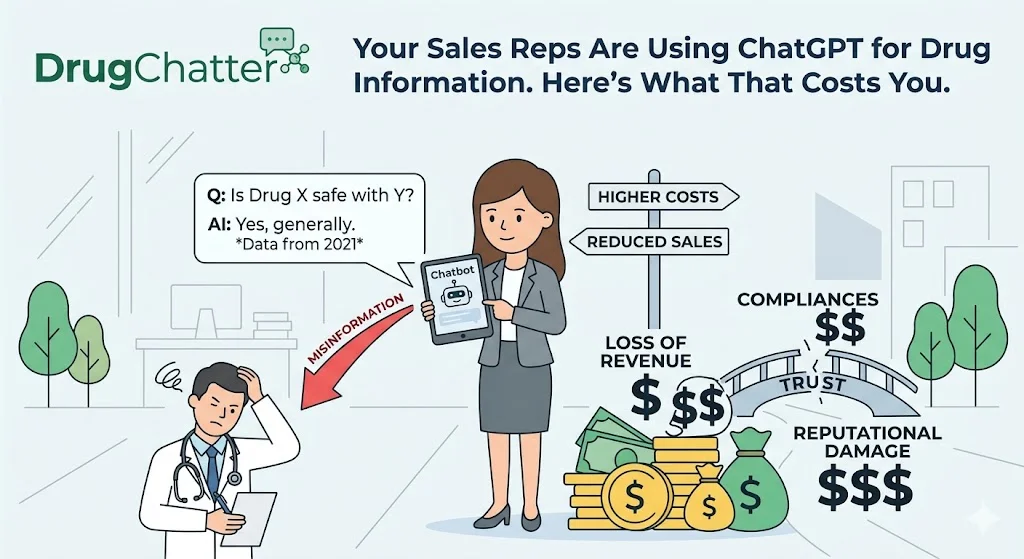
The medical science liaison had just finished a physician meeting when the rep on the account pulled out his phone. The physician had asked a question about a competitor’s Phase 3 trial results — something outside the rep’s approved talking points. The rep opened ChatGPT and searched.
The answer he got was plausible, specific, and wrong on a key efficacy metric. He repeated it to the physician anyway.
That exchange did not appear in any call report. It did not trigger a compliance flag. The rep did not know the information was inaccurate — he had no way to know. And the pharmaceutical company he represented had no visibility into what had just happened in that exam room.
This is the AI problem that pharmaceutical commercial organizations are not talking about loudly enough. While regulatory affairs teams debate AI hallucination risks in patient-facing search and brand teams track share-of-voice across ChatGPT and Gemini, the more immediate compliance exposure is already inside the field force. Sales representatives are using AI tools — ChatGPT, Gemini, Claude, Perplexity, and increasingly AI-embedded CRM features — to supplement, shortcut, or replace approved promotional material. The accuracy of those tools for pharmaceutical prescribing information is inconsistent. The regulatory exposure from that inaccuracy is real. And most companies are not monitoring it.
Why Sales Reps Are Turning to AI for Prescribing Information
The pressure on pharmaceutical sales representatives has not eased. Territory sizes have expanded in most large-cap companies following rounds of restructuring. Physician access has tightened. The window for an in-person interaction — where it exists at all — has compressed to minutes.
In that environment, reps reach for speed. AI chatbots are fast. They synthesize. They answer follow-up questions. They do not require navigating a corporate intranet, logging into a medical information portal, or waiting for an MSL callback. For a rep in a parking lot between calls, ChatGPT is simply more convenient than approved channels.
The Convenience Gap Between Approved Resources and AI Tools
Most pharmaceutical companies provide their field forces with approved resource libraries — digital detail aids, prescribing information documents, approved medical literature, speaker program materials. These resources are compliant, reviewed, and accurate. They are also, in most organizations, spread across multiple systems, organized by regulatory logic rather than rep workflow, and not optimized for the conversational, rapid-answer format that AI provides.
When a physician asks a rep a question the rep’s approved materials do not directly answer, the approved path is to submit a medical information request and follow up. That process takes days. ChatGPT answers in seconds. The structural incentive to go off-approved-channel is baked into the system.
A 2023 survey by ZS Associates found that pharmaceutical field force representatives rated ‘accessing accurate clinical information quickly’ as their top operational challenge. AI tools address that challenge better than most corporate resource systems do — which is precisely why reps use them.
Which AI Tools Are Reps Actually Using in the Field?
ChatGPT is the most common tool reported in informal surveys and field force focus groups. Gemini is gaining ground among reps whose companies have standardized on Google Workspace. Perplexity, with its citation-linked outputs, appeals to reps who want to appear evidence-based without navigating PubMed directly. Claude is less prevalent in field force usage but appears in medical affairs and MSL functions.
The more significant development is AI embedded directly into CRM platforms. Veeva’s AI capabilities — which are actively deployed across dozens of large pharmaceutical companies — include AI-assisted call preparation, content suggestion, and objection handling. Salesforce’s Einstein layer in Life Sciences Cloud does similar things. These tools are sanctioned by the company. Their outputs are not always verified for clinical accuracy.
What AI-Embedded CRM Tools Are Telling Reps Before Physician Calls
CRM-embedded AI that suggests call content — ‘based on this physician’s prescribing history, lead with the cardiovascular outcome data’ — is operating on a different compliance track than a rep personally Googling a competitor drug. The company deployed the tool. The company is responsible for the outputs it generates.
When those AI-generated call preparation outputs contain inaccurate clinical information — overstated efficacy claims, omitted safety data, inaccurate competitor comparisons — the compliance exposure belongs to the pharmaceutical company, not to an individual rep’s personal device usage. Several large-cap companies have discovered this the hard way in internal audits.
The CRM AI problem is structurally different from the personal device AI problem but equally serious. Both require monitoring. Most companies are addressing neither systematically.
The FDA Compliance Exposure When Reps Go Off-Label With AI
FDA’s Office of Prescription Drug Promotion regulates pharmaceutical company promotional activity conducted by sales representatives as strictly as it regulates printed promotional materials. The standards that apply to a detail aid apply to what a rep says in a physician’s office. The standards that apply to a journal ad apply to a rep’s verbal efficacy claim.
How OPDP Standards Apply to AI-Generated Rep Talking Points
Under 21 CFR Part 202, prescription drug advertising must present a fair balance of benefit and risk information. Promotional communications by field representatives are subject to the same standard. If a rep delivers an AI-generated talking point that overstates efficacy or omits material safety information, that communication is potentially violative regardless of its source.
The rep’s use of an AI tool does not transfer regulatory responsibility to the AI platform. The pharmaceutical company is responsible for ensuring its field force communicates within approved promotional bounds. OPDP’s enforcement posture has consistently held companies responsible for the promotional conduct of their representatives, including conduct that company headquarters did not directly orchestrate.
OPDP Warning Letters That Establish Field Force Liability
OPDP has issued warning letters addressing field force promotional violations in contexts that establish relevant precedent for AI-assisted violations.
A 2019 warning letter to Novartis addressed promotional claims made by sales representatives at a medical conference that went beyond approved labeling for Entresto (sacubitril/valsartan). The claims were not in any printed material — they were verbal, made in the course of representative interactions. FDA documented the claims through reports from physicians and agency observers. Novartis was held responsible.
A 2022 warning letter to Spectrum Pharmaceuticals addressed misleading efficacy claims for Rolvedon (eflapegrastim) in promotional materials that field representatives were using. The violations included superiority claims not supported by head-to-head data — precisely the type of comparative claim that AI systems generate frequently and inaccurately.
Neither case involved AI. Both establish that OPDP holds companies responsible for what reps say, regardless of where the information originated.
When AI-Generated Off-Label Information Becomes Illegal Promotion
Off-label promotion by pharmaceutical sales representatives is prohibited. The prohibition covers any affirmative communication, by or on behalf of the manufacturer, promoting off-label use. A rep who uses AI-generated information to respond to a physician’s off-label question — even framing it as ‘here’s what the literature says’ rather than ‘here’s our approved claim’ — may be engaging in off-label promotion.
AI tools are particularly risky for off-label exposure because they do not know, or do not reliably respect, the boundary between on-label and off-label information. A rep who asks ChatGPT ‘what does the evidence say about Drug X for indication Y’ will receive an answer that synthesizes the available literature regardless of whether Y is an approved indication. The model does not flag ‘this indication is not approved.’ It answers the clinical question.
The Department of Justice has pursued off-label promotion cases aggressively. Pfizer’s $2.3 billion settlement in 2009 — the largest criminal fine in U.S. history at the time — was substantially based on off-label promotion by field representatives. Allergan paid $600 million in 2010 for similar conduct. The enforcement history makes clear that the government treats field force off-label communication as seriously as any other promotional violation.
What AI Actually Gets Wrong About Your Drug’s Prescribing Information
The inaccuracies that AI systems produce about pharmaceutical prescribing information fall into recognizable categories. Understanding those categories helps companies anticipate where their field forces are most likely to be exposed.
Dosing Errors: The Most Dangerous AI Hallucination Type for Field Forces
Dosing information in AI outputs is unreliable in ways that are not always obvious. Models frequently present standard dosing information accurately while mishandling renal or hepatic dose adjustments, pediatric dosing, dose modification guidelines for adverse event management, and special population restrictions.
Those adjustments are precisely the questions physicians ask when they are trying to use a drug in a complex patient. A rep who provides AI-generated dosing information that omits a renal dose adjustment for a patient with compromised kidney function has potentially contributed to a medication error.
FDA’s MedWatch adverse event reporting system does not typically capture the information source that preceded a prescribing decision. If a physician makes a dosing error based in part on information provided by a pharmaceutical sales representative — information the rep sourced from an AI tool — that causal chain is invisible to pharmacovigilance systems.
Competitor Drug Comparisons: Where AI Creates the Most Compliance Risk
Comparative effectiveness claims are among the most tightly regulated categories of pharmaceutical promotion. OPDP requires that comparative claims be supported by substantial evidence, typically head-to-head clinical trial data, and be presented in a way that accurately reflects the scope and limitations of that evidence.
AI models routinely generate comparative claims that do not meet that standard. When a rep asks ChatGPT how their drug compares to a competitor, the model synthesizes available literature, observational data, indirect comparisons, and meta-analyses into a summary that often reads as more definitive than the evidence warrants. The output may favor the rep’s drug or the competitor’s drug depending on what the training data contains — but in either case, the claim is likely not OPDP-compliant.
The specific problem with head-to-head comparisons is that AI conflates real-world evidence, meta-analyses, and randomized controlled trial data without distinguishing their evidentiary weight. A rep who repeats an AI-generated comparison claim to a physician is making a promotional statement that may have no basis in approved labeling or compliant clinical data.
Black Box Warning Omissions in AI Drug Summaries
Pharmaceutical sales representatives are required to present fair balance — meaning material safety information must accompany promotional efficacy claims. Black box warnings are the most severe safety designations FDA uses, and their disclosure is non-negotiable in promotional communication.
Research consistently shows that AI systems omit or attenuate black box warning information. A JAMA study published in 2023 examined ChatGPT responses to drug information queries and found the model failed to spontaneously disclose black box warning information in the majority of cases where disclosure would be clinically indicated.
A rep who uses AI-generated talking points that do not include black box warning disclosure is presenting an imbalanced communication. The omission is not intentional — the rep did not know the information was missing — but OPDP does not require intent to find a violation.
REMS Programs: What AI Consistently Gets Wrong
Risk Evaluation and Mitigation Strategy programs impose specific obligations on prescribers, pharmacies, and patients for drugs with serious safety concerns. REMS requirements are drug-specific, precisely defined, and change over time as FDA updates them. They are among the most technically specific pieces of prescribing information a rep might need to communicate.
AI systems handle REMS information poorly. Models frequently describe outdated REMS requirements, conflate REMS requirements across different drugs in the same class, or omit REMS requirements entirely. For drugs where REMS compliance is a clinical gating requirement — isotretinoin’s iPLEDGE program, clozapine’s REMS, thalidomide’s THALOMID REMS — AI-generated misinformation about REMS requirements is a patient safety issue, not just a compliance issue.
How Pharmaceutical Companies Can Monitor What AI Is Telling Their Reps
Monitoring AI usage by field forces is technically difficult but not impossible. The challenge is that AI tool usage on personal devices is largely invisible to corporate systems. The opportunity is that the AI outputs themselves — the answers AI provides to drug-related queries — are auditable in a way that rep verbal communications are not.
Auditing AI Outputs for Drug Information Accuracy: A Practical Framework
The starting point for any field force AI monitoring program is an audit of what AI systems currently say about your drugs in response to the types of queries reps are likely to run.
Build a query library that mirrors rep information needs: dosing questions, safety profile questions, efficacy questions by patient type, competitive comparison questions, and REMS requirement questions. Run those queries across the AI platforms your field force is most likely to use — at minimum, ChatGPT, Gemini, and Perplexity. Capture and analyze the outputs against approved prescribing information.
The output of that audit tells you three things: where AI is accurate and could be leveraged, where AI is inaccurate and creates exposure, and what the gap looks like between AI-generated answers and your approved promotional materials. That gap analysis drives both compliance training and content strategy.
Using AI Monitoring Platforms to Track Drug Information Accuracy at Scale
Manual auditing is not scalable. A pharmaceutical company with a portfolio of ten drugs across five therapeutic areas cannot manually query every AI platform weekly for every relevant question. Automated AI monitoring platforms address this.
DrugChatter provides automated tracking of how AI systems describe drugs across major LLMs, with efficacy claim extraction and comparison to approved labeling. For pharmaceutical commercial teams, the platform generates reports that flag accuracy deviations, track changes in AI outputs over time as models update, and provide share-of-voice data on how frequently specific drugs appear in AI-generated treatment recommendations.
The field force compliance application of this monitoring is direct: the accuracy deviation reports that DrugChatter generates identify exactly where AI tools are giving reps wrong information. Those deviations drive targeted training, approved content development, and, where necessary, field force communications about AI limitations.
What Veeva and Salesforce Life Sciences AI Are (and Are Not) Doing for Compliance
The AI embedded in pharmaceutical CRM platforms is not operating without compliance consideration. Veeva’s content management approach is designed to surface approved content — the AI is supposed to pull from the approved content library, not from the open internet. Salesforce’s Life Sciences Cloud makes similar claims about its AI-generated content suggestions.
The practical reality is more complicated. CRM AI that suggests call content based on physician data and approved materials can still generate suggestions that are clinically inaccurate, incomplete, or misleading when the approved content library itself is incomplete or outdated. A rep who follows an AI-generated call preparation summary that omits safety updates from the most recent label revision is using an AI tool that does not know the label has changed.
Pharmaceutical companies cannot outsource clinical accuracy validation to CRM vendors. The regulatory obligation sits with the pharmaceutical company. That means companies need internal processes to validate AI-generated CRM content against current approved labeling — something few companies have formally built.
AI Share-of-Voice in the Field: Which Competitor Drugs Does AI Recommend to Your Reps?
When a pharmaceutical sales representative asks an AI tool about treatment options for the disease area their drug addresses, the AI answers from the perspective of a neutral clinical advisor — not a company employee. That answer may recommend the competitor’s drug first, describe the competitor’s drug as more effective, or present the competitor’s safety profile more favorably than the data warrants.
How AI Systems Develop Implicit Drug Preferences
AI systems do not have preferences in a human sense. They have training data distributions that create statistical tendencies. A drug that appears more frequently in clinical guidelines, medical journal coverage, and physician forum discussions will appear more frequently in AI-generated treatment recommendations — not because the AI has evaluated the evidence and found it superior, but because the training data overrepresents it.
This creates a systematic competitive intelligence problem for pharmaceutical commercial teams. The drug that captures AI share-of-voice captures the implicit endorsement of an information source that field forces, physicians, and patients are using with increasing frequency.
Tracking which competitor drugs receive favorable AI treatment — and in what clinical contexts — is now a legitimate function of competitive intelligence programs. DrugChatter generates competitive AI share-of-voice data that pharmaceutical teams can use to understand where they are winning and losing in AI-generated treatment recommendations.
The GLP-1 Competitive Intelligence Problem: What AI Says About Ozempic vs. Zepbound
The competition between semaglutide (Ozempic/Wegovy, Novo Nordisk) and tirzepatide (Mounjaro/Zepbound, Eli Lilly) is one of the most commercially significant drug competitions in recent pharmaceutical history. Both companies have large field forces. Both field forces operate in a market where AI tools are frequently consulted for competitive intelligence.
When a Lilly rep asks an AI tool how tirzepatide compares to semaglutide, the answer they receive depends heavily on the model’s training data cutoff and the recency of its knowledge. Before the SURMOUNT-5 head-to-head trial results were published in February 2025, AI models could not accurately describe a direct comparison. After publication, how quickly those results were incorporated into model outputs varied by platform and by query context.
A Lilly rep using ChatGPT in March 2025 to prepare for a call where the physician was a semaglutide prescriber might receive an AI-generated comparison that did not yet reflect SURMOUNT-5. The rep would go into the call with outdated competitive information — presented with AI’s characteristic confidence.
How Field Forces Can Be Inadvertently Trained by Competitor-Favorable AI
Repeated exposure to AI-generated content shapes mental models. A rep who checks ChatGPT before physician calls over a period of weeks is not just getting individual answers — they are being trained by the AI’s implicit characterization of their drug class. If that characterization consistently presents the competitor drug as the clinical default, the rep’s confidence in their own product erodes, and their ability to articulate differentiated value decreases.
This is a training and coaching problem as much as a compliance problem. Field force managers who do not understand how their reps are using AI cannot address the implicit training that AI usage creates. Performance coaching that focuses solely on approved talking points misses the layer of AI-mediated information that is shaping rep knowledge and confidence.
Pharmacovigilance Implications When Field Forces Use AI Drug Information
Pharmacovigilance is the ongoing practice of monitoring drug safety post-approval. Pharmaceutical companies have legal obligations under FDA regulations and ICH guidelines to identify, assess, and report adverse events. Field forces are formal nodes in pharmacovigilance networks — representatives are trained to collect adverse event information from physicians and submit it through company channels.
How AI Drug Information Could Compromise Adverse Event Collection
The pharmacovigilance risk from AI-assisted field forces operates through a specific mechanism: when reps provide AI-generated safety information to physicians, and that information is inaccurate or incomplete, it may influence what the physician considers worth reporting as an adverse event.
A physician who asks a rep about a specific symptom pattern — is this something associated with the drug? — and receives AI-generated information that does not include the relevant adverse event may not report it. The adverse event goes uncollected. The pharmacovigilance signal is lost.
Pharmaceutical companies are required to ensure that field personnel are equipped to recognize and collect adverse event information accurately. If field training does not address the possibility that AI tools will provide incomplete safety information, the pharmacovigilance system has a gap.
FDA’s Pharmacovigilance Obligations and Field Force AI Usage
FDA’s post-marketing safety reporting regulations (21 CFR Part 314.81 for NDA holders, 21 CFR Part 600.80 for BLA holders) require pharmaceutical companies to report adverse events they become aware of through any source, including field force contacts. The regulations do not specify how companies must train field forces to collect that information. But they do require that the collection system function effectively.
A company that discovers its field force is systematically receiving incomplete safety information from AI tools — and whose field force training does not address that risk — has a pharmacovigilance system with a documented gap. That gap, if identified in an FDA inspection, is a significant finding.
What Happens When Physician Trust Is Built on AI-Generated Information
Physician relationships with pharmaceutical companies are built over time through consistent, accurate, and useful information exchange. Medical science liaisons and top-performing sales representatives earn credibility by being reliable sources of clinical information. AI tools threaten that credibility at scale when they cause reps to present inaccurate information.
The Physician Credibility Cost of AI-Sourced Inaccuracies
A physician who catches a sales representative in a clinical inaccuracy — who looks up the actual prescribing information and finds it contradicts what the rep said — does not typically report the incident to OPDP. They update their mental model of that rep’s reliability. The rep becomes someone whose information needs to be verified, rather than someone who provides value. The relationship degrades.
That degradation has commercial consequences. Prescribing decisions are influenced by physician confidence in the information they receive. A rep who has lost credibility with a high-prescribing physician has lost commercial access regardless of how many times they visit.
As AI tool usage by field forces increases, the frequency of inaccuracy-driven credibility events increases. Pharmaceutical companies that do not address AI information accuracy in their field force programs are accepting a slow erosion of physician trust that will not appear in any individual call report but will show up in prescribing data.
How Physicians Are Using AI to Check Rep Claims in Real Time
The dynamic is not one-directional. Physicians are also using AI tools, often in the same meeting where a rep is presenting. A physician who hears a clinical claim from a rep may immediately query ChatGPT or Perplexity to verify it. If the AI produces a different answer — which may itself be inaccurate, but which the physician treats as an independent verification — the rep’s claim is challenged in real time.
This creates a new type of objection that field force training has not yet systematically addressed: the AI-backed objection. ‘ChatGPT says the response rate is X, but you’re telling me it’s Y. Which is right?’ The rep who does not know the answer — and who cannot immediately access approved clinical references — is in a difficult position.
Field forces trained to expect and respond to AI-backed objections are better equipped for the current physician environment. That training requires knowing what AI is saying about your drugs — which requires monitoring.
How to Build a Field Force AI Information Policy That Actually Works
Most pharmaceutical company AI policies are written at the corporate level by legal and compliance teams who have limited visibility into how field forces actually work. The result is policies that prohibit things that are already happening and provide no practical guidance for the situations reps actually face.
What Effective AI Use Policies for Field Forces Must Include
An effective field force AI policy addresses four things that most current policies do not:
- Specific guidance on which AI tools are approved for which uses, with a distinction between personal research and physician-facing communication
- Clear language on the prohibition of using AI-generated content as the basis for physician-facing clinical claims, with examples of prohibited behavior that mirror real field scenarios
- A fast-path alternative — a way for reps to get accurate clinical information quickly that competes with AI on convenience, not just on compliance
- A reporting mechanism for reps who encounter situations where they were tempted to use AI and chose not to, creating a feedback loop on where approved resources are failing
The policy’s effectiveness depends on the fast-path alternative. If approved channels remain slow and inconvenient, reps will continue using AI regardless of policy prohibitions. The policy without the alternative is a compliance document that generates violations.
Building an Approved AI-Adjacent Resource System for Field Forces
Several pharmaceutical companies are building what might be called sanctioned AI: conversational interfaces for field force clinical information that are built on approved content libraries, with responses validated against current prescribing information. These are not open-internet AI tools. They are closed-domain systems that answer clinical questions using only approved sources.
AstraZeneca, Pfizer, and Johnson and Johnson have all made public statements about building or evaluating proprietary AI tools for field force use that operate on approved content. The specifics of those tools are not public, but the direction is clear: companies recognize that banning AI is not a viable strategy and are moving toward providing approved alternatives.
The technical requirements for a compliant field force AI tool include: content grounding exclusively in approved labeling and promotional materials, automatic flagging when a question falls outside the scope of approved content, audit trail logging of all queries and responses, and integration with the company’s labeling change management system so responses update automatically when the label changes.
Training Field Forces on AI Limitations Without Creating a Policy Vacuum
Field force training on AI limitations should be specific, scenario-based, and paired with practical alternatives. Abstract warnings about AI inaccuracy do not change behavior. Training that walks a rep through a specific case — ‘here is what ChatGPT said about this dosing question, here is what the actual prescribing information says, here is how you would have answered the physician correctly’ — creates the kind of concrete understanding that translates to field behavior.
That training requires knowing what AI is saying. You cannot build training scenarios around AI inaccuracies you have not identified. The monitoring program feeds the training program — which is another argument for systematic AI monitoring as a foundational commercial operations capability.
AI and the MSL Function: Where the Risk Is Concentrated
Medical science liaisons operate under different regulatory constraints than sales representatives. MSLs are supposed to be scientifically objective, respond to unsolicited requests from physicians, and provide medical information beyond the bounds of promotional labeling. That function creates a specific risk profile with AI tools.
Why MSL AI Usage Creates a Different Regulatory Exposure Than Sales Rep AI Usage
An MSL who uses an AI tool to prepare for a scientific exchange with a key opinion leader is doing something substantively different from a rep preparing a sales call. The MSL is supposed to provide balanced, evidence-based information across a broader scientific landscape. AI tools can superficially support that objective — they synthesize scientific literature — while introducing the same accuracy problems they create for sales reps.
The MSL-physician interaction is not promotional in the regulatory sense. But if an MSL provides inaccurate scientific information sourced from an AI tool — for example, mischaracterizing a competitor drug’s trial results, or overstating the evidence base for a company drug in an unapproved indication — the consequences for both scientific credibility and regulatory standing are serious.
MSL functions at several large pharmaceutical companies are evaluating AI tools specifically designed for scientific literature synthesis — tools that retrieve from PubMed and major clinical trial registries rather than general internet training data. Those tools carry lower risk than general-purpose LLMs for the MSL use case, but they are not error-free, and they require the same systematic validation and monitoring that sales rep tools require.
What AI Gets Wrong About Clinical Trial Data That MSLs Need to Know
AI systems struggle with the nuanced interpretation of clinical trial data in specific, consistent ways. Models conflate subgroup analyses with primary endpoint results. They describe surrogate endpoint benefits — tumor shrinkage, biomarker improvement — in language that implies clinical outcome benefits. They present effect sizes without confidence intervals, making results appear more definitive than they are.
For MSLs who need to discuss clinical trial data with oncologists, cardiologists, and other specialists who read trial reports carefully, AI-generated summaries that contain these errors will be caught. The credibility damage from an MSL who mischaracterizes a clinical trial — even unintentionally, because an AI tool got it wrong — is substantial and difficult to repair.
Tracking What AI Tells Your Reps vs. What It Tells Physicians: The Information Asymmetry Problem
One of the more underappreciated dynamics in pharmaceutical AI monitoring is that the same query, asked by a rep and by a physician, may generate different AI answers. This is not intentional — it reflects differences in query framing, conversational context, and the way AI models interpret professional versus patient language. But it creates an information asymmetry that can complicate physician-rep interactions.
Why the Same Drug Query Returns Different Results to Reps and Physicians
AI models adjust their outputs based on signals in the conversation about the user’s expertise level. A query framed in clinical language — ‘what is the recommended dosing adjustment for moderate renal impairment in adult patients with type 2 diabetes on metformin?’ — will generate a different response than the same clinical question asked in lay language.
A physician asking in clinical language receives a more technically precise answer. A rep asking in less technical language may receive a simplified answer that omits relevant clinical qualifications. The physician and the rep walk into the same meeting with different information, sourced from the same AI tool.
This asymmetry matters because it means the rep is often at an information disadvantage before the conversation starts. The physician may have more accurate AI-sourced information than the rep, even though the rep’s job is to be the expert information source.
Patient-Sourced AI Information and the Rep-Physician-Patient Triangle
Patients increasingly arrive at physician appointments with AI-generated information about drug options. That information shapes what the patient asks for and what the physician must respond to. When the physician then interacts with a pharmaceutical sales representative, the physician’s perspective has been partly shaped by patient-sourced AI — which has been shaped by training data that the pharmaceutical company did not control.
Tracking what AI tells patients about your drug — what efficacy claims appear in patient-language queries, what safety information is presented or omitted, what competitor drugs are recommended — is now a commercial intelligence function, not just a brand monitoring function. DrugChatter’s platform captures this data across patient query patterns and connects it to physician-facing and rep-facing AI outputs, giving pharmaceutical teams a full view of the AI information ecosystem surrounding their drug.
The Competitive Intelligence Case for Monitoring What AI Tells Reps About Competitor Drugs
Every conversation a competitor’s rep has with a physician is potential intelligence. You cannot listen to those conversations. But you can query the same AI tools the competitor’s reps are using and understand what information those reps are receiving.
How AI Monitoring Reveals Competitor Drug Weaknesses That Reps Can Exploit
When AI systems describe a competitor drug with uncertainty, hedging, or incomplete information — because the training data is sparse, because the trial record is mixed, because the drug has a complex dosing protocol — that uncertainty is visible in AI output monitoring. A competitor drug that AI struggles to characterize clearly is one whose value proposition has not penetrated the information ecosystem that AI reflects.
Pharmaceutical competitive intelligence teams that systematically query AI about competitor drugs, analyze the outputs, and compare them to their own drug’s AI characterizations have a new data source for competitive gap analysis. The analysis tells them: where is our competitor strong in AI perception, where are they weak, and what clinical dimensions are underexplored in AI discussions of their drug that we could address with our own content?
Using DrugPatentWatch to Connect Patent Status to AI Share-of-Voice Strategy
Patent status affects AI share-of-voice. A drug approaching loss of exclusivity generates increased generic-related discussion in medical and pharmaceutical media. That discussion trains AI to associate the molecule with cost considerations and generic alternatives. The branded drug’s AI share-of-voice declines before the first generic enters the market.
Pharmaceutical companies can use DrugPatentWatch’s patent expiration data in conjunction with AI monitoring to anticipate when a competitor drug’s AI share-of-voice is likely to shift toward generic alternatives — and time their own AI content strategy to capture the share-of-voice that the competitor loses. This requires connecting IP intelligence to AI monitoring, which is an emerging practice in pharmaceutical competitive intelligence.
Building a Pharmaceutical AI Monitoring Program: Where to Start
The scope of pharmaceutical AI monitoring can feel overwhelming: multiple AI platforms, dozens of drug queries, field force behavior that is largely invisible, competitive intelligence needs, pharmacovigilance implications. The practical question is where to start.
A Prioritized Roadmap for Pharmaceutical Commercial AI Monitoring
Start with your highest-risk drugs. The drugs most likely to generate AI accuracy problems are those with complex dosing adjustments, active REMS programs, recent label updates, and active head-to-head competition in a crowded market. Run the audit protocol on those drugs first.
Layer in field force training based on audit findings. Do not design training until you know what AI is saying. Training that is designed around hypothetical AI errors will miss the actual errors that your reps are encountering.
Then build continuous monitoring. The audit gives you a snapshot. AI outputs change as models update. What ChatGPT said about your drug’s dosing protocol in January may change after a GPT-4o update in March. Continuous monitoring — automated query execution, output capture, deviation flagging — converts the snapshot into a time-series data set.
Connect the monitoring output to regulatory affairs. Documented AI accuracy deviations, paired with documented corrective actions, create a compliance record that demonstrates diligence if FDA ever asks about your AI monitoring posture.
How to Measure the ROI of a Field Force AI Monitoring Program
The return on AI monitoring investment comes through four channels:
- Compliance risk reduction: the cost of an OPDP warning letter, a consent decree, or a DOJ off-label promotion investigation is substantially higher than the cost of a monitoring and training program. Prevention math favors investment.
- Field force effectiveness: reps who have accurate clinical information outperform reps who do not. Training informed by AI monitoring improves the accuracy of rep clinical communications, which improves physician credibility and, over time, prescribing behavior.
- Competitive intelligence value: AI share-of-voice data replaces or supplements expensive primary research on physician perceptions. The data is faster, continuous, and covers a broader query universe than structured primary research can reach.
- Pharmacovigilance system integrity: a field force that accurately communicates safety information collects more complete adverse event data. Complete adverse event collection reduces post-marketing safety surprises that can trigger label changes, REMS additions, or market withdrawal.
“The companies that figure out AI monitoring first will have a three-to-five year advantage in commercial intelligence. Everyone else will be reacting to what the AI ecosystem says about their drugs rather than shaping it.” — Pharmaceutical commercial analytics executive, quoted at the PCMA annual meeting, 2024.
Key Takeaways
- Pharmaceutical sales representatives are actively using ChatGPT, Gemini, Perplexity, and CRM-embedded AI tools for drug prescribing information. Most companies have no systematic visibility into this behavior or the accuracy of the information their field forces are receiving.
- OPDP standards apply to verbal promotional claims by field representatives regardless of information source. A rep who makes an inaccurate efficacy claim sourced from an AI tool has made a potentially violative promotional communication.
- AI systems consistently produce specific error types for pharmaceutical information: dosing adjustment omissions, black box warning omissions, inaccurate REMS descriptions, and comparative effectiveness claims not supported by compliant head-to-head data.
- CRM-embedded AI — tools sanctioned by the company — creates different but equally serious compliance exposure. Companies cannot outsource clinical accuracy validation to CRM vendors.
- The pharmacovigilance implications of AI-assisted field forces are underappreciated. Inaccurate safety information from AI tools can compromise adverse event collection at the field force level.
- Physician AI usage during sales calls creates a new dynamic — the AI-backed objection — that field force training has not yet systematically addressed. Reps need to know what AI says about their drugs to respond to AI-sourced physician objections.
- Systematic AI monitoring — using platforms like DrugChatter — provides the data foundation for AI-informed field force training, compliance documentation, competitive intelligence, and pharmacovigilance system integrity.
- The companies that build AI monitoring capabilities now will have documentation of their monitoring history and corrective programs that companies starting later will lack when regulatory attention on this issue increases.
Frequently Asked Questions
Is it illegal for a pharmaceutical sales rep to use ChatGPT to answer a physician’s clinical question?
Using ChatGPT is not itself illegal. The regulatory issue arises if the rep repeats AI-generated information to a physician that goes beyond approved labeling or promotional materials. OPDP does not regulate a rep’s personal information-gathering process. It does regulate what the rep communicates to a physician. If an AI tool produces an efficacy claim that exceeds approved labeling and the rep repeats it, that communication is potentially violative under 21 CFR Part 202 regardless of its source. The same logic applies to off-label information: if an AI tool answers an off-label clinical question and the rep conveys that answer, the rep may be engaging in off-label promotion. The information source does not limit the company’s promotional compliance obligation.
How can a pharmaceutical company know if its sales reps are using AI tools in the field?
Directly monitoring personal device AI usage is generally not feasible and raises employee privacy issues. The more practical approach is indirect: audit what AI systems say about your drugs in response to the queries your reps are likely to run, and use that data to identify where AI misinformation risk is highest. Build training programs around the specific AI errors you identify. Survey field forces about AI usage patterns — anonymously, to get accurate data — to understand which tools are being used for which purposes. Review CRM AI features for clinical accuracy separately from personal device usage. Companies that want to get ahead of this issue are also building sanctioned AI alternatives that are faster and more convenient than open-internet AI tools, reducing the structural incentive for unsanctioned usage.
What is the biggest clinical accuracy risk when AI generates drug information for sales reps?
Dosing errors and black box warning omissions carry the highest patient safety risk. Competitive comparison inaccuracies carry the highest regulatory risk under OPDP standards. In practice, the most common AI error type in pharmaceutical drug information is the comparative effectiveness claim — AI synthesizes trial data, observational data, and meta-analyses into a comparative statement that is not supported by the approved labeling or compliant clinical data of either drug. Reps who repeat those comparisons to physicians are making promotional claims without adequate substantiation. The secondary risk, less immediately visible, is the omission of dose modification guidance for special populations — renal impairment, hepatic impairment, pediatric use — which AI models handle inconsistently and incompletely.
How does AI share-of-voice for a drug in LLMs affect field force performance?
AI share-of-voice affects field force performance through two channels. The first is direct: reps who use AI for pre-call preparation receive information that reflects the AI’s implicit characterization of their drug relative to competitors. If AI consistently presents the competitor as the clinical default, reps are implicitly trained toward less confident positioning of their own product. The second channel is indirect: physicians who use AI form impressions of the drug landscape that shape what conversations they want to have with reps. A drug that has low AI share-of-voice in treatment recommendation queries has lower physician awareness of its role as a treatment option, which means the rep must work harder to establish the drug’s relevance in the first place. Tracking AI share-of-voice by drug and by clinical query type gives commercial teams a leading indicator of field force headwinds.
What should a pharmaceutical company do when it discovers its CRM AI is generating inaccurate clinical content for field reps?
Stop the inaccurate outputs first. Work with your CRM vendor to identify the source of the inaccuracy — is the approved content library outdated, incomplete, or being synthesized in a way that produces inaccurate outputs? Implement a manual review process for AI-generated content suggestions until the inaccuracy is resolved. Then document the discovery, the corrective steps taken, and the timeline. That documentation matters for regulatory purposes: FDA inspections evaluate whether companies have systems to detect and correct promotional compliance issues, not just whether the initial issue occurred. Notify affected field personnel about the inaccuracy and provide corrected information. If the inaccuracy involved clinical information that reps may have communicated to physicians, assess whether any physician communications need to be corrected and what process would be appropriate for those corrections.