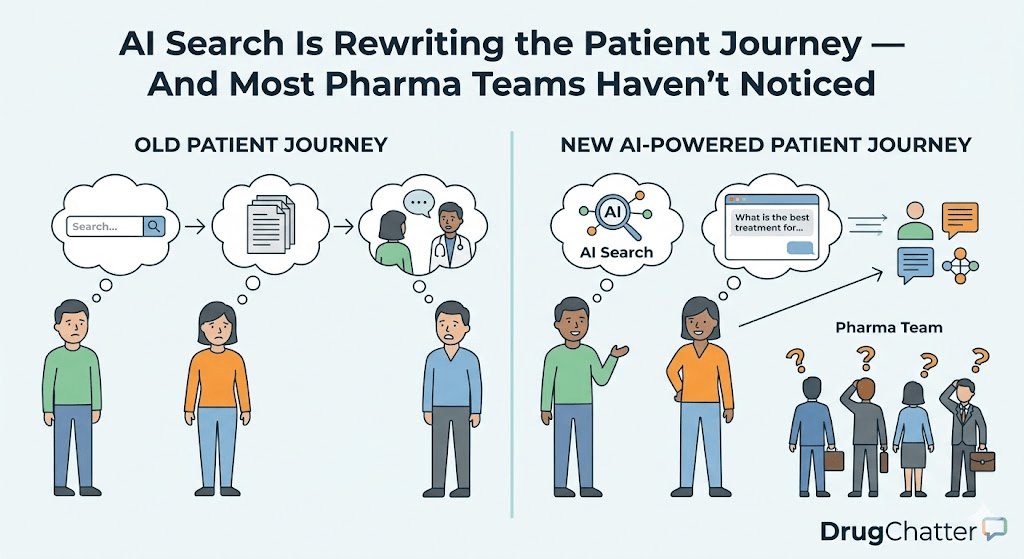
For two decades, pharmaceutical commercial teams built their patient journey models around a predictable sequence: symptom onset, physician visit, diagnosis, prescription, dispense, adherence. Digital channels complicated the model — patients started Googling symptoms before calling their doctor, reading WebMD between appointments, joining Facebook groups after diagnosis. But the basic architecture of the journey held.
That architecture is fracturing now, and faster than most pharmaceutical market research functions have acknowledged. The fracture line runs through AI search.
When a 52-year-old man in Atlanta notices his ankles are swelling and types ‘ankle swelling causes and treatment’ into Perplexity, he does not get ten blue links. He gets a synthesized answer, a differential diagnosis, and a drug recommendation — assembled in four seconds from sources he never sees. If he follows up with ‘is Entresto safe for heart failure patients over 50,’ he gets a confident pharmacological response from a language model that may be drawing on prescribing information that was updated six months ago, or literature that does not reflect his comorbidity profile, or patient forum posts from people whose situations are nothing like his.
He will not know any of that. He will walk into his cardiologist’s appointment either more informed than he would have been, or misinformed in ways that are invisible to his physician because neither of them knows what the AI told him.
This is the patient journey now. Pharmaceutical companies that have not rebuilt their commercial and medical affairs intelligence frameworks around this reality are working from an incomplete map.
How AI Search Has Changed Each Stage of the Patient Journey
The patient journey framework that commercial teams use to plan campaigns, patient support programs, and HCP engagement divides the experience into stages: disease awareness, diagnosis, treatment initiation, adherence, and re-engagement. AI search has altered the dynamics of each stage, though unevenly and in ways that differ by therapeutic area.
AI and Disease Awareness: How Patients Self-Diagnose Using ChatGPT
Disease awareness is the stage where AI search has had the largest aggregate effect in the shortest time. Patients have always self-diagnosed to some degree, but the quality and specificity of AI-generated symptom analysis far exceeds what a Google search returned five years ago. A patient describing a constellation of symptoms to ChatGPT receives a structured differential diagnosis that approximates what an experienced clinician would generate from the same description.
That has measurable consequences for pharmaceutical companies. Drugs that are the standard of care for conditions AI systems identify early and accurately will see increased consideration in patients who arrive at physician appointments already self-diagnosed and treatment-curious. Drugs for conditions that AI systems frequently misclassify or underdiagnose will see the opposite effect.
A 2024 analysis by the Cleveland Clinic Center for Continuing Education found that ChatGPT correctly identified the primary diagnosis in 72% of complex case vignettes — a performance level comparable to a third-year medical resident. For patients researching common conditions, the AI is often clinically adequate. For rare or complex presentations, it is not, but patients cannot always tell the difference.
Pharmaceutical companies in rare disease should be running systematic tests of how AI systems describe the symptoms of their target conditions and how accurately they route patients toward diagnosis. A rare disease drug manufacturer whose indication is chronically underdiagnosed should want to know whether the AI systems patients consult first are helping or hindering that diagnosis pathway.
How AI Chatbots Are Influencing Treatment Decisions Before the First Prescription
The pre-prescription stage of the patient journey — the period between diagnosis and treatment initiation — has historically been defined by the physician-patient conversation. That conversation still happens, but it is now preceded, for a significant fraction of patients, by an AI consultation that shapes what the patient brings to the appointment.
Patients who have consulted AI about their diagnosis before seeing their physician ask different questions, request different drugs by name, and push back more on treatment recommendations that differ from what the AI told them. This is not universally negative — a better-informed patient is often a better treatment partner. But it creates specific commercial dynamics that pharmaceutical brand teams need to account for.
A branded drug that is recommended by AI systems as first-line treatment will see increased patient pull-through at the point of the physician conversation. A drug that AI frames as a second-line option — even when clinical guidelines support first-line use — faces a patient information headwind that begins before the physician has a chance to present the evidence.
Measuring AI’s role in pre-prescription treatment consideration requires systematic monitoring of what AI systems actually say in response to queries that newly diagnosed patients make. Platforms like DrugChatter track these AI treatment recommendation patterns across major LLM platforms, giving commercial teams the data they need to understand where their brand stands in the AI-mediated pre-prescription conversation.
Does AI Search Change Which Doctor Patients See First?
Referral pathway dynamics are part of the patient journey that commercial teams have studied extensively. AI search is altering them in ways that are only beginning to generate data. Patients who receive an AI-generated differential diagnosis that points toward a specialist condition — autoimmune disease, rare cardiac abnormality, specific cancer type — sometimes seek specialist care directly rather than routing through primary care.
This AI-driven specialist routing compresses the patient journey in ways that benefit therapeutic areas where diagnosis delay is the primary access barrier. For pharmaceutical companies whose drugs treat conditions that are frequently misdiagnosed or delayed in the primary care setting, an AI information environment that routes patients accurately toward specialists is commercially valuable. Monitoring whether AI is performing that routing function accurately for your indication is now part of the commercial intelligence problem.
AI Search and the ‘Appointment Agenda’: How Patients Prepare for Doctor Visits Using LLMs
Market research firms have documented a pattern they term ‘appointment agenda setting’ — the practice of patients querying AI specifically to prepare for physician appointments, generating a list of questions, drug names to mention, or concerns to raise. This practice is growing fastest among patients managing chronic conditions, who have both the most to gain from optimized appointments and the most frustration with limited physician time.
For pharmaceutical brand teams, the appointment agenda dynamic means that AI share-of-voice translates more directly into physician-patient conversation share-of-voice than traditional patient media would. A patient who queried AI about Dupixent before her dermatology appointment and received a favorable, accurate response is more likely to mention Dupixent to her dermatologist than a patient who saw a television advertisement. The AI interaction is personal, responsive, and perceived as objective — three qualities that paid media cannot replicate.
Which AI Platforms Are Patients Using to Research Their Medications?
Not all AI search platforms are equal in their pharmaceutical information quality, citation behavior, or user demographic profile. Pharmaceutical teams building AI monitoring programs need to prioritize platforms by their actual reach in health-related queries.
ChatGPT vs. Perplexity vs. Google Gemini for Drug Research: Which Platform Dominates Patient Queries?
ChatGPT holds the largest overall user base for health-related AI queries, driven by brand recognition and mobile accessibility. OpenAI reported 400 million weekly active users in February 2025. Even if health queries represent a small fraction of total usage, the absolute volume of pharmaceutical queries through ChatGPT is larger than any competing platform.
Perplexity has differentiated itself by providing cited answers — responses that include visible source links, which patients perceive as more reliable than uncited AI responses. For pharmaceutical information queries, this citation behavior means that Perplexity’s drug responses are anchored to specific retrievable sources, which makes its citation patterns more directly actionable for pharma content strategists than the opaque knowledge synthesis of GPT-4.
Google Gemini commands attention not because of its standalone AI app adoption — which trails ChatGPT significantly — but because of its integration into Google Search through AI Overviews. AI Overviews appear at the top of Google results for a growing share of health queries, reaching patients who never consciously chose to interact with an AI tool. A patient searching ‘metformin and alcohol interaction’ in Google may receive an AI Overview before any traditional search result. That AI Overview is a Gemini output. For pharmaceutical companies whose products have significant Google search volume, Gemini’s AI Overview performance is their most important AI monitoring priority, not because Gemini is the best AI, but because it reaches the most patients passively.
How Microsoft Copilot and Bing AI Are Influencing Drug Research in Enterprise Health Settings
Microsoft Copilot’s integration into Windows and Microsoft 365 gives it a distinct distribution pathway: the enterprise desktop. Physicians using Microsoft-powered hospital systems, payers building formulary documentation, and pharmaceutical sales representatives preparing call plans may all encounter Copilot-generated pharmaceutical information in professional contexts. The error consequences in professional healthcare settings are different from consumer settings, because professional users may have less incentive to double-check an AI answer than a patient who is personally at risk.
Pharmaceutical companies with significant HCP marketing programs should add Microsoft Copilot to their AI monitoring scope specifically for clinical and institutional query types — treatment guidelines, drug interaction checks, formulary positioning queries — where the professional user base is most concentrated.
Claude and AI Search: What Anthropic’s Model Says About Prescription Drugs
Anthropic’s Claude has a reputation among technically sophisticated users for careful, caveat-rich responses on medical topics. Claude more consistently declines to make definitive treatment recommendations than GPT-4 or Gemini, and more frequently adds recommendations to consult a physician. This behavioral profile reduces but does not eliminate inaccuracy risk on pharmaceutical queries.
Where Claude presents specific monitoring challenges for pharmaceutical companies is in its tendency to engage at length with complex, multi-part pharmaceutical queries — drug interaction scenarios, off-label evidence discussions, comparative mechanism questions — that other platforms decline more quickly. Claude’s longer, more detailed responses on these topics can influence patients with above-average health literacy who seek more than a surface-level answer.
‘Sixty-one percent of patients who used an AI chatbot to research a prescription medication reported that the AI response influenced their subsequent conversation with their physician, and 34% said the AI response led them to request a specific medication by name.’ — Wolters Kluwer Health Survey on AI and Patient Behavior, 2024
AI Search Share-of-Voice for Drugs: How to Measure It and Why It Matters
Share-of-voice has been a core pharmaceutical commercial metric for decades. In the traditional media environment, it measured how often a brand appeared in paid and earned media relative to competitors. In the AI search environment, the concept is structurally similar but methodologically different in ways that require new measurement approaches.
How to Measure a Drug’s Share of Voice in ChatGPT, Gemini, and Perplexity
AI share-of-voice measurement starts with query construction. You need a comprehensive library of queries representing how patients and physicians actually ask about your therapeutic category — not how your brand team thinks they ask. This requires combining Google Search Console data (which shows actual search queries), social listening data from patient communities, and clinical query research from medical affairs teams.
That query library then gets sent systematically to each major LLM platform at regular intervals. The responses are logged and analyzed for: whether your drug is mentioned, in what context (primary recommendation, alternative, cautionary mention, comparison), with what accuracy relative to current labeling, and alongside which competitors.
The resulting dataset gives you AI share-of-voice: the fraction of relevant AI responses that mention your drug, broken down by platform, query type, and sentiment. Run this analysis quarterly and you get a trend line. Run it weekly and you can detect rapid shifts — a new competitor publication, a safety signal, a major clinical trial readout — before they appear in prescribing data.
AI Share-of-Voice vs. Traditional Branded Search: Which Metric Predicts Patient Behavior Better?
The relationship between AI share-of-voice and patient behavior is not yet as well-established as the relationship between branded search volume and patient behavior, because the measurement infrastructure is newer. But the directional evidence from early adopters suggests that AI share-of-voice is a leading indicator, not a lagging one.
AI share-of-voice captures the information environment patients encounter before they form search intent. A patient who receives a favorable AI response about your drug may not search for your brand at all — they go directly to a physician conversation or to your patient support program. Traditional branded search would miss this patient entirely. AI monitoring catches the influence point that precedes the search.
Companies using platforms like DrugChatter for AI share-of-voice measurement have reported detecting competitor gains in AI mention frequency up to six weeks before those gains appeared in new prescription data — consistent with the hypothesis that AI share-of-voice is a leading indicator of prescribing trends.
Do LLMs Recommend Generic Drugs Over Branded Drugs, and How Do You Track It?
The short answer is yes, with conditions. LLMs trained on general internet content encounter dramatically more discussion of generic drugs in cost-focused contexts — PBM formulary guides, insurance coverage forums, consumer advocacy content — than they encounter branded drug promotional content, which is regulated and less prevalent in crawlable web data.
The pattern that emerges from systematic AI query testing in multiple therapeutic categories is this: queries framed around cost consistently elicit generic-first recommendations across all major LLM platforms. Queries framed around clinical performance or specific patient characteristics produce more nuanced, often branded responses. Queries that mimic how newly diagnosed, non-expert patients typically ask — imprecise, emotionally framed, not clinically structured — tend toward generic recommendations because they trigger the AI’s cost-sensitivity defaults.
Tracking generic substitution recommendations in AI requires including patient-vernacular queries in your monitoring library, not just clinical queries. If your monitoring only tests technically precise queries, you are measuring how AI responds to physicians and health-literate patients, not to the broader patient population that will significantly influence your brand’s commercial performance.
How AI Search Is Changing Drug Launch Dynamics for New Pharmaceutical Products
A drug that launches into an AI information environment where the therapeutic category is mature and well-represented in LLM training data faces a specific challenge: the AI’s default answer for category queries references established drugs, because established drugs have generated more training content. A new drug’s clinical evidence, however strong, may not be in the model’s training data at all if the launch postdates the training cutoff.
The implication for launch planning is that AI-specific content strategy now belongs in the pre-launch checklist. In the months before approval, manufacturers should be publishing peer-reviewed content, structured patient information, and clinical summaries that are specifically formatted for retrieval by AI systems — not just for human readers. This is not about gaming AI; it is about ensuring that when a patient asks Perplexity about treatment options for your indication six months post-launch, your drug appears in the answer.
Drug Misinformation in AI Search: What Patients Are Being Told and Why It’s Wrong
The quality of pharmaceutical information in AI search varies significantly by drug class, query type, and platform. Understanding where the errors concentrate helps pharmaceutical teams prioritize their monitoring and response programs.
Where AI Gets Drug Information Wrong Most Often: A Category-by-Category Analysis
Error rates in AI pharmaceutical information are not evenly distributed across therapeutic areas. Several patterns emerge from benchmarking studies conducted by academic medical centers and pharmaceutical intelligence firms between 2023 and 2025.
Oncology: AI systems consistently present drug combination data accurately for established regimens but mischaracterize emerging combination protocols from recent trials. Given the pace of oncology evidence evolution, knowledge cutoff gaps are most consequential in this area.
Psychiatry and CNS: AI systems demonstrate the highest error rates for psychiatric drug dosing, partly because dosing in psychiatry is highly individualized and context-dependent in ways that resist the general-purpose summaries LLMs produce. Off-label use discussions for psychiatric drugs are also extensive and poorly contextualized.
Immunology and biologics: AI systems handle the general mechanism profiles of TNF inhibitors, IL-inhibitors, and JAK inhibitors adequately but frequently mischaracterize biosimilar interchangeability and frequently conflate products within drug classes in ways that could result in incorrect patient expectations about specific products.
Cardiovascular: AI systems generally handle cardiovascular drug classes accurately for common conditions, but perform poorly on polypharmacy interaction queries, which are the queries most likely to come from the highest-risk cardiovascular patients.
Why AI Gives Outdated Drug Safety Information — and How Long the Gap Lasts
The knowledge cutoff problem in pharmaceutical AI is not a temporary limitation that will resolve as models are updated. It is a structural feature of how large language models are built. Training a major LLM takes months and costs tens of millions of dollars. Models are not retrained continuously; they are updated on cycles that typically span six to eighteen months. FDA drug labeling changes continuously. The gap between a label update and its incorporation into LLM training data is, at minimum, several months and may extend to years depending on the specific model and update cycle.
For drugs with stable, long-established safety profiles, this gap is manageable. For drugs that have undergone recent label changes — new contraindications, updated REMS requirements, revised dosing recommendations — the gap is a patient safety issue.
FDA issued eight Risk Evaluation and Mitigation Strategy modifications for approved drugs in 2023 alone. Every drug whose REMS was updated in 2023 is being described without those updates by any LLM with a training cutoff earlier than the modification date, and it will continue to be described that way until the next model update incorporates the change. Pharmaceutical companies should maintain a real-time crosswalk between their label change history and the training cutoffs of major LLMs to identify where their most dangerous accuracy gaps are.
How AI Systems Handle Off-Label Drug Discussions and Why Pharma Should Monitor Them
Off-label drug use discussions in AI search represent one of the highest-value monitoring targets for pharmaceutical commercial and regulatory teams. LLMs discuss off-label applications freely, drawing on published literature, case reports, and patient community content without the regulatory constraints that govern manufacturer communications.
This creates a specific commercial dynamic: AI systems may be generating significant demand for off-label applications of pharmaceutical products, or deflating demand by characterizing off-label evidence as weaker than manufacturers believe it to be. Either outcome has commercial significance, and neither shows up in traditional media monitoring.
The case of ketamine and esketamine (Spravato, Janssen) illustrates the complexity. Esketamine has FDA approval for treatment-resistant depression and major depressive disorder with suicidal ideation. Ketamine infusion clinics operate in a different regulatory space. AI systems queried about treatment-resistant depression discuss both the approved Spravato pathway and the broader ketamine infusion landscape, often without clearly delineating the regulatory distinction. For Janssen, this creates an AI information environment that is technically accurate but commercially imprecise — patients researching Spravato may receive responses that redirect them toward unregulated ketamine clinics, or vice versa. Monitoring this dynamic requires systematic AI query testing, not periodic manual checks.
AI Hallucinations About Drug Interactions: The Highest-Risk Misinformation Category
Drug interaction misinformation in AI search is the category with the most direct potential for patient harm. Patients asking about interactions are often managing complex medication regimens — exactly the patient population where an incorrect interaction answer carries the highest clinical consequence.
Benchmarking studies show that AI systems handle common, well-documented drug interactions accurately in the majority of cases. The error rate rises significantly for less-common interactions, for drugs approved after the model’s training cutoff, and for multi-drug interaction queries (three or more drugs), where the combinatorial complexity exceeds the coverage of most training datasets. A patient asking about the interaction between a recently approved drug and their existing five-drug regimen is asking exactly the query that LLMs handle least accurately.
Pharmaceutical companies should include multi-drug interaction queries in their AI monitoring programs and prioritize accuracy review of any newly approved product in the context of common comedications. The interaction information environment a new drug launches into is as important as the efficacy and safety information environment, and it requires specific attention in AI monitoring programs.
AI and Physician Behavior: How HCPs Are Using LLMs in Clinical Practice
The patient side of the AI search equation receives more commercial attention than the physician side, partly because patient behavior is more visible to brand teams and partly because direct-to-consumer influence is a more familiar commercial lever. But physician AI adoption is growing faster than most pharmaceutical medical affairs teams have built infrastructure to address.
How Many Physicians Use AI for Prescribing Decisions in 2024 and 2025
The American Medical Association’s 2024 Digital Health Survey found that 38% of physicians reported using a general-purpose AI chatbot for clinical information at least monthly, up from 16% in 2022. Among physicians under 45, the figure was 54%. Among residents and fellows, self-reported AI use for clinical questions exceeded 70%.
These are not physicians using clinical-grade AI tools integrated into EHR systems with current drug databases. They are physicians typing queries into ChatGPT, Perplexity, or Gemini on their personal devices, receiving responses from models with the same knowledge cutoff limitations and accuracy constraints that apply to patient queries — without necessarily the critical appraisal framework to identify when the AI is wrong.
The pharmaceutical industry has invested heavily in ensuring that physicians have access to accurate product information through detail visits, medical science liaisons, and continuing medical education. None of those channels reach the moment when a physician is privately querying an AI about a prescribing question. AI monitoring of physician-relevant queries — dosing, drug interactions, patient subgroup selection, head-to-head comparisons — is a medical affairs intelligence function that most pharmaceutical companies have not yet formalized.
What Physicians Ask AI About Drugs That They Won’t Ask a Sales Representative
Physician AI queries reveal a category of clinical questions that physicians are unlikely to raise in a formal interaction with a pharmaceutical company — questions about competitor drugs, about the limits of clinical evidence for a product, about real-world performance versus trial performance, and about off-label applications they are considering.
This category of unguarded clinical query is commercially valuable information that has historically been inaccessible. Analyzing the query patterns that physician AI use generates — through systematic query library testing that mirrors how physicians tend to frame clinical questions — gives medical affairs teams a view of the information gaps and competitive considerations that physicians are actively trying to resolve outside of formal engagement channels.
Medical science liaisons can be more effective when they know what questions physicians are privately asking AI, because those questions reveal the precise information needs that MSL interactions could address. Pharmaceutical companies that treat AI monitoring as a brand protection exercise miss this medical affairs intelligence value.
How AI Search Is Changing the Pharmaceutical Sales Rep Model
The pharmaceutical sales representative model has been under structural pressure for a decade, as physician access restrictions tightened and digital channels multiplied. AI search adds a new dimension: physicians who can query a language model for drug information on demand have less need for the information-delivery function that detail visits historically provided.
The response from pharmaceutical companies that have analyzed this shift is to retrain medical affairs and commercial field teams toward insight exchange rather than information delivery. Rather than presenting clinical data the physician can now retrieve from AI, MSLs and sales representatives who understand what AI is telling physicians about their product — accurately, inaccurately, or with competitive framing — can add value by correcting, supplementing, and contextualizing the AI information environment the physician already inhabits.
This requires knowing what that AI information environment is. Field teams without AI monitoring data are operating without a map of the information landscape they are entering.
Patient Sentiment in AI Search: Tracking How Drugs Are Perceived Before and After Prescription
Patient sentiment toward a drug shapes adherence, advocacy, and word-of-mouth referral throughout the treatment journey. Traditional sentiment analysis focuses on social media, patient forums, and survey data. AI search adds a new sentiment dimension: how is the AI characterizing your drug’s tolerability, side effect profile, and patient experience to patients who are actively researching it?
How AI Search Shapes Patient Expectations Before Treatment Initiation
Expectation formation is one of the most predictive variables in medication adherence research. Patients whose expectations about a drug’s side effects match their actual experience are significantly more likely to remain on therapy than patients who encounter unexpected effects — in either direction, but particularly when the experience is worse than expected.
AI search is now a primary expectation-formation channel for new-to-therapy patients. What the AI tells a patient about the first-month experience on a GLP-1, an immune checkpoint inhibitor, or an MS disease-modifying therapy directly shapes the mental model they carry into treatment initiation. If the AI’s description of the side effect profile is accurate and balanced, the expectation match will be reasonable. If it overweights severe or uncommon effects — as the negative-skew dynamics of training data suggest it often will — the expectation mismatch becomes an adherence risk before the first dose is taken.
Pharmaceutical companies with strong patient support programs should integrate AI sentiment monitoring into the patient journey triggers that activate those programs. If AI monitoring reveals that the information environment for your drug’s first weeks on therapy is dominated by severe side effect narratives, proactive patient education outreach at the point of prescription should specifically address those AI-amplified concerns — not because the AI is necessarily wrong, but because patients will arrive with those concerns whether or not they are well-founded.
How Negative AI Narratives About Drug Side Effects Drive Discontinuation
The nocebo effect — the phenomenon by which negative expectations generate worse outcomes — is well-documented in medication adherence literature. Patients told that a drug causes nausea report nausea at higher rates than patients on the same drug who were not primed with that expectation. AI search is now generating nocebo priming at population scale, for free, before the first physician conversation.
The discontinuation pathway from AI-generated negative expectation looks like this: a patient receives a prescription, researches the drug before filling it, encounters AI responses emphasizing adverse effects that are rare or manageable, begins therapy with high anxiety about those effects, interprets normal bodily sensations through the AI-generated adverse event frame, and discontinues within the first 30 to 90 days.
This pathway is not hypothetical. Adherence researchers have documented that pre-treatment internet research — even on accurate medical websites — is associated with higher rates of early discontinuation for drugs with well-known side effect profiles. The effect is likely to be larger for AI responses, because AI responses are more personalized, more interactive, and more persuasive than static web pages.
Monitoring Patient Sentiment Shifts in AI Search After a Drug Safety Communication
When FDA issues a safety communication about a marketed drug — a drug safety update, a REMS modification, a MedWatch alert — the information enters the public domain and begins propagating through news sites, patient forums, and social media. Eventually it enters LLM training data. But the velocity and accuracy of that propagation varies significantly across channels and platforms.
Pharmaceutical companies currently track how safety communications appear in media and social platforms in near real-time. Tracking how and when safety communications enter AI search responses requires systematic AI monitoring before, immediately after, and in the months following a safety communication. This tracking answers a specific question: how long does it take for a safety update to appear accurately in AI responses, and is the AI over- or under-representing the safety concern during the lag period?
The answer has significant implications for patient safety programs and for FDA compliance. If AI systems are describing a safety concern more severely than the FDA communication warrants, the manufacturer needs to know — and to decide whether it has an obligation to correct that information environment. If AI systems are not yet reflecting a safety update, patients querying AI in the post-communication period are receiving pre-update information, which may constitute a patient safety gap even though the manufacturer has met its FDA communication obligations.
FDA Compliance and AI Search: Regulatory Risk Pharma Teams Are Not Tracking
Does the FDA Have Jurisdiction Over What AI Chatbots Say About Prescription Drugs?
FDA’s jurisdiction over drug promotion attaches to communications made by or on behalf of manufacturers. A third-party AI chatbot that generates incorrect or promotional content about a prescription drug is not, under current regulatory frameworks, subject to FDA enforcement action for that content. The third-party AI company is not a regulated entity for drug promotion purposes. The manufacturer is not responsible for content it did not generate.
That regulatory gap is real, and it is creating an information environment for prescription drugs that is less regulated than any pharmaceutical communication channel that has previously existed at comparable scale. A television advertisement for a prescription drug must include a full recitation of risks. ChatGPT describing the same drug has no such requirement.
FDA has signaled awareness of this gap. Its Technology Modernization Action Plan and its Digital Health Center of Excellence have identified AI-generated health information as an emerging policy area. But formal regulatory guidance on AI-generated drug information from third parties has not been issued as of mid-2025, and the timeline for such guidance is uncertain.
When AI-Generated Drug Promotion by Manufacturers Becomes an FDA Compliance Problem
The regulatory clarity that does exist covers manufacturers’ own AI deployments. Any AI system deployed by a pharmaceutical manufacturer that generates promotional content about a prescription drug is subject to 21 CFR Part 202 requirements — including the requirement for fair balance of risk information. This applies regardless of whether the promotional claim was intended by the manufacturer or generated autonomously by the AI system.
FDA’s OPDP issued a warning letter in 2023 to a pharmaceutical company whose customer-facing chatbot was generating efficacy claims without accompanying risk information. The warning letter characterized the chatbot’s output as promotional labeling under FDA’s definition, applied the same standards that would apply to a printed promotional piece, and gave the company 15 days to respond and take corrective action. The drug involved was not named publicly in FDA’s summary of the warning letter, consistent with FDA’s practice of protecting commercially sensitive information, but the enforcement action established the agency’s position clearly.
Pharmaceutical companies with any patient-facing or HCP-facing AI tools — symptom checkers, patient support chatbots, MSL-assist tools, digital detail aids — should be conducting regular AI output audits specifically to test whether those tools are generating promotional claims that would not pass OPDP review. This is a legal and regulatory compliance requirement, not a brand preference.
Pharmacovigilance and AI Search: Does Monitoring LLM Outputs Satisfy ICH E2E Requirements?
ICH E2E, the international guideline on pharmacovigilance planning, requires manufacturers to have systematic approaches to detecting safety signals from all available sources. The guideline was last meaningfully updated before large language models existed as a consumer product. Its reference to ‘all available sources’ did not contemplate AI search as a source.
The question of whether pharmacovigilance monitoring programs are required to include AI-generated content is unresolved under current guidance. EMA’s 2024 reflection paper on AI in medicines regulation came closer than any prior regulatory document to suggesting that marketing authorization holders should monitor AI-generated content as part of their pharmacovigilance obligations. FDA has not issued equivalent guidance but the direction of regulatory travel is visible.
Pharmaceutical pharmacovigilance teams that integrate AI monitoring now — before it is formally required — are building an audit trail that demonstrates regulatory good faith. Those that wait for formal guidance to require it will be retroactively building programs under time pressure and after a period in which their pharmacovigilance signal detection was, arguably, incomplete.
AI Search and Generic Drug Competition: What Brand Teams Need to Monitor
How AI Search Is Accelerating Generic Adoption for Off-Patent Drugs
Generic substitution has always been driven primarily by economics — payer formulary design, pharmacy benefit structure, and insurance tier placement. AI search adds an information-environment accelerant. When patients query AI about their medication costs and the AI recommends a generic equivalent, that recommendation arrives without the commercial friction of a pharmacist conversation or an insurance explanation of benefits. It arrives as a direct, responsive answer to a question the patient already had.
For pharmaceutical companies managing late-lifecycle branded products facing generic competition, AI’s role in informing patients about generic options is now a factor in the generic erosion model. AI share-of-voice measurement for late-lifecycle brands should include tracking of generic mention frequency — how often does an AI query about your brand return a recommendation to consider the generic equivalent, and how does that frequency change over time?
Sites like DrugPatentWatch track patent expiration timelines and competitive generic entry with precision. Cross-referencing that patent intelligence with AI monitoring data gives brand teams a forward-looking view of how the AI information environment will shift as generic competition approaches — intelligence that allows earlier lifecycle management decisions.
AI Search and Biosimilar Substitution Recommendations: What LLMs Say About Adalimumab Biosimilars
The adalimumab biosimilar market — which launched in the United States in 2023 with FDA approval of multiple Humira biosimilars from manufacturers including Amgen (Amjevita), AbbVie’s licensing partners, and others — provides the largest current case study in AI-mediated biosimilar substitution dynamics.
AI query testing on adalimumab-related queries across major LLM platforms reveals significant inconsistency in how biosimilar interchangeability is characterized. Some platforms accurately describe the FDA interchangeability designation and its implications for pharmacy-level substitution. Others present biosimilar options without the interchangeability distinction that determines whether a physician authorization is required for a pharmacist switch. This inconsistency creates different implications for different actors: patients may request biosimilars that are not interchangeable with their current product, pharmacists may decline to substitute when patients expect they can, and prescribers may receive patient questions about biosimilar options that their AI encounters have framed inaccurately.
AbbVie, which has an obvious commercial interest in the accuracy of AI biosimilar information about Humira, has not publicly disclosed an AI monitoring program. Monitoring the AI information environment around your products approaching biosimilar competition is a commercial intelligence function that becomes valuable two to three years before biosimilar entry — when the information environment that will shape patient and physician expectations is still being formed.
How AI Search Influences Formulary Compliance and Step Therapy Outcomes
Formulary compliance — whether a patient actually fills the formulary-preferred drug rather than requesting a non-preferred alternative — is an underexamined area of AI search influence. Patients who query AI about treatment options for a condition in which their formulary requires step therapy through a less expensive drug may receive AI responses that describe the step therapy drug inaccurately, overstate the preferred drug’s advantages, or understate the preferred drug’s equivalency to the non-preferred option.
This creates a patient information environment where formulary design is being actively counteracted by AI-generated information about drug quality or efficacy differences. Pharmaceutical companies whose products are non-preferred on major formularies, or whose products are subject to step therapy requirements, should be monitoring how AI characterizes the step therapy sequence — because the AI is now a patient advocate (of a kind) in the formulary compliance conversation, and it may be advocating in ways that help or hurt your commercial position depending on what it says.
Building Pharmaceutical AI Search Intelligence: Tools, Workflows, and Organizational Ownership
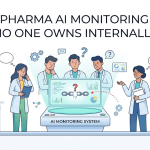
Who Owns AI Search Monitoring Inside a Pharmaceutical Company?
The organizational ownership question is one of the largest practical barriers to effective pharmaceutical AI monitoring. AI search affects commercial, medical affairs, pharmacovigilance, regulatory, and legal functions simultaneously, and no single function has a natural mandate to own the full scope of the problem.
The companies that have made the most progress in building AI monitoring programs have typically placed ownership in one of two places: within a digital center of excellence that reports to commercial leadership, or within a medical information function that has strong regulatory affairs alignment. The first model has stronger commercial intelligence application. The second has stronger pharmacovigilance and compliance application. Few companies have yet built a unified function that serves both.
The organizational design question matters because it determines what questions AI monitoring programs actually try to answer. A commercially-led program will track brand mention frequency and competitive positioning. A medically-led program will track accuracy and safety signal content. The pharmaceutical companies that will generate the most value from AI monitoring are those that build programs designed to answer both sets of questions and route findings to the appropriate functional owners.
What a Pharmaceutical AI Search Monitoring Workflow Looks Like in Practice
A functional AI monitoring workflow for a pharmaceutical brand has four operational components that run on different cadences:
Weekly: Systematic query testing across ChatGPT, Gemini, Claude, Perplexity, and Copilot using the core brand and competitive query library. Automated logging of responses. Flagging of significant changes in mention frequency, framing, or accuracy against the prior week’s baseline.
Monthly: Accuracy review of flagged responses against current approved labeling. Medical writer or pharmacist review of safety-relevant content. Pharmacovigilance team review of any AI-generated content describing adverse events, drug interactions, or contraindications. Brief to medical affairs and brand teams on significant AI information environment changes.
Quarterly: Full share-of-voice analysis across therapeutic category. Competitive benchmarking of AI mention frequency and framing. Review of citation source composition for Perplexity and Copilot responses. Strategic review of content gaps that AI monitoring has identified — information the AI is getting wrong or not capturing that manufacturer content could address.
Event-triggered: Immediate monitoring pulse following any label change, safety communication, major clinical trial readout, or significant media event affecting the brand. These event-triggered monitoring cycles answer a specific question: how quickly and accurately has the AI information environment updated to reflect the new information?
How to Choose a Pharmaceutical AI Monitoring Platform: DrugChatter and the Market Landscape
The market for pharmaceutical AI monitoring platforms is early and fragmented. Most pharmaceutical companies that have deployed systematic AI monitoring have either built internal programs using general-purpose data infrastructure, or adopted pharma-specific platforms designed for this use case.
Purpose-built pharmaceutical AI monitoring platforms like DrugChatter offer several advantages over internal builds: drug-specific query libraries that have been validated against actual patient and physician search behavior, accuracy benchmarking frameworks calibrated to FDA labeling standards, and pharmacovigilance-relevant categorization of AI outputs that maps to existing PV workflows. For companies that do not have the data engineering resources to build and maintain monitoring infrastructure internally, a purpose-built platform substantially reduces the time-to-insight.
The evaluation criteria for pharmaceutical AI monitoring platforms should include: coverage of major LLM platforms including ChatGPT, Gemini, Claude, Perplexity, and Copilot; ability to customize query libraries by drug, therapeutic category, and patient segment; accuracy benchmarking against current approved labeling with update frequency aligned to label change schedules; and output categorization that maps to both commercial intelligence and pharmacovigilance workflow needs.
How to Build a Pharmaceutical AI Query Library That Reflects Real Patient Behavior
The most common technical failure in pharmaceutical AI monitoring programs is building a query library that reflects how pharmaceutical professionals think patients and physicians ask about drugs, rather than how they actually do. Clinical query libraries built by medical affairs teams overrepresent technical, precise queries. Marketing-built query libraries overrepresent brand-favorable query framings. Neither captures the range of real patient and physician query behavior.
Building a representative query library requires at least four data inputs: Google Search Console data for the brand and therapeutic category (actual queries that reach the manufacturer’s web properties); social listening data from patient forums, Reddit health communities, and condition-specific Facebook groups; medical information call center logs (which capture the questions patients and HCPs call manufacturers to ask — a direct signal of information gaps); and physician query data from MSL interaction notes, where available.
The resulting query library should include branded and generic drug name variants, symptom-based queries that precede drug-name queries in the patient journey, comparison queries between your drug and its primary competitors, cost and coverage queries, and off-label use queries relevant to your indication. This breadth ensures that AI monitoring captures the full range of patient and physician touchpoints, not just the touchpoints brand teams find most comfortable to monitor.
Key Takeaways
AI search has inserted a new, largely unmonitored touchpoint into every stage of the patient journey — from symptom research and self-diagnosis through treatment selection, initiation, adherence, and physician appointment preparation. Pharmaceutical commercial models that do not account for this touchpoint are systematically incomplete.
ChatGPT, Gemini, Perplexity, Claude, and Microsoft Copilot each reach pharmaceutical query audiences differently. Gemini AI Overviews in Google Search reach the largest patient population passively. Perplexity’s citation behavior makes it the highest-value platform for pharmaceutical content strategy. ChatGPT has the largest standalone user base for health queries.
AI share-of-voice measurement requires systematic, automated query testing across multiple platforms — not periodic manual checks. Companies using structured AI monitoring programs have detected competitor AI share-of-voice gains up to six weeks before those gains appeared in new prescription data.
LLMs consistently underperform on drug interaction queries for recently approved drugs, multi-drug polypharmacy scenarios, and biosimilar interchangeability questions — exactly the query types where errors have the highest clinical consequence.
AI search generates nocebo effects at population scale, priming new-to-therapy patients with negative side effect expectations before treatment initiation. Patient support programs should be calibrated to address the AI-amplified side effect concerns that monitoring identifies, not only the side effect profile described in the label.
FDA currently holds manufacturers accountable for AI-generated promotional content in tools they deploy. Third-party AI liability is unresolved, but EMA has moved further than FDA toward suggesting that pharmacovigilance monitoring should extend to AI-generated content about marketed drugs.
Organizational ownership of AI monitoring within pharmaceutical companies should span commercial, medical affairs, pharmacovigilance, and regulatory functions. Single-function ownership systematically underutilizes the intelligence the monitoring generates.
Purpose-built pharmaceutical AI monitoring platforms like DrugChatter substantially reduce the infrastructure cost of running systematic AI monitoring programs compared to internal builds, with drug-specific accuracy benchmarking and pharmacovigilance workflow integration that general-purpose data tools do not provide.
FAQ: AI Search and the Pharmaceutical Patient Journey
How does AI search influence patient behavior differently at each stage of the treatment journey?
The influence is stage-specific. At the awareness and diagnosis stage, AI shapes which conditions patients self-identify and which specialists they seek. At the pre-prescription stage, AI influences which drugs patients request by name and what treatment expectations they carry into physician appointments. At adherence, AI shapes side effect expectations and informs patients’ decisions about whether to continue therapy. At re-engagement, AI provides information about treatment alternatives that patients may raise with their physicians. Each stage requires different monitoring priorities: accuracy and diagnostic framing at awareness; competitive positioning and recommendation framing at pre-prescription; sentiment and side effect characterization at adherence.
What is the most important AI platform for pharmaceutical brands to monitor?
The answer depends on commercial priorities. For brands with significant Google search traffic — most large-market pharmaceutical products — Google Gemini’s AI Overviews are the highest-priority monitoring target because they appear in standard Google Search results and reach patients who are not actively choosing to use an AI tool. For brands in therapeutic areas where patients are heavy researchers and health-literate, Perplexity’s cited answers are high priority because they are perceived as more authoritative and because citation source analysis is directly actionable. For overall patient population reach, ChatGPT remains the largest standalone AI health query platform. An effective monitoring program covers all five major platforms: ChatGPT, Gemini, Claude, Perplexity, and Microsoft Copilot.
Can pharmaceutical companies legally influence what AI systems say about their drugs?
Manufacturers can legally produce high-quality, accurate, structured content about their drugs that is designed to be retrievable by AI systems — and this is a legitimate content strategy practice that FDA has not restricted. What manufacturers cannot do is generate content that makes promotional claims without fair balance information, regardless of whether the intended audience is a human reader or an AI training dataset. LLM search optimization for pharmaceutical brands should be implemented through the same content review process as any digital promotional content — not as a back-channel promotional technique. The line between improving the AI information environment and making promotional claims is the same line FDA has always drawn, and it applies regardless of distribution channel.
How should pharmacovigilance teams integrate AI search monitoring into existing signal detection workflows?
AI search monitoring outputs should be integrated into pharmacovigilance workflows at two levels. First, as a surveillance input: regular review of AI-generated content about a product’s adverse event profile, drug interactions, and contraindications, assessed against current labeling for accuracy and cross-referenced with incoming FAERS reports for potential signal correlation. Second, as a signal amplification indicator: when a safety signal is detected through conventional channels, AI monitoring data provides insight into whether that signal is being amplified, muted, or distorted in the AI information environment that patients are consulting. Both inputs should be formally documented in the Pharmacovigilance System Master File, both to create an audit record and to ensure findings are reviewed within established signal assessment timelines.
How long does it take for an FDA drug label change to appear accurately in AI search responses?
The lag between an FDA label change and accurate incorporation into major LLM responses varies significantly by platform and model update cycle, but benchmarking data suggests a range of three to eighteen months is typical. The specific lag depends on: the model’s training cutoff date relative to the label change date; whether the post-change information has been published in sources that are heavily weighted in the model’s training data (FDA.gov, major medical news outlets, prescribing information aggregators); and whether the model uses real-time web retrieval (as Perplexity and ChatGPT with web browsing do) or relies entirely on static training data. Real-time retrieval models reflect label changes faster, but their retrieval is source-dependent and may prioritize sources that have not yet updated their content. Pharmaceutical companies should monitor AI accuracy on recently updated labels specifically, because the lag period is when patient safety risk from AI information is highest.