When a patient asks ChatGPT whether they can take Ozempic while on metformin, that answer — accurate or not — shapes their next conversation with a physician. When Perplexity tells a caregiver that Jardiance ‘may cause dehydration and should be avoided in elderly patients,’ it is functionally giving medical advice without a prescribing license, a black box warning label, or a pharmacist on the other end of the line.
Medical affairs teams used to track what physicians said at conferences, what patients posted on PatientsLikeMe, and what competitors filed with the FDA. Now they have a new category of influence to watch: what large language models say about their drugs, in real time, to millions of patients who treat the output as gospel.
This is not a theoretical problem. It is a compliance exposure, a brand risk, and — in a world where adverse event reports can be triggered by any ‘received information’ source — a pharmacovigilance obligation that is still being written.
Here is what medical affairs teams need to monitor, why it matters, and how the leading pharmaceutical companies are already doing it.
Why AI Search Has Become a Drug Information Channel Medical Affairs Cannot Ignore
Search behavior is changing fast. According to Gartner, traditional search engine volume will drop 25% by 2026 as generative AI tools absorb informational queries. A significant slice of that traffic involves health and medication questions. Google’s own data has long shown that roughly 7% of all searches are health-related. Translate that shift to AI, and you have tens of millions of daily drug information queries flowing through systems that were not built to handle pharmaceutical compliance.
ChatGPT, Gemini, Claude, Perplexity, and Microsoft Copilot now answer drug questions that used to go to WebMD, Drugs.com, or a pharmacist’s counter. The difference is that these models:
- Do not carry FDA-approved labeling
- Cannot verify whether a user is a patient, caregiver, or HCP
- May cite outdated clinical data or confabulate drug interactions
- Present answers with a confidence that printed PI sheets never could
For medical affairs, that combination is the problem. The AI channel is live, scaled, and largely unmonitored by the companies whose products are being discussed.
‘We found that across five leading LLMs, drug interaction information was inaccurate or incomplete in approximately 34% of queries we tested — and branded drugs were more often affected than generics because models were trained on older clinical summaries.’ — DrugChatter internal benchmark report, 2024
How Often Are Brand-Name Drugs Mentioned Across ChatGPT, Gemini, and Perplexity?
The frequency varies by therapeutic category. GLP-1 drugs — Ozempic, Wegovy, Mounjaro, Zepbound — dominate AI-generated responses about weight loss and diabetes management because they are culturally saturated in the data LLMs trained on. A 2024 analysis by DrugChatter found that Ozempic was mentioned in roughly 73% of AI responses to queries about injectable diabetes medications, compared to 41% for its branded peer Mounjaro — despite Mounjaro having equivalent or superior clinical trial data in several outcomes measures.
That gap is not clinical. It is a training data artifact. And it has real commercial consequences.
Do LLMs Recommend Generic Drugs More Often Than Branded Drugs?
The short answer: yes, and the gap widens for older molecule classes. When a patient asks an LLM what medication is used for hypertension, they are far more likely to receive lisinopril, amlodipine, or metoprolol than Entresto or Verquvo — even when the clinical profile favors the branded agent for their stated condition. Models trained on cost-effectiveness literature, Medicare formulary data, and public health guidelines encode a structural preference for generics that branded medical affairs teams are only beginning to measure.
This matters most in therapy areas where formulary dynamics are already competitive: cardiology, oncology biosimilars, and immunology. If Humira’s biosimilars — Hadlima, Cyltezo, Hyrimoz — are consistently recommended by AI ahead of Skyrizi or Rinvoq for inflammatory conditions, AbbVie has a medical affairs problem that does not show up in traditional share-of-voice analytics.
Can AI Hallucinations About Drug Safety Trigger FDA Risk?
This is the question medical affairs and regulatory counsel are quietly wrestling with. The FDA’s pharmacovigilance regulations under 21 CFR Part 314 define an adverse event report obligation when a company receives information about a patient experience — but the statute was written before AI-generated medical content existed at scale.
The ambiguity centers on two scenarios:
Scenario One: A patient reads an AI-generated answer stating that Drug X causes liver damage at standard doses (a hallucination), stops taking the drug, and experiences a clinical event. Does the pharmaceutical company have a reporting obligation if it becomes aware of the AI output?
Scenario Two: An LLM consistently describes a drug’s side effect profile in terms that conflict with the FDA-approved label — for example, understating the frequency of a black box warning event. If medical affairs teams discover this and do not act, does regulatory inaction create liability?
The FDA has not issued formal guidance on either scenario. What is clear is that the agency’s 2023 AI/ML Action Plan and its evolving draft guidance on digital health technologies signal it is watching how companies respond to AI-generated drug misinformation. Proactive monitoring is not yet a formal obligation. Willful blindness, however, has historically been treated poorly in enforcement actions.
What Happens When ChatGPT Gets a Black Box Warning Wrong?
Black box warnings are the FDA’s highest-tier safety alert. They cover drugs like isotretinoin (severe birth defects), clozapine (agranulocytosis), and fluoroquinolones (tendon rupture, aortic aneurysm). In testing by independent researchers, LLMs have been found to omit, understate, or misframe black box warnings in a measurable percentage of safety-related responses.
A 2023 study published in JAMA Internal Medicine evaluated ChatGPT’s ability to answer common medication questions and found that while the model performed reasonably on general pharmacology questions, it struggled with nuanced contraindication and drug interaction scenarios — the exact queries where patients need accuracy most.
For the pharmaceutical company whose drug is involved, a systematically wrong AI answer at scale is not just a reputation problem. It is a signal that needs to be in a monitoring report.
Off-Label Drug Use in AI Responses: A Specific Compliance Flashpoint
LLMs routinely discuss off-label uses of drugs because their training data includes medical literature, Reddit threads, patient forum posts, and clinical preprints where off-label use is extensively documented. When a user asks whether ketamine is effective for treatment-resistant depression, they may receive a detailed answer covering off-label IV infusion protocols — a response that would violate pharmaceutical promotion rules if it came from a company representative.
The AI is not the company. But the company’s drug is in the answer. Medical affairs teams need to know:
- Which off-label uses are being discussed in AI responses about their drugs
- Whether those discussions align with, or contradict, published clinical evidence
- Whether any AI-generated off-label discussion creates downstream prescriber or patient behavior that could surface in adverse event reports
This is where AI monitoring overlaps directly with signal detection in traditional pharmacovigilance.
Tracking Share of Voice Across ChatGPT, Gemini, Claude, and Perplexity
Share of voice in AI is not the same as share of voice in paid search or earned media. It does not depend on ad spend, media relations, or SEO. It depends on what the model learned, what sources it was trained on, and how it resolves conflicts between clinical evidence and popular discourse.
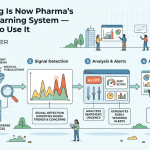
Medical affairs teams need a structured methodology to measure it. The basic framework involves:
- Defining a query set that mirrors real patient and HCP searches
- Running those queries systematically across multiple LLMs
- Coding responses for drug mentions, sentiment, accuracy, and competitor positioning
- Tracking changes over model update cycles
Tools like DrugChatter have been built specifically for this pharmaceutical context, allowing teams to benchmark drug mentions across AI platforms in a way that manual prompt-testing cannot scale to.
How Eli Lilly Is Watching What AI Says About Mounjaro and Zepbound
Eli Lilly has not made its internal AI monitoring program public, but its market behavior signals a sophisticated understanding of the LLM landscape. The company has invested heavily in direct-to-patient digital channels, including its LillyDirect platform, which connects patients to telehealth prescribers and pharmacy fulfillment — a structure that makes Lilly less dependent on AI search recommendations and more capable of owning the patient relationship upstream.
That is a strategic hedge. If an LLM systematically recommends Ozempic over Zepbound for weight loss (because Ozempic’s name recognition is baked into more training data), Lilly benefits from a direct enrollment pathway that bypasses that AI layer entirely.
Medical affairs teams at Lilly, Novo Nordisk, and other large pharmaceutical companies are monitoring AI not just as a brand channel but as a competitive intelligence source — understanding which clinical attributes AI models associate with their drugs versus competitors’ drugs.
How Novo Nordisk Monitors AI Mentions of Ozempic and Wegovy
Novo Nordisk faces a different problem: its brands are over-represented in AI. When every major LLM defaults to Ozempic as the answer to ‘best GLP-1 for weight loss,’ the challenge shifts from visibility to accuracy control. Novo’s medical affairs team needs to monitor whether AI answers correctly distinguish Ozempic (approved for type 2 diabetes) from Wegovy (approved for chronic weight management), since the two share the same active ingredient — semaglutide — but have different indications, dosing schedules, and label language.
Conflating them in an AI response is not just a marketing error. It is a potential off-label promotion signal that, if detected in a company employee’s output, would trigger immediate legal review.
Which Drugs Are Most Frequently Mentioned by AI — and Why It Is Not Random
AI mention frequency correlates with three factors: media coverage volume in training data, clinical publication density, and social media discussion volume. Drugs that generated significant news coverage, Reddit discourse, or Twitter/X debate before the model’s training cutoff are structurally overrepresented.
That creates predictable distortions:
- Blockbuster drugs (Humira, Keytruda, Eliquis) are mentioned frequently and often accurately
- Newer approvals with less training data are underrepresented or described with outdated clinical profiles
- Drugs that attracted controversy (Aduhelm, Makena, Juxtapid) carry residual negative framing even when their label or clinical position has since evolved
- Drugs with complex names or recent rebrandings (Leqembi vs lecanemab) are inconsistently named across models
How Patients Are Actually Asking About Drugs in AI Search
Patient query patterns in AI search differ from traditional search in ways that matter for medical affairs signal detection. Traditional search queries tend to be short and keyword-based: ‘Ozempic side effects’ or ‘Eliquis dosing.’ AI search queries are conversational and contextual: ‘I’m 67 years old with kidney disease and my doctor mentioned Jardiance — is it safe for me to take it with my blood pressure medication?’
That shift in query structure changes the nature of the risk. The longer the query, the more specific the clinical context, and the higher the chance that an AI response will enter territory that the drug’s label was not designed to address.
How Patients Describe Drug Side Effects to AI — and What Medical Affairs Can Learn
Patients describing side effects to AI assistants use lay terminology that differs substantially from MedDRA coding. They say ‘my heart feels weird’ rather than ‘palpitations.’ They describe ‘feeling foggy’ rather than ‘cognitive impairment.’ They mention ‘stomach issues’ without differentiating nausea, gastroparesis, or reflux.
That language gap matters for two reasons. First, AI models must bridge it when generating responses, and they do not always do so accurately. Second, medical affairs teams monitoring AI conversations for adverse event signals need natural language processing tools calibrated to patient vocabulary — not clinical terminology.
Traditional pharmacovigilance has always faced this translation problem in patient forum monitoring. AI search now amplifies the volume and removes the friction that used to slow information spread.
What Reddit AI Citations Tell Pharma Brand Teams
LLMs trained on Reddit data carry embedded patient sentiment that surfaces in drug-related responses. Subreddits like r/diabetes, r/GLP1, r/ChronicPain, and r/ChronicIllness generate high-volume, experiential drug discussion. When an LLM trained on that corpus answers a question about Mounjaro’s side effects, the answer may structurally reflect the dominant Reddit sentiment — even if that sentiment diverges from the drug’s clinical profile.
Medical affairs teams that monitor Reddit as part of their social listening programs are effectively monitoring a source that AI models amplify at scale. The r/Ozempic community’s concerns about hair loss after semaglutide, for example, generated enough discussion volume that LLMs began surfacing it as a common side effect — even though it is not in the FDA label and clinical evidence for it is weak.
That amplification loop — from patient forum to LLM training data to AI answer — is a new form of adverse event signal propagation that medical affairs teams need to track.
AI Pharmacovigilance: Can LLM Outputs Be Used for Signal Detection?
The answer is a qualified yes — with significant methodology requirements attached.
Traditional pharmacovigilance signal detection draws on spontaneous adverse event reports (MedWatch, EudraVigilance), electronic health record data, and literature surveillance. Social media monitoring has been an accepted supplementary source since the FDA’s 2014 guidance on using social media for pharmacovigilance. AI-generated content occupies an analogous position: it is not a primary signal source, but patterns in AI responses can surface emerging safety concerns before they appear in formal reporting systems.
The practical workflow looks like this:
- Run weekly or monthly structured queries against major LLMs covering the drug’s indication, side effect profile, interactions, and patient population
- Code responses for adverse event terminology using NLP tools calibrated to patient and clinical language
- Identify responses where the AI describes an adverse event not currently in the drug’s label or in disproportionate frequency
- Flag those responses for medical review and cross-reference against FAERS data and recent literature
This is not a replacement for formal pharmacovigilance. It is an early warning layer that catches signal trends before they accumulate in regulated databases.
Can AI Outputs Be Submitted as Adverse Event Reports to the FDA?
Not directly. FDA adverse event reporting requirements under 21 CFR 314.81 require identifiable patient information, a suspect drug, and an adverse experience — criteria that an AI-generated response cannot satisfy on its own. But if an AI response leads to a patient making a medication decision that results in a reportable adverse event, and the company becomes aware of that causal chain, the reporting obligation may apply to the clinical outcome, not the AI output.
The FDA has signaled that it wants pharmaceutical companies to maintain ‘robust signal detection’ programs that cover digital channels. AI-generated content is a digital channel. That is a reasonable basis for including AI monitoring in a pharmacovigilance SOPs update — which several large pharmaceutical companies are already undertaking quietly.
Why AI Hallucinations About Drug Interactions Are the Highest-Risk Output Category
Drug interactions are the category where AI gets things most dangerously wrong. Interaction databases are complex, frequently updated, and highly context-dependent — factors that make them poor fits for a model that learned from a static training corpus.
Specific failure patterns include:
- Missing QT-prolonging interactions (azithromycin plus antipsychotics, for example) that are well-documented in clinical pharmacology but underrepresented in general health writing
- Overstating interactions for drug pairs that have theoretical mechanisms but low clinical significance
- Describing interactions in absolute terms (‘do not take’) when the actual guidance is dose- or patient-specific
- Confusing drug class interactions with drug-specific data
A patient who asks an LLM whether their blood thinner is safe to take with ibuprofen and receives an incomplete or wrong answer is not a hypothetical concern. That query pattern is common, the stakes are high, and the AI is frequently inadequate to the task.
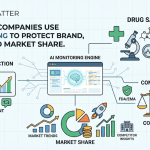
How Pharmaceutical Brand Teams Can Build an AI Monitoring Program
Building a medical affairs AI monitoring program is not a one-person, one-quarter project. It requires cross-functional ownership, defined query protocols, regulatory alignment, and a data infrastructure that can scale across multiple LLM platforms simultaneously.
The core program components are:
Step One: Define the Query Universe
Start with your existing patient and HCP search query data. Google Search Console, Veeva Pulse, and any paid search keyword data will tell you what people are actually searching for about your drug. Translate those queries into conversational AI-search formats. A keyword like ‘Jardiance side effects kidney’ becomes ‘I have chronic kidney disease and my cardiologist mentioned Jardiance — what are the risks for someone with my condition?’
Build a query library of at minimum 50 to 100 prompts per drug, covering:
- Indication and mechanism questions
- Side effect and safety questions
- Drug interaction questions
- Dosing and administration questions
- Competitor comparison questions
- Off-label use questions specific to your drug’s therapy area
Step Two: Run Systematic Cross-Platform Testing
Manual prompt-testing across ChatGPT, Gemini, Claude, and Perplexity does not scale. DrugChatter provides a structured platform for pharmaceutical teams to run this kind of systematic monitoring at scale, with response coding, trend tracking, and competitive benchmarking built in. Without a platform, you are looking at a manual process that requires dedicated analysts and is vulnerable to inconsistency in how responses are evaluated.
Run queries at regular intervals — weekly for drugs with active safety signals, monthly for stable products. Model updates happen without announcement and can shift drug-related responses materially.
Step Three: Code and Classify Responses
Raw LLM responses need to be classified against a defined rubric before they generate actionable intelligence. The classification framework should cover:
- Accuracy against FDA-approved labeling
- Mention of required safety information (black box warnings, REMS elements)
- Competitor drug mentions and their framing
- Off-label content identification
- Patient sentiment indicators
- Source citations and their reliability
This is where NLP tooling matters. Manual coding is workable for small query sets but breaks down at the volume required for a comprehensive monitoring program.
Step Four: Create a Cross-Functional Governance Structure
AI monitoring outputs touch multiple functions. Safety data belongs in pharmacovigilance. Label accuracy issues go to regulatory affairs. Brand positioning findings go to commercial medical affairs. Off-label content signals go to legal and compliance. Build a steering committee or monthly review cadence that routes findings to the right function without creating information silos.
Physician Perception of AI Drug Recommendations: What Medical Affairs Needs to Know
HCP attitudes toward AI-generated medical information are shifting faster than most medical affairs teams are tracking. A 2024 survey by the American Medical Association found that 38% of physicians reported patients bringing AI-generated information about medications to their appointments — up from a baseline that barely registered in 2022.
That creates a new dynamic in the physician-patient consultation. When a patient arrives with an AI-generated summary of their medication options, the HCP has two choices: engage with that information or dismiss it. Most physicians engage, which means the accuracy of what the AI said has real clinical downstream effects.
How Physicians Are Using AI to Research Drug Prescribing Decisions
The HCP AI query pattern is different from patient queries. Physicians tend to ask AI systems about:
- Relative efficacy comparisons between drugs in a class
- Management of specific drug interactions or contraindications
- Dosing adjustments for renal or hepatic impairment
- Emerging data from recent clinical trials not yet in guidelines
- Biosimilar interchangeability questions
Each of these query types carries distinct accuracy risk profiles. Relative efficacy comparisons are particularly problematic because LLMs may draw on older trial data or meta-analyses that predate the current evidence base. A model that recommends Drug A over Drug B based on a 2019 meta-analysis — when a 2023 head-to-head trial reversed that finding — is giving physicians outdated guidance at scale.
What Happens When Medical Science Liaisons Discover AI Is Contradicting Their Field Messages?
MSL programs invest substantial resources in training HCPs on a drug’s clinical profile. When an AI system tells a physician something that directly contradicts the MSL’s message — a different preferred dosing sequence, a different safety signal hierarchy, a different interpretation of a trial result — it creates an educational problem that the field force cannot solve one visit at a time.
Medical affairs teams need to know when AI is actively countering their field messages, not as a crisis to suppress but as a signal that requires a coordinated response: updated medical information resources, potential label clarification requests, or engagement with AI platform developers through their medical accuracy correction mechanisms.
Both OpenAI and Google have formal channels for reporting medical inaccuracies in their models. Most pharmaceutical companies have not yet formalized a process for using those channels systematically.
AI Brand Monitoring for Drug Launches: Getting It Right From Day One
New drug launches face a specific AI monitoring challenge: the model knows nothing about them. A drug approved in 2024 may have minimal presence in an LLM’s training data, which means the AI either ignores it, confabulates information based on the drug class, or — worse — conflates it with a similar drug it does know.
The practical consequence is that AI systems may not recommend newly approved drugs even when they represent the clinical standard of care for a specific patient population. Medical affairs teams planning launches need to account for this ‘AI invisibility’ period — potentially 12 to 24 months before a drug accumulates enough training data to appear consistently in LLM responses.
How to Improve a Drug’s AI Visibility Without Violating Promotion Rules
LLM training data comes from publicly available sources: clinical trial registries, peer-reviewed publications, FDA press releases, patient advocacy organization websites, and mainstream media coverage. None of those sources are promotional channels in the regulatory sense — which means a medical affairs team can legitimately invest in ensuring its drug’s clinical profile is well-represented in exactly those locations.
Concrete tactics include:
- Ensuring ClinicalTrials.gov entries are complete, current, and use precise clinical language
- Publishing medical information resources on the company’s medical affairs portal with clear schema markup
- Supporting patient advocacy organizations in publishing accurate, non-promotional drug information
- Working with publisher partners to ensure peer-reviewed publications are open-access where possible
These are not SEO hacks. They are clinical communications best practices that happen to align with how LLMs learn about drugs.
Can Pharmaceutical Companies Correct AI Misinformation About Their Drugs?
Yes, through two distinct pathways. The first is the feedback and correction mechanisms that AI platforms offer. OpenAI, Anthropic, Google, and Microsoft all have processes for flagging medically inaccurate content. These processes are slow, inconsistent, and not guaranteed to result in model updates on any defined timeline — but they are better than silence.
The second pathway is content ecosystem improvement. If an AI model’s inaccurate answer about your drug is traceable to a specific Wikipedia article, a patient forum thread, or an outdated news piece that was heavily indexed in training data, correcting those source documents improves the accuracy of future model outputs. This requires careful legal review to ensure it does not constitute off-label promotion or unauthorized medical communications, but it is a legitimate medical affairs strategy.
Drug Misinformation in AI: Real Cases Medical Affairs Teams Should Study
The documented record of AI drug misinformation is already substantial enough to inform a monitoring program design. These are real cases, not hypotheticals:
The Ivermectin Problem: How LLMs Encoded Misinformation at Scale
During and after the COVID-19 pandemic, ivermectin was the subject of a massive social media and news coverage cycle that conflated its approved antiparasitic indications with unproven COVID treatment claims. LLMs trained on that period’s data absorbed both the accurate clinical information and the misinformation simultaneously. For months after the FDA and EMA clearly restated that ivermectin was not approved for COVID, AI systems gave inconsistent answers to questions about its use — reflecting the contested information landscape in their training data rather than the regulatory consensus.
Merck, ivermectin’s branded manufacturer, was in the unusual position of having its drug’s legitimate clinical profile obscured by a misinformation wave that the company did not create and could not directly control. That dynamic — a company’s drug being misrepresented in AI due to external information events — will recur for other drugs in other circumstances.
The Aduhelm Controversy and How AI Encodes Regulatory Conflict
Biogen’s Aduhelm (aducanumab) had one of the most contested FDA approval histories in recent memory. The FDA’s 2021 accelerated approval — granted over the objection of its own advisory committee, three members of which resigned in protest — generated a volume of critical coverage that LLMs absorbed heavily. Even after Biogen’s voluntary withdrawal of the drug in 2024, AI systems were generating responses that described the Aduhelm controversy in present tense and with specific details of the advisory committee dissent.
For a drug company with a contentious regulatory history, AI monitoring is not optional. The model does not update when you issue a press release. It updates when its next training cycle incorporates the corrected information ecosystem — which takes months and is not guaranteed.
Hormone Therapy and the WHI Legacy in LLM Responses
The Women’s Health Initiative study published in 2002 generated a generation of medical practice change around hormone replacement therapy that subsequent research has substantially revised. The nuanced 2022 and 2023 re-analyses — showing that the risks identified in WHI were largely specific to older women using combination therapy past menopause onset, and that younger perimenopausal women face a very different risk profile — are accurately represented in clinical literature.
They are not accurately represented in many LLM responses about HRT. Models trained on the larger corpus of general health writing reflect the post-2002 fear narrative more than the post-2022 clinical revision. For companies marketing estradiol products, progesterone formulations, or combination HRT, AI is actively undermining accurate patient education at scale — and medical affairs teams at Pfizer, Bayer, and TherapeuticsMD need to be tracking it.
Building an AI Monitoring Stack: Tools, Vendors, and Internal Infrastructure
A complete medical affairs AI monitoring program combines several technology layers. No single vendor currently covers all of them.
Drug-Specific AI Query Monitoring Platforms
DrugChatter is purpose-built for pharmaceutical AI monitoring — tracking how specific drugs are discussed across major LLMs, identifying inaccuracies, and benchmarking share of voice against competitors. Unlike generic social listening tools, it is calibrated to pharmaceutical compliance requirements and can surface regulatory-relevant content patterns rather than raw mention counts.
DrugPatentWatch provides patent lifecycle intelligence that intersects with AI monitoring when monitoring programs need to understand why a generic drug is appearing more frequently in AI responses — often because a patent cliff event generated significant news and forum coverage that shifted training data composition.
Social Listening Tools With LLM Integration
Brandwatch, Sprinklr, and Talkwalker now offer AI search monitoring features alongside traditional social listening. For pharmaceutical companies already using these platforms for patient forum monitoring, adding AI search monitoring to the same workflow reduces integration complexity. The limitation is that these tools were built for brand marketing, not medical affairs compliance — their classification frameworks need customization to be useful for pharmacovigilance signal detection.
Internal Infrastructure Requirements
Building any component of AI monitoring in-house requires:
- A managed API access framework for querying ChatGPT, Gemini, and other models at scale without triggering rate limits or terms-of-service violations
- An NLP classification layer trained on pharmaceutical terminology and adverse event language
- A data storage and trend tracking infrastructure that preserves query-response pairs over time for regulatory documentation
- Legal review of data collection and storage practices in relevant jurisdictions
Most pharmaceutical companies are not yet at this level of internal build-out. The practical path for 2025 and 2026 is a combination of purpose-built vendor platforms for core monitoring and internal data science resources for custom analysis layers.
FDA and EMA Signals on AI Drug Information: What Regulators Are Watching
The FDA has moved cautiously but steadily toward addressing AI-generated health misinformation. Its 2023 AI/ML Action Plan committed the agency to developing regulatory frameworks for AI applications in healthcare, including — implicitly — AI-generated drug information. The agency’s Digital Health Center of Excellence has been accumulating evidence on how patients use AI for health decisions, though it has not yet issued specific guidance on pharmaceutical company monitoring obligations.
The EMA is further along in some respects. Its 2024 reflection paper on AI in medicines regulation included explicit language about AI-generated medical information as a regulatory concern and flagged that marketing authorization holders may have responsibilities related to correcting AI misinformation about their products. That paper is non-binding, but it signals where formal guidance is likely to go.
How FDA Warning Letters Have Addressed Digital Drug Misinformation — And What Comes Next
The FDA has issued warning letters for social media drug promotion since at least 2012, covering platforms like Facebook, Twitter, and YouTube. The legal basis for those letters rests on the company’s ability to control or influence the content — a standard that applies to the company’s own promotional materials but has not been applied to third-party platforms or AI systems.
The question for the next regulatory cycle is whether pharmaceutical companies have a corrective duty when AI systems misrepresent their FDA-approved drugs. The FDA’s authority over prescription drug promotion under the Federal Food, Drug, and Cosmetic Act does not directly address AI-generated content. But the agency has shown a willingness to extend existing frameworks to new digital contexts when patient safety is demonstrably at risk.
Medical affairs and regulatory affairs teams should be briefing their legal counsel on this landscape now, not when the first warning letter arrives.
How REMS Programs Intersect With AI Monitoring Obligations
Risk Evaluation and Mitigation Strategies — REMS programs — are FDA-mandated risk management requirements for drugs with serious safety concerns. Drugs with REMS requirements include isotretinoin (iPLEDGE), clozapine (REMS programs for each manufacturer), and several oncology biologics.
When an LLM discusses a REMS drug without mentioning the REMS requirements, it is providing structurally incomplete safety information to a patient or caregiver who may not know what they are missing. For companies with REMS programs, AI monitoring of whether models accurately describe REMS requirements is arguably the highest-priority monitoring task. An AI that tells a patient ‘you can take isotretinoin for acne — just make sure to avoid pregnancy’ without describing the iPLEDGE mandatory enrollment requirements is actively creating a patient safety risk.
Patient Sentiment Analysis in AI: Reading Between the Lines of LLM Responses
Patient sentiment embedded in LLM responses is qualitatively different from sentiment extracted from patient forums. Forum sentiment reflects what patients who chose to post actually said. LLM sentiment reflects a statistical aggregation of sentiment from across the patient-written data the model trained on — which means it can surface patient concerns that never reached a single high-traffic forum but were distributed widely across lower-traffic sources.
For drugs with stigmatized indications — psychiatric medications, HIV treatments, addiction medicine drugs — this aggregated sentiment may carry cultural biases from the training data that distort the AI’s representation of patient experience in ways that individually reviewed forum posts might not.
How AI Encodes and Amplifies Drug Stigma
Methadone and buprenorphine are effective treatments for opioid use disorder. They are also treatments that carry significant social stigma in large sections of the internet writing that LLMs learned from. When AI systems describe these medications, they often frame them with hedges, caveats, and qualifications that reflect that stigma rather than the clinical evidence base — which shows both drugs to be safe, effective, and associated with reduced overdose mortality.
Companies marketing addiction medicine products — Indivior (Suboxone), BioLinerx, and the generic buprenorphine manufacturers — have a specific AI monitoring interest in detecting when models reproduce stigma-laden framing that discourages appropriate treatment seeking. That is patient harm with a measurable scale, and it is actionable through both the content correction pathways described above and through engagement with patient advocacy organizations that have their own channels with AI platform developers.
Tracking Voice-of-the-Customer Trends Before They Hit Patient Forums
One underused application of AI monitoring for medical affairs is prospective query analysis. If patients are asking AI systems about a specific drug concern — a pattern of queries about injection site reactions for a subcutaneous biologic, for example — those queries may signal an emerging patient experience trend that has not yet surfaced in high enough volume on PatientsLikeMe or Reddit to register in traditional social listening.
AI query patterns can function as an early voice-of-the-customer signal. A drug that generates a sudden increase in ‘is it normal to experience X’ queries in AI systems may be experiencing a patient experience issue that traditional adverse event reporting will capture weeks later, after the formal reporting threshold is reached.
Competitive Intelligence in AI: What Your Rivals’ Drug Mentions Tell You
AI monitoring is not only defensive. It is one of the richest sources of competitive intelligence available to a medical affairs team — and most pharmaceutical companies are not yet systematically extracting it.
When you run a competitor comparison query across LLMs — ‘which is better for heart failure with reduced ejection fraction, Entresto or Coreg?’ — the response tells you:
- Which drug the model defaults to as primary recommendation
- What clinical evidence the model associates with each drug
- What safety signals the model flags for each drug
- What patient population criteria the model uses for differentiation
Run that query across ChatGPT, Gemini, Claude, and Perplexity and you have a competitive landscape snapshot that reflects how each model has encoded the clinical literature — which is a reasonable proxy for how well-educated patients and HCPs who use those tools will perceive the competitive dynamic.
How AI Share-of-Voice Differs From Traditional SOV Measurement
Traditional share of voice in pharmaceutical measures: paid media spend, earned media mentions, conference presence, and HCP reach metrics. AI share of voice measures something different: the probability that an AI system will mention your drug, recommend it, or frame it favorably in response to a relevant clinical query.
That probability is influenced by factors that pharmaceutical companies do not traditionally manage: the volume of training data mentioning the drug, the sentiment of that data, the recency of major publications in the training corpus, and the model architecture choices made by the AI provider.
A drug can have zero paid media spend and dominate AI share of voice because it generated a large volume of peer-reviewed publications and patient forum discussion. A drug with a large promotional budget can be nearly invisible in AI responses because it was launched recently and has thin training data coverage.
Medical affairs teams need a separate measurement framework for AI SOV — one that reflects these structural realities rather than importing assumptions from paid media analytics.
Key Takeaways
- AI systems including ChatGPT, Gemini, Claude, and Perplexity now function as a primary drug information channel for patients and, increasingly, HCPs — with no FDA oversight of what they say.
- LLM drug mention frequency is determined by training data composition, not clinical evidence quality. Older drugs, drugs with high media coverage, and generic molecules are structurally overrepresented.
- AI drug interaction information is inaccurate in a significant portion of tested queries — the highest-risk category for patient harm from AI misinformation.
- AI hallucinations about drug safety do not currently trigger automatic FDA reporting obligations, but the regulatory direction favors expanded company monitoring responsibilities, particularly for REMS drugs and those with black box warnings.
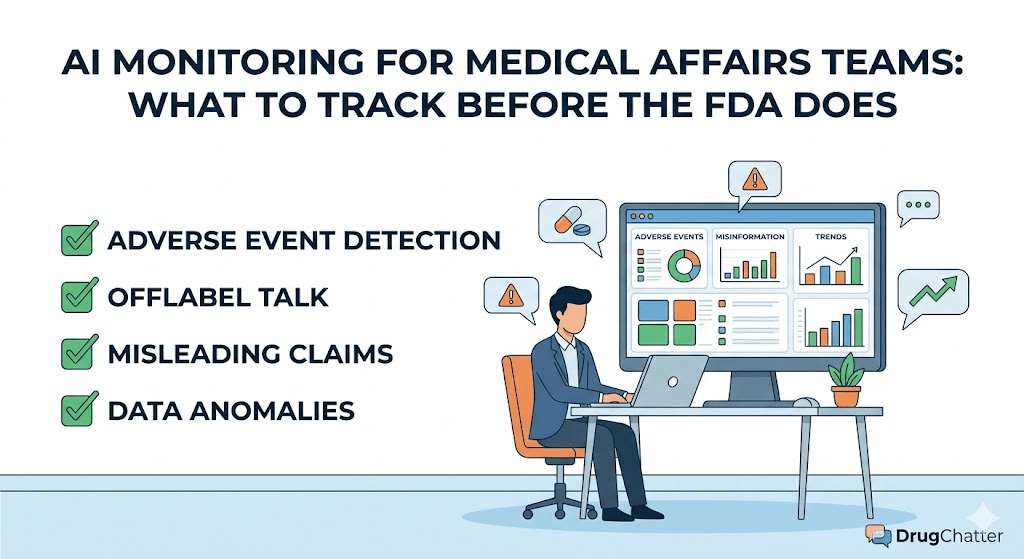
- Medical affairs teams need a structured, cross-platform AI monitoring program covering accuracy, safety signal detection, off-label content, competitor positioning, and patient sentiment — not periodic manual spot-checking.
- Purpose-built platforms like DrugChatter exist specifically for pharmaceutical AI monitoring at scale, reducing the manual burden of systematic cross-LLM query analysis.
- Competitive intelligence extracted from AI monitoring is a legitimate and underused medical affairs capability — revealing how models encode clinical evidence, safety profiles, and prescribing rationale for your drug versus competitors’.
- Patient sentiment patterns in AI queries can surface emerging voice-of-the-customer trends before they register in traditional social listening or adverse event reporting systems.
Frequently Asked Questions
What is AI monitoring for medical affairs in pharmaceutical companies?
AI monitoring for medical affairs refers to the systematic tracking of how large language models — including ChatGPT, Gemini, Claude, and Perplexity — represent, describe, and recommend a pharmaceutical company’s drugs. This includes monitoring for inaccurate safety information, off-label content, competitor mentions, brand share of voice, and patient sentiment patterns. It is distinct from traditional social media monitoring because AI systems generate synthesized responses rather than reproducing user-generated content, which creates unique accuracy risks and pharmacovigilance implications.
Can AI-generated drug misinformation trigger FDA enforcement action?
Not directly at present. The FDA’s current promotional regulations apply to content that pharmaceutical companies or their agents produce, sponsor, or can reasonably be said to control. AI-generated content from third-party platforms does not meet that standard. However, the FDA’s evolving digital health guidance and the EMA’s 2024 reflection paper on AI in medicines regulation both signal movement toward expanded company responsibilities for correcting AI misinformation about their drugs — particularly for products with REMS requirements or black box warnings. Legal and regulatory affairs teams should be monitoring this regulatory development closely.
How often do LLMs give inaccurate drug safety information?
Accuracy rates vary significantly by drug, query type, and model. Drug interaction queries are the highest-risk category. In benchmark testing conducted by DrugChatter across five leading LLMs, approximately one-third of drug interaction responses contained inaccurate or materially incomplete information. Black box warning omission rates were also meaningful. Accuracy tends to be better for well-established drugs with large training data footprints and worse for newer approvals, complex interaction scenarios, and REMS drugs where complete safety communication requires several specific elements.
How do pharmaceutical companies monitor what AI says about their drugs?
The primary methods are: systematic query testing using structured prompt libraries run against major LLMs on a defined schedule; purpose-built monitoring platforms like DrugChatter that automate cross-platform query analysis and response coding; and NLP-based classification tools that categorize responses by accuracy, safety signal relevance, and competitive positioning. Effective programs combine vendor platforms for scale with internal medical affairs review for clinical interpretation. Most large pharmaceutical companies are in early stages of formalizing these programs as of 2025.
Does AI share of voice for drugs correlate with prescription market share?
The research on this correlation is early but directionally suggestive. In therapeutic categories where patients are highly engaged in their own medication decision-making — GLP-1 drugs for weight management, psychiatric medications, chronic condition treatments — AI share of voice is likely to influence patient-initiated conversations with HCPs, which in turn affects prescribing. The mechanism is less direct in categories where HCPs make prescribing decisions with minimal patient input. The strongest correlation evidence is for consumer-activated therapy areas where AI search has partially replaced traditional health website searches. Eli Lilly’s investment in direct-to-patient channels like LillyDirect is a market signal that at least one large pharmaceutical company is treating the AI influence pathway as real and consequential.