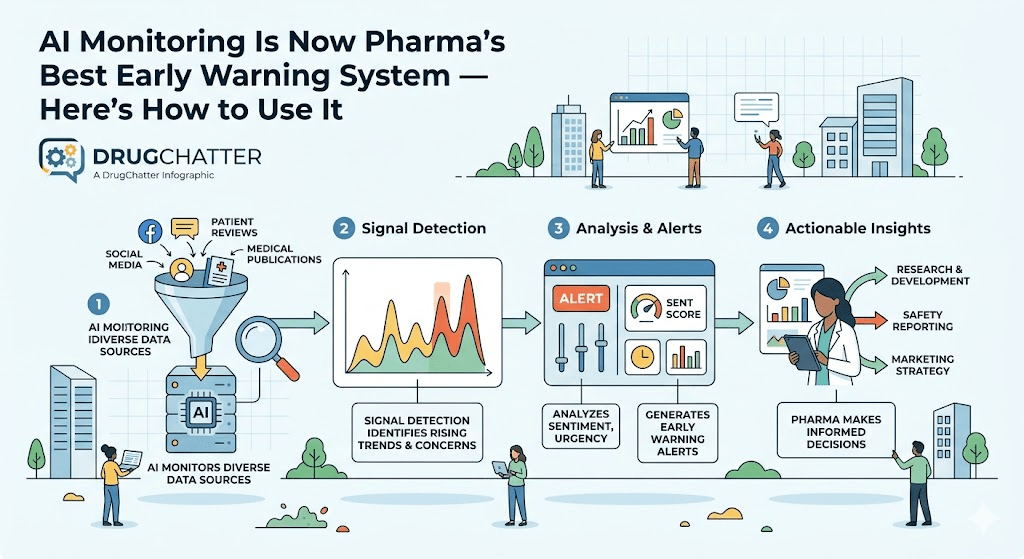
Before a drug problem reaches the FDA, it travels through the internet. A cluster of patient forum posts. A Reddit thread that catches fire. A string of blog articles citing one small study. That signal chain has always existed. What is new is that AI systems — ChatGPT, Gemini, Claude, Perplexity, and a growing list of specialty health AI tools — are now amplifying those signals and delivering them directly to millions of patients and physicians as authoritative answers.
That changes the early warning math for pharmaceutical companies.
When a patient concern exists only in a niche subreddit, its potential impact is bounded by Reddit’s reach. When that same concern gets encoded into an LLM’s response patterns and delivered as a confident AI answer to every person who asks about the drug, the reach is unbounded and the source is invisible. The patient does not know the AI learned about their drug from a forum thread. They hear an authoritative voice.
Pharmaceutical companies that understand this dynamic are building AI monitoring programs designed to detect emerging issues before they reach the AI layer — and to catch AI-specific distortions that have no analog in traditional media monitoring. Companies that have not built this capability are operating with a meaningful blind spot in their brand surveillance infrastructure.
This article covers what AI monitoring as an early warning system actually looks like in practice: the signals it tracks, the regulatory exposure it addresses, the tools that make it operational, and the specific drug situations where it has mattered most.
Why Traditional Pharma Brand Monitoring Misses What AI Monitoring Catches
Traditional pharmaceutical brand monitoring programs watch social media, news coverage, medical journals, and patient advocacy sites. These programs are mature, well-resourced, and genuinely useful. They miss one thing: what AI systems are telling people right now.
The Signal Gap Between Social Listening and AI Listening
Social listening captures what people say about drugs. AI listening captures what AI systems say to people about drugs. The two are related but not identical, and the gap between them is where the early warning value lives.
An AI system trained six months ago on patient forum data may be generating responses today that reflect concerns or narratives that have since been updated, corrected, or superseded. Traditional social listening would capture the current forum discussion. AI monitoring captures what the AI is still saying based on its older training data — a potentially outdated and misleading picture that is being delivered at scale to current users.
That time-lag effect means AI monitoring can identify two distinct problems simultaneously: what is being said about your drug now in patient and physician communities, and what AI systems learned from what was said about your drug months or years ago. Both matter. They are not always the same.
How AI Search Has Changed Where Patients Get Drug Information
Pew Research data from 2023 showed that roughly a third of American adults had used AI systems to get health information. By 2024, that figure had grown substantially, particularly among adults under 45. The growth in AI health queries is accelerating faster than the growth in traditional search queries on health topics.
Patients are not abandoning WebMD or Mayo Clinic. They are adding AI as a first-pass information source — asking ChatGPT a question, getting a synthesized answer, and then deciding whether to search further. That makes AI the triage layer for health information. What AI says determines which downstream sources patients consult.
For pharmaceutical brands, this means AI share-of-voice has become a primary determinant of patient first impressions. A drug that is described favorably, accurately, and prominently in AI answers has a significant awareness and consideration advantage over a drug that is described inaccurately, incompletely, or not at all.
What Pharma Brand Teams Gain From Systematic AI Monitoring
A systematic AI monitoring program delivers four capabilities that conventional brand monitoring does not:
Real-time efficacy and safety claim tracking: What AI is saying about your drug’s benefits and risks, compared to what the FDA label says it should say.
Competitive share-of-voice intelligence: Which drugs AI mentions first, most favorably, and most frequently when patients and physicians ask about your drug class.
Early detection of emerging narratives: Patient concerns and physician hesitations that have not yet reached mainstream media but are showing up in AI training data and outputs.
Regulatory exposure documentation: A timestamped record of AI outputs about your drug that supports duty-to-correct compliance and demonstrates diligence to FDA if asked.
DrugChatter has built its pharmaceutical AI monitoring platform around these four capabilities, providing brand teams with structured output that integrates into existing medical affairs and regulatory workflows.
The Anatomy of an AI Early Warning Signal in Pharma
An early warning signal in pharmaceutical AI monitoring is not always a dramatic hallucination. Often it is a subtle shift — a change in language, a new term appearing in AI descriptions of a drug, a competitor drug mentioned more frequently in answers that used to favor yours. Reading these signals requires understanding what they represent and what they predict.
How Drug Narratives Enter the AI Training Corpus
LLMs are trained on text drawn from across the web: news articles, medical literature, patient forums, blog posts, regulatory filings, social media content, and more. The relative weight of each source type varies by model and by training run. But the basic dynamic is consistent: the more text that exists about a drug, in whatever sentiment and framing, the stronger the model’s prior about that drug.
A new safety signal that generates significant coverage — a post-marketing study showing an unexpected adverse event, a physician letter published in a major journal, a high-profile news report on a drug complication — will eventually be encoded into AI responses. The lag between when the content is published and when it appears reliably in AI outputs varies by platform and by model update schedule. That lag is typically weeks to months.
Understanding that lag is the core of AI early warning strategy. If you can identify a narrative forming in medical literature or patient communities before it completes the journey into AI training data and model outputs, you have time to prepare: to brief medical science liaisons, to update educational content, to engage proactively with the AI platforms, and to document your awareness for regulatory purposes.
Detecting Sentiment Shifts in AI Drug Descriptions Before They Trend
Sentiment in AI drug descriptions is measurable. When models describe a drug in response to patient queries, they use language that reflects the aggregate sentiment of their training corpus. That language can be systematically tracked using NLP sentiment analysis applied to captured AI outputs.
A drug whose AI sentiment score shifts from predominantly positive to mixed over a monitoring period signals that something changed in the underlying data the model is drawing on. That shift may reflect new adverse event reports entering the medical literature. It may reflect a surge in negative patient forum posts. It may reflect a competitor’s comparative effectiveness data being published and picked up by media. Whatever the cause, the sentiment shift in AI outputs is an early indicator of a developing narrative.
Pharmaceutical teams that detect sentiment shifts in AI monitoring can investigate the upstream cause before the narrative reaches full mainstream visibility. That investigation window — typically weeks — is more than enough time to prepare a response.
Off-Label AI Mentions: The Early Warning No Pharma Team Can Ignore
Off-label drug mentions in AI outputs are a distinct and particularly sensitive early warning signal. When an AI system describes a drug as useful for an indication it is not approved for — whether through explicit recommendation or clinical implication — it creates conditions for off-label prescribing influenced by AI rather than clinical evidence.
FDA regulations prohibit pharmaceutical companies from promoting off-label use. When AI generates off-label promotion effectively, the company faces a complex regulatory situation: it did not create the content, but it may be expected to correct it, and its failure to correct it after becoming aware of it carries increasing regulatory exposure over time.
Detecting off-label AI mentions requires comparing AI outputs to approved labeling on an indication-by-indication basis. This is not a manual process at scale. Automated comparison tools — which extract indication language from AI outputs and flag mismatches against the label — are the only practical mechanism for monitoring the full scope of off-label AI discussion about a multi-indication drug portfolio.
Which Drugs Are Most Vulnerable to AI Narrative Distortion Right Now?
Not every drug in a pharmaceutical portfolio faces equal AI monitoring risk. The factors that drive AI narrative vulnerability are measurable, and understanding them helps brand teams prioritize monitoring resources.
GLP-1 Drugs and the AI Information Ecosystem: Ozempic, Wegovy, Mounjaro, Zepbound
The GLP-1 drug class is the highest-priority AI monitoring target in the pharmaceutical industry right now, and the reasons are structural. Semaglutide (Ozempic, Wegovy) and tirzepatide (Mounjaro, Zepbound) generated extraordinary media coverage between 2022 and 2024. That coverage was disproportionately positive and disproportionately focused on weight loss outcomes, often without adequate discussion of side effects, discontinuation rates, or the distinction between diabetes-indicated and obesity-indicated products.
AI systems trained on that corpus produce descriptions of GLP-1 drugs that overstate efficacy, understate gastrointestinal side effects, and frequently confuse which product is approved for which indication. Ozempic is routinely described in weight loss contexts despite Wegovy being the obesity-approved product. Tirzepatide’s head-to-head advantage over semaglutide, demonstrated in SURMOUNT-5 published in February 2025, is incompletely encoded in most current LLMs.
For Novo Nordisk and Eli Lilly, both of which have multiple drugs in this class with distinct approvals and clinical profiles, AI monitoring is not optional. The share-of-voice competition between Ozempic and Wegovy, and between the semaglutide and tirzepatide franchises, is playing out in AI answers that neither company controls.
How Keytruda and Opdivo Are Described in AI Oncology Answers
Pembrolizumab (Keytruda, Merck) and nivolumab (Opdivo, Bristol Myers Squibb) are the two most commercially important checkpoint inhibitors on the market, with combined annual revenue exceeding $30 billion. Both drugs are approved for multiple tumor types across many biomarker-defined populations. Both are therefore candidates for AI-generated overgeneralization — descriptions that apply trial results from one tumor type and biomarker profile to a broader population than the evidence supports.
In systematic AI query testing, models frequently describe response rates from specific Keytruda trials as if they apply to all solid tumor patients. They sometimes omit PD-L1 expression requirements when describing treatment eligibility. They describe the durability of responses in terms drawn from the highest-performing trial cohorts rather than the median patient experience.
For oncology medical affairs teams, the AI characterization of their drugs’ benefit-risk profiles is a patient safety issue in the most direct sense. A cancer patient who has an inflated expectation of response — because an AI told them the drug has an 80% response rate when the actual rate in their biomarker population is 30% — faces a psychological and clinical harm when reality diverges from expectation.
Immunology Drugs and the Generic Substitution AI Risk
Drugs in immunology — particularly the large-molecule biologics used in rheumatoid arthritis, inflammatory bowel disease, and dermatology — face a specific AI early warning risk around biosimilar substitution. As reference biologics like adalimumab (Humira) and etanercept (Enbrel) face biosimilar competition, AI systems increasingly describe the biosimilars as equivalent alternatives without acknowledging the regulatory distinctions between interchangeable and non-interchangeable biosimilars.
The FDA’s biosimilar interchangeability designation has a specific legal meaning: only interchangeable biosimilars can be substituted by a pharmacist without physician authorization. AI systems routinely blur this distinction, describing all biosimilars as freely substitutable. For brand teams managing the transition from reference biologic to competitive biosimilar environment, AI-generated substitution recommendations that bypass the interchangeability distinction represent both a commercial threat and a patient safety concern.
How to Build a Pharma AI Monitoring Program That Actually Works
Building an effective pharmaceutical AI monitoring program requires architectural decisions about scope, methodology, and integration that are different from the decisions made for traditional social listening programs. The technical requirements, the vocabulary of analysis, and the regulatory integration points are all distinct.
Defining the Query Architecture: What to Ask AI Systems and How Often
The foundation of an AI monitoring program is a structured query library — a set of questions, systematically designed, that covers the clinical and commercial landscape of each monitored drug.
A complete query library for a single drug includes four categories:
Patient-language queries: Questions phrased as a patient would ask them. ‘How effective is [drug] for [condition]?’, ‘What are the side effects of [drug]?’, ‘How long does [drug] take to work?’, ‘Can I stop taking [drug] if I feel better?’
Physician-language queries: Questions phrased as a prescriber would ask. ‘What is the mechanism of action of [drug]?’, ‘What are the contraindications for [drug] in renal impairment?’, ‘How does [drug] compare to [competitor] for [indication]?’
Competitive queries: Questions that pit your drug against alternatives. ‘What is the most effective treatment for [condition]?’, ‘Is [your drug] or [competitor drug] better for [patient type]?’
Off-label probe queries: Questions designed to surface AI off-label discussion. ‘Can [drug] be used for [unapproved indication]?’, ‘Is [drug] used in [unapproved population]?’
Query frequency should be calibrated to drug risk level. High-priority drugs — those in active competitive markets, those with recent safety updates, those with significant patient volume — should be queried weekly across all target AI platforms. Lower-priority drugs can run monthly. All queries should be run at the same time of day to minimize variability in outputs driven by model load.
Which AI Platforms Should Pharma Teams Monitor First?
The answer depends on where your patients and physicians spend their time, but a baseline monitoring set covers four platforms: ChatGPT (OpenAI), Gemini (Google), Claude (Anthropic), and Perplexity. Each has different user demographics, different retrieval architectures, and different tendencies in how they handle drug queries.
ChatGPT commands the largest consumer health query volume in the United States. Its outputs reflect a broad synthesis of internet text with GPT-4o’s tendency toward confident, synthesized answers. Gemini is increasingly integrated into Google Search itself, making it particularly relevant for physician queries that flow through Google. Claude tends toward more cautious, hedged language on medical topics. Perplexity provides citations with its answers, making it the most traceable and the easiest to audit for source quality.
As AI-native health platforms proliferate — tools like Amazon’s HealthScribe, Suki, and specialized oncology AI systems — the monitoring surface will expand. A monitoring program that covers only the four major consumer LLMs will miss physician-facing AI tools that may carry higher per-query influence on prescribing decisions.
Integrating AI Monitoring Outputs Into Medical Affairs Workflows
The output of an AI monitoring program is only as valuable as the workflow it feeds into. Many pharmaceutical companies have built AI monitoring capabilities that produce data nobody acts on, because the output is not integrated into a review process with defined owners and response protocols.
Effective integration requires three defined handoffs. First, flagged AI outputs — those where claim deviation from labeling is detected — should route to medical affairs review on a defined cadence, alongside the weekly or monthly social listening reports those teams already receive. Second, competitive share-of-voice data should route to brand teams as part of regular competitive intelligence briefings. Third, off-label mention flags should route to regulatory affairs for assessment under the duty-to-correct framework, with documentation requirements built into the workflow.
DrugChatter’s platform produces structured output designed for exactly these handoffs, with claim deviation flags, share-of-voice dashboards, and off-label mention logs formatted for pharmaceutical regulatory and medical affairs review processes.
AI Hallucination Monitoring: How Pharma Teams Detect False Claims Before Patients Do
The term ‘hallucination’ covers a spectrum in pharmaceutical AI monitoring. At one end are outright fabrications — a drug described as approved for an indication that does not exist, a clinical trial result attributed to a study that was never conducted. At the other end are subtle distortions — a response rate rounded up, a confidence interval omitted, a surrogate endpoint described as a survival benefit.
The Three Hallucination Types That Create FDA Exposure
Three categories of AI hallucination create direct regulatory exposure for pharmaceutical companies, ranked by severity of potential consequence.
The first is indication hallucination: an AI system describes a drug as approved for an indication it does not have. This is the clearest case for regulatory action and the easiest to detect through automated label-comparison tools. Keytruda described as approved for a tumor type where it has only investigational status, or a drug described as approved for a pediatric population when it has only adult approval, are examples. FDA’s OPDP has been explicit that off-label promotion through any channel — including channels the company does not control — can trigger regulatory scrutiny when the company has material connection to the content or is aware of the error and fails to correct it.
The second is quantitative hallucination: an AI system states specific efficacy numbers — response rates, survival benefits, symptom improvement scores — that do not match the values in the approved prescribing information. This is harder to detect because the AI may be citing a real study while misquoting its results, or citing accurate results from a subgroup analysis as if they apply to the full approved population.
The third is comparative hallucination: an AI system describes a drug as superior to a competitor without head-to-head data, or describes comparative effectiveness from a non-randomized real-world evidence study as if it has the same evidentiary weight as a Phase 3 trial. FDA regulates comparative effectiveness claims tightly in promotional materials. The same standards do not apply to AI outputs, but they create the expectation against which AI outputs will eventually be measured.
How to Run a Systematic AI Hallucination Audit for Your Drug Portfolio
A hallucination audit is a structured process that compares AI outputs to the ground truth of approved labeling. Run quarterly, it gives a pharmaceutical company a defensible, documented picture of the accuracy of AI information about its products.
The audit process has five steps. First, define the ground truth document set: the current FDA-approved prescribing information for each drug in the portfolio, the current EMA SmPC where applicable, and the current Risk Evaluation and Mitigation Strategy if one exists. Second, run the standardized query library against each target AI platform and capture outputs in full. Third, extract all clinical claims from the captured outputs: indication descriptions, efficacy numbers, safety statements, dosing information, and population eligibility criteria. Fourth, compare extracted claims against the ground truth documents, flagging discrepancies. Fifth, classify flagged discrepancies by type (indication, quantitative, comparative), severity, and affected platform.
The audit output is a structured discrepancy log that can be reviewed by medical affairs and regulatory affairs, used to prioritize corrective actions, and filed as documentation of the company’s monitoring diligence.
Can AI Hallucinations About Drugs Trigger FDA Warning Letters?
Not directly, and not yet. FDA Warning Letters from OPDP target pharmaceutical company promotional activities, and AI-generated content is not currently classified as pharmaceutical promotional activity. But two pathways exist through which AI hallucinations could contribute to regulatory action.
The first is the duty-to-correct pathway. If a pharmaceutical company’s own materials are the source from which an AI has generated inaccurate information — if a press release, a speaker program slide deck, or a patient website contains content that the AI encoded and now delivers inaccurately — then the company’s original content is the proximate cause of the hallucination. FDA has shown willingness to follow that chain. A 2022 OPDP warning letter to a specialty pharma company cited inaccurate claims on a company-operated website that had been republished across third-party platforms. The principle — that the company is responsible for the downstream accuracy of its original content — is extensible to AI training data.
The second pathway is inaction. A company that conducts AI monitoring, discovers that AI systems are making materially false claims about its drug, and takes no corrective action has documented its own awareness and inaction. If a regulatory inquiry later arises — triggered by a patient complaint, a physician report, or a media investigation — that documented inaction is discoverable.
AI Share-of-Voice in Drug Markets: How to Measure It and What It Means
Share-of-voice in pharmaceutical markets has historically been measured in promotional spend, physician contact frequency, and search impression share. AI share-of-voice is a new metric with no established industry standard — but the underlying commercial logic is identical: the drug that appears most prominently in the information sources patients and physicians consult has a structural awareness and consideration advantage.
How to Calculate AI Share-of-Voice for Your Drug vs. Competitors
AI share-of-voice is calculated by running a standardized set of drug-class queries across target AI platforms and recording which drugs are mentioned, in what position, and with what attributed characteristics. A query about first-line treatment for a specific condition that produces a response mentioning Drug A before Drug B gives Drug A a share-of-voice advantage on that query. Run across hundreds of queries and multiple platforms, this produces a share-of-voice index for each drug in a competitive class.
The calculation requires attention to three dimensions. First, mention frequency: how often is the drug named in AI responses to drug-class queries, expressed as a percentage of total drug mentions? Second, position: is the drug mentioned first, or does it appear after competitors? Position matters because AI-generated recommendations follow a similar attention hierarchy to search results — first-mentioned receives more user attention. Third, characterization: when the drug is mentioned, is the characterization positive, neutral, or mixed? A drug mentioned frequently but characterized negatively has a different share-of-voice profile than a drug mentioned rarely but characterized strongly favorably.
What AI Share-of-Voice Data Reveals That Promotional Spend Data Does Not
Traditional share-of-voice metrics reflect what pharmaceutical companies invest in promotion. AI share-of-voice reflects what the information ecosystem has encoded about a drug independent of promotional investment. The two can diverge significantly.
A drug that has been on the market for a decade may have accumulated substantial positive AI share-of-voice through years of patient forum discussion, journal citations, and physician educational content — even if its promotional budget has declined. A newly approved drug with a large promotional budget may have minimal AI share-of-voice because the model was trained before the launch and has not yet incorporated the new drug’s information.
That divergence is commercially actionable intelligence. A brand team that discovers its drug has high promotional share-of-voice but low AI share-of-voice knows it has an AI-specific gap to address. A brand team that discovers its drug has lower AI share-of-voice than its promotional investment would predict knows its content strategy is not translating into AI training data coverage.
Tracking AI Share-of-Voice Over Time: Why Single Snapshots Miss the Story
AI models are not static. OpenAI updates GPT-4o. Google updates Gemini. Anthropic updates Claude. Each update can shift the model’s characterization of a drug — sometimes materially, sometimes subtly. A single AI share-of-voice measurement captures a moment. Longitudinal tracking captures the trend.
Longitudinal AI share-of-voice data — collected monthly over six to twelve months — produces a different class of intelligence than any point-in-time audit. It shows whether AI characterizations of your drug are improving or declining, which competitive drugs are gaining AI share-of-voice at your expense, and whether specific events — a new label update, a safety communication, a published comparative trial — have influenced AI descriptions of your drug.
DrugPatentWatch tracks patent timelines that drive competitive market dynamics. Connecting that data to AI share-of-voice tracking — watching how AI descriptions of a drug shift as it approaches patent expiration and biosimilar or generic entry — produces early commercial intelligence about how the AI information ecosystem will characterize the market transition.
Patient Sentiment in AI Answers: What Patients Are Really Hearing About Your Drug
Patient sentiment analysis in traditional pharmaceutical research relies on surveys, patient advisory boards, and social media analysis. AI monitoring adds a new layer: not just what patients say about drugs, but what AI tells patients about drugs when patients ask.
How AI Encodes Patient Experience From Reddit, PatientsLikeMe, and Healthboards
Patient forums — Reddit communities like r/ChronicIllness, r/AutoimmuneDisease, and condition-specific subreddits, as well as platforms like PatientsLikeMe and Healthboards — are significant sources of AI training data. These forums contain authentic patient experience reports: treatment responses, side effects, quality of life observations, and emotional reactions to drug therapy.
When LLMs synthesize this data, they produce drug descriptions that carry the emotional register of patient experience alongside the clinical data from published literature. The result is AI outputs that feel more personally relevant than label language — but that may also carry the biases of a self-selected patient population. Patients who post about drug experiences are often those with strong experiences, positive or negative. The average patient who has an unremarkable but clinically appropriate response to a drug is underrepresented in forum data and therefore underrepresented in AI training data.
For pharmaceutical companies, understanding which patient communities are feeding AI descriptions of their drugs — and what the sentiment distribution of those communities looks like — is a form of training data intelligence. It predicts future AI sentiment before the model is updated.
Using AI Monitoring to Identify Patient Concerns That Have Not Reached Physicians Yet
There is a consistent lag between when a patient concern emerges in patient communities and when it reaches physician awareness. Patients discuss concerns with each other — in forums, in social media groups, in AI chat sessions — before they bring those concerns to their prescribers. That lag represents an intelligence opportunity for pharmaceutical companies and a patient safety gap.
AI monitoring can shorten the detection window. When an AI system begins incorporating a new patient concern into its responses to drug queries — describing a side effect that previously had minimal mention, or expressing a hesitation about a drug that was not present in earlier outputs — it signals that the underlying patient community discussion has reached sufficient volume to have been encoded into training data.
For pharmacovigilance purposes, that signal may be worth investigating even before the concern reaches FAERS reporting thresholds. A new symptom cluster being discussed by patients, now appearing in AI drug descriptions, is a candidate for enhanced monitoring under existing pharmacovigilance frameworks.
How AI-Generated Drug Descriptions Influence Patient Adherence
The relationship between AI drug descriptions and patient behavior is not yet well characterized in the clinical literature, but the directional logic is clear. Patients who receive an AI description of their drug as highly effective with minimal side effects will have calibrated expectations that may not match their actual experience. When the actual experience diverges — the drug is less effective than expected, or side effects are more prominent — the patient may conclude the drug is not working and discontinue.
Conversely, patients who receive an AI description of their drug as moderately effective with common side effects that typically resolve may be better prepared for the reality of treatment and better positioned to persist through initial side effects.
Both scenarios represent an AI influence on patient adherence. Neither is measured in current adherence programs. Pharmaceutical companies that begin incorporating AI description analysis into patient adherence research will be capturing a variable that other companies are ignoring.
The Physician Perception Problem: What Doctors Are Learning From AI About Your Drug
Physician use of AI for clinical information is growing faster than most pharmaceutical companies have adjusted to. A 2024 survey by the American Medical Association found that more than 40% of physicians reported using AI tools at least occasionally for clinical information needs. Among physicians under 45, the rate was higher.
How LLMs Answer Physician Drug Queries Differently From Patient Queries
AI systems do not typically apply different knowledge bases to physician and patient queries. They apply different tone. When a query uses physician-level technical language — asking about mechanism of action, contraindications, or pharmacokinetics — the AI shifts to more technical vocabulary. But the underlying knowledge base is the same, and the same training data biases apply.
A physician asking ChatGPT about the clinical evidence base for a drug in a specific patient population receives a synthesis that draws on the same training corpus as a patient asking whether the drug works. The physician’s clinical training may allow them to critically evaluate the output in ways a patient cannot. But time-pressured clinical settings do not always allow for critical evaluation. AI answers that are broadly accurate but subtly overstated reach physicians who may act on them without verification.
What AI Says About Your Drug in Continuing Medical Education Contexts
AI tools are increasingly used in continuing medical education settings — physicians reviewing a new therapy area, preparing for a patient conversation, or catching up on a drug class they do not frequently prescribe. In these contexts, AI accuracy matters more than in a casual information lookup, because the physician may be forming foundational prescribing knowledge from the AI summary.
If AI systems consistently overstate the efficacy of a drug in physician CME contexts — describing it as more broadly effective than its label supports, or understating the patient selection required for optimal outcomes — the effect on prescribing patterns could be clinically consequential. Pharmaceutical medical science liaison programs have not generally been designed to counter AI-generated physician misconceptions. They may need to be.
How MSL Teams Can Use AI Monitoring Data in Physician Interactions
Medical science liaisons are the primary mechanism through which pharmaceutical companies correct physician misconceptions about their drugs. Historically, MSLs work from feedback collected through physician interactions, advisory board discussions, and medical meeting conversations. AI monitoring adds a new source: systematic evidence of what physicians are likely hearing from AI systems before an MSL interaction.
An MSL who knows that ChatGPT is currently describing their drug as appropriate for a broader patient population than the label supports can open a physician conversation with specific evidence-based correction of that characterization, without the physician needing to acknowledge that they consulted an AI. The MSL is addressing a real misconception that may be influencing the physician’s prescribing decisions, whether or not the physician attributes that misconception to an AI source.
Regulatory Compliance and AI Monitoring: Building the Documentation Pharma Needs
The regulatory case for pharmaceutical AI monitoring is not speculative. It rests on existing FDA and EMA frameworks that create obligations companies can meet — or fail to meet — right now.
How FDA’s Duty-to-Correct Doctrine Applies to AI Misinformation
FDA’s duty-to-correct framework holds that pharmaceutical companies have an obligation to correct material misinformation about their products when they become aware of it, even when they did not author the misinformation. The doctrine developed in the context of third-party medical publications — a journal article that describes a drug’s efficacy inaccurately based on the company’s own submitted data — but its logical extension to AI-generated content is direct.
A pharmaceutical company that conducts systematic AI monitoring and documents that a major LLM consistently describes its drug as approved for an indication it does not have has established that it is aware of material misinformation. The duty-to-correct question then becomes: what corrective action is reasonably available?
The options available to pharmaceutical companies for correcting AI errors are different from those available for correcting a journal article, and FDA has not specified what constitutes ‘reasonable’ corrective action in this context. But the options are not zero: engaging AI platform trust and safety teams, publishing corrective content that will be indexed in future training data, updating labeling with clearer language where misinterpretation is systematic, and documenting all corrective efforts. Companies that take these steps are in a demonstrably better position with regulators than companies that do not.
What the EU AI Act Means for Pharmaceutical AI Monitoring Obligations
The EU AI Act, which became fully applicable in August 2026, creates formal obligations for companies that deploy AI systems classified as ‘high-risk.’ AI systems that provide drug information to patients or inform clinical decision-making are likely to fall into this category.
Under the Act, high-risk AI system operators must maintain human oversight mechanisms, ensure output accuracy, maintain logs for audit purposes, and implement risk management systems. For pharmaceutical companies operating patient-facing AI tools in the EU, these obligations are direct. For pharmaceutical companies that are simply affected by what general-purpose AI systems say about their drugs, the Act creates indirect pressure: as AI platforms face compliance obligations around medical content accuracy, they become more receptive to pharmaceutical company engagement on content correction.
Building a Regulatory-Ready AI Monitoring Documentation System
Regulatory-ready documentation for AI monitoring has four components. First, a query log: timestamped records of every query run against every monitored AI platform, with the full model output captured. Second, a discrepancy log: structured records of every instance where AI output was found to deviate from approved labeling, classified by type, severity, and platform. Third, a corrective action log: records of every corrective action taken in response to detected discrepancies, including platform reports submitted, content published, and MSL briefings conducted. Fourth, a review log: records of medical affairs and regulatory affairs review of AI monitoring outputs, documenting who reviewed what and when.
This documentation system does not need to be built from scratch. The workflow infrastructure that pharmaceutical companies already maintain for social listening, medical information request tracking, and OPDP compliance documentation is adaptable to AI monitoring. The new elements are the query execution infrastructure and the claim deviation flagging tools — capabilities that platforms like DrugChatter provide specifically for the pharmaceutical regulatory context.
Generic Substitution and Biosimilar Monitoring in AI: The Commercial Stakes
Generic and biosimilar competition represents the largest source of pharmaceutical revenue loss in a drug’s lifecycle. AI’s role in accelerating or shaping that substitution narrative is commercially material in ways that have not yet been quantified but are clearly directional.
Do LLMs Steer Patients Toward Generic Alternatives?
When patients ask AI systems about drug costs, AI systems routinely recommend generic alternatives. This is often clinically appropriate. It is not always clinically appropriate — and the cases where it is not appropriate are the ones that pharmaceutical companies have a legitimate interest in monitoring.
For narrow therapeutic index drugs — warfarin, levothyroxine, lithium, cyclosporine, tacrolimus — generic substitution without physician oversight can have clinical consequences. FDA has specific requirements for how NTI drug substitution should be managed. AI systems routinely omit these requirements when recommending generic alternatives, describing the substitution as straightforwardly equivalent.
For biologics, the interchangeability distinction that FDA has carefully constructed — designating specific biosimilars as interchangeable based on rigorous switching studies — is almost universally ignored by AI systems, which describe all approved biosimilars as substitutable alternatives. A patient who switches from a reference biologic to a non-interchangeable biosimilar based on AI recommendation has received advice that bypasses the clinical judgment FDA intended to preserve.
How AI Describes Patent Cliff Drugs: A Commercial Intelligence Opportunity
When a pharmaceutical company’s drug approaches patent expiration, the competitive narrative shifts. Industry coverage focuses on generic entry timelines, price erosion expectations, and market share projections. AI systems encode that narrative and begin describing the branded drug in the context of impending generic competition — sometimes before the company has built a strategic response to the patent cliff.
AI monitoring can provide early commercial intelligence about this narrative shift. When AI descriptions of a drug begin including patent status, generic entry timelines, or cost comparison framing, it signals that the patent cliff narrative has reached mainstream information sources. Brand teams that detect this shift can prepare life cycle management communications, patient switching programs, and physician education efforts before the generic entry narrative is fully established in the AI ecosystem.
DrugPatentWatch provides patent timeline data that, combined with AI monitoring of narrative shifts, gives pharmaceutical companies a more complete picture of the competitive landscape they are navigating.
The Business Case for Pharmaceutical AI Monitoring: What the ROI Looks Like
Pharmaceutical companies are accustomed to evaluating investments through the lens of promotional ROI — dollars spent per physician contact, per market share point, per prescription generated. AI monitoring ROI is different in kind: it is primarily a risk mitigation investment, with some revenue-protective upside.
Quantifying the Regulatory Risk Avoidance Value of AI Monitoring
FDA Warning Letters from OPDP can trigger significant consequences: required corrective communications, remediation of promotional materials, enhanced FDA oversight of future promotional programs, and reputational impact that is difficult to quantify but real. The average cost of an OPDP Warning Letter response — including legal review, corrective communication development, and FDA correspondence — runs to several million dollars. Major enforcement actions run substantially higher.
If AI monitoring detects a material AI claim deviation — an indication hallucination that could be traced to the company’s original materials — and the company takes documented corrective action, it has potentially avoided an enforcement event. The probability of that event is not certain, but it is not zero, and the cost of avoidance is far lower than the cost of the event itself.
Revenue Protection Through AI Share-of-Voice Management
The revenue-protective upside of AI monitoring is in share-of-voice management. A drug that regains AI share-of-voice from a competitor — through content strategy, platform engagement, and training data investment — captures a portion of the patient and physician awareness that AI generates. Quantifying that capture is difficult, but competitive AI share-of-voice analysis can detect the share loss that would otherwise be invisible.
For a drug with $1 billion in annual US revenue competing in a drug class where AI share-of-voice is shifting toward a competitor, even a one or two percentage point shift in prescribing decisions that is AI-influenced represents tens of millions of dollars in annual revenue exposure. AI monitoring programs that detect and respond to that shift cost a fraction of the revenue at risk.
How to Make the Internal Case for AI Monitoring Investment
The internal case for pharmaceutical AI monitoring investment should be framed around three audiences: brand leadership, medical affairs, and regulatory affairs. Each has a distinct interest.
For brand leadership, the framing is competitive intelligence and revenue protection. AI share-of-voice is a new competitive battlefield. Companies that monitor it have information their competitors may not. Companies that manage it have an influence channel that conventional promotional spend cannot access.
For medical affairs, the framing is physician education effectiveness. MSL interactions that address AI-generated physician misconceptions are more efficient than interactions that must first diagnose what the physician believes. AI monitoring provides the diagnostic layer.
For regulatory affairs, the framing is documented diligence and duty-to-correct compliance. The cost of building a monitoring program is small compared to the cost of a regulatory enforcement action that could have been documented and avoided.
‘Seventy-three percent of patients who used AI for health information in 2024 said the AI answer influenced their decision to seek care, ask their doctor about a specific treatment, or change their adherence behavior.’ — Rock Health Digital Health Consumer Adoption Report, 2024.
What Comes Next: The AI Monitoring Capabilities Pharma Will Need in Two Years
AI monitoring as a pharmaceutical discipline is young. The tools available today are sufficient for early warning detection, share-of-voice measurement, and regulatory documentation. The tools needed in two years will be more sophisticated — and the companies that build foundational programs now will be better positioned to extend them.
Multimodal AI Monitoring: What Happens When Drug Misinformation Goes Visual
Current pharmaceutical AI monitoring focuses on text outputs from text-input queries. The next challenge is multimodal: AI systems that generate images, videos, and audio responses to drug queries. Drug misinformation delivered through an AI-generated video explanation carries different persuasive properties than text-based misinformation — it is more engaging, more memorable, and harder to fact-check.
AI image generators are already being used to create health content, including drug information graphics. AI video generation is advancing toward a point where a patient could receive an AI-generated ‘explainer video’ about their drug that overstates efficacy in visual form. Pharmaceutical AI monitoring programs that are text-only will miss this developing category.
Agentic AI and Drug Decisions: The Monitoring Frontier
Agentic AI systems — AI that takes actions on behalf of users, not just answers questions — are moving into healthcare contexts. An AI agent that helps a patient manage their medication schedule, communicates with a pharmacy on their behalf, or pulls information from the patient’s health record to provide personalized drug recommendations represents a qualitatively different information system than a chatbot that answers questions.
Agentic AI that makes drug recommendations — even refill recommendations, adherence prompts, or treatment option summaries — is entering regulatory territory that FDA has not yet fully mapped. Pharmaceutical companies that begin monitoring agentic AI interactions now will have the contextual expertise to engage with regulators as that territory is mapped.
How Real-Time AI Monitoring Will Change Pharmacovigilance by 2027
The convergence of AI monitoring and pharmacovigilance is the most significant structural change coming to drug safety surveillance in the next decade. As AI query volumes grow and patient willingness to discuss health concerns with AI systems increases, the volume of drug-relevant patient reports available in AI interaction data will dwarf what flows through FAERS.
Signal detection methodologies developed for FAERS — disproportionality analysis, Bayesian data mining, case series identification — are adaptable to AI interaction data. The technical barriers are not trivial, but they are not prohibitive. Pharmaceutical companies and academic pharmacovigilance programs that begin developing AI interaction signal detection methods now will define the standard of practice for the field.
Key Takeaways
AI monitoring is a distinct discipline from traditional social listening. It tracks what AI systems tell patients and physicians about drugs, not just what people say about drugs in public forums.
The early warning value of AI monitoring comes from two sources: detecting narratives forming in patient communities before they reach AI encoding, and detecting AI-specific distortions that have no analog in traditional media coverage.
GLP-1 drugs, checkpoint inhibitors, and drugs facing biosimilar competition face the highest current risk of AI narrative distortion. Semaglutide, tirzepatide, pembrolizumab, and adalimumab are priority monitoring targets.
Three types of AI hallucination create direct regulatory exposure: indication hallucinations, quantitative efficacy hallucinations, and comparative effectiveness hallucinations. All three require automated detection tools to catch at scale.
AI share-of-voice is commercially material and does not correlate directly with promotional spend. A drug’s AI prominence is a function of its training data coverage, which reflects years of accumulated media, scientific, and patient community discussion.
FDA’s duty-to-correct doctrine creates real exposure for pharmaceutical companies that are aware of AI misinformation about their drugs and take no documented corrective action. Building a monitoring and documentation program is a regulatory diligence requirement, not just a brand management option.
The ROI case for pharmaceutical AI monitoring rests on regulatory risk avoidance and revenue protection through share-of-voice management. Both are measurable against the cost of the monitoring program.
DrugChatter provides purpose-built pharmaceutical AI monitoring tools that cover query execution, claim deviation detection, share-of-voice tracking, and regulatory documentation — designed to integrate with existing medical affairs and regulatory workflows.
Frequently Asked Questions
How is pharmaceutical AI monitoring different from social media listening?
Social media listening captures what patients, physicians, and the public say about drugs in public digital forums — Reddit, Twitter/X, patient communities, news comment sections. AI monitoring captures what AI systems say to those same people when they ask drug questions. The two are related but distinct: AI systems train on social media data, so what people say eventually influences what AI says. But AI outputs are not a real-time reflection of social media sentiment — they reflect the sentiment of training data, which may be months or years old. AI monitoring also captures AI-specific distortions that do not appear in social media, such as indication hallucinations or quantitative efficacy errors generated by the model’s synthesis process. Both programs are necessary; neither replaces the other.
Which AI platforms should pharmaceutical companies prioritize monitoring?
A baseline monitoring program should cover ChatGPT (the highest consumer health query volume), Gemini (integrated into Google Search and therefore relevant to physician queries), Claude (growing in professional and healthcare contexts), and Perplexity (citation-based answers that allow source auditing). Beyond these four, priority should go to AI tools that have specific penetration in target physician specialties — oncology AI clinical decision support tools, for example, if your portfolio includes oncology assets. Monitoring scope should expand as AI adoption grows and as specialty AI tools proliferate in clinical settings.
What is the regulatory obligation for pharmaceutical companies when AI overstates their drug’s efficacy?
No FDA guidance document yet specifies this obligation directly. The applicable framework is FDA’s existing duty-to-correct doctrine, which holds that companies have an obligation to correct material misinformation about their products when they become aware of it, regardless of whether they authored the misinformation. Once a company’s AI monitoring program documents awareness of material AI efficacy overstatement, the company has an interest in taking documented corrective action — engaging AI platform trust and safety teams, publishing corrective content, briefing MSLs. Inaction after documented awareness creates regulatory exposure. The EU AI Act, fully applicable from August 2026, creates more formal obligations for companies deploying AI in EU health contexts.
How often should pharmaceutical companies run AI monitoring queries?
Frequency should be calibrated to commercial and regulatory priority. High-priority drugs — those in active competitive markets, those with recent safety updates, those facing patent expiration, or those with known AI accuracy issues — should be queried weekly across all target platforms. Standard portfolio drugs should be queried monthly. All queries should be run at consistent times to minimize variability, and all outputs should be archived with timestamps. Model updates from AI platforms — when OpenAI releases a new version of GPT, for example — should trigger an immediate out-of-cycle audit of high-priority drugs to detect any shift in AI characterizations driven by the model update.
Can AI monitoring data be used in FDA adverse event reports?
Not directly in the current FAERS framework, which requires specific adverse event report formats tied to individual patient cases. But AI monitoring data can inform pharmacovigilance in two indirect ways. First, AI monitoring can detect patient safety signals — new side effect descriptions, new drug interaction concerns, new adherence disruptions — before those signals reach FAERS reporting volume. That early detection can trigger enhanced monitoring under existing pharmacovigilance protocols. Second, AI monitoring documentation of detected safety information gaps — AI systems that understate black box warnings or omit REMS requirements — creates a record that supports voluntary safety communication efforts and demonstrates proactive pharmacovigilance engagement to FDA.