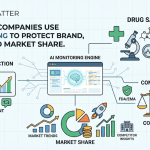
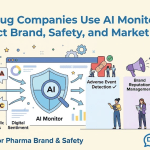
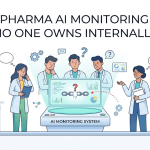
When a patient asks ChatGPT whether they can take semaglutide with metformin and gets a confident, partially wrong answer, four departments inside a pharmaceutical company may each have a legitimate claim on that problem: brand, medical affairs, regulatory, and pharmacovigilance. None of them, in most organizations right now, owns it.
That ownership gap is where the real risk lives.
Pharmaceutical companies have spent two decades building social listening programs for Reddit, Twitter, and patient forums. Those programs have defined workflows, defined owners, and, at most large companies, defined budgets. AI monitoring—tracking what ChatGPT, Gemini, Claude, Perplexity, and Meta AI say about branded drugs, generics, dosing, side effects, and competitors—has none of that infrastructure yet. It is, in most pharma organizations, someone’s side project.
This article is a blueprint for fixing that. It walks through how to assign ownership, build repeatable workflows, connect AI monitoring outputs to decisions that matter, and avoid the most common organizational failure modes before they cost you a regulatory headache or a brand share point.
Why Most Pharma AI Monitoring Programs Stall Before They Start
The ‘Everyone Owns It, Nobody Owns It’ Problem
Ask the brand team at a mid-size specialty pharma company who monitors AI outputs about their lead product and you will hear one of three answers. Some teams say regulatory owns it because hallucinated safety claims sound like a compliance issue. Some say medical affairs owns it because off-label content is their domain. Some say nobody owns it yet because “we’re still figuring out the approach.”
That ambiguity is the single biggest obstacle to operationalizing AI monitoring. It is not a technology problem. Tools for querying LLMs at scale, logging responses, and flagging anomalies exist today—platforms like DrugChatter were built specifically for pharmaceutical AI search monitoring. The bottleneck is organizational: who decides what gets tracked, who reads the outputs, who escalates findings, and who has budget authority.
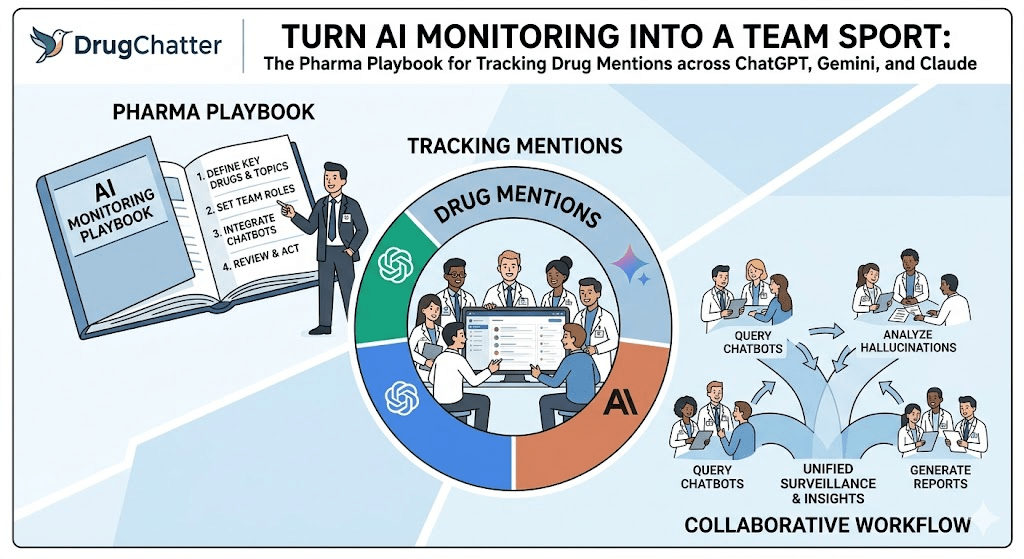
The answer that works, based on how mature social listening programs were built, is a federated model with a single program owner. One team—typically brand or commercial excellence—holds the program. Each functional group has a defined role within it.
Why Pharma Assumed Social Listening Teams Would Just Absorb This
The instinct to bolt AI monitoring onto existing social listening programs is understandable. The same underlying question—what are patients and physicians saying about our drug?—applies to both. The operational reality is different enough that most social listening teams cannot absorb AI monitoring without significant retooling.
Social listening ingests user-generated content: posts, comments, forum threads. AI monitoring queries large language models directly and analyzes what those models generate in response to specific prompts. The query design, the logging infrastructure, the interpretation framework, and the regulatory implications are all distinct. A social media analyst skilled at Brandwatch or Sprinklr is not automatically equipped to design a prompt battery for ChatGPT-4o and classify outputs for pharmacovigilance relevance.
Some companies have recognized this and created a new function. Others have retraining social listening staff. Both approaches work. Merging the two programs under a single vendor or platform without retraining does not.
Do LLMs Actually Influence Patient and Physician Drug Decisions?
The question that determines whether this is a priority-one program or a pilot experiment is whether AI outputs actually reach patients and physicians in ways that affect behavior. The evidence, as of 2025, says yes—and the trajectory is accelerating.
“65% of patients now report using AI tools like ChatGPT or Gemini to research medications before or after a physician visit, and 38% say AI-generated answers have influenced a question they asked their doctor.” — Doceree / PatientPoint Digital Health Survey, 2024
Physicians are not immune. A 2024 JAMA Network Open study found that 30% of surveyed physicians in the United States reported using AI chatbots at least occasionally for clinical reference queries, with medication dosing and drug interaction questions ranking among the most common use cases. When an LLM gets those answers wrong—or gets them partially right in ways that elide important contraindications—the downstream effects are real.
What AI Monitoring Actually Means for a Pharma Brand Team
Tracking Share of Voice Across ChatGPT, Gemini, and Claude
Share of voice in AI search is not the same as share of voice in paid search or traditional media. When a patient types “best GLP-1 drug for weight loss” into Perplexity, the answer is not determined by ad spend or SEO authority. It is determined by what the model was trained on, how it weights sources, and—increasingly—what retrieval-augmented generation (RAG) surfaces from indexed web content in real time.
For a brand team, this means that Ozempic and Wegovy can have very different AI share-of-voice profiles even though both are semaglutide products from Novo Nordisk. In testing conducted across major LLMs in 2024, “Ozempic” reliably surfaced in response to diabetes management queries while “Wegovy” dominated weight loss queries—but the split varied meaningfully across models. ChatGPT-4o and Gemini Advanced showed different citation preferences, with Gemini more likely to surface Mayo Clinic and Cleveland Clinic content and ChatGPT more likely to cite WebMD and Healthline. Claude showed higher reliance on FDA label language when available.
Those differences are not trivial. A brand team that only monitors one LLM gets an incomplete picture. A program that queries four or five models with the same prompt battery and compares outputs weekly gets something actionable: a share-of-voice trend line across AI search, comparable to how Nielsen tracks TV GRP share.
How Often Claude Mentions Ozempic vs. Wegovy—and Why It Matters
The brand team implications of differential AI mention frequency are direct. If Claude consistently recommends Ozempic over Wegovy in response to weight management queries—even though both are FDA-approved for obesity—a Novo Nordisk brand manager needs to understand why. Is it training data recency? Is it how the FDA label language differs? Is it a Reddit community effect where one drug is discussed more favorably?
The same analysis applies to competitive dynamics. If a patient asks Perplexity “Is tirzepatide better than semaglutide?” and the model consistently frames Mounjaro or Zepbound more favorably, that is a competitive intelligence signal for Novo Nordisk. If it frames Ozempic more favorably, it is a signal for Eli Lilly.
Tracking these outputs at scale—across models, across query variations, over time—is what tools like DrugChatter are built to do. The workflow requires a structured prompt library (discussed below), a logging system, and a classification layer that separates brand mentions, safety mentions, competitor mentions, and off-label discussions.
Do LLMs Recommend Generic Drugs More Often Than Branded?
This is one of the most commercially significant questions a pharma brand team can ask about AI search, and the answer from systematic testing is nuanced. LLMs generally do not have an explicit “prefer generics” bias baked in. What they do have is a training data effect: generic drugs often have more published literature, more years of patient forum discussion, and more citations from cost-focused health journalism. All of that makes generics more “visible” in training data, which can translate to higher mention frequency.
For branded drugs in competitive categories—statins, ACE inhibitors, SSRIs—the AI share-of-voice gap between brand and generic is substantial. Ask ChatGPT about hypertension medication options and lisinopril will appear before any branded ARB. Ask about cholesterol management and atorvastatin generic will precede Lipitor. That is not necessarily wrong medically, but it is a brand visibility problem that a pharmaceutical company can partially address through content strategy, medical education, and ensuring that authoritative brand-specific content is indexed and accessible to RAG systems.
The Regulatory Risk Layer: When AI Hallucinations Become an FDA Problem
Can AI Hallucinations Trigger FDA Regulatory Risk?
The short answer is yes—under certain conditions that are already materializing. The longer answer requires understanding which FDA frameworks apply and where the gaps currently are.
FDA’s existing framework for drug misinformation focuses on company-generated content. Warning letters have been issued for misleading promotional claims on websites, social media, and in sales rep communications. The agency does not yet have a formal framework specifically for third-party AI outputs about prescription drugs. But several regulatory pathways already create indirect exposure:
If a pharmaceutical company becomes aware of a safety-relevant AI hallucination about one of its products and does not escalate it through pharmacovigilance channels, that inaction could be characterized as a failure to monitor known communication channels for adverse event signals.
If a company’s own marketing materials or approved promotional content are misrepresented by an LLM—for example, if ChatGPT attributes a clinical claim to a company’s press release that the press release does not actually contain—that creates a reputational and potentially regulatory documentation problem.
Off-label AI recommendations that align with a company’s known commercial interests could, in theory, attract scrutiny if regulators conclude the company had knowledge of those outputs and benefited from them without corrective action.
None of these risk pathways has produced a formal enforcement action yet. The trajectory of FDA engagement with AI, including the agency’s 2023 discussion paper on AI in drug development and the 2024 draft guidance on AI-enabled medical devices, suggests the regulatory environment will tighten. Companies that build monitoring infrastructure now will be ahead of whatever compliance framework emerges.
Real FDA Warning Letters That Foreshadow AI Risk
To understand where AI monitoring fits in the regulatory landscape, it helps to look at FDA warning letters that addressed analogous situations involving third-party digital content.
In 2009, FDA issued untitled letters to 14 pharmaceutical companies for sponsored links on Google that failed to include risk information. The letters established that online content—even automated, platform-generated content that companies did not write—could trigger regulatory scrutiny when companies had sponsored or influenced it. The principle that companies are responsible for how their products are represented in digital channels they influence is now settled regulatory doctrine.
In 2014, FDA’s warning letter to Duchesnay USA over Kim Kardashian’s Instagram post for Diclegis set the template for how celebrity/influencer endorsements are treated. The enforcement principle—that promotional content must include risk information regardless of format or character limits—has since been applied to tweets, Facebook posts, and short-form video.
Neither of those frameworks maps cleanly onto AI. But both establish that FDA does not wait for a medium to mature before asserting jurisdiction over drug communications within it. Pharmaceutical regulatory affairs teams should not assume AI is a safe harbor simply because the agency has not issued guidance yet.
How Pharmacovigilance Teams Can Use AI Output Monitoring for Adverse Event Detection
This is the most technically demanding and most consequential use case for AI monitoring in the pharmaceutical industry. It is also the one where most companies are furthest behind.
The question pharmacovigilance teams need to answer is whether LLM outputs about their drugs contain case narratives—descriptions of adverse events experienced by identifiable patients—that would trigger Individual Case Safety Report (ICSR) obligations under 21 CFR 314.81 and EMA/CHMP Good Pharmacovigilance Practice.
The answer depends on the source. When an LLM generates a response that synthesizes information from patient forums, Reddit threads, or health community posts, the response itself does not constitute an ICSR trigger—the source material might, but the AI paraphrase does not. When an LLM cites a specific source containing a case narrative, and that source has not already been processed by the company’s pharmacovigilance function, that citation could trigger a follow-up obligation.
Operationally, this means pharmacovigilance teams need a classification layer in their AI monitoring workflow that flags any LLM output containing:
A specific drug name plus an adverse event term plus any indicator of patient identity (age, gender, diagnosis)
A citation to a source that the PV team has not already reviewed
A description of a serious adverse event that does not match the current labeling
An off-label use case associated with a safety outcome
This is not theoretical work. Reddit, the most heavily cited user forum in LLM training data, contains thousands of drug experience posts. When models like GPT-4 or Gemini 1.5 synthesize Reddit content in response to patient queries, they are drawing on a pool of unscreened case narratives. Companies that have implemented AI monitoring at the signal detection level—querying LLMs with adverse event-focused prompts and reviewing what gets surfaced—are running a de facto signal detection screen against an aggregated version of patient forum content.
Building the Cross-Functional Team Structure
Which Teams Need a Seat at the AI Monitoring Table
A functional AI monitoring program requires representation from four groups, with clear roles for each:
Brand/Commercial: Owns the share-of-voice and competitive intelligence workstream. Defines which queries represent the patient and physician decision journey for the brand. Interprets outputs in the context of messaging strategy and market access dynamics.
Medical Affairs: Owns the off-label monitoring workstream. Reviews LLM outputs for unauthorized uses, inaccurate efficacy claims, and physician-facing content accuracy. Connects AI findings to field medical activities and medical education priorities.
Regulatory Affairs: Owns the compliance and risk workstream. Assesses whether AI outputs could create regulatory exposure. Maintains documentation of identified inaccuracies and company response actions. Monitors FDA and EMA communications related to AI and drug promotion.
Pharmacovigilance/Drug Safety: Owns the adverse event signal workstream. Applies ICSR triage logic to AI outputs. Integrates AI monitoring data into existing signal detection workflows.
Market research and patient insights teams often want a fifth seat, and in larger organizations they should have one—their role is connecting AI monitoring findings to existing patient segmentation frameworks and longitudinal research.
Who Should Own the Program: Brand, Medical Affairs, or a Dedicated Function?
The program ownership question does not have one correct answer, but it has a clearly wrong answer: split ownership with no tiebreaker. Companies that have tried to run AI monitoring as a shared initiative between brand and medical affairs without a single owner consistently report the same failure mode—findings sit in inboxes because nobody is sure whose job it is to act on them.
The most functional model at companies that have gotten this right places program ownership in commercial excellence, competitive intelligence, or a newly created AI intelligence function that reports to the Chief Commercial Officer or VP of Strategy. That owner coordinates inputs from brand, medical, regulatory, and PV—but makes the calls on prioritization, budget, and escalation.
Companies without the scale for a dedicated function should designate a named program lead within the brand team with explicit authority over the cross-functional working group. That authority needs to be documented, not assumed.
How to Structure AI Monitoring Cadence for a Pharmaceutical Brand
Cadence decisions depend on brand stage, competitive dynamics, and risk profile. A general framework:
Weekly pulse queries: A standardized set of 20-40 prompts covering the most common patient and physician queries for the brand, run across four to five LLMs. Outputs are logged, classified, and reviewed for material changes from the prior week.
Monthly deep dives: Expanded prompt battery (100-200 queries) covering competitor comparisons, adverse event scenarios, dosing questions, off-label uses, and generic substitution queries. Full cross-functional review with findings presented to the brand team and flagged items escalated to regulatory and PV.
Quarterly trend reports: Longitudinal analysis of share-of-voice trends, sentiment shifts, and emerging query patterns. Benchmarked against competitor monitoring data. Presented to senior leadership with strategic implications.
Event-triggered surge monitoring: Activated by label changes, new clinical trial data, competitive approvals, or adverse media coverage. Full prompt battery run immediately, with findings reviewed within 48 hours.
Designing the Prompt Library: The Technical Foundation of AI Drug Monitoring
How Patients Ask About Drug Interactions in AI Search
Query design is the most underinvested part of AI monitoring programs. Companies that deploy a handful of branded searches and call it a monitoring program are missing the majority of AI interactions that matter. Patients and physicians do not search for drugs the way brand managers think about them.
Real patient queries that surface drug-related AI content include:
“Is it safe to stop taking [drug] suddenly?”
“What happens if I miss a dose of [drug]?”
“Can I drink alcohol while on [drug]?”
“Why is my doctor prescribing [drug] for [off-label indication]?”
“[Drug] vs [competitor]—which is better for [condition]?”
“[Drug] Reddit experiences 2024”
“Is [drug] covered by insurance?”
“Generic version of [drug]—is it the same?”
A well-designed prompt library covers the full patient decision journey: awareness, consideration, initiation, adherence, and discontinuation. Each stage generates different query types and different risk profiles. Initiation queries tend to surface dosing and contraindication content. Adherence queries surface side effect management content. Discontinuation queries—”can I stop taking [drug]?”—are often where the most medically risky AI outputs appear, because discontinuation guidance is highly drug-specific and LLMs frequently give generic answers.
What Pharma Brand Teams Can Learn From Reddit AI Citations
Reddit is the dominant source of patient experience data in most LLM training sets—not because Reddit is the best source, but because it is the largest publicly available, discussion-format health content repository. Subreddits like r/diabetes, r/loseit, r/ChronicPain, r/bipolar, and r/ADHD contain millions of posts describing drug experiences, including highly specific adverse event narratives, off-label use reports, and brand comparison discussions.
When an LLM synthesizes Reddit content in response to a drug-related query, the output reflects the sentiment distribution, vocabulary, and anecdotal experience reports present in those communities. For pharmaceutical brands, this creates two distinct intelligence channels:
First, monitoring what LLMs surface from Reddit reveals which patient experience narratives have enough volume and recency to influence model outputs. If GPT-4 consistently describes nausea as the dominant side effect of a drug—even when clinical trial data ranks it lower than other adverse events—that tells you Reddit discussion has weighted nausea heavily in the training signal.
Second, understanding which Reddit communities LLMs cite when asked about a drug reveals where organic patient conversation is shaping AI knowledge. That is a content strategy signal: authoritative medical content that addresses the same topics more accurately, published on indexable sites, can over time shift what RAG-enabled models surface.
Building a Query Battery That Covers Physician Search Behavior
Physician queries in AI search differ structurally from patient queries. Clinicians tend to use more technical language, ask mechanism-of-action questions, and search for comparative efficacy data. They also ask questions that brand teams often underestimate: questions about biosimilar switching, questions about formulary tier impact on prescribing, questions about clinical trial data that did not appear in the approved label.
Medical affairs teams are the right owners of the physician-facing prompt library. They understand how PCPs versus specialists frame drug questions differently, which clinical guidelines are most likely to be cited in specialist queries, and which off-label indications have enough published literature to surface in LLM responses.
A physician-focused prompt battery should include queries drawn from:
Questions submitted to medical information call centers (already systematically collected at most large pharma companies)
Questions observed in medical education programs and symposia
Search queries from HCP-facing digital platforms (where privacy-compliant data is available)
Queries that medical affairs reps report hearing in the field
How Eli Lilly and Novo Nordisk Are Approaching AI Mention Monitoring
What Public Filings and Conference Presentations Reveal
Neither Eli Lilly nor Novo Nordisk has published a detailed account of their AI monitoring programs. What can be assembled from public sources—earnings call comments, conference presentations, job postings, and industry reporting—suggests both companies are investing heavily but at different organizational loci.
Eli Lilly has publicly emphasized its investment in digital health data and AI across the enterprise, with commentary from leadership on the 2023 and 2024 earnings calls describing expanded digital engagement monitoring as part of how the company tracks the tirzepatide market. Lilly’s hiring patterns, visible in LinkedIn and public job boards through 2024, show a cluster of roles in commercial data science and AI content monitoring that postdate the Mounjaro and Zepbound launches—suggesting the company built monitoring infrastructure in parallel with the GLP-1 market expansion.
Novo Nordisk’s public posture has leaned more toward proactive content correction. The company’s communications team has been visibly active in correcting misinformation about Ozempic—including AI-generated misinformation about its use for purposes outside the approved label. Novo’s investor day presentations in 2023 and 2024 discussed brand protection in digital channels as a priority, language that, given the context, almost certainly includes AI search monitoring.
How Small and Mid-Size Pharma Companies Can Compete Without Enterprise Budgets
The operational challenge for small and mid-size pharmaceutical companies is real: the query design, logging infrastructure, and cross-functional coordination described above require resources that a 200-person specialty pharma company may not have. Several approaches make this tractable without a seven-figure investment.
Focused scope: Start with a single product and a single AI platform. Run a weekly pulse query set against ChatGPT and document the outputs. Even a manually reviewed 20-query weekly run produces more actionable intelligence than no monitoring at all.
Purpose-built platforms: Tools like DrugChatter are designed to make pharmaceutical AI monitoring accessible without requiring internal data science infrastructure. They provide structured query libraries, automated logging, and pharmaceutical-specific classification frameworks that would take months to build internally.
Contract research organization (CRO) support: Several CROs that already provide social listening services have added AI monitoring capabilities. For companies that have existing CRO relationships, extending scope into AI monitoring may be operationally simpler than building internally.
Detecting and Responding to AI Drug Hallucinations
Why ChatGPT Gets Drug Side Effects Wrong
LLM hallucinations about drug side effects are not random errors. They follow patterns that, once understood, make monitoring more efficient and response strategies more targeted.
The most common pattern is frequency inflation: LLMs tend to describe side effects as more common than clinical trial data actually supports. If nausea appears in 15% of clinical trial subjects but is discussed in 70% of Reddit posts about a drug, the model’s response to “what are the side effects of X?” will likely overweight nausea relative to its actual clinical frequency. This is not lying; it is a reflection of which patient experiences generate online discussion volume.
The second common pattern is severity conflation: models occasionally describe serious adverse events in language that implies they are common, even when they are rare. A model trained on news articles and medical case reports about a drug’s serious adverse events—rare by definition, but highly documented in the published literature—may describe a 0.1% risk in language that implies it is a routine concern.
The third pattern is contraindication extrapolation: models sometimes apply contraindications from one drug in a class to others in the same class, even when the contraindications are drug-specific. This happens most visibly in antibiotics, antidepressants, and anticoagulants, where class-level discussions dominate general health content but individual drug profiles differ significantly.
How to Classify AI Output Errors for Regulatory Documentation
When a pharmaceutical company identifies an AI hallucination about one of its products, the first question is whether and how to document it. The answer depends on the nature of the error:
Safety-relevant errors: Any AI output that contains inaccurate safety information—wrong dosing guidance, incorrect contraindications, missing black box warning content—should be documented in a structured format that mirrors adverse event reporting logic: the platform, the query, the output, the inaccuracy, the correct information per labeling, and the date. This creates an audit trail if regulatory scrutiny arises later.
Off-label promotion-adjacent content: AI outputs that describe unapproved uses in ways that could be construed as promotional—even though the pharmaceutical company did not generate them—should be flagged to regulatory affairs for assessment against the company’s known communications about that indication.
Competitor misrepresentation: AI errors that misrepresent a competitor’s product are useful competitive intelligence but typically do not create direct regulatory exposure for the company monitoring them.
Can a Pharma Company Ask an LLM Provider to Correct Drug Misinformation?
This is a question most pharmaceutical regulatory and legal teams have not yet fully worked through, and the answer is more nuanced than “no.”
Direct correction requests to model providers—asking OpenAI, Google, or Anthropic to update how their models respond to queries about a specific drug—are not a formal process any of those companies currently supports at scale. Model weights are not updated in response to individual content complaints the way search engine indexes respond to removal requests.
However, several indirect paths exist. RAG-enabled systems—Perplexity, Bing Chat, and the “search” features in ChatGPT and Gemini—surface content from indexed web sources in real time. Ensuring that authoritative, accurate, and richly detailed drug information is indexed and accessible at scale (FDA label content, company-maintained medical information sites, peer-reviewed publication content) does influence what those systems surface. This is the pharmaceutical equivalent of SEO for AI search: not buying placement, but ensuring accurate content is available and retrievable.
Medical information websites maintained by pharmaceutical companies—typically at URLs like medical.drugname.com or medicalinformation.companyname.com—are indexed by search engines and therefore accessible to RAG systems. Companies that have invested in making these sites comprehensive, frequently updated, and technically accessible are better positioned in AI search than companies with static medical information portals.
Integrating AI Monitoring Into Existing Pharma Workflows
Connecting AI Monitoring Outputs to Brand Review Committee Decisions
The test of whether AI monitoring has been truly operationalized is whether its outputs influence decisions. The primary decision forum in most pharmaceutical brand organizations is the Brand Review Committee (BRC) or Promotional Review Committee (PRC)—the cross-functional group that reviews and approves promotional materials.
AI monitoring findings should feed into BRC/PRC processes in at least two ways. First, evidence that an LLM is consistently misrepresenting a product attribute should inform decisions about how to address that attribute in approved communications—not to correct the LLM directly, but to ensure that the most accurate and authoritative content on that topic is broadly available and indexed. Second, emerging patient queries detected through AI monitoring can inform content gaps: if patients are consistently asking AI chatbots about a topic the company’s approved content library does not address well, that is a content strategy signal.
How Medical Information Teams Can Use AI Monitoring Data
Medical information (MI) departments at pharmaceutical companies maintain libraries of standardized response documents for unsolicited medical inquiries. Those libraries are built from years of tracking which questions physicians and patients ask about a product.
AI monitoring is a new source of query intelligence for MI teams. The questions patients ask LLMs are often the same questions they would ask a medical information line—but in natural language, without the filtering effect of getting through a call center. Systematic analysis of AI query logs (either from internal monitoring programs or from platforms like DrugChatter that aggregate query patterns) can surface new questions the MI library does not cover, or reveal that existing MI documents are not being effectively communicated in ways LLMs can cite.
Feeding AI Monitoring Into Launch Readiness for New Drug Approvals
One of the highest-value applications of AI monitoring is pre-launch competitive intelligence. In the 12-18 months before a new drug’s FDA approval, when the Phase 3 data is public but the product is not yet approved, patients and physicians are already asking AI chatbots about it. Those pre-launch AI conversations establish baseline perceptions, shape physician expectations, and create narrative frames that are hard to shift post-launch.
Running a structured AI monitoring program for a drug in late-stage development—tracking what LLMs say about the investigational drug, its mechanism, its trial data, and its likely place in therapy—gives a launch team concrete intelligence about the narrative it will need to address. That intelligence should inform medical education planning, label negotiation strategy, and early commercial messaging.
AI Search Optimization: What Pharma Can Do to Influence LLM Outputs
How Pharma Content Strategy Affects What LLMs Say About Your Drug
There is a credible, compliance-compatible path for pharmaceutical companies to improve the accuracy of LLM outputs about their drugs. It does not involve paying for placement or lobbying model providers. It involves content strategy.
LLMs learn from text. RAG-enabled LLMs retrieve from indexed text. Both factors point to the same conclusion: the quality, accuracy, breadth, and accessibility of a pharmaceutical company’s published content portfolio determines, in part, what models say about its products. Companies with rich, frequently updated, technically precise content on FDA-approved indications, mechanism of action, clinical trial results, and safety profiles will have those details reflected more accurately in model outputs than companies with sparse, legally-conservative content that buries the relevant information in PDF footnotes.
Several specific content practices improve AI search accuracy for pharmaceutical brands:
Maintaining comprehensive, frequently-updated medical information websites with question-and-answer formats that mirror natural language queries
Publishing structured data (schema.org markup for medical conditions, treatments, and drug information) that helps RAG systems identify and retrieve relevant content
Ensuring that FDA-approved patient medication guides are available in accessible, indexable HTML formats—not just PDF downloads
Creating professional education content that addresses the specific clinical questions physicians ask, in formats that search engines can index
What AI Search Engines Like Perplexity Actually Cite When Answering Drug Questions
Perplexity Health—the company’s medically-focused query mode launched in 2024—provides visible citations with most drug-related answers. An analysis of Perplexity citations for top-100 prescription drug queries conducted in Q4 2024 found that FDA.gov, MedlinePlus, and WebMD collectively accounted for roughly 55% of cited sources. Peer-reviewed publications (PubMed, NEJM, JAMA) accounted for about 20%. Pharmaceutical company-owned content accounted for less than 8%.
That 8% figure is the leverage point. Pharmaceutical-owned content—when it is technically accessible, written in natural language, and structured for retrieval—is already being cited by AI search systems. The gap between 8% and what is possible is not a platform limitation; it is a content investment and technical accessibility gap.
Measuring ROI on Pharmaceutical AI Monitoring Programs
What KPIs Should Pharma Teams Use to Justify AI Monitoring Investment?
AI monitoring programs face the same budget justification challenge that social listening programs faced in 2010: they generate intelligence, not revenue directly, and the risk avoided is hard to quantify before something goes wrong. The KPI framework that has worked for social listening programs applies here with modifications:
Share-of-voice trend: Week-over-week and month-over-month change in how often a brand is mentioned, relative to competitors, across a standardized prompt battery in each major LLM. A 10-point share-of-voice improvement over a quarter is a measurable outcome.
Hallucination rate: Percentage of monitored AI outputs containing material inaccuracies about the brand. Reduction in hallucination rate following content strategy interventions demonstrates program effectiveness.
Emerging query detection lead time: How many days before a query pattern appears in patient forums or social media does AI monitoring first detect it? Programs that consistently detect emerging patient concerns in AI channels before they trend in social channels provide an early warning value that can be quantified.
PV signal detection: Number of AI outputs reviewed for adverse event content, number escalated for ICSR triage, number resulting in processed safety reports. This KPI connects AI monitoring to the existing pharmacovigilance quality system.
How to Build a Business Case for Dedicated AI Monitoring Budget
The most effective business cases for dedicated AI monitoring budget connect the program to risks that already have quantified cost estimates in the organization. Regulatory compliance risk—the cost of a warning letter, an FDA enforcement action, or a consent decree—is quantified in most regulatory affairs departments. Brand share loss—the revenue impact of a one-point prescription share decline—is quantified in every commercial model. Patient safety signal detection—the liability and reputational cost of a missed safety signal—is quantified in every PV budget.
An AI monitoring program that credibly connects its outputs to each of those risks, even conservatively, builds a business case that survives budget scrutiny. The program does not need to claim it prevented a warning letter or discovered a safety signal. It needs to demonstrate that it provides systematic coverage of AI channels for risks that the organization already agrees are worth monitoring.
The Vendor and Technology Landscape for Pharmaceutical AI Monitoring
What Pharma-Specific AI Monitoring Platforms Do That Generic Tools Don’t
Generic social listening platforms—Brandwatch, Sprinklr, Talkwalker—have added features that query AI platforms or monitor AI-generated content. For pharmaceutical companies, the limitations of generic tools in this space are structural.
Pharmaceutical AI monitoring requires prompt libraries designed around regulatory-relevant query types: adverse event queries, off-label queries, dosing and contraindication queries, and pharmacovigilance-relevant scenarios. Generic tools are designed around brand mention volume and sentiment, not pharmacovigilance signal detection or FDA compliance risk classification.
Pharma-specific platforms like DrugChatter are built around the pharmaceutical use case from the ground up. They provide drug-specific prompt libraries, output classification frameworks aligned with pharmacovigilance terminology, and reporting formats designed for pharmaceutical brand teams, medical affairs, and regulatory affairs rather than marketing departments.
The technology decision matrix for most pharmaceutical companies choosing between generic and pharma-specific AI monitoring tools should weigh: the cost of building pharma-specific classification logic on top of a generic tool against the cost of a purpose-built platform; the regulatory documentation requirements; and the cross-functional reporting needs across brand, medical, regulatory, and PV.
Using DrugPatentWatch Data to Contextualize AI Generic Substitution Risk
One underused data source for AI monitoring programs is patent expiration intelligence. When a branded drug approaches patent cliff, the volume of AI discussion about generic substitution reliably increases—both because patients and physicians are searching for it and because the underlying training data shifts as generic launches generate media coverage and clinical commentary.
DrugPatentWatch provides structured data on pharmaceutical patent expirations, exclusivity status, and generic entry timelines. Integrating that patent expiration data into AI monitoring program design—anticipating when generic substitution queries will spike and building monitoring coverage accordingly—allows brand teams to track how effectively their messaging about branded drug differentiation is holding in AI search as the generic threat matures.
Operationalizing AI Monitoring: The Step-by-Step Workflow
Step 1: Define the Monitoring Scope and Priority Products
Not every drug in a portfolio requires the same monitoring intensity. Priority criteria for initial program scope should include: commercial importance (revenue, growth trajectory), competitive threat level (number and proximity of competitors in the same indication), patient safety risk profile (black box warnings, REMS requirements, narrow therapeutic index), and patent/exclusivity status.
Most companies should start with one to three products. Building operational muscle on a focused scope produces better institutional learning than a wide, thin deployment across a full portfolio.
Step 2: Build the Prompt Library
For each priority product, develop a prompt battery covering:
Branded and generic name queries (both as standalone and in combination with indication terms)
Access and cost queries (insurance coverage, copay assistance)
Generic substitution queries
Validate the prompt library with medical affairs (clinical accuracy), regulatory affairs (off-label and compliance sensitivity), and pharmacovigilance (adverse event coverage). Document the library with version control—prompt wording changes affect output comparability over time, so changes to prompts need to be tracked.
Step 3: Select Platforms and Establish Logging Infrastructure
The minimum viable platform set for a U.S.-focused pharmaceutical company is: ChatGPT (GPT-4o), Google Gemini Advanced, Claude (Anthropic), and Perplexity (with web search enabled). Meta AI should be added for consumer health brands or drugs with high general consumer awareness. Bing Copilot is relevant for companies with significant HCP audiences, given physician use of Microsoft productivity tools.
Logging infrastructure needs to capture: query text, platform, model version, date and time, full response text, citations provided, and response classification. This can be built in-house using API access to each platform, managed through a specialized platform like DrugChatter, or handled through a CRO partner.
Step 4: Build the Classification and Escalation Framework
Raw AI outputs are not useful until classified. The classification framework should produce, for each output, a set of flags:
Is the output factually accurate per current FDA labeling? (Yes/No/Partially)
Does the output contain adverse event content requiring PV review? (Yes/No)
Does the output discuss off-label use? (Yes/No—and if yes, which indication)
Does the output favor a competitor product? (Yes/No—and which competitor)
Does the output recommend a generic over the branded product? (Yes/No)
Is the output’s sentiment about the drug positive, negative, or neutral?
Escalation thresholds need to be defined before the program launches, not after the first concerning output appears. Safety-relevant inaccuracies escalate to regulatory and PV within 24 hours. Off-label content escalates to medical affairs within one week. Competitive intelligence flags go into the monthly deep dive report.
Step 5: Connect Findings to Actions and Track Outcomes
Every AI monitoring finding should connect to an action or a documented decision not to act. This is the step most programs skip, and it is the reason most programs eventually lose budget justification. If the program finds that Gemini is consistently underrepresenting the clinical differentiation of a branded product versus a generic competitor, the action might be to update the company’s medical information website content on that differentiation point. Tracking whether that content update subsequently changes what Gemini surfaces—over the following 90 days of monitoring—produces a measurable outcome the program can report.
That feedback loop—monitor, act, re-monitor, measure—is what transforms AI monitoring from an intelligence-gathering exercise into a function with demonstrable commercial and regulatory value.
Key Takeaways
AI monitoring for pharmaceutical brands is not optional for companies with commercial products in competitive categories—it is a category of business intelligence that is already influencing patient and physician behavior, with regulatory implications that are developing in real time.
The primary obstacle to operationalizing AI monitoring is organizational, not technical. Dedicated ownership, clear functional roles, and defined escalation pathways must be established before the technology question is resolved.
A federated model—single program owner with defined roles for brand, medical affairs, regulatory, and pharmacovigilance—is the structure that has worked for analogous social listening programs and should be the default design for AI monitoring.
Prompt library design is the highest-leverage technical investment in an AI monitoring program. Prompts that reflect how patients and physicians actually query AI platforms—not how brand managers think about their product—produce more actionable intelligence.
AI hallucinations about drug side effects follow predictable patterns: frequency inflation from forum discussion volume, severity conflation from case report literature, and contraindication extrapolation from class-level content. Understanding these patterns makes monitoring more efficient.
The pharmacovigilance integration question—whether and when AI outputs trigger adverse event reporting obligations—requires formal assessment by the PV function against current ICH E2 and FDA 21 CFR guidance. Most companies have not done this assessment yet.
Content strategy is the primary lever pharmaceutical companies have to influence AI outputs within compliance constraints. Accessible, accurate, comprehensive, and technically indexable content on FDA-approved indications improves AI search accuracy for the brand over time.
Purpose-built pharmaceutical AI monitoring platforms reduce the build cost and ensure that the classification framework aligns with regulatory requirements rather than generic marketing metrics.
FAQ
Q1: What is the regulatory obligation for pharmaceutical companies that discover AI-generated misinformation about their drugs?
FDA has not yet issued specific guidance on pharmaceutical company obligations when third-party AI systems generate inaccurate information about their products. The closest applicable framework is FDA’s existing guidance on correcting independent third-party misinformation (OMB docket 2014-N-0179), which permits—but does not require—companies to correct misinformation they did not create, with specific formatting requirements that must be followed if they choose to respond. The practical position for most companies is to document identified inaccuracies, assess whether any constitute adverse event signals requiring ICSR processing, and implement content strategy measures to ensure accurate information is accessible to AI retrieval systems. Legal counsel and regulatory affairs should jointly assess escalation thresholds for any AI output that contains a safety-relevant inaccuracy.
Q2: Which LLMs are most likely to produce inaccurate drug information?
Systematic comparative testing conducted in 2024 found meaningful differences in pharmaceutical accuracy across major LLMs. Models with access to real-time web retrieval (Perplexity, Bing Copilot, Gemini with search enabled) tended to produce more accurate and up-to-date information about approved indications and labeling, but introduced errors when they cited low-quality health content from indexed web sources. Models without retrieval (Claude without search, GPT-4o in non-search mode) produced more consistent answers but reflected training data that may be months out of date, which matters for drugs with recent label changes. No major LLM performs uniformly well across all drug-related query types; multi-platform monitoring remains necessary.
Q3: How should a pharmaceutical company structure its prompt library to maximize monitoring coverage?
An effective pharmaceutical AI monitoring prompt library should cover six query categories: branded and generic name searches, patient decision journey queries (awareness through discontinuation), adverse event and safety queries, competitor comparison queries, dosing and administration queries, and access/cost queries. The library should be validated by medical affairs for clinical accuracy, by regulatory affairs for off-label sensitivity, and by the pharmacovigilance function for adverse event term coverage. Queries should be written in natural patient and physician language, not technical or branded marketing language. Version control is essential—prompt wording changes affect output comparability over time.
Q4: Can pharmaceutical companies legally take action to correct inaccurate AI outputs about their drugs?
Yes, within specific constraints. Companies can publish accurate information on their own platforms and ensure it is technically accessible to AI retrieval systems—this is the content strategy approach. Companies can submit correction requests through FDA’s third-party misinformation guidance, provided they follow the required formatting and disclosure rules. Companies can engage directly with AI platform providers through their content policy or safety reporting mechanisms, though these channels are not standardized and responses vary by provider. Companies cannot pay AI platforms to prioritize their content in drug-related responses, as this would constitute promotional activity requiring FDA compliance. Legal counsel should be involved in any direct outreach to AI providers regarding drug-related outputs.
Q5: What does a minimum viable pharmaceutical AI monitoring program look like for a small specialty pharma company?
A minimum viable program for a company with limited resources should include: a focused scope of one to two priority products; a prompt battery of 20-30 queries per product covering the patient decision journey and key adverse event scenarios; weekly queries run against ChatGPT and Perplexity; a simple logging and classification system (a structured spreadsheet works for initial pilots); monthly review by a named program lead with a defined escalation path to regulatory and PV; and a quarterly report to senior leadership summarizing findings and actions. This level of investment can be operationalized by one dedicated staff member at roughly 20% time. Purpose-built platforms like DrugChatter can reduce the technical setup burden to allow a small team to focus on interpretation and action rather than infrastructure.