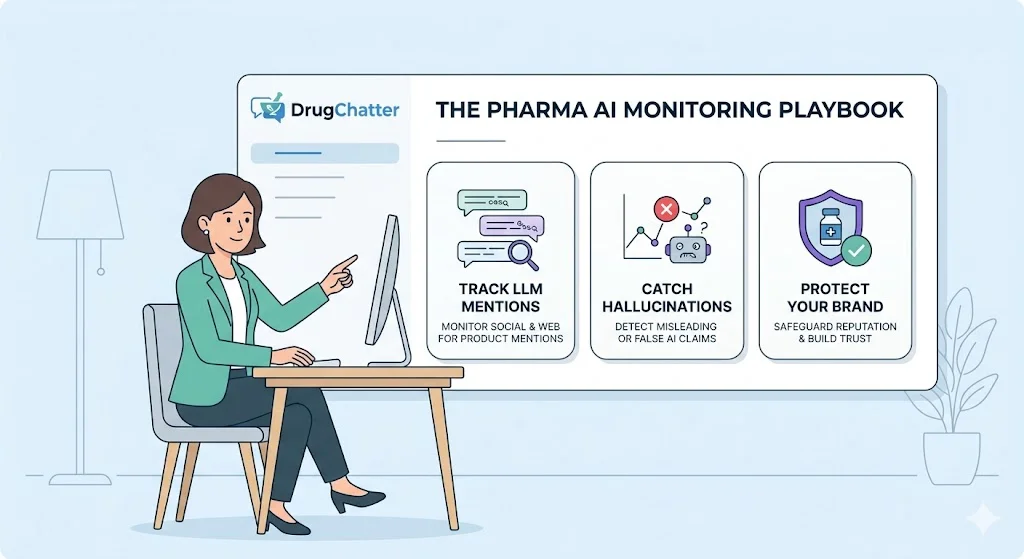
Most pharmaceutical companies still don’t know what ChatGPT says about their drugs. They don’t know whether Perplexity recommends their biologic over a competitor’s. They don’t know whether Claude describes their drug’s black-box warning accurately, or whether Google’s AI Overviews are sending patients to outdated prescribing information.
This isn’t a niche digital marketing problem. It’s a brand, safety, and compliance exposure that grows every month as more patients and physicians route their drug questions through AI search instead of Google.
This playbook is a step-by-step operational guide for pharmaceutical companies that want to build systematic AI monitoring capabilities — not a pilot, not a proof of concept, but a functional program that generates brand intelligence, flags safety risks, and positions the organization for the regulatory requirements coming down the pipeline.
The framework covers query architecture, platform selection, response classification, action routing, competitive benchmarking, and the organizational structure needed to make AI monitoring a durable capability rather than a one-time exercise.
Why Pharma Needs an AI Monitoring Program Right Now
What AI Search Is Replacing — and What That Costs Drug Brands
Pharmaceutical companies have spent decades optimizing for Google. They understand how to build authoritative health content, how to manage branded versus generic keyword competition, and how to ensure their FDA-approved information surfaces when patients search for their drugs.
That infrastructure doesn’t transfer to AI search. When a patient types a drug question into ChatGPT, the response isn’t a ranked list of pages the company can influence through SEO. It’s a synthesized answer generated from training data and, in systems with live retrieval, from whatever sources the model selects in real time.
The competitive implication is direct: a drug company that has spent years building search authority has no analogous advantage in AI search. Share of voice in AI responses is determined by clinical literature density, training data composition, retrieval source quality, and conversational query patterns — none of which respond to traditional brand investment in predictable ways.
Novo Nordisk’s Ozempic dominated DTC advertising from 2021 onward. But if Eli Lilly’s tirzepatide has accumulated more favorable clinical trial coverage, more physician commentary, and more patient forum discussion than semaglutide, AI systems trained on that data will lean toward Mounjaro in comparative responses — regardless of what the advertising spend ratio looks like.
The Three Risks Pharma Isn’t Measuring in AI Responses
Pharmaceutical companies that haven’t started AI monitoring are exposed across three distinct risk categories:
Brand risk: AI responses to indication-level queries (“what’s prescribed for moderate-to-severe plaque psoriasis?”) shape patient and physician awareness before any branded touchpoint. If your drug isn’t being mentioned — or is being mentioned less favorably than a competitor — you’re losing share of voice in a channel that’s growing faster than any other.
Safety risk: LLMs hallucinate. They state outdated contraindications, confuse dosing between similar drugs, omit black-box warnings added after their training cutoff, and synthesize adverse effect profiles that blend accurate and inaccurate information. A patient who acts on hallucinated drug information and experiences harm creates liability exposure and regulatory scrutiny that the manufacturer needs to be prepared for.
Compliance risk: The FDA’s pharmacovigilance regulations require manufacturers to monitor available data sources for safety signals. As AI-generated drug conversations become a measurable source of patient-reported adverse experiences, “available data sources” will expand to include AI monitoring. Companies without documented monitoring programs will have a harder time demonstrating due diligence when that standard evolves.
Step 1: Building Your AI Query Library — The Foundation of Any Monitoring Program
How to Construct Drug Queries That Actually Reflect How Patients Ask AI
The most common mistake in early pharma AI monitoring pilots is using keyword-style queries that reflect how teams think about their drug, not how patients actually ask about it. A query library built around phrases like “Keytruda efficacy metastatic NSCLC” will miss the vast majority of real patient interactions with AI, which look more like “I was just diagnosed with lung cancer and my oncologist mentioned an immunotherapy drug starting with K — what should I know?”
Conversational query construction requires a different research process. The best sources for authentic patient query language are:
- Patient forum posts on Reddit (r/cancer, r/diabetes, r/rheumatoid, r/MultipleSclerosis, and drug-specific subreddits) — these contain the exact language patients use when seeking information
- Existing patient advisory board transcripts and patient support line call recordings, which capture how patients verbalize drug concerns
- Google’s “People Also Ask” boxes for your drug’s name, which surface real patient query patterns in structured form
- Pharmacovigilance case narratives from FAERS — the language patients use to describe adverse events often mirrors the language they use to query AI about the same concerns
Build the query library in layers. Start with the queries that are highest-stakes, then expand to coverage queries.
Query Categories Every Pharma AI Monitoring Library Needs
A complete query library for a single drug should contain queries across at least eight distinct intent categories:
Safety and side effects. These are the highest-stakes queries and the most likely to contain hallucinated or outdated information. For each drug, build queries around every adverse event listed in the package insert — both common and serious. Include queries framed from the patient perspective (“what happens if I take too much [drug name]?”) and the caregiver perspective (“is [drug name] safe for elderly patients?”).
Dosing and administration. LLMs frequently confuse dosing protocols, especially for drugs with titration schedules, weight-based dosing, or indication-specific dose differences. Build queries for each approved dosage strength, each indication with distinct dosing, and queries about what happens if a dose is missed or doubled.
Drug interactions. Query against the most common co-prescribed agents for your indication and any interactions listed in the prescribing information. For complex drugs like anticoagulants, immunosuppressants, or HIV antiretrovirals, the interaction query list can be extensive.
Indication and mechanism. How accurately does the AI explain what your drug does, what it’s approved for, and how it works? These queries reveal whether the model has a fundamentally correct or incorrect mechanistic understanding of your drug.
Comparison and competitive queries. Queries that ask AI to compare your drug to competitors are where competitive intelligence value is highest. “Humira vs Skyrizi for psoriatic arthritis,” “Is Jardiance or Farxiga better for heart failure?” — these queries reveal how AI frames your competitive positioning.
Off-label use. For drugs with significant off-label use (Ozempic for weight loss in non-diabetic patients, gabapentin for anxiety, quetiapine for insomnia), build queries that capture how AI is describing and implicitly endorsing or warning against unapproved uses.
Cost and access. Patients increasingly ask AI about drug costs, insurance coverage, manufacturer copay programs, and generic availability. These queries reveal how AI is framing affordability — and whether it’s accurately describing your patient assistance programs.
Physician-facing clinical queries. Build a separate query layer written in clinical language — the queries a physician or pharmacist might ask. “What is the mechanism of action of belimumab in lupus nephritis?” or “Does apixaban require dose adjustment in moderate renal impairment?” These queries test whether AI clinical information quality meets the standard a prescriber needs.
How Many Queries Do You Need? Sizing the Library by Drug Profile
The size of the query library should scale with the drug’s complexity and commercial profile. A rough framework:
- Simple, single-indication, low-interaction drugs (many primary care generics): 50–100 queries
- Moderate-complexity branded drugs with 2–3 indications and known interaction profiles: 150–300 queries
- High-complexity drugs — oncology biologics, immunosuppressants, cardiovascular agents with narrow therapeutic windows: 400–700 queries
- Drugs with significant off-label use or active public controversy (GLP-1 agonists, ADHD stimulants, SSRIs): add 100–200 queries specifically for off-label and sentiment-related intents
For companies monitoring a full portfolio, purpose-built platforms like DrugChatter automate query execution across LLM platforms at scale — which is the only practical approach when the library exceeds a few hundred queries per drug.
Step 2: Platform Selection — Which AI Systems Actually Matter for Drug Monitoring
ChatGPT, Gemini, Claude, Perplexity — Ranked by Pharma Monitoring Priority
Not all AI platforms carry equal weight for pharmaceutical monitoring. The right prioritization depends on which systems your patients and physicians are actually using, how those systems handle medical content, and what’s technically feasible to monitor at scale.
For most pharmaceutical companies in 2025, the monitoring priority stack looks like this:
Priority 1: Google AI Overviews. Google’s AI-generated summaries appear at the top of search results for a large share of drug-related queries — and they reach users who have never consciously chosen to interact with an AI system. A patient searching “Eliquis and alcohol” on Google may get an AI Overview before they see a single traditional search result. This is the highest-reach AI drug information channel and the one most directly connected to organic search traffic that pharmaceutical companies already measure.
Priority 2: ChatGPT (GPT-4o with browsing). The largest dedicated AI user base, with live web retrieval that means responses can incorporate current FDA communications and recent clinical news. High patient volume, high influence on health decisions, and the platform most likely to be cited when AI drug misinformation surfaces in media coverage.
Priority 3: Perplexity AI. Lower overall volume than ChatGPT but disproportionately used by health-literate, research-oriented users — the patients and caregivers who are most likely to act on AI drug information and most likely to share it. Perplexity cites its sources, which makes it uniquely useful for understanding which sources are shaping AI responses about your drug.
Priority 4: Claude (Anthropic). Growing health and professional user base. Claude’s responses tend toward clinical caution and mechanistic explanation, making it particularly relevant for monitoring how AI frames drug safety and pharmacology questions. Claude’s response style also serves as a useful control against which to compare the more retrieval-heavy responses from ChatGPT and Perplexity.
Priority 5: Microsoft Copilot. Copilot’s integration into Microsoft 365 and its use in clinical workflow tools (notably its integration with Epic through Microsoft’s Health and Life Sciences vertical) makes it increasingly relevant for physician-facing drug information. Lower consumer volume but growing clinical relevance.
Does AI Platform Architecture Affect Drug Information Quality?
Yes, substantially. The architecture differences between platforms produce systematically different types of drug information errors — and pharmaceutical monitoring programs need to account for this.
Retrieval-augmented generation (RAG) systems — ChatGPT with browsing, Perplexity, Gemini with search — can incorporate current information but also inherit the inaccuracies of whatever sources they retrieve. A RAG system that retrieves a poorly-maintained drug monograph from a third-party health website will generate a response that inherits those errors and presents them with the model’s confident, authoritative tone.
Pure LLM responses without retrieval — Claude on most queries, older GPT-4 without browsing — reflect training data distributions. They’re susceptible to knowledge cutoff errors (missing safety communications added after training), but less susceptible to source-quality errors since they’re not pulling live content.
The implication for monitoring: you need different evaluation criteria for RAG-based versus pure LLM responses. For retrieval systems, audit the sources cited. For pure LLM systems, audit for training cutoff gaps and statistical confabulation patterns.
What About AI Voice Assistants and Multimodal Queries?
Voice-based drug queries — through Siri (now integrated with ChatGPT for Plus users), Google Assistant, and Amazon Alexa — represent a monitoring gap for most pharma companies. Voice query logs aren’t accessible through any systematic monitoring approach, and the responses generated for voice delivery are often shorter and less nuanced than text responses, increasing the risk that key safety caveats get dropped.
Multimodal queries — patients photographing pill bottles, uploading lab reports, or sending images of rashes to ask about medication reactions — are another growing category. These bypass text-based query monitoring entirely. The practical monitoring approach for voice and multimodal, at this stage, is to ensure that the underlying text-based responses are accurate, since voice and multimodal systems in most cases build on the same underlying models.
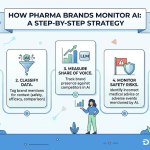
Step 3: Response Classification — Turning Raw AI Outputs Into Actionable Intelligence
How to Score AI Drug Responses for Accuracy, Completeness, and Brand Impact
Collecting AI responses is straightforward. Turning them into structured, actionable data requires a classification framework that can be applied consistently across platforms, queries, and time periods.
A five-dimension scoring framework covers the dimensions that matter most for pharmaceutical decision-making:
Dimension 1: Factual accuracy. Does the response accurately reflect the current FDA-approved label? Score on a three-point scale: Accurate (consistent with current prescribing information), Partially accurate (directionally correct with specific errors or omissions), or Inaccurate (contains factual errors that could mislead a patient or clinician). Inaccurate responses should be flagged immediately for action routing.
Dimension 2: Safety information completeness. Does the response include appropriate safety information — black-box warnings, contraindications, significant adverse events — in proportion to the query’s clinical stakes? A response to “is [drug] safe in pregnancy?” that omits a known teratogenicity risk is incomplete in a clinically meaningful way, even if it contains no outright errors.
Dimension 3: Brand mention quality. Is the brand name mentioned? Is it mentioned accurately, favorably, or in a context that misrepresents the drug’s indication or profile? Does the response default to the generic name when the branded name was queried?
Dimension 4: Competitive framing. In comparative queries, how is your drug positioned relative to competitors? Is it mentioned first or last? Is it described as more or less effective, safer or riskier, more or less convenient? These are the share-of-voice signals that brand teams need.
Dimension 5: Off-label and misinformation flags. Does the response mention off-label uses? Does it treat them as established or experimental? Does it contain any information that contradicts FDA-approved indications in ways that could constitute drug misinformation?
Building a Drug Response Taxonomy for Longitudinal Tracking
One-time AI response audits have limited value. The intelligence value compounds when you track the same query across the same platforms over time — because you can detect when AI responses change, what triggers those changes, and whether your information environment efforts are having any effect.
A longitudinal tracking taxonomy needs consistent identifiers for each query, each platform, each response date, and each score on each dimension. The database structure should allow you to answer questions like: Did our AI side-effect profile improve after we updated our Drugs.com monograph? Did competitive mention share shift after our Phase 3 data published? Did a safety communication update get reflected in AI responses within 30 days?
This kind of longitudinal intelligence is what separates a monitoring program from a one-time audit. Platforms like DrugChatter are built to collect, classify, and trend this data at the scale pharmaceutical portfolios require, without the manual overhead that makes DIY longitudinal tracking impractical beyond a handful of drugs.
What AI Responses Reveal About Patient Sentiment That Surveys Can’t
There’s a secondary intelligence layer in AI response monitoring that most programs underutilize: what the queries themselves — as a corpus — reveal about patient concerns, beliefs, and information needs.
When patients ask AI “does Ozempic cause thyroid cancer” in large numbers, that query pattern reveals a patient anxiety that is distinct from what clinical trial adverse event tables show. It’s a concern shaped by the drug’s black-box warning (which mentions thyroid C-cell tumors in rodent studies), amplified by media coverage, and being researched at high volume. The drug company doesn’t need to see individual patient records to understand that this concern is active in the patient population and shaping how people approach their prescribers.
Query pattern analysis — what are patients most commonly asking AI about this drug? — is a form of voice-of-the-customer research with no historical precedent. Unlike surveys, which measure what patients say when asked, AI query patterns reflect what patients actually want to know when they have complete privacy and no social desirability effects.
Step 4: Action Routing — What to Do With What You Find
When AI Drug Misinformation Requires Immediate Response
Not all AI inaccuracies require the same response urgency. A classification framework for action routing should triage findings into four response tiers:
Tier 1 — Immediate escalation: AI responses that contain safety misinformation with direct patient harm potential. Examples: incorrect dosing information for a narrow therapeutic index drug, omission of a black-box warning in response to a safety-specific query, contraindication errors that could lead to adverse drug interactions. These findings go immediately to medical affairs, pharmacovigilance, and regulatory affairs — not brand marketing.
Tier 2 — Scheduled correction effort: AI responses that are inaccurate but not immediately dangerous — outdated indication information, incorrect mechanism descriptions, minor brand name errors. These require a correction strategy targeting the information sources the AI is drawing on, executed on a defined timeline.
Tier 3 — Competitive intelligence routing: Share-of-voice data, competitive framing findings, and off-label mention patterns. These go to brand and commercial teams for integration into strategy and messaging reviews.
Tier 4 — Trend monitoring: Patterns in query volume and sentiment that don’t require immediate action but should inform patient communications, medical affairs planning, and future label or indication strategy. These feed into quarterly intelligence reports for senior medical and commercial leadership.
How to Correct Inaccurate AI Drug Information Legally and Effectively
Pharmaceutical companies can’t contact OpenAI or Anthropic to request a correction when their drug is misrepresented in an AI response. The information environment intervention works upstream, through the sources AI systems retrieve and train on.
The correction playbook has four tracks:
Track 1 — Authoritative source auditing. Audit the primary sources AI systems draw on for your drug: FDA.gov drug pages, Drugs.com, Medscape, RxList, MedlinePlus, and Wikipedia. Identify specific inaccuracies in each source. Engage each platform through its standard content correction process — Wikipedia through editorial talk pages, Drugs.com and Medscape through their clinical editorial teams, FDA pages through the agency’s label update process. This is slow but foundational.
Track 2 — Medical affairs content publishing. Publish high-quality, structured, authoritative medical content on your brand’s owned domains and through medical publication channels. This content — clinical summaries, mechanism of action explanations, patient FAQ documents — feeds into the corpus that retrieval systems draw on. The more authoritative content that accurately represents your drug exists in the web’s information layer, the better your baseline AI response quality will be.
Track 3 — Clinical literature acceleration. For drugs where AI responses are being shaped by a thin or outdated clinical literature base, accelerating publication of real-world evidence, post-marketing studies, and systematic reviews is a legitimate long-term information environment strategy. This is slow (publication timelines are what they are) but creates the most durable AI information improvement.
Track 4 — Patient education content. Well-structured patient-facing content on owned and earned platforms — patient FAQ pages, patient assistance program pages, condition education resources — gets retrieved by AI systems when patients ask practical questions. Ensuring this content is current, accessible, and well-structured improves AI response quality for the patient queries that are most likely to drive behavior.
Can You Submit Corrections Directly to AI Companies?
OpenAI, Google, Anthropic, and Perplexity all have feedback mechanisms for flagging inaccurate responses. None of these mechanisms is designed for systematic pharmaceutical correction at scale, and none comes with commitments to correction timelines or audit trails.
That said, for high-severity safety misinformation — a clearly hallucinated drug interaction or a dangerously incorrect dosing statement — using official feedback channels to document the inaccuracy is worth doing. It creates a record, and as AI companies build out their health content quality processes (which all major players are actively doing), documented correction requests from pharmaceutical manufacturers will carry weight.
The FDA’s Office of Prescription Drug Promotion has not yet issued specific guidance on how manufacturers should handle AI misinformation, but the agency’s track record of taking seriously documented manufacturer efforts to address misinformation — including in traditional digital channels — suggests that documented AI correction efforts will be viewed favorably.
Step 5: Competitive Benchmarking — Measuring AI Share of Voice Against Rivals
How to Run a Competitor AI Mention Analysis
Competitive AI benchmarking requires running your query library — or a defined subset focused on indication-level and comparison queries — against the same AI platforms for competitor drugs simultaneously. The analysis answers several distinct competitive questions:
Which drug in the class gets mentioned first in response to unprompted indication queries? When a patient asks “what medication is prescribed for atrial fibrillation?”, which anticoagulant does the AI name first, and does it name them all or just one?
In direct comparison queries, what criteria does the AI use to differentiate drugs in the class, and which drug is framed more favorably on each criterion? For TNF inhibitors, AI responses to “Humira vs Enbrel for rheumatoid arthritis” will typically frame a set of differentiating factors — mechanism, dosing convenience, biosimilar availability, side effect profile. The framing of each factor reflects the information environment’s current consensus and shapes how patients and physicians approach the comparison.
What is the sentiment distribution across mentions — positive, neutral, cautious, or negative — and how does it compare to competitors? A drug that is mentioned frequently but always in the context of side effect concerns has a different competitive problem than one that is mentioned infrequently but always positively.
Tools like DrugChatter structure competitive AI benchmarking as a standard workflow, tracking mention share, mention sentiment, competitive framing, and longitudinal trends across drug classes and AI platforms. Without that kind of systematic structure, competitive AI analysis becomes a manual exercise that consumes enormous analyst time and can’t be replicated consistently.
What Does a Strong AI Share-of-Voice Position Actually Look Like?
Strong AI share-of-voice for a drug has four characteristics:
First, the drug is mentioned by name — not just by generic name or drug class — in response to relevant indication queries. Many AI responses default to generic names and drug classes, particularly for older drug categories. A strong branded position means the AI is surfacing the brand name in contexts where it’s clinically relevant.
Second, when mentioned in comparative contexts, the drug is described accurately and in terms consistent with its FDA-approved profile and clinical differentiation. Safety information is presented proportionally — not omitted, not disproportionately emphasized relative to competitors.
Third, the drug’s approved indications are accurately represented. It’s not being mentioned in contexts that suggest unapproved uses, and it’s not being omitted from queries for which it has a clear approval.
Fourth, patient-facing safety information in AI responses is consistent with the current package insert, including any recent label updates or FDA safety communications. Outdated safety information — either overstating or understating risk relative to the current label — is a red flag regardless of direction.
Generic Substitution in AI Responses: How Often Are LLMs Recommending Generics?
The generic substitution question is one of the most commercially sensitive in pharmaceutical AI monitoring. When a patient asks “is there a cheaper version of [brand drug]?” or “what is the generic of [brand drug]?”, the AI response can influence dispensing outcomes directly.
AI systems are accurate about generic availability in most cases — this is well-documented information in training data. The more nuanced monitoring question is whether AI is proactively mentioning generics in contexts where the patient didn’t ask, or whether it’s framing generic substitution as unambiguously appropriate in cases where there are clinical reasons to prefer the branded drug (complex release mechanisms, narrow therapeutic index variability, indication-specific formulation differences).
For drugs where branded-to-generic switching has clinical implications — extended-release formulations, biologics with biosimilar interchangeability designations, drugs with REMS that may not fully carry over to all generics — this is a monitoring priority that intersects brand, medical affairs, and pharmacovigilance.
Step 6: Pharmacovigilance Integration — What AI Monitoring Can and Can’t Do for Drug Safety
Using AI Query Patterns as a Pharmacovigilance Signal Detection Layer
The most ambitious application of pharmaceutical AI monitoring is using it as an early warning system for adverse event signals. The logic is straightforward: patients experiencing adverse events increasingly describe those experiences to AI systems before filing an MedWatch report (or more commonly, without ever filing one). If a wave of patients starts asking ChatGPT about a specific symptom in relation to a specific drug, that query surge precedes formal adverse event reporting in the FAERS database.
This hypothesis has partial empirical support. A 2023 analysis by researchers at the University of Florida examined whether Google search query volumes for drug side effect terms predicted FAERS adverse event report volumes for the same drug-event pairs. They found statistically significant leading relationships for several drug classes — suggesting that patient information-seeking behavior in digital channels does precede formal reporting.
If search query volumes carry that signal, AI query volumes likely carry it too — and with better clinical specificity, since conversational AI queries contain more symptom context than a keyword like “Jardiance urinary tract infection.”
What AI Monitoring Can’t Replace in Pharmacovigilance
The limitations are as important as the opportunities. AI monitoring cannot replace any component of a validated pharmacovigilance system under current regulatory standards. It cannot generate confirmed adverse event cases, satisfy MedWatch reporting obligations, or substitute for expedited 15-day reports under 21 CFR 314.81.
The appropriate integration point is upstream of the formal pharmacovigilance process: AI monitoring as a signal detection and hypothesis generation layer that informs where pharmacovigilance teams focus their structured data analysis. A spike in patient queries about peripheral neuropathy and Drug X is not an adverse event — it’s a reason to pull the FAERS data for Drug X and peripheral neuropathy and see whether the signal is there in structured form.
Documenting this workflow — AI signal detected, structured FAERS analysis conducted, results reviewed by medical officer — is also how pharmaceutical companies demonstrate proactive safety surveillance culture to regulators.
Off-Label AI Discussions and REMS Monitoring Obligations
Drugs with Risk Evaluation and Mitigation Strategies — REMS — have specific FDA-mandated communication requirements designed to ensure that prescribers, dispensers, and patients receive accurate safety information. REMS programs exist for drugs including isotretinoin (iPLEDGE), opioid analgesics, clozapine, and a growing number of other high-risk medications.
When AI systems discuss these drugs, the question of whether their responses are consistent with REMS communication requirements is directly relevant to manufacturers. If ChatGPT is describing the use of a REMS drug in a way that contradicts the safety messaging required under the REMS, and patients are acting on that information, the gap between required REMS communication and AI-generated reality is a regulatory issue that manufacturers need to be tracking.
No FDA guidance currently requires manufacturers to monitor AI responses for REMS consistency. But the logic of REMS — that manufacturers bear responsibility for ensuring adequate safety communication reaches end users — makes AI monitoring of REMS drug responses a reasonable proactive compliance investment.
Step 7: Organizational Structure — Who Owns Pharmaceutical AI Monitoring?
The Cross-Functional Problem and How to Solve It
AI drug monitoring touches brand marketing, medical affairs, pharmacovigilance, regulatory affairs, patient advocacy, and legal. That cross-functional footprint is exactly why most pharma organizations have been slow to build systematic programs — no single function has the mandate or budget to own it, and the cross-functional alignment process in large pharmaceutical companies can take years.
The companies that have moved fastest have done so because a senior leader — typically a Chief Medical Officer, Vice President of Medical Affairs, or Chief Digital Officer — has defined AI monitoring as a strategic priority, allocated dedicated budget, and created a formal cross-functional steering committee with decision authority.
The operational structure that works:
- A dedicated AI monitoring program manager (or team at larger companies) who owns query library maintenance, platform monitoring cadence, and response database management
- A medical affairs reviewer who is responsible for accuracy classification and Tier 1/Tier 2 escalation decisions
- A pharmacovigilance liaison who reviews safety-relevant findings and integrates them with the formal signal detection workflow
- A brand analytics owner who receives competitive intelligence outputs and integrates them with commercial reporting
- A regulatory affairs representative who tracks the evolving FDA/EMA AI guidance landscape and ensures the monitoring program stays ahead of emerging obligations
How Often Should Pharma Companies Run AI Monitoring Audits?
Monitoring cadence should vary by drug profile and by monitoring purpose:
For Tier 1 safety query categories — queries about serious adverse events, black-box warnings, contraindications, and drug interactions for high-risk medications — monthly monitoring is the minimum. Quarterly is insufficient for drugs with active post-market safety communications or ongoing label updates.
For competitive intelligence queries — indication-level and comparison queries — quarterly monitoring is typically adequate, with additional runs triggered by specific competitive events (competitor label updates, new clinical trial publications, competitor safety communications).
For patient sentiment and off-label query patterns — monthly monitoring with quarterly trend reporting to senior leadership is appropriate for most drugs. Drugs with active off-label controversies (GLP-1s, ADHD stimulants, gabapentin) may warrant more frequent review during periods of elevated public attention.
Step 8: Preparing for Regulatory Scrutiny of Your AI Monitoring Program
How the FDA Is Thinking About Pharma AI Monitoring Obligations
The FDA has been deliberate in building its AI regulatory framework from the device side inward. The agency’s approach to AI-enabled medical devices — codified in its 2021 action plan for AI/ML-based Software as a Medical Device — established principles of continuous monitoring and lifecycle management that are now being extended to other AI contexts.
For pharmaceutical companies specifically, the most relevant regulatory signal comes from the FDA’s pharmacovigilance framework rather than its AI device framework. The 2005 FDA Guidance on Good Pharmacovigilance Practices requires manufacturers to conduct “proactive safety surveillance” using all “reasonably accessible” data sources. As AI drug conversations become a measurable, structured, accessible data source — particularly as AI platforms develop health-specific data products — “reasonably accessible” will expand.
The EMA’s 2023 Reflection Paper on the Use of Artificial Intelligence in the Life Cycle of Medicines similarly called out the need for pharmaceutical companies to consider AI-generated information as a component of their benefit-risk monitoring activities. The EMA’s language is non-binding guidance, but it signals the direction of regulatory expectation in European markets.
What a Defensible AI Monitoring Program Documentation Looks Like
If the FDA or EMA were to ask a pharmaceutical company to demonstrate its AI monitoring activities — in the context of a pharmacovigilance inspection, a REMS assessment, or a post-marketing commitment review — the documentation that would support that demonstration includes:
- A written program description covering program objectives, scope (which drugs, which platforms), query library methodology, classification framework, action routing protocols, and review cadence
- Dated query library versions with rationale for query inclusion and updates
- Stored AI responses with timestamps, platform identification, and applied classification scores
- Action routing records showing how findings were escalated, to whom, and what actions were taken
- Integration records showing how AI monitoring findings fed into formal pharmacovigilance workflows
- Periodic summary reports reviewed and signed by responsible medical officers
This documentation infrastructure is also the infrastructure that demonstrates to legal counsel that the company has been acting with appropriate diligence if an AI-related adverse event case ever generates litigation.
The ROI of Pharmaceutical AI Monitoring: What Are You Actually Getting?
Quantifying the Value of AI Brand Intelligence for Drug Companies
The ROI conversation for AI monitoring in pharmaceuticals operates across four value categories, each with different measurement approaches:
Brand protection value. AI share-of-voice data feeds directly into brand tracking KPIs that pharmaceutical marketing teams already manage. If you’re spending eight figures annually on a DTC campaign and your AI mention share is declining relative to a competitor with more favorable clinical literature, that’s a strategic signal worth having before the prescription data reflects it. The early warning value of AI brand monitoring is a fraction of what it would cost to discover the same trend 12-18 months later in market share data.
Safety risk mitigation value. The cost of a single significant adverse event linked to patient misinformation — in litigation costs, regulatory response costs, brand remediation costs, and stock price impact — is orders of magnitude larger than the cost of a comprehensive AI monitoring program. Quantifying this as expected value requires making assumptions about probability, but the asymmetry is clear: monitoring costs are predictable and bounded; adverse event costs are large and probabilistic.
Patient intelligence value. AI query pattern analysis gives pharmaceutical medical affairs and patient advocacy teams insight into patient concerns, misconceptions, and information needs that is genuinely difficult to replicate through traditional research methods. The queries patients type into AI — specific, unguarded, contextually rich — are a high-fidelity signal for what patients actually want to know about their medications. This intelligence has direct value for patient communications design, label clarity improvements, and patient support program development.
Regulatory positioning value. A well-documented AI monitoring program positions a pharmaceutical company favorably relative to peers when FDA/EMA guidance on AI monitoring obligations eventually arrives. Companies that have built the capability before it’s required can demonstrate compliance from day one. Those that haven’t will face the pressure of building the infrastructure under regulatory scrutiny — always a worse situation than proactive development.
“By 2026, we expect AI-generated health content to influence more than 40% of patient-initiated drug information seeking in the U.S. Pharmaceutical companies that don’t have systematic AI monitoring programs will be managing their brand and safety reputation in the dark for a growing share of the patient journey.” — Pharmaceutical Technology Outlook, 2024 Annual Digital Health Survey
Key Takeaways
- AI monitoring for pharmaceutical companies is not an optional digital marketing enhancement — it’s a brand protection, pharmacovigilance, and emerging compliance requirement that is growing in urgency as AI search captures a larger share of drug information queries.
- A systematic AI monitoring program requires four foundational components: a well-constructed query library (built in conversational patient language, not SEO keyword language), multi-platform polling across ChatGPT, Gemini, Claude, Perplexity, and Google AI Overviews, structured response classification across accuracy and brand dimensions, and action-routing protocols that connect findings to the right internal functions.
- LLMs produce different types of errors depending on their architecture. Retrieval-augmented systems (ChatGPT with browsing, Perplexity) are susceptible to source-quality errors. Pure LLMs are susceptible to training-cutoff errors and statistical confabulation. Monitoring programs need evaluation criteria tailored to each architecture type.
- Competitive AI benchmarking — tracking how often and how favorably a drug is mentioned relative to competitors across AI platforms — is a new form of brand intelligence with no direct historical precedent. It doesn’t correlate with ad spend in predictable ways and is best tracked longitudinally rather than as a point-in-time snapshot.
- AI monitoring generates actionable patient sentiment data that traditional research can’t replicate. The queries patients type into AI — specific, unguarded, contextually rich — reveal what patients actually want to know about their medications, which has direct value for medical affairs, patient communications, and patient support program design.
- The FDA’s evolving pharmacovigilance framework will eventually formalize AI monitoring expectations. Companies that build documented programs now will be ahead of that requirement. Companies that wait will build under regulatory pressure.
- Purpose-built tools like DrugChatter are the practical path to AI monitoring at pharmaceutical portfolio scale — query execution, response classification, longitudinal trending, and competitive benchmarking across multiple LLMs simultaneously, without the manual overhead that makes DIY approaches impractical beyond a handful of drugs.
- The organizational problem is as real as the technical one. AI monitoring needs a senior sponsor, a cross-functional steering committee, and a dedicated program manager. Leaving it as a shared responsibility across marketing, medical affairs, and pharmacovigilance without clear ownership means it won’t get built.
FAQ: Pharmaceutical AI Monitoring
What is pharmaceutical AI monitoring and why does it matter now?
Pharmaceutical AI monitoring is the systematic practice of tracking, classifying, and acting on how AI search systems — ChatGPT, Gemini, Claude, Perplexity, Google AI Overviews — generate, retrieve, and present information about specific drugs. It matters now because AI search has become a primary drug information channel for patients and, increasingly, for clinicians. Unlike Google search, where pharmaceutical companies can monitor traffic, optimize content, and audit the information environment, AI responses leave no impression data and generate no keyword reports. Companies that don’t actively monitor have no visibility into how their drug is being described to a growing share of their end users. The risks — inaccurate safety information, unfavorable competitive positioning, off-label misinformation, missed adverse event signals — are measurable and growing.
How do you detect AI hallucinations about drugs specifically?
Drug-specific hallucination detection requires comparing AI-generated responses against a ground truth document set — primarily the current FDA-approved prescribing information, FDA safety communications, and EMA SmPC where applicable. The comparison is run across four hallucination categories: factual errors (information that contradicts the current label), omission errors (required safety information that is missing from a response where it should appear), temporal errors (information that was accurate before the training cutoff but has since changed), and confabulation errors (plausible-sounding information with no basis in the label or approved clinical literature). Manual review by a medical affairs clinician is required for high-severity findings. Automated comparison tools can flag candidate hallucinations for human review at scale, but clinical judgment cannot be removed from the Tier 1 safety classification step.
Can pharmaceutical companies get AI companies to correct inaccurate drug information?
Not reliably or quickly through direct requests. AI companies including OpenAI, Google, Anthropic, and Perplexity have feedback mechanisms for reporting inaccurate responses, but these are not designed for systematic pharmaceutical correction at scale and come with no correction timeline commitments or audit trails. The effective correction strategy works upstream: identifying which sources an AI system is drawing on for inaccurate information and correcting those sources — Drugs.com monographs, Wikipedia drug articles, Medscape drug pages, FDA.gov label pages. Corrections to authoritative upstream sources propagate into AI responses over time through both retrieval (for systems with live web access) and model retraining cycles. For urgent safety misinformation, using official feedback channels to document the inaccuracy is worth doing as a record-creation measure, even without expectation of rapid correction.
What is AI share of voice for pharmaceuticals and how is it different from traditional share of voice?
Traditional pharmaceutical share of voice measures advertising spend or earned media mention volume as a proportion of a drug class total. AI share of voice measures how often and how favorably a specific drug is mentioned in AI responses across a defined set of queries and platforms. The two metrics don’t correlate in predictable ways. A drug with a dominant DTC advertising position may have lower AI share of voice than a competitor with a stronger clinical literature base, because AI systems draw on clinical publications, patient forum discussions, and web content rather than advertising spend. AI share of voice also varies by query type — a drug might have strong share of voice in mechanism-of-action queries but weak share of voice in comparative queries — and by platform, since ChatGPT, Gemini, and Claude have different underlying information sources and generate meaningfully different responses to the same drug queries.
How does pharmaceutical AI monitoring intersect with pharmacovigilance requirements?
Current FDA and EMA pharmacovigilance regulations require manufacturers to monitor available data sources for adverse event signals using proactive safety surveillance. AI monitoring intersects with this obligation in two ways. First, AI query patterns — specifically, spikes in patient queries about specific symptoms in the context of specific drugs — can function as leading indicators of adverse event signals that precede formal FAERS reporting. Second, as AI platforms become more structured and accessible as data sources, regulators are likely to define them as “reasonably accessible” sources that manufacturers have an obligation to monitor. Companies that integrate AI monitoring findings into their formal pharmacovigilance signal detection workflows — documenting the integration and the resulting actions — are building the compliance infrastructure ahead of the formal regulatory requirement. Those that don’t are creating a documented gap in their surveillance approach that will be harder to close after the requirement arrives.