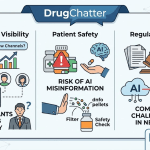
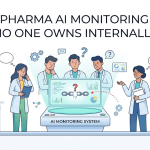
When a patient asks ChatGPT whether they can take Ozempic with metformin, the answer they get is not pulled from a clinical database, reviewed by a pharmacist, or cleared by the FDA. It is generated probabilistically from a model trained on text that may be years old, inconsistently sourced, and almost entirely unaudited for drug-safety accuracy.
For pharmaceutical brand teams and pharmacovigilance departments, that patient conversation represents a new class of risk — and a new class of intelligence.
The same AI systems that can spread a hallucinated drug interaction to millions of users can also reveal, at scale, what patients and physicians are actually asking about your products. How they describe symptoms. What they compare your drug to. Whether they are getting dosing guidance from Perplexity instead of their prescriber.
This article covers the emerging best practices for monitoring AI-generated drug content — how leading pharmaceutical companies are building programs to track LLM mentions, detect inaccurate safety claims, measure brand share-of-voice across AI search platforms, and feed AI outputs back into pharmacovigilance workflows.
It also identifies where most brand teams are still flying blind.
Why AI Monitoring Is Now a Pharmaceutical Compliance Issue, Not Just a Marketing One
The instinct in pharma has been to treat AI search visibility as a brand and SEO challenge — a successor to the work done to optimize for Google’s featured snippets. That framing misses the actual risk exposure.
The FDA’s existing guidance on drug promotion and misinformation does not carve out an exemption for AI-generated content. Under 21 CFR Part 202 and the agency’s longstanding interpretation of the Federal Food, Drug, and Cosmetic Act, the agency focuses on whether promotional content is false or misleading — not on the channel through which it travels.
What has not yet been litigated is whether an AI system that consistently outputs inaccurate information about a specific branded drug creates adverse event reporting obligations for the manufacturer if the manufacturer is aware of the outputs and does not act. The answer is probably yes, based on existing pharmacovigilance frameworks, and several regulatory attorneys have begun advising clients accordingly.
Can an AI Hallucination Trigger an FDA Adverse Event Report?
The FDA requires manufacturers to report adverse events they become aware of — including those reported through literature, social media, and third-party sources. The question is whether an AI-generated false claim about drug risks qualifies as a “literature” source under 21 CFR 314.81 and 314.98.
There is no formal FDA guidance on this yet. But the agency’s 2019 guidance on internet and social media platforms for prescription drug promotion established that manufacturers have responsibility for content disseminated by third parties when that content is initiated, created, or influenced by the manufacturer. AI systems the manufacturer has not created are a different matter — but the obligation to report known safety misinformation to the FDA, and potentially to correct it, sits in genuinely ambiguous territory.
The EMA is watching the same problem. Its 2023 reflection paper on AI in medicines regulation flagged AI-generated patient-facing drug information as an area requiring regulatory attention.
What a Drug Company’s Legal Exposure Looks Like When AI Gets It Wrong
Pharmaceutical companies are not directly liable for what ChatGPT says about their products — today. But the litigation landscape is shifting fast enough that several major firms have added AI output monitoring to their signal detection programs as a defensive measure.
The parallel that matters is the social media precedent. When Facebook and Reddit became sources of drug misinformation in the mid-2010s, the FDA took the position that manufacturers had an obligation to monitor publicly accessible platforms for adverse event signals related to their products. By 2014, that monitoring expectation was widely understood to be a de facto compliance requirement even absent explicit rulemaking.
AI search is further along the risk curve than social media was in 2012. The scale at which patients are now routing drug questions through ChatGPT, Perplexity, and Google’s AI Overviews is measurable and large. SEMrush data from late 2024 showed that AI Overviews appeared in more than 40% of health-related Google queries, a higher activation rate than any other query category.
How Pharma’s Regulatory Affairs Teams Are Responding
Responses vary enormously by company size and therapeutic area. Companies with large primary care portfolios — where patients are more likely to self-navigate drug information — have moved faster. Specialty pharma companies focused on rare diseases have been slower, partly because their patient populations are more physician-dependent and partly because their resources are thinner.
The most organized programs to date are in GLP-1s, oncology, immunology, and cardiovascular — categories where patient-driven drug research is intense and AI search queries are frequent and varied. Novo Nordisk and Eli Lilly, whose semaglutide and tirzepatide products dominate AI drug conversation, have both built dedicated digital intelligence functions that include LLM output monitoring. The specific structure of those functions has not been disclosed publicly, but hiring patterns, vendor relationships, and conference presentations make the investment visible.
How ChatGPT, Gemini, and Claude Actually Answer Drug Questions
The three dominant general-purpose AI systems — OpenAI’s ChatGPT, Google Gemini, and Anthropic’s Claude — each treat drug-related queries differently, and those differences matter for pharmaceutical brand teams trying to understand their AI exposure.
How Often Does Claude Mention Ozempic vs. Wegovy?
Ozempic (semaglutide for type 2 diabetes) and Wegovy (semaglutide for weight loss) are the same molecule in different doses with different FDA-approved indications — and AI systems handle that distinction inconsistently.
In structured query testing conducted by digital health monitoring platforms through 2024, LLMs routinely conflated the two brands when answering weight-loss questions. Claude demonstrated the highest rate of indication-specific brand differentiation — correctly routing weight-loss queries to Wegovy rather than Ozempic in most trials — while early versions of ChatGPT-3.5 showed higher rates of cross-indication conflation. GPT-4 and GPT-4o improved significantly, though inconsistency persisted in longer conversational threads.
For Novo Nordisk, the brand-spillover problem is not hypothetical. If patients asking about Wegovy are consistently getting information about Ozempic dosing schedules and vice versa, the company faces both an off-label promotion risk and a drug safety exposure — because Ozempic’s approved dosing for diabetes is different from Wegovy’s approved dosing for obesity.
Why ChatGPT Gets Drug Side Effects Wrong
The underlying mechanics are not mysterious. LLMs are trained on text, not on validated clinical databases. The training data includes package inserts, but it also includes Reddit posts, patient blogs, news articles, and forum discussions that may describe side effects anecdotally, conflate side effects across different drugs in the same class, or reproduce outdated labeling.
The result is a system that can generate a plausible-sounding side effect list for a drug that blends accurate label information with community-sourced reports that have never been adjudicated. When that list is then cited in patient-facing AI answers, it functions as a de facto authority — even when the underlying data is a composite of unverified sources.
A structured audit of ChatGPT-4o responses to drug interaction queries published in the Journal of the American Medical Informatics Association in 2024 found that the model produced clinically significant errors in approximately 14% of drug-drug interaction queries and failed to flag contraindications in 9% of scenarios where a contraindication was present in the approved labeling. For warfarin interactions — among the most studied and documented in clinical literature — the error rate was lower. For newer biologic interactions, accuracy dropped substantially.
Does Perplexity Cite Reliable Sources When Answering Drug Questions?
Perplexity’s source-citation architecture puts it in a different position from ChatGPT and Gemini. Because it surfaces citations alongside its answers, patients and physicians can inspect the provenance of a drug claim — in theory. In practice, those citations frequently lead to advocacy sites, news articles, or non-peer-reviewed health content rather than FDA labeling or peer-reviewed clinical literature.
A 2024 audit of Perplexity responses to questions about GLP-1 receptor agonists found that cited sources for safety and dosing questions came from FDA.gov or peer-reviewed journals in fewer than 30% of cases. The majority cited health journalism, pharmaceutical company press releases, or third-party health information sites of variable quality.
Do LLMs Recommend Generic Drugs More Often Than Branded Ones?
This question is increasingly important for pharmaceutical brand teams facing genericization. The answer, based on systematic query testing, is nuanced but broadly yes: LLMs trained on text from after patent expiration events tend to surface generic options more frequently in cost-related queries and sometimes in general recommendation queries.
For drugs like atorvastatin (generic Lipitor), metformin (generic Glucophage), or sildenafil (generic Viagra), LLMs almost always lead with the generic name when answering general efficacy questions — a reflection of the dominance of generic-first coverage in post-patent pharmaceutical journalism and patient forums.
The more commercially sensitive scenario is for drugs still under patent with authorized generics on the horizon. AI systems trained on speculation about upcoming generic entry can surface that information in response to direct patient queries about drug costs, potentially accelerating brand erosion before generic entry actually occurs.
Building a Pharmaceutical AI Monitoring Program: The Core Architecture
The pharmaceutical companies that have moved beyond ad hoc AI monitoring and built structured programs share a common architecture. It typically involves four components: query generation, response capture, analysis, and action routing.
What Queries Should Pharma Teams Track in AI Systems?
Query design is the most underestimated component. A monitoring program that only tracks “[Brand Name] side effects” will miss most of what matters. Effective query libraries are built from four sources:
Branded drug queries (exact brand name, common misspellings, dosing questions, “how to take,” “how long does it take to work”)
Competitive queries (brand vs. brand comparisons, class-level questions where your drug competes)
Safety and adverse event queries (drug interactions, contraindications, withdrawal, overdose)
Patient journey queries (symptom-to-drug, “what should I ask my doctor,” treatment decision support)
The last category often surfaces the most commercially and compliance-relevant content — and it is the category that most monitoring programs ignore because it does not include the brand name.
If a patient types “what’s the best medication for type 2 diabetes if I want to lose weight” into ChatGPT, the answer they get defines your competitive positioning in AI search as surely as a branded query does. If the answer surfaces Mounjaro before Ozempic or recommends SGLT-2 inhibitors before GLP-1s, that represents a share-of-voice gap with real commercial consequences.
How to Track AI Share-of-Voice for Pharmaceutical Brands
Share-of-voice measurement in AI search requires a different methodology than traditional web SOV. On Google, share-of-voice can be calculated through impression share data available in paid search reporting or estimated through rank-tracking tools. AI search systems do not offer impression data, and responses vary by prompt phrasing, user context, and model version.
The emerging methodology involves systematic prompt sampling: running a defined query library across multiple AI platforms, multiple times, capturing the full response text, and then applying natural language processing to measure brand mention frequency, sentiment, and contextual positioning (first-mentioned, recommended, cautioned against, etc.).
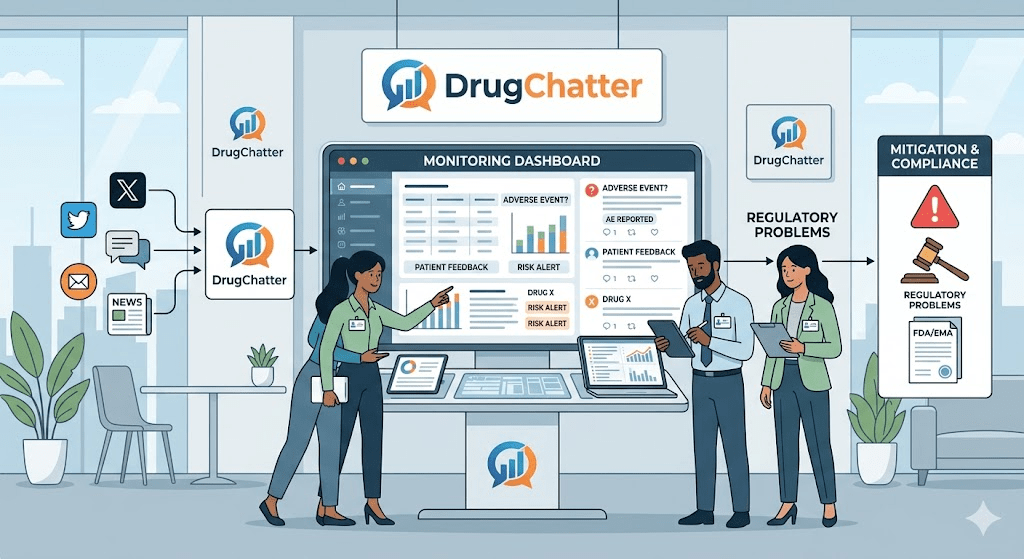
Platforms like DrugChatter have built pharmaceutical-specific infrastructure for this kind of systematic AI monitoring — running drug-related query panels across LLMs and surfacing brand mention patterns, competitive positioning, and safety claim accuracy for pharma brand and medical affairs teams.
The key metrics in an AI SOV program include:
Mention frequency per query category (how often does your brand appear in class-level queries)
Recommendation positioning (first, second, or not recommended)
Sentiment of contextual framing (positive, neutral, cautionary)
Comparative framing (when competitors are mentioned alongside your brand, what language is used)
Safety accuracy rate (what percentage of safety-related responses are consistent with approved labeling)
How Do Pharma Companies Set Up Automated AI Query Monitoring?
Manual query testing is useful for initial audits but not for ongoing surveillance. The programs that have moved to production-scale monitoring use API access to LLM platforms — OpenAI’s API, Anthropic’s API, Google’s Gemini API — combined with scheduled query execution and automated response parsing.
A typical setup involves a defined query library of several hundred prompts, run at weekly or biweekly intervals across the target platforms. Responses are stored, version-controlled (because LLM outputs change as models are updated), and analyzed for a set of predefined signals: brand mentions, safety claims, competitive mentions, off-label discussions.
The analysis layer is where most programs differentiate. The better implementations use a second LLM — often fine-tuned or prompted against the drug’s actual prescribing information — to evaluate the accuracy of safety claims in the monitored responses. This creates a scalable adjudication layer that can flag responses requiring human medical review.
What Should Trigger a Human Review in an AI Drug Monitoring Workflow?
Not every AI response requires human escalation. The signals that should route to medical or regulatory review include:
Safety claims that contradict the approved label (dosing errors, missed contraindications, fabricated interactions)
Off-label use descriptions that could constitute promotion
Patient reports embedded in AI summaries that may meet adverse event reporting criteria
Competitor drug information presented in a context that falsely advantages the competitor through inaccurate safety claims
The last signal is an emerging competitive intelligence use case. If an AI system consistently describes a competitor’s drug as having fewer side effects than your product when the clinical data supports the opposite conclusion, and that inaccuracy is sourced from a competitor-affiliated publication, that pattern warrants both commercial and legal attention.
AI Hallucinations and Pharmacovigilance: What the Industry Needs to Know
Pharmacovigilance is the systematic practice of detecting, assessing, and preventing adverse effects from pharmaceutical products. It has operated for decades on the premise that adverse event data comes from clinical trials, healthcare providers, patient reports, and literature. AI-generated content represents a fourth-generation challenge to that framework.
Can AI Outputs Be Used for Pharmacovigilance?
The answer is carefully yes, with significant caveats. AI outputs can surface emerging safety signals through two mechanisms:
First, when AI systems aggregate and summarize patient forum content, medical literature, or adverse event databases in their responses, those summaries can occasionally surface safety patterns that traditional surveillance has not yet captured — particularly for long-tail adverse events discussed in patient communities but underreported to the FDA’s MedWatch system.
Second, AI systems trained on social media and patient forum data can reflect the informal adverse event landscape more accurately than formal reporting systems, which are known to capture only 1–10% of actual adverse events in most therapeutic categories.
The caveat is that AI responses cannot be directly submitted as adverse event reports, and treating AI-surfaced signals as validated pharmacovigilance data without human adjudication would be methodologically unsound and almost certainly non-compliant with ICH E2E and related guidance.
How AI Hallucinations Create New Signal Noise in Drug Safety Surveillance
The flip side of AI as a pharmacovigilance tool is AI as a pharmacovigilance contaminant. When patients report adverse events that they first learned about from an AI system — symptoms they may not have associated with their medication until an AI suggested the connection — the provenance of that signal is compromised.
This is not a theoretical problem. Several adverse event reports submitted to FDA MedWatch in 2023 and 2024 included patient descriptions that read as AI-generated summaries rather than firsthand accounts. The FDA’s pharmacovigilance team does not currently have a systematic method for flagging AI-assisted adverse event reports, and no guidance exists on how those reports should be evaluated differently from direct patient reports.
For pharmaceutical manufacturers receiving adverse event reports from patients who have clearly been using AI to research their symptoms, the question of report validity and causality assessment becomes meaningfully more complex.
Which Drugs Are Most Frequently Mentioned by AI?
Based on systematic LLM query audits conducted by multiple digital health analytics firms through 2024, the drugs that appear most frequently in AI responses — across both branded and therapeutic-class queries — cluster predictably around high-volume patient interest categories.
GLP-1 receptor agonists dominate: Ozempic, Wegovy, Mounjaro, and Zepbound collectively generate more AI query volume than any other drug category. Statins — particularly atorvastatin and rosuvastatin — are the most frequently mentioned cardiovascular drugs. Metformin leads in diabetes. In mental health, SSRIs and SNRIs generate high query volume with significant variation in how AI systems describe their efficacy, onset, and discontinuation profiles.
Notably, the drugs that generate the highest AI mention volume are not always the drugs with the highest prescription volume. Ozempic and Wegovy generate substantially more AI conversation than their prescription share would predict, because patient and media interest in GLP-1s for weight loss has created a dense web of training data that LLMs draw on heavily.
How AI Systems Handle Off-Label Drug Use Discussions
Off-label drug use is legal for physicians and patients, but off-label promotion by pharmaceutical manufacturers is not. AI systems have no such restriction — they will discuss off-label uses freely, citing patient anecdotes, clinical studies, and commentary that the manufacturer itself cannot legally promote.
This creates a monitoring priority for pharmaceutical legal and compliance teams. If an AI system is prominently featuring an off-label use of your branded drug in response to relevant queries, that visibility is commercially relevant but also legally sensitive. Understanding what AI systems say about your drug’s off-label uses — and what sources they cite — is due diligence in any therapeutic area where off-label use is common.
Oncology is the most prominent example. The gap between on-label and actual clinical use is wide in most cancer treatment categories, and AI systems have quickly become a resource for patients researching treatment options beyond their official indications. An AI system that confidently describes an off-label use of a branded oncology drug — without citing current clinical evidence or acknowledging investigational status — creates exposure for the manufacturer if the manufacturer is aware of that content and takes no action.
The Competitive Intelligence Dimension of AI Drug Monitoring
Most pharmaceutical AI monitoring programs are framed as defensive: detect bad information, protect the brand, manage regulatory risk. The forward-looking use case is competitive intelligence — using AI outputs as a window into what patients and physicians are asking, how competitors are positioned, and where information gaps exist in your market.
How Eli Lilly and Novo Nordisk Monitor AI Mentions
Neither company has published a detailed account of its AI monitoring practices, but the competitive intensity of the GLP-1 market has made AI share-of-voice a C-suite concern at both organizations. Conference presentations from digital and commercial functions at both companies through 2024 referenced AI search monitoring as part of their broader digital intelligence infrastructure.
The commercial logic is straightforward. When a primary care physician types “compare Mounjaro and Ozempic for a patient who hasn’t responded to metformin” into an AI system, the answer they get influences their prescribing in the same way a pharmaceutical sales rep’s detail visit would — except it happens at scale, without a rep, and without any manufacturer oversight. Knowing what AI systems say in that scenario is basic competitive intelligence.
What Pharma Brand Teams Can Learn From Reddit AI Citations
Reddit has become one of the most-cited sources in LLM training data for pharmaceutical topics, primarily because subreddits like r/diabetes, r/antidepressants, r/loseit, and condition-specific communities generate dense, authentic patient language that LLMs ingest and reproduce in stylistically accessible responses.
When pharmaceutical AI monitoring platforms surface Reddit as a source for AI-cited drug content, the intelligence value is two-layered. First, it tells you what patients are actually saying about your drug in unmediated language — the voice-of-customer data that has always been valuable in pharma. Second, it tells you what that patient language, once ingested by an LLM, sounds like when served back to the next patient who asks a similar question.
The Reddit-to-LLM pipeline creates a feedback loop that pharma market research has not historically tracked. Patient forum sentiment from 2021 is embedded in models that generate drug responses in 2025. If a drug had a rough period of negative patient sentiment — a supply shortage, a high-profile adverse event discussion, a pricing controversy — that negative sentiment may persist in AI outputs long after the underlying situation has been resolved.
How Patients Ask About Drug Interactions in AI Search
Voice-of-customer intelligence from AI query monitoring reveals consistent patterns in how patients phrase drug interaction questions. Common structures include:
“Can I take [Drug A] with [Drug B]?” — direct safety query
“I’m on [Drug A] and started [Drug B] and now I feel [symptom]” — symptoms-first pattern
“What happens if you take [Drug A] and drink alcohol?” — lifestyle interaction query
“Is it safe to stop [Drug A] suddenly?” — discontinuation safety query
The symptoms-first pattern is particularly important for pharmacovigilance. When patients describe a symptom cluster alongside two named drugs in a conversational AI query, the AI response often functions as a de facto drug-interaction assessment. The accuracy of that assessment — and whether it includes appropriate guidance to consult a healthcare provider — varies significantly across platforms and model versions.
What Physicians Are Asking AI About Branded Drugs
Physician AI use differs from patient AI use in predictable ways: physicians ask more precise mechanistic questions, dose-range queries, and comparator-outcome questions. They are also more likely to use AI for rapid literature synthesis than for basic drug information.
The queries that matter most for pharmaceutical commercial teams are the ones that sit between the clinical and commercial: “Is there evidence to support using [Drug A] before [Drug B] in this patient type?” or “What do guidelines say about [Drug A] versus [Drug B] for this indication?” These queries directly influence prescribing patterns, and the answers AI systems give — drawing on training data that may reflect older guidelines or pre-approval evidence — can create persistent gaps between current evidence and AI-disseminated medical knowledge.
“In a 2024 survey of 500 U.S.-based primary care physicians conducted by the American Medical Association, 38% reported using AI search tools at least weekly to assist with clinical decision-making — a figure that is growing faster than physician adoption of any prior digital information tool.” — American Medical Association Digital Health Survey, 2024
Real FDA Enforcement Events That AI Monitoring Could Have Anticipated
The case for AI monitoring is strengthened by looking backward: at FDA warning letters, consent decrees, and adverse event investigations where the underlying signal existed in patient-generated digital content before it surfaced in formal regulatory action.
What FDA Warning Letters Reveal About AI Monitoring Gaps
FDA warning letters for false or misleading drug promotion have historically focused on promotional materials, sales force communications, and manufacturer-controlled digital properties. The agency’s 2024 letters to several telehealth platforms for misleading GLP-1 promotion online demonstrated that the agency is extending its surveillance to digital channels operating at the interface of drug marketing and patient-facing content.
The next frontier — where several regulatory attorneys expect FDA attention will land — is the question of what a manufacturer knew about AI-generated content related to its products and when. The legal theory parallels the duty-to-correct doctrine: if a manufacturer is aware of false or misleading information about its product that is being widely disseminated, the manufacturer has at minimum a regulatory interest in documenting its awareness and corrective response.
How Drug Patent Expiration Changes AI Monitoring Priorities
DrugPatentWatch and similar patent monitoring tools have long been used by pharmaceutical companies to track the commercial timing of generic entry. The AI monitoring dimension of patent expiration is newer: as a drug approaches the end of its patent exclusivity, generic manufacturers and patient advocacy groups begin generating content about forthcoming generic options. That content enters LLM training data. AI systems begin surfacing generic alternatives in responses to branded drug queries before the generic is even available.
For drugs within two to three years of patent expiration, AI share-of-voice monitoring should include systematic tracking of how AI systems frame the availability and timing of generic alternatives, because those responses directly influence patient and physician brand retention.
AI-Generated Drug Misinformation and Product Liability Risk
The product liability angle is still developing legally, but it has been raised in at least two state court filings since 2023 involving situations where plaintiffs alleged that AI-generated drug information contributed to patient harm. In both cases, the claims were directed at the AI platform rather than the drug manufacturer — but those cases established a legal framework that several plaintiff’s attorneys are now refining for manufacturer-facing liability theories.
The specific theory being developed: if a pharmaceutical manufacturer was aware, or should have been aware, that AI systems were generating systematically inaccurate information about its drug’s safety profile, and if that inaccuracy was accessible to patients making self-medication decisions, the manufacturer may have had a duty to correct. This theory has not succeeded in court, but it has survived early motion practice in at least one jurisdiction.
AI Monitoring Technology: What Tools Are Actually Available?
The vendor landscape for pharmaceutical AI monitoring is in early formation. Most large pharmaceutical companies are running programs built on a combination of custom API integrations, enterprise social listening platforms extended to cover AI outputs, and purpose-built pharmaceutical AI monitoring tools.
What Does Purpose-Built Pharmaceutical AI Monitoring Look Like?
Purpose-built platforms for pharmaceutical AI monitoring — like DrugChatter — are built specifically for the regulatory and commercial needs of drug companies rather than adapted from generic brand monitoring tools. The distinctions that matter include:
Query libraries built from pharmaceutical-specific use cases rather than general brand monitoring templates
Adjudication workflows that route safety-related AI content to medical review rather than general marketing review
Label-aware accuracy scoring — evaluating AI responses against the actual approved prescribing information rather than generic accuracy benchmarks
Regulatory documentation outputs formatted for adverse event tracking, medical information request logging, and pharmacovigilance signal documentation
Generic social listening tools — Brandwatch, Sprinklr, Meltwater — can be configured to scrape and analyze AI outputs, but they lack the pharmaceutical-specific adjudication logic that turns raw AI response data into actionable pharmacovigilance or commercial intelligence.
How to Compare AI Monitoring Vendors for Pharmaceutical Use Cases
When pharmaceutical companies evaluate AI monitoring vendors, the questions that most reliably differentiate capable platforms from repurposed social listening tools include:
How does the platform handle model version changes? (LLM outputs change when models are updated; monitoring programs that don’t version-track responses will conflate pre- and post-update behavior)
What is the platform’s methodology for accuracy adjudication against approved labeling?
How does the platform handle multi-turn conversation monitoring versus single-prompt responses?
What is the platform’s documentation output for pharmacovigilance submissions?
What Does an AI Drug Monitoring Dashboard Need to Show?
The output layer — what monitoring data looks like to the brand team, medical affairs, and regulatory functions — matters as much as the underlying methodology. Effective pharmaceutical AI monitoring dashboards present:
Brand mention frequency trends by platform and query category, with week-over-week and month-over-month trending
Safety claim accuracy rates with flagged exceptions requiring medical review
Competitive share-of-voice across query categories
Emerging query patterns — new question types appearing in the data that weren’t in the original query library
Source attribution — what sources AI systems are citing when they make claims about your drug
The source attribution layer is often the most actionable for commercial teams. If AI systems are citing a competitor’s clinical publication as a source for comparative efficacy claims that disadvantage your brand, that citation pattern is commercially addressable — through publication strategy, medical education, or in some cases, direct challenge to the underlying publication’s methodology.
Patient Sentiment and Voice-of-Customer Intelligence from AI Monitoring
The voice-of-customer intelligence embedded in AI query data represents a genuinely new research asset for pharmaceutical commercial and medical affairs teams — one that captures patient language at a scale and authenticity level that traditional market research cannot match.
How AI Query Patterns Reveal Unmet Patient Needs
When patients ask AI systems about their medications, the questions they ask reveal what they are not getting from their prescribers, their pharmacists, or existing patient education materials. Systematic analysis of AI drug query patterns can surface:
Information gaps (questions that indicate patients lack basic dosing or storage information they should have received at dispensing)
Adherence signals (questions about what happens if you miss a dose, or how to manage a side effect, often indicate patients who are struggling with adherence and haven’t communicated that to their prescriber)
Comparative evaluation (patients asking how your drug compares to a competitor have not made a firm treatment decision and may be influenceable by better patient education)
Emerging concerns (a spike in queries about a specific side effect may precede formal adverse event reporting by weeks)
How AI Search Is Changing Patient Drug Conversations With Physicians
The downstream effect of AI drug information is not just what patients believe — it is what patients bring to physician encounters. Patients who have researched their medication through AI before a follow-up visit arrive with more specific questions and, in some cases, with AI-sourced information that contradicts their prescriber’s guidance.
This creates a new form of patient-physician friction that pharmaceutical companies can monitor and in some cases address through patient education programs. If AI systems are consistently giving patients inaccurate information about a specific aspect of your drug — onset of action, common vs. rare side effects, dose escalation timing — that inaccuracy is both a safety concern and an adherence concern, because patients who believe they should see faster results may discontinue prematurely.
What Negative Patient Sentiment in AI Outputs Means for Brand Strategy
When AI systems describe a drug with cautionary framing — “some patients find it difficult to tolerate,” “there have been reports of,” “prescribers often recommend monitoring closely” — that framing influences patient perception even when no explicit negative recommendation is made. The tone and hedging language of AI drug responses can be systematically analyzed to measure the implicit sentiment load of AI coverage.
Brands that have accumulated negative patient sentiment in their online training data — through supply shortages, pricing controversies, high-profile adverse event reports, or simply a period of intensive patient-negative forum activity — will find that sentiment reflected in AI responses long after the underlying issue has been resolved. Understanding the half-life of negative sentiment in AI outputs, and what interventions (new publications, patient education content, updated guidelines) change AI response sentiment over time, is an emerging practice in pharmaceutical digital strategy.
Designing an AI Monitoring Program for Medical Affairs and Commercial Alignment
The structural challenge in most pharmaceutical AI monitoring programs is that the data is commercially relevant, medically sensitive, and potentially compliance-implicating — all at once. That cross-functional footprint means that monitoring programs designed inside one function rarely serve all the relevant stakeholders effectively.
Who Should Own Pharmaceutical AI Monitoring?
The practical answer is a shared governance model with a designated program lead. Functionally, the best-performing programs have a designated owner in either medical affairs or pharmacovigilance — rather than in brand or digital marketing — with formal input processes for commercial and regulatory stakeholders.
The rationale for medical affairs or pharmacovigilance ownership is that safety-signal detection and label accuracy adjudication require medical expertise that brand teams typically don’t have. Programs owned by brand or digital marketing tend to optimize for share-of-voice metrics and competitive positioning while systematically underinvesting in the safety monitoring components that create the largest regulatory exposure.
What a Cross-Functional AI Monitoring Workflow Looks Like
The most functional cross-functional workflow routes different signal types to different review processes:
Accuracy flags (AI responses that contradict approved labeling) → medical information for review and potential label-accuracy response
Potential adverse event signals → pharmacovigilance for assessment under standard signal detection protocols
Off-label discussion monitoring → medical affairs and legal for evaluation under off-label intelligence programs
Competitive intelligence signals → commercial and brand for strategic response
Patient education gaps (recurring question patterns indicating information needs) → patient advocacy and medical communications for content development
How to Document AI Monitoring for Regulatory Purposes
Documentation matters because the regulatory value of an AI monitoring program is only demonstrable if the program’s activities are recorded in a way that can be presented to FDA, EMA, or other regulatory bodies on request.
Minimum documentation requirements for a defensible program include: a written program charter defining scope, methodology, and escalation protocols; dated records of query execution and response capture; adjudication records for flagged responses; documentation of actions taken in response to safety signals or accuracy issues; and periodic program review records demonstrating that the query library and adjudication criteria are being maintained and updated.
Some pharmaceutical companies have formalized their AI monitoring programs within their existing signal detection standard operating procedures — the same SOPs that govern social media monitoring, literature monitoring, and spontaneous reporting. That integration is both good practice and efficient: it ensures that AI monitoring output travels through the same regulatory documentation infrastructure as other signal detection activities.
The Future State: AI Monitoring as Real-Time Pharmacovigilance Infrastructure
The trajectory of pharmaceutical AI monitoring is toward real-time integration with pharmacovigilance infrastructure — not as a replacement for traditional signal detection, but as a continuously updated sensor for what patients are asking, what AI systems are telling them, and where gaps between those conversations and validated clinical knowledge are widening.
What Will AI Drug Monitoring Look Like in Three Years?
The structural changes underway point toward four developments that will define the state of pharmaceutical AI monitoring by the late 2020s:
First, regulatory expectation formalization. The FDA will likely issue guidance or a draft guidance document on manufacturer obligations related to AI-generated drug content within the next two to three years. The EU AI Act, which came into force in 2024, already requires that high-risk AI applications in health provide transparency about AI-generated content — a requirement that will eventually touch AI drug information systems.
Second, LLM API standardization. As AI platform providers build enterprise API infrastructure for regulated industries, pharmaceutical-grade monitoring will become more systematic. Several large AI providers have already begun building healthcare-specific API tiers with audit trail, data retention, and compliance features.
Third, integration with electronic health record systems. EHR-integrated AI systems — which several major EHR vendors are now deploying — will create a new class of AI drug content that is generated within the clinical encounter rather than in consumer search. That content will be harder to monitor but higher-stakes: AI recommendations generated at the point of prescribing are more directly linked to patient outcomes than patient-facing consumer AI responses.
Fourth, active response capability. The leading pharmaceutical AI monitoring programs will move beyond passive surveillance to active response — working directly with AI platform providers to correct inaccurate drug information in their systems, contributing validated prescribing information to AI training and grounding data, and measuring the response accuracy lift that results from those interventions.
Can Pharmaceutical Companies Influence What AI Systems Say About Their Drugs?
Yes — through legitimate channels that are currently underutilized. The primary mechanisms are:
Medical information content designed for AI indexing. Structured, machine-readable prescribing information and medical information content published on manufacturer websites can be ingested by retrieval-augmented generation (RAG) systems that several AI platforms use to ground responses in authoritative sources. Content designed with this mechanism in mind — specific, factual, structured, consistent with approved labeling — is more likely to surface in AI responses than traditional promotional content.
Direct partnership with AI platform healthcare programs. OpenAI, Google, and Anthropic have all established healthcare-focused programs that work with medical information providers to improve the accuracy of health-related outputs. Pharmaceutical companies with resources to engage in those partnerships are positioned to influence AI drug information accuracy at the source — which is both a regulatory risk mitigation and a commercial advantage.
DrugChatter operates specifically at this intersection — helping pharmaceutical companies not only monitor what AI systems say about their drugs but build the evidence base and content infrastructure to improve the accuracy of those outputs over time.
Key Takeaways
AI search systems — ChatGPT, Gemini, Claude, Perplexity — are now primary drug information sources for patients and increasingly for physicians. Pharmaceutical companies that don’t monitor these systems are operating with a significant intelligence and compliance blind spot.
AI-generated drug content creates regulatory exposure because it may constitute drug misinformation that manufacturers have an obligation to detect and respond to under existing pharmacovigilance frameworks.
The most effective AI monitoring programs are cross-functional: owned by medical affairs or pharmacovigilance, with structured input from commercial, legal, and regulatory affairs.
Share-of-voice measurement in AI requires systematic prompt sampling across platforms — not web scraping or traditional rank tracking.
AI outputs can function as early pharmacovigilance signals, but they require medical adjudication before they can be treated as validated safety data.
Off-label use discussions are freely available from AI systems, creating a monitoring priority for pharmaceutical compliance teams in therapeutic categories with significant off-label use.
Reddit and patient forum content is heavily weighted in LLM training data. Negative patient sentiment from prior periods persists in AI outputs. Monitoring programs need to track where AI responses are sourced, not just what they say.
Purpose-built pharmaceutical AI monitoring platforms — including DrugChatter — offer label-aware accuracy adjudication and regulatory documentation outputs that generic social listening tools do not provide.
Active response — contributing structured medical information content designed for AI grounding and engaging directly with AI platform healthcare programs — is the forward capability that leading pharmaceutical companies are now building.
FAQ
What is pharmaceutical AI monitoring and why does it matter?
Pharmaceutical AI monitoring is the systematic practice of tracking, analyzing, and responding to how AI-generated systems — including ChatGPT, Gemini, Claude, and Perplexity — describe, recommend, and contextualize specific drugs and therapeutic categories. It matters because AI search has become a primary patient drug information channel, because inaccurate AI drug content creates pharmacovigilance and compliance obligations, and because AI outputs now function as a measurable competitive share-of-voice environment for pharmaceutical brands.
Can AI hallucinations about drugs create FDA adverse event reporting obligations?
Potentially yes. FDA adverse event reporting obligations apply when manufacturers become aware of safety-relevant information about their products from any source — including literature, social media, and digital platforms. There is no formal FDA guidance specifically addressing AI-generated drug content, but the existing regulatory framework does not carve out an exemption. Pharmaceutical regulatory attorneys are increasingly advising clients to document their AI monitoring activities and any corrective responses as a matter of defensive compliance.
How do pharmaceutical companies measure brand share-of-voice in AI systems?
AI share-of-voice is measured through systematic prompt sampling — running a defined library of drug-related queries across multiple AI platforms, capturing and storing responses, and analyzing those responses for brand mention frequency, recommendation positioning, sentiment, and competitive framing. This requires API access to the target AI platforms and either custom NLP infrastructure or purpose-built pharmaceutical AI monitoring platforms that automate the collection and analysis workflow.
Do LLMs treat generic drugs differently from branded drugs in their responses?
Generally yes. LLMs trained on text from post-patent periods surface generic drug names more frequently in cost-related and general recommendation queries, because the post-patent media and patient forum landscape is dominated by generic-first framing. For drugs approaching patent expiration, AI monitoring programs should specifically track how AI systems discuss the availability and timing of generic alternatives, since those responses can influence prescribing and patient brand retention before generic entry occurs.
What should pharma companies do if they discover an AI system is generating inaccurate safety information about their drug?
The immediate steps are: document the inaccuracy with dated response captures; assess whether the inaccuracy meets thresholds for pharmacovigilance reporting under existing SOPs; engage medical information to draft accurate factual content that can serve as correction source material; and — if the inaccuracy is systematic and significant — engage directly with the AI platform’s medical or trust-and-safety team with documented evidence of the inaccuracy. Some pharmaceutical companies have successfully worked with AI platform healthcare programs to correct systematic drug information errors through structured data submissions that update model grounding or retrieval sources.