A patient with newly diagnosed Type 2 diabetes asks ChatGPT which medication her doctor is most likely to prescribe. The response names a competitor’s drug first, mentions your branded product in the third paragraph, and subtly suggests it carries a higher cardiovascular risk — information that reflects a clinical trial controversy from four years ago, not the current label.
Your brand team doesn’t know this happened. Your medical affairs department hasn’t seen it. Your pharmacovigilance system has no record of it. And it’s happening thousands of times a day.
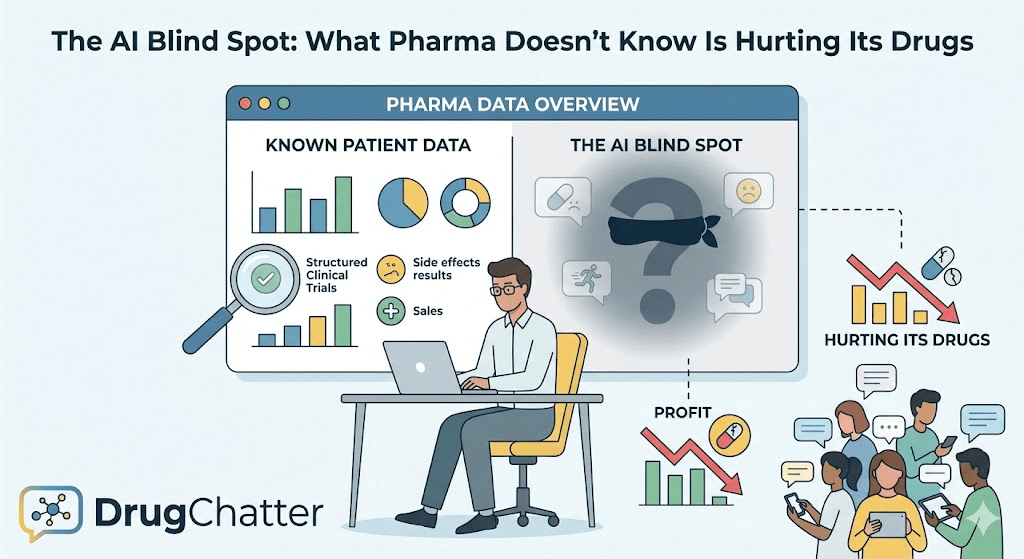
This is the pharmaceutical industry’s current AI monitoring reality: a vast, consequential, patient-facing information channel that most drug companies are not watching.
The gap isn’t a technology problem. The tools to monitor AI-generated drug content exist. The gap is awareness, organizational will, and a persistent industry assumption that AI search is a peripheral channel rather than a primary one. That assumption is wrong, and the cost of maintaining it is growing.
What Is AI Saying About Your Drug Right Now?
The Scale of the Monitoring Gap in Pharmaceutical AI
The pharmaceutical industry spends approximately $6.5 billion annually on market research in the United States alone, according to IQVIA estimates. It deploys sophisticated social listening programs, conducts continuous patient and physician surveys, monitors medical conference presentations, and tracks competitor press releases with near-real-time precision.
None of that infrastructure captures what ChatGPT says when a patient asks about your drug.
As of mid-2025, no major pharmaceutical company has publicly disclosed a systematic, cross-platform AI response monitoring program. Several have piloted manual audits — a medical affairs analyst querying ChatGPT quarterly with a handful of brand-relevant questions. A few have engaged external vendors for AI-adjacent social listening. But systematic, continuous, multi-platform monitoring of LLM-generated content about specific drugs remains rare.
The scale of what’s being missed is not trivial. Perplexity AI processes over 500 million queries per month, with health representing one of its highest-volume categories. Google’s AI Overviews appear in the majority of pharmaceutical keyword searches. ChatGPT’s user base exceeds 200 million weekly active users globally. The combined reach of these platforms for drug-related queries almost certainly exceeds that of traditional pharma marketing channels — and the information those platforms deliver is beyond the industry’s current visibility.
How AI Platforms Are Replacing Package Inserts for Patients
For most of the past three decades, patients who wanted information about a new prescription went to one of three sources: their pharmacist, the package insert, or a health website like WebMD. Each of those sources has some structural accountability to accuracy — the pharmacist is licensed, the package insert is FDA-approved, WebMD has editorial standards and liability exposure.
AI assistants have displaced all three for a growing segment of patients. The displacement is not accidental — it’s a product of genuine utility. An AI assistant gives a personalized, conversational response to a complex question in plain language, without requiring the patient to parse regulatory boilerplate or navigate a cluttered health portal.
The problem is that the accuracy accountability structure that governs pharmacists, package inserts, and professional health websites doesn’t apply to AI. A ChatGPT response about drug side effects is not reviewed by a pharmacist, not approved by the FDA, and not subject to the editorial liability exposure that makes WebMD relatively careful about what it publishes. It’s a statistical prediction that happens to be articulate.
Pharmaceutical companies that understand their patients are increasingly getting drug information from this channel — and doing nothing to monitor it — are operating without visibility into one of the most influential patient touchpoints in their drug’s information lifecycle.
Why Most Pharma Companies Are Flying Blind on AI Drug Mentions
The Organizational Reasons Pharma Has No AI Monitoring Strategy
Ask a pharmaceutical brand team who owns AI monitoring and you’ll typically get a pause, followed by one of three answers: “That’s probably a digital health question,” “Medical affairs would be responsible for accuracy issues,” or “We assumed IT was tracking that.” None of those answers reflect an actual program.
The organizational problem has four roots.
First, AI monitoring sits at the junction of brand marketing, medical affairs, pharmacovigilance, and regulatory affairs — four functions that routinely operate in silos at large pharmaceutical companies. No function has a clear mandate over AI-generated content, so none of them have built programs for it.
Second, the metrics frameworks pharmaceutical companies use to measure brand performance — prescription share, market share, promotional response rates, physician reach and frequency — have no natural slot for AI mention share. What you don’t measure, you don’t manage.
Third, there’s a tacit assumption at many pharmaceutical companies that AI-generated drug information is a downstream consequence of their existing content strategy. If they publish good content on their brand website, that content will flow into AI responses. This assumption is partially correct and mostly misleading. AI systems draw on hundreds of sources, weight them in ways no content strategist fully controls, and synthesize responses that may bear little resemblance to any single source.
Fourth, pharmaceutical legal and regulatory functions have been cautious about any active engagement with AI platforms, fearing that monitoring could be construed as creating an obligation to correct inaccuracies — an obligation they’re not resourced to fulfill. This legal risk aversion, which may itself be based on incomplete analysis, is actively preventing companies from gathering intelligence they need.
What ‘We Monitor Social Media’ Doesn’t Cover in the AI Age
Many pharmaceutical companies believe their existing social listening programs provide adequate coverage of the AI information environment. They don’t.
Social listening tools — Brandwatch, Sprinklr, Talkwalker, and similar platforms — monitor public posts on social media platforms, forums, and news sites. They capture what patients post about their drug experiences. They do not capture what AI systems tell patients about drugs.
The distinction matters because AI-generated content is not a social media post. It’s a synthesized response delivered privately, in a one-to-one conversation, that leaves no public trace. A patient who asks ChatGPT about Jardiance and receives an inaccurate interaction warning doesn’t post that response on Twitter. The exchange is invisible to social listening tools, invisible to brand monitoring dashboards, and invisible to the drug manufacturer — unless they’ve built specific AI monitoring capabilities.
Tools like DrugChatter address exactly this gap. Rather than monitoring what patients say about drugs in public forums, DrugChatter monitors what AI systems say to patients about drugs — systematically querying LLMs with drug-relevant prompts and analyzing the responses for accuracy, sentiment, brand mention frequency, competitive framing, and safety information quality. That’s a fundamentally different data source from social listening, and it requires purpose-built tooling.
The Accuracy Problem: How Often Is AI Drug Information Just Wrong?
Research on LLM Accuracy for Medical and Drug Queries
The peer-reviewed literature on LLM accuracy for medical information has grown rapidly since 2022, and the findings are consistent enough to warrant serious attention from pharmaceutical companies.
A 2023 study in JAMA Internal Medicine evaluated ChatGPT’s responses to 93 frequently asked medication questions and found that while the model performed well on broad mechanism-of-action questions, it produced factual errors in approximately one in four responses involving specific dosing or drug interaction queries. Narrow therapeutic index drugs — those where small dosing errors have large clinical consequences — showed the highest error rates.
A 2024 study in the British Journal of Clinical Pharmacology tested multiple LLMs, including GPT-4, Claude 2, and Gemini, on a standardized set of pharmacology questions. GPT-4 scored highest, but still produced clinically relevant errors in 18% of drug interaction queries. The models were particularly unreliable on recently updated drug interactions — those where the evidence had shifted after the models’ training cutoffs.
A 2024 analysis by researchers at Stanford Medicine evaluated AI Overviews responses to drug queries across 200 branded pharmaceutical searches. The study found that AI Overviews cited outdated or superseded information in 31% of cases where the drug’s label had been updated within the prior 18 months.
These are not catastrophic failure rates. The majority of AI drug responses are directionally reasonable. But “mostly correct” is a dangerous standard for medical information, and the error patterns — clustering around label updates, narrow therapeutic index drugs, and complex interactions — represent exactly the risk categories that pharmaceutical pharmacovigilance programs are designed to address.
The Training Cutoff Problem: When Drugs Change and AI Doesn’t Know
Every LLM has a training data cutoff — a date after which it has no knowledge of events unless it retrieves current web content. For pharmaceutical companies, this creates a specific and predictable accuracy risk.
Drug labels change. Black box warnings are added. Contraindications are updated. Dosing recommendations shift based on post-marketing surveillance. New drug interactions are identified. These changes are communicated through FDA label updates, Dear Healthcare Provider letters, and REMS modifications — all of which generate text that eventually propagates into training data, but with a significant lag.
ChatGPT’s knowledge cutoff for GPT-4 was April 2023. GPT-4o’s cutoff is October 2023. Claude 3.5’s training data ends in early 2024. These cutoffs mean that significant label changes from the past year or two may not be reflected in model responses, even when those models appear to be giving authoritative, current information.
Models with live web retrieval — ChatGPT with browsing, Perplexity by design — can in principle access current label information. But they retrieve selectively, and their retrieval logic doesn’t guarantee that a recently updated FDA label will be prioritized over older content that ranks well in their source selection algorithms.
The practical risk for pharmaceutical companies: a drug that received a significant safety update in 2024 may still be described by AI systems using pre-update framing — with no indication to the patient that the information is outdated.
Off-Label AI: When ChatGPT Discusses Uses Your Drug Can’t Promote
The FDA’s restrictions on off-label drug promotion are among the most consistently enforced in pharmaceutical regulation. The legal framework — built on decades of FDA enforcement actions and subsequent judicial decisions — prohibits manufacturers from promoting drugs for uses not covered by their approved labeling, even when clinical evidence supports those uses.
AI systems have no such restriction.
When a patient or physician asks an AI about off-label uses of a drug, the system responds based on what’s in its training data — which includes clinical trial results, medical journal articles, conference proceedings, and physician commentary, all of which may document off-label uses extensively. The AI isn’t promoting the drug in the regulatory sense. It’s generating a response based on patterns in scientific and medical text.
This creates a structurally novel situation for pharmaceutical companies. AI is effectively performing the off-label education that manufacturers cannot do themselves — sometimes accurately, sometimes not. And because it happens in private conversations, there’s no public record for regulatory review.
For drugs with well-documented off-label uses — Ozempic for weight loss in non-diabetic patients before Wegovy’s approval, Botox for migraine prevention before its 2010 FDA approval, Sildenafil for pulmonary arterial hypertension before Revatio — AI conversations almost certainly accelerated off-label use in ways that preceded and exceeded any manufacturer-initiated activity.
Pharmaceutical companies need to monitor these conversations — not to suppress the discussions, which they have no mechanism to do, but to understand the off-label information environment their products exist in, correct inaccuracies when they appear, and understand the patient populations initiating these queries.
Drug Safety Surveillance in the Age of AI: What Pharmacovigilance Teams Are Missing
Can AI-Generated Patient Narratives Be Used as Pharmacovigilance Signals?
Pharmacovigilance has always been constrained by under-reporting. The FDA estimates that formal adverse event reports through MedWatch capture only 1 to 10 percent of actual adverse events. This chronic under-reporting has driven decades of investment in alternative signal detection: spontaneous reporting database mining, electronic health record surveillance, insurance claims analysis, and social media monitoring.
AI conversations represent the next frontier — and they’re currently almost entirely untapped.
When a patient describes their drug experience to an AI assistant — the specific symptoms, the timeline relative to dose changes, the concurrent medications, the clinical context — they’re generating exactly the kind of structured narrative that pharmacovigilance case reports are built from. The difference is that they’re telling an AI, not a manufacturer, a pharmacist, or the FDA.
The evidentiary gap is real. A patient describing symptoms to ChatGPT doesn’t constitute a valid adverse event case under FDA or EMA standards — there’s no confirmed reporter, no causality assessment, no demographic data collection that meets regulatory requirements. But aggregate patterns in AI drug conversations can function as hypothesis-generating signals that direct pharmacovigilance resources toward specific drugs, specific symptoms, and specific patient populations.
If a systematic analysis of AI drug conversations shows a sudden spike in patient-initiated queries about cardiac symptoms and Drug X over a 60-day window, that’s a signal worth investigating through formal channels. It doesn’t replace the FAERS system — it feeds it.
How Generic Substitution Appears in AI Drug Recommendations
When patients ask AI systems “is there a cheaper version of Humira?” or “what’s the generic for Eliquis?” the responses reveal how well the models understand the competitive biosimilar and generic landscape — and how that understanding shapes what patients hear about branded drugs.
Eliquis (apixaban) is a useful case study. Bristol Myers Squibb and Pfizer’s anticoagulant has faced significant generic entry pressure since the drug’s patent situation became contested. Patients querying AI about generic Eliquis availability receive responses that reflect the complex ongoing litigation between the manufacturers and generic companies — but the accuracy and currency of that information varies substantially by platform and model version.
A patient asking ChatGPT whether generic apixaban is available may receive an answer that reflects the legal status as of the model’s training cutoff, not as of the query date. In a competitive situation where patent litigation outcomes shift the availability of generic alternatives, this matters both to patients making cost decisions and to manufacturers tracking brand preference.
The biosimilar market for biologics presents an even more complex AI monitoring challenge. Humira’s biosimilar landscape — with multiple interchangeable biosimilars from companies including Amgen (Amjevita), AbbVie’s own Hadlima, Sandoz (Hyrimoz), and others entering the market in 2023 — created a rapidly shifting competitive environment that AI models have struggled to accurately represent. Patients asking about Humira alternatives may receive responses that omit recently approved biosimilars, misrepresent interchangeability designations, or describe price differentials that no longer reflect current formulary positioning.
What Emerging Patient Concerns Look Like in AI Queries Before They Trend
One of the most valuable but least exploited capabilities of systematic AI monitoring is early detection of emerging patient concerns. The pattern is predictable: a side effect or safety issue first surfaces in patient forums and social media, generates clinical discussion, then reaches mainstream health media, then triggers regulatory attention. Social listening programs catch the forums-and-social-media phase. Traditional pharmacovigilance catches the clinical report phase. Almost nothing catches the signal earlier.
AI query patterns can provide that earlier signal. When patients begin experiencing a new or unexpected drug effect, one of their first moves is to ask an AI assistant about it — often before they post on Reddit, often before they mention it to their doctor. The queries they generate are specific, first-person, and rich in clinical detail: “I’ve been on Jardiance for three months and I’ve developed what looks like a yeast infection that won’t go away — is this related to the medication?”
That query contains a named drug, a specific adverse effect consistent with a known mechanism, a timeline, and a patient hypothesis about causality. It’s precisely the kind of information that pharmacovigilance systems want. And it’s going to an AI assistant rather than a MedWatch form.
Pharmaceutical companies that build AI monitoring programs capable of detecting query pattern shifts — not just tracking mentions, but tracking the types of questions being asked — gain a genuine early warning capability that their current pharmacovigilance infrastructure doesn’t provide.
‘Social media monitoring captures what patients say publicly about drugs. AI query monitoring captures what they ask privately — and the private questions are often more clinically specific, more emotionally honest, and more predictive of emerging safety signals than anything they post publicly.’ — Drug Safety Alliance, 2024 Digital Pharmacovigilance White Paper
AI Brand Monitoring for Drugs: Building the Intelligence Stack
What Pharmaceutical AI Brand Intelligence Actually Measures
Brand intelligence in pharmaceutical AI monitoring isn’t a single metric — it’s a stack of related measurements that together describe how a drug exists in the AI information environment. The core measurements:
- Mention frequency: How often is the drug named in AI responses to relevant indication-level and class-level queries? How does this compare to named competitors across the same query set?
- Recommendation positioning: When an AI recommends treatments, where in the response does your drug appear? First-mentioned carries different weight than mentioned third in a list of alternatives.
- Sentiment valence: Is the drug discussed positively, neutrally, cautiously, or negatively? Does the AI associate it primarily with clinical efficacy or primarily with side effect risk?
- Safety information accuracy: Does the AI’s description of the drug’s safety profile match the current FDA-approved label? Are black box warnings included where relevant? Are deprecated warnings still being mentioned?
Each of these measurements has a competitive intelligence dimension — how does your drug compare to competitors on each metric — and a compliance dimension — where does the AI description diverge from the approved label in ways that could affect patient safety or create regulatory exposure.
How DrugPatentWatch and DrugChatter Fit Into AI Monitoring Workflows
No single tool covers the full AI monitoring intelligence stack. Effective pharmaceutical AI monitoring programs typically combine multiple data sources.
DrugPatentWatch provides the patent and exclusivity intelligence that contextualizes how AI systems should be describing a drug’s competitive and generic landscape. If a drug’s composition-of-matter patent expired in 2023, DrugPatentWatch’s data tells you what the AI should be saying about generic availability — and systematic AI monitoring tells you what it’s actually saying. The gap between those two is intelligence.
DrugChatter provides the AI-specific layer: systematic querying of LLMs and AI search platforms with drug-relevant prompts, structured response analysis, longitudinal tracking, and competitive benchmarking. For pharmaceutical brand teams and medical affairs departments that want to understand how their drug is positioned in AI responses relative to competitors, and where AI descriptions diverge from approved labeling, DrugChatter’s purpose-built framework reduces the manual burden of building that capability in-house.
The combination of patent intelligence, competitive landscape data, and AI response monitoring gives pharmaceutical teams a more complete picture of the information environment their drug exists in — one that traditional brand tracking and social listening alone can’t provide.
Which AI Platforms Matter Most for Pharmaceutical Brand Monitoring?
Not all AI platforms warrant equal monitoring attention. The prioritization depends on patient population, indication, and query type — but a general framework holds across most pharmaceutical contexts.
Google AI Overviews deserve first priority. Google remains the dominant search engine globally, and its AI Overviews now appear in a large majority of pharmaceutical keyword searches. The AI Overview is often the first content a patient or caregiver sees — above all organic results, above all paid placements, above the brand’s own website. Getting this response wrong, or leaving it unmonitored, is a top-of-funnel brand and safety risk.
ChatGPT is the second priority for most indications. Its user base is large, its responses are detailed, and its browsing capability means it can surface recent clinical and news content — including competitor announcements and regulatory actions — that purely training-data-based models wouldn’t access.
Perplexity is high priority for health-literate, research-oriented patients and for physician queries. Its citation model is traceable: you can see which sources it used, which allows pharmaceutical teams to understand and influence the source environment that shapes its drug responses.
Claude and Microsoft Copilot round out the primary monitoring set. Claude’s distinctive tendency toward mechanistic framing and clinical caution makes it particularly influential in contexts where patients or physicians are trying to understand how a drug works rather than just whether to take it. Copilot’s integration into Microsoft’s enterprise and healthcare platforms makes it increasingly relevant for physician-facing queries.
Competitive Intelligence in AI Drug Search: Tracking What Your Rivals Don’t Know You’re Tracking
How AI Share-of-Voice Differs From Prescription Market Share
Market share in pharmaceuticals is typically measured in prescriptions filled. AI share of voice measures something different and earlier in the decision chain: how prominent a drug is in the information environment that shapes prescribing decisions before a physician writes a script and before a patient fills it.
The relationship between AI share of voice and prescription share is not linear, and the direction of causality runs both ways. Drugs with high prescription market share tend to have high AI mention frequency because they generate more clinical literature, more patient discussion, and more media coverage — all of which feed into LLM training data. But AI mention frequency can also drive prescription share by shaping what patients ask about in clinical consultations and what physicians hear from patients who have already queried an AI before their appointment.
The competitive intelligence value is highest in therapeutic areas where multiple drugs are competing for the same patient population and where the clinical differentiation is not overwhelming. In the GLP-1 class, the clinical differentiation between semaglutide and tirzepatide is real but not dispositive for many patients — both are effective, both have manageable side effect profiles, and both are expensive. In that context, AI share of voice — which drug gets recommended first, which gets described more favorably, which gets associated with efficacy versus side effect risk — can meaningfully influence patient preference and physician choice.
How Competitors May Already Be Using AI Monitoring Against You
If your company isn’t monitoring AI responses about your drugs, consider the competitive implication: other companies may be. The same AI monitoring capabilities that help you understand what ChatGPT says about your drug also reveal what it says about competitor drugs — their mention frequency, their sentiment, their safety framing, the queries that prompt their recommendation.
A competitor with a systematic AI monitoring program knows which query types trigger favorable AI recommendations for their drug and unfavorable ones for yours. They know which source websites AI systems are drawing on for comparative drug information and can prioritize getting their clinical data well-represented in those sources. They know when a safety concern about their drug is surfacing in AI responses and can address it before it becomes a patient-facing information problem.
The competitive intelligence arms race in AI drug monitoring is early-stage. The companies that invest now build data assets — longitudinal AI response databases, query pattern libraries, source influence maps — that will be difficult for late entrants to replicate.
Physician Query Patterns in AI: What Doctors Are Actually Asking LLMs About Drugs
The assumption that AI drug queries are primarily a patient phenomenon is increasingly incorrect. Physician use of AI assistants for clinical decision support — drug interaction checks, dosing confirmation, treatment guideline navigation, differential diagnosis support — is growing rapidly, particularly among younger physicians and in time-pressured clinical settings.
A 2024 survey by the American Medical Association found that 38% of physicians reported using an AI assistant for clinical decision support at least once per week, up from 14% in 2022. Among physicians under 40, the figure was 54%. The most common use case was medication-related: checking interactions, confirming dosing in special populations, and reviewing treatment guidelines.
For pharmaceutical companies, this means AI-generated drug information isn’t just a patient education issue — it’s a prescribing decision input. When an internist asks ChatGPT whether Drug X is safe in a patient with stage 3 CKD and receives an inaccurate or outdated response, the downstream effect is a prescribing decision, not just a patient belief. The clinical stakes of AI accuracy are correspondingly higher in this physician-facing use case.
Monitoring AI responses to physician-style queries — clinical, indication-specific, dosing-focused — is a distinct program need from monitoring patient-style queries. The query language is different, the information depth required is different, and the accuracy standards are higher. Pharmaceutical medical affairs teams that understand this distinction will build more useful monitoring programs than those that treat all drug queries as equivalent.
FDA, EMA, and the Coming Regulatory Framework for AI Drug Information
What Existing FDA Guidance Says About Digital Drug Misinformation
The FDA’s existing guidance on digital and social media communications from pharmaceutical companies provides the regulatory baseline from which AI-specific rules will almost certainly be extended. The key documents:
The 2014 FDA guidance on internet and social media platforms with character space limitations addressed how manufacturers must handle misinformation in abbreviated digital formats. The FDA’s position was clear: manufacturers have obligations to respond to misinformation about their products in digital spaces, even when they didn’t create the misinformation.
The 2014 FDA guidance on responding to unsolicited requests for off-label information addressed how companies can respond when asked about off-label uses in digital contexts. The guidance permits non-promotional responses that direct inquirers to existing scientific literature — but only when the inquiry is genuinely unsolicited and the response is non-promotional.
Neither document addresses AI-generated content specifically. But both establish the principle that manufacturers have responsibilities in the digital information environment that extend beyond the content they directly produce. Extending that principle to AI-generated content about their drugs is a logical next step for FDA enforcement.
EMA’s Reflection Paper on AI: What European Pharma Compliance Teams Should Know
The European Medicines Agency published its reflection paper on the use of artificial intelligence in the medicinal product lifecycle in March 2023. The paper addressed AI in drug development, clinical trials, and manufacturing quality — but its framing of AI’s role in the post-approval pharmacovigilance space has direct implications for AI monitoring obligations.
The EMA noted that pharmaceutical companies are expected to ‘use all available information’ to detect safety signals, and that the rapid expansion of digital data sources — including social media, patient forum data, and digital health platforms — creates both opportunities and obligations. The paper explicitly encouraged companies to develop systematic capabilities for monitoring ‘patient-relevant digital sources’ as part of their pharmacovigilance systems.
AI-generated drug content is, under a reasonable reading of this framework, a ‘patient-relevant digital source’ — one that reaches patients at scale, influences their drug-related beliefs and behaviors, and can carry safety-relevant information that is inaccurate, outdated, or incomplete. European pharmaceutical companies with pharmacovigilance obligations under EU Regulation 536/2014 and Directive 2001/83/EC should be consulting their legal and regulatory affairs teams about whether AI monitoring falls within existing pharmacovigilance scope.
Will the FDA Mandate AI Drug Content Monitoring? What the Timeline Looks Like
FDA rulemaking is slow. From guidance draft to final rule typically takes two to five years, and enforcement actions following new guidance take additional time to develop. The FDA’s Digital Health Center of Excellence, which would likely author any AI-specific pharmaceutical monitoring guidance, has been expanding its scope and resources since its establishment in 2020 — but its current published guidance doesn’t yet address AI-generated drug information monitoring by manufacturers.
The most likely pathway to mandatory AI monitoring requirements doesn’t run through new rulemaking. It runs through enforcement. If the FDA issues warning letters to manufacturers for failure to correct AI-generated misinformation about their drugs — applying existing misbranding and corrective advertising frameworks to a novel context — that enforcement action would effectively establish a de facto obligation without requiring a new regulation.
Drug safety lawyers surveyed by industry publication Pink Sheet in late 2024 suggested that this scenario — enforcement-driven rather than rulemaking-driven AI monitoring obligations — is more likely in the near term than a formal guidance document. Companies that have built AI monitoring programs before enforcement arrives will have documentation of their proactive diligence. Companies that haven’t built those programs will be explaining their inaction retroactively.
How to Build a Pharmaceutical AI Monitoring Program: A Step-by-Step Framework
Step One: Building Your AI Query Library for Drug Monitoring
The foundation of any pharmaceutical AI monitoring program is a comprehensive query library — the set of questions you’ll systematically pose to AI platforms to assess how they describe your drug. Building this library is not trivial, and doing it poorly produces misleading data.
A well-constructed query library for a single branded drug typically contains 80 to 150 queries organized across six categories:
- Indication queries: ‘What is [Drug X] prescribed for?’ ‘What conditions does [generic name] treat?’
- Safety and side effect queries: ‘What are the side effects of [Drug X]?’ ‘Is [Drug X] safe during pregnancy?’ ‘Does [Drug X] cause liver damage?’
- Dosing queries: ‘How do you take [Drug X]?’ ‘What happens if you miss a dose of [Drug X]?’
- Competitive comparison queries: ‘Is [Drug X] better than [Competitor Y]?’ ‘What’s the difference between [Drug X] and [generic name]?’
- Cost and access queries: ‘Is there a generic version of [Drug X]?’ ‘How much does [Drug X] cost without insurance?’
- Off-label and emerging use queries: Any known off-label uses or uses in development that are discussed in clinical literature
The queries should be written in natural language that reflects how patients and physicians actually phrase questions in AI chat interfaces — not in the keyword shorthand of Google search. ‘What are the side effects of [Drug X]’ is a Google-style query. ‘I was just prescribed [Drug X] and I’m worried about side effects — what should I watch for?’ is an AI-style query. Both belong in your library. They often produce different responses.
Step Two: Systematic Cross-Platform Polling and Response Documentation
Once you have a query library, you need a process for systematically running those queries across platforms and documenting the responses. This is where purpose-built tools like DrugChatter provide substantial efficiency advantages over manual programs.
A manual AI monitoring program — an analyst running queries and copying responses into a spreadsheet — can cover perhaps 20 to 30 queries per platform per week before the process becomes unsustainable. A systematic tool can run a full query library across multiple platforms simultaneously, document responses in a structured database, flag changes from prior periods, and generate reports that identify the most significant divergences from approved labeling or shifts in competitive positioning.
The polling cadence matters. For most branded drugs, monthly polling provides a reasonable baseline. For drugs with active label updates, ongoing litigation, or competitive biosimilar entries, weekly polling is more appropriate. For drugs in the middle of an FDA safety review or a major clinical trial result disclosure, daily monitoring during the event window is worth the investment.
Step Three: Response Analysis — Accuracy, Sentiment, and Competitive Positioning
Raw AI response data is only valuable if you analyze it systematically. The analysis framework should cover four dimensions:
Accuracy scoring: Compare each AI response to the current FDA-approved label. Score it as fully accurate, partially accurate, or inaccurate. Flag specific claims — dosing, contraindications, interactions, black box warnings — that diverge from the label. Route flagged items to medical affairs for clinical review.
Sentiment classification: Assess whether the overall framing of each response is favorable, neutral, cautious, or negative toward the drug. Track how sentiment varies across platforms and query types. Sentiment shifts over time — as new clinical data, competitor entries, or adverse event discussions enter the information environment — are early indicators of brand perception trends.
Competitive mention analysis: Track which competitor drugs are mentioned in responses to queries about your drug, and how they’re framed relative to yours. Which competitor gets mentioned most frequently? Which gets the more favorable efficacy framing? Which gets associated with the more serious side effect profile?
Source attribution: For AI platforms that cite sources (primarily Perplexity, and ChatGPT with browsing), identify which sources are being used to generate responses about your drug. This source map tells you where your drug’s AI information environment is being constructed and which sources you should prioritize keeping accurate and current.
Step Four: Routing Intelligence to the Right Internal Functions
AI monitoring data is only actionable if it reaches the right people. The routing structure should be defined before the monitoring program launches, not built reactively after the first batch of findings.
Accuracy errors and safety information gaps go to medical affairs and pharmacovigilance — specifically to the teams responsible for label maintenance, corrective action programs, and adverse event signal detection. These findings should be logged in the pharmacovigilance system with a record of the source (AI platform), the specific inaccuracy, and the date of detection.
Brand mention trends and competitive positioning data go to brand marketing and commercial strategy. Share-of-voice shifts across AI platforms should be tracked alongside prescription share data to identify whether AI positioning changes lead or lag prescribing trend changes.
Off-label discussion patterns go to regulatory affairs and medical affairs. These findings require particularly careful handling — pharmaceutical companies need to understand what AI is saying about their drug’s off-label uses without taking actions that could be construed as off-label promotion by implication.
Patient sentiment patterns and emerging concern signals go to patient advocacy, outcomes research, and where relevant, post-marketing study planning. If AI queries reveal a patient concern about a drug that isn’t reflected in existing patient research, that’s a hypothesis worth testing through formal patient research channels.
Case Studies: What Goes Wrong When Pharma Doesn’t Monitor AI
Ozempic Stomach Paralysis: How AI Amplified a Safety Narrative Pharma Was Slow to Address
The gastroparesis discussion around semaglutide — Ozempic and Wegovy — provides a concrete example of how AI can amplify a patient safety narrative before pharmaceutical companies have a coordinated response.
Reports of delayed gastric emptying and severe gastrointestinal symptoms in patients using GLP-1 agonists began appearing in patient forums in late 2022 and early 2023. The FDA updated Ozempic’s label in September 2023 to add gastroparesis to the list of adverse event reports — not as a confirmed causal relationship, but as a post-marketing adverse event signal.
In the months between the patient forum emergence of this concern and the FDA label update, AI systems were being queried extensively about ‘Ozempic stomach paralysis,’ ‘Ozempic gastroparesis,’ and ‘Ozempic digestive problems.’ The responses those systems generated during this window drew on the clinical literature available at the time — which was limited and inconclusive — producing responses that ranged from dismissive (‘this is not a recognized side effect’) to alarmist (‘Ozempic commonly causes stomach paralysis’).
Novo Nordisk’s ability to influence those AI responses during this window was limited. But a systematic AI monitoring program would have detected the query surge weeks before mainstream media coverage, potentially allowing the company to update its own published patient education materials — a legitimate action — in a way that would eventually propagate into AI retrieval. Instead, the information vacuum was filled by AI-synthesized responses of inconsistent quality.
The Zantac Litigation and AI: A Warning for Pharmacovigilance Teams
The ranitidine (Zantac) litigation and subsequent FDA market withdrawal in 2020 offers a cautionary framework for thinking about AI-generated drug information and manufacturer liability.
Ranitidine’s removal from the market followed FDA findings that the drug degrades to produce NDMA, a potential carcinogen, at levels above acceptable limits. The litigation that followed — spanning thousands of individual cases and several major class action proceedings — centered in part on what GlaxoSmithKline, Sanofi, Pfizer, and other manufacturers knew about NDMA contamination and when they knew it.
The relevance to AI monitoring is not the specific chemistry — it’s the manufacturer knowledge question. Courts in pharmaceutical product liability cases consistently examine what information was available to manufacturers in the normal course of monitoring their products’ safety performance. As AI-generated drug information becomes a mainstream source of patient drug information, and as AI monitoring tools become commercially available, the argument that manufacturers should have been monitoring this channel becomes progressively harder to rebut.
A pharmaceutical company defending a product liability claim five years from now that attempts to argue it had no obligation to monitor AI-generated content about its drug — at a time when purpose-built AI monitoring tools were commercially available and the FDA had issued explicit guidance about digital drug information monitoring — will be in a difficult position.
Patient Sentiment Analysis in AI Search: What the Questions Reveal
Reading Patient Anxiety From AI Query Patterns
The questions patients ask AI systems about drugs are a direct readout of patient anxiety — more unfiltered and more specific than anything a market research survey captures. Patients don’t perform for AI the way they sometimes perform for researchers. They ask what they actually want to know.
Analysis of AI query patterns around specific drugs reveals consistent archetypes of patient concern that pharmaceutical companies can use to improve their patient support materials, refine their risk communication, and identify gaps between what clinical trials measured and what patients actually experience.
The most common patient-anxiety query archetypes:
- Discontinuation fear: ‘What happens if I suddenly stop taking [Drug X]?’ ‘Is [Drug X] hard to stop?’ — Most common for psychiatric drugs, steroids, and opioids
- Identity and appearance concern: ‘Does [Drug X] cause weight gain?’ ‘Can [Drug X] cause hair loss?’ — Most common for psychiatric drugs, immunosuppressants, and hormonal therapies
- Interaction anxiety: ‘Can I take [Drug X] with [common OTC]?’ ‘Can I drink alcohol on [Drug X]?’ — Universal across drug classes
- Long-term safety uncertainty: ‘What are the long-term effects of [Drug X]?’ ‘Is it safe to take [Drug X] for years?’ — Most intense for newer drugs with limited post-marketing history
Each archetype represents a patient information need that manufacturers can legitimately address through FDA-compliant patient education materials. When AI monitoring reveals that a drug generates a high volume of discontinuation-fear queries, that’s a signal that the patient education program should be strengthened around discontinuation guidance — a straightforward, compliant action that also improves the information environment AI systems draw on.
How AI Query Data Compares to Traditional Patient Research
Traditional pharmaceutical patient research — focus groups, online surveys, in-depth interviews — has well-known limitations. Recruitment bias, social desirability effects, question framing artifacts, and cost constraints all compress the range and authenticity of patient insights that traditional research captures.
AI query data complements these methods in ways that address several of their limitations. Queries are self-initiated — no recruitment bias. They’re private — no social desirability effects. They’re phrased in the patient’s own language — no question framing artifact. And they occur at population scale at a cost structure that traditional research can’t match.
The limitations run the other direction: AI query data doesn’t include demographic information, doesn’t capture patient outcomes, and can’t support causal inference about behavior. But as a source of patient language, patient anxiety topography, and patient information-seeking behavior, it’s a genuinely new data source with few precedents.
Key Takeaways
- The majority of pharmaceutical companies have no systematic program to monitor what AI systems say about their drugs — leaving a significant patient-facing information channel unaudited for accuracy, sentiment, and competitive positioning.
- LLMs produce factual errors in a consistent subset of drug-related queries, with the highest error rates clustering around label changes, narrow therapeutic index drugs, and drug interaction queries — exactly the categories that matter most for patient safety.
- Existing social listening and web monitoring programs do not capture AI-generated drug responses. They require separate, purpose-built tooling like DrugChatter to monitor LLM outputs systematically.
- AI share of voice — how often and how favorably a drug is mentioned across AI platforms relative to competitors — is a new competitive intelligence metric that doesn’t track linearly with ad spend or prescription market share.
- Off-label drug discussions occur at scale in AI conversations with no regulatory constraint. Pharmaceutical companies need to monitor these discussions for accuracy, even though they cannot initiate them.
- Patient AI query patterns provide voice-of-the-customer intelligence that traditional patient research doesn’t capture — specifically the private, unperformed questions patients ask when they’re genuinely concerned about their medications.
- The FDA has not yet issued AI-specific pharmaceutical monitoring guidance, but existing pharmacovigilance frameworks — and the enforcement history of digital misinformation obligations — point toward monitoring obligations that are a matter of when, not whether.
- Companies that build systematic AI monitoring capabilities now build data assets, compliance documentation, and competitive intelligence advantages that cannot be replicated quickly by late entrants.
FAQ: Pharmaceutical AI Monitoring, LLM Drug Accuracy, and Regulatory Compliance
Does monitoring AI-generated drug content create a legal obligation to correct inaccuracies?
This is the question that most often paralyzes pharmaceutical legal and regulatory teams when AI monitoring comes up, and the honest answer is: the obligation isn’t clearly defined yet. The FDA’s existing guidance on digital drug misinformation applies most clearly to content on platforms a manufacturer sponsors or controls. AI platform responses don’t fall neatly into that category. However, the FDA’s broader misbranding framework — which applies when a manufacturer becomes aware of materially false or misleading information about their drug in the public information environment — could be read to create corrective obligations once systematic monitoring reveals specific inaccuracies. The practical recommendation from most drug safety lawyers is to monitor and document, develop a corrective action process for clear safety information inaccuracies, and engage regulatory affairs counsel before making public statements about AI-generated drug content.
How do LLM training cutoffs affect the accuracy of drug safety information in AI responses?
Every major LLM has a training data cutoff — a date after which the model has no knowledge unless it retrieves current content. For drug safety information, cutoffs matter acutely because labels change. A model trained through mid-2023 may not reflect a black box warning added in late 2023 or a contraindication update issued in 2024. Models with live retrieval capabilities (ChatGPT with browsing, Perplexity) can access current content, but their retrieval logic doesn’t guarantee that updated FDA label content will be prioritized. Pharmaceutical companies should identify which of their drugs have received significant label changes within the past 24 months and prioritize those drugs for AI monitoring, since they represent the highest risk of outdated-information errors.
What’s the difference between AI share of voice and prescription market share?
Prescription market share measures drugs dispensed. AI share of voice measures how prominently a drug appears in the AI-generated information environment that patients and physicians consult before prescribing and dispensing decisions are made. The two metrics are related but not identical. A drug with high prescription share may have lower AI share of voice if its clinical profile is less differentiated in clinical literature (which feeds training data) or if patient forum sentiment around it is negative. A newly launched drug with low prescription share may have higher AI share of voice if its clinical trial results generated substantial coverage. Tracking both metrics — and watching for divergences — provides a more complete picture of a drug’s competitive position than either metric alone.
Can pharmaceutical companies influence what AI systems say about their drugs without violating FDA rules?
Yes. Manufacturers can take several legitimate actions that improve the quality of AI-generated information about their drugs without crossing into prohibited off-label promotion or AI manipulation. Keeping public-facing clinical and safety content current and well-structured on authoritative domains improves retrieval quality for AI systems with live browsing. Correcting factual errors in widely-referenced public sources — Wikipedia, major drug databases, medical reference sites — propagates accurate information into AI training data and retrieval. Publishing high-quality FDA-compliant patient education materials in formats and locations that AI retrieval favors — structured, semantically rich, on authoritative domains — legitimately improves the training and retrieval environment. What manufacturers cannot do is attempt to inject content into AI systems through prompt manipulation, pay for preferential placement in AI responses, or create content designed to perform AI-targeted off-label promotion under the guise of legitimate education.
How should a pharmaceutical company prioritize which drugs to monitor in AI first?
Start with the highest-risk intersection of patient query volume and label complexity. The drugs most worth monitoring first are those that: generate high patient-initiated AI query volume (typically chronic disease drugs, drugs with cultural visibility, or drugs with high patient anxiety around side effects); have received significant label changes in the past 24 months; operate in competitive therapeutic areas where AI share of voice is potentially consequential; or have known off-label use discussions in patient communities that are likely to surface in AI conversations. Practically, for most pharmaceutical portfolios this means prioritizing the top three to five commercially significant brands, with particular attention to any that have had recent safety communications, competitive biosimilar entries, or significant clinical trial results that post-date major LLM training cutoffs.