The Pharma AI Visibility Problem: Why Your Drug Is Losing Ground in ChatGPT, Gemini, and Claude — And What to Do About It

Six months ago, a brand director at a mid-sized specialty pharma company asked ChatGPT what the leading treatment options were for her drug’s primary indication. Her product was not mentioned. A competitor she had beaten in every head-to-head clinical trial was listed first. A drug whose patent expired four years ago came second. Her brand — with a differentiated mechanism, a cleaner side effect profile, and three years of post-marketing safety data — was absent entirely.

She did not have a content problem. She did not have a clinical evidence problem. She had a pharma AI visibility problem, and she had no system for detecting it, tracking it over time, or doing anything about it.

That scenario is now routine. Pharmaceutical brands that have invested heavily in digital search presence, HCP engagement, and patient education materials are discovering that none of that investment translates directly into AI search visibility. The channels have changed. The rules are different. And the monitoring infrastructure that pharma built for Google search, social media, and traditional media does not work for AI-generated responses.

This is why DrugChatter monitoring exists. Not because AI is an interesting technology trend, but because pharmaceutical companies are making regulatory, commercial, and patient safety decisions without visibility into a channel that is already shaping patient behavior and physician perception at scale.


What Is the Pharma AI Visibility Problem?

The pharma AI visibility problem has a precise definition: the gap between what a pharmaceutical company believes AI systems are saying about its products and what those systems are actually saying, in real time, across the queries that real patients and physicians are sending them.

That gap is not small. It is not occasional. It is structural and ongoing, because AI systems are not static. They change with model updates, with shifts in retrieval architecture, with changes in the sources they draw from, and with the evolving composition of their training data. A brand that was accurately represented in GPT-4 in January may be misrepresented in GPT-4o in March and absent from Gemini in June. Without continuous monitoring, no one at the manufacturer knows.

How AI Search Differs From Google Search for Pharmaceutical Brands

Google search is transparent in a specific, actionable way. A pharmaceutical digital team can see where its product pages rank for target keywords. It can run competitive gap analyses. It can track ranking changes after algorithm updates. It can A/B test content changes and measure the effect on impressions and clicks. The feedback loop is tight.

AI search is none of those things. When a patient asks ChatGPT about a treatment option, there is no ranking position. There is no keyword density metric. There is no backlink authority score. The model generates a response based on weights embedded during training and, in retrieval-augmented configurations, based on what it pulls from the web in real time. The inputs are opaque. The outputs are probabilistic. Two identical queries on the same platform, sent minutes apart, can produce meaningfully different responses.

This opacity is not a temporary limitation waiting for a technical fix. It is inherent to how large language models work. The monitoring problem it creates for pharmaceutical companies is not going to be solved by better SEO. It requires a different category of tool — one purpose-built to systematically probe, log, analyze, and track AI outputs specifically for drug-related queries.

Which AI Platforms Are Patients and Physicians Using to Research Drugs

The platform landscape matters because each major AI system has different training data, different knowledge cutoffs, different retrieval architectures, and different tendencies on pharmaceutical queries. A brand’s AI visibility is not a single number — it is a profile across platforms, and those profiles diverge in commercially significant ways.

As of mid-2025, the platforms generating the highest pharmaceutical query volume are:

  • ChatGPT (OpenAI) — GPT-4o and its predecessors remain the dominant AI query tool for health information among both patients and physicians. The model’s response to drug queries has improved with each version but still produces systematic errors on safety information, label currency, and comparative efficacy framing.
  • Google Gemini — increasingly significant because its outputs appear as AI Overviews directly in Google Search results, reaching patients who never open a dedicated AI application. A Gemini AI Overview about a drug appears above organic search results for a growing share of pharmaceutical queries.
  • Perplexity — the platform that most closely resembles a traditional search engine, with cited sources and real-time web retrieval. Its pharmaceutical query volume skews toward research-oriented users, including physicians and pharmacists. Its citation behavior makes it the highest-priority platform for content strategy analysis.
  • Anthropic Claude — strong performance on complex medical reasoning queries, used disproportionately by healthcare professionals, researchers, and medically sophisticated patients. Tends toward more careful hedging on drug safety claims but is not immune to factual errors on specific product details.
  • Microsoft Copilot — embedded in Windows, Microsoft 365, and Bing, giving it reach among users who have not made a deliberate choice to use AI, including older patient demographics who rely on Bing as their default search engine.

Each platform requires a distinct monitoring approach. Aggregating across all five gives a complete picture of AI share-of-voice that no single-platform analysis can provide.

Why Traditional Social Listening Tools Cannot Solve the AI Visibility Problem

The instinct of most pharmaceutical digital and insights teams, when they first recognize the AI visibility problem, is to ask whether their existing social listening vendor can handle it. The answer is almost always no, and understanding why clarifies what a purpose-built solution actually needs to do.

Social listening tools are designed to monitor content that humans have posted — Reddit threads, Twitter/X posts, patient forum discussions, news articles. They crawl, index, and analyze text that exists as a persistent artifact on the web. AI-generated responses are not persistent artifacts. They are generated in the moment, in response to a query, and they do not exist as indexable web content unless someone explicitly posts them.

To monitor AI outputs, you have to generate them. You have to send queries to AI platforms, capture the responses, store them, analyze them for accuracy and sentiment, compare them over time, and do all of this at sufficient volume across sufficient query variation to produce statistically meaningful intelligence. That is a fundamentally different technical operation from web crawling, and it requires infrastructure built specifically for that purpose.

‘Pharmaceutical companies spend an average of $47 million annually on brand monitoring and competitive intelligence, yet fewer than 4% of that budget touches AI-generated content — the fastest-growing category of health information consumption.’ — Fierce Pharma / Veeva Systems Digital Benchmarking Survey, 2024


The Five Failure Modes That Created the Need for DrugChatter Monitoring

DrugChatter monitoring exists because of five specific, recurring failures in how pharmaceutical companies have tried to understand their AI visibility. Each failure mode has a real cost — in patient safety, in regulatory exposure, and in commercial performance.

Failure Mode 1: The Manual Spot-Check Problem

The most common approach pharmaceutical companies have taken to AI monitoring is having someone on the brand team periodically type the drug name into ChatGPT and report what it says. This approach is not without value — it is better than nothing — but it produces intelligence that is anecdotal, non-comparable over time, non-systematic across platforms, and vulnerable to the fundamental variability of LLM outputs.

Because LLMs are probabilistic, a single query on a single platform at a single point in time captures one sample from a distribution. If that sample happens to be accurate and positive, the brand manager concludes there is no problem. If it happens to be inaccurate and negative, she concludes there is a serious problem. Neither conclusion is statistically supportable from a single data point.

Systematic AI monitoring requires sending hundreds or thousands of query variants across multiple platforms, aggregating the results, and analyzing distributions rather than individual outputs. The difference between spot-checking and systematic monitoring is the difference between checking your blood pressure once and wearing a continuous monitor.

Failure Mode 2: The Knowledge Cutoff Gap

Every major LLM has a training data cutoff — a date after which new information has not been incorporated into the model’s weights. For pharmaceutical information, this creates a specific and persistent accuracy problem that is separate from hallucination.

FDA approves new drugs, updates existing drug labeling, issues safety communications, adds boxed warnings, and modifies REMS programs continuously. An LLM with a knowledge cutoff six months ago does not know about label updates that happened five months ago. It does not know about safety communications issued after its training ended. It does not know that a biosimilar achieved interchangeability designation, or that a drug received a new contraindication in a specific patient population, or that a competing product was approved for a new indication that changes the competitive landscape.

The gap between an LLM’s knowledge cutoff and the date a patient queries it can be months or years, depending on how frequently the model is updated. During that gap, the model answers confidently and incorrectly on questions where accurate, current information exists. For manufacturers whose drugs have undergone significant label changes, the knowledge cutoff gap is not a minor nuance — it is an active patient safety issue.

Failure Mode 3: Training Data Bias Against Branded Drugs

The composition of LLM training data systematically disadvantages branded pharmaceutical products relative to generics. This is not a deliberate choice by AI developers. It is a mathematical consequence of what the internet contains.

Generic drug information is produced by multiple manufacturers, dozens of pharmacy benefit management documents, hundreds of consumer health websites, thousands of patient forum discussions, and millions of prescription records that generate discussion across social platforms. Branded drug promotional content, by contrast, is tightly regulated by FDA. Manufacturers cannot generate the volume and variety of online content that would give branded drugs proportional representation in AI training data.

The result is an AI information environment that defaults to generic-first responses for cost-related queries, that treats established brand-name drugs as first-line options regardless of clinical evidence supporting newer alternatives, and that systematically underrepresents the clinical differentiation that makes branded drugs worth prescribing over cheaper options. Detecting this bias requires systematic comparative query testing across branded and generic framing — exactly what DrugChatter monitoring provides.

Failure Mode 4: Off-Label Discussion Without Regulatory Context

LLMs discuss off-label drug use freely, accurately, and without the regulatory context that distinguishes a published clinical hypothesis from FDA-approved clinical evidence. This creates a specific set of risks that pharmaceutical companies are not currently equipped to track.

When a patient asks ChatGPT whether a drug approved for rheumatoid arthritis might help with ankylosing spondylitis, the model provides a detailed, clinically informed response drawing on published literature. When a physician asks Claude about using a cardiovascular drug at a dose not specified in the label for a difficult-to-treat patient, the model engages with the clinical reasoning. When a patient asks Gemini about low-dose use of a psychiatric medication for a non-psychiatric application, the model discusses the evidence that exists.

None of this is legally problematic for the AI platforms. All of it is relevant to pharmaceutical manufacturers who need to know when and how their products are being discussed in off-label contexts, because those discussions shape patient demand, create formulary pressure, generate adverse event risk in unstudied populations, and may attract regulatory attention to the information environment around their product.

Failure Mode 5: No Cross-Platform Baseline for Share-of-Voice Comparison

Share-of-voice measurement in traditional pharmaceutical marketing is imperfect but functional. Companies can compare prescription volume, HCP reach, media spending, and digital engagement metrics across competitors. These metrics are imperfect proxies for brand awareness and preference, but they are standardized enough to support comparative analysis.

AI share-of-voice has no equivalent standardized metric — yet. Without systematic monitoring, a pharmaceutical company cannot answer the most basic competitive intelligence question: how often is my drug mentioned in AI responses compared to my primary competitor, and is that ratio improving or deteriorating over time?

The absence of this baseline means that competitive AI share-of-voice shifts happen silently. A competitor’s drug gains AI mention frequency following a major clinical publication. A new biosimilar entry begins appearing in AI comparisons of treatment options. An established brand loses AI visibility following a safety communication that gets incorporated into model training. None of these shifts register in any monitoring system that does not specifically track AI outputs over time.


How DrugChatter Monitoring Works: The Technical Architecture Behind Pharmaceutical AI Tracking

What DrugChatter Actually Monitors and How It Differs From Generic AI Monitoring Tools

DrugChatter is purpose-built for pharmaceutical AI monitoring. The distinction matters because generic AI monitoring tools — most of which are brand monitoring platforms that have added LLM tracking as a feature — were not designed with pharmaceutical-specific requirements in mind.

Pharmaceutical AI monitoring requires capabilities that general-purpose tools lack. The query library needs to cover branded drug names, generic drug names, INN nomenclature, drug class queries, indication-based queries, symptom-based queries, and the specific vocabulary that real patients use when they do not know the clinical terminology. The accuracy benchmarking needs to compare AI outputs against FDA-approved labeling — not just against published literature or general medical knowledge. The pharmacovigilance routing needs to flag potential adverse event signals in AI responses and connect them to FAERS reporting workflows.

Generic monitoring platforms can tell you that your drug name appeared in an AI response. DrugChatter tells you whether the response was accurate relative to current approved labeling, what sentiment and framing surrounded the mention, whether it recommended your drug as first-line or as an alternative, what safety claims were made and whether they were correct, and how the response compared to what the same platform said about your primary competitor to the same query last week.

Building a Pharmaceutical AI Query Library: Why Coverage Determines Intelligence Quality

The quality of AI monitoring intelligence is determined almost entirely by the comprehensiveness of the query library — the set of questions sent to AI platforms to generate responses for analysis. A narrow query library produces narrow intelligence. A query library built only on the queries a brand manager thinks to ask systematically misses the queries that real patients and physicians are actually sending to AI systems.

Effective pharmaceutical query libraries are built from four sources:

  • Search keyword data: the actual queries patients and physicians type into Google, Bing, and other search engines when researching a drug — available through SEO research tools and provides the vocabulary of real user intent
  • Patient forum analysis: the questions and discussions in Reddit communities, patient advocacy forums, and condition-specific online communities, which reveal the specific concerns, vocabulary, and information needs of the patient population
  • Clinical vocabulary mapping: the terminology physicians use in clinical contexts, including drug interaction queries, dosing edge cases, and population-specific questions that patients rarely ask but physicians regularly consult AI to answer
  • Competitive framing queries: comparative questions that pit your drug against specific competitors, which reveal how AI systems frame head-to-head choices and whether the framing reflects the clinical evidence or a biased information environment

A comprehensive query library for a single pharmaceutical product typically includes several hundred to several thousand distinct queries, tested across multiple platforms at regular intervals. The volume is not optional — it is what converts anecdote into statistically meaningful intelligence.

Accuracy Benchmarking Against FDA-Approved Labeling: The Core Compliance Function

Every AI response generated about a pharmaceutical product needs to be evaluated against a specific standard: the current FDA-approved labeling for that product. Not published literature. Not clinical guidelines. Not historical labeling. The current approved prescribing information as it exists today.

This benchmarking is the core compliance function of pharmaceutical AI monitoring, and it requires human expertise that automated text comparison cannot fully replace. An AI response that says a drug ‘may cause liver enzyme elevations’ when the current labeling says ‘monitor liver function tests in patients with pre-existing hepatic impairment’ is neither accurate nor inaccurate by simple text comparison — it is selectively incomplete in a clinically significant way. Identifying that distinction requires a pharmacist or medical writer who knows the labeling well enough to evaluate the response against it.

DrugChatter’s accuracy benchmarking infrastructure combines automated detection of specific factual claims — dosing information, contraindications, drug interaction flags, indication statements — with human expert review for clinical completeness and framing accuracy. The combination produces accuracy assessments that are actionable for regulatory affairs teams, not just interesting data points for brand managers.

How Sentiment and Framing Analysis in AI Drug Monitoring Differs From Social Media Sentiment

Sentiment analysis of AI outputs requires different methodology than social media sentiment analysis, because the source is different. Social media sentiment reflects authentic human emotional response — frustration, relief, gratitude, fear. AI sentiment is a synthesized reflection of the training data’s sentiment distribution, which is itself a function of the internet’s content composition.

For pharmaceutical monitoring purposes, sentiment in AI responses is less important than framing. Framing questions include: Is the drug presented as first-line or as a second-line alternative? Is it described as effective, as generally well-tolerated, or primarily through the lens of its side effects? Is it recommended for the patient population described in the query, or hedged toward physician referral? Is it compared favorably or unfavorably to the competitor that appears in the same response?

Framing analysis is more technically demanding than sentiment scoring but more commercially actionable. A drug that is consistently framed as a ‘last resort’ option in AI responses is losing ground in the AI information environment regardless of whether the overall sentiment score is neutral or positive.


Pharmacovigilance and AI: Can DrugChatter Monitoring Generate Safety Signals?

Can AI Outputs Be Used for Pharmacovigilance Signal Detection?

This question sits at the boundary of what current regulatory guidance covers and what manufacturers should be considering regardless of formal guidance. The short answer is: AI outputs cannot replace traditional pharmacovigilance signal sources, but they can supplement them in ways that have real value for drug safety teams.

The mechanism is indirect. AI responses about a drug’s safety profile reflect the composition of the information environment that trained the model — including patient forums, social media, published case reports, and adverse event discussions that have become part of the public record. When a pattern of AI responses about a drug consistently emphasizes a particular adverse event, that pattern may indicate that the adverse event is discussed prominently enough in public sources to have become embedded in the model’s response tendencies.

This is not the same as a spontaneous adverse event report. It is not FAERS-reportable data. But it is a signal about what patients are reading and discussing, and it may surface emerging safety concerns before they appear in spontaneous reports or prescribing data. Several pharmaceutical companies have piloted programs that treat AI safety signal patterns as an input to signal detection decision-making — not as definitive evidence, but as a prompt for more rigorous investigation through traditional channels.

AI Hallucination Monitoring for Drug Safety: What Needs to Be on Your Radar

The pharmacovigilance dimension of AI hallucination monitoring is distinct from the brand management dimension. For brand teams, a hallucination about a drug’s efficacy is primarily a competitive intelligence concern. For drug safety teams, a hallucination about a drug’s adverse event profile is a patient safety concern — potentially a serious one.

The hallucination patterns that drug safety teams should monitor most closely are:

  • False contraindication claims: AI responses that state a drug is contraindicated in a patient population where no contraindication exists in current labeling — may cause patients to discontinue treatment they need
  • Exaggerated adverse event frequency: AI responses that describe rare adverse events as common, or common adverse events as severe, generating nocebo effects and unnecessary treatment discontinuation
  • Drug interaction fabrications: AI responses that describe drug interactions that do not exist in clinical evidence, leading patients or physicians to avoid combinations that are actually safe and clinically appropriate
  • Dosing errors: AI responses that state incorrect doses, frequency, or administration requirements — the highest-acuity hallucination category for patient safety

Each of these hallucination types requires a different response protocol. Dosing errors and false contraindications warrant the most urgent escalation. Sentiment and framing errors warrant commercial response. All of them need to be tracked, categorized, and reported with sufficient specificity to support action.

How FDA’s FAERS System Interacts With AI-Influenced Adverse Events

FDA’s Adverse Event Reporting System does not currently capture whether a patient’s decision to discontinue or modify medication use was influenced by AI-generated information. This is a structural gap in pharmacovigilance that the agency has acknowledged as a growing concern.

The practical implication for manufacturers is that adverse events driven by AI misinformation are almost certainly underreported and misattributed. A patient who stops a blood thinner because an AI told her it was incompatible with a supplement she takes, and who subsequently has a stroke, generates a real adverse event. That event may be reported to FAERS as an unexplained treatment discontinuation, not as an AI-influenced safety decision. The root cause is invisible to the reporting system.

Manufacturers who know, from AI monitoring data, that a particular misinformation pattern is circulating about their drug are in a position to investigate whether that pattern correlates with adverse event reporting patterns. That correlation analysis is not currently standard practice in pharmacovigilance, but it is methodologically straightforward for manufacturers with both AI monitoring data and access to their FAERS report history.

EMA Guidance on AI and Pharmacovigilance: What European Drug Companies Must Know Now

The European Medicines Agency’s 2024 reflection paper on artificial intelligence in medicines regulation went further than any FDA document in addressing AI monitoring as a potential pharmacovigilance obligation. The paper specifically raised the question of whether marketing authorization holders operating under EMA oversight have an obligation to monitor publicly accessible AI systems for information about their products that could affect patient safety.

EMA did not answer that question definitively — the paper was a reflection document, not binding guidance. But the framing established that EMA views AI monitoring as within the scope of pharmacovigilance obligations, not merely a commercial activity. For pharmaceutical companies operating in Europe, the appropriate response is to treat AI monitoring as a compliance matter and document it in the Pharmacovigilance System Master File, in anticipation of guidance that formalizes the requirement.


Brand Monitoring in AI Search: Building a Competitive Intelligence Program

How to Measure AI Share of Voice for a Pharmaceutical Product

AI share-of-voice measurement for pharmaceutical products requires a methodology that does not exist in any standard marketing measurement framework. The closest analogy is unaided brand awareness measurement in traditional market research — asking people what comes to mind when they think about a treatment category, without prompting them with specific brand names — but applied to AI-generated responses rather than human recall.

The measurement approach works as follows. A comprehensive library of indication-based and symptom-based queries — ‘what is the best treatment for moderate-to-severe plaque psoriasis?’ — is sent to each major AI platform at regular intervals. Responses are analyzed for which drugs are mentioned, in what order, with what framing, and in what competitive context. The resulting data produces an AI share-of-voice score for each drug in each indication across each platform, comparable over time and across competitors.

This score is commercially meaningful in the same way unaided brand awareness is commercially meaningful: it tells you whether your drug is mentally available to the AI system when a patient or physician asks a relevant question, and it tells you where you stand relative to your competitors without prompting the AI to compare specific products.

Tracking AI Share of Voice for Humira, Skyrizi, and Rinvoq: A Real-World Example

The transition from AbbVie’s Humira to its next-generation immunology drugs Skyrizi and Rinvoq provides a concrete example of why AI share-of-voice monitoring matters commercially. Humira, as the best-selling drug in pharmaceutical history, has deep representation in AI training data — a decade of published literature, patient forum discussion, and clinical guideline mentions have embedded it in LLM knowledge as the default reference point for multiple inflammatory conditions.

Skyrizi and Rinvoq are clinically superior to Humira on several efficacy endpoints in several indications. But clinical superiority does not automatically translate to AI visibility. LLMs trained on the accumulated historical record of Humira’s dominance in inflammatory disease treatment will continue to default to Humira in responses unless two conditions are met: the clinical evidence for Skyrizi and Rinvoq is sufficiently prominent in the sources that AI systems retrieve, and the AI system’s knowledge cutoff is recent enough to incorporate the latest clinical data.

Monitoring AI share-of-voice for this brand transition tells AbbVie whether the clinical evidence is actually penetrating the AI information environment on the timeline that commercial planning assumes. If AI systems are still defaulting to Humira for queries where Skyrizi has superior label claims, that gap is a commercial problem with a diagnosable root cause that can be addressed through content strategy.

Competitor Drug Monitoring in AI: How to Detect When a Rival Gains AI Visibility

AI share-of-voice is a zero-sum game within any given response. When a patient asks an AI system what the best treatment options are for a specific condition, the model generates a list of some finite length. If a competitor’s drug appears on that list more frequently after a major clinical publication, a new indication approval, or a high-profile trial readout, your drug’s share of that list decreases by definition.

Detecting competitive AI visibility gains requires continuous monitoring of competitive framing queries — queries that ask the AI to compare treatment options for a specific indication without specifying which drugs to compare. These queries reveal changes in the AI’s default competitive framing before those changes appear in prescribing data or market research, which typically lag actual market shifts by months.

The intelligence value of detecting a competitive AI visibility gain early is that it allows brand teams to investigate the root cause and respond before the prescribing impact materializes. If a competitor gained AI visibility because of a major trial publication, the response may be a medical affairs content push. If the gain came from increased patient community discussion, the response may be a patient education investment. Neither response is possible without early detection.

Generic Substitution in AI Responses: Are LLMs Telling Patients to Switch Drugs

The most commercially sensitive AI monitoring question for branded drug manufacturers is whether AI systems are actively recommending that patients switch from branded drugs to generic or biosimilar alternatives. The answer depends on how the question is asked, but the directional finding from systematic monitoring is consistent: AI systems recommend generics and biosimilars in cost-framed queries at rates that would surprise most brand teams.

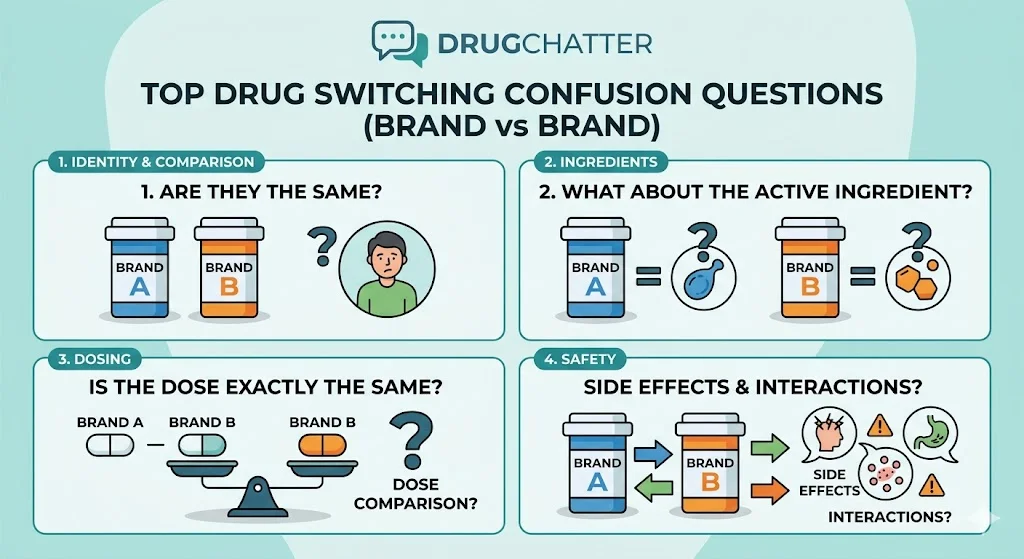
Query an AI system with ‘My insurance won’t cover [branded drug]. What should I do?’ and the response will almost invariably recommend exploring generic alternatives, biosimilar substitution where applicable, and patient assistance programs. This is reasonable advice — it reflects real cost constraints that real patients face. But it also means that every cost-framed query about a branded drug is, from the AI system’s perspective, an opportunity to recommend a lower-cost alternative.

For manufacturers with branded products facing biosimilar competition — Humira, Stelara, Enbrel, Keytruda in the not-distant future — AI monitoring of generic substitution queries is a specific commercial intelligence priority. Understanding how frequently AI systems recommend biosimilar substitution, in what patient populations, and with what framing, provides intelligence that no other monitoring system captures.


FDA Compliance and AI: What Manufacturers Must Track to Stay Ahead of Regulators

FDA Warning Letters, AI-Generated Content, and What the Precedents Mean for Your Brand

FDA’s Office of Prescription Drug Promotion has not issued comprehensive guidance on AI-generated pharmaceutical content. What it has done is apply existing promotional standards to AI-generated content without qualification — which, in practice, means that manufacturers cannot use AI as a defense against promotional violation claims.

The 2023 warning letter involving a pharmaceutical chatbot that generated promotional claims without fair balance established the foundational precedent: the channel does not change the standard. A chatbot generating promotional content is subject to the same requirements as a detail piece, a patient brochure, or a television advertisement. The fact that the output was generated by an AI system rather than written by a human copywriter is irrelevant to the promotional standard.

For manufacturers who have deployed AI tools in any patient-facing or HCP-facing context — patient support chatbots, AI-assisted MSL tools, digital health applications that include drug information — the implication is that every AI-generated output constitutes potential promotional content subject to FDA oversight. Monitoring those outputs for fair balance compliance is not optional. It is a regulatory obligation that flows directly from existing promotional regulations.

Off-Label Drug Promotion Risks in AI: Where the Regulatory Line Is Drawn

Off-label promotion is the area where AI monitoring intersects most directly with pharmaceutical regulatory risk, because the distinction between permissible scientific exchange and impermissible off-label promotion does not translate cleanly to AI-generated content.

A manufacturer’s medical affairs team can discuss off-label data with a physician in response to an unsolicited request. A manufacturer’s promotional team cannot proactively discuss off-label uses with any audience. An AI system deployed by a manufacturer that responds to patient queries about off-label uses — even accurately, drawing on published literature — is in a regulatory grey zone that FDA has not yet defined.

The safest approach for manufacturers with deployed AI tools is to treat any AI response about off-label use as potential promotional content, subject to the same review processes as a detail piece about an off-label indication. This is a conservative position, but it is the only position that is defensible if FDA issues a warning letter about an AI system’s off-label responses.

Third-party AI platforms discussing off-label uses of a manufacturer’s drug are a different category of risk — not direct regulatory exposure for the manufacturer, but a market intelligence signal that off-label use patterns are forming and may require proactive response through REMS programs, Dear Healthcare Provider letters, or medical affairs outreach.

Does Your Drug Have a Label Change Pending? Here Is Why That Affects AI Monitoring Priority

Label changes create a specific AI monitoring priority condition. When an FDA label change takes effect — adding a new indication, modifying a dosing recommendation, adding or removing a boxed warning, updating contraindications — the information in AI systems does not change on the same timeline. The model’s training cutoff determines when and whether that change gets incorporated.

For drugs with active label change processes, the gap between FDA action and LLM update is a period of elevated risk. Patients and physicians querying AI during this period will receive responses based on the old label. If the label change involves a new safety warning, patients who rely on AI for drug information may not receive it through that channel for months. If the label change expands an indication, AI systems will not recommend the drug for the new indication until their training data is updated.

Manufacturers with pending or recently approved label changes should treat the post-change period as an elevated AI monitoring priority, with increased query frequency and specific attention to whether AI responses are reflecting the current label or the prior version.

REMS Programs and AI: Are Patients Getting Accurate Safety Information From AI Systems

Risk Evaluation and Mitigation Strategy programs are FDA’s mechanism for managing drugs with serious known risks — requiring specific safety monitoring, patient enrollment, or use restrictions as a condition of market access. REMS requirements are among the most important elements of drug labeling from a patient safety perspective, and they are among the categories of information that AI systems most frequently misrepresent.

AI systems struggle with REMS information for two reasons. First, REMS programs are specific, procedural, and subject to modification — exactly the kind of detailed, current information that training data cutoffs most severely affect. Second, REMS information is not prominently featured in the consumer health content that dominates AI training data — it lives in prescribing information, FDA communications, and REMS program materials that are less web-prominent than patient forum discussions and consumer health articles.

For drugs with REMS programs, AI monitoring should include specific queries designed to test whether AI systems accurately represent REMS requirements to patients and physicians. A patient receiving incorrect information about monitoring requirements for isotretinoin, clozapine, or any other REMS-mandated drug from an AI system faces real safety risk. Detecting those inaccuracies is a patient safety function, not just a compliance exercise.


Patient Sentiment and Voice-of-Customer Intelligence From AI Monitoring

What AI Monitoring Reveals About Patient Concerns That Market Research Misses

Traditional patient market research — surveys, focus groups, interviews — captures what patients say when asked. AI query analysis captures what patients ask when they think no one is watching. The difference is significant, because patients ask AI questions they would not ask a physician, a pharmacist, or a market researcher.

The questions patients ask AI about their medications reveal unmet information needs, fears, misconceptions, and decision points that patient education materials rarely address adequately. Systematic analysis of query patterns — what questions real patients ask about your drug, in what vocabulary, with what implicit assumptions — is a form of voice-of-customer research that traditional market research cannot replicate.

A manufacturer that knows patients are systematically asking AI about their drug’s interaction with a common supplement they did not think to mention in patient education materials has an actionable insight. A manufacturer that knows patients are asking about dosing flexibility in ways that suggest they are routinely adjusting their own doses has a patient safety signal. These insights do not come from FAERS reports or prescription data — they come from the queries patients are sending to AI systems right now.

Nocebo Effects and AI: How Negative AI Drug Narratives Hurt Real-World Outcomes

The nocebo effect — negative health outcomes driven by negative expectations — has been documented in pharmaceutical clinical trials for decades. Patients who expect side effects report them at higher rates, experience them more severely, and discontinue treatment more frequently than patients who do not have those expectations. The effect is real, it is clinically significant, and it has a direct impact on real-world effectiveness data relative to clinical trial outcomes.

AI-generated drug information is now a significant source of negative expectation-setting for new-to-therapy patients. The training data composition problem that causes AI systems to overweight rare and severe adverse events means that a patient researching a new medication by asking ChatGPT will frequently encounter a side effect profile that is more alarming than what the prescribing physician communicated. That discrepancy creates exactly the expectation mismatch that drives nocebo effects.

Manufacturers who track the sentiment and completeness of AI-generated side effect profiles for their drugs are, in effect, monitoring a real-world confounder in their outcomes data. A drug that performs worse in real-world effectiveness studies than in clinical trials, in a patient population that over-indexes on AI health information seeking, may be facing an AI-driven nocebo problem rather than a genuine efficacy issue.

How to Use AI Monitoring Data to Improve Patient Education Materials

The most direct commercial application of patient voice-of-customer intelligence from AI monitoring is improving the content of patient education materials. Manufacturers invest significantly in FDA-reviewed patient guides, medication guides, and digital patient education content. Those materials are designed to address the questions manufacturers think patients will have — which is systematically different from the questions patients actually ask.

AI monitoring data bridges that gap. If analysis of patient queries to AI systems reveals that a high proportion of patients ask about a specific drug interaction that existing patient materials address inadequately, that is an actionable content gap. If patients are consistently asking AI to explain a side effect in plain language that the existing medication guide describes only in clinical terms, that is a readability gap. If patients are asking AI questions about drug storage or administration that would be addressed by a brief instructional video the manufacturer has not produced, that is a content format gap.

Each of these gaps is identifiable from AI query analysis and addressable through patient education content strategy — without requiring a primary market research study, a focus group recruitment effort, or a months-long research timeline.


The Physician Perception Dimension: What AI Tells HCPs About Your Drug

How Physicians Use AI for Drug Information — And Why It Matters for Medical Affairs

The American Medical Association’s 2024 digital health survey found that 38% of physicians reported using a general-purpose AI chatbot for clinical information at least monthly. That number has increased in every quarterly measurement since AI chatbots became mainstream tools, and it is expected to continue increasing as AI capabilities improve and physician workflows increasingly integrate AI tools.

The clinical queries physicians send AI systems are qualitatively different from patient queries. Physicians ask about mechanisms of action, clinical trial endpoints, head-to-head efficacy data, dosing in renal or hepatic impairment, management of specific adverse events, and drug interactions in complex polypharmacy patients. These queries are more specific, more clinical, and more likely to reveal gaps between what the published literature supports and what AI systems say.

Medical affairs teams exist to provide accurate scientific information to physicians. They have historically done this through MSL interactions, publication strategies, medical information request responses, and sponsored medical education. None of those channels addresses what AI systems tell physicians when they ask clinical questions at 9 p.m. before a complex patient consultation. AI monitoring of physician-relevant query types extends the reach of medical affairs without requiring additional field resources.

What Do AI Systems Tell Oncologists About Keytruda vs. Opdivo? A Competitive Framing Analysis

The immuno-oncology category provides one of the clearest demonstrations of AI competitive framing analysis, because it involves multiple drugs with overlapping indications, a rich body of comparative clinical literature, and physicians who are actively using AI to navigate complex treatment decision trees.

Keytruda (pembrolizumab, Merck) and Opdivo (nivolumab, Bristol Myers Squibb) compete across multiple oncology indications, with different approval footprints, different biomarker strategies, and different head-to-head data. When oncologists query AI about treatment selection in specific tumor types and patient populations, the framing of AI responses reflects the AI’s synthesis of published clinical evidence — and that synthesis is not always accurate, balanced, or current.

AI monitoring of oncologist-relevant queries in this competitive space reveals which clinical differentiators are making it into AI responses and which are not, which trials are shaping AI framing, and whether the AI’s competitive positioning reflects the current state of the evidence or a historical snapshot that no longer represents the clinical reality. That intelligence is directly relevant to Merck’s and BMS’s medical affairs publication and education strategies.

AI-Generated Drug Interaction Warnings: When LLMs Get Pharmacology Wrong

Drug interaction queries are among the highest-risk categories for AI inaccuracy, because the stakes of a wrong answer are immediate and clinical. A physician who receives an incorrect drug interaction warning from an AI system may avoid a combination that is actually safe, depriving a patient of beneficial treatment. A physician who receives a false reassurance about a drug interaction may combine drugs that are genuinely contraindicated.

Benchmarking studies of LLM performance on drug interaction queries consistently find error rates that would be unacceptable in any approved clinical decision support system. The errors are not random — they cluster around specific categories: drug interactions that are real but overstated in the clinical literature get amplified by AI systems trained on content that similarly overstates them; newly identified interactions that postdate model training cutoffs are absent; and interactions that are well-established in specialized databases like Micromedex are sometimes missing from general-purpose LLM responses that were not trained on those databases.

Pharmaceutical manufacturers should specifically monitor AI responses to drug interaction queries involving their products, because those queries represent the highest-acuity accuracy requirement and the highest patient safety risk when AI systems get them wrong.


The ROI of Pharmaceutical AI Monitoring: Making the Business Case

How to Quantify the Commercial Value of AI Brand Monitoring for a Drug Portfolio

The business case for pharmaceutical AI monitoring rests on four value drivers, each measurable in terms that pharmaceutical commercial teams use to make investment decisions.

The first value driver is brand protection. AI share-of-voice in drug categories is already influencing patient demand and physician preference in measurable ways. A branded drug that is systematically absent from AI responses to indication-level queries loses awareness in a patient population that is increasingly using AI for health research. Quantifying this loss requires establishing a baseline AI share-of-voice and tracking it over time — which is only possible with systematic monitoring.

The second value driver is regulatory risk avoidance. The cost of an FDA warning letter for a promotional violation runs into the tens of millions of dollars in legal fees, remediation costs, and commercial disruption, before accounting for reputational damage. Proactive monitoring of AI-generated content about a manufacturer’s products — including AI tools the manufacturer has deployed — is a reasonable investment against that risk.

The third value driver is pharmacovigilance efficiency. Identifying AI-driven misinformation patterns before they generate adverse event reports or physician complaints allows manufacturers to intervene earlier and at lower cost than responding after a safety signal has already emerged. The value of early intervention in pharmacovigilance is well-established; applying that principle to AI-driven safety signals is a logical extension.

The fourth value driver is competitive intelligence quality. AI monitoring generates competitive intelligence that no other monitoring system produces — specifically, how AI systems frame head-to-head comparisons without prompting, which competitors gain AI visibility following clinical publications, and how generic substitution recommendations evolve in real time. That intelligence has direct value for brand strategy and launch planning.

What DrugPatentWatch Data Tells You About AI Visibility Timing Around Patent Cliffs

Patent expiration is the commercial event that most dramatically reshapes AI share-of-voice for branded drugs, because generic entry generates a rapid expansion of generic-related content in the information environment that trains AI systems. DrugPatentWatch provides real-time patent status data that, combined with AI monitoring, allows manufacturers to predict and track AI visibility changes around patent cliff events.

The AI visibility shift typically begins before generic market entry, as coverage of pending patent challenges, FDA generic application filings, and biosimilar development programs generates training-relevant content. A manufacturer monitoring AI responses around an approaching patent cliff can see the AI share-of-voice erosion beginning before generics reach pharmacy shelves — early enough to inform both commercial defense strategies and the content strategy for the period immediately following generic entry.

Building the Internal Stakeholder Case for AI Monitoring Investment

Pharmaceutical companies making the internal case for AI monitoring investment face a specific challenge: the decision-makers who control the budget — heads of brand, commercial operations, regulatory affairs, and pharmacovigilance — are not yet experiencing the consequences of the monitoring gap in ways that have surfaced in formal reporting. The problem is invisible until you build the monitoring infrastructure to see it.

The most effective internal stakeholder argument combines a concrete demonstration — running a systematic AI share-of-voice audit of the current portfolio across the five major platforms and presenting the results — with a regulatory risk frame that connects AI monitoring to existing pharmacovigilance and promotional compliance obligations. The demonstration provides the commercial relevance. The regulatory frame provides the compliance urgency.

Regulatory affairs and pharmacovigilance leaders are typically more immediately responsive to the compliance argument than commercial leaders are to the brand argument, because their professional obligations create a lower tolerance for unmonitored risk. Starting the internal conversation with regulatory affairs and pharmacovigilance, rather than brand, often produces faster organizational traction for AI monitoring investment.


Key Takeaways

  • The pharma AI visibility problem is structural and ongoing: AI systems are generating pharmaceutical information continuously, and most manufacturers have no systematic way to know what those systems are saying about their products, their competitors, or their patients’ treatment options.
  • Traditional monitoring tools — social listening platforms, search rank trackers, media monitoring services — cannot solve this problem because AI outputs are not persistent web content. Monitoring AI requires sending queries and capturing responses, not crawling what already exists online.
  • The five core failure modes driving the need for purpose-built monitoring are: manual spot-checking that produces anecdote rather than intelligence; knowledge cutoff gaps that mean AI responds confidently with outdated labeling information; training data bias that systematically disadvantages branded drugs; off-label discussion without regulatory context; and the absence of any cross-platform AI share-of-voice baseline for competitive comparison.
  • Pharmacovigilance teams have specific, urgent reasons to incorporate AI monitoring into their programs. AI-driven adverse events are occurring but are invisible to FAERS because patients do not identify AI as the source of their treatment decisions. EMA’s 2024 reflection paper signals that AI monitoring is within scope of pharmacovigilance obligations for European marketing authorization holders.
  • FDA’s enforcement posture is clear on one point: the channel does not change the promotional standard. AI-generated content in manufacturer-deployed systems is subject to the same fair balance requirements as any other promotional channel. REMS program information, off-label content, and comparative efficacy claims all require monitoring regardless of whether they appear in a chatbot, a sales tool, or a printed brochure.
  • AI monitoring generates four categories of commercial value: brand protection through share-of-voice tracking, regulatory risk avoidance through compliance monitoring, pharmacovigilance efficiency through early signal detection, and competitive intelligence through framing analysis that no other monitoring system provides.
  • DrugChatter exists because this monitoring gap is real, the consequences are material, and the gap cannot be closed with tools designed for a different information environment. The AI information environment requires infrastructure built specifically for it.

FAQ

What exactly is the pharma AI visibility problem and why does it matter now?

The pharma AI visibility problem is the gap between what pharmaceutical companies believe AI systems are saying about their products and what those systems are actually saying, across the queries real patients and physicians send them daily. It matters now because AI chatbots have become a primary drug information source for tens of millions of patients — ahead of calling a pharmacist, visiting a patient advocacy website, or reading the medication guide. A manufacturer that does not know how its drug is characterized in AI responses does not know what patients are learning about their product before they fill their prescription, before they take the first dose, or before they decide whether to continue treatment.

How does DrugChatter monitoring differ from standard social media listening for pharmaceutical brands?

Social listening tools monitor content that humans have posted — Reddit threads, forum discussions, news articles. They crawl and index text that already exists on the web. AI-generated responses are not persistent web content. They are generated in real time, in response to specific queries, and they do not exist as indexable artifacts unless someone explicitly posts them. Monitoring AI outputs requires sending queries to AI platforms, capturing the responses, storing them, and analyzing them systematically over time. DrugChatter does this with pharmaceutical-specific query libraries, accuracy benchmarking against current FDA-approved labeling, and pharmacovigilance-relevant categorization — capabilities that no general-purpose social listening tool provides.

Can AI monitoring data actually be used in a pharmacovigilance program?

AI monitoring data cannot replace spontaneous adverse event reports or substitute for FAERS submission obligations. But it can supplement traditional pharmacovigilance in meaningful ways. Patterns in AI responses about a drug’s safety profile — particularly when those patterns emphasize adverse events at frequencies inconsistent with the approved label — may indicate that those adverse events are discussed prominently enough in public sources to have shaped the model’s response tendencies. That pattern can prompt more rigorous investigation through traditional channels. Several pharmaceutical companies have piloted programs that treat AI safety signal patterns as a supplementary input to signal detection decision-making. EMA’s 2024 reflection paper suggested that monitoring AI-generated content about marketed products may be within scope of pharmacovigilance obligations for European authorization holders.

How frequently do AI systems need to be queried for pharmaceutical AI monitoring to be meaningful?

Monitoring frequency depends on the risk profile of the product and the purpose of the monitoring. For products with active safety reviews, pending label changes, or significant off-label discussion, daily or near-daily systematic querying provides the most current signal. For stable products in established categories, weekly or bi-weekly monitoring typically captures commercially meaningful shifts in AI framing or share-of-voice. The important principle is that a single spot-check at any frequency provides anecdote rather than intelligence. Meaningful pharmaceutical AI monitoring requires tracking changes in AI responses over time, across multiple platforms, across a large enough query library to average out the probabilistic variation inherent in LLM output generation.

What should pharmaceutical companies do when they find that an AI system is generating inaccurate information about their drug?

The response depends on the nature and severity of the inaccuracy. Dosing errors and false safety contraindications represent the highest priority category and should be escalated immediately to pharmacovigilance and regulatory affairs for assessment of patient safety risk and potential regulatory reporting obligations. Inaccurate efficacy or framing claims warrant a medical affairs content response — ensuring that accurate, authoritative, AI-retrievable content about the drug is published and accessible in the sources that AI systems are most likely to draw from. Off-label inaccuracies require legal review before any response is formulated, because the response itself could constitute promotional activity. All findings should be documented systematically in monitoring records that can support regulatory inquiries about the manufacturer’s monitoring program.

DrugChatter - Know what AI is saying about your drugs
Scroll to Top