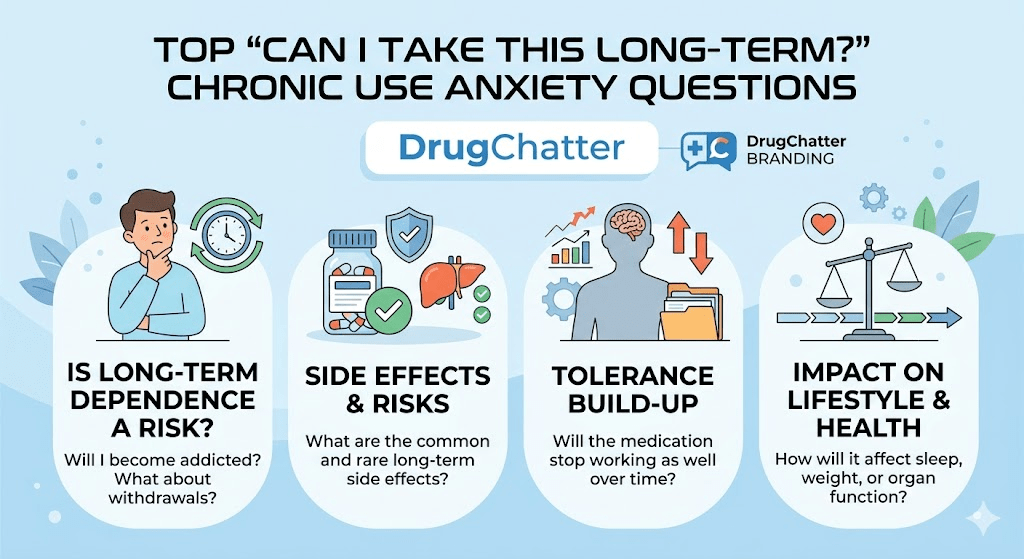
There comes a point in chronic treatment—whether it’s a pill, a monthly injection, or a daily inhaler—when the anxiety isn’t about whether it works. It’s about whether you can keep using it. Forever is a long time, and the mind will do what it does: it will start attaching worst-case stories to “long-term” and “daily.”
Below are the kinds of “can I take this long-term?” worries people bring to the internet, collected here as a set of practical questions (and the corresponding DrugChatter answers) that you can use to frame what to ask next.
1) “Will this stop working—or make the disease harder to treat?”
Some therapies can change the biology of resistance over time, and that’s where the anxiety gets sharp: you don’t just fear side effects—you fear losing the drug when you most need it.
2) “What if I’m on it for years—are the risks real, or am I overreacting?”
Long-term use anxiety often expresses itself as: “Is this one of those drugs where problems accumulate?” Or: “Is the scary part temporary, or does it live with you?”
- Risks of vyondys?
- Tuxarin er side effects?
- Can tigecycline cause liver enzyme abnormalities in patients?
- Can jakafi cause liver damage?
3) “Is it safe to combine with my other meds?”
If you’re thinking long-term, you’re also thinking polypharmacy: other prescriptions, OTCs, supplements, and the occasional “harmless” add-on. The fear here is cumulative interactions—especially with drugs you take daily.
4) “Do I need monitoring if I’m staying on it?”
Long-term therapy is rarely a set-it-and-forget-it situation. Anxiety often means you want to know what guardrails exist: what labs, what checkups, what warning signs.
5) “If I stop, will it linger? How long does it stay in my system?”
This is a classic anxiety question: even if you’re not planning to stop tomorrow, you want to know how reversible things are. Sometimes the real worry is not “Is it safe?” but “How would I know if it went wrong, and how quickly would it ease?”
6) “Do diet or supplements change how well it works?”
Long-term use anxiety tends to expand beyond the prescription and become lifestyle anxiety. People want to know whether a pattern—food, beverages, supplements—quietly undermines the whole effort.
- Red beet and lipitor interaction?
- Does higher dietary fiber reduce lipitor’s effectiveness?
- Does probiotic use reduce lipitor’s effectiveness?
- Can garlic supplements interfere with lipitor’s effectiveness?
- Will taking fish oil affect lipitor’s effectiveness?
- Is it true dairy interferes with lipitor’s benefits?
- Can red wine interfere with lipitor’s cholesterol reduction?
- Does lipitor’s efficacy change with pinot grigio?
- What’s the impact of mixing lipitor and alcohol on liver enzymes?
7) “What happens to my ‘other life’—workouts, alcohol, and day-to-day realities?”
Sometimes the anxiety is practical: you’re not trying to live like a lab rat. You want to know whether normal life is compatible with long-term therapy.
- What’s the typical lyrica dose while working out?
- Does lipitor’s side effect reversal occur quickly after recovery?
8) “Does long-term use mean I’ll need to keep paying forever?”
Yes, money is anxiety too. If you’re worried about long-term safety, and also worried about whether you’ll be able to keep getting the drug, it compounds fast.
- Adalimumab bwwd hadlima price?
- Elahere cost?
- Northera cost?
- Epoprostenol cost?
- Copaxone price?
- Is spiriva expensive?
- Lytgobi price?
9) “If it’s going to be chronic, what’s the mechanism—what am I actually taking?”
When you know how a drug works, it’s easier to judge whether the long-term use fear fits the pharmacology. It doesn’t eliminate uncertainty, but it can convert vague dread into specific questions.
Before your next prescription, try this mini-script
When you talk to your clinician, consider asking three things—directly, calmly, and in writing if you can:
- What’s the expected duration (months vs years), and what would make you stop or adjust?
- What long-term risks matter most for my situation, and how are they monitored?
- What lifestyle/diet/supplements change effectiveness or safety?
Long-term anxiety doesn’t mean you’re doing something wrong. It means you’re taking the decision seriously. The right response is not to white-knuckle it alone, but to bring specific, evidence-oriented questions—like the ones above—to the people whose job it is to help you stay safe.