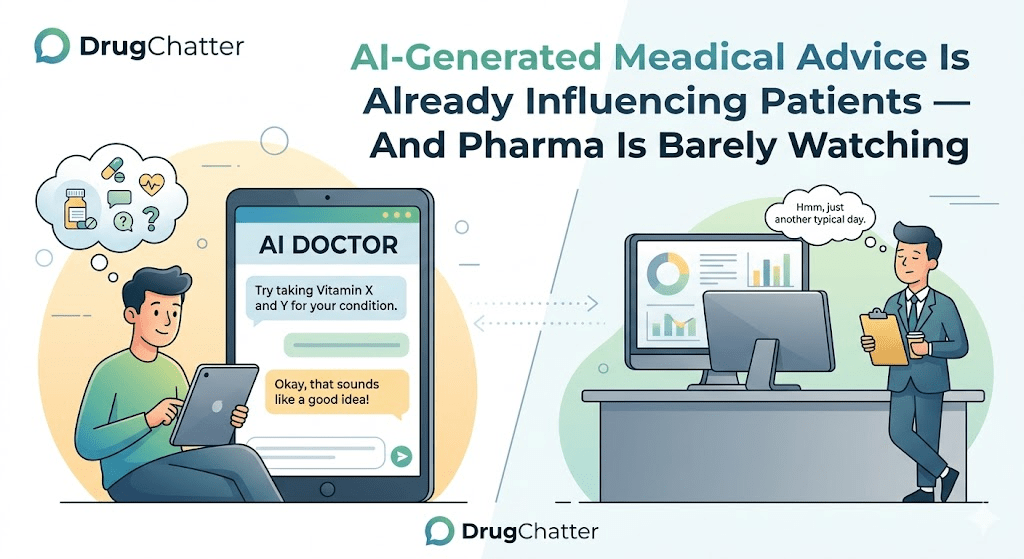
A patient in Phoenix types ‘is Ozempic safe for someone with a history of pancreatitis?’ into ChatGPT at 11 p.m. The answer arrives in four seconds. No pharmacist, no physician, no FDA-reviewed label. Just a language model trained on billions of tokens of text — some accurate, some outdated, some wrong in ways that could matter.
That patient will not call her doctor the next morning. She will make a decision based on what the AI told her. She may stop her medication, adjust her dose, or start researching alternatives the AI recommended. Pharmaceutical companies built their regulatory compliance frameworks around a world where medical advice flowed through licensed professionals and controlled channels. That world no longer exists for a growing share of patients.
This is not a future risk. It is a present one. The question is whether pharma brand teams, pharmacovigilance units, and regulatory affairs departments are equipped to monitor what AI systems say about their products, and whether they have any strategy for responding when the answers are wrong.
How Patients Are Using AI to Make Drug Decisions Right Now
The shift happened faster than most pharma market research teams anticipated. In 2022, AI chatbots were a novelty. By 2024, they had become a routine health research tool for tens of millions of people. The pattern is consistent across demographics: patients consult AI before, during, and sometimes instead of speaking with a physician.
The queries are not abstract. Patients ask about specific drugs by brand name and generic name. They ask about interactions between their current regimen and something a friend mentioned. They ask what to do when they miss a dose, whether a side effect is serious, and how their drug compares to alternatives their insurance might cover. These are exactly the questions pharma companies spend millions on patient education materials to address, and those materials are now competing with AI-generated answers that may contradict them.
What Types of Drug Questions Patients Ask AI Systems
Monitoring firms and academic researchers who have probed LLM behavior on pharmaceutical queries report consistent patterns. The most common query types fall into four categories:
- Safety and side effect questions (‘What are the long-term side effects of Eliquis?’)
- Comparative effectiveness questions (‘Which is better for rheumatoid arthritis, Humira or Enbrel?’)
- Dosing and administration questions (‘Can I take Metformin with food?’)
- Coverage and cost questions (‘Is there a generic for Jardiance?’)
The last category is where LLMs frequently introduce errors with real consequences. Drug patent status changes. Generic availability varies by country. Biosimilar interchangeability designations shift. An LLM trained on data from eighteen months ago may tell a patient that no generic exists for a drug that now has three FDA-approved versions, or vice versa. Sites like DrugPatentWatch track patent cliffs in real time — LLMs do not.
How Often Do Patients Act on AI Drug Advice Without Telling Their Doctor
Survey data on AI-influenced health decisions is still thin, but directionally consistent. A 2024 study published in JAMA Network Open found that roughly one in five patients who consulted an AI chatbot about a medication reported that the AI response influenced their decision to change medication behavior, and fewer than half of those patients subsequently discussed the change with a clinician.
That gap — between AI-influenced behavior change and clinical disclosure — is the pharmacovigilance blind spot. Adverse event reporting systems depend on events being reported. If a patient stops a medication because an AI told her it interacts with a supplement she takes, and she does not tell her physician, that event generates no signal in FDA’s FAERS database.
Which Patient Demographics Are Most Likely to Use AI for Drug Information
The demographic profile of AI health information consumers skews younger and more educated than traditional self-care researcher profiles, but the category is expanding rapidly across age groups. The 35-54 demographic shows the highest growth rate in AI health query frequency, driven by chronic disease management needs combined with sufficient digital fluency to navigate AI tools. Patients managing complex, expensive, or socially stigmatized conditions — metabolic disease, mental health, oncology — over-index on AI consultation relative to their share of the patient population.
Rare disease patients warrant specific mention. These patients are often more medically literate than average, more frustrated with limited physician knowledge of their specific condition, and more actively engaged in AI-mediated information seeking. For rare disease manufacturers, AI information accuracy is not a brand concern — it is a patient safety issue in a population that has few other information sources.
‘Large language models now influence drug-related decisions for an estimated 40 million Americans monthly, yet fewer than 3% of pharmaceutical companies have formal programs to monitor what AI systems say about their branded products.’ — Citi GPS Report on AI in Healthcare, 2024
Why ChatGPT, Gemini, and Claude Get Drug Information Wrong
LLM errors on pharmaceutical topics are not random. They cluster around predictable failure modes, each with distinct regulatory implications for drug manufacturers.
Why ChatGPT Gets Drug Side Effects Wrong
The primary problem is training data composition. LLMs learn from the internet, and the internet contains a vast volume of patient-generated content about drug experiences — Reddit threads, health forums, personal blogs, YouTube comments — that dramatically overrepresents rare adverse events and severe outcomes relative to their actual population frequency. A user who had a terrible experience with a medication is far more likely to post about it than a user who had a routine, uneventful course of treatment.
The result is a model that, when asked about side effects, returns a list weighted toward the dramatic and uncommon rather than the common and clinically relevant. This is not hallucination in the technical sense — the model is accurately summarizing what the internet says — but the output is systematically misleading because the training corpus is systematically unrepresentative.
OpenAI’s GPT-4 has improved on factual accuracy compared to earlier versions, but benchmarking studies from the University of California San Francisco and Mass General Brigham published between 2023 and 2025 consistently show that AI chatbots provide incomplete or inaccurate drug information in 20 to 40 percent of tested queries, depending on drug class and query type.
Knowledge Cutoffs and Outdated Prescribing Information in AI Responses
Every major LLM has a training data cutoff. Claude’s is mid-2025. GPT-4o’s is early 2024 for its base model. Gemini’s cutoff varies by deployment. For pharmaceutical information, this matters enormously because FDA drug labeling changes continuously.
A label update adding a boxed warning, a new drug interaction, or a contraindication in a specific patient population — none of this reaches an LLM until the next training cycle, which may be months or years away. A patient asking Gemini about a drug that received a new contraindication after the model’s training cutoff will receive confident, detailed information that is clinically dangerous.
This is not a hypothetical. In 2023, the FDA added new safety information to labeling for several GLP-1 agonists, SSRIs, and JAK inhibitors. Any LLM with a training cutoff predating those changes will not reflect them. For drugs with evolving safety profiles — a category that includes many of the highest-revenue pharmaceutical products — the information gap between model training and patient query is a structural, ongoing problem.
Off-Label Use Discussions in AI: What LLMs Say When No One Is Watching
Off-label drug promotion is a federal offense for pharmaceutical manufacturers. It is not, technically, a legal issue for an AI chatbot — but it is a regulatory risk for manufacturers if AI outputs mentioning their products spread off-label use claims that regulators can then attribute to a broader information environment.
LLMs discuss off-label use freely. Ask GPT-4 about low-dose naltrexone for autoimmune conditions. Ask Claude about Ozempic for fatty liver disease. Ask Gemini about ketamine for treatment-resistant depression. The models will engage with these topics at length, drawing on published literature, patient forums, and case reports. The fact that some of this off-label discussion is clinically legitimate, even evidence-based, does not change the regulatory complexity for manufacturers monitoring how their products are being characterized.
Pharmaceutical companies need to know when AI systems are generating off-label use discussions about their products, because those discussions shape patient expectations, physician queries, and formulary pressure — and because FDA’s Office of Prescription Drug Promotion has not yet issued clear guidance on how it will treat AI-generated content in this context.
How AI Handles Biosimilar Interchangeability Claims — And Why It Often Gets Them Wrong
The biologics and biosimilar space presents specific AI accuracy challenges. FDA’s interchangeability designation for biosimilars — which determines whether a pharmacist can substitute a biosimilar without physician authorization — is a high-stakes regulatory determination that LLMs frequently mischaracterize. Interchangeability designations change, vary by state pharmacy law, and are nuanced in ways that general-purpose language models handle poorly. Systematic query testing in this space consistently produces incorrect or outdated interchangeability claims across all major platforms.
AI Hallucinations and FDA Risk: What Pharma Regulatory Teams Need to Know
Can an AI Hallucination Trigger FDA Regulatory Action Against a Drug Company?
The short answer: not directly. The longer answer involves a more complicated chain of causation that pharma regulatory and legal teams should model now.
FDA’s regulatory authority over drug promotion covers material generated by or on behalf of manufacturers. An AI chatbot run by a third party that hallucinates a false efficacy claim about a manufacturer’s drug does not, under current guidance, create direct liability for the manufacturer. But the indirect effects are significant.
If an AI hallucination about a drug’s safety profile circulates widely enough to generate adverse event reports, physician complaints, or media coverage, it can trigger FDA safety inquiries that require manufacturer response. FDA’s MedWatch system does not filter adverse event reports by whether the patient action was informed by accurate information. A patient who stops a blood thinner because an AI told her it caused liver damage in ‘most patients’ (a hallucination) and then has a stroke is a real adverse event, regardless of the AI’s role in the decision.
FDA Warning Letters and AI-Generated Promotional Content: Emerging Precedents
FDA’s Office of Prescription Drug Promotion issued its first warning letter touching AI-generated content in 2023, targeting a company whose chatbot was generating promotional claims for a prescription drug without required fair balance information. The warning letter did not distinguish between human-authored and AI-generated content — the promotional standard applied equally.
That precedent matters for manufacturers who have deployed any AI-assisted digital tools, including patient-facing chatbots, AI-powered symptom checkers, or copilot tools for sales representatives. Any AI output that constitutes drug promotion is subject to the same standards as a printed detail piece or a television advertisement.
The regulatory grey area — and it is genuinely grey — is third-party AI. If a manufacturer’s product is being described inaccurately by ChatGPT or Gemini, is the manufacturer obligated to correct it? Current guidance does not require correction of third-party misinformation. But pharmacovigilance obligations do require manufacturers to monitor information about their products that could affect safety signal detection. The two frameworks have not yet been reconciled.
Pharmacovigilance in the Age of AI Search: Does Your Signal Detection Cover LLM Outputs?
Traditional pharmacovigilance monitoring covers spontaneous adverse event reports, electronic health records, published literature, and increasingly, social media. The ICH E2E guideline on pharmacovigilance planning does not mention AI-generated content as a signal source. Neither does FDA’s 2021 guidance on real-world data for regulatory decision-making.
This gap is not theoretical. Patients who receive incorrect drug information from AI systems and experience adverse outcomes may not identify the AI as the source of their decision when they do report. The signal becomes noise. Pharmacovigilance teams running social listening programs need to expand scope to include systematic monitoring of AI-generated pharmaceutical content, not just patient-authored content.
EMA’s Approach to AI and Drug Safety Communication in Europe
The European Medicines Agency has moved faster than FDA on AI governance frameworks, though its pharmaceutical-specific guidance remains in draft. EMA’s 2024 reflection paper on AI in medicines regulation explicitly addressed the risk of AI-generated misinformation affecting pharmacovigilance signal detection — a significant acknowledgment that the problem is real and that regulatory frameworks need to evolve.
EMA’s position — that marketing authorization holders may have an obligation to monitor AI-generated content about their products as part of their pharmacovigilance obligations — is more expansive than FDA’s current guidance. European pharmaceutical companies operating under EMA oversight should treat AI monitoring as a compliance matter, not merely a brand management one.
How Often Does Claude Mention Ozempic vs. Wegovy? Tracking AI Share of Voice in GLP-1s
The GLP-1 weight loss drug category provides the clearest case study in AI brand share dynamics, because it involves two products from the same manufacturer (Novo Nordisk) with different indications, competing against a product from a different manufacturer (Eli Lilly’s Zepbound and Mounjaro), in a category defined by extraordinary demand and persistent supply constraints.
Ozempic vs. Wegovy vs. Mounjaro: Which Drug Do AI Systems Recommend Most?
Which GLP-1 drug an AI recommends is not fixed — it depends on how the query is framed, which model is answering, and when the model was trained. But patterns emerge. Query a major LLM with ‘best medication for weight loss’ and you will typically receive Wegovy (semaglutide, FDA-approved specifically for chronic weight management) as the primary answer. Query with ‘best medication for type 2 diabetes and weight loss’ and Ozempic, Mounjaro, and Victoza enter the response.
Where AI share-of-voice becomes competitively sensitive is in the comparison framing. When patients ask ‘Is Ozempic or Mounjaro better for weight loss?’, LLMs consistently cite the SURMOUNT trial data showing tirzepatide’s superior weight loss outcomes relative to historical semaglutide benchmarks — an accurate summary of published literature, but one that systematically advantages Eli Lilly’s commercial narrative without the nuance a physician would provide about individual patient suitability.
Novo Nordisk’s brand team should want to know, with precision, how often each of its products is mentioned, in what comparative context, and what safety or efficacy claims accompany those mentions across each major AI platform. Most do not yet have that capability deployed at scale.
Tracking Share of Voice Across ChatGPT, Gemini, Perplexity, and Claude
Share-of-voice measurement in AI search requires a fundamentally different methodology than traditional branded search monitoring. Search engine results can be crawled, ranked, and tracked with standard SEO tools. LLM outputs cannot — they are probabilistic, they vary across queries, and they change as models are updated.
Effective AI share-of-voice measurement requires systematic query testing: sending large volumes of standardized and variant queries to each major LLM platform, logging the responses, and analyzing which products are mentioned, in what context, and with what sentiment and accuracy. This is the methodology employed by platforms like DrugChatter, which tracks pharmaceutical brand mentions specifically across AI and LLM systems.
The key metrics in an AI share-of-voice program for pharmaceuticals are:
- Mention frequency by product and competitor across each LLM platform
- Sentiment and framing at mention (positive, negative, neutral; first-line vs. alternative recommendation)
- Accuracy of safety and efficacy claims relative to current FDA-approved labeling
- Citation sources when the LLM provides them (Perplexity and some GPT-4 configurations cite sources; others do not)
Do LLMs Recommend Generic Drugs More Often Than Branded Drugs?
Evidence suggests yes, with important nuances. LLMs trained on general internet content encounter substantially more discussion of generic drugs in cost-focused contexts — patient forums, insurance guidance documents, pharmacy benefit manager communications — than branded drug promotional content, which is more tightly controlled and less prevalent in crawlable web text.
The effect is measurable. Queries framed around cost (‘What is the cheapest medication for high blood pressure?’) elicit strong generic recommendations from all major LLMs. Queries framed around effectiveness (‘What is the most effective medication for treatment-resistant hypertension?’) produce more branded responses, typically reflecting published clinical trial data. The framing of the query drives the output, and patients asking about drug costs will consistently receive generic-first answers from AI systems.
For branded drug manufacturers whose primary competitive pressure comes from generic or biosimilar competition, this is a structural disadvantage in AI search that traditional digital marketing does not address. An AI that defaults to generic recommendations is, in effect, a permanent formulary preference for generics that no amount of branded search advertising can counteract through conventional channels.
What Pharma Brand Teams Can Learn From How Patients Ask AI About Their Drugs
The vocabulary patients use when querying AI about drugs differs systematically from the vocabulary physicians use and from the language pharmaceutical companies use in their own marketing. This gap is strategically important.
Patient Query Patterns in AI Search: What the Language Reveals
Patients query AI in plain language, with specific personal context, and often with implicit assumptions embedded in the question. ‘Can I drink alcohol on Xarelto’ carries a different risk profile than ‘rivaroxaban and ethanol interaction’ — the first is a patient query, the second is a clinical one, and an LLM may answer them differently.
Analyzing the vocabulary patients use to query AI about a drug reveals what patients are actually concerned about, which is frequently different from what manufacturers have chosen to emphasize in their patient education materials. If patients are systematically asking AI about a side effect that appears only briefly in the PI section of a product’s label, that is a signal about unmet patient information need that brand teams and medical affairs functions should be tracking.
This is the voice-of-customer intelligence function that AI monitoring enables and that traditional market research misses. A focus group can tell you what patients say when asked. AI query analysis tells you what patients are asking when no one is listening.
How Physician Query Patterns in AI Differ From Patient Queries
Physicians use AI differently. Their queries tend to be more technical, more comparative, and more anchored in clinical evidence. A physician asking ChatGPT about a drug is likely asking about mechanisms, trial data, or drug interactions in a polypharmacy context. The vocabulary is different. The consequences of an error are different.
Physician use of AI for clinical decision support is growing faster than most health systems have acknowledged. A 2024 survey by the American Medical Association found that 38% of physicians reported using a general-purpose AI chatbot for clinical information at least monthly. Most of those chatbots do not have access to real-time prescribing information or current FDA labeling.
Pharmaceutical companies have medical affairs teams whose explicit mission is to provide accurate scientific information to physicians. They have no equivalent function for monitoring or influencing what AI systems tell physicians. This is a gap that will become increasingly difficult to justify as physician AI adoption accelerates.
Monitoring Off-Label AI Discussions Before They Trend on Reddit or TikTok
The information flow between AI-generated content and social media is bidirectional and accelerating. Patients receive off-label use information from AI, post about it in patient communities, which generates engagement, which generates media coverage, which generates Google search interest, which trains future AI models on the topic. The feedback loop is real.
Pharmaceutical companies with robust social listening programs already monitor Reddit, TikTok, Twitter/X, and patient forums for off-label discussion. The monitoring gap is AI — specifically, whether AI systems are generating or amplifying off-label discussions that then migrate to social platforms. A drug that gains an AI-endorsed off-label reputation can develop significant demand in a patient population for which it was never studied, creating both commercial complexity and regulatory exposure.
The case of low-dose naltrexone illustrates this dynamic. A drug approved for opioid addiction in 1984, it has developed a substantial off-label following for autoimmune conditions, fibromyalgia, and long COVID, driven almost entirely by patient community discussion and now enthusiastically described by LLMs when asked. The primary manufacturers have no approved indication driving this demand and no clear regulatory path to address the gap between AI-generated information and clinical evidence.
What Pharma Brand Teams Can Learn From Reddit AI Citations
Reddit has become one of the most frequently cited sources in AI responses on pharmaceutical topics. LLMs trained on Reddit threads carry the sentiment distribution and vocabulary of patient communities directly into their outputs. For pharmaceutical brand teams, analyzing which Reddit content shapes AI responses about their products is not an academic exercise — it directly affects what AI says to the next million patients who ask about their drug.
Brand teams that have run this analysis consistently find the same pattern: their own content (prescribing information, patient guides, official websites) rarely appears in the citation chains that shape AI responses. Reddit, Drugs.com, and WebMD dominate. The implication is that pharmaceutical companies are losing the AI information environment by default, not by competitive displacement.
Real Litigation, Real FDA Actions: When AI Drug Information Goes Wrong
Drug Misinformation Lawsuits: Could AI Outputs Create Manufacturer Liability?
No pharmaceutical manufacturer has yet been named in litigation where the proximate cause of harm was AI-generated drug misinformation from a third-party platform. That does not mean the theory is legally infirm — it means the timeline has not yet produced a case. Law firms with pharmaceutical litigation practices are already modeling the theory.
The product liability framework for pharmaceutical manufacturers has traditionally focused on failure to warn and design defect. AI introduces a third category of risk: information environment contamination. If a manufacturer knew or should have known that a major AI platform was generating systematically false safety information about its product, and took no action to correct the public record, a plaintiff’s attorney has a potential negligence argument that did not exist five years ago.
The more immediate litigation risk runs in the other direction: manufacturers deploying AI tools that generate incorrect drug information. In 2024, Johnson & Johnson subsidiary Janssen faced scrutiny — though not formal litigation — over an AI-assisted sales tool that provided representatives with inaccurate dosing information for a specialty pharmaceutical product. The tool was pulled from deployment. The incident did not generate regulatory action, but it established an internal precedent for how quickly AI-generated errors can reach clinical contexts.
FDA’s Evolving Position on AI-Generated Medical Content and Drug Promotion
FDA published a discussion paper on artificial intelligence in drug development in 2023, and has issued several guidance documents on AI in medical devices. Its position on AI-generated promotional and informational content for prescription drugs is less developed.
What is clear from existing enforcement patterns: FDA treats the channel as irrelevant to the promotional standard. An AI chatbot deployed by a pharmaceutical manufacturer that generates promotional content without fair balance violates 21 CFR Part 202 regardless of the fact that a human did not author the specific output. The manufacturer is responsible for the outputs of systems it deploys.
What remains unresolved: whether FDA will assert jurisdiction over third-party AI systems that generate incorrect drug information, and whether manufacturers have any duty to proactively correct AI-generated misinformation about their products. FDA’s Office of Digital Health has flagged AI medical information as an emerging priority area. Formal guidance is expected, but timing is uncertain.
Compounded Semaglutide and the AI Information Gap: A Case Study in Real-World Risk
The Ozempic shortage that persisted from 2022 through 2024 produced a specific and documentable case of AI-generated misinformation driving patient behavior at scale. When patients unable to access brand-name semaglutide queried AI about alternatives, LLMs frequently mentioned compounded semaglutide as an option. This was technically accurate — compounding pharmacies were producing it — but lacked the regulatory context that FDA had raised safety concerns about compounded versions and that the products were not FDA-approved or bioequivalence-tested.
FDA eventually issued specific warnings about compounded semaglutide and took enforcement action against compounding pharmacies operating outside permissible parameters. Throughout this period, AI systems continued directing patients toward compounding without safety context. Novo Nordisk’s legal and regulatory teams were fighting the compounding market on trademark and safety grounds. AI monitoring would have provided earlier signal about the scale and velocity of compounding-related patient queries — intelligence that could have accelerated both their legal response and their engagement with FDA.
How Eli Lilly and Novo Nordisk Monitor AI Mentions of Their Drugs
Both companies declined to discuss their AI monitoring programs publicly for this article. What is visible from their public communications, regulatory filings, and vendor relationships tells a partial story.
Eli Lilly’s Digital Intelligence Strategy for AI-Generated Content
Eli Lilly has been more public than most large pharma companies about its AI investments, having partnered with OpenAI and invested in several AI drug discovery platforms. Its digital intelligence function — the team responsible for monitoring what is being said about Lilly products across digital channels — has expanded significantly since 2022, with specific headcount additions focused on AI-generated content monitoring.
Lilly’s public affairs team has responded directly to AI-generated misinformation about Mounjaro and Zepbound on at least two occasions since 2023, issuing clarifying statements through medical affairs channels when AI-generated social media posts attributed incorrect efficacy claims to clinical trial data. This response pattern suggests an active monitoring program, though its scope and methodology have not been disclosed publicly.
Lilly’s broader AI strategy also encompasses clinical trial operations, drug discovery, and regulatory submission automation. The company’s investment in AI infrastructure positions it to develop more sophisticated AI monitoring capabilities than companies that have not built equivalent internal AI competency.
Novo Nordisk and the Ozempic AI Information Problem
No drug has generated more AI search queries in the past three years than semaglutide. The demand created by social media attention and subsequent AI-amplified information created a supply shortage that persisted for more than two years and generated significant compounding pharmacy activity — itself a regulatory challenge that FDA addressed directly.
Novo Nordisk’s commercial strategy for Wegovy and Ozempic has had to account for an AI information environment that the company did not create and that it cannot directly control. AI systems discussing off-label weight loss use of Ozempic drove demand that exceeded manufacturing capacity. AI systems discussing shortage workarounds directed patients toward unregulated alternatives. Both dynamics were visible in patient forums and social media before they appeared in prescribing data or adverse event reports.
AstraZeneca, Pfizer, and Emerging AI Monitoring Practices Across Big Pharma
AstraZeneca has been publicly active on AI monitoring as a component of its broader AI strategy, referencing digital safety surveillance in investor presentations since 2023. The company’s Rare Disease unit has specific AI monitoring protocols for its smaller patient populations, where a single viral piece of misinformation can reach a meaningful percentage of the total patient population within days.
Pfizer deployed AI-assisted pharmacovigilance infrastructure during the COVID-19 vaccine period that subsequently informed its commercial drug monitoring capabilities. The scale of vaccine-related AI misinformation during 2020 through 2022 forced rapid capability development that Pfizer has since adapted for its prescription drug portfolio.
Building an AI Drug Monitoring Program: Practical Frameworks for Pharma Teams
Which Pharmaceutical Companies Have Formal AI Monitoring Programs
As of mid-2025, fewer than 15% of top-50 pharmaceutical companies by revenue have deployed systematic AI monitoring programs covering LLM outputs, according to industry surveys conducted by ZS Associates and IQVIA. Among those that do, the programs vary considerably in scope and methodology.
The most advanced programs share several characteristics: they query multiple LLM platforms systematically and at scale; they test both branded and generic queries; they compare AI outputs to current FDA-approved labeling; and they feed findings into both brand strategy and pharmacovigilance functions rather than treating AI monitoring as a purely digital marketing activity.
The least advanced programs — which constitute the majority — consist of occasional manual checks by brand managers who periodically ask ChatGPT about their products and report the results informally. This approach misses the fundamental nature of LLM variability: the same query can produce different outputs in different sessions, on different platforms, with different phrasing, and at different times. Manual spot-checking generates anecdote, not intelligence.
How to Set Up AI Brand Monitoring for a Pharmaceutical Product
A functional AI drug monitoring program requires infrastructure in four areas:
- Query library development: Building a comprehensive library of branded, generic, comparative, and symptom-based queries that represent how real patients and physicians ask about your drug and its competitors. This requires combining search data, patient forum analysis, and clinical vocabulary — not just the queries a marketing team would think to ask.
- Systematic testing infrastructure: Automated or semi-automated systems for sending queries to major LLM platforms (ChatGPT, Gemini, Claude, Perplexity, Copilot) at regular intervals and logging responses for analysis. Manual testing at the scale required for actionable intelligence is not feasible for most organizations.
- Accuracy benchmarking: A structured methodology for comparing AI outputs to current approved labeling, published clinical evidence, and competitor-specific claims. This requires pharmacist or medical writer review, not just automated text comparison.
- Cross-functional routing: Clear processes for routing AI monitoring findings to the teams that can act on them — brand strategy, medical affairs, pharmacovigilance, regulatory affairs, and legal. AI monitoring findings that go only to digital marketing are systematically underutilized.
Platforms like DrugChatter are purpose-built for pharmaceutical AI monitoring, offering query tracking across multiple LLM platforms with drug-specific accuracy benchmarking and pharmacovigilance-relevant categorization. For companies building internal programs, these platforms provide infrastructure that would otherwise require substantial custom development investment and ongoing maintenance.
How to Detect AI Hallucinations About Your Drug’s Safety Profile
Hallucination detection in pharmaceutical AI monitoring requires a specific methodology because not all inaccuracies are technically hallucinations. LLMs can be wrong in three distinct ways, each requiring different response:
Factual hallucination: the model generates false information that has no basis in any source (e.g., attributing a clinical trial result that never occurred to a drug). Attribution error: the model accurately describes something true about a different drug and assigns it to your drug. Temporal error: the model accurately describes your drug’s historical labeling but presents outdated information as current.
Each error type requires a different detection and response strategy. Factual hallucinations are the highest priority for pharmacovigilance purposes. Attribution errors are the highest priority for competitive intelligence. Temporal errors are the highest priority for regulatory compliance, particularly for drugs with recent label changes, new boxed warnings, or post-marketing safety communications.
Can AI Outputs Be Used for Pharmacovigilance? The Evidence So Far
Several academic groups and at least two large pharmaceutical companies have piloted programs using AI-generated content as a pharmacovigilance signal source. The methodology involves treating AI outputs as a form of synthesized patient experience data — not direct evidence of adverse events, but indicators of what safety information is reaching patients and how patients are likely to interpret and act on it.
The pilot results are directionally positive but methodologically immature. AI outputs do surface adverse event themes that later appear in FAERS reports, suggesting predictive potential. The false positive rate is high, requiring substantial human review. The regulatory status of AI-derived signals — whether they must be evaluated within standard pharmacovigilance timelines, how they should be documented in Periodic Benefit-Risk Evaluation Reports — has not been addressed by FDA or EMA.
AI Citation Sources in Drug Information: Why Perplexity and Bing Change the Game
How Perplexity AI and Microsoft Copilot Cite Drug Information Sources
The introduction of citation-generating AI systems — Perplexity, Microsoft Copilot with Bing, and the cited-answer features in ChatGPT’s web browsing mode — creates a different problem from non-cited LLM outputs. When an AI cites a source, that source gains credibility and traffic. When the source is inaccurate, the citation amplifies the inaccuracy. When the source is accurate but out of date, the citation creates a false sense of reliability.
Pharmaceutical companies should be analyzing not just what AI systems say about their drugs, but what sources those systems cite when they do. A pattern of LLMs citing a particular patient forum, advocacy group, or news outlet for claims about your drug is actionable intelligence — it tells you what content is shaping AI responses, and it identifies content you may need to correct, supplement, or counterprogram through content strategy.
The reverse is also true: pharmaceutical companies that produce high-quality, accessible, crawlable content about their drugs — including patient-facing labeling summaries, prescribing information in structured data formats, and peer-reviewed publications — improve the probability that AI systems will cite accurate sources. Content strategy for AI search differs from content strategy for Google search, but investment in authoritative source content pays dividends in both channels.
Which Sources Do LLMs Prefer When Answering Drug Interaction Questions
Analysis of cited AI responses on drug interaction queries reveals a consistent source hierarchy. Medscape, Drugs.com, and FDA.gov appear most frequently as cited sources across major LLM platforms for drug interaction content. PubMed abstracts appear frequently for efficacy and safety questions. Patient advocacy organization websites appear more often than expected, particularly for rare disease medications.
Manufacturer-produced content — prescribing information PDFs, medication guides, official product websites — appears less frequently than these resources, even when the manufacturer content is more authoritative. Official drug labeling is not optimized for the way AI systems retrieve and synthesize information. Changing this requires thinking about prescribing information as AI-readable content, not just as a regulatory document that satisfies labeling requirements.
LLM Search Optimization for Pharma: What It Is and Whether It Is Legal
A nascent discipline called LLM search optimization (or generative engine optimization) has emerged from the SEO community, focused on structuring content so that AI systems retrieve and cite it preferentially. The pharmaceutical application of this discipline raises regulatory questions that have not yet been resolved.
If a pharmaceutical manufacturer structures its content specifically to increase the frequency with which AI systems cite it in drug-related queries, is that promotional activity subject to FDA oversight? The manufacturer has not generated the AI output — but it has deliberately influenced the output by shaping the source material. This question will reach FDA’s desk within the next regulatory cycle. Manufacturers should be thinking about it now, before an enforcement precedent defines the answer unfavorably.
Patient Sentiment Analysis in AI Search: Monitoring How Patients Feel About Your Drug
What AI Sentiment Analysis Reveals That Traditional Market Research Misses
Patient sentiment in AI-generated content reflects the training data’s underlying sentiment distribution — which, as noted, overweights negative experiences. But this overweighting is itself a signal. If patients who experience your drug negatively are disproportionately vocal in the communities that train AI systems, that content shapes AI responses to patient queries, which shapes prospective patient expectations, which affects adherence and treatment initiation decisions.
Pharmaceutical companies have studied patient-reported outcomes and adherence barriers for decades. AI monitoring adds a new dimension: what is the prevailing information environment that shapes patient expectations before they even start treatment? A drug with excellent clinical outcomes but a strongly negative AI information profile will face adherence challenges that clinical data alone does not predict.
How Negative AI Narratives About Drugs Affect Patient Adherence and New-to-Therapy Rates
The mechanism is not complicated. A patient prescribed a medication researches it before filling the prescription. She asks ChatGPT. The model returns a response reflecting the negative sentiment overrepresentation in its training data. She reads about side effects she did not hear from her physician. She fills the prescription but starts at a lower dose than prescribed. She experiences the side effects the AI predicted. She stops the medication.
This scenario is documented in medication adherence research under the construct of nocebo effect — negative health outcomes driven by negative expectations. AI-generated drug information is now a significant and undercharacterized source of nocebo-inducing expectation-setting in new-to-therapy patients. Pharmaceutical companies tracking AI sentiment about their drugs are monitoring a real-world confounder in their clinical outcomes data.
A drug that performs worse in real-world effectiveness studies than in clinical trials may be facing an AI information environment problem, not just a patient population difference. Brand teams and HEOR functions should be accounting for this possibility in their real-world evidence analyses.
How AI Medical Misinformation Spreads From LLMs to Patient Communities
The spread pathway is now well-documented. AI generates content in response to a query. The patient shares the AI response in a patient forum or Facebook group. Other patients see it, treat it as authoritative (‘I asked AI and it said…’), and repeat it. The repeated claim generates Google search activity. The search activity surfaces the patient forum content. LLMs trained on updated data incorporate the patient forum content into future responses. The misinformation completes a loop from AI output back to AI training data.
Pharmaceutical companies monitoring only social media catch the problem mid-loop. Monitoring AI directly catches it at the source. The earlier in the loop you intervene — whether through content correction, source quality improvement, or direct platform engagement — the less amplification the misinformation achieves.
The Competitive Intelligence Dimension: Using AI Monitoring to Track Competitor Drugs
How AI Systems Compare Competing Drugs — And What That Tells Brand Strategists
LLMs generate comparative drug assessments continuously, in response to the large volume of comparative queries patients and physicians send them. These assessments are not neutral — they reflect whatever the training data says about comparative effectiveness, tolerability, and cost, filtered through the model’s architecture.
Systematic monitoring of how AI systems compare your drug to its primary competitors reveals intelligence that is difficult to obtain through any other channel. You learn which competitor attributes the AI — and, by extension, the information environment — treats as advantages. You learn what clinical differentiators are and are not making it into AI responses. You learn whether your drug is framed as first-line or second-line in AI-generated treatment algorithms.
This intelligence is directly applicable to message strategy. If AI systems consistently frame a competitor as preferred for a patient subgroup you believe your drug serves equally well, that gap between AI-generated perception and clinical reality is a message development opportunity for medical affairs and a signal that your published evidence may not be penetrating the information channels that train AI systems.
Which Drugs Are Most Frequently Mentioned by AI Systems Across Major Therapeutic Categories
Across therapeutic areas, AI mention frequency correlates strongly with three factors: Google search volume for the drug name (which reflects training data composition), volume of published clinical literature, and presence in high-traffic patient communities. Drugs with large patient populations, high media coverage, or significant social media presence tend to dominate AI responses even when clinical evidence does not justify their prominence.
This creates specific competitive dynamics. An older, well-established drug with a large patient community may receive more AI mentions than a newer drug with superior clinical evidence simply because the information environment is thicker. New product launches face an AI share-of-voice deficit that compounds their existing brand awareness challenges. Launch planning for new drugs should now include AI information environment strategy alongside traditional media and HCP engagement planning.
Generics vs. Branded Drugs in AI: Is Your Brand Losing the AI Search Battle?
The AI search disadvantage for branded drugs relative to generics is structural, not incidental. Branded drug content is regulated by FDA, which means manufacturers have limited ability to generate the volume and variety of content that trains AI to respond favorably to branded queries. Generic drug information is produced by multiple manufacturers, many patient communities, and numerous cost-transparency organizations, creating a richer training data environment that AI systems default to for cost-sensitive queries.
For drugs approaching patent expiration, this dynamic is particularly significant. As generic entry approaches, pharmaceutical companies often see their branded AI share-of-voice erode even before generic prescribing volume increases, because the information environment shifts before prescribing habits do. AI monitoring provides an early indicator of this erosion that prescribing data does not.
Key Takeaways
- AI chatbots are now a primary drug information channel for tens of millions of patients. Pharmaceutical companies have not developed corresponding monitoring or response capabilities at scale.
- LLM errors on pharmaceutical information cluster around predictable failure modes: training data overrepresentation of negative experiences, knowledge cutoff gaps, and off-label use discussion without regulatory context.
- AI share-of-voice in drug categories is real and measurable. LLMs consistently favor generics for cost queries and show systematic biases in comparative drug recommendations that brand teams should quantify and address.
- Pharmacovigilance frameworks have not yet incorporated AI-generated content as a signal source. This creates a growing blind spot in adverse event detection for drugs with significant AI information presence.
- FDA’s current enforcement posture holds manufacturers responsible for AI-generated promotional content in systems they deploy. Third-party AI liability is unresolved but the theory is being actively developed in pharmaceutical litigation circles.
- Effective AI drug monitoring requires systematic query testing across multiple platforms, accuracy benchmarking against current approved labeling, and cross-functional routing of findings — not manual spot-checking by brand managers.
- The competitive intelligence value of AI monitoring extends beyond brand protection: how AI systems frame your drug versus competitors reveals information environment gaps that traditional market research does not capture.
- Platforms like DrugChatter provide purpose-built pharmaceutical AI monitoring infrastructure. The alternative is building custom capability at significantly higher cost and longer timelines.
FAQ: AI-Generated Medical Advice and Pharmaceutical Monitoring
Can AI-generated drug information create liability for pharmaceutical manufacturers?
Direct liability for third-party AI misinformation about a manufacturer’s drug is legally unresolved. Manufacturers are clearly liable for AI-generated content in tools they deploy directly. Indirect risk — through pharmacovigilance obligations to monitor all information sources relevant to product safety — is a growing area of regulatory attention, particularly under EMA’s 2024 reflection paper on AI and medicines regulation. Manufacturers who can demonstrate active monitoring and response programs are better positioned against regulatory scrutiny and potential litigation than those who cannot.
What is the difference between an AI hallucination and an AI knowledge gap when it comes to drug information?
A hallucination generates information that does not exist in any source — fabricated trial data, nonexistent drug interactions, invented adverse events. A knowledge gap produces technically accurate information that is out of date — pre-update safety labeling, pre-approval status, superseded dosing guidance. Both are dangerous, but they require different monitoring and response strategies. Hallucinations are highest-priority for pharmacovigilance. Knowledge gaps are highest-priority for regulatory compliance, especially following label updates, new safety communications, or REMS modifications.
How should pharmaceutical companies incorporate AI monitoring into their pharmacovigilance programs?
The ICH E2E guideline on pharmacovigilance planning should be interpreted to include AI-generated content as a signal source, in the same category as patient forums and social media. Practical implementation requires regular systematic querying of major LLM platforms, categorization of AI outputs by accuracy and adverse event relevance, and formal reporting pathways into the pharmacovigilance function. Companies should document their AI monitoring methodology in their Pharmacovigilance System Master File, as this will likely become an EMA expectation under evolving guidance.
Which AI platforms should pharmaceutical companies prioritize for drug mention monitoring?
ChatGPT (GPT-4 and GPT-4o), Google Gemini, Anthropic Claude, Perplexity, and Microsoft Copilot collectively cover the large majority of AI health query volume as of 2025. Perplexity warrants particular attention because it cites sources, making its citation patterns directly actionable for content strategy. Gemini requires priority attention for brands with significant Google search presence, because Gemini’s responses now appear as AI Overviews in Google Search for a growing share of health queries, reaching patients who never opened a dedicated AI app.
What is the regulatory status of pharmaceutical companies optimizing content to influence what AI says about their products?
No regulatory authority has issued guidance specifically addressing LLM search optimization for pharmaceutical content. However, existing promotional regulations apply to manufacturer-generated content regardless of the intended audience or distribution channel. Content produced specifically to influence AI training data or AI retrieval — if that content makes promotional claims about a prescription drug — is subject to FDA promotional review standards. The safest approach is to treat AI content optimization as an extension of existing digital promotional review processes, applying the same fair balance and accuracy requirements that apply to digital advertising.