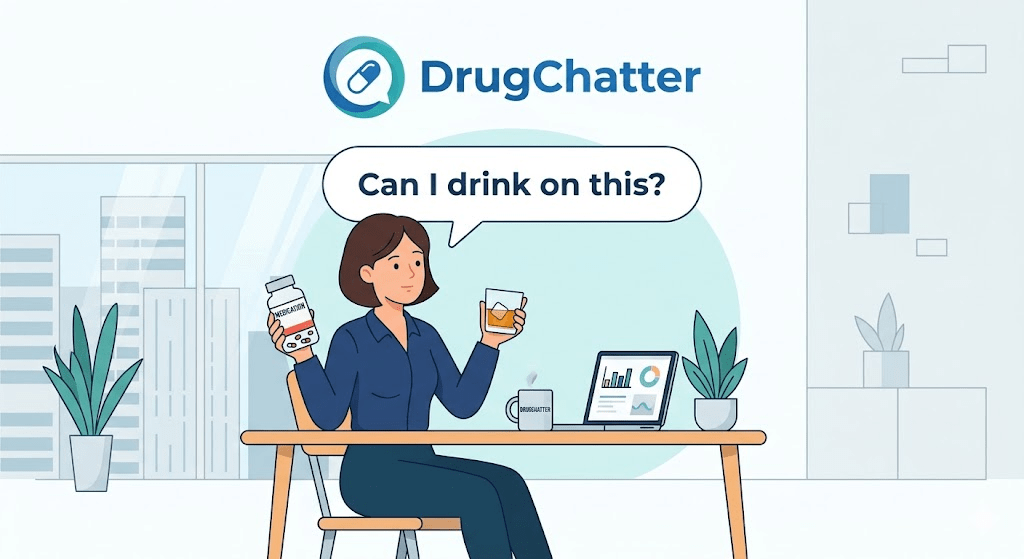
Alcohol has a way of slipping into medical conversations whether clinicians invite it or not. Patients rarely ask about it in isolation. It shows up attached to statins, antidepressants, fish oil capsules, chemotherapy regimens—like an uninvited second opinion sitting next to the prescription bottle.
What follows is a tour through the most common alcohol-and-medication questions people actually ask on DrugChatter, viewed in a Derek Lowe–style lens: cautious, pharmacology-first, and mildly suspicious of simple answers.
Statins (especially Lipitor) and alcohol: the everyday tension
Few combinations generate more quiet concern than cholesterol drugs and a glass of wine.
At the center is Atorvastatin, where the real question is less “can I?” and more “what happens over time if I do?”
Two recurring questions show the pattern:
- How long after Lipitor can I drink wine?
- Which body parts are most affected by Lipitor–alcohol interaction?
Mechanistically, this isn’t a “chemical clash” so much as a shared burden on hepatic processing. Statins are already liver-metabolized; alcohol adds variability to the same system. The concern isn’t usually acute toxicity in moderate use—it’s cumulative stress and the difficulty of predicting individual liver responses over months or years.
The practical takeaway in the literature tends to be unexciting but important: stability matters more than timing tricks.
Methotrexate: where caution becomes policy
With Methotrexate, alcohol stops being a lifestyle detail and becomes a liver safety discussion.
Here the pharmacology is less forgiving. Methotrexate itself carries hepatotoxic risk, and alcohol doesn’t need to “interact” in a dramatic receptor-level way to matter. Two independent liver stresses can converge into a single clinical concern: enzyme elevation, fibrosis risk over long periods, and monitoring thresholds becoming more important than theoretical mechanisms.
Clinically, this is why guidance often shifts from “limit alcohol” to “avoid or strictly minimize,” especially in chronic therapy.
Vascepa and omega-3 therapies: surprisingly frequent questions
Fish oil sounds harmless, which is exactly why people ask about mixing it with alcohol.
For Icosapent Ethyl (Vascepa), the concern isn’t intoxication—it’s whether alcohol changes cardiovascular benefit or side effect profile.
Pharmacologically, omega-3s don’t have a direct ethanol interaction pathway. But alcohol is not neutral in lipid metabolism, triglyceride production, or inflammation. So the question quietly shifts from “interaction” to “counteracting goals.”
That subtle shift—drug vs lifestyle signal—is where most confusion lives.
Niacin: flushing, heat, and alcohol’s amplifying effect
Niacin is already famous for flushing. Alcohol tends to make it more so.
Here the mechanism is more direct: vasodilation stacking on vasodilation. Histamine release, prostaglandin pathways, and peripheral blood vessel responses can all overlap. The result is not dangerous in most cases—but it is unmistakably uncomfortable, and sometimes a reason patients abandon therapy prematurely.
The broader pattern: alcohol as a “system modifier,” not a single interaction
Across these questions, a pattern emerges that pharmacology textbooks hint at but patients discover firsthand:
Alcohol rarely “breaks” a drug. It changes the system the drug is working in.
That includes:
- liver enzyme capacity (statins, methotrexate)
- lipid metabolism (omega-3 therapies)
- vascular responses (niacin flushing)
- and long-term risk framing (what counts as “safe enough”)
In that sense, alcohol is less a co-medication and more a background variable that quietly shifts the baseline of everything else.
A final, uncomfortable clarity
Most alcohol–medication questions are not really about chemistry. They’re about predictability.
Patients aren’t asking “is this interaction known?” as much as “can I still rely on my body behaving the same way tomorrow?”
Medicine rarely answers that with certainty. It usually answers with gradients: low risk, moderate concern, avoid if possible, monitor if necessary.
Which, depending on your perspective, is either frustrating—or exactly the kind of honesty pharmacology requires.