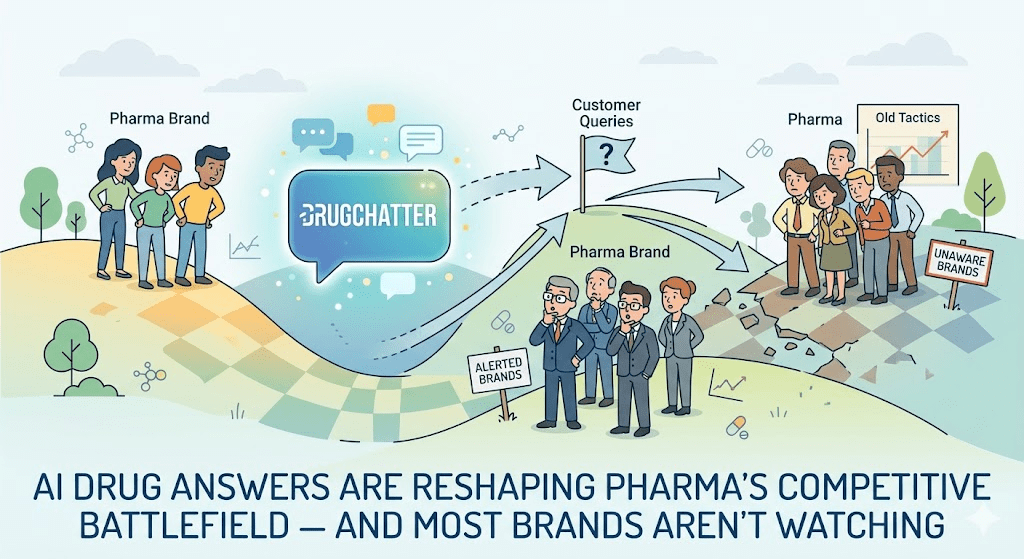
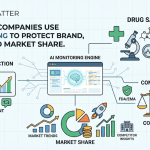
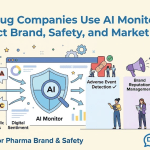
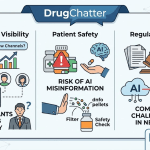
When a patient types ‘what’s the best GLP-1 for weight loss’ into ChatGPT, the answer they get back is not neutral. It reflects training data, citation patterns, source weighting, and probabilistic language modeling — none of which a pharmaceutical brand team controls, and very few are even tracking.
That is the new competitive dynamic in drug marketing. Search engine optimization, share-of-voice on television, and paid digital impressions still matter. But a structurally different distribution channel has emerged: AI-generated answers. Patients, caregivers, and physicians are now receiving drug information from systems that synthesize, summarize, and recommend without disclosing their source weights, without regulatory review, and without any mechanism for brand teams to submit corrections.
The pharmaceutical industry built its market intelligence infrastructure for a world of web pages, journal abstracts, and social media posts. That world still exists. But a growing share of the information consumed about drugs now flows through large language models — ChatGPT, Gemini, Claude, Perplexity, Microsoft Copilot, and the AI-assisted search features embedded into Google and Bing. These systems answer drug questions in the first person, with confidence, and without footnotes visible enough for most users to check.
This article examines what pharmaceutical companies stand to lose — and gain — by taking AI-generated drug answers seriously as a monitoring and competitive intelligence priority. It covers hallucination risk, FDA compliance implications, share-of-voice measurement across LLMs, the emerging pharmacovigilance question, and what leading brand teams are starting to do about it.
Why AI-Generated Drug Answers Are Now a Commercial Priority
How Patients Are Using ChatGPT, Gemini, and Perplexity for Drug Information
The behavioral shift is not hypothetical. Studies and usage data increasingly show that patients consult AI systems before, during, and after clinical encounters. They ask about dosing, side effects, drug interactions, cost, and alternatives. They ask whether their doctor’s recommendation matches ‘what the internet says.’ And increasingly, what the internet says is what an LLM says.
A 2024 survey by the National Alliance on Mental Illness found that a meaningful proportion of patients with mental health conditions reported using AI chatbots for medication information. Research published in JAMA Network Open in 2023 found that ChatGPT performed comparably to physicians in answering patient-style medical questions in some domains — which is partly reassuring and partly alarming, because ‘comparable’ is not ‘correct,’ and the error distribution of an LLM is nothing like the error distribution of a clinician.
What makes this commercially significant is the nature of the questions being asked. Patients are not only asking factual questions like ‘what is metformin.’ They are asking comparative questions: ‘Is Ozempic or Mounjaro better for weight loss?’ ‘Does Wegovy cause more nausea than Saxenda?’ ‘Which SGLT2 inhibitor has the best heart data?’ These are the questions where brand position, clinical differentiation, and competitive perception are formed. And these are the questions being answered by systems that no pharma brand team has optimized for.
Which Drugs Are Most Frequently Mentioned by AI Systems?
GLP-1 agonists dominate AI drug conversations by a wide margin. Ozempic (semaglutide), Wegovy (semaglutide), Mounjaro (tirzepatide), and Zepbound (tirzepatide) appear with extraordinary frequency across ChatGPT, Gemini, Claude, and Perplexity, driven by the category’s cultural prominence and volume of training data from news coverage, patient forums, and clinical literature.
Beyond GLP-1s, high-mention drugs include statins (rosuvastatin, atorvastatin), antidepressants (sertraline, escitalopram, bupropion), ADHD medications (Adderall, Vyvanse, Concerta, generic amphetamine salts), immunotherapies (Keytruda, Opdivo), and biosimilars. The pattern is not surprising: AI mention frequency correlates with training data volume, which correlates with the drugs most written about in the sources these systems were trained on — medical journals, news sites, Reddit, patient advocacy sites, and government databases.
Specialty drugs for rare diseases — even blockbusters like Dupixent (dupilumab) or Skyrizi (risankizumab) — appear less frequently in unsolicited AI answers, though they surface readily in direct questions. The implication for brand teams is that prominence in AI answers is partly a function of media and digital presence, not just clinical merit.
How AI Search Share-of-Voice Differs From Traditional Search Metrics
Traditional search share-of-voice is a ranking metric: how often does your brand appear in the first page of results for relevant queries? AI share-of-voice is a mention metric: when an LLM answers a drug question, does it mention your drug, recommend your drug, or frame your drug favorably relative to competitors?
These are fundamentally different measurements. A drug can rank well organically on Google while being rarely mentioned by ChatGPT. A drug with thin digital presence can appear frequently in AI answers if the clinical literature it generated was particularly authoritative and well-represented in training data.
Tools like DrugChatter are built specifically for this pharmaceutical AI monitoring gap — tracking how AI systems discuss specific drugs across multiple LLMs, comparing brand mentions against competitors, and surfacing the sentiment and clinical framing applied to each mention. The measurement methodology differs from social listening and from search rank tracking; it requires systematically querying AI systems with standardized prompts and analyzing the outputs at scale.
Can AI Hallucinations Trigger FDA Risk? The Compliance Dimension
What Counts as a Drug Hallucination and Why It Matters Legally
LLM hallucinations in drug contexts are not abstract. They include fabricated dosing instructions, incorrect contraindication statements, false efficacy claims, invented clinical trial results, and wrong drug interaction warnings. Any of these, if acted upon by a patient or caregiver, creates real harm potential.
The regulatory question is whether a pharmaceutical manufacturer bears any liability when an AI system trained on its promotional materials, press releases, or published clinical data generates a hallucinated or misleading drug answer. The answer is unsettled — but it is not clearly ‘no.’
FDA’s existing framework for misinformation addresses manufacturer-generated content. It does not yet directly address third-party AI systems generating inaccurate drug information using a manufacturer’s branded drug name. The FDA has issued draft guidance on AI in drug development and manufacturing but has not published specific guidance on AI-generated promotional or informational content about prescription drugs.
What FDA has been clear about is that adverse event reports generated or surfaced through any channel — including digital monitoring — create reporting obligations. If a pharmaceutical company’s AI monitoring program identifies a hallucinated safety claim being widely circulated by an LLM, the company’s pharmacovigilance team faces a question: does this trigger a reporting obligation even though the claim is fabricated? The answer likely depends on whether the hallucination describes an adverse event that plausibly occurred in the real world — and that analysis requires legal and regulatory judgment, not just technical monitoring.
Real FDA Warning Letters Involving Digital Misinformation: What Pharma Can Learn
FDA’s track record of warning letters related to digital drug promotion provides relevant context. The agency has issued warning letters to manufacturers for inadequate risk disclosure in social media posts, paid search ads with truncated safety information, and promotional tweets lacking fair balance. In 2023 and 2024, FDA continued enforcement activity related to social media promotion, including letters addressing Instagram and TikTok content.
None of these involve AI-generated content — yet. But the underlying logic is transferable. FDA expects that when drug information reaches patients through any channel, it meets accuracy and fair-balance standards. The agency has shown willingness to act when digital channels distribute claims that would be unacceptable in a print ad.
The novel question for AI is who the responsible party is. If Novo Nordisk’s approved label information is used by OpenAI’s training pipeline and ChatGPT subsequently generates an answer that omits a black box warning, is that an FDA enforcement matter against OpenAI, against Novo Nordisk, or against neither? No court has answered this. No warning letter has addressed it. But the question is live enough that pharmaceutical regulatory affairs teams should be tracking it closely.
Off-Label AI Recommendations: When LLMs Suggest Unapproved Uses
Off-label AI recommendations represent a specific and measurable risk. LLMs regularly discuss off-label drug uses — not because they are designed to promote them, but because their training data reflects the medical literature, which documents off-label uses extensively. When a user asks ‘can I use Ozempic for PCOS,’ an LLM trained on endocrinology literature may describe the emerging evidence base in terms that functionally constitute a recommendation.
Brand teams for drugs with significant off-label use profiles — methotrexate, gabapentin, low-dose naltrexone, ketamine — face a specific monitoring priority: tracking whether AI systems are framing off-label discussions in ways that align or conflict with FDA-approved labeling, and whether those framings are driving patient inquiries that create adverse event documentation obligations.
A pharmaceutical company cannot suppress off-label discussion in LLM outputs. It can, however, monitor what those discussions say, understand how they diverge from approved labeling, and use that intelligence to inform medical affairs strategy, label update decisions, and proactive FDA communication.
Why ChatGPT Gets Drug Side Effects Wrong — And What That Costs Brands
The Training Data Problem: How Outdated Information Persists in LLM Answers
LLMs have knowledge cutoffs. GPT-4’s training data extended to early 2023. Gemini and Claude have different cutoff dates with different update cycles. Perplexity, which retrieves live web content, has a more current but still imperfect picture. The practical consequence is that LLMs may present outdated drug information with the same confident tone they use for current information.
For drugs with recently updated safety labeling, recently published clinical trial results, or recently approved new indications, this lag creates a specific brand risk. A drug that received a positive safety update or an expanded indication in 2024 may still be described by AI systems using 2022 safety language. A drug whose competitor received a new FDA warning in 2023 may not have that warning reflected in AI-generated comparisons.
Brand monitoring teams tracking AI answers need to flag these temporal discrepancies. They are not hallucinations in the strict sense — they were accurate at the time of training. But they are clinically misleading, and in competitive terms, they may unfairly disadvantage or advantage specific drugs depending on the direction of the update.
How Often Claude Mentions Ozempic vs. Wegovy — And What the Difference Signals
Ozempic and Wegovy contain the same active ingredient (semaglutide) but carry different FDA approvals: Ozempic for type 2 diabetes, Wegovy for chronic weight management. Their AI mention patterns differ substantially and in ways that matter commercially.
Ozempic gets mentioned more frequently in AI answers to weight-loss questions despite being off-label for that use. This is a direct consequence of training data: Ozempic generated far more media coverage than Wegovy through 2022 and 2023, driven by social media-fueled demand, supply shortages, and celebrity association. An AI system that learned from that corpus reflects that pattern, even if Wegovy is the clinically and legally appropriate drug to mention in a weight-loss context.
For Novo Nordisk’s brand team, this is not an abstract curiosity. It means that a drug with a different approval, a higher list price, and a different risk-benefit profile is being recommended in AI-generated answers in place of the approved weight-loss agent. It is off-label AI promotion at scale, driven by data patterns rather than intentional design, and it creates both a competitive problem and a regulatory one.
Systematic monitoring tools, including DrugChatter, enable brand teams to track these mention patterns across LLMs over time — measuring not just whether a drug is named but whether it is named in the correct therapeutic context, with accurate labeling alignment, and at what frequency relative to competitors.
Do LLMs Recommend Generic Drugs More Often Than Branded Alternatives?
The short answer is yes, with caveats. LLMs trained on health system guidelines, academic medical literature, and government drug information sources inherit the institutional preference for generics that dominates those sources. When a user asks about treatment for hypertension, high cholesterol, or type 2 diabetes, AI systems frequently lead with generic options — amlodipine, atorvastatin, metformin — before or instead of branded agents.
This has two commercial implications. For branded drugs with generic competitors, AI systems may systematically de-prioritize the brand without malice — simply reflecting the consensus of the training data. For branded drugs without generic competition, AI systems may recommend the category while defaulting to the best-known agent, which may or may not be the most recently approved or most clinically differentiated option.
Pharmaceutical companies tracking AI share-of-voice need to measure not just raw mention frequency but contextual mention quality: Is the drug mentioned as a first-line option or a last resort? Is it mentioned with its brand name or only as a molecule? Is it compared favorably or unfavorably to generic alternatives? These qualitative dimensions require structured AI output analysis, not just keyword counting.
How Eli Lilly and Novo Nordisk Are Thinking About AI Monitoring
What Pharmaceutical Market Research Teams Are Actually Doing Right Now
Public disclosures from major pharmaceutical companies about AI monitoring programs are sparse. What is visible comes from conference presentations, job postings, and industry publications. The picture that emerges is of organizations at different stages of maturity — with a handful of large-cap companies running systematic AI monitoring programs and a majority of mid-sized and specialty pharma companies still treating AI mentions as a curiosity rather than a measurable channel.
Eli Lilly, whose tirzepatide franchise (Mounjaro and Zepbound) competes directly with semaglutide, has invested heavily in digital intelligence infrastructure. The company’s market research function uses social listening tools, HCP survey panels, and search trend analysis to track competitive positioning. Whether that infrastructure currently encompasses systematic LLM output monitoring is not publicly confirmed, but the competitive environment makes it a logical priority.
Novo Nordisk faces a specific challenge: the company has two semaglutide brands with distinct approval profiles — Ozempic and Wegovy — and a third, Rybelsus (oral semaglutide), with its own positioning. Managing AI share-of-voice across three co-existing brands with overlapping molecules requires monitoring infrastructure that tracks not just drug name mentions but indication-specific context.
Both companies operate in a category where AI-generated content significantly shapes patient and payer awareness. The GLP-1 market has generated more organic consumer discussion than perhaps any drug category in the past decade, and AI systems trained on that discussion reflect — and amplify — the existing patterns of public awareness.
What Pharma Brand Teams Can Learn From Reddit AI Citations
Reddit is one of the most heavily weighted consumer health discussion platforms in LLM training data. Subreddits like r/loseit, r/diabetes, r/ADHD, r/antidepressants, and r/ChronicPain contain millions of patient experience posts that discuss drug efficacy, side effects, tolerability, and cost in granular, personal terms. This content shapes LLM outputs in ways that published clinical literature does not.
When patients report on Reddit that Ozempic causes more nausea than their doctor predicted, or that their insurance denied Wegovy and their pharmacist suggested a different GLP-1, these reports become training signal. LLMs trained on this data learn associations between drug names and qualitative descriptors that may not appear in any clinical trial publication.
For brand teams, Reddit is not just a social listening target — it is an upstream input into the AI systems that will answer drug questions for the next several years. Monitoring what Reddit’s most-upvoted drug discussions say about your brand is effectively monitoring what AI systems will eventually say about your brand. The lag is real, but the directional relationship is strong.
“By 2026, an estimated 49% of U.S. adults will use an AI assistant for health-related information at least monthly, compared with 11% in 2022.” — Rock Health Digital Health Consumer Adoption Report, 2024
Tracking AI Share-of-Voice Across ChatGPT, Gemini, and Claude
How to Build a Systematic LLM Monitoring Program for Drug Brands
Systematic LLM monitoring for pharmaceutical brands requires four components: a standardized query library, a multi-platform testing protocol, a structured output analysis framework, and a time-series tracking system.
The query library should include four types of prompts. Condition-first queries ask about treatment options for a specific disease and observe which drugs are mentioned. Drug-direct queries ask about a specific drug and analyze the framing, safety language, and comparative context returned. Comparison queries pit two drugs head-to-head and measure which receives favorable treatment. Patient-voice queries simulate how real patients ask — colloquially, with incomplete medical terminology — to surface how AI handles ambiguous or informal drug questions.
Across ChatGPT (GPT-4 and o3), Gemini Pro, Claude (Anthropic), Perplexity, and Microsoft Copilot, the same query will produce meaningfully different answers. Some systems weight clinical literature more heavily; some reflect more consumer-facing sources; some include citations that allow source analysis. Tracking these differences over time reveals not just where your brand stands but how each platform’s training and retrieval architecture shapes drug narrative.
What Metrics Actually Matter When Measuring AI Drug Mentions
The useful metrics for AI drug mention monitoring fall into four categories.
Mention rate: How frequently does the drug appear in answers to relevant queries, measured across a standardized query set? This is share-of-voice in raw terms.
Position: When multiple drugs are mentioned, where does your drug appear? First mention, last mention, and contextual prominence all carry commercial significance.
Sentiment and framing: Is the drug described as effective, well-tolerated, and recommended — or as expensive, risky, or a second-line option? Sentiment scoring of LLM outputs requires natural language analysis tuned to clinical language.
Accuracy alignment: Does the AI-generated description of the drug match FDA-approved labeling? Discrepancies in indication, dosing, contraindications, or safety warnings are flags for both brand and regulatory teams.
How AI Answers Change When Users Ask Physician-Style vs. Patient-Style Questions
LLM responses to drug questions vary significantly based on the sophistication and framing of the query. A query phrased as ‘what is the recommended first-line pharmacotherapy for HbA1c above 9 in newly diagnosed type 2 diabetes’ will produce a different answer than ‘my doctor said I might need diabetes medication, what should I ask about.’ The underlying information may overlap, but the cited drugs, the risk language used, and the framing of clinical decision-making differ substantially.
This has a specific implication for pharmaceutical brand teams targeting both HCP and DTC audiences. A drug that performs well in physician-style AI queries may not appear prominently in patient-style AI queries, and vice versa. Monitoring programs need to test both query types and segment the results accordingly.
The physician-style vs. patient-style divergence also reveals something about which information sources each LLM weights for different query types. Physician-style queries tend to surface answers grounded in clinical guidelines and trial data. Patient-style queries surface answers with more consumer-media influence — and more Reddit.
Can AI Outputs Be Used for Pharmacovigilance?
The Emerging Regulatory Debate Over LLM-Sourced Adverse Event Data
Pharmacovigilance in the traditional model relies on voluntary adverse event reporting — MedWatch submissions, spontaneous reports from healthcare providers, and mandatory manufacturer reporting of serious unexpected adverse reactions. Social media monitoring has been a supplementary source for years, with FDA guidance on the use of internet data for safety signal detection published as far back as 2013.
LLM outputs create a novel variation of this question. If an AI system, in response to a patient query, generates language that describes a previously unreported adverse event — even if that language is fabricated — does it have pharmacovigilance relevance? The answer turns on whether the hallucination reflects an underlying signal in the training data, which may include patient forum posts describing real adverse events that never generated formal MedWatch submissions.
More straightforwardly: if patients are describing adverse events to AI chatbots rather than reporting them through official channels, those events are accumulating in chatbot conversation logs rather than MedWatch databases. This is a real and unresolved gap in the adverse event surveillance architecture.
FDA has not yet issued guidance specifically addressing LLM-sourced pharmacovigilance data. EMA’s artificial intelligence strategy, published in 2023 and updated in 2024, acknowledges the growing use of AI in drug safety monitoring but does not mandate any specific approach to LLM output surveillance.
What Pharma Safety Teams Need to Know About AI-Generated Patient Reports
Pharmaceutical safety teams already monitor patient forums, Twitter, and consumer health sites for adverse event signals. The extension to AI-generated content requires two additional capabilities.
First, monitoring what patients tell AI systems — which is only possible through aggregate analysis of publicly available AI interaction patterns, since individual conversation logs are private. Some AI platforms publish aggregate usage statistics; others do not. Third-party research on how patients use AI for health queries provides inferential data.
Second, monitoring what AI systems tell patients about adverse events. If ChatGPT systematically underreports the incidence of a serious adverse event — say, citing 5% incidence when the actual label says 12% — that gap creates a patient expectation problem. Patients who experience the adverse event may attribute it to something other than the drug, delay reporting, or discontinue incorrectly. This is not a speculative scenario; it is a predictable consequence of LLMs summarizing clinical trial data imperfectly.
How Medical Affairs Teams Can Use AI Monitoring for Signal Detection
Medical affairs has an opportunity to use AI monitoring offensively, not just defensively. By systematically querying AI systems with patient-voice prompts across a drug’s known adverse event profile, medical affairs teams can identify which adverse events AI systems are underweighting, overweighting, or framing incorrectly. This intelligence can inform labeling update considerations, patient education materials, and HCP communication strategies.
If AI systems consistently underreport a specific adverse event that the clinical team knows to be commercially significant — say, gastrointestinal tolerability issues for a GLP-1 — that underreporting shapes patient expectations in ways that can produce post-prescription disappointment and discontinuation. Medical affairs teams who identify this pattern early can proactively build patient education content that addresses the expectation gap before it drives adherence problems.
Drug Misinformation in AI Search: How Bad Is the Problem?
Documented Cases of AI Systems Providing Dangerous Drug Information
The academic and clinical literature on AI drug information accuracy is growing. A 2023 study in JAMA Internal Medicine evaluated ChatGPT responses to drug interaction questions and found error rates that varied significantly by drug class. A study in the Annals of Emergency Medicine found that ChatGPT gave incorrect dosing information for several common medications in a pediatric context. Research from the University of California, San Francisco found that AI chatbots sometimes recommended medications that were contraindicated for the case presentations they were given.
These are not edge cases. They reflect a systematic pattern: LLMs produce confident-sounding drug information that is accurate in aggregate but unreliable at the case-specific level. The population-level accuracy of an LLM’s drug information is genuinely impressive. The individual-patient accuracy — when the patient has a specific comorbidity, a specific medication list, or a specific allergy — is substantially lower.
This distinction matters for how pharmaceutical companies think about AI monitoring. A drug that is accurately described in most AI contexts but inaccurately described in high-risk edge cases (pediatric use, renal impairment, pregnancy) carries a specific brand risk that average accuracy metrics do not capture. Monitoring programs need to test edge cases, not just standard queries.
How Patients Ask About Drug Interactions in AI Search — and What AI Gets Wrong
Drug interaction queries are one of the highest-volume and highest-risk categories of AI health queries. Patients ask about alcohol and their medication, about combining two prescriptions, about herbal supplements and drug interactions. They do so in casual language that may omit critical specifics: drug dose, indication, patient age, renal function.
LLMs handle drug interaction queries inconsistently. For well-documented interactions with strong clinical literature coverage — warfarin and NSAIDs, MAOIs and SSRIs, methotrexate and trimethoprim — AI systems generally perform well. For less-studied interactions, for newly approved drugs, or for combination queries involving three or more agents, accuracy degrades.
For pharmaceutical companies, this creates a specific monitoring priority: tracking how AI systems describe interactions involving their drugs, particularly for recently approved agents whose interaction data is thin in the training corpus. A newly launched specialty drug may have its interaction profile described by AI systems based on class-effect assumptions rather than drug-specific data — an inaccuracy that patient education materials and prescriber communications need to proactively address.
AI Brand Monitoring for Pharmaceutical Companies: A Practical Framework
How to Detect Hallucinated Safety Claims Before They Reach Patients
Hallucinated safety claims are the highest-priority monitoring target for pharmaceutical brand and regulatory teams. These include fabricated clinical trial results, invented efficacy statistics, incorrect black box warning language, and false contraindication statements. Any of these, circulating through AI systems at scale, creates patient harm potential and brand damage.
Detection requires systematic querying of AI systems with prompts that specifically probe safety claims: ‘What are the serious side effects of [drug]?’ ‘Does [drug] have a black box warning?’ ‘Can [drug] be used in patients with kidney disease?’ Comparing AI outputs to FDA-approved labeling on a structured basis, with regular cadence, generates a gap analysis that identifies both hallucinated content and outdated content.
Platforms like DrugChatter are designed to automate this monitoring at scale, querying multiple LLMs with standardized prompt libraries and surfacing discrepancies against approved labeling automatically. This removes the manual burden from brand teams and creates the consistent time-series data needed to identify when a new hallucination pattern emerges.
Identifying Emerging Patient Concerns Before They Trend on Reddit or TikTok
One underappreciated capability of AI monitoring is early signal detection. Because patients consult AI systems about drug concerns before those concerns accumulate enough volume to trend on social media, AI output patterns can serve as a leading indicator of emerging patient concerns.
If a large number of patients are asking AI systems about a specific side effect — and the AI systems, drawing on their training data, are confirming the concern with reference to patient forum posts — that pattern may appear in AI output analysis before it surfaces in social listening dashboards. The mechanism is indirect: the training data that shapes AI responses about patient concerns reflects patient forum discussions that may be months or years old. But when those concerns are being actively queried, the query volume itself signals current patient preoccupation.
Brand teams with systematic AI monitoring programs can use this signal directionally. A spike in AI queries about a specific adverse event, detectable through AI monitoring APIs and usage analytics, is a leading indicator of a patient concern trend that will eventually reach social media, patient advocacy organizations, and potentially press coverage.
How to Track Generic Substitution Recommendations in AI Answers
Generic substitution is a commercial risk for branded drugs facing patent expiration or existing alongside established generics. AI systems trained on formulary data, pharmacy benefit guidelines, and academic prescribing literature reflect the institutional preference for generic substitution — and they communicate that preference to patients and caregivers who ask about their medication costs or alternatives.
Monitoring AI generic substitution recommendations requires testing a specific query type: cost and alternatives questions. ‘Is there a cheaper alternative to [brand]?’ ‘What is the generic version of [drug]?’ ‘Does [brand] have an equivalent generic?’ These queries reliably surface how AI systems are framing the generic option, whether they are accurately describing bioequivalence, and whether they are directing patients toward formulary alternatives the brand team would prefer to address proactively.
Brands with patient support programs, co-pay assistance, or specialty pharmacy partnerships need to ensure that AI systems are, at minimum, not actively misrepresenting these programs when patients ask about cost. Monitoring for accurate representation of patient assistance program information in AI outputs is a concrete, actionable monitoring task.
AI Search Optimization for Pharmaceutical Brands: What Works in 2025
Does Submitting Accurate Drug Information to Authoritative Sources Improve AI Answer Quality?
The short answer is yes, but the mechanism is indirect and slow. LLMs are trained on large corpora that include FDA drug labeling databases, ClinicalTrials.gov, PubMed, and authoritative medical reference sites like Drugs.com and Medscape. Pharmaceutical companies that maintain accurate, comprehensive, and consistently structured information in these authoritative sources influence the training data that shapes future LLM outputs.
This is not the same as submitting content directly to an LLM. There is no approved submission pathway for pharmaceutical companies to correct AI-generated drug information, and no platform has established a formal mechanism for drug manufacturers to certify or update AI-generated content about their products. The influence pathway runs through the sources the LLMs were trained on — and through retrieval-augmented generation systems that cite live web sources.
Retrieval-augmented generation (RAG) systems — including Perplexity and the AI-assisted search features in Google and Bing — do cite live web content, which means that pharmaceutical companies with authoritative, up-to-date web presence can influence these systems more directly. Ensuring that official drug websites, patient information portals, and FDA-linked labeling documents are properly indexed, current, and structured for AI citation is a meaningful technical strategy.
What Pharma Medical Affairs Teams Need to Know About AI Citation Patterns
AI systems that include citations — Perplexity in particular — reveal their source weighting transparently. Analyzing which sources are cited when an AI system answers questions about your drug tells you which organizations, journals, and websites are shaping AI answers in your category. If a competing organization’s clinical guideline is consistently cited as the source for treatment recommendations in your category, that represents an influence dynamic your medical affairs team needs to understand.
Citation analysis also reveals gaps. If AI systems citing live web sources frequently reference competitor-sponsored registry data or competitor-authored consensus guidelines in answers about your drug category, that reflects a content gap your medical affairs publication strategy should address. Publishing authoritative, clearly structured clinical content in forms that AI citation systems recognize and index is not academic publishing strategy — it is AI search strategy.
How Physician Search Behavior Is Shifting Toward AI Systems for Drug Information
Healthcare professionals are adopting AI tools at a measurable pace. A 2024 Doximity survey found that over 40% of physicians had used AI tools for clinical information tasks in the prior month. Specialty-specific patterns vary: oncologists, who deal with rapidly evolving treatment landscapes, show higher AI adoption rates than generalists; psychiatrists show complex patterns driven by the diversity of their medication armamentarium.
When physicians use AI tools for drug information, they tend to ask higher-complexity questions than patients: mechanism of action queries, pharmacokinetic questions, drug interaction checks, and treatment guideline summaries. These queries surface different aspects of LLM drug knowledge than patient-style queries, and they require different monitoring strategies.
The brand risk for pharmaceutical companies in physician-facing AI queries is primarily accuracy and clinical differentiation. If an LLM describing your drug’s mechanism of action, clinical trial design, or head-to-head data does so inaccurately — even subtly — that inaccuracy shapes physician perception in ways that traditional sales force detail may not correct. A physician who hears accurate information from a rep but has a different understanding from AI pre-conditioning may simply not update their priors.
Patient Sentiment in AI Answers: Measuring What LLMs Say About Drug Experience
How AI Systems Describe Drug Tolerability and What That Does to Patient Expectations
Drug tolerability — the day-to-day patient experience of taking a medication — is commercially significant in ways that clinical trial data does not fully capture. A drug with excellent efficacy data but a tolerability profile that AI systems describe negatively will face adherence challenges driven not by direct patient experience but by expectation-setting that occurred before the first dose.
AI systems describe drug tolerability by synthesizing clinical trial adverse event tables, patient forum narratives, and physician-authored content. The relative weight given to each source varies by platform. A patient who asks ChatGPT about the tolerability of Vyvanse before starting treatment for ADHD will receive an answer that reflects some mix of Shire’s clinical trial data, Reddit posts from r/ADHD about lived experiences, and prescribing information summaries from medical reference sites. The resulting answer may be accurate on average but misleading for a specific patient’s likely experience.
Brand teams can use AI monitoring to track the specific tolerability language being applied to their drugs — not just negative vs. positive sentiment, but specific symptom descriptors and frequency language. If AI systems consistently overstate the incidence of a tolerability complaint that the clinical data shows is mild and transient, correcting that pattern in AI outputs requires identifying the underlying source — whether a poorly worded label section, a widely circulated patient forum post, or a media coverage pattern.
How Voice-of-Customer AI Analysis Compares to Traditional Patient Surveys
Traditional voice-of-customer research in pharmaceutical marketing relies on surveys, focus groups, and ethnographic interviews. These methods are expensive, slow, and limited by self-selection bias. AI-enabled voice-of-customer analysis offers a different tradeoff: faster, broader, and cheaper, but with different biases.
The biases in AI-derived patient sentiment are systematic and learnable. LLMs overrepresent digitally engaged patients, English-language content, and commercially significant drugs with large training data footprints. They reflect the time-period of their training data. They may conflate patient experiences with a brand-name drug with experiences with a generic formulation of the same molecule.
Despite these limitations, AI-derived patient sentiment analysis — structured querying of LLMs about patient experience with specific drugs, combined with analysis of the source patterns that underlie those answers — offers pharmaceutical market researchers a faster, cheaper signal than traditional survey-based VOC. Used as a complement to traditional methods rather than a replacement, it accelerates the identification of patient experience patterns worth investigating more rigorously.
Competitive Intelligence Through AI Monitoring: The Playbook
How to Compare Your Drug’s AI Share-of-Voice Against Competitors Weekly
Weekly AI share-of-voice tracking requires a consistent query protocol applied across a fixed set of LLM platforms. The protocol starts with condition-level queries for each indication your drug covers, competitive comparison queries pitting your drug against named competitors, and patient-style cost and alternatives queries.
For each query, the monitoring program records: which drugs were mentioned, in what order, with what characterization, and with what safety language. These outputs are scored against a competitive share-of-voice rubric — a drug mentioned first with positive clinical framing gets a higher score than a drug mentioned as a second-line alternative. Trends in these scores over weeks and months reveal competitive dynamics that no other monitoring source provides.
Platforms built for pharmaceutical AI monitoring, like DrugChatter, can operationalize this workflow, maintaining query libraries, running systematic tests across multiple LLMs, and generating share-of-voice dashboards that brand teams can review without building custom AI infrastructure. For pharmaceutical companies without internal AI engineering resources, this kind of specialized platform is the practical path to systematic monitoring.
What a Competitor’s AI Profile Tells You About Their Digital Strategy
A competitor’s AI mention profile reveals the information environment their brand operates in, even without access to their internal strategy documents. A drug that consistently receives favorable AI framing on clinical differentiation is likely generating strong academic publication activity and positive clinical guideline representation. A drug that appears frequently in cost-related AI answers has likely built strong patient assistance program visibility in digital channels.
Conversely, a competitor drug that receives negative AI sentiment on tolerability — even if the drug’s clinical trial data shows acceptable tolerability — may be the beneficiary of a social media campaign by a patient advocacy group, a competing manufacturer’s disease education effort, or simply a high-volume of patient forum posts from early adopters who experienced tolerability issues.
Understanding why a competitor’s AI profile looks the way it does is as useful as understanding what it looks like. The ‘why’ points toward actionable response strategies: where to invest in publication activity, where to build patient education infrastructure, and where to address digital content gaps that may be disadvantaging your drug’s AI representation.
Can Pharmaceutical Companies Influence What AI Says About Their Drugs?
There is no direct submission pathway for pharmaceutical companies to correct or influence AI-generated drug content. LLM providers do not operate sponsored content programs for drug manufacturers, and regulatory considerations would make any such pathway complex.
The influence pathways that exist are indirect but real. Ensuring that FDA drug labeling databases accurately reflect current approved language is the highest-leverage single action. Maintaining authoritative, regularly updated drug information on official brand websites and patient information portals gives retrieval-augmented AI systems accurate source material to cite. Publishing in peer-reviewed journals and ensuring that positive clinical data is indexed in PubMed with clear, consistent terminology contributes to the training data corpus over longer time horizons.
Medical affairs teams can work with independent medical education organizations to publish accurate clinical content that becomes source material for AI systems. While promotional content is appropriately excluded from AI training data by most platforms, peer-reviewed clinical education content is not.
None of these strategies guarantee AI output accuracy. They shift probabilities. In a competitive pharmaceutical market, shifting the probability that AI systems describe your drug accurately and favorably — even marginally — is worth systematic investment.
What Drug Patent Watch and Competitive Intelligence Platforms Add to AI Monitoring
Using Patent Expiration Data to Anticipate AI Generic Substitution Trends
Patent expiration timelines have direct implications for AI share-of-voice. As a branded drug approaches patent expiration, the volume of generic-related content in AI training data grows: press releases about generic approvals, formulary coverage updates, pricing comparisons. AI systems absorb this content and begin shifting their generic substitution recommendations before the brand team may expect.
Platforms like DrugPatentWatch provide systematic patent status and generic entry data that, when combined with AI monitoring, let brand teams anticipate when AI share-of-voice is likely to shift. A brand approaching loss of exclusivity in 18 months should be monitoring AI generic substitution language now — not after generic launch — to understand the trajectory and inform lifecycle management strategy.
The relationship between patent status and AI mention patterns is not deterministic. Drugs with strong brand equity, unique formulations, or patient support program differentiation can maintain AI share-of-voice after generic entry. But without monitoring, brand teams lack the data to know whether their lifecycle management investments are affecting AI positioning.
Key Takeaways
AI-generated drug answers — from ChatGPT, Gemini, Claude, Perplexity, and integrated AI search — now represent a commercially significant information channel that most pharmaceutical brand teams are not systematically monitoring.
Share-of-voice in AI differs fundamentally from traditional search rank metrics. Measuring it requires structured query testing, output analysis, and competitive comparison across multiple LLM platforms.
LLM hallucinations about drug safety, dosing, and indications create measurable patient harm risk and potential regulatory exposure. Pharmaceutical companies should be monitoring AI outputs against FDA-approved labeling on a regular basis.
The Ozempic/Wegovy split is a live example of AI mention patterns creating off-label confusion at scale — demonstrating that AI share-of-voice management is both a brand and a compliance issue.
Off-label AI recommendations, AI-generated adverse event language, and generic substitution recommendations are each distinct monitoring categories requiring their own query protocols and analytical frameworks.
AI monitoring can serve as a leading indicator of emerging patient concerns, surfacing signals before they trend on social media by detecting query patterns that precede volume accumulation.
The influence pathways for pharmaceutical companies are indirect: authoritative labeling databases, peer-reviewed publications, patient-facing digital infrastructure, and retrieval-indexed brand websites are the levers that shape future AI outputs.
Tools like DrugChatter and DrugPatentWatch allow pharmaceutical teams to operationalize AI monitoring at scale without building custom LLM infrastructure internally.
Frequently Asked Questions
What is pharmaceutical AI monitoring and why does it matter for drug brands?
Pharmaceutical AI monitoring is the systematic tracking of how large language models — including ChatGPT, Gemini, Claude, Perplexity, and others — generate answers about specific drugs, drug categories, and therapeutic areas. It matters because a growing share of drug information consumed by patients, caregivers, and healthcare professionals now flows through AI-generated answers rather than brand-controlled channels. A drug that is inaccurately described, de-prioritized, or associated with incorrect safety language by AI systems faces patient expectation problems, adherence risks, and competitive disadvantage that traditional brand monitoring programs do not detect.
Can AI hallucinations about drugs create FDA compliance risks for pharmaceutical companies?
The regulatory framework has not yet definitively addressed manufacturer liability for AI-generated drug misinformation. What is clear is that pharmaceutical companies with active pharmacovigilance programs face questions about whether AI-generated adverse event language — even if hallucinated — triggers reporting obligations when it describes real patient harm scenarios. Companies that identify AI hallucinations about their drugs in the course of monitoring programs should involve regulatory affairs and legal counsel in determining the appropriate response. The absence of clear FDA guidance creates risk in both directions: acting may be unnecessary; failing to act may prove indefensible.
How does AI share-of-voice differ from traditional pharmaceutical search share-of-voice?
Traditional search share-of-voice measures ranking and click-share on search engine results pages. AI share-of-voice measures mention frequency, contextual framing, and clinical positioning in AI-generated answers. A drug can have strong traditional SEO performance and weak AI share-of-voice if its digital presence is optimized for Google ranking signals that do not translate to LLM training data relevance. Conversely, a drug with thin SEO presence but strong academic publication activity may receive favorable AI treatment based on clinical literature weighting in training data. The two metrics require separate measurement methodologies and can diverge substantially.
What pharmaceutical companies are currently monitoring AI mentions of their drugs?
Public disclosure is limited, but evidence from conference presentations, job listings, and industry reporting suggests that the largest pharmaceutical companies — including some GLP-1 market leaders, major oncology players, and CNS-focused companies — are running or building AI monitoring programs. The majority of mid-sized specialty pharmaceutical companies are not yet conducting systematic monitoring. This creates a competitive intelligence gap that early movers can exploit: comprehensive AI share-of-voice data collected before a competitor builds their monitoring program provides baseline data that is impossible to reconstruct retroactively.
How can small and mid-sized pharmaceutical companies start monitoring AI drug mentions without building internal AI infrastructure?
Specialized pharmaceutical AI monitoring platforms are the practical starting point for companies without internal LLM engineering resources. DrugChatter provides purpose-built monitoring for pharmaceutical brands, running standardized query libraries across multiple AI platforms and generating competitive share-of-voice dashboards without requiring internal technical development. The alternative — manual monitoring by brand team members who periodically query AI systems and record outputs — is better than nothing but does not produce the consistent, time-series data needed for trend analysis or regulatory documentation. Starting with a specialized platform, even for a defined set of priority drugs and query types, is faster and more defensible than ad hoc monitoring.