When a patient types “what’s the difference between Ozempic and Wegovy” into ChatGPT, they don’t get ten blue links. They get a paragraph. One answer. Synthesized, confident, and delivered without footnotes.
That single paragraph now carries the weight of what search engine results pages used to distribute across dozens of competing sources. And pharmaceutical companies, built around the assumption that marketing influence flows through physician detailing, patient advocacy sites, and paid media, have almost no visibility into what those paragraphs say.
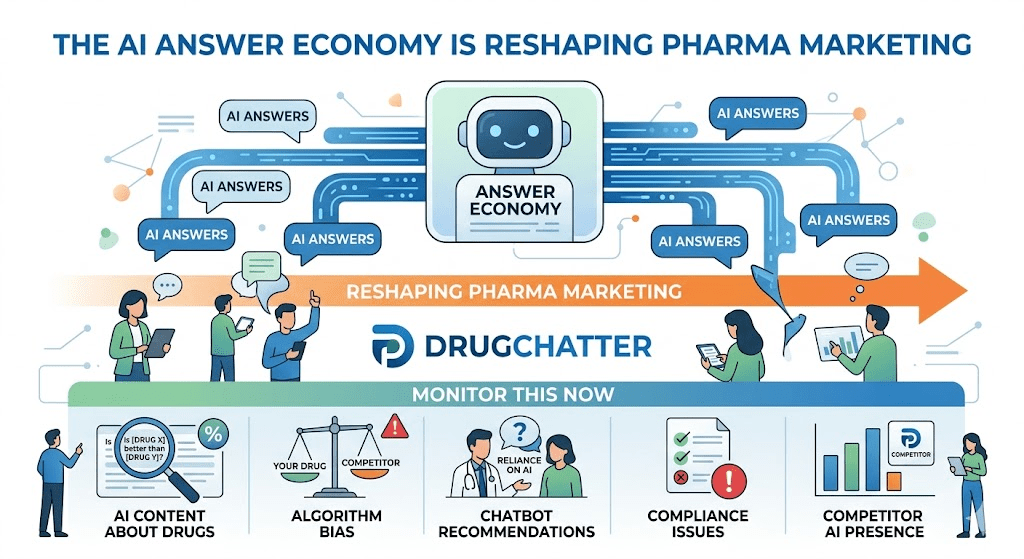
This is the AI answer economy. It doesn’t care about your branded search spend. It doesn’t privilege your FDA-approved label. It draws from training data and live retrieval at a scale and speed that brand teams cannot yet match, monitor, or correct.
The companies that figure out how to track, audit, and respond to AI-generated drug information first will hold a structural advantage in brand management, patient engagement, pharmacovigilance, and competitive intelligence. Those that don’t will discover the problem the hard way — through adverse event signals they missed, off-label narratives they didn’t catch, or brand erosion they couldn’t measure.
This article explains what the AI answer economy means for pharmaceutical marketing, what’s actually happening inside the large language models that patients and physicians now consult daily, and what the most forward-looking pharma teams are doing about it.
What the AI Answer Economy Actually Means for Drug Brands
From Ten Blue Links to One Confident Paragraph
Google’s dominance over pharmaceutical consumer search was already a distortion. Organic results were captured by WebMD, Drugs.com, and RxList. Paid results required constant compliance review. Social listening covered Twitter and Reddit but not intent-rich search queries. The information environment was messy, but it was at least observable.
AI search changes the visibility problem entirely. ChatGPT crossed 100 million weekly active users faster than any consumer application in history and has continued growing. Google’s AI Overviews appear at the top of search results for health queries by default. Perplexity positions itself explicitly as an answer engine for research-grade questions. Microsoft Copilot is embedded in the tools clinicians and hospital administrators already use.
Each of these systems synthesizes answers from training corpora and, in some cases, live web retrieval. They don’t just surface content — they rewrite it, merge it, and present it as a unified response. A patient asking “Can I take metformin if I have kidney disease?” receives a synthesized clinical answer that may draw from medical literature, patient forums, drug labeling, and outdated sources simultaneously, with no clear attribution hierarchy.
For pharma brand teams, this creates a monitoring blind spot the size of a continent.
How AI Systems Learn What to Say About Drugs
Understanding what LLMs say about drugs requires understanding where their knowledge comes from. Large language models like GPT-4, Gemini 1.5, and Claude are trained on web-scale corpora that include medical literature, FDA drug labels, patient forums, news articles, clinical trial summaries, and the full text of Reddit threads discussing medication experiences.
The training process does not distinguish between a peer-reviewed NEJM paper and a Reddit post with 2,000 upvotes. Both become embedded in the model’s weights. The model then generates answers by predicting likely next tokens given a prompt — essentially averaging across everything it read, weighted by patterns in the data.
This means that a drug with extensive negative patient forum coverage — Accutane’s discussion of depression, for example, or the voluminous Reddit threads on SSRI discontinuation syndrome — may be described with more prominent side effect language than a drug with equivalent clinical risk but lower online discussion volume. The model reflects the internet’s emotional intensity about a drug, not the FDA label’s clinical precision.
Retrieval-augmented generation (RAG) systems like Perplexity add live web search on top of base model knowledge, which creates a different set of risks: the model may cite recent news stories, including misinformation, lawsuit coverage, or preliminary research that has not been replicated.
Why Pharmaceutical Brand Teams Are Structurally Unprepared
Pharma’s existing monitoring infrastructure was built for a different information environment. Social listening tools monitor Twitter, Instagram, Facebook, and forums for keyword mentions. Pharmacovigilance teams parse adverse event reports filed through MedWatch. Medical affairs tracks publications. Competitive intelligence watches prescribing data and market research.
None of these functions systematically queries LLMs, captures AI-generated drug descriptions, compares responses across models, or tracks how those descriptions change over time as models are updated.
The result is a gap. A brand team may have real-time dashboards covering 47 social media sources and zero visibility into whether ChatGPT describes their drug’s efficacy accurately, what side effects Claude leads with, or whether Gemini recommends a competitor’s product in response to a patient’s symptom query.
Why ChatGPT Gets Drug Side Effects Wrong — And What It Costs You
Hallucinations vs. Training Data Bias: Two Different Problems
Pharmaceutical AI monitoring requires distinguishing between two categories of inaccurate AI output. The first is hallucination: the model generates a plausible-sounding claim that has no basis in its training data. The second is training data bias: the model accurately reflects what its training data said, but that data was wrong, outdated, or unrepresentative.
Both create liability exposure. Both can damage brand equity. But they require different responses.
A hallucinated drug interaction — say, a model claiming that semaglutide interacts with a specific antibiotic with no evidence basis — is a factual error the company can potentially flag to the AI provider. A training data bias problem — where the model overweights early trial data suggesting a side effect that subsequent research disproved — is harder to correct and requires engaging the model’s retrieval sources.
Research from academic groups studying LLM performance on medical questions has documented both failure modes. A 2023 study published in JAMA Internal Medicine evaluated ChatGPT’s responses to drug information queries and found accuracy rates that varied significantly by drug category and question type, with the model performing worst on drug interaction questions and questions requiring quantitative dosing precision.
Real Cases Where AI Drug Information Has Created Regulatory and Brand Risk
The FDA has not yet issued formal guidance specifically addressing AI-generated drug misinformation as a pharmacovigilance signal. But the agency’s existing framework for adverse event reporting, misinformation monitoring, and promotional compliance is broad enough to capture some AI-related scenarios.
In 2023, the FDA issued warning letters to several compounders producing semaglutide products that were being marketed partly through social media and online health platforms making efficacy claims that went beyond the approved indication. While those cases involved human-generated content, they illustrate the agency’s willingness to act on off-label promotion that reaches patients through digital channels — a category that AI search output could eventually fall into, particularly if companies are found to have influenced AI training data or retrieval systems to promote off-label uses.
Separately, the FTC has signaled interest in AI-generated health content through its broader enforcement activities around deceptive health advertising online. The commission’s 2023 Health Products Compliance Guidance specifically addressed testimonials and endorsements, and FTC staff have publicly discussed the applicability of existing deception standards to AI-generated content.
How AI Describes Drug Risks Compared to the FDA Label
One of the most consistent findings from teams that have audited LLM drug descriptions is that the models frequently reorder the prominence of adverse effects relative to the FDA label. The label’s black box warnings — the most serious category — may be mentioned by AI systems as one item in a longer list rather than given the categorical prominence the label assigns them.
For drugs with black box warnings, this creates a specific risk. A patient asking Claude or ChatGPT whether a medication is safe receives an answer that may technically mention the black box warning but bury it beneath five bullet points about more common, less serious side effects. The model is not hallucinating; it is reorganizing information in a way that alters the effective safety communication.
Warfarin, clozapine, isotretinoin, and the entire class of tumor necrosis factor inhibitors carry black box warnings that require structured risk communication to patients under FDA REMS programs. Whether AI systems are describing these drugs in ways consistent with REMS communication requirements is an open compliance question that almost no pharma company has yet formally evaluated.
How Often Claude Mentions Ozempic vs. Wegovy — And Why the Gap Matters
Measuring AI Share of Voice for Pharmaceutical Brands
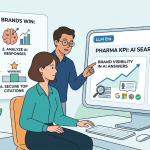
Share of voice in traditional pharma marketing measures how often your brand appears relative to competitors across paid media, earned media, and owned channels. AI share of voice measures something more specific: how often, in response to relevant patient and physician queries, does an LLM recommend, describe, or reference your product versus a competitor’s?
This is not a trivial distinction. Ozempic (semaglutide injection, approved for Type 2 diabetes) and Wegovy (semaglutide injection, higher dose, approved for obesity) are manufactured by Novo Nordisk and contain the same active molecule. They compete in different indication categories but overlap substantially in the queries patients bring to AI search: “best GLP-1 drug,” “semaglutide for weight loss,” “Ozempic vs Wegovy for weight loss,” and variations thereof.
An AI system that consistently defaults to Ozempic in response to weight loss queries — even though Wegovy carries the approved obesity indication — represents a brand intelligence signal Novo Nordisk’s marketing team would want to capture. Conversely, an AI system that mentions Mounjaro (tirzepatide, Eli Lilly) in response to every GLP-1 query is a competitive intelligence data point worth tracking weekly.
Platforms like DrugChatter are designed to surface exactly this kind of AI-generated drug mention data across multiple LLMs, giving brand teams systematic visibility into how their drugs appear in AI-generated answers.
Do LLMs Recommend Generic Drugs More Often Than Branded Versions?
This is one of the most commercially sensitive questions in AI pharmaceutical monitoring, and the answer appears to be: it depends on the drug class and the query framing, but there is a measurable tilt toward generics in certain contexts.
LLMs trained on cost-conscious medical literature, patient advocacy content, and insurance guidance frequently absorb the framing that generics are equivalent to branded drugs. For drugs where bioequivalence is well-established and generics are widely available, this is clinically accurate. For drugs where formulation differences matter — extended-release versus immediate-release profiles, drug delivery mechanisms, or narrow therapeutic index drugs — generic substitution language in AI outputs can be clinically consequential.
Branded drugs with generic equivalents face a specific AI share of voice challenge: the model may know the brand name but default to recommending the generic in cost-related queries. For drugs still under patent protection with no generic available, the brand faces a different risk: the model may describe an older, cheaper drug in the same class as the preferred option, citing cost or access.
Tracking this behavior systematically — across query types, across models, and over time — is the beginning of a defensible brand strategy for the AI search environment.
How Patients Ask About Drug Interactions in AI Search
Patient queries to AI systems about drug interactions follow patterns that differ substantially from the structured, symptom-first queries traditional search engine optimization was built around. Patients ask in natural language: “I’m taking metoprolol and my doctor wants to add fluoxetine, is that safe?” They ask in the context of their specific conditions: “Can I take ibuprofen if I’m on blood thinners?” They ask comparative questions that require the model to rank options: “Which is safer for my stomach, naproxen or ibuprofen?”
These conversational queries are the queries AI systems are built to answer. They’re also the queries where errors carry the highest patient harm potential, and where pharmaceutical companies have the greatest interest in ensuring accurate information reaches the patient.
Monitoring the patterns of patient drug interaction queries — even without monitoring individual patients — gives pharma teams insight into the safety questions their drugs generate in the real world. If AI systems are fielding high volumes of questions about a specific drug interaction, that’s a pharmacovigilance signal worth investigating regardless of whether the AI’s answer is accurate.
Can AI Hallucinations Trigger FDA Risk? The Regulatory Exposure Analysis
FDA’s Current Framework for AI-Generated Drug Information
The FDA’s authority over pharmaceutical promotion extends to labeling, advertising, and any company-generated communication that makes claims about a drug’s safety or efficacy. The agency does not currently regulate AI-generated content as a category, and it has not issued formal guidance specifically addressing LLM outputs about drugs.
What the agency has done is expand its digital health framework, establish the Digital Health Center of Excellence, and begin publishing draft guidance on AI/ML-based software as a medical device. These developments signal regulatory attention to AI in healthcare without yet creating a specific compliance framework for AI-generated drug information.
The gap creates both risk and ambiguity. If a pharmaceutical company were found to have deliberately influenced an LLM’s training data or retrieval system to generate favorable off-label descriptions of its products, existing promotional compliance standards could apply. The mechanism — prompt engineering, data seeding, RAG system manipulation — would be novel, but the underlying conduct would be recognizable to FDA enforcement attorneys.
Adverse Event Reporting and AI: What Counts as a Signal?
FDA’s adverse event reporting system (FAERS) relies on voluntary reporting from patients, healthcare providers, and pharmaceutical companies. Companies are required to report adverse events they become aware of through any channel, including social media monitoring, literature review, and direct patient contact.
Whether an AI system generates descriptions of adverse events that aren’t in FAERS — because patients are reporting to AI chatbots rather than to their physicians or to the company — is a pharmacovigilance question that regulators in Europe have begun exploring more actively than FDA. The European Medicines Agency’s 2022 reflection paper on data quality for pharmacovigilance specifically addressed social media and digital source monitoring. AI-generated patient conversations represent the next frontier of that framework.
A pharmaceutical company that queries AI systems and discovers that users are describing a side effect pattern not captured in its FAERS database is, arguably, in receipt of a pharmacovigilance signal it is obligated to evaluate. The legal analysis is unsettled, but the direction of regulatory travel is clear: digital channels generate valid signals, and companies are expected to monitor them.
What Pharma Brand Teams Can Learn From Reddit AI Citations
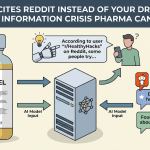
Reddit has become one of the most frequently cited sources in AI retrieval-augmented generation systems. Perplexity in particular has indexed Reddit extensively, and Reddit’s own AI search partnerships mean that forum content increasingly surfaces in AI-generated health answers.
Subreddits like r/diabetes, r/medication, r/antidepressants, r/AskDocs, and condition-specific communities generate millions of posts per year that describe real-world drug experiences in language AI systems find highly relevant to patient queries. These posts are experiential, unfiltered, and often clinically significant — they describe side effects patients don’t report to their doctors, dosing adjustments patients make without medical supervision, and drug combinations patients discover through peer advice.
When AI systems cite or synthesize Reddit content in drug answers, they are effectively amplifying the signal of these patient communities to a vastly larger audience. A post describing a severe side effect that garnered 500 upvotes on r/antidepressants may become embedded in ChatGPT’s standard description of that drug’s tolerability profile.
Pharma teams that monitor Reddit not just for brand mentions but for the specific claims and experiences that AI systems are most likely to amplify have a lead-time advantage. They can see the signal before it gets embedded in model outputs and baked into the AI answer economy’s consensus.
Tracking AI Share of Voice Across ChatGPT, Gemini, and Claude
Why Responses Differ Across LLMs for the Same Drug Query
ChatGPT, Gemini, Claude, and Perplexity do not produce the same answer to the same drug query. The differences are systematic, not random. They reflect differences in training data, fine-tuning, safety filtering, retrieval architecture, and the specific editorial choices each company made when aligning the model to be helpful in medical contexts.
Claude (Anthropic) applies a notably conservative safety filter to health queries, frequently recommending users consult a physician and declining to give specific dosing guidance. This makes it less likely to produce specific adverse event descriptions and more likely to redirect, which affects both its usefulness as a patient resource and the type of brand exposure pharmaceutical companies face in Claude-generated answers.
ChatGPT (OpenAI), particularly in its GPT-4o configuration, provides more clinical specificity and is more willing to compare drugs directly. Gemini (Google) benefits from Google’s medical knowledge graph and index of medical literature but may reflect Google’s commercial relationships in ways that affect which drugs surface prominently. Perplexity provides live retrieval with citations, making it the most auditable of the major systems but also the most volatile, since its answers shift with the live web.
A pharmaceutical company auditing its AI share of voice needs to query all four systems — at minimum — with a standardized battery of queries covering brand name queries, indication queries, competitor comparison queries, and adverse event queries. Single-model audits produce misleading results.
How to Run a Competitive AI Share-of-Voice Audit
A structured AI share-of-voice audit for a pharmaceutical brand involves four components. First, query design: building a representative set of queries that covers the realistic range of patient and physician questions about the drug, its competitors, and its indication category. Second, systematic data collection: running those queries across target LLMs at regular intervals and capturing the full text of responses. Third, analysis: coding responses for brand mentions, sentiment, safety language, competitive references, and off-label content. Fourth, benchmarking: comparing results to previous audit periods to track change over time.
The query design phase is where most teams underinvest. Patients don’t ask “what is the mechanism of action of liraglutide?” They ask “how does Victoza work?” or “what does Victoza do to your stomach?” The query set needs to reflect actual patient language, which means drawing from social listening data, search query analytics, and call center transcripts rather than from the medical affairs team’s assumptions about how patients think about the drug.
Tools like DrugChatter systematize this process by running standardized pharmaceutical queries across multiple LLMs and returning structured data on how different drugs and brands appear in AI-generated answers — giving brand teams the benchmarking infrastructure they’d otherwise have to build themselves.
Which Drugs Are Most Frequently Mentioned by AI Systems?
GLP-1 receptor agonists dominate AI pharmaceutical query volumes by a significant margin. Ozempic, Wegovy, Mounjaro, Zepbound, Saxenda, and Victoza collectively account for a disproportionate share of consumer AI drug queries, driven by the extraordinary media coverage these drugs received between 2022 and 2025 and their crossover from diabetes treatment to mainstream weight management discussion.
Beyond GLP-1s, the drugs that appear most frequently in AI-generated health answers track closely with the drugs that generate the most patient discussion online: antidepressants (particularly SSRIs and SNRIs), statins, blood pressure medications, contraceptives, and sleep medications. These are high-prevalence drugs with active patient communities, extensive online discussion, and significant variation in patient experience that drives ongoing query volume.
Specialty drugs — oncology agents, rare disease treatments, immunologics — appear less frequently in consumer AI queries but more frequently in physician and payer queries. The AI monitoring strategy for a specialty drug looks different from the strategy for a primary care medication, reflecting the different user base asking questions.
Pharmacovigilance in the LLM Age: Can AI Outputs Be Used as Safety Signals?
The Theoretical Case for AI-Generated Pharmacovigilance Data
The argument for treating AI-generated drug discussions as a pharmacovigilance source rests on a simple observation: patients are telling AI systems things they don’t tell their doctors. They describe side effects they find embarrassing. They ask about drug interactions they’re managing without medical supervision. They describe symptom patterns that precede or follow medication changes. They ask “is it normal to feel this way on X drug?” in ways that reveal clinical experiences their prescribers never captured.
If AI systems are becoming a primary channel for patient health communication — and the usage data suggests they are — then the conversations patients have with those systems contain pharmacovigilance-relevant information that existing surveillance systems are missing entirely.
The practical challenge is access. AI companies do not, as standard practice, share user query data with pharmaceutical manufacturers. Privacy regulations in most jurisdictions would constrain such sharing even if the companies were willing. What pharmaceutical companies can access is the AI-generated output side: what the models say in response to queries, which reveals the aggregate pattern of what users are asking about.
EMA and FDA Divergence on Digital Pharmacovigilance
The European Medicines Agency has moved faster than FDA in formally incorporating digital data sources into pharmacovigilance thinking. EMA’s 2022 reflection paper on real-world data quality addressed social media monitoring and electronic health records as pharmacovigilance sources with explicit acknowledgment that digital patient communities generate valid safety signals.
FDA’s approach has been less structured. The agency’s Sentinel System monitors electronic health records and claims data for drug safety signals but has not formally integrated social media or AI-generated content. The agency’s 2019 guidance on social media and internet communications for pharmaceutical companies focused on promotional compliance rather than pharmacovigilance.
The regulatory divergence means that European-based pharmaceutical companies or companies with significant EMA obligations may face earlier pressure to develop AI monitoring capabilities as a regulatory compliance matter, not just a commercial intelligence function.
Off-Label Drug Discussions in AI: What’s Being Said and Who’s Asking
Off-label drug use is legal in clinical practice — physicians can prescribe approved drugs for unapproved indications based on clinical judgment. Pharmaceutical companies cannot promote off-label uses. AI systems occupy an ambiguous middle ground: they describe off-label uses because those uses appear in their training data, including in medical literature and patient forums, without any commercial intent behind the description.
The practical result is that AI systems are often more forthcoming about off-label drug uses than any pharmaceutical company’s owned content can be. ChatGPT will explain the evidence base for low-dose naltrexone in autoimmune conditions. Claude will discuss ketamine’s off-label depression applications. Gemini will describe the data on metformin in polycystic ovary syndrome.
For brand teams, this creates both a monitoring imperative and a strategic tension. You want to know what AI systems are saying about your drug’s off-label uses — because that information is reaching patients and physicians and shaping prescribing discussions — but you cannot respond to it in the same way you’d respond to a competitor’s on-label claim. Legal and regulatory counsel needs to be part of the AI monitoring workflow from the outset.
How Eli Lilly and Novo Nordisk Are Approaching AI Brand Monitoring
What Public Disclosures Reveal About Big Pharma’s AI Intelligence Functions
Neither Eli Lilly nor Novo Nordisk has publicly disclosed a formal AI brand monitoring program, but both companies’ recent investments and organizational developments suggest active capability-building in this area.
Eli Lilly established an AI center of excellence in 2023 with a stated focus on drug discovery, clinical trials, and patient engagement. The company has publicly discussed using AI for real-world evidence generation and patient support, which creates the organizational infrastructure that brand monitoring would logically plug into. Lilly’s aggressive entry into AI-powered direct-to-patient communications for Mounjaro and Zepbound also reflects an understanding that the patient AI interaction layer is commercially significant.
Novo Nordisk has invested in digital health partnerships and data analytics capabilities at a scale that reflects the company’s recognition that its GLP-1 franchise — now arguably the most discussed drug category in AI search — requires sophisticated digital intelligence. The company’s collaboration with analytics firms and its expansion of patient support programs both generate data streams relevant to AI monitoring.
What neither company has disclosed — and what few pharmaceutical companies have publicly acknowledged — is systematic querying of LLMs to track how their drugs appear in AI-generated answers. That capability is emerging at specialized vendors and in the more sophisticated brand analytics teams, but it has not yet become a standard line item in pharma marketing budgets.
Building the Internal Case for AI Monitoring Investment
The ROI case for pharmaceutical AI monitoring breaks down into four components. The first is brand protection: identifying and responding to inaccurate AI descriptions of your drug before they reach physicians or influence prescribing decisions. The second is competitive intelligence: understanding how AI positions your drug relative to competitors in response to patient and physician queries. The third is pharmacovigilance enhancement: using AI-generated content patterns as a leading indicator of patient safety questions that may be underreported through traditional channels. The fourth is regulatory risk management: identifying AI-generated content that could constitute promotional compliance risk or that misrepresents the approved label.
Each of these has a dollar-denominated business case. Brand equity erosion from persistent AI misinformation about a drug’s efficacy or tolerability translates into prescribing share. Competitive intelligence gaps translate into lost opportunities to respond to competitor positioning. Pharmacovigilance failures translate into regulatory enforcement risk. None of these is hypothetical — all have precedents in the traditional digital channel context.
“LLMs are now the first point of contact for health information for a growing segment of patients, particularly younger and more digitally engaged patients. A pharmaceutical brand that doesn’t know what ChatGPT says about its drug doesn’t know how that segment of patients thinks about it.” — Eyeforpharma Digital Health Summit, 2024
How Patients and Physicians Search for Drug Information in AI Systems
Patients approach AI drug queries differently from physician queries, and both differ from the query patterns that traditional SEO was built to capture. Understanding these differences is essential for designing an effective AI monitoring program.
Patient queries are predominantly symptom-first: the patient describes an experience and asks what’s causing it or whether it’s related to their medication. “I’ve been on lisinopril for two weeks and I have a constant cough, is this the medication?” is a patient query. It’s specific, experience-grounded, and seeks confirmation or explanation rather than clinical information per se.
Patient queries are also concern-driven, particularly around side effects and drug interactions. Patients consult AI specifically because they want an immediate answer to a worry, often at a time — late evening, weekend — when they can’t reach their physician. The AI response they receive at that moment carries outsize influence on their next action: whether they continue taking the medication, whether they call their doctor, whether they stop the drug without medical supervision.
Experience-seeking queries are a third pattern: “What has been other people’s experience with Prozac for anxiety?” These queries explicitly look for social proof and experiential data, which AI systems increasingly provide by synthesizing forum and patient community content. The aggregated experience the AI describes may or may not be representative of the drug’s actual real-world performance profile.
Physician Query Patterns: Mechanism, Evidence, and Comparison
Physician queries to AI systems cluster around mechanism of action, clinical evidence, dosing, and drug interaction questions. Physicians use AI as a reference tool for specific clinical questions rather than for general health information. “What is the evidence base for using SGLT-2 inhibitors in heart failure with reduced ejection fraction?” is a physician query.
The AI monitoring implication for pharmaceutical companies is that physician queries require a different audit approach than patient queries. The evidence the AI cites, the clinical guidelines it references, and the competitor drugs it mentions as alternatives are all commercially significant in ways that require medical affairs and scientific communications input rather than just brand team oversight.
Physician-directed AI audit programs should include monitoring of AI responses to clinical decision-making queries in the relevant therapeutic area — not just branded drug queries — to understand the broader evidence context that AI is presenting to prescribers.
How AI Systems Handle Drug Pricing and Access Queries
Cost and insurance coverage queries represent a growing share of AI drug interactions. “How much does Humira cost without insurance?” and “Is Jardiance covered by Medicare?” are the kinds of questions that used to drive patients to GoodRx, insurance hotlines, or pharmacy consultations. AI systems now answer them directly, with varying degrees of accuracy.
Drug pricing is volatile. List prices, net prices after rebates, patient assistance program availability, biosimilar competition, and insurance formulary placement all change frequently. LLMs trained on data from 18 months ago may describe pricing and access situations that are materially different from current reality — either overstating costs (because they don’t know about current patient assistance programs) or understating them (because they predate a price increase).
For brands with significant patient access programs — copay assistance, free drug programs, hub services — ensuring that AI systems have current and accurate information about those programs is a direct patient support and brand trust issue.
Drug Misinformation in AI: Real Cases, Real Risks
Compounded Semaglutide and the AI Information Ecosystem
The semaglutide compounding controversy of 2023 and 2024 is the clearest case study available for how AI systems can amplify pharmaceutical misinformation at scale.
When Ozempic and Wegovy faced supply shortages, FDA placed them on the drug shortage list, which temporarily permitted compounding pharmacies to produce compounded semaglutide. A market of online telehealth companies and compounders rapidly developed, marketing compounded semaglutide at lower prices than branded products. Social media coverage was extensive. And AI systems — trained on that coverage — began describing compounded semaglutide in ways that presented it as equivalent to the branded products.
Novo Nordisk publicly disputed the safety and quality equivalence of compounded semaglutide. FDA ultimately removed semaglutide from the shortage list in early 2025, which made most compounded versions illegal to sell. But the AI-generated information describing compounded semaglutide as a legitimate, equivalent alternative persisted in model outputs long after the regulatory situation changed — because models don’t update in real time.
This lag effect is one of the most serious AI monitoring challenges pharmaceutical companies face. An LLM’s knowledge of the regulatory status of a drug or a market situation may be months or years behind the current reality, and the model presents outdated information with the same confidence it presents current information.
AI-Amplified Lawsuit Coverage and Brand Perception
Pharmaceutical litigation generates news coverage that becomes training data for LLMs. When Bayer’s Roundup litigation, Johnson & Johnson’s talc cases, or the 3M earplug litigation produced extensive news coverage, that coverage became embedded in AI training corpora. Pharmaceutical litigation generates similar dynamics.
Lawsuits alleging that GLP-1 receptor agonists cause gastroparesis and intestinal obstruction were filed in 2023 and generated significant media coverage. Whether those claims are ultimately meritorious is a legal question that will take years to resolve. What AI systems do in the interim is present the lawsuit coverage as part of their standard description of these drugs’ risk profiles — because their training data includes the news stories about the suits.
A patient asking ChatGPT “what are the risks of Ozempic?” may receive an answer that lists clinical adverse events from the FDA label alongside references to the gastroparesis litigation, without any clear signal about the evidentiary difference between the two. The lawsuit allegation and the established clinical finding get similar rhetorical weight.
Monitoring how litigation coverage is being incorporated into AI drug descriptions — and whether it’s being presented with appropriate uncertainty framing — is a brand protection function that legal, medical affairs, and marketing need to coordinate on.
Biosimilar Confusion: When AI Conflates Reference Products and Biosimilars
The biosimilar market created a new category of AI drug information risk: conflation. AI systems trained on biosimilar market coverage frequently conflate reference products with biosimilars, attributing clinical trial data from the reference product to the biosimilar or vice versa. They may also incorrectly describe interchangeability designations, which have specific FDA regulatory meaning that the models handle inconsistently.
For companies with reference biologic products facing biosimilar competition — AbbVie’s Humira, Amgen’s Enbrel, Johnson & Johnson’s Stelara — AI systems that conflate the originator and its biosimilars create a direct brand equity risk. A physician query about Humira’s clinical evidence may return an answer that mixes data from adalimumab biosimilar trials into the Humira-specific evidence base, potentially affecting the prescriber’s perception of the branded product’s clinical differentiation.
LLM Search Optimization for Pharma: What It Is and What It Isn’t
The Difference Between Traditional SEO and AI Answer Optimization
Traditional pharmaceutical SEO focused on ranking for search queries — appearing in the top results when users searched for drug names, conditions, or symptoms. Success was measured in organic rankings, click-through rates, and traffic to branded properties.
AI answer optimization — sometimes called GEO (generative engine optimization) or AEO (answer engine optimization) — focuses on a different outcome: ensuring that authoritative, accurate information about your drug appears in the training data and retrieval sources that AI systems draw from when generating answers. Success is measured in citation frequency, information accuracy in AI outputs, and brand mention prominence in AI-generated drug descriptions.
The tactics are different. SEO involved on-page optimization, backlink building, and structured data markup. AI answer optimization involves creating high-quality, factually precise content in formats that AI systems reliably retrieve and cite — detailed drug information pages, well-structured clinical summaries, peer-reviewed publications with accessible abstracts, structured patient education content.
What AI answer optimization is not is a mechanism for promotional manipulation. Attempting to engineer AI outputs to make promotional claims about a drug would raise the same regulatory concerns as any other off-label promotion, potentially more so given the scale and perceived authority of AI-generated content.
Structured Data, Medical Knowledge Graphs, and AI Retrieval
Pharmaceutical companies that have invested in structured medical content — drug databases, clinical summary libraries, structured adverse event data — are better positioned in the AI retrieval environment than companies whose product information exists primarily in PDF drug labels and promotional materials.
AI retrieval systems favor structured, well-organized content that clearly states facts about drugs in accessible language. A drug information page that clearly states the approved indication, the mechanism of action, the most common adverse events, and the contraindications in structured HTML with appropriate schema markup is more likely to be retrieved accurately than the same information buried in a 200-page prescribing information PDF.
Medical knowledge graphs — structured databases of drug-indication, drug-interaction, and drug-mechanism relationships — are increasingly being integrated into AI systems as a reliability layer on top of base model knowledge. Companies that contribute to or are indexed by these knowledge graphs (Drugs.com, DrugBank, the NLM’s DailyMed database) have a pathway to ensuring AI systems access authoritative product information.
Measuring AI Citation Share: Which Sources Do LLMs Trust for Drug Information?
When retrieval-augmented AI systems cite sources in drug answers, the citation distribution reveals which information sources they consider authoritative. For pharmaceutical information, the most frequently cited sources in AI systems with live retrieval include FDA.gov (particularly DailyMed and MedlinePlus), PubMed abstracts and full-text articles, WebMD and Drugs.com, Mayo Clinic, and increasingly condition-specific patient advocacy sites.
Branded pharmaceutical company websites are cited rarely. This is partly a function of AI safety filtering — models are cautious about citing promotional sources — and partly a function of the content architecture of pharma company sites, which are built for regulatory compliance and promotional effectiveness rather than the kind of factual, structured information AI systems prefer to retrieve.
A pharmaceutical company that wants its authoritative product information to appear in AI-generated answers needs to be present in the sources AI systems actually cite, which means ensuring FDA label information is current and accessible, that peer-reviewed publications on the drug are indexed and accessible, and that high-quality patient education content appears on sites the AI systems treat as authoritative.
Building a Pharmaceutical AI Monitoring Program: Workflow and Technology
The Five Functions Every Pharma AI Monitoring Program Needs
A mature pharmaceutical AI monitoring program covers five core functions. The first is systematic LLM querying: regular, structured queries across target AI platforms using a standardized query battery covering brand, competitor, indication, and adverse event queries. The second is response capture and storage: building a database of AI responses over time to enable change detection and trend analysis. The third is content analysis: coding responses for accuracy, sentiment, brand mentions, competitive references, and compliance risk indicators. The fourth is alert and escalation workflows: defining the thresholds that trigger escalation to medical affairs, legal, or regulatory teams. The fifth is reporting and intelligence distribution: ensuring findings reach the functions that can act on them — brand team, medical affairs, pharmacovigilance, regulatory affairs, legal — in formats they can use.
Most pharmaceutical companies are at function one or two at best. The monitoring field is nascent enough that even the most sophisticated teams are still defining what they’re trying to measure rather than optimizing an established measurement system.
Technology Stack Options for Pharma AI Monitoring
The technology stack for pharmaceutical AI monitoring ranges from manual to automated. At the manual end, a team member runs a standardized set of queries across LLM platforms, captures responses in a spreadsheet, and codes them against a rubric. This is feasible for a small query set but doesn’t scale to the query volumes needed for robust monitoring.
At the automated end, dedicated platforms query multiple LLMs via API, capture and store responses, apply NLP analysis to code content, and generate dashboard outputs tracking brand mentions, sentiment, accuracy scores, and competitive positioning over time. This is where tools like DrugChatter operate — providing pharmaceutical companies with structured AI monitoring infrastructure without requiring them to build query automation and analysis pipelines from scratch.
Between those extremes, many teams are assembling bespoke solutions using LLM APIs, Python-based query automation, and internal analytics tools. These bespoke solutions can be effective but require dedicated technical resources and ongoing maintenance as LLM APIs and model behaviors evolve.
Integrating AI Monitoring into Pharmacovigilance Workflows
For AI monitoring to function as a pharmacovigilance tool — not just a brand intelligence tool — it needs to be connected to the company’s adverse event detection and reporting infrastructure. This means defining what AI-generated content constitutes a pharmacovigilance signal, establishing a workflow for reviewing and evaluating such signals, and documenting the company’s approach for potential regulatory review.
The definition question is not simple. An AI system describing a side effect that’s already in the label and well-documented in FAERS is not a new signal. An AI system describing a side effect pattern that is not in the label and is not present in FAERS data — potentially because patients are reporting it to AI rather than through traditional channels — requires investigation.
Practically, this means pharmacovigilance teams need to be involved in designing the query battery and the content analysis rubric for AI monitoring, not just receiving reports from the brand team after the fact.
Competitor Drug Monitoring Across AI Platforms: A Tactical Guide
How to Track Competitor Mentions in AI-Generated Answers
Competitive AI monitoring starts with mapping the query space for your therapeutic area. What questions does a patient or physician ask when trying to choose between drugs in your category? Those are the queries where AI share-of-voice matters competitively.
For a cardiovascular brand, that might include queries about the relative safety profiles of different statins, comparisons of PCSK9 inhibitors versus statin intensification, or the evidence base for different anticoagulants in atrial fibrillation. For an oncology brand, it might include queries about first-line versus second-line treatment sequencing, the evidence base for combination regimens, and patient experience comparisons across therapy types.
Running those queries systematically across ChatGPT, Gemini, Claude, and Perplexity, and coding the responses for which drugs are mentioned, which are mentioned first, and which are described most favorably, gives a competitive AI share-of-voice picture that is genuinely novel — this data didn’t exist three years ago and isn’t captured by any traditional competitive intelligence source.
Detecting When AI Recommends Your Competitor First
Position within an AI response matters, even if it’s less defined than search ranking. AI systems that describe a therapeutic area typically mention drugs in an order that reflects the model’s implicit ranking of clinical prominence — which is usually driven by prescribing volume, publication volume, and media coverage volume. For a newer entrant or a drug in a crowded class, appearing third or fourth in AI-generated therapeutic area descriptions is a commercial disadvantage.
Tracking position changes over time — before and after major clinical data publications, product launches, or market events — gives brand teams evidence of whether real-world events are shifting their drug’s AI positioning. A major trial publication that generated substantial media coverage may shift where the drug appears in AI therapeutic area descriptions within a few months of model updates.
Understanding Why AI Systems Favor Certain Drug Classes
AI systems tend to favor drugs that are prominent in the training corpus, which correlates with prescribing volume, media coverage, and publication output — not necessarily with clinical superiority for any given patient. This creates a self-reinforcing dynamic: the drugs with the highest market share and most extensive online discussion generate the most AI mentions, which increases their perceived authority in the AI information environment.
New drugs entering established categories face an AI awareness gap that is separate from their payer access challenges or physician awareness challenges. Even a drug with a genuinely superior clinical profile may be mentioned less frequently than an established competitor in AI-generated answers for months or years after launch, simply because its training data footprint is smaller.
Understanding this dynamic — and developing a content and publication strategy designed to build AI training data presence, not just traditional search presence — is one of the most underexplored strategic opportunities in pharmaceutical marketing right now.
What Comes Next: AI Drug Monitoring at Scale
The Regulatory Future of AI Pharmacovigilance
Regulatory expectations for pharmaceutical AI monitoring will increase. The direction of travel is clear even if the timeline is uncertain. EMA’s digital pharmacovigilance work, FDA’s expanding real-world evidence framework, and the ICH’s ongoing work on pharmacovigilance system standards all point toward an environment where digital signal monitoring — including AI-generated content — becomes a regulatory expectation rather than a competitive differentiator.
Companies that build AI monitoring capabilities now, before regulatory mandates arrive, will have mature programs by the time compliance is required. Companies that wait for regulatory pressure will be building their programs under enforcement scrutiny.
The Patient Engagement Dimension: When AI Becomes the Doctor’s Waiting Room
The deepest long-term consequence of the AI answer economy for pharmaceutical companies may not be regulatory or competitive — it may be the fundamental change in how patients arrive at clinical encounters. A patient who spent 45 minutes querying ChatGPT about their medication options before a doctor’s appointment has a different set of priors, questions, and resistances than a patient who received information only from their physician and pharmacist.
That change is already happening. Patients are arriving at appointments with AI-generated summaries of their conditions, AI-generated questions about their prescriptions, and AI-generated second opinions on treatment recommendations. The AI information environment shapes clinical encounters, which shapes prescribing decisions, which shapes market outcomes.
Pharmaceutical companies that understand what AI systems are telling patients — and ensure that information is accurate, complete, and consistent with the approved label — are participating in that clinical encounter in a way that companies without AI monitoring capability simply cannot.
Building for the Multi-Model World: Why Single-Platform Monitoring Fails
The AI search landscape is not consolidating around a single platform. ChatGPT, Gemini, Claude, Perplexity, and Microsoft Copilot are all growing, reaching different user segments, and producing meaningfully different drug descriptions. The pharmaceutical company that monitors only ChatGPT is monitoring roughly 30–40% of the relevant AI query volume, depending on the therapeutic area and patient demographic.
A robust AI monitoring program tracks all major platforms and treats the differences between them as signal rather than noise. The fact that Claude is more conservative about drug dosing information than ChatGPT, or that Perplexity’s answers shift more rapidly in response to new media coverage, are facts that a brand team can act on.
The platforms will continue to evolve. New models will enter the market. Existing models will be updated, sometimes substantially changing how they describe specific drugs. A monitoring program built for the current landscape needs to be flexible enough to incorporate new platforms as they achieve clinical relevance.
Key Takeaways
AI search systems — ChatGPT, Gemini, Claude, Perplexity — now answer drug questions for millions of patients and physicians daily, with zero visibility for pharmaceutical brand teams unless they build active monitoring programs.
LLM drug descriptions reflect training data patterns, not FDA label priorities. Black box warnings may be deprioritized. Generic drugs may be favored. Lawsuit coverage may be presented with the same weight as clinical evidence.
Share of voice across AI platforms is a real, measurable, commercially significant metric. Brands like Ozempic and Mounjaro that dominate AI mention frequency gain an information environment advantage that compounds over time.
AI hallucinations and training data bias are distinct problems requiring different responses. Both carry regulatory and brand risk that existing pharmacovigilance and compliance frameworks were not designed to capture.
FDA has not yet mandated AI monitoring, but EMA’s digital pharmacovigilance framework signals the regulatory direction. Companies building capabilities now are ahead of the compliance curve.
Patient queries to AI systems contain pharmacovigilance-relevant information — adverse event descriptions, off-label use reports, drug interaction concerns — that is not captured through traditional surveillance channels.
Tools like DrugChatter provide structured infrastructure for pharmaceutical AI monitoring across multiple LLMs, enabling systematic brand tracking, competitive intelligence, and safety signal detection without custom engineering builds.
The AI answer economy favors drugs with large training data footprints — high prescribing volume, extensive publication records, significant media coverage. Newer drugs face an AI awareness gap separate from their traditional launch challenges.
FAQ: Pharmaceutical AI Monitoring
Can pharmaceutical companies be held liable for inaccurate AI descriptions of their drugs?
Current FDA and FTC frameworks do not hold pharmaceutical companies liable for AI-generated content they did not create or commission. However, if a company were found to have deliberately influenced AI training data or retrieval systems to generate off-label promotional content, existing promotional compliance standards would likely apply. Companies also have a responsibility under adverse event reporting regulations to evaluate pharmacovigilance signals they become aware of — including, arguably, signals that emerge from monitoring AI-generated drug descriptions.
How often should pharmaceutical companies audit their drug’s AI presence?
Major LLMs are updated frequently — sometimes every few weeks at the fine-tuning level, and every several months with major model versions. A minimum audit frequency for commercially significant drugs is monthly, with alert-triggered audits following major clinical publications, litigation developments, regulatory actions, or significant media coverage events. Real-time monitoring infrastructure that flags unusual changes in AI drug descriptions provides faster response than periodic audits alone.
Which AI platform should pharmaceutical companies prioritize monitoring?
No single platform captures the full AI drug query landscape. ChatGPT has the largest consumer user base, making it the highest-priority starting point for patient-facing drug queries. Gemini is increasingly important as it integrates into Google Search through AI Overviews, affecting the search results that the largest drug information audience sees. Perplexity is disproportionately used by higher-education and research-oriented users, making it important for physician and payer query monitoring. A credible program covers at least three platforms.
What is the difference between AI share of voice and traditional branded search share of voice?
Traditional branded search share of voice measures how frequently your drug appears in search engine results pages relative to competitors, typically weighted by search volume and ranking position. AI share of voice measures how frequently your drug is mentioned, recommended, or described in AI-generated answers to relevant queries. The mechanisms are different — AI share of voice is not directly influenced by paid search, SEO tactics, or backlink profiles — and the measurement methodology requires querying AI systems directly rather than analyzing SERP data.
Can AI monitoring replace traditional pharmacovigilance signal detection?
No, and framing it as a replacement creates both regulatory and practical risks. AI monitoring functions as a complementary signal source — one that captures patient experiences and concerns that flow to AI systems rather than through traditional adverse event reporting channels. Traditional FAERS-based surveillance, literature review, and clinical monitoring remain the primary pharmacovigilance infrastructure. AI monitoring adds a new input stream that captures a patient population increasingly communicating health experiences through AI channels rather than through physicians and formal reporting systems.