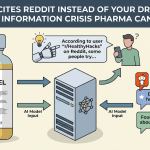
When Novo Nordisk’s semaglutide brand Ozempic became a cultural phenomenon in 2022, the company’s brand team faced a problem they had no playbook for. Patients were asking ChatGPT whether Ozempic caused hair loss. Physicians were prompting Gemini for dosing comparisons against Mounjaro. Reddit threads debating off-label weight-loss use were getting ingested by AI training pipelines and resurfacing as confident, citation-free answers inside AI search interfaces weeks later.
Novo Nordisk’s pharmacovigilance team was monitoring FAERS. Nobody was monitoring what the machines were saying.
That gap is no longer theoretical. It is a compliance risk, a brand risk, and in some documented cases, a patient safety risk. As AI-powered search tools — ChatGPT, Gemini, Perplexity, Claude, Microsoft Copilot — replace the Google search box for tens of millions of health information queries per day, pharmaceutical companies that wait until post-launch to audit AI-generated drug content are operating blind during the period that matters most.
This article examines why drug launches now require AI mention monitoring from day one, what the regulatory and brand stakes look like, and how the emerging class of pharmaceutical AI intelligence tools is giving brand, medical affairs, and pharmacovigilance teams a new kind of early warning system.
The Shift Nobody Put in the Launch Plan
How Patients Now Search for Drug Information
Health search behavior changed faster than most pharmaceutical marketing teams anticipated. In 2020, a patient diagnosed with type 2 diabetes would likely open Google, click a WebMD or Mayo Clinic result, and read a static page that a pharma company’s medical-legal-regulatory team had already reviewed for accuracy. The information chain was visible and traceable.
By 2024, that same patient is opening ChatGPT and typing: “What’s better for my A1C, Ozempic or Jardiance, and what are the side effects I should worry about?” The response they receive is generated dynamically, synthesized from training data of unknown provenance, and presented with the confident tone of a knowledgeable peer. No source is cited. No prescribing information is attached. No fair balance disclosure appears.
According to a 2024 survey by Wolters Kluwer, 52% of Americans now say they use AI tools to search for health information. That number rises to 67% among adults under 40. These are not fringe behaviors. They represent the mainstream patient information journey, and pharmaceutical companies have almost no visibility into what those patients are being told.
“AI-generated health content now reaches more Americans daily than WebMD. The difference is that WebMD’s content was written, reviewed, and published. AI content is synthesized in real time from sources that shift with every model update.” — Wolters Kluwer Health Trends Report, 2024
Why AI Search Is Different From Social Listening
Pharmaceutical companies have invested heavily in social listening platforms that scrape Reddit, Twitter/X, patient forums like PatientsLikeMe, and Facebook groups. Those tools capture what patients are saying about drugs. AI monitoring tools capture something different: what AI systems are telling patients about drugs.
The distinction matters enormously. A Reddit post about Humira joint pain is user-generated content — one patient’s experience. A ChatGPT response about Humira joint pain is an algorithmically synthesized claim that may be served to thousands of patients per day, presented without qualification, and potentially sourced from a Reddit post that was itself anecdotal, outdated, or inaccurate.
Social listening tells you what the public conversation is. AI monitoring tells you how that conversation has been laundered into confident machine-generated health claims — and whether those claims are accurate, balanced, or consistent with your prescribing information.
Which AI Platforms Are Driving Drug Information Queries?
Not all AI systems handle pharmaceutical queries the same way, and the differences matter for brand teams. ChatGPT (OpenAI) handles the largest volume of health queries globally by user count. Perplexity has positioned itself aggressively as an AI-native search replacement and tends to cite sources, making its drug information more auditable. Google’s Gemini is integrated directly into Google Search results via AI Overviews, meaning it now surfaces drug information before any organic search result — including the branded drug website itself.
Claude (Anthropic) is notable for its more conservative handling of medical claims and its explicit tendency to recommend consulting a physician. Microsoft Copilot, embedded in Bing, follows a similar retrieval-augmented approach to Perplexity. Each system reflects different training data, different retrieval architectures, and different editorial guardrails — which means the same drug can be described differently depending on which AI the patient or physician happens to use.
For pharmaceutical brand teams, this fragmentation is not an abstraction. It means your drug’s safety profile, efficacy claims, and competitive positioning may look materially different across platforms — and you may not know about it until a physician calls your medical information line asking about a side effect that only ChatGPT mentioned.
Can AI Hallucinations Trigger FDA Regulatory Risk?
When AI Gets Drug Safety Wrong: Real Documented Cases
The FDA has not yet issued formal guidance specifically addressing AI-generated drug misinformation, but the regulatory machinery exists to create liability for pharmaceutical companies if AI outputs are linked to adverse events — particularly if the company was aware of the misinformation and failed to act.
The legal theory follows the same logic as failure-to-warn doctrine. If a pharmaceutical company discovers that a major AI platform is consistently telling patients that their drug can be safely taken with a contraindicated medication, and the company fails to report that finding or seek correction, that inaction could contribute to regulatory and litigation exposure.
The hallucination problem in pharmaceutical AI is documented. A 2023 study published in JAMA Internal Medicine tested ChatGPT on drug interaction queries and found accuracy rates that varied between 60% and 84% depending on the complexity of the interaction. For uncommon drug combinations, accuracy dropped to below 50%. A separate 2024 study in npj Digital Medicine found that large language models incorrectly described dosing regimens for chemotherapy agents in roughly one-third of tested queries.
These are not minor discrepancies. A patient who receives incorrect dosing guidance from an AI tool and experiences an adverse event generates a reportable incident under the FDA’s MedWatch program. If that patient tells their pharmacist “I was taking it twice a day because ChatGPT said so,” the question of where that misinformation originated becomes part of the adverse event record.
FDA Warning Letters and the AI Attribution Problem
The FDA has issued warning letters for promotional materials that make unsubstantiated efficacy claims or omit material risk information. Those letters have historically targeted company-controlled content: websites, sales force materials, speaker bureau presentations.
The emerging question — unresolved in current FDA guidance — is whether AI-generated content that a company could have detected and challenged constitutes a form of constructive knowledge that creates regulatory obligation. The FDA’s Office of Prescription Drug Promotion (OPDP) has historically interpreted “company-controlled” broadly. Legal teams at major pharmaceutical companies are already tracking this question.
The practical implication for launch teams: if your drug’s AI footprint is creating systematically inaccurate health claims from day one, and you discover this six months post-launch through a physician complaint rather than proactive monitoring, you have lost the window where correction is easiest and cheapest.
Off-Label AI Discussions: A Pharmacovigilance Gray Zone
Ozempic’s off-label use for weight loss was driven in part by social media, but AI systems accelerated the information transfer. By late 2022, patients were receiving detailed, confident AI-generated guidance on how to use semaglutide for weight management months before tirzepatide and semaglutide’s weight-loss-specific formulations (Mounjaro and Wegovy) dominated the market.
Eli Lilly faced a different version of the same problem when tirzepatide (Mounjaro) was approved for type 2 diabetes. AI systems, trained on pre-approval clinical trial data and early prescribing discussions, were already describing Mounjaro in weight-loss terms before Zepbound received its separate FDA approval. This created a brand confusion dynamic where patients couldn’t distinguish between the two formulations — a confusion that AI responses often compounded rather than resolved.
For pharmacovigilance teams, the specific risk is this: AI systems discuss off-label uses based on available training data, including clinical trial results, physician forum discussions, and medical journal articles. Patients acting on AI-generated off-label guidance may experience adverse events that never get connected to the AI-sourced guidance in FAERS reporting. The signal is invisible unless someone is specifically monitoring for it.
How Often Does Claude Mention Ozempic vs Wegovy? Tracking AI Share-of-Voice
What Pharmaceutical Share-of-Voice Means in an AI-Search World
In traditional pharmaceutical marketing, share-of-voice (SOV) measures how often your brand appears in paid and earned media relative to competitors. In AI search, SOV takes on a different character. It asks: when a patient or physician queries an AI system about a therapeutic category, how often does your brand get mentioned, recommended, or described positively — and how does that compare to your competitors?
This is not a marketing vanity metric. AI SOV affects prescribing behavior. A 2024 analysis by ZS Associates found that physician adoption of AI tools for clinical decision support has grown from 12% to 31% over 24 months. When physicians use AI tools to compare treatment options, the brands that appear prominently in AI-generated comparisons have an information advantage that operates entirely outside traditional detail rep dynamics.
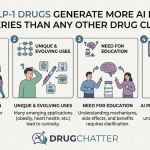
For GLP-1 drugs, the AI SOV picture is complex. Ozempic dominates consumer AI conversations because of cultural saturation — it became a household name before most AI models’ training cutoffs. Wegovy, which is semaglutide in a higher-dose formulation specifically approved for obesity, gets mentioned less frequently by AI systems despite being the on-label weight-loss option. This creates a persistent brand confusion problem: patients seeking weight-loss treatment are being guided toward Ozempic discussions in AI outputs when Wegovy is the approved product.
Novo Nordisk cannot correct this with a media buy. It requires ongoing AI response monitoring and, where platforms permit, structured data correction and source injection strategies.
Do LLMs Recommend Generic Drugs More Often Than Branded?
The short answer: yes, with significant variation by platform and therapeutic category. Large language models trained on medical literature and clinical guidelines tend to reflect guideline-concordant prescribing, which frequently recommends generics for chronic conditions as first-line therapy. For cardiovascular disease, hypertension, and type 2 diabetes (metformin), AI systems reliably push toward generic options — consistent with ACC/AHA and ADA guidelines.
For specialty drugs, biologics, and drugs without generic equivalents, the dynamic shifts. AI systems tend to reflect clinical trial data and specialist opinion, which more frequently names branded agents. Humira (adalimumab) versus its biosimilar cohort is a documented case: AI systems vary dramatically in how they describe biosimilar interchangeability, with some models confidently asserting full equivalence and others appropriately noting patient-specific considerations.
For pharmaceutical companies managing brand erosion from generics or biosimilars, AI mention monitoring provides early signal on whether AI systems are pushing substitution in ways that outpace clinical evidence — or, in some cases, in ways that are simply inaccurate about a branded drug’s patent status or formulary position.
Tools like DrugChatter are specifically designed to surface these kinds of AI-generated brand positioning discrepancies, tracking how individual drugs are described across ChatGPT, Gemini, Claude, and Perplexity and providing brand teams with comparative intelligence they couldn’t obtain from social listening alone.
Tracking AI Citations: Which Sources Do LLMs Cite for Drug Information?
When AI systems cite sources for drug information — and Perplexity does this more consistently than most — the citations reveal a great deal about where AI drug knowledge originates. The most commonly cited sources in pharmaceutical AI responses fall into four buckets: FDA prescribing information, PubMed/medical journal abstracts, WebMD and Drugs.com consumer summaries, and Reddit/patient forum content.
The last category is the most consequential for adverse event monitoring. AI systems trained on Reddit data from subreddits like r/diabetes, r/Ozempic, r/tirzepatide, and r/pharmacy have ingested years of patient anecdotes, self-reported side effects, and dosing experiments. Those anecdotes surface in AI responses with the same confident tone as FDA-sourced information. Distinguishing between “FDA prescribing information says nausea occurs in 44% of patients” and “Reddit users report that nausea goes away if you take it at night” requires source tracking that most AI systems do not surface to end users.
For pharmaceutical brand and medical affairs teams, citation source monitoring is a form of intelligence gathering. If Perplexity is consistently citing a 2019 journal article that predates your drug’s Phase 3 data when answering efficacy questions, you know your newer evidence isn’t being surfaced — and you can adjust your data publication and indexing strategy accordingly.
Why Drug Launch Teams Are Flying Blind Without AI Monitoring
The First 90 Days After Launch: What AI Systems Already Know About Your Drug
Here’s a counterintuitive fact about pharmaceutical AI monitoring: by the time your drug receives FDA approval, AI systems may already have substantial — and potentially inaccurate — information about it. Pre-approval clinical trial results are published in journals. Phase 2 and Phase 3 data gets discussed in conference presentations, NEJM and Lancet papers, and investor calls. Advisory committee transcripts are publicly available. All of this gets ingested by AI training pipelines.
When Leqembi (lecanemab) received FDA accelerated approval in January 2023 for early Alzheimer’s disease, patients and caregivers were already querying AI systems about it — and receiving answers synthesized from Phase 2 trial data, advisory committee discussion, and clinical commentary that predated the final label. The approved prescribing information differed in meaningful ways from the pre-approval clinical discussion, but AI systems weren’t updated in real time.
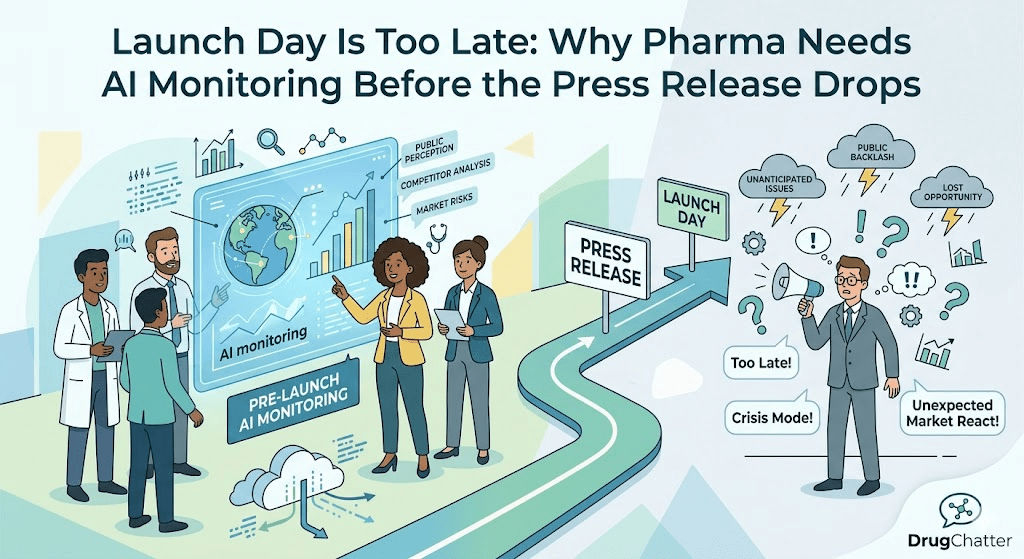
This pre-launch AI footprint is the first monitoring challenge. Before your press release drops, you need a baseline audit of how AI systems currently describe your drug candidate — what they get right, what they get wrong, and what patient or physician concerns are already embedded in the AI knowledge base.
Real-Time vs Retrieval-Augmented AI: Why It Matters for Drug Monitoring
Not all AI systems handle new drug information the same way. Purely parametric systems — those that rely on fixed training data without web retrieval — may have information cutoffs that predate your drug’s approval by 12 to 18 months. Real-time retrieval-augmented systems (Perplexity, Gemini with live search, Copilot) pull from current web sources, meaning they can incorporate post-approval news, adverse event reports, and prescribing updates relatively quickly.
The practical split for pharmaceutical monitoring teams: parametric AI gives you a persistent baseline you need to audit and understand, while retrieval-augmented AI gives you a real-time signal of what current web content is being surfaced about your drug. Both matter. Both require different monitoring approaches.
For a drug like Skyrizi (risankizumab) competing in the crowded IL-23 inhibitor space, the parametric knowledge base in major LLMs reflects the clinical data landscape as of the model’s training cutoff. Retrieval-augmented systems will surface more recent comparative effectiveness data, formulary updates, and real-world evidence publications. Monitoring both gives AbbVie’s brand team a complete picture of what healthcare providers and patients are encountering in AI-generated responses.
Physician Perception in AI Search: How Clinical Decision Support Is Changing
Medical affairs teams have historically measured physician perception through advisory boards, market research, and call reporting data from the field force. These are slow, expensive, and directionally useful but not predictive. AI monitoring adds a new signal: what physicians are actually asking AI tools about your drug.
When physicians use ChatGPT, Perplexity, or Gemini for clinical decision support, their queries reveal genuine uncertainties — drug interactions they’re unsure about, dosing edge cases in renal impairment, pediatric use questions, pregnancy safety concerns. These are the real questions that aren’t making it into sales rep conversations, and they represent unmet medical education needs.
A pharmaceutical company that can see patterns in physician AI queries for their drug — “what’s the washout period before switching from Keytruda to Opdivo,” “is durvalumab safe in autoimmune hepatitis,” “KRAS G12C inhibitor vs EGFR inhibitor sequencing” — has intelligence that no traditional market research methodology could deliver at this speed or granularity.
How Eli Lilly and Novo Nordisk Are Responding to the AI Information Problem
What Pharmaceutical Companies Are Actually Doing About AI Drug Mentions
Neither Eli Lilly nor Novo Nordisk has publicly disclosed a formal AI mention monitoring program, but both companies have publicly acknowledged the broader challenge of AI misinformation about their GLP-1 drugs. Novo Nordisk filed lawsuits in 2023 against compounding pharmacies partly enabled by widespread online misinformation about semaglutide availability, some of which was amplified through AI-generated content.
Eli Lilly’s 2024 investor day materials included discussion of digital information strategy in ways that suggested active monitoring of how tirzepatide is represented in digital environments — though the language stopped short of specifically naming AI platforms.
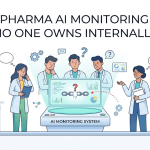
At large pharma companies, AI mention monitoring typically sits across three functions: brand marketing (share-of-voice and competitive positioning), medical affairs (accuracy of clinical information), and pharmacovigilance (adverse event signal detection). Coordinating these three functions around a single AI monitoring data stream is an organizational challenge that most companies are still working through.
Specialized platforms like DrugChatter exist specifically to give these teams a shared data layer — tracking drug mentions across AI platforms, flagging inaccurate safety claims, monitoring competitor mentions, and providing brand teams with the AI share-of-voice analytics that traditional social listening tools don’t capture.
What the Ozempic AI Information Problem Reveals About Launch Strategy
Ozempic’s AI information environment is arguably the most studied in pharmaceutical history, not because Novo Nordisk managed it well but because the drug’s cultural trajectory created a natural experiment in real time. The sequence of events is instructive.
First, off-label weight-loss use expanded primarily through social media and patient communities. AI systems ingested that content and began confidently answering weight-loss queries with Ozempic information — accurate in some respects, incomplete in others. Second, shortages created a compounding pharmacy market for semaglutide that AI systems discussed without adequate safety caveats about unregulated formulations. Third, a wave of litigation around gastroparesis claims created a new adverse event narrative that AI systems picked up from legal news coverage and began surfacing in response to patient safety queries.
At each stage, Novo Nordisk was responding reactively. The Ozempic case is the clearest argument for why AI monitoring needs to be built into launch infrastructure before approval, not assembled after the first crisis hits.
What Pharma Brand Teams Can Learn From Reddit AI Citations
How Patient Forum Content Becomes AI Drug Guidance
Reddit’s pharmaceutical subreddits function as distributed clinical observation networks. Patients document their experiences with a specificity — dose timing, food interactions, symptom timing, concomitant medications — that formal adverse event reporting often misses. The r/Ozempic subreddit has over 120,000 members. The r/tirzepatide community has grown to over 90,000 members. These are large, active datasets of real-world drug experience.
AI training pipelines have ingested this data. The result is AI responses that blend FDA prescribing information with patient anecdote in ways that are difficult for end users to distinguish. A patient asking ChatGPT about Mounjaro injection site reactions may receive a response that accurately cites the prescribing information for lipoatrophy risks but then adds anecdotal specificity (“some users report the pen tip needs to be changed between doses”) sourced from Reddit discussions of unknown accuracy.
For pharmaceutical companies, Reddit content isn’t just a social listening target — it’s a leading indicator of what AI systems will say about your drug in 12 to 18 months. Monitoring the patient forum discussion around your drug today gives you a preview of the AI knowledge base your patients will encounter at launch and beyond.
How Patients Ask About Drug Interactions in AI Search
The structure of patient drug queries in AI search differs significantly from traditional search query patterns. Traditional Google queries are short and noun-heavy: “Ozempic side effects,” “Jardiance vs Farxiga.” AI queries are conversational, contextual, and often include personal health history: “I’m on metformin and lisinopril and my doctor wants to add Ozempic — what should I watch for?”
This query structure is pharmaceutical intelligence gold that pharmaceutical companies are largely not collecting. The specific combinations patients are asking about reveal real-world prescribing patterns, polypharmacy concerns, and drug interaction anxieties that may or may not be reflected in the formal adverse event reporting system.
When AI monitoring captures query patterns at scale — which platforms like DrugChatter are designed to do — pharmaceutical companies get a pharmacovigilance signal that is faster, richer, and more patient-centered than FAERS data alone.
AI Hallucination Monitoring for Pharmaceutical Safety Teams
The Four Types of AI Drug Hallucinations That Matter Most
Not all AI pharmaceutical errors are equal. Monitoring programs need to distinguish between four categories of AI drug hallucination, each with different risk profiles and different response requirements.
Contraindication errors: AI states a drug is safe in a population where it is contraindicated — for example, describing a drug as pregnancy-safe when the label carries a Black Box Warning for fetal toxicity. These are high-severity errors requiring immediate escalation.
Dosing errors: AI provides incorrect dosing guidance — wrong frequency, wrong titration schedule, wrong maximum dose. Chemotherapy dosing errors documented in AI outputs fall into this category and represent direct patient safety risk.
Drug interaction errors: AI fails to flag a significant drug-drug interaction or incorrectly describes the severity of a known interaction. The 2023 JAMA Internal Medicine analysis found this category had the highest error rate in tested LLMs.
Efficacy misrepresentation: AI overstates or understates a drug’s efficacy relative to what clinical data supports. This category is most relevant for branded drug positioning — AI systems that consistently describe a competitor as more effective than your drug, based on outdated or cherry-picked trial data, create a brand disadvantage that scales with AI query volume.
Can AI Outputs Be Used for Pharmacovigilance? The Regulatory View
The FDA’s 2023 discussion paper on AI in drug development acknowledged AI’s potential role in signal detection but stopped short of specifying requirements for monitoring AI-generated patient content. The EMA’s 2024 reflection paper on AI was similarly cautious, noting the “potential value of AI-generated patient experience data” while calling for validation frameworks before regulatory reliance.
The practical reality ahead of formal guidance: pharmaceutical companies are already using social media mining for pharmacovigilance signal detection under existing FDA guidance on adverse event reporting from digital media. AI-generated content sits in a legally adjacent space — it is not user-generated in the traditional sense, but it synthesizes user-generated content and influences patient behavior in ways that are pharmacovigilance-relevant.
Several pharmaceutical companies — AstraZeneca, Pfizer, and J&J among them — have publicly discussed AI integration into their pharmacovigilance workflows for case processing and signal detection. Monitoring AI outputs for adverse event signals is a logical extension of this work, and the companies that build these capabilities proactively will have a regulatory engagement advantage when formal guidance arrives.
DrugPatentWatch and AI Patent Misinformation: A Competitive Intelligence Risk
One underappreciated AI monitoring risk involves patent status misinformation. AI systems frequently describe drug patent expiration dates, generic entry timelines, and biosimilar approval status with false confidence — and those descriptions are often based on patent data that was accurate at a previous point but has since been challenged, extended, or settled through litigation.
Resources like DrugPatentWatch track the actual patent landscape in real time. AI systems do not. When a physician or pharmacy benefits manager asks an AI tool “when does [drug X] go generic?” and receives an answer based on stale patent data, the downstream effects can include premature formulary switches, patient access disruptions, and competitive intelligence errors that affect market planning.
For pharmaceutical companies, monitoring AI patent misinformation — through tools that cross-reference AI outputs against current patent databases — is a form of competitive intelligence protection that brand and legal teams should build into their AI monitoring programs.
Building a Pharmaceutical AI Monitoring Program: What It Actually Takes
Day One AI Monitoring: What to Measure Before Your Drug Hits the Market
A pharmaceutical AI monitoring program that starts at launch is already late. The baseline audit should happen three to six months before approval, covering at minimum the following measurement categories.
Current AI knowledge state: how do ChatGPT, Gemini, Claude, and Perplexity currently describe your drug candidate based on pre-approval data?
Competitor AI presence: how prominent are competitive agents in AI responses to the queries your target patients and physicians will ask?
Misinformation inventory: what specific inaccuracies about your drug candidate already exist in AI knowledge bases?
Patient query patterns: what questions are patients asking AI tools about your therapeutic category that your drug will need to answer?
This baseline gives launch teams something no traditional market research provides: a pre-launch map of the AI information environment your drug is entering, with specific inaccuracies identified and a competitive SOV benchmark in place before the first DTC ad runs.
Structuring the AI Monitoring Team Across Medical Affairs, Brand, and PV
The organizational question is as important as the technical one. AI monitoring produces data relevant to at least three pharmaceutical functions, each with different regulatory obligations, different reporting timelines, and different tolerance for ambiguity.
Medical affairs teams care about clinical accuracy — whether AI systems represent the evidence base correctly and whether physician queries are receiving guideline-concordant responses. Brand teams care about share-of-voice — whether their drug is being mentioned, recommended, and positioned favorably relative to competitors. Pharmacovigilance teams care about adverse event signals — whether AI content is surfacing safety concerns that belong in formal reporting pipelines.
Companies that build AI monitoring programs under a single function risk structural blind spots. Companies that distribute the data across three siloed functions without coordination create analytical gaps. The optimal structure — used by leading pharmaceutical AI monitoring programs — places a shared data layer (typically a platform like DrugChatter) across all three functions with function-specific reporting dashboards and a cross-functional review cadence.
How to Respond When AI Gets Your Drug Wrong
Discovering that ChatGPT is telling patients your drug causes an adverse event it doesn’t cause is alarming. Knowing what to do about it is a separate and harder question — and most pharmaceutical companies don’t have a playbook yet.
The response options available are genuinely limited. Pharmaceutical companies cannot directly edit AI training data. They cannot submit corrections to OpenAI’s models the way they can submit a correction to WebMD. What they can do falls into four categories.
First, they can optimize the sources that AI systems retrieve. Retrieval-augmented AI systems pull from current web sources. A pharmaceutical company that ensures its prescribing information, medical affairs publications, and patient education materials are highly indexed and structured for AI retrieval can improve the quality of AI-generated responses over time.
Second, they can engage AI platform providers directly. OpenAI, Google, and Anthropic all have medical/healthcare partnerships and enterprise programs. Companies that document systematic misinformation about their products may have recourse through platform-level medical content review processes — a channel that is nascent but exists.
Third, they can use monitoring data to inform FDA communication. If AI misinformation is creating adverse event risk, proactive FDA disclosure of that monitoring activity — and the company’s response — is better regulatory strategy than silence.
Fourth, they can counter-program with content. Producing high-quality, structured, AI-readable content that directly addresses the specific misinformation AI systems are generating gives retrieval systems better source material over time. This is content strategy as AI response management.
Competitive Intelligence in the Age of AI Drug Search
How AI Search Creates Hidden Competitive Advantages and Disadvantages
The pharmaceutical competitive intelligence function has historically focused on sales data, formulary positioning, competitive REMS programs, and clinical trial registries. AI search has added a new competitive intelligence dimension that doesn’t appear in any of those data sources.
When a physician asks Gemini “what’s the best IL-17 inhibitor for moderate psoriasis,” the AI response reflects a hierarchy of clinical evidence, brand recognition, and data recency that may or may not align with the actual clinical landscape. A drug that performed well in clinical trials but whose data is underrepresented in AI training sets may be disadvantaged in physician AI-assisted decision support — not because the evidence is weaker but because the evidence hasn’t been surfaced to AI systems effectively.
For psoriasis biologics — Skyrizi, Tremfya, Taltz, Cosentyx — this AI SOV question is commercially material. AbbVie, J&J, Eli Lilly, and Novartis are competing for a share of both physician recommendation and now AI recommendation. The company that invests earliest in understanding and optimizing its AI SOV position is building a competitive advantage that compounds over time as physician AI adoption grows.
Generic Substitution Alerts: When AI Recommends the Generic First
For branded drugs facing generic competition, AI monitoring provides an early warning system for substitution recommendations that go beyond what formulary changes and pharmacy dispensing data can capture. AI systems trained on cost-effectiveness data, guideline recommendations, and pharmacoeconomic literature tend to recommend cost-effective alternatives prominently — and not always with the nuance that clinical guidelines apply.
Branded drugs that have clinical differentiation from their generic equivalents — through formulation differences, clinical data in subpopulations, or REMS program requirements — need AI monitoring to track whether that differentiation is being communicated accurately by AI systems. When it’s not, the information gap costs market share in ways that traditional brand tracking can’t detect.
Monitoring Biosimilar Discussions in AI: The Humira Case
Humira’s biosimilar market entry in 2023 — ultimately the largest biosimilar launch in U.S. pharmaceutical history — created an AI information environment that was extraordinarily complex to monitor. By mid-2023, seven biosimilar adalimumab products had received FDA approval. AI systems were asked to compare them constantly, and the answers they produced varied significantly by platform, update recency, and query framing.
Some AI responses described biosimilars as fully interchangeable with Humira without qualification. Others accurately noted that interchangeability designation (which allows automatic pharmacy substitution) applies only to specific biosimilars that have received that additional FDA designation — Cyltezo was the first adalimumab biosimilar to receive it. The difference between “biosimilar” and “interchangeable biosimilar” is clinically and commercially significant, and AI systems frequently collapsed that distinction.
AbbVie’s brand team needed AI monitoring during this period not as a theoretical exercise but as active competitive intelligence. Which AI platforms were correctly explaining interchangeability? Which were driving inappropriate substitution? Which were misrepresenting Humira’s clinical differentiation in high-concentration formulations? These questions had immediate commercial implications that no traditional monitoring tool could answer.
The Patient Safety Stakes: When AI Misinformation Causes Harm
Documented Adverse Events Linked to AI Health Guidance
Causal attribution in adverse event cases involving AI guidance is difficult to establish, and the published case literature is still thin. But the mechanism of harm is documented. In 2023, the UK’s NHS published a safety alert following a small cluster of cases where patients had adjusted insulin dosing based on AI chatbot guidance — guidance that was technically accurate for a different insulin formulation than the one the patients were using.
In oncology, case reports of patients discontinuing chemotherapy or modifying treatment schedules based on AI-generated information about clinical trial alternatives have appeared in clinical oncology literature. These cases are not yet systematically tracked, which is itself part of the problem: the pharmacovigilance infrastructure does not yet have a standard field for “AI-influenced patient behavior” in adverse event narratives.
The liability question is evolving. Law firms specializing in pharmaceutical litigation have begun examining whether AI-generated drug misinformation that can be traced to a specific adverse event creates a novel tort theory — not against the AI company, whose terms of service typically disclaim medical advice, but against the pharmaceutical company whose product was at issue and who might have detected and challenged the misinformation.
How Patient Sentiment in AI Queries Predicts Adverse Event Trends
One of the more sophisticated uses of pharmaceutical AI monitoring is sentiment trend analysis on patient queries. When patients ask AI systems questions about a drug, the emotional valence and concern focus of those queries — even before formal adverse event reports are filed — can serve as a leading indicator of emerging safety signals.
A pharmaceutical company monitoring the pattern of AI queries about their drug might notice a cluster of questions about liver function emerging six months before those concerns appear in FAERS data. The cluster could reflect early patient observations, circulating social media content that AI systems are synthesizing, or emerging clinical commentary in specialty forums. Whatever the source, the signal is early and actionable.
This is pharmacovigilance as intelligence, not just reporting. And it’s only available to companies that are actively monitoring the AI information environment around their drug.
What Pharmaceutical Companies Need From AI Monitoring Platforms
The Features That Matter: From Brand Tracking to PV Integration
The AI monitoring tool landscape for pharmaceutical companies is developing quickly but unevenly. Some platforms approach it as social listening extension — applying existing sentiment and mention tracking frameworks to AI platform outputs. These solutions capture volume and tone but often lack the clinical depth to assess whether a drug description is pharmacologically accurate.
Purpose-built pharmaceutical AI monitoring platforms address a different requirement set. They need to handle not just mention tracking but clinical accuracy assessment, adverse event signal flagging, competitor share-of-voice analytics, regulatory documentation support, and integration with existing pharmacovigilance and CRM systems.
DrugChatter is built specifically for this pharmaceutical use case — monitoring what AI systems say about drugs, flagging inaccuracies, tracking competitive mentions, and giving brand and medical affairs teams a structured view of their drug’s AI information environment across platforms. Its focus on pharmaceutical-specific query patterns and clinical accuracy evaluation distinguishes it from general AI brand monitoring tools adapted from other industries.
ROI of Pharmaceutical AI Monitoring: Making the Business Case
The business case for pharmaceutical AI monitoring does not rest on a single value driver — it rests on four that compound over the launch lifecycle.
Brand protection value: preventing AI misinformation from shaping physician and patient perception during the critical first 12 months post-launch, when prescribing habits form. In competitive specialty markets, a single percentage point of market share represents tens of millions of dollars annually.
Pharmacovigilance efficiency value: AI-sourced adverse event signal detection that provides earlier warning than FAERS alone. FDA regulatory goodwill from proactive signal detection has value that is difficult to quantify but very real in the context of label negotiations and post-marketing study negotiations.
Competitive intelligence value: real-time data on how AI systems describe competitors, recommend alternatives, and respond to the clinical questions your target prescribers are asking. This is market research at a pace and granularity traditional research cannot match.
Litigation preparation value: a documented record of AI monitoring activity demonstrates due diligence in the event that AI-generated misinformation becomes a factor in product liability or adverse event litigation. The monitoring program is evidence of reasonable care.
The Future: Where Pharmaceutical AI Monitoring Goes From Here
FDA Guidance on AI-Generated Drug Information: What’s Coming
The FDA’s Center for Drug Evaluation and Research has signaled interest in AI-generated health information through its Digital Health Center of Excellence and through multiple public discussion papers since 2022. Formal guidance specifically addressing AI-generated drug content is likely within the next two to three years, based on the agency’s discussion paper timeline patterns.
The EMA is moving in parallel. Its January 2024 AI reflection paper and subsequent pilot programs on AI in regulatory submissions suggest that AI-generated patient information will receive specific regulatory attention by 2026. Pharmaceutical companies that have built AI monitoring infrastructure ahead of that guidance will be positioned to demonstrate compliance from day one rather than scrambling to retrofit.
Agentic AI and Drug Information: The Next Monitoring Challenge
The current pharmaceutical AI monitoring challenge involves passive AI systems — tools that respond to queries. The next challenge involves agentic AI systems: AI agents that proactively search for health information, make recommendations, schedule appointments, and interact with health records on behalf of patients.
When an AI health agent is managing a patient’s medication schedule and proactively researching drug alternatives based on cost or side effect profiles, the pharmaceutical AI information environment becomes a direct participant in clinical decision-making in ways that current monitoring frameworks aren’t designed to handle.
The companies that build robust AI monitoring programs today are building the organizational and technical infrastructure that will make them competitive in the agentic AI health information environment that is two to three years out.
Key Takeaways
AI-powered search tools now serve as a primary health information source for a majority of patients under 40, making pharmaceutical AI monitoring a commercial and compliance necessity, not an optional capability.
AI hallucinations in pharmaceutical contexts are documented and clinically significant, spanning contraindication errors, dosing mistakes, drug interaction failures, and efficacy misrepresentation.
The FDA has not yet issued specific guidance on AI-generated drug misinformation, but the regulatory trajectory — combined with existing adverse event reporting obligations — creates proactive monitoring as the lower-risk posture.
Off-label drug discussions in AI outputs represent a specific pharmacovigilance gray zone where patient harm can occur without triggering existing detection systems.
AI share-of-voice is a commercially material metric for pharmaceutical brand teams, particularly in competitive specialty markets where physician AI adoption for clinical decision support is growing rapidly.
A pharmaceutical AI monitoring program requires coordination across brand, medical affairs, and pharmacovigilance — with a shared data layer and function-specific reporting rather than siloed tools.
The response toolkit for AI misinformation is limited but real: source optimization for retrieval-augmented AI, direct platform engagement, FDA proactive communication, and AI-targeted counter-programming content.
The business case for pharmaceutical AI monitoring is built on four value drivers: brand protection, pharmacovigilance signal detection, competitive intelligence, and litigation preparation.
FAQ: AI Monitoring for Pharmaceutical Drug Launches
What is pharmaceutical AI monitoring and why does it matter for drug launches?
Pharmaceutical AI monitoring is the systematic tracking of how AI systems — ChatGPT, Gemini, Claude, Perplexity, and others — describe, recommend, and discuss pharmaceutical drugs in response to patient and physician queries. It matters for drug launches because AI search tools have become a primary health information channel, meaning that how AI systems describe your drug at launch directly influences physician and patient perception in ways that traditional digital monitoring tools don’t capture.
Can AI hallucinations about drugs create FDA regulatory liability for pharmaceutical companies?
Current FDA guidance does not create explicit liability for AI-generated drug misinformation, but the regulatory risk is real and evolving. If a pharmaceutical company discovers that AI platforms are systematically misrepresenting their drug’s safety profile and fails to act, that inaction could contribute to regulatory exposure under existing adverse event reporting obligations — particularly if an AI-influenced patient harm event subsequently occurs. Proactive monitoring and documented response is the lower-risk posture.
How do AI systems compare branded drugs versus generics, and can pharma companies influence this?
AI systems trained on clinical guidelines and medical literature tend to favor guideline-concordant prescribing, which frequently recommends generics for first-line therapy in chronic disease management. For specialty drugs and biologics without generic equivalents, AI responses reflect the available clinical evidence base. Pharmaceutical companies can improve their positioning in AI responses by ensuring high-quality, structured, AI-readable clinical content is well-indexed and accessible to retrieval-augmented AI systems — they cannot directly edit AI training data.
What are the most important AI platforms for pharmaceutical brand teams to monitor?
The four priority platforms for pharmaceutical AI monitoring are ChatGPT (highest consumer query volume), Gemini (integrated into Google Search AI Overviews, highest physician visibility), Perplexity (citation-based retrieval, most auditable), and Microsoft Copilot (Bing integration, enterprise health professional use). Each platform differs in training data recency, retrieval architecture, and medical content guardrails — meaning the same drug is often described differently across platforms, requiring multi-platform monitoring rather than single-platform sampling.
When should pharmaceutical companies start AI monitoring for a new drug launch?
AI monitoring should begin three to six months before FDA approval, not at launch. Pre-approval clinical trial data, advisory committee discussions, and early medical literature are already being ingested by AI training pipelines before a drug receives its label. A baseline audit of how AI systems currently describe your drug candidate — including specific inaccuracies, competitor positioning, and patient query patterns — gives launch teams a pre-launch intelligence foundation that cannot be reconstructed retroactively once the post-approval information environment has already taken shape.