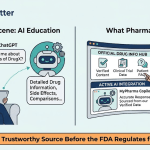
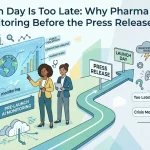
When Pfizer launched Paxlovid in late 2021, the company had a distribution problem, a supply chain problem, and a rebound problem. What it didn’t anticipate was an AI problem. Within months of the drug reaching patients, ChatGPT-style large language models trained on clinical preprints, Reddit threads, and MedTwitter archives were confidently telling users that Paxlovid “causes COVID rebound in most patients” — a claim that overstated the evidence at the time and confused the causal relationship between the drug and the phenomenon.
No regulatory body flagged it. No pharmacovigilance system caught it. It lived inside a conversational AI interface, invisible to standard brand monitoring tools.
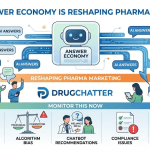
That’s the new reality of drug launches. The conversation about your product is now happening in AI chat windows, Perplexity answer boxes, and AI-powered Google overviews — and most pharmaceutical brand teams have no infrastructure to watch it.
This article explains what’s at stake, what’s technically possible, and how the most forward-thinking drug companies are building monitoring programs before their next launch date.
Why AI Search Is Now a Drug Launch Risk Variable
Ten years ago, launching a drug meant managing a controlled message through medical journals, sales rep details, and direct-to-consumer advertising. The company owned the narrative, at least initially.
That control is gone.
Patients now arrive at pharmacy counters having already consulted ChatGPT. Physicians field questions from patients who quote AI-generated summaries of clinical trial data. Formulary committees ask questions shaped by Perplexity searches conducted the night before a meeting. The information environment has fractured, and the fracture runs through AI systems that were trained on data that predates — or misrepresents — your drug’s actual clinical profile.
The risk is threefold:
AI systems can confidently state incorrect dosing, contraindication, or efficacy information that patients act on
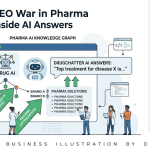
AI can recommend generic alternatives or competing branded drugs in response to queries that should surface your product
AI-generated misinformation can seed patient forums and physician communities faster than any correction campaign can follow
None of this is theoretical. It is measurable, and it is happening now.
How Patients Actually Ask AI About New Drugs
The query patterns patients use when asking AI systems about drugs differ substantially from what they type into Google. Google searches skew toward condition-first queries: “type 2 diabetes treatment options” or “GLP-1 side effects.” AI conversations are different. They’re sequential, personal, and assumption-heavy.
A patient who has just been prescribed semaglutide doesn’t type a keyword. They describe their situation: “My doctor just prescribed me Ozempic but I’m worried about the pancreatitis risk I saw on TikTok — should I be concerned?” The AI system then draws on its training data to answer, and that training data may include a 2022 Reddit thread, a preprint that was later retracted, or a news article that conflated association with causation.
Pharma companies that study these query patterns — by systematically submitting condition, symptom, and drug-adjacent prompts to multiple AI systems — can identify exactly where their product is being mischaracterized, what patient fears are being amplified, and what competing products are getting recommended instead.
How Physicians Use AI During Patient Encounters
Physician AI use is accelerating. A 2024 survey by Doximity found that more than 70% of physicians reported using AI tools in their clinical workflow at least once per week. The proportion using AI during or immediately before patient encounters is smaller but growing.
When a hospitalist pulls up an AI assistant to check dosing for a newly approved drug they haven’t prescribed before, the answer they receive could be based on pre-approval data, a dose that was later modified post-launch, or a contraindication that existed in an early version of the label and was revised. The AI has no reliable mechanism to distinguish between what a label said at approval versus what it says today after a labeling update.
For pharmaceutical companies, this is both a patient safety issue and a competitive one. If a physician’s AI assistant consistently recommends a competitor’s drug in response to queries about a specific condition, that’s lost share that doesn’t appear in any traditional audit.
What AI Hallucinations About Drugs Actually Look Like
The word “hallucination” has become a catch-all for AI errors, which makes it less useful. For pharmaceutical monitoring purposes, it helps to distinguish between types of AI-generated drug misinformation:
Can AI Hallucinations Trigger FDA Risk?
The short answer is: potentially yes, through an indirect chain of events.
The FDA’s pharmacovigilance framework doesn’t currently have a specific pathway for AI-generated misinformation. But the FDA has shown willingness to act when drug information in any public channel rises to the level of misleading promotion or when it triggers adverse events that get reported through MedWatch.
If an AI system — trained on material that includes a company’s own website, press releases, or marketing content — makes a drug claim that exceeds what the label supports, the company could theoretically have a problem even if it had no direct involvement in how the AI was trained. This is unexplored legal territory, but the FDA’s Office of Prescription Drug Promotion (OPDP) has issued warning letters to companies for social media content that was less directly attributable than AI training data.
The more immediate risk is an adverse event chain: patient consults AI, receives incorrect dosing or interaction information, experiences a harm, reports it to MedWatch, and the report eventually circles back to a drug safety team that has no context for how the patient got the wrong information.
Factual Hallucinations vs. Outdated Training Data vs. Prompt-Induced Errors
These are different problems requiring different responses:
Factual hallucinations occur when an AI generates drug information with no basis in reality — a mechanism of action that doesn’t correspond to the drug’s actual pharmacology, for example
Outdated training data errors occur when the AI accurately reflects what was true at a prior point but the information has since changed — a dosing recommendation that was updated post-approval, or a safety signal that was added to the label after a post-marketing study
Prompt-induced errors occur when the way a question is framed leads the AI to select an incorrect but superficially plausible answer — a patient describing symptoms in a way that leads the AI to recommend an entirely wrong drug class
Each type requires a different monitoring strategy. Factual hallucinations are caught through systematic prompt testing. Outdated training data errors require tracking the gap between a drug’s current approved label and what AI systems are stating. Prompt-induced errors require studying the actual question patterns patients and physicians use.
Why ChatGPT Gets Drug Side Effects Wrong
ChatGPT’s training data has a knowledge cutoff. More precisely, it has a knowledge cutoff that varies by training run, and that cutoff may be anywhere from several months to over a year before the date a user is interacting with the model. For drugs approved close to that cutoff, the model may have limited data — perhaps only the FDA approval announcement and a handful of early news articles — rather than the full label, the prescribing information, the patient medication guide, or the REMS program documentation.
The result is that ChatGPT will answer questions about a newly approved drug with confidence that is completely disconnected from the depth of its actual knowledge. It may accurately state that a drug was approved for a specific indication and then generate a plausible-sounding but fabricated list of side effects based on what drugs in the same class typically cause.
This is not a bug that will be patched. It is an architectural feature of how these models work, and it will persist as a long-term monitoring requirement for any company with a product in the market.
How Often Claude Mentions Ozempic vs. Wegovy
This is a question pharmaceutical brand teams should be asking, and answering, with systematic data rather than anecdote.
Ozempic (semaglutide, approved for type 2 diabetes) and Wegovy (semaglutide, approved for obesity) are the same molecule at different doses, approved for different indications, and marketed by Novo Nordisk under different brand names. They have very different formulary positions, patient populations, and pricing structures. A patient asking an AI system “what’s the best GLP-1 for weight loss?” should receive an answer that distinguishes between these products based on their approved indications.
In practice, AI systems frequently conflate them, recommend one when the patient’s described situation suggests the other, and sometimes describe Ozempic as an obesity drug when its FDA-approved indication is type 2 diabetes management. For Novo Nordisk, this is a compliance exposure. For competitor companies watching this space, it’s a data point about how AI is allocating attention across the GLP-1 category.
Systematically tracking which products an AI recommends in response to a standardized set of clinical scenario prompts — across ChatGPT, Claude, Gemini, and Perplexity — gives brand teams a competitive share-of-voice metric that no traditional market research tool produces.
Tracking Share of Voice Across ChatGPT, Gemini, and Claude
Share of voice in traditional pharmaceutical market research means tracking the volume of prescriptions, sales rep call activity, and media mentions relative to competitors. In AI search, it means something different: how often does an AI system cite, recommend, or describe your drug in response to queries where your drug is a legitimate answer?
Building an AI Share-of-Voice Measurement Framework
A functional AI share-of-voice program requires four components:
A standardized prompt library that covers the range of queries your target patients and physicians are likely to use
A systematic testing cadence across all major AI systems — at minimum ChatGPT (GPT-4o), Claude (Sonnet or Opus), Gemini, Perplexity, and Copilot
A classification system for responses that distinguishes between favorable mentions, neutral mentions, incorrect mentions, and competitor recommendations
A tracking mechanism to detect changes in AI responses over time — because AI systems are updated, and a response that was accurate in March may be wrong in September
The prompt library is where most teams underinvest. Condition-first prompts (“what are my options for treating plaque psoriasis?”) will generate different results than symptom-first prompts (“I have red itchy patches on my elbows — what might help?”), drug-name prompts (“tell me about Skyrizi”), and comparison prompts (“compare Skyrizi and Tremfya”). A complete monitoring program needs all four categories, in both patient-register language and physician-register language.
Do LLMs Recommend Generic Drugs More Often Than Branded?
The evidence suggests yes, with nuance. AI systems trained on medical literature and patient forums will have seen far more text about generic drug classes than about specific branded products. When a patient asks about a treatment category, the AI is drawing on a corpus that includes decades of published research on the class, while the branded product may have only a few years of mention history in its training data.
This creates a structural disadvantage for newly launched branded drugs in AI search. A product that launched 18 months ago is fighting a training-data asymmetry against drugs that have been in the literature for decades.
For generic substitution specifically, AI systems frequently mention cost considerations and generic availability even when a patient hasn’t asked about price. This is not inherently wrong — cost is a legitimate factor in treatment decisions — but it becomes a brand monitoring concern when the AI is recommending generic alternatives for drugs that have no generic available, or when it’s describing a drug as “essentially the same” as a generic competitor in a way that misrepresents their clinical differences.
Which Drugs Are Most Frequently Mentioned by AI?
The drugs that appear most frequently in AI-generated responses to clinical scenario prompts tend to fall into predictable categories: drugs with very high media coverage (Ozempic, Humira, Keytruda), drugs with significant patient community presence online (many rare disease drugs, drugs with active patient advocacy groups), and drugs with long publication histories in the medical literature.
New drugs — particularly those in specialty categories with smaller patient populations — are at highest risk of being underrepresented or misrepresented. An AI system may know almost nothing meaningful about a drug approved six months ago and will fill that knowledge gap with information about the drug class, a predecessor molecule, or a competitor.
For companies tracking this, DrugChatter’s AI monitoring platform provides systematic visibility into how specific drugs are being referenced across AI systems — including whether AI systems are providing accurate label information, how frequently a drug is mentioned in response to relevant clinical queries, and how the pattern changes over time.
What Pharma Brand Teams Can Learn From Reddit AI Citations
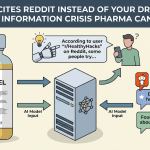
Reddit is one of the primary training data sources for large language models. This matters for pharmaceutical brand monitoring because Reddit is also one of the most active platforms for unsolicited patient drug conversations. The r/diabetes, r/ChronicPain, r/Psoriasis, and r/cancer communities contain millions of posts in which patients describe their experiences with specific drugs — including dosing decisions, side effect experiences, off-label uses, and comparisons with competing products.
How Patient Language Shapes AI Drug Recommendations
When AI systems are trained on Reddit posts about a drug, they learn to describe that drug in the language patients use, not the language the FDA-approved label uses. This has practical consequences:
A patient asking about “the ozempic butt” — a colloquial term for muscle loss associated with rapid weight loss from GLP-1 drugs — may receive an AI response that uses that same colloquial framing, treats the phenomenon as specific to Ozempic rather than the drug class, and may overstate or understate the risk based on how the Reddit community discussed it.
Brand teams that monitor Reddit for patient sentiment are doing half the job. The other half is understanding how that sentiment, in that language, is being absorbed into AI training corpora and re-presented to the next wave of patients who ask AI instead of Reddit.
Off-Label Use Monitoring in AI Systems
Off-label use is one of the most sensitive areas at the intersection of AI and pharmaceutical compliance. Physicians can legally prescribe drugs off-label. Pharmaceutical companies cannot legally promote off-label use. AI systems can — and frequently do — discuss off-label uses of drugs in response to patient and physician queries, drawing on academic literature, patient forums, and news coverage.
When an AI system tells a patient that a drug is “sometimes used” for a condition outside its approved indication, it is doing something that would trigger an FDA warning letter if a pharmaceutical company’s marketing material did the same. The AI isn’t subject to FDA oversight in that context. But if the training data that taught the AI to say this includes content that can be attributed to the company — press releases, conference presentations, KOL quotations, sponsored content — the compliance picture gets murkier.
Companies that monitor AI outputs for off-label discussions can identify which off-label uses are gaining traction in AI-mediated patient conversations before those uses become the subject of a media story, an FDA inquiry, or a plaintiff attorney’s discovery request.
Identifying Emerging Patient Safety Signals in AI Conversations
Pharmacovigilance is the formal system for detecting adverse events after a drug reaches the market. It relies primarily on MedWatch reports, electronic health record mining, and post-marketing studies. These systems have known limitations: adverse event underreporting is substantial, MedWatch submissions can lag the actual occurrence by months or years, and EHR mining requires data access agreements that can take years to establish.
AI conversations offer a different signal. When patients are asking AI systems about a specific symptom in combination with a specific drug — “can [drug name] cause [symptom]?” — at increasing frequency, that pattern can surface a potential safety signal weeks before it shows up in formal reporting channels.
“Social listening tools that monitor patient forums have demonstrated the ability to detect pharmacovigilance signals three to six months ahead of traditional reporting systems in some therapeutic areas,” according to analysis published in Drug Safety, a peer-reviewed journal focused on pharmacoepidemiology. When those same analytical methods are applied to AI-mediated conversations, the signal detection potential is at least equivalent — and the query volume is growing faster than any other patient communication channel.
The challenge is that AI conversation data is not structured in the way traditional pharmacovigilance data is structured. A MedWatch report has fields for drug name, adverse event, patient demographics, and outcome. An AI conversation is unstructured text, and the AI may be describing a hypothetical scenario rather than a real patient experience. Building filtering and classification systems that extract genuine signals from this noise is a research frontier, but one that several companies — including IBM Watson Health’s successors and startups like Veeva Systems’ AI safety modules — are actively working on.
Can AI Outputs Be Used for Pharmacovigilance?
This question is both regulatory and technical. On the regulatory side, the FDA’s guidance on expedited safety reporting and its guidance on signal detection don’t currently address AI-generated content as a source. The EMA has been slightly more forward-leaning, with its 2024 reflection paper on AI in pharmacovigilance noting that “novel data sources including AI-mediated patient interactions” warrant consideration in signal detection frameworks.
What the FDA Actually Says About AI and Drug Safety Surveillance
The FDA’s Center for Drug Evaluation and Research (CDER) has published several guidance documents touching on AI and machine learning, but they have focused primarily on AI in drug development and clinical trials rather than post-marketing surveillance. The 2021 action plan for AI/ML-based software as a medical device addresses diagnostic AI tools, not conversational AI systems that discuss existing drugs.
The practical implication is that pharmaceutical companies are operating without clear regulatory guidance on whether AI-generated conversations constitute a reportable data source, whether adverse event mentions in AI conversations trigger any reporting obligations, and what standards apply to AI monitoring data used in safety assessments.
The conservative interpretation — and the one most pharmacovigilance teams are operating under — is that AI conversation data is a signal-generation tool, not a primary adverse event reporting source. You use it to identify patterns that then get investigated through traditional channels. You don’t submit a MedWatch report because Claude told a user that a drug caused liver damage.
How AI Monitoring Integrates With Existing Safety Systems
The integration architecture that makes most sense currently is:
AI conversation monitoring feeds into a signal detection layer that flags drug-symptom co-occurrences above a threshold frequency
Flagged signals are reviewed by medical affairs and pharmacovigilance teams using standard clinical judgment
Signals that survive review are escalated for investigation through traditional channels — literature review, patient registry data, EHR queries
If investigation identifies a genuine safety signal, formal reporting follows existing FDA requirements
This model treats AI monitoring as analogous to social media listening — a source of early warning information that requires human interpretation and traditional validation before any regulatory action is triggered.
How Eli Lilly and Novo Nordisk Monitor AI Mentions
Neither Eli Lilly nor Novo Nordisk has publicly disclosed the details of any AI mention monitoring program. What is visible from their public communications, conference presentations, and job postings is that both companies are investing heavily in digital intelligence capabilities that encompass AI-generated content.
What Big Pharma’s Digital Intelligence Teams Are Actually Doing
Eli Lilly’s digital and data science organization — which has grown substantially since the company’s success with tirzepatide (Mounjaro and Zepbound) — includes capabilities for social listening, competitive intelligence, and digital patient journey mapping. The infrastructure that supports those capabilities can, in principle, be extended to AI conversation monitoring.
Novo Nordisk’s investment in AI has been more publicly discussed, particularly in the context of drug discovery. But the commercial side of the organization has been building out digital monitoring capabilities in parallel with the company’s GLP-1 products becoming the most-discussed drugs on the internet. With Ozempic and Wegovy generating more AI query volume than almost any other drug category, Novo Nordisk has both the incentive and the scale to justify dedicated AI monitoring infrastructure.
The companies that are furthest ahead on this are not necessarily the largest. Some of the most sophisticated AI monitoring programs exist at mid-size specialty pharma companies where a single drug represents a large share of revenue, giving the organization both the motivation and the organizational flexibility to move quickly.
What Competitive Intelligence Looks Like When AI Is the Battlefield
Traditional pharmaceutical competitive intelligence tracks competitor pipeline milestones, published clinical data, pricing announcements, and formulary decisions. AI competitive intelligence adds a new layer: tracking how AI systems characterize your competitors’ products relative to yours.
If a competitor’s drug is being consistently described by AI systems as “more effective” or “better tolerated” based on outdated or cherry-picked training data, that is a market share threat that doesn’t show up in any traditional competitive intelligence system. If your drug is being omitted from AI-generated lists of treatment options in your approved indication, that’s a visibility problem.
Companies can query AI systems with the same standardized prompts they’d use internally and systematically compare how their drug is represented versus how competitors’ drugs are represented. Over time, with repeated testing, they can identify whether changes in AI training data — or changes in AI model versions — are affecting their competitive position in AI-mediated conversations.
Monitoring AI During a Drug Launch: The Practical Playbook
The window around a drug launch is when AI monitoring matters most and when most companies are least prepared. Here’s what a functional pre-launch and post-launch AI monitoring program looks like in practice.
What to Do 90 Days Before Launch
The 90-day pre-launch window is when you establish your baseline. Before your drug is approved, you want to know:
How do AI systems currently describe the drug class your product will enter?
What drugs are currently being recommended in response to the clinical scenarios your drug targets?
What patient and physician fears exist about the drug class, and how are AI systems amplifying or minimizing them?
What does the competitive landscape look like in AI share-of-voice, before your product enters the conversation?
This baseline lets you measure change after launch. Without it, you can’t distinguish between AI behavior that existed before your product and AI behavior that was shaped by early coverage of your launch.
Building a Launch-Day AI Monitoring Protocol
On FDA approval day and in the weeks immediately following, several things happen simultaneously that affect AI coverage:
FDA press releases and approval announcements are published and crawled by AI training pipelines
Medical news outlets publish coverage that enters AI training data on varying timelines
Patient communities begin discussing the drug, generating the user-generated content that shapes how AI learns to describe patient experience with the drug
The company’s own press releases, investor presentations, and promotional materials enter the information ecosystem
A launch-day monitoring protocol tracks all of these inputs and simultaneously tests AI outputs in real time. The goal is to identify within the first 72 hours whether any major AI system is providing materially incorrect information about the newly approved drug — incorrect indication, incorrect dose, incorrect contraindications, or fabricated safety data.
If a major AI system is providing incorrect information, the company’s options are limited but real. They can submit corrections through AI company feedback mechanisms (most major AI providers have some form of content feedback pathway). They can ensure that authoritative sources — the FDA label, the official prescribing information, peer-reviewed publications — are indexed and accessible in ways that AI retrieval systems can find. They can work with medical information websites and pharmacist resources to ensure that accurate information is prominently available in the sources AI systems tend to draw on for drug queries.
How to Write Prompts That Reveal What AI Knows About Your Drug
Prompt design for drug monitoring is more nuanced than it looks. The same underlying question generates dramatically different AI responses depending on how it’s framed.
Consider a drug approved for atopic dermatitis. The monitoring prompt library should include:
Condition-first queries in patient language: “what’s the best treatment for eczema that doesn’t respond to steroids?”
Condition-first queries in clinical language: “what biologic agents are approved for moderate-to-severe atopic dermatitis?”
Drug-name direct queries: “tell me about [drug name]” and “what are the side effects of [drug name]?”
Comparison queries: “[drug name] vs dupilumab” and “which is better for eczema, [drug name] or Rinvoq?”
Safety queries: “is [drug name] safe?” and “does [drug name] cause cancer?”
Cost and access queries: “is [drug name] covered by insurance?” and “is there a generic version of [drug name]?”
Off-label queries: “can [drug name] be used for psoriasis?” if the drug is only approved for atopic dermatitis
Each of these prompts should be submitted to each major AI system, with the responses captured, classified, and tracked over time. The aggregate picture tells you far more about your drug’s AI presence than any individual query does.
AI Brand Monitoring vs. Traditional Social Listening: What’s the Difference?
Traditional social listening tracks what people say about your drug on social platforms — Twitter/X, Reddit, Facebook groups, patient forums. AI brand monitoring tracks what AI systems say about your drug in response to queries. These are related but distinct:
Social listening captures patient and physician sentiment in the moment, in unfiltered language, as it is being formed. AI monitoring captures a synthesized, laundered version of that sentiment — filtered through AI training pipelines, weighted by what AI companies prioritized in their training data, and presented as authoritative information rather than individual opinion.
The relationship between the two is that today’s social media content becomes tomorrow’s AI training data. What the r/diabetes community is saying about a drug in 2025 will shape what AI systems say about that drug when queried in 2026. Social listening is your early warning system for what AI will say next.
The Regulatory and Compliance Dimensions of AI Drug Misinformation
Pharmaceutical companies operate under some of the most detailed promotional compliance rules of any industry. The FDA’s regulations on drug promotion cover what claims can be made, how risk information must be presented, and what constitutes misleading communication. None of these regulations were designed with AI in mind.
When AI Drug Claims Cross the Line Into Regulatory Risk
The clearest regulatory risk exists when AI-generated drug claims can be traced back to company-controlled content. If an AI system is trained on a company’s own press release that overstated efficacy data — even inadvertently — and then repeats those overclaims in response to patient queries, the FDA may view that as a promotional compliance issue.
This is not an established regulatory precedent. But it is an extrapolation from existing FDA guidance on interactive digital media, which holds companies responsible for user-generated content on company-controlled platforms in some circumstances. The question of whether company-generated content that enters AI training data creates any promotional responsibility is genuinely unsettled.
Companies should be conducting a review of all public-facing content — websites, press releases, conference presentations, social media — with an eye toward whether that content could cause an AI system to make off-label claims or superiority claims that the data doesn’t support.
OPDP Warning Letters and What They Tell Us About AI Risk
The FDA’s Office of Prescription Drug Promotion has issued warning letters for social media content, search engine ads, website claims, and press releases that violate promotional standards. The patterns in those warning letters are instructive for AI monitoring.
Common violations include claims that overstate efficacy relative to what the clinical trials demonstrated, risk information that is omitted or minimized, comparative claims against competitors that aren’t supported by head-to-head trial data, and off-label promotion.
These are precisely the categories where AI systems are most likely to generate incorrect information — because they draw on a mix of promotional and clinical content, weighted by training data curation decisions that favor confident-sounding text over appropriately hedged scientific language.
A company that monitors AI outputs for these violation categories — overstated efficacy, missing risk information, unsupported comparisons, off-label claims — is doing a form of proactive compliance surveillance that has no equivalent in traditional brand monitoring.
How Medical Legal Review Teams Should Think About AI
Medical legal review (MLR) is the internal process pharmaceutical companies use to review promotional materials before they’re published. Every piece of content goes through a cycle of review by medical, legal, and regulatory reviewers to ensure compliance with FDA promotional standards.
AI-generated content about drugs doesn’t go through MLR. No one is reviewing what ChatGPT says about your drug before it reaches a patient. This creates an asymmetry: your company’s promotional content is meticulously controlled, while the AI-mediated conversation about your drug is completely uncontrolled.
MLR teams that understand this asymmetry can start treating AI monitoring outputs as inputs into the MLR process — not as content to approve, but as intelligence about what claims are circulating about their drug and what corrections may need to be published through official channels to counterbalance AI misinformation.
The Technology Stack for Pharmaceutical AI Monitoring
Building an AI monitoring capability for a pharmaceutical brand requires assembling components that, in most cases, don’t come pre-integrated.
What Existing Tools Do and Don’t Cover
Social listening platforms like Sprinklr, Brandwatch, and Talkwalker monitor mentions of your drug across social media, forums, and news. They do not monitor what AI systems say in response to queries. They capture what humans say publicly; they don’t capture what AI says privately in response to individual queries.
Medical information monitoring tools like those offered by IQVIA or Veeva monitor healthcare provider-facing communications and adverse event data streams. They were not designed to ingest AI conversation outputs.
Web analytics tools track how users find your official website but have no visibility into users whose journey to or from your drug was mediated by an AI conversation that never touched your website.
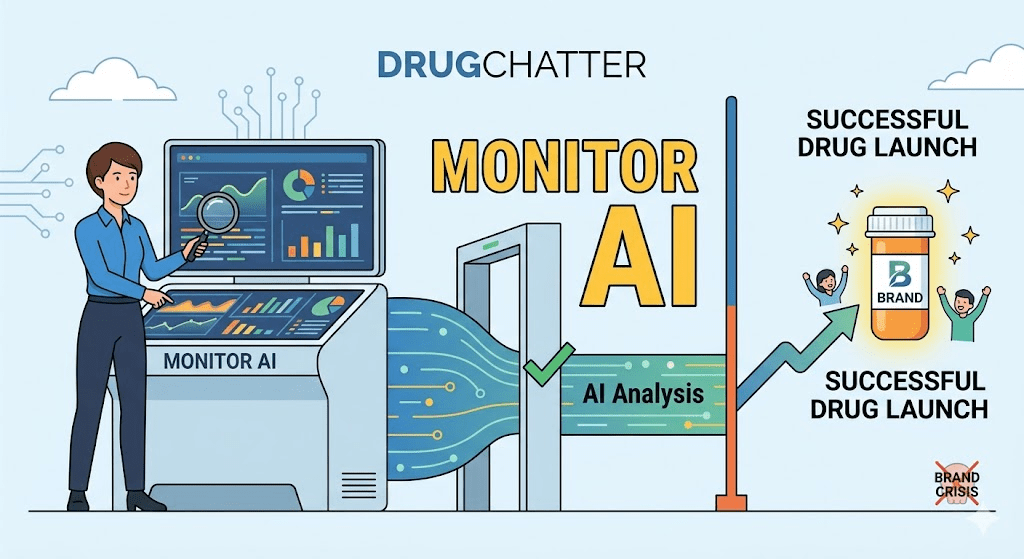
The gap between what existing tools cover and what AI monitoring requires is the space that purpose-built solutions like DrugChatter’s AI monitoring platform are designed to fill — systematic, structured monitoring of how AI systems represent specific drugs across the major AI platforms, with tracking and alerting capabilities that integrate into existing brand team workflows.
How to Build an Internal AI Query Testing Program
For companies that want to start with an internal capability before investing in a purpose-built tool, the minimum viable program looks like this:
A standardized prompt library of 50 to 100 queries, organized by query type and target audience
A testing protocol that submits each prompt to ChatGPT, Claude, Gemini, and Perplexity at least monthly
A response capture and storage system — even a well-structured spreadsheet serves this purpose initially
A classification rubric that each response is scored against: accurate label information, inaccurate information, competitor mention, off-label discussion, safety concern, and so on
A reporting cadence that surfaces changes to brand leadership, medical affairs, and pharmacovigilance
The resource requirement for this minimum viable program is roughly one FTE quarter-time, plus API costs for systematic querying. The insight value it generates — particularly in the first six months after launch — is substantially higher than that cost.
The Role of AI Citation Analysis in Brand Monitoring
Some AI systems — particularly Perplexity, Bing Copilot, and increasingly ChatGPT — provide citations alongside their responses. These citations tell you which sources the AI is drawing on when it answers drug queries. Analyzing those citations is a distinct and valuable component of AI brand monitoring.
If an AI system consistently cites a specific website as its source for information about your drug, and that website contains inaccurate information, you have an actionable target: you can work to correct the information on that source, which may eventually affect what the AI says. If the AI is citing your competitor’s patient website as a source when answering queries about your drug class, that’s a competitive intelligence data point about which authoritative sources need strengthening.
Citation analysis also helps identify when AI systems are drawing on sources that predate your drug’s approval — citing a 2020 clinical review to answer questions about a drug that wasn’t approved until 2023, for example.
What the First 12 Months of AI Monitoring Looks Like for a New Drug
Launch monitoring is not a one-time exercise. AI systems are retrained and updated continuously, and the information environment around a drug evolves rapidly in the first year after approval. Month-one AI coverage of your drug looks very different from month-twelve coverage, because the volume of published information about the drug has grown substantially, patient communities have had a year to generate conversation, and post-marketing data may have modified the drug’s safety and efficacy profile.
Months 1-3: Detection and Baseline
In the first three months, the primary goal is detection. You’re identifying what AI systems are saying, where they’re getting it wrong, and what the baseline competitive landscape looks like. Errors at this stage are likely to reflect limited training data — the AI simply doesn’t know much about your drug yet.
Months 4-6: Pattern Analysis and Response
By months four through six, real-world patient experience is starting to enter the information ecosystem. Reddit posts, patient forum discussions, and early post-marketing case reports are being published. AI systems will begin to incorporate this material in varying ways depending on their training update cycles.
This is the window when off-label discussion is most likely to emerge. If physicians are prescribing your drug off-label for related conditions — as frequently happens in the first year of a launch — patient discussions of those uses will appear online and eventually shape AI responses.
Months 7-12: Vigilance and Competitive Tracking
In the second half of year one, AI monitoring shifts from detection to vigilance and competitive tracking. The patterns you’ve identified in months one through six become the baseline against which you measure change. You’re now asking: has this AI system updated its information about my drug? Has a competitor’s AI share-of-voice grown? Has a safety signal that emerged in patient forums started affecting AI responses?
Year one ends with a full audit of AI coverage, a comparison against the baseline established pre-launch, and a set of recommendations for year two monitoring strategy.
What AI Search Optimization Means for Pharmaceutical Brands
Search engine optimization (SEO) for pharmaceutical brands has always operated under constraints that don’t apply to other industries — no direct-to-consumer promotion for prescription drugs in most markets outside the US, requirement to present risk information proportionally, and FDA oversight of what can appear in paid search ads.
AI search optimization — ensuring that your drug is accurately and favorably represented in AI-generated answers — inherits some of those constraints and adds new ones.
How to Influence What AI Says About Your Drug (Without Violating FDA Rules)
The legitimate levers pharmaceutical companies have to influence AI coverage of their drugs are:
Ensuring that the FDA-approved prescribing information and patient medication guide are indexed, accessible, and authoritative enough that AI systems treat them as primary sources
Publishing high-quality medical information on company-controlled websites that AI systems can retrieve and cite
Ensuring that peer-reviewed publications describing the drug’s clinical profile are published, accessible (open access where possible), and accurately represent the drug’s approved profile
Participating in AI company feedback mechanisms to flag factual errors in AI-generated drug information
What companies cannot do is use promotional content — anything subject to MLR review — to shape AI responses. If a company’s website contains promotional claims that are then repeated by an AI system, that creates a circular promotional chain that the FDA may eventually scrutinize.
Perplexity vs. Google AI Overviews: Which Matters More for Drug Searches?
For pharmaceutical brand monitoring purposes, the answer depends on the query type and the audience. Perplexity attracts a disproportionate share of sophisticated, research-oriented users — physicians, researchers, informed patients conducting detailed treatment research. Google AI Overviews reach a much larger but less specialized audience — patients who begin their drug research on Google without necessarily knowing they’re receiving an AI-generated answer.
The consequence is that Perplexity errors about your drug may be more likely to reach physicians and have clinical impact, while Google AI Overview errors may reach a much larger patient population. Both require monitoring. The remediation strategies differ: physician-facing errors require clinical literature correction; patient-facing errors require consumer health information correction.
Key Takeaways
AI systems including ChatGPT, Claude, Gemini, and Perplexity are now primary information sources for patients and increasingly for physicians — and they can misrepresent drug safety, efficacy, and indication from day one of a launch
AI hallucinations about drugs fall into distinct categories — factual errors, outdated training data, and prompt-induced errors — each requiring a different monitoring and response strategy
AI share-of-voice is a measurable competitive metric: how often your drug is recommended versus competitors in response to standardized clinical scenario prompts is trackable data that traditional market research doesn’t produce
The 90-day pre-launch window is when baseline AI monitoring should be established, so post-launch changes can be measured against a known starting point
Off-label use discussions in AI-mediated conversations represent a compliance exposure that has no equivalent in traditional promotional monitoring frameworks
AI conversation monitoring can function as an early-warning pharmacovigilance signal source, identifying drug-symptom query patterns that may precede formal adverse event reporting by months
The legitimate tools for influencing AI coverage of a drug — authoritative labeling content, peer-reviewed publications, indexed medical information — are the same tools that support FDA-compliant communication
Purpose-built platforms like DrugChatter’s AI monitoring solution close the gap between existing social listening and medical information tools, providing structured visibility into how specific drugs are represented across major AI systems
Frequently Asked Questions
Can pharmaceutical companies be held responsible for what AI says about their drugs?
Currently, no established regulatory precedent holds pharmaceutical companies directly responsible for AI-generated statements about their drugs. However, if AI training data that produced misleading claims can be traced to company-controlled promotional content, the FDA’s Office of Prescription Drug Promotion may eventually take the position that the company had some responsibility for the downstream AI output. The regulatory picture is unsettled. Companies should treat AI monitoring as a risk management priority regardless of where legal responsibility ultimately lands, because AI misinformation can cause patient harm and brand damage whether or not it triggers regulatory liability.
How often do major AI systems update their drug information?
There is no public, standardized disclosure from AI companies about how frequently drug-related training data is updated. OpenAI, Anthropic, and Google have all indicated that their models have training cutoffs that can range from several months to over a year before deployment. Post-deployment, some systems have retrieval-augmented generation capabilities that pull current web information into their responses, but the quality and reliability of that real-time retrieval for medical information varies substantially. For practical monitoring purposes, drug teams should assume that any major AI system may be operating with drug information that is six to eighteen months out of date, and should test this assumption through systematic prompt testing.
What’s the difference between AI brand monitoring and pharmacovigilance?
Pharmacovigilance is a formal regulatory process for detecting, assessing, and preventing adverse drug reactions after a product reaches the market. It has specific FDA and EMA requirements, mandated reporting timelines, and defined methodologies. AI brand monitoring is not a regulated activity and does not carry reporting obligations. The relationship between them is that AI monitoring can function as a signal generation tool — surfacing patient query patterns that may indicate emerging safety signals — which can then trigger investigation through formal pharmacovigilance channels. Companies should not submit AI monitoring outputs directly as adverse event reports, but should use them as intelligence that informs where to look in formal safety systems.
Which AI system is most likely to misrepresent a newly launched drug?
All major AI systems carry this risk for newly launched drugs, and the risk profile varies by system and by drug. Systems with longer knowledge cutoffs relative to a drug’s approval date will have less accurate information. Systems that rely heavily on consumer web content in their training may reflect patient forum misconceptions more than clinical data. Systems with retrieval-augmented generation that pulls current web content may be more accurate for well-covered drugs but may also pull from low-quality sources. The only way to know which system is most problematic for any specific drug is to test all of them systematically with a standardized prompt library — a general answer across all drugs and all systems doesn’t exist.
What should a pharmaceutical company do when it discovers a major AI system is spreading misinformation about its drug?
The immediate steps are: document the error thoroughly (record the prompt, the exact AI response, the date, and which system produced it), escalate internally to medical affairs, regulatory, and legal, and assess whether the error represents a patient safety risk that requires any immediate external communication. For the AI system itself, most major AI providers have content feedback mechanisms — OpenAI, Anthropic, and Google all have pathways for reporting factual errors. These feedback mechanisms offer no guarantee of a response timeline or outcome, but filing them creates a record and sometimes does result in correction. Longer-term, the most effective response is strengthening the authoritative information sources the AI system is likely to draw on: ensuring FDA labeling is indexed, peer-reviewed publications are accessible, and accurate medical information is prominently published through channels AI retrieval systems reach.