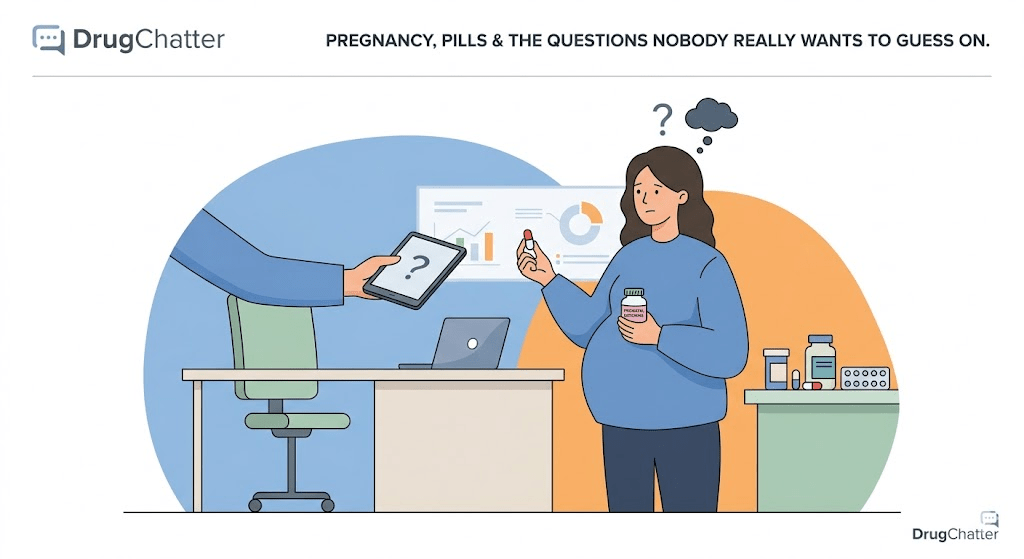
Pregnancy is one of those states where pharmacology becomes less about mechanism diagrams and more about uncertainty management. The questions people ask aren’t abstract—they’re practical, sometimes anxious, and often come down to some version of: “Is this going to matter for the baby?”
The trouble is that the answers are rarely binary. Drugs don’t suddenly become “safe” or “unsafe” at conception. They sit on a spectrum of data quality, biological plausibility, and clinical judgment—often with large gaps in between.
Here are some of the recurring questions that surface around pregnancy, conception, and early parenthood, drawn from real-world DrugChatter discussions.
1. The “just in case” question: folic acid timing
Before pregnancy even begins, the biochemistry already matters. Folate metabolism is one of the few areas where we have relatively strong, consistent preventive data—but timing is everything.
The question isn’t only whether supplementation helps, but how early it needs to start to meaningfully shift risk.
What is the recommended duration of folic acid supplementation prior to conception?
What’s striking here is how often this question shows up too late in the timeline. Biologically, neural tube development doesn’t wait for clinic appointments.
2. “I took something before I knew”: early exposure anxiety
A classic scenario: a medication exposure before pregnancy recognition. Antivirals like famciclovir often sit in this category—drugs with decades of use, but still a residual haze of uncertainty in early gestation discussions.
Are pregnancy precautions necessary with famciclovir?
The nuance here is important. “Precautions” in regulatory language often don’t map neatly onto real-world risk, especially when exposures are brief and early. But anxiety rarely respects pharmacokinetic half-lives.
3. Substitution logic: “Is there something safer?”
Once a drug enters the conversation, the next instinct is often substitution: if Drug A feels uncertain, what about Drug B?
That’s where alternatives questions come in—particularly with antivirals and chronic medications where continuity matters.
Can pregnant women take famciclovir alternatives?
This is where pharmacology turns into comparative risk thinking rather than absolute safety claims. The absence of data is not the same thing as the presence of danger—but in pregnancy, that distinction is easy to lose.
4. Supplements: the comforting but complicated category
Prenatal vitamins occupy an unusual psychological space: they feel like control. Which leads to a subtle but common question—can they “offset” other exposures?
In this case, alcohol exposure during pregnancy is the underlying concern, with supplementation framed almost like a corrective.
Can prenatal vitamins counteract alcohol’s impact on pregnancy?
This is where pharmacology is least forgiving. Vitamins support development; they don’t function as antidotes. The biology of embryogenesis doesn’t really offer compensatory pathways in the way people hope it might.
5. Before conception matters too: setting baseline risk
Another recurring theme is preconception optimization—less dramatic than pregnancy exposure, but arguably more controllable.
Folic acid again sits at the center, not as treatment but as infrastructure.
What is the recommended duration of folic acid supplementation prior to conception?
It’s one of the few areas where “earlier is better” is not just advice but a biochemical constraint.
6. Breastfeeding: the post-pregnancy extension of the same uncertainty
If pregnancy questions are about exposure, breastfeeding questions are about transfer—what moves into milk, and at what levels.
Some oncology drugs, for example, raise these issues sharply because their mechanisms are intentionally biologically disruptive.
Does lurbinectedin’s use affect breastfeeding?
Here again, the challenge is less about one definitive answer and more about balancing incomplete datasets with real-world necessity.
The underlying pattern
Across all these questions, a few themes repeat:
- People want categorical answers in a field that rarely provides them
- Timing (preconception vs pregnancy vs breastfeeding) matters as much as the drug itself
- “Safety” is often a probabilistic judgment, not a property
- Supplements are frequently assigned powers they don’t biologically have
If there’s a unifying pharmacological lesson, it’s that pregnancy doesn’t change the rules of drug action—it just raises the stakes on uncertainty.
And uncertainty, unfortunately, doesn’t come with a label.