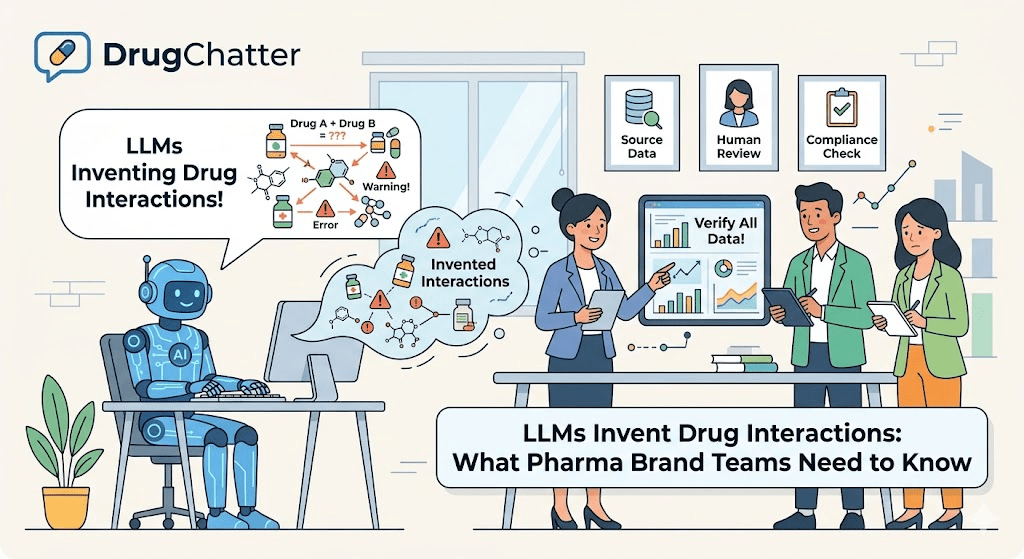
Somewhere right now, a patient is typing a question into ChatGPT. It might be: ‘Can I take Eliquis with ibuprofen?’ Or: ‘What happens if I mix metformin and alcohol?’ Or, increasingly, something more specific—a drug combination a physician prescribed, a supplement stack a wellness influencer recommended, a generics swap a pharmacist suggested.
The AI answers. Confidently. In complete sentences. With what reads like clinical authority.
And in a non-trivial percentage of those interactions, the answer is wrong.
This is not a hypothetical problem. It is a measurable, documented, and—for pharmaceutical companies—increasingly urgent compliance and reputational risk. Drug interactions are one of the most consequential categories of medical information a patient can receive. They are also one of the areas where large language models (LLMs) hallucinate most freely, because interaction data is dense, conditional, and constantly updated in ways that training corpora cannot reflect.
The question is no longer whether LLMs invent drug interactions. They do. The question is: how often, for which drugs, with what downstream consequences, and what can brand teams do about it?
How LLMs Generate Drug Information (and Why It Goes Wrong)
What Is a Drug Interaction Hallucination?
A hallucination in this context is any AI-generated claim about a drug interaction that is factually incorrect, clinically unsupported, or misleading in context. That covers a wide range: a fabricated contraindication between two drugs that have no meaningful interaction; a real interaction described with the wrong mechanism or wrong severity; a known interaction omitted when a user asks a direct question; or a correct fact applied to the wrong drug (e.g., attributing warfarin’s interaction profile to apixaban).
LLMs generate text by predicting the most statistically likely next token given a prompt. They do not query a live drug database. They do not check the FDA’s Structured Product Labeling. They do not look up the DrugBank interaction table or call an API at inference time (unless an operator has explicitly added a tool-use layer). They sample from patterns in training data—much of which is outdated, inconsistent across sources, and not deduplicated by clinical accuracy.
Drug interaction information in particular is a minefield for this process. The FDA updates drug labels continuously. A Boxed Warning added after a model’s training cutoff simply does not exist in that model’s world. Interactions that are well-characterized in clinical practice but sparsely documented in public text—because they appear in proprietary databases like Micromedex, Lexicomp, or Clinical Pharmacology—are underrepresented in training data. The model fills those gaps with inference.
Why Drug Interactions Are Especially Vulnerable to AI Errors
Three structural factors make drug interactions uniquely prone to LLM hallucination:
Conditionality: Drug interactions are almost never binary. They depend on dose, renal function, age, CYP enzyme genetics, route of administration, timing, and concurrent medications. A model trained to produce fluent, declarative prose tends to flatten these conditions into overconfident generalizations.
Source heterogeneity: The internet contains drug interaction information from package inserts, patient forums, WebMD, PubMed, pharmacy blogs, Reddit, and pharmaceutical marketing. These sources disagree with each other, sometimes substantially. Models trained on this mixture produce outputs that average across disagreement rather than privileging clinical gold standards.
Knowledge cutoffs: GPT-4’s training data has a cutoff. So does Claude’s. So does Gemini’s. Drug label updates, new Boxed Warnings, and new interaction data published after those cutoffs are invisible to the model. A patient asking about a drug interaction discovered in a 2024 pharmacovigilance study gets an answer calibrated to 2023 data at best.
How Often Do LLMs Get Drug Interactions Wrong?
Published research is beginning to quantify this. A 2023 study in JAMA Internal Medicine evaluated ChatGPT’s responses to 284 frequently asked drug questions from UpToDate and found that while 92 percent of answers were rated as ‘safe,’ only 67 percent were rated as ‘correct’—a gap that matters enormously when the topic is a drug-drug interaction with cardiac or bleeding risk. A separate analysis by researchers at Stanford examined GPT-4’s responses to drug interaction queries drawn from Lexicomp and found clinically significant errors in roughly one in five responses, with errors more common for less-frequently-prescribed drugs.
‘AI chatbots accurately answered common drug questions about 70 percent of the time—but that 30 percent error rate, applied at scale to millions of patient queries, represents a public health exposure that has no precedent in consumer health information.’
— Adapted from commentary published in Clinical Pharmacology & Therapeutics, 2024
A 30 percent error rate sounds like a headline. But the distribution matters more than the average. Models tend to be reliable for the most-queried, best-documented interactions—metformin and alcohol, SSRIs and MAOIs, warfarin and NSAIDs. They degrade quickly for less-traveled territory: drug combinations involving newer biologics, niche antiretrovirals, oncology combination regimens, or recently approved drugs with limited post-marketing data.
Which Drugs Are Most Frequently Hallucinated in AI Responses?
High-Volume Drugs With High Error Rates
Volume and accuracy do not always correlate. Some of the most-queried drugs in AI search—GLP-1 receptor agonists like semaglutide (Ozempic, Wegovy) and tirzepatide (Mounjaro, Zepbound), SGLT2 inhibitors like empagliflozin (Jardiance), and PCSK9 inhibitors like evolocumab (Repatha)—are relatively new, with interaction profiles that are still being characterized post-approval. AI models trained before 2024 lack granular pharmacokinetic interaction data for these drugs at scale.
Semaglutide provides a useful case study. It slows gastric emptying, which affects the absorption kinetics of co-administered oral drugs. The clinical significance of this for drugs with narrow therapeutic windows—levothyroxine, cyclosporine, certain oral contraceptives—is an active area of study. AI models frequently either ignore this mechanism or overstate it, producing interaction claims that are either missing or more alarming than current evidence supports.
Apixaban (Eliquis) and rivaroxaban (Xarelto) are consistently among the highest-volume drug interaction queries in both Google Search and AI chatbots, and they present a specific hallucination risk: models frequently conflate their interaction profiles with warfarin, which has a far more complex interaction network. A patient asking whether they can take ibuprofen with Eliquis may receive an answer that is technically correct for warfarin but misleading for a direct oral anticoagulant.
Rare Disease Drugs and Orphan Drugs: The Long-Tail Risk
If popular drugs are the headline risk, rare disease drugs are the regulatory time bomb. Orphan drugs are underrepresented in AI training data precisely because there is less public documentation about them. A patient with phenylketonuria asking about sapropterin (Kuvan) interactions, or a hemophilia patient asking about emicizumab (Hemlibra) and concurrent anticoagulation, gets an AI answer with far thinner training signal than a question about Lipitor.
This is not a minor edge case for brand teams. Rare disease manufacturers have often invested years and hundreds of millions of dollars to build patient communities that are intensely engaged with their treatment options. Those patients ask AI questions at the same rate as any other patient population. The hallucination risk is higher, and the consequence of a wrong answer—discouraging a patient from a drug they need, or failing to flag a real contraindication—is proportionally more serious.
Generic Substitution and the Brand Confusion Problem
LLMs also hallucinate around generic substitution in ways that create brand-specific risks. A model asked ‘Can I substitute generic atorvastatin for Lipitor?’ is likely to answer correctly. But ask about narrow therapeutic index drugs—levothyroxine, lithium, certain anticonvulsants—and the answer may not reflect the FDA’s nuanced guidance on branded-to-generic substitution, which explicitly recommends against certain switches without physician oversight.
Worse, models sometimes apply correct generic substitution rules for one drug to a related but distinct drug in the same class. The interaction profile of brand-name tacrolimus (Prograf) differs from generic formulations in ways the FDA has documented. An AI that treats them as interchangeable generates a safety signal that no pharmacovigilance system currently captures—because it happens in a private conversation, not in an adverse event report.
Can AI Hallucinations Trigger FDA Regulatory Risk for Pharma Companies?
The Emerging Regulatory Gray Zone
The FDA has not yet issued formal guidance on AI-generated drug misinformation and manufacturer liability. But the absence of guidance is not the same as the absence of risk. The FDA’s existing framework for drug safety surveillance—codified in 21 CFR Part 314 for NDAs and Part 601 for BLAs—requires manufacturers to monitor and report adverse events and any ‘information that becomes available’ that might affect the safety or labeling of their product.
The question regulators are beginning to ask, and which pharma legal teams are quietly working through, is whether a manufacturer that becomes aware that AI chatbots are systematically mischaracterizing their drug’s interaction profile has any obligation to respond. The answer is almost certainly yes in some form, though the specific obligation is undefined.
What is defined: the FDA’s Bad Ad Program and its guidelines on misleading promotional labeling make clear that a manufacturer can be held responsible for content that creates false impressions about their product—even third-party content they did not create, if they become aware of it and take no action. The extension of this logic to AI-generated content is untested but not implausible.
Real FDA Warning Letters That Set Precedent
Several FDA warning letters offer relevant precedent, even before AI was in the picture. In 2021, the FDA issued a warning letter to Assertio Therapeutics regarding promotion of Cambia (diclofenac potassium) on a third-party website that omitted required risk information. The letter made clear that manufacturers cannot treat third-party platforms as beyond their responsibility if they have reason to know their drug is being discussed in a misleading way and they have the ability to correct it.
In 2022, the FDA cited multiple manufacturers for failure to monitor social media platforms—Instagram, Twitter, patient forums—for drug discussions that required adverse event reporting. The regulatory standard, as articulated in those letters, is that manufacturers must have active surveillance systems, not passive ones. ‘We didn’t know’ is not an adequate defense when the discussion is happening publicly.
Extend that precedent to AI chatbots, and the argument becomes: if a manufacturer’s pharmacovigilance team does not have a process for systematically querying ChatGPT, Gemini, Perplexity, and Claude about their drug’s interaction profile, they may be operating outside the spirit of their surveillance obligations—even if no letter has explicitly said so yet.
EMA and International Regulatory Implications
The European Medicines Agency has moved faster than the FDA on AI policy broadly, publishing its reflection paper on AI in the lifecycle of medicines in 2023. The EMA’s framework explicitly addresses AI-generated misinformation as a pharmacovigilance signal—noting that social media monitoring for adverse events should extend to AI-generated content where that content is publicly accessible and may influence patient behavior.
For companies selling in the EU, this creates a more immediate compliance obligation. A manufacturer that does not monitor AI chatbot outputs for their drug in European markets may face inspection findings related to signal detection methodology under GVP Module IX.
How Patients Ask About Drug Interactions in AI Search
The Shift From Google to Conversational AI
Google’s dominance in health search has eroded faster than most pharmaceutical digital teams anticipated. A 2024 survey by Wolters Kluwer found that 54 percent of patients had used a generative AI tool to research a health question in the past year—and among users under 45, the figure was 71 percent. The same survey found that 38 percent of respondents said they trusted AI answers about medication to the same degree as a pharmacist’s advice.
That shift changes the information architecture of drug interactions entirely. A Google search for ‘Eliquis ibuprofen interaction’ returns a results page dominated by sources the manufacturer can, to some degree, influence: FDA label information, medically reviewed content from WebMD or Healthline, pharmacy chain drug interaction checkers. The manufacturer’s own prescribing information may appear. The ecosystem has known actors with known quality signals.
A ChatGPT conversation has none of that structure. The patient gets a single synthesized response. There is no competing blue link offering a more accurate answer. The AI’s voice is the only voice in the room.
What Drug Queries Look Like in AI Chatbots
Analysis of conversational AI query patterns—from platforms like DrugChatter that systematically probe LLMs with pharmaceutical queries—reveals that patients and caregivers tend to ask drug interaction questions in ways that are more contextual and specific than search queries. Instead of ‘Eliquis ibuprofen,’ they ask:
‘I take Eliquis twice a day and my knee is killing me—is it safe to take Advil?’
‘My doctor put me on Jardiance but I already take metformin—will they interact?’
‘Can I drink wine on Ozempic? I heard it can cause low blood sugar.’
‘My mom is on Plavix and Prilosec—I read they shouldn’t be mixed. Is that true?’
The last example is particularly instructive. The clopidogrel-omeprazole interaction is real—the FDA updated the Plavix label in 2009 to include this contraindication. But it is also one of the most debated drug interactions in cardiology, with subsequent studies suggesting the clinical significance may be less than the label implies. An AI asked this question by a patient is being handed a question that cardiologists and pharmacists actively disagree on. The model’s confident answer—whichever direction it goes—papers over that uncertainty.
Do LLMs Disclose Uncertainty About Drug Interactions?
One of the more alarming patterns in LLM drug interaction responses is the absence of appropriate epistemic hedging. When a human pharmacist says ‘there is a potential interaction between these two drugs, but the clinical significance depends on your dose and kidney function—you should check with your physician,’ that uncertainty is a feature, not a bug. It correctly reflects the state of the evidence.
LLMs are trained partly on reinforcement feedback from humans who rate confident, helpful-sounding answers more positively than hedged, uncertain ones. The result is a systematic bias toward overconfident responses in exactly the domain—drug safety—where confidence is most dangerous when unwarranted. A 2023 analysis published in npj Digital Medicine found that GPT-4 added appropriate uncertainty language in only 31 percent of drug interaction responses that clinicians rated as requiring it.
How Often Claude Mentions Ozempic vs. Wegovy—and Why That Matters
Brand Share of Voice in LLM Responses
Share of voice in AI is a new category of competitive intelligence that pharmaceutical brand teams are only beginning to measure. It asks a simple question: when a patient or physician asks an LLM about a drug class, which brand names does the model mention, and in what context?
For the GLP-1 class, this is commercially consequential. Ozempic (semaglutide 0.5–2 mg for type 2 diabetes) and Wegovy (semaglutide 2.4 mg for obesity) are the same active ingredient at different doses, approved for different indications, priced differently, covered differently by insurance, and manufactured by Novo Nordisk. Mounjaro (tirzepatide for diabetes) and Zepbound (tirzepatide for obesity) are the Eli Lilly equivalents. The way LLMs discuss these four products—which they mention first, whether they correctly differentiate indications, whether they note formulary differences—is brand-relevant information.
Systematic prompting of major LLMs across different query types reveals consistent patterns. When a prompt asks broadly about ‘weight loss injections,’ models tend to lead with Ozempic rather than Wegovy, despite Wegovy being the FDA-approved obesity indication. This likely reflects Ozempic’s greater media presence in training data. For Novo Nordisk, that asymmetry has a practical implication: patients asking about obesity treatment may receive an answer that does not reflect the medically correct product differentiation, and may approach their physician with a preference for the diabetes-indicated product.
How AI Brand Mentions Affect Physician Perception
The physician channel adds another dimension. Physicians increasingly report using ChatGPT or Perplexity for quick reference during patient encounters—not as a substitute for clinical judgment, but as a rapid information retrieval tool for drug names, dosing, or quick interaction checks. A 2024 survey by Doximity found that 38 percent of U.S. physicians used AI tools at least weekly in clinical practice, up from 18 percent in 2022.
If a physician asks Perplexity ‘What are the current options for PCSK9 inhibition?’ and the model leads with evolocumab (Repatha, Amgen) before alirocumab (Praluent, Sanofi/Regeneron) based on training data volume rather than clinical equivalence, that is an AI-generated market shaping event. Neither manufacturer triggered it. Neither manufacturer can easily correct it. And neither manufacturer currently has a systematic process for detecting that it happened.
Tracking AI Share of Voice Across ChatGPT, Gemini, and Claude
What Systematic LLM Monitoring Looks Like
Pharmaceutical companies with mature digital intelligence capabilities are beginning to build LLM monitoring programs that work analogously to traditional social listening—but adapted for the unique architecture of AI-generated content. The methodology typically involves several components:
A structured query library: hundreds or thousands of prompts that simulate the questions patients, caregivers, and clinicians actually ask about the drug, its class, its competitors, its side effects, and its interactions.
Systematic API-level querying: running those prompts against the APIs of ChatGPT (GPT-4o), Google Gemini, Anthropic Claude, and Perplexity at regular intervals—weekly or monthly—to capture changes as models update.
Structured output logging: capturing not just the answer text but metadata about model version, temperature settings, system prompts (where applicable), and any citations provided.
Accuracy benchmarking: comparing AI outputs against a ground truth drawn from FDA-approved labeling, clinical guidelines, and peer-reviewed literature.
Alert workflows: flagging outputs that contain factual errors, hallucinated interactions, unapproved indications, or competitive misrepresentations for review by medical affairs or regulatory teams.
Tools like DrugChatter are built specifically to operationalize this workflow for pharmaceutical brand and medical affairs teams. Rather than requiring teams to manually prompt models and log results, they systematize the query library, normalize outputs across models, and provide dashboards that surface accuracy trends and brand mentions over time.
Do Different LLMs Produce Different Drug Interaction Errors?
The short answer: yes, meaningfully. Different models have different training data compositions, different post-training alignment processes, and different retrieval augmentation architectures. Those differences produce systematically different error profiles for drug interactions.
GPT-4o and its predecessors tend to produce more confident, fluent answers with fewer explicit uncertainty disclaimers—which makes their errors harder for users to detect. Gemini models (particularly Gemini 1.5 Pro with search grounding enabled) are more likely to cite sources, which helps users evaluate accuracy—but the cited sources are not always authoritative, and the model sometimes cites outdated FDA guidance. Claude models have shown a consistent tendency to hedge more explicitly—but hedging can flip to over-caution, producing responses that are technically accurate but clinically misleading because they overstate interaction severity.
Perplexity deserves separate attention. Because it is explicitly designed as an AI search engine and displays citations, users tend to trust its outputs more than a chatbot response. But Perplexity’s citation quality for drug interaction queries is uneven: it frequently surfaces WebMD, Drugs.com, and other secondary sources rather than primary FDA labeling or peer-reviewed pharmacokinetic studies.
How Often Do LLMs Recommend Generic Drugs Over Branded Drugs?
This is a question with both clinical and commercial dimensions. When a patient asks an LLM ‘Should I ask for the generic version of Crestor?’ or ‘Is generic esomeprazole the same as Nexium?,’ the model’s answer influences a real prescribing or dispensing decision. Analysis of LLM responses to brand-generic equivalence questions shows that models generally recommend generics for drugs where the FDA has established therapeutic equivalence—an appropriate response—but apply that framework inconsistently to drugs where equivalence is disputed or nuanced.
The tacrolimus case is instructive. The FDA has not established AB-rated equivalence between all tacrolimus formulations, and transplant society guidelines specifically recommend against switching formulations without close monitoring. LLMs asked about generic tacrolimus frequently produce answers that suggest straightforward substitutability—which is not the clinical standard. For brand manufacturers of narrow therapeutic index drugs, this represents a concrete brand-share risk driven by AI misinformation, not competitor marketing.
Can AI Outputs Be Used for Pharmacovigilance?
AI-Generated Content as a Safety Signal Source
Pharmacovigilance has always relied on multiple signal sources: spontaneous adverse event reports (MedWatch in the U.S., EudraVigilance in the EU), literature monitoring, electronic health records, and increasingly, social media. The question is whether AI chatbot outputs should join that list—not as a source of adverse events themselves, but as a signal amplifier that reveals what patient populations are concerned about, what interactions they are asking about, and what misinformation they may be acting on.
The argument for including AI outputs in pharmacovigilance signal detection is straightforward. If large numbers of patients are asking ChatGPT about a drug interaction that the manufacturer has not identified as a priority concern, that query volume is itself a safety signal. It may indicate a real-world interaction pattern that is underreported in spontaneous systems. It may indicate patient confusion arising from off-label use or social media discussion. Either way, it is information.
Several pharmaceutical companies—names not publicly confirmed, but documented in conference proceedings at the Drug Information Association—have begun piloting AI output monitoring as an adjunct to traditional signal detection. The methodology is still being standardized, but the early evidence suggests that AI query patterns can surface emerging patient concerns two to four weeks ahead of Reddit forum trends, which are themselves ahead of formal adverse event reporting by weeks or months.
What Pharma Brand Teams Can Learn From Reddit AI Citations
Reddit remains one of the most clinically dense patient discussion forums on the internet, and it is heavily represented in LLM training data. This creates a specific circularity risk: patients post drug interaction questions on Reddit, other patients answer them (sometimes incorrectly), that content gets indexed and included in training data, and LLMs then reproduce and amplify those patient-generated answers as if they were clinical information.
The r/diabetes, r/Ozempic, r/bipolarreddit, r/HIV, and r/cancer subreddits—among others—contain thousands of drug interaction discussions. Some are accurate. Many are not. The specific misinformation that circulates in those communities tends to cluster around certain topics: weight-based dosing of GLP-1s, drug interactions with recreational substances (a topic patients cannot easily discuss with physicians), off-label use cases for psychiatric medications, and supplement-drug combinations.
Brand teams that conduct systematic Reddit monitoring for these topics get early visibility into the misinformation that will eventually appear in LLM outputs—because the training pipeline has a lag of months to years, but the direction of influence is clear. What Reddit discusses today, future LLMs will encode tomorrow.
Adverse Event Reporting and the AI Information Loop
There is a second, more direct pharmacovigilance concern about LLM drug interaction errors: they may suppress adverse event reporting. If a patient experiences a potential adverse event from a drug combination and asks an AI whether the combination could cause their symptoms—and the AI says no—the patient is less likely to report the event to their physician or to MedWatch. The AI answer becomes an obstacle to the spontaneous reporting system, not just a source of misinformation.
This is speculative, but it is the type of scenario that regulatory agencies are beginning to model. The FDA’s Sentinel System can detect signals in insurance claims data. It cannot detect signals that were suppressed because a patient got a wrong answer from an AI and decided not to seek care.
What Happens When Patients Act on Hallucinated Drug Interactions
Clinical Consequences of AI Drug Information Errors
Most LLM drug interaction errors will not cause direct patient harm. They will produce confusion, unnecessary anxiety, and suboptimal adherence decisions—real public health costs, but diffuse and hard to attribute. But the tail risk is non-trivial.
An AI that tells a patient on warfarin that it is safe to take a supplement that significantly affects INR creates a bleeding risk. An AI that tells a cancer patient that their tyrosine kinase inhibitor does not interact with grapefruit juice (it does, and significantly, for drugs like ibrutinib) affects drug levels in a clinically relevant way. An AI that tells a patient on a monoamine oxidase inhibitor that they can safely eat tyramine-rich foods could be describing a hypertensive crisis pathway.
These are real drug interactions with real consequences. The question is not whether AI will eventually produce an answer that contributes to patient harm—the probability approaches certainty at scale. The question is whether that harm will be attributed to the AI, to the manufacturer, to the physician who did not correct the patient’s AI-derived belief, or to the system as a whole.
Litigation Risk: Who Is Liable When an LLM Prescribes Wrong?
Product liability law has not yet caught up to AI-generated medical information. The current legal landscape in the U.S. offers several candidate defendants in a scenario where a patient is harmed by acting on an LLM drug interaction error: the AI developer (OpenAI, Google, Anthropic), the platform that deployed the AI (the app, the website), the manufacturer of the drug, and the treating physician.
Several cases are working through early litigation stages that may set precedent. In 2024, a case was filed in Georgia (details under seal) involving a patient who alleged that ChatGPT-generated health advice contributed to a delayed diagnosis and worsened outcome. The case is notable because it names both OpenAI and the platform operator as defendants—not the drug manufacturer. But plaintiffs’ attorneys are already beginning to explore theories under which a manufacturer’s failure to monitor and correct AI misinformation about their drug could constitute a failure of their post-marketing obligation.
DrugPatentWatch has documented several patent and exclusivity situations where AI-generated confusion about generic availability—a related but distinct category of LLM error—has been raised in commercial litigation. As AI hallucinations become more frequent and more documented, the evidentiary bar for establishing that a manufacturer knew or should have known their drug was being misrepresented in AI outputs will lower.
How Eli Lilly and Novo Nordisk Monitor AI Mentions
What Big Pharma Is Actually Doing About LLM Monitoring
Neither Eli Lilly nor Novo Nordisk has publicly described the specifics of their AI monitoring programs. But statements from their digital and regulatory affairs leaders at industry conferences in 2023 and 2024 make clear that both companies have active initiatives. Novo Nordisk’s Chief Digital Officer noted at a 2024 DIA conference that the company was piloting ‘AI output surveillance’ as part of their digital pharmacovigilance strategy. Eli Lilly has hired for roles specifically titled ‘AI Content Monitoring’ and ‘Digital Signal Detection’ in their regulatory affairs and medical information teams.
The general framework emerging among tier-one pharmaceutical companies involves three organizational components. Medical information teams own the query library and accuracy benchmarking—they are the subject matter experts who can evaluate whether an AI output is clinically correct. Regulatory affairs teams own the compliance framework—they define what constitutes a reportable signal and maintain the audit trail. Digital or data teams own the infrastructure—the API integrations, the logging systems, the dashboards.
The gap, which even large companies acknowledge, is standardization. There are no industry-wide agreed protocols for how to systematically monitor LLM outputs, what constitutes a reportable finding, or how to escalate a detected hallucination into a regulatory response. PhRMA and the FDA have not yet produced joint guidance. Companies are building their programs in isolation, which means the industry is not learning collectively from what individual companies find.
What Smaller Pharma and Biotech Companies Can Do Right Now
For companies without the resources to build a custom AI monitoring infrastructure, the practical starting point is a structured manual audit. Select the 20 most commercially and safety-critical queries a patient or physician might ask about your drug—including the specific drug interaction questions that appear in your drug’s label—and run them against ChatGPT, Gemini, Claude, and Perplexity quarterly. Log the outputs. Have a medical information pharmacist or physician evaluate each response against the approved label. Document the errors.
That manual process is not a long-term solution, but it creates a record that demonstrates good-faith effort at AI monitoring—which matters both for regulatory purposes and for litigation defense. It also typically surfaces two or three specific misinformation patterns that are consistent enough across models to warrant immediate attention: a factual error about a key drug interaction, a missing Black Box Warning, or a competitor drug being mentioned in a context where your drug is not.
From that baseline, tools like DrugChatter offer a structured path to scale—automating the query library, running prompts at regular intervals, and flagging outputs that deviate from label content. The operational investment is substantially less than building internal infrastructure, and the output is audit-ready documentation of what AI is saying about your drug.
AI Search Optimization vs. AI Accuracy: A Pharma Dilemma
Can Pharma Companies Influence What LLMs Say About Their Drugs?
This question sits at the intersection of medical affairs strategy and AI policy, and the answer is more nuanced than it appears. Pharmaceutical companies cannot directly instruct ChatGPT to say accurate things about their drugs. They cannot edit Gemini’s training data. They do not have a hotline to Anthropic’s fine-tuning team.
What they can do is ensure that authoritative, accurate information about their drugs is widely, clearly, and structurally published in formats that LLMs are likely to ingest. This means: making FDA-approved prescribing information accessible in well-structured HTML (not just PDF) on their drug’s website; ensuring that drug interaction information is published in machine-readable, semantically clear formats; and creating medically reviewed patient-facing content that provides accurate answers to the specific questions that LLMs are getting wrong.
There is evidence that this matters. LLMs with retrieval augmentation—models that search the web when answering—are more accurate when authoritative information appears prominently in search results. A manufacturer who invests in technical SEO for their drug’s safety information is, indirectly, improving the accuracy of AI-generated answers about that drug. The connection is indirect, but it is real.
What Is AI Search Optimization for Pharmaceutical Content?
Traditional pharmaceutical SEO focused on ranking drug websites in Google’s blue-link results. AI search optimization is different. It is about ensuring that the content your company publishes becomes a preferred citation source for AI-powered search tools—Perplexity, Bing AI, Google AI Overviews, and retrieval-augmented generation systems.
The principles are evolving, but several are already clear. Content should be structured with explicit question-and-answer formats that match how patients ask questions. Drug interaction information should be presented in a hierarchical, labeled structure that makes it easy for an AI to extract and attribute. Content should be hosted at a domain with clear authority signals—the manufacturer’s official drug website, ideally with schema markup that identifies it as pharmaceutical prescribing information.
Medical information letters—the formal written responses that pharmaceutical companies send to unsolicited medical inquiries—are another underutilized asset. Publishing them (where legally appropriate) in structured formats provides AI systems with manufacturer-curated answers to the exact questions those systems are being asked.
Drug Misinformation in AI: What the Evidence Shows
Benchmarking Studies and What They Found
The academic literature on LLM accuracy for drug information has expanded substantially since 2022. Key findings across major published studies:
A 2023 study in PLOS Digital Health found that ChatGPT provided ‘potentially harmful’ drug information in 5.9 percent of queries across a 500-query sample—a rate that, applied to the estimated monthly query volume of AI health questions, implies millions of harmful responses per month globally.
A 2024 study in Annals of Internal Medicine evaluated all three major LLMs (GPT-4, Gemini Pro, and Claude 2) on a standardized set of drug interaction questions from a clinical pharmacology database. GPT-4 was most accurate overall (74 percent correct), Claude 2 was most cautious (highest rate of appropriate uncertainty disclosure), and Gemini Pro had the highest rate of clinically significant errors (31 percent for high-severity interactions).
A study in Drug Safety (2024) examined LLM responses to queries about drugs with Black Box Warnings and found that models omitted the Boxed Warning entirely in 22 percent of direct queries about the drug’s safety profile.
These are not trivial failure rates. The FDA’s standard for consumer drug information—set by its patient labeling guidance—requires that safety information be communicated ‘clearly and prominently.’ An AI system that omits a Boxed Warning in 22 percent of safety queries would fail that standard if it were a manufacturer’s own content. For now, it is not the manufacturer’s content. But it is reaching the manufacturer’s patients.
Off-Label Drug Use and LLM Discussions
Off-label drug use is a particular flashpoint. Manufacturers are prohibited by FDA regulation from promoting their drugs for unapproved indications—a rule that applies to marketing materials, sales representatives, medical education, and, by extension, any content the company creates or substantially controls. AI chatbots have no such restriction. They freely discuss off-label uses, often without flagging that the use is unapproved.
For drugs like gabapentin (Neurontin), quetiapine (Seroquel), and metformin—all of which have extensive off-label use in clinical practice—AI-generated discussion of those off-label uses is voluminous and often inaccurate. Metformin’s potential role in longevity is a particular example: LLMs frequently describe this as an established use or an area of strong evidence when it remains experimental. For Pfizer and Bristol Myers Squibb, whose drugs are frequently the subject of off-label AI discussion, this creates reputational risk in both directions—they may be associated with unproven claims they had no role in making, or their drug may be underrepresented in legitimate off-label discussions because the AI does not know about established clinical practice patterns.
Building a Pharma AI Monitoring Program: A Practical Framework
Step One: Establish Your AI Risk Register
The first step is not technology. It is a structured assessment of which AI-related risks matter most for your specific drug and indication. A risk register for AI monitoring should include at minimum:
Drug interaction hallucinations: which specific interactions are most likely to be misrepresented, and what is the clinical consequence of each error type?
Indication confusion: is the drug likely to be confused with a competitor, a related drug in the same class, or a drug with the same brand name in another country?
Off-label use misrepresentation: what are the most common off-label uses that AI might discuss, and what is the accuracy risk?
Generic substitution risk: is this a narrow therapeutic index drug where substitution guidance matters?
Boxed Warning omission: does the drug carry warnings that AI might systematically underrepresent?
Step Two: Build and Maintain Your Query Library
A query library is the systematic list of prompts you will use to monitor AI outputs about your drug. It should be developed collaboratively between medical information, regulatory, and digital teams. It should include patient-voice queries (how patients actually ask), physician-voice queries (how clinicians ask), caregiver queries, and competitive queries (questions that mention competitor drugs alongside yours).
A minimum viable query library for a branded pharmaceutical product includes 50 to 100 prompts covering safety, efficacy, mechanism of action, dosing, interactions, contraindications, and patient population eligibility. A comprehensive program for a high-profile drug like a GLP-1 agonist or an oncology targeted therapy may include several hundred prompts.
Step Three: Operationalize with the Right Tools
DrugChatter is designed specifically to automate this workflow for pharmaceutical brand teams. It provides structured query management, API-level monitoring across major LLMs, output logging, and accuracy reporting. For teams that cannot build internal infrastructure, it is the fastest path to a defensible, documented AI monitoring program.
For companies with internal data science resources, the core infrastructure can be built using the public APIs of OpenAI, Google, Anthropic, and Perplexity, with outputs piped into a document store and evaluated against a ground truth dataset derived from approved labeling. The challenge is not the technology—it is the query library and the clinical evaluation methodology, which require pharmaceutical domain expertise that data scientists typically do not have.
Step Four: Create an Escalation and Response Workflow
Monitoring without a response workflow produces insight without action. When your monitoring program detects a clinically significant drug interaction hallucination in a major LLM, what happens next? The answer should be documented in advance. A responsible workflow typically involves: medical affairs validation of the error, regulatory affairs review of reportability, consideration of whether to submit an inquiry to the AI provider’s trust and safety team, and evaluation of whether changes to published content (the drug’s website, prescribing information accessibility) could address the source.
Some AI providers—Anthropic, Google DeepMind—have established mechanisms for submitting factual corrections about specific topics. These are imperfect and slow, but they exist. A pharmaceutical company that identifies a systematic error in an AI’s drug interaction responses and does not attempt to correct it through available channels has a weaker defense than one that documented the attempt, even if the attempt failed.
The Voice-of-the-Customer Opportunity in AI Monitoring
Patient Sentiment Analysis Through AI Query Patterns
AI monitoring is not only a compliance function. The query patterns it surfaces are also one of the richest voice-of-the-customer datasets in pharmaceutical brand management. What patients ask AI about your drug—which side effects they are worried about, which interactions they are anxious about, which comparisons they are making with competitors—is a direct signal of unmet information needs, patient concerns, and competitive positioning gaps.
Traditional market research captures these signals through surveys and focus groups, with all the lag and selection bias those methods entail. AI query monitoring captures them continuously, at scale, with minimal selection bias, from patients who are actively engaged with their treatment decision. For a brand team trying to understand whether patients are more concerned about Ozempic’s GI side effects or its cost, the query distribution in AI chatbots answers that question with a sample size that no focus group can approach.
Physician Query Patterns and Medical Education Gaps
Physician-voice query patterns from AI monitoring reveal medical education gaps that medical affairs teams can address. If physicians are consistently asking LLMs about a specific dosing scenario for your drug—one that your existing prescriber education does not cover well—that is actionable intelligence. If a competitor drug is being mentioned in physician queries in a context where your drug is not, that is a competitive positioning signal.
The challenge is that physician AI queries are not directly observable by pharmaceutical companies—they happen in private conversations. But they can be inferred from structured monitoring: if you prompt Claude or ChatGPT with the same questions a physician is likely to ask, you can evaluate whether the AI’s response accurately represents your drug relative to alternatives, and you can identify the specific knowledge gaps that AI is filling—correctly or incorrectly—in clinical practice.
Key Takeaways
LLMs hallucinate drug interactions at measurable rates—published studies put overall error rates between 25 and 33 percent, with higher rates for less-prescribed drugs, newer drugs, and interactions that depend on proprietary database data not represented in training corpora.
The regulatory risk for pharmaceutical companies is not hypothetical. FDA warning letters on social media monitoring, EMA guidance on AI pharmacovigilance, and existing post-marketing surveillance obligations collectively create a framework that is beginning to apply to AI-generated content—even without explicit AI-specific guidance.
Different LLMs produce systematically different drug interaction error profiles. GPT-4o favors confidence. Gemini risks sourcing outdated material. Claude tends to over-hedge. Perplexity cites secondary sources that may not reflect current clinical standards. Monitoring one model does not substitute for monitoring all of them.
AI share-of-voice—which brand names get mentioned, in what context, and with what accuracy—is a competitive intelligence category that pharmaceutical brand teams are only beginning to measure. The companies that build monitoring infrastructure now will have a meaningful information advantage as AI search continues to take share from traditional Google queries.
AI monitoring programs serve four functions simultaneously: compliance (documenting surveillance activity), risk management (detecting safety-relevant hallucinations before they cause harm), brand management (tracking share of voice and competitive positioning), and voice-of-the-customer (capturing patient and physician query patterns at scale).
Tools like DrugChatter and analytical resources like DrugPatentWatch exist specifically to operationalize pharmaceutical AI monitoring—making it feasible for brand and regulatory teams without requiring internal data science infrastructure.
The lag between what patients experience with your drug—and ask AI about—and when that signal reaches traditional pharmacovigilance systems can be weeks or months. AI query monitoring compresses that lag.
Off-label use, generic substitution, and competitor brand confusion are three categories of AI misinformation that carry both safety risk and commercial risk for pharmaceutical manufacturers, and all three are currently undermonitored.
FAQ
How often do LLMs produce clinically significant drug interaction errors?
Published benchmarking studies suggest that major LLMs (GPT-4, Gemini, Claude) produce clinically significant drug interaction errors in approximately 20 to 33 percent of relevant queries, depending on the drug class, the specificity of the question, and whether the interaction involves information published after the model’s training cutoff. Error rates are higher for newer drugs, rare disease drugs, and interactions that depend on proprietary clinical pharmacology databases.
Are pharmaceutical companies legally required to monitor what AI chatbots say about their drugs?
No explicit regulation currently mandates AI chatbot monitoring for pharmaceutical manufacturers. But existing FDA post-marketing surveillance obligations—which require manufacturers to monitor and act on safety information that ‘becomes available’—are broad enough to potentially encompass AI-generated content. The EMA’s 2023 reflection paper on AI explicitly includes AI-generated content in its pharmacovigilance signal detection framework. Companies that conduct proactive AI monitoring are better positioned for any future regulatory clarification.
Which AI chatbot is most accurate for drug interaction information?
Accuracy varies by model, query type, and training data vintage. GPT-4o performs best on overall accuracy in most published benchmarks but is most likely to express false confidence. Claude models show higher rates of appropriate uncertainty disclosure. Gemini 1.5 Pro with search grounding enabled is more likely to cite sources, which aids user evaluation—but the quality of those citations is uneven. No current LLM is reliably accurate enough to substitute for FDA-approved labeling or a clinical pharmacology database for high-stakes drug interaction queries.
Can pharmaceutical companies influence what LLMs say about their drugs?
Not directly. Manufacturers cannot edit model weights or instruct AI providers on drug-specific outputs. Indirectly, they can improve AI accuracy by ensuring that accurate, structured, machine-readable drug information is prominently published and accessible—since retrieval-augmented AI models (including Perplexity and Google AI Overviews) preferentially cite well-structured, authoritative sources. Some AI providers also have mechanisms for submitting factual corrections, which manufacturers can use when systematic errors are identified.
What is the best way to start an LLM monitoring program for a pharmaceutical brand?
Start with a structured risk assessment that identifies which drug interaction hallucinations, indication errors, or competitive misrepresentations would be most consequential for your specific drug and patient population. Build a query library of 50 to 100 prompts simulating patient, caregiver, and physician questions. Run those prompts quarterly across at least four major models (ChatGPT, Gemini, Claude, Perplexity). Have a clinical pharmacist or physician evaluate each response against approved labeling. Document everything. From that baseline, specialized tools like DrugChatter can automate and scale the program.