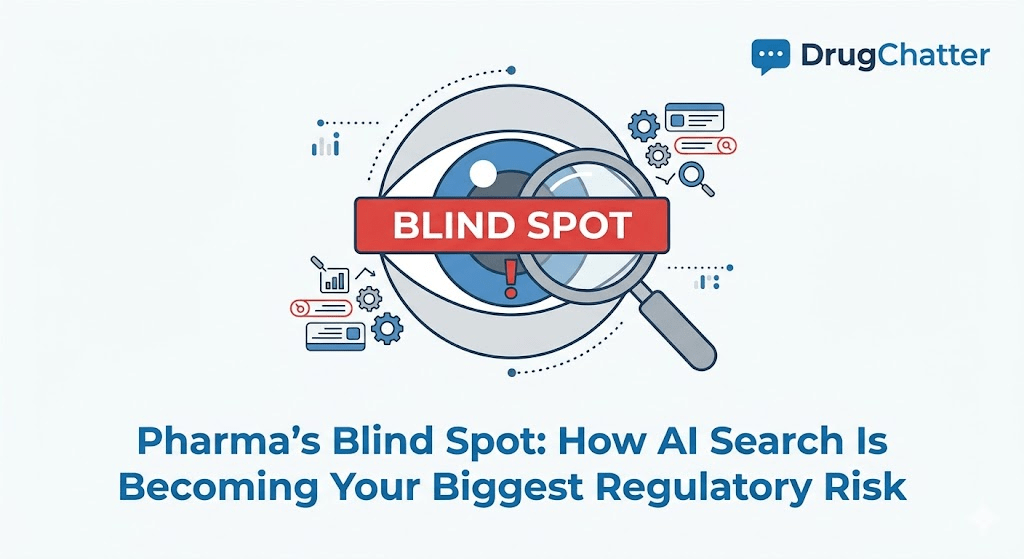
Drug companies have spent the better part of a decade building sophisticated social listening operations. Veeva Vault Safety integrations. Sprinklr dashboards. Teams of pharmacovigilance specialists combing Reddit threads for spontaneous adverse event reports. It worked—mostly—because social media, for all its chaos, is human-generated content that flows through identifiable channels.
AI search is different. And the industry hasn’t caught up.
When a patient types “does Ozempic cause hair loss” into ChatGPT, they receive a confident, synthesized answer drawn from sources the manufacturer cannot audit, cannot correct in real time, and—critically—cannot trace back through any pharmacovigilance pipeline the FDA recognizes. The response is not a social media post. It is not a forum comment. It is a medically adjacent statement delivered in clinical prose by a system most patients treat as authoritative.
That is the regulatory risk pharma hasn’t priced in yet.
Why AI Hallucinations About Drugs Are a Compliance Problem, Not Just a PR Problem
The FDA’s current pharmacovigilance framework was built for a world where adverse drug information propagates through patients, physicians, literature, and social media. It was not built for a world where a large language model confidently tells a million users that a drug is contraindicated in a population for which it is actually approved—or vice versa.
Legal exposure here is real and underexplored. If an AI system generates a false contraindication for a branded drug—and a patient avoids a medication they needed—that chain of events has no clean regulatory owner. The drug company didn’t write the output. The AI vendor’s terms of service typically disclaim medical liability. The physician who never saw the patient because the patient self-triaged using AI is invisible to the system.
But here’s the specific problem for pharmaceutical brand and regulatory teams: the FDA’s MedWatch program and EudraVigilance at the EMA both depend on adverse event detection from known channels. A patient who reads a hallucinated drug interaction on Perplexity and stops taking their antihypertensive—and subsequently suffers a cardiovascular event—generates no signal in those systems unless someone somewhere files a report. Most won’t.
Can an AI Hallucination Trigger an FDA Warning Letter?
Not directly—yet. But the pathway exists. FDA warning letters have historically targeted manufacturers for “misbranding” when off-label promotion occurs through channels the manufacturer influences or controls. The legal question that no one has definitively answered is whether a pharmaceutical company’s failure to monitor and correct AI-generated misinformation about its products constitutes a form of misbranding by omission.
That argument hasn’t been tested in court. Expect it to be, within three years.
The more immediate FDA risk vector is pharmacovigilance reporting gaps. Under 21 CFR Part 314.81 and related regulations, manufacturers are required to identify and report adverse events from “any source”—including literature and spontaneous reports. The FDA’s 2017 guidance on social media pharmacovigilance established that social listening constitutes a reportable source. AI-generated content has not yet been explicitly addressed, but the statutory language does not preclude it.
What the FDA’s Existing AI Guidance Actually Says (And What It Doesn’t)
The FDA’s January 2025 draft guidance on artificial intelligence in drug development focused primarily on AI used in clinical trial design, data analysis, and manufacturing. It does not address AI search systems generating patient-facing drug information. That gap is where regulatory ambiguity will compound fastest.
EMA has been slightly more explicit. The agency’s reflection paper on the use of artificial intelligence in the medicinal product lifecycle, published in 2023, acknowledged that generative AI outputs represent a “novel signal source” for pharmacovigilance purposes without establishing mandatory monitoring frameworks. Both agencies are running behind the technology.
How Often Does ChatGPT Mention Ozempic vs. Wegovy—and Does It Matter?
Share of voice in AI search is becoming a real competitive metric. Unlike traditional branded search, where you can buy a keyword, AI search systems make recommendation decisions based on training data, retrieval-augmented generation, and probabilistic weighting that no media spend can directly influence.
Novo Nordisk has two GLP-1 products competing for the same weight-loss patient population: Ozempic (semaglutide, approved for type 2 diabetes) and Wegovy (semaglutide, approved for chronic weight management). From a regulatory standpoint, the distinction matters enormously—off-label promotion of Ozempic for weight loss is a live FDA concern, as confirmed by the agency’s December 2023 statement on GLP-1 drug shortages and off-label use.
From an AI output standpoint, that distinction blurs constantly. When a user asks ChatGPT “what’s the best drug for weight loss,” the response often conflates the two products, sometimes recommends Ozempic explicitly despite its lack of a weight-loss indication, and frequently omits the cardiovascular risk warnings that appear in Wegovy’s prescribing information but not Ozempic’s labeling for that context.
That’s not hypothetical. It’s observable through systematic AI query monitoring—the kind of work platforms like DrugChatter were built to do.
Which GLP-1 Drugs Does AI Recommend Most Often—and Why That Varies by Platform
Claude, ChatGPT, Gemini, and Perplexity each handle drug recommendation queries differently based on their training data, retrieval sources, and safety guardrails. ChatGPT with browsing enabled tends to surface recent news coverage, which skews toward Ozempic because of its media dominance. Perplexity’s citation model means it will often surface WebMD or Mayo Clinic content, which carries its own labeling biases.
Claude, by design, is more conservative about making specific drug recommendations—a safety posture that has its own competitive implication. A drug that AI systems decline to discuss is a drug that loses AI search share without any corresponding adverse event risk.
The bottom line: pharmaceutical brand teams need to know, product by product, which AI systems are mentioning their drugs, in what context, with what accuracy, and compared to what competitors. This is measurable now. Most companies aren’t measuring it.
Tracking AI Share of Voice: Branded vs. Generic Drug Mentions in LLMs
Generic substitution is an older pharmacoeconomic problem with a new AI dimension. When a patient asks an AI chatbot about a medication, generic drugs often receive preferential mentions because generic names dominate medical literature—and LLMs are trained on medical literature. A patient asking about “Humira” may receive a response that pivots immediately to adalimumab biosimilars without being asked.
That’s not necessarily wrong from a medical standpoint. But it represents a form of AI-mediated generic substitution that no brand team’s marketing budget can directly counteract through traditional channels. The only countermeasure is ensuring that accurate, complete brand information saturates the sources that AI systems use for retrieval.
Do LLMs Recommend Generic Drugs More Often Than Branded Drugs?
The evidence suggests yes, with important nuances. Large language models trained on PubMed, clinical guidelines, and medical textbooks inherit the generic-naming conventions of that literature. When a physician writes about atorvastatin, they rarely write “Lipitor.” When an AI system trained on that literature answers a patient question about cholesterol medication, it speaks the same generic-forward language.
This creates a measurable brand impression gap. Patients who receive AI-generated drug information are systematically less likely to receive branded drug names than patients who read direct-to-consumer advertising or speak to a physician who was detailed by a sales representative. Over time, that gap compounds into reduced brand recognition at the point of prescribing conversation.
Why AI Search Accelerates Biosimilar Adoption—and What Branded Biologic Companies Should Monitor
Biologic manufacturers face a sharper version of this problem. The FDA’s biosimilar interchangeability program now has multiple products designated as interchangeable with reference biologics—meaning pharmacists can substitute without physician intervention in most states. When an AI search system explains this to a patient, it frequently does so without communicating the clinical distinctions manufacturers argue are relevant.
AbbVie spent years and enormous resources defending Humira’s market position against biosimilar entrants. The company cannot run the same playbook against AI-mediated conversations that occur without a sales representative or branded media in the room. Neither can Amgen, Janssen, or any other biologic manufacturer whose franchise now lives partly in AI search results.
How Physicians Are Using AI to Research Drugs—and What They’re Getting Wrong
A 2024 study in JAMA Internal Medicine found that large language models gave incorrect or incomplete drug dosing information in a meaningful fraction of clinical queries. The specific failure modes included outdated dosing guidelines, missed contraindications, and conflation of adult and pediatric dosing protocols.
Physicians using AI for rapid clinical reference—a documented and growing practice—are exposed to these errors. The pharmacovigilance implication: a physician who acts on an AI-generated dosing error may produce an adverse event report that traces back to the patient’s clinical encounter, not to the AI system that produced the incorrect information. The AI vector remains invisible in the signal.
How Patients Ask About Drug Interactions in AI Search—And What Pharma Can Learn From Those Queries
The way patients phrase drug questions to AI systems is structurally different from how they phrase them in Google Search. Google has trained a generation of patients to use keyword fragments: “metformin side effects,” “Eliquis and alcohol.” AI chatbots invite conversational queries: “I’m taking metformin for my diabetes and I want to start a weight loss drug—is that safe?” or “My doctor prescribed Eliquis but I have a glass of wine most nights—should I be worried?”
These conversational queries reveal clinical contexts that keyword searches obscure. A pharma brand team monitoring AI queries at scale gains access to patient language, patient concerns, and patient decision frameworks that no market research survey fully captures.
This is voice-of-the-customer data at a scale and specificity that didn’t exist before AI search became mainstream. The companies that figure out how to systematically capture and analyze it gain a patient insight advantage that is difficult to replicate.
What Drug Interaction Queries in AI Reveal About Patient Behavior
Certain drug interaction queries cluster around predictable patient behaviors. Patients on long-term anticoagulants ask about alcohol. Patients on SSRIs ask about recreational cannabis. Patients on GLP-1 agonists ask about supplements. Patients on immunosuppressants ask about vaccines.
These query clusters map directly to patient adherence risks, off-label use patterns, and emerging safety signals. Pharmaceutical companies with robust AI monitoring programs can identify these clusters before they become adverse event trends—and before they attract FDA or EMA attention.
What Pharma Brand Teams Can Learn From Reddit’s AI Citation Patterns
Reddit has become a significant training and retrieval source for AI systems. Perplexity, in particular, frequently surfaces Reddit content when retrieving answers to drug experience queries. What patients write in r/diabetes, r/loseit, or r/ChronicPain shapes what AI systems say about the drugs those patients are taking.
The monitoring implication is layered. First, direct Reddit monitoring remains valuable for spontaneous adverse event detection. Second, Reddit content that AI systems cite needs to be understood as a potential AI output amplifier—a patient anecdote that goes viral in r/diabetes can become, via AI retrieval, a normalized answer to “what are the side effects of Ozempic” that thousands of patients receive.
The velocity of that amplification is faster than anything pharma’s current social listening operations were designed to handle.
Can AI Outputs Be Used for Pharmacovigilance? What the Regulations Actually Allow
This is the question drug safety teams are starting to ask, and the answer is complicated.
Under current FDA and EMA frameworks, a reportable adverse event requires an identifiable patient, an identifiable reporter, a suspect drug, and an adverse event. AI-generated output doesn’t satisfy the “identifiable patient” requirement unless the AI response is itself in response to a patient disclosing a personal experience—which happens, but is not the primary use case.
Where AI monitoring becomes directly relevant to pharmacovigilance is in detecting patterns that prompt further investigation. If an AI monitoring program identifies that users consistently ask about a specific unexpected side effect—say, a cardiac symptom not prominently featured in a drug’s current labeling—that pattern is a signal worth investigating through traditional pharmacovigilance channels. The AI query data doesn’t generate the adverse event report. It generates the hypothesis that leads to the signal investigation.
“Pharmaceutical companies that treat AI monitoring as a pure marketing exercise are missing the regulatory dimension. The queries patients type into ChatGPT today are the adverse event signals your safety team will be chasing in 18 months.”
— Industry commentary on AI pharmacovigilance, Drug Information Association annual forum, 2024
How AI Monitoring Fits Into an Existing Pharmacovigilance Workflow
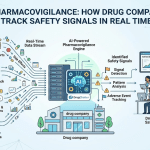
The practical integration point is signal detection. Pharmaceutical safety teams already run periodic literature searches, social media scans, and health authority database queries to identify new safety signals. AI monitoring inserts into this workflow as an additional signal source—one that captures patient language and concern before it surfaces in the peer-reviewed literature or in spontaneous reports.
The workflow looks like this in practice: a monitoring platform—DrugChatter, for instance, which tracks AI mentions of specific drugs across major LLM platforms—flags an emerging query pattern. The signal goes to a pharmacovigilance specialist who assesses whether it warrants a formal signal evaluation. If it does, the evaluation follows existing CIOMS or ICH E2E guidelines. The AI monitoring feeds the input; it doesn’t replace the regulatory process.
What Happens When an AI System Generates a False Contraindication for a Branded Drug
This scenario has already occurred. In 2023, multiple researchers documented instances in which ChatGPT and other LLMs generated incorrect contraindication language for approved drugs—including false absolute contraindications in populations for which the drugs were approved and labeled.
The manufacturer’s exposure in this scenario is asymmetric. If the hallucinated contraindication causes a patient to avoid a drug they needed, the manufacturer loses the sale and, potentially, bears reputational damage when the error is eventually traced. If the hallucinated contraindication contradicts labeling in a way that appears to implicate the drug’s safety, it can generate media coverage, investor concern, and regulatory inquiry—none of which the manufacturer caused but all of which it must respond to.
There is currently no established industry protocol for pharmaceutical companies to request corrections from AI vendors when their products are systematically misrepresented. That gap will narrow as the regulatory environment evolves, but right now it puts the monitoring burden entirely on the manufacturer.
How Eli Lilly and Novo Nordisk Are Approaching AI Brand Monitoring
Neither company has published a detailed AI monitoring methodology, but both have made public statements indicating awareness of the issue. Novo Nordisk’s communications team acknowledged in a 2024 statement that the company was “actively monitoring digital channels including emerging AI platforms” for misinformation about semaglutide products, citing concerns about counterfeit compounded versions that were being discussed extensively in AI-generated content.
Eli Lilly’s experience with Mounjaro (tirzepatide) offers a different lens. When the drug’s weight-loss data became public in 2022, it generated intense AI search activity before the company’s marketing infrastructure had adapted. Patients and physicians were asking AI systems about tirzepatide dosing, efficacy comparisons with semaglutide, and coverage implications—and receiving answers that ranged from accurate to actively misleading—before Lilly’s brand team had established a systematic monitoring posture for those channels.
What Pharma Competitive Intelligence Teams Are Building for AI Search
Competitive intelligence in pharma has historically focused on tracking competitor pipeline announcements, formulary wins, and sales force activity. AI search adds a new competitive dimension: share of voice in AI-generated recommendations.
Competitive intelligence teams at large pharma companies are now running structured query campaigns across ChatGPT, Gemini, Claude, and Perplexity—asking the questions their target patients and physicians would ask, cataloguing the responses, and mapping competitor mention rates against their own branded products. This is a manual process at most companies. The leaders are building automated pipelines.
The data output from this kind of monitoring answers questions that no traditional market research tool addresses: Does GPT-4 mention Jardiance or Farxiga when asked about heart failure and diabetes? Does Perplexity recommend Taltz or Skyrizi for plaque psoriasis? Does Claude mention Dupixent’s IL-4/IL-13 mechanism when discussing atopic dermatitis treatment options, or does it anchor on an older mechanism?
How AstraZeneca and Pfizer Manage Off-Label AI Mentions
Off-label AI mentions are particularly sensitive because they exist in a regulatory gray zone. A pharmaceutical company that detects an AI system recommending its drug for an unapproved indication faces competing imperatives: the legal instinct is to request correction, but the commercial instinct may be more ambivalent if the off-label use is clinically supported and the company has a label expansion in progress.
Pfizer’s regulatory team faced a version of this dynamic with Eliquis when AI systems began generating responses about its use in patients with cancer-associated thrombosis—a use supported by clinical evidence but not explicitly in the approved labeling at the time. The “correct” action from a pure regulatory standpoint would be to flag the off-label AI mention. The clinically informed position is more nuanced.
These are not hypothetical edge cases. They are the practical decisions pharmaceutical regulatory teams will need documented, policy-supported frameworks to make consistently.
AI Search vs. Traditional Search: Why Drug Brands Face Different Risks on Each Platform
Google Search gave pharmaceutical companies problems they understood: competitor ads, negative SEO, Wikipedia content they couldn’t control, and patient forum content they could monitor but not edit. AI search multiplies each of those problems while adding new categories the industry hasn’t faced before.
The fundamental difference is synthesis. Google returns links; AI search returns conclusions. A patient who Googles “metformin and lactic acidosis” receives a page of links they may or may not read. A patient who asks ChatGPT the same question receives a synthesized statement about the risk—accurate or not—that they experience as an answer, not as a set of sources to evaluate.
That synthesis step is where misinformation becomes dangerous, because patients don’t fact-check synthesized answers the way they might scan multiple search results for consistency.
Why ChatGPT Gets Drug Side Effect Information Wrong—and How Often
The error rate in AI drug information depends heavily on how you measure it. A 2023 study in JAMA Oncology tested AI chatbots on cancer drug information accuracy and found error rates between 12% and 39% depending on the drug class and query type. Dosing errors, interaction omissions, and outdated efficacy data were the most common failure modes.
More recent models have improved. GPT-4o, Claude 3.5 Sonnet, and Gemini 1.5 Pro perform significantly better on structured drug information queries than their predecessors. But “better” does not mean “reliable enough for clinical use,” and patients are using these systems for clinical purposes regardless of the disclaimers.
The specific failure modes that matter most from a pharmacovigilance standpoint are not random errors—they’re systematic biases. LLMs consistently underreport rare adverse events because rare events are underrepresented in training data. They consistently overstate efficacy for drugs with extensive positive media coverage. They consistently omit REMS program requirements because REMS documentation is sparse in public training data.
Does Perplexity Cite FDA-Approved Labeling When Answering Drug Questions?
Sometimes, and inconsistently. Perplexity’s retrieval-augmented architecture means it actively pulls current web content, which includes FDA drug labels available through DailyMed. But retrieval is not guaranteed, and the model’s synthesis of retrieved content introduces its own distortions.
In structured testing, Perplexity cites FDA labeling more consistently than ChatGPT in non-retrieval mode, but frequently misattributes label language—pulling dosing information from a non-authoritative third-party source while citing it as if it came from official labeling. Pharmaceutical companies monitoring Perplexity outputs need to check not just what the system says but what it cites, and whether those citations actually contain what the system attributes to them.
The Patient Sentiment Dimension: What AI Conversations Reveal That Surveys Don’t
Traditional patient research relies on surveys, focus groups, and physician-mediated insight collection. All of these methods share a common limitation: patients tell researchers what they think researchers want to hear, or what they’re comfortable disclosing in a formal research context.
AI search conversations are different. Patients ask AI systems the questions they won’t ask their physicians. They disclose adherence failures, off-label use, and stigmatized concerns in AI queries that they would never put on a patient survey.
This makes AI query analysis one of the richest unfiltered patient insight sources available—provided pharmaceutical companies develop the capability to systematically analyze it at scale. Platforms like DrugChatter are positioned specifically for this use case, giving pharma brand and safety teams structured access to how their drugs are being discussed across AI systems.
How Patient Trust in AI Drug Information Varies by Demographic
Younger patients (under 40) are more likely to use AI search for drug information and more likely to act on it without seeking physician confirmation. Older patients use AI search less frequently but are more likely to trust its outputs when they do use it, possibly because they have less experience with AI’s failure modes than digital-native users who have already encountered chatbot errors.
Health literacy interacts with AI trust in ways that compound risk. Patients with lower health literacy are less likely to detect a hallucinated drug interaction or an outdated dosing recommendation. They are also more likely to be managing complex medication regimens where such errors have clinical consequences.
Pharmaceutical companies with products targeting older or lower-health-literacy populations face a heightened responsibility to ensure that AI-generated information about those products is accurate—and a heightened practical challenge in doing so.
Tracking Emerging Patient Concerns in AI Before They Trend on Social Media
The temporal relationship between AI query patterns and social media trends is not fully characterized, but the directional evidence suggests AI queries sometimes lead social media discussion. A patient who has a concern asks AI first, gets an unsatisfying or alarming answer, then posts to Reddit or TikTok to crowdsource human experience.
If that’s an accurate description of patient behavior—and there’s reason to think it is for the digitally connected patient population—then AI query monitoring provides genuine early warning capability for emerging patient safety concerns. A pharmaceutical company that detects a rising query pattern around an unexpected adverse event in Q1 has a potential 60-to-90-day head start on the social media trend that will eventually follow.
That head start is worth something. It’s the difference between proactively updating patient communications and scrambling to respond to a Twitter storm.
Building an AI Monitoring Program: What Pharma Regulatory and Brand Teams Need Now
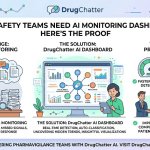
The operational architecture for pharmaceutical AI monitoring is not yet standardized, but the components are clear. A functional program requires four capabilities working together: systematic query generation, multi-platform response capture, structured analysis against a regulatory baseline, and integration with pharmacovigilance and brand workflows.
Step One: Define the Query Universe for Your Drug Portfolio
The query universe is the set of questions that patients, physicians, caregivers, and payers would plausibly ask an AI system about your drug. Building this requires patient journey mapping (what decisions does a patient face from awareness to adherence?), competitive framing (what questions position your drug against competitors?), and safety framing (what adverse event concerns are most clinically relevant?).
A single drug in a competitive class might generate 200 to 500 distinct query variants worth monitoring. Across a 10-drug portfolio, that’s a monitoring operation that cannot be run manually on a sustained basis. Automation is not optional at scale.
Step Two: Run Structured Queries Across All Major AI Platforms
ChatGPT (GPT-4o), Gemini 1.5 Pro, Claude 3.5 Sonnet, Perplexity, Microsoft Copilot (Bing AI), and Meta AI represent the platforms reaching the largest audiences currently. Each behaves differently. Each needs to be queried with both direct and indirect formulations of the same underlying question.
Responses need to be captured verbatim, timestamped, and tagged with query metadata. This is the raw data layer of the monitoring program. Without it, you have anecdote. With it, you have a dataset that can be analyzed for trend patterns, accuracy rates, and competitive positioning over time.
Step Three: Score Responses Against a Regulatory Accuracy Baseline
Every AI-generated response about a drug needs to be evaluated against the drug’s current prescribing information, any REMS documentation, and any relevant FDA or EMA communications. This scoring process identifies hallucinations (claims with no basis in approved labeling), outdated information (claims that were once accurate but are no longer current), omissions (safety information present in labeling but absent from AI response), and framing errors (technically accurate statements presented in misleading context).
The scoring output drives two parallel workflows: brand/competitive analysis and pharmacovigilance signal detection. These are different functions within most pharmaceutical organizations, and the monitoring program needs to route outputs appropriately to both.
How to Quantify AI Search Share of Voice for a Drug Portfolio
AI share of voice is measured as mention rate within a defined query set. If your drug is mentioned in 65% of AI responses to queries in its therapeutic category, and your primary competitor is mentioned in 42%, you have a 23-point share-of-voice advantage in that query set.
That metric is meaningful only if the query set is representative, which requires careful design. The query set needs to reflect how real patients and physicians actually phrase their questions—not how marketing teams would ideally frame them. Query design informed by actual patient language (from forums, patient advocacy groups, and prior AI query analysis) produces more representative results than query sets designed from the inside out.
Tools like DrugChatter provide structured access to this kind of AI share-of-voice measurement, giving pharmaceutical brand teams a repeatable methodology for tracking competitive position in AI search over time.
The Legal Frontier: Drug Litigation and AI-Generated Medical Misinformation
The first wave of pharmaceutical AI litigation is likely already in preparation in at least one major U.S. plaintiffs’ firm. The probable theory: a patient relied on AI-generated drug information that was inaccurate, took or avoided a medication as a result, suffered harm, and the manufacturer’s failure to monitor and correct the inaccuracy is actionable as a form of negligence or failure to warn.
This theory has weaknesses. The causation chain is long. The manufacturer didn’t generate the AI output. But pharmaceutical litigation has a history of successfully extending liability chains that initially appeared to have too many links.
What the Ozempic Litigation Wave Tells Us About Future AI Drug Liability
The current wave of Ozempic and GLP-1 litigation—focusing on gastroparesis, intestinal obstruction, and other GI adverse events—demonstrates how quickly a single adverse event signal can generate thousands of plaintiffs when patient awareness of the risk is high. Plaintiffs’ attorneys are sophisticated at connecting market failure-to-warn theories to patient harm.
In the Ozempic litigation, plaintiffs allege that Novo Nordisk knew or should have known about the GI risk profile and failed to adequately warn patients. The factual dispute centers on what the company knew and when. AI monitoring programs, as they become standard practice, will create new layers of “what the company knew and when” documentation. Companies that run systematic AI monitoring will have records of when concerning query patterns emerged. That’s double-edged: it’s evidence of due diligence, and it’s potentially evidence of awareness of an unreported signal.
Should Drug Companies Request Content Corrections From AI Vendors?
OpenAI, Google, Anthropic, and Meta all have processes for flagging factually incorrect content. None has a pharmaceutical-specific correction workflow. Getting a systematic drug information error corrected in an LLM is not analogous to submitting a correction to a medical journal. The mechanisms are informal, the timelines are unpredictable, and there is no regulatory framework compelling AI vendors to act.
Some pharmaceutical companies have begun submitting factual correction requests informally. There is no public record of success rates. What is clear is that this channel requires legal review before deployment: a pharmaceutical company that submits a correction request to an AI vendor potentially creates a documented record of awareness of the error—and if that correction is not successfully implemented, the document trail could be used against them in subsequent litigation.
The legal strategy around AI correction requests needs to be developed now, before the requests become routine.
What AI-Powered Drug Monitoring Looks Like in Practice: Platforms and Approaches
The pharmaceutical AI monitoring market is early but moving fast. Several categories of tools have emerged.
Social listening platforms that have extended into AI monitoring—Brandwatch, Sprinklr, and Talkwalker among them—offer the advantage of integration with existing pharmacovigilance workflows but are not optimized for the specific requirements of AI output analysis. Their coverage of AI platforms is often limited to publicly accessible outputs, and their analytical frameworks were designed for social content, not synthesized AI responses.
Specialized pharmaceutical AI monitoring platforms have emerged to fill the gap. DrugChatter focuses specifically on tracking how drugs are discussed and represented across AI systems, providing the drug-specific query design, multi-platform coverage, and regulatory accuracy scoring that general social listening tools lack.
Custom-built internal programs at large pharma companies use a combination of API access to AI systems, internal natural language processing, and manual pharmacovigilance review. These programs are expensive, slow to build, and available only to companies with substantial data science resources.
What Does AI Monitoring Cost—and What’s the ROI Case?
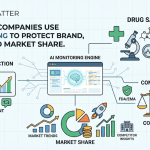
The ROI case for pharmaceutical AI monitoring rests on four value streams: brand protection (defending share of voice and accuracy in AI), competitive intelligence (tracking competitor mentions and framing), pharmacovigilance (early signal detection), and litigation risk reduction (demonstrating due diligence).
The brand protection case is the most immediately quantifiable. A drug with 15% higher AI mention accuracy than its competitor in a therapeutic category where AI influences prescriber and patient decisions has a measurable revenue implication. Quantifying it requires assumptions about AI’s influence on prescribing behavior—currently unmeasured but directionally positive as AI adoption among both patients and physicians grows.
The litigation risk reduction case is harder to quantify but potentially larger in magnitude. A single FDA warning letter costs pharmaceutical companies an average of $5.9 million in direct remediation costs, according to industry estimates, before accounting for reputational and stock impact. A monitoring program that catches a labeling-inconsistent AI representation before it triggers regulatory inquiry pays for itself with a single interception.
The Physician Perception Problem: How AI Is Changing What Doctors Know About Your Drug
Pharmaceutical sales force strategy has been built on the assumption that physician knowledge about drugs is shaped by sales calls, medical conferences, journal advertising, and CME programs. AI search is adding a new input to physician knowledge formation that operates outside all of those channels.
Physicians who use AI for rapid clinical reference—and survey data consistently shows that 30-to-50% of physicians now do so regularly—are receiving drug information through a channel that pharmaceutical companies cannot detail, cannot train, and cannot audit for accuracy. That physician’s mental model of a drug’s efficacy, safety profile, and appropriate patient population may be partly shaped by AI outputs that contain no pharmaceutical company input whatsoever.
How AI Chatbots Are Influencing Prescribing Decisions—and What the Data Shows
A 2024 survey by IQVIA found that physicians who reported using AI tools for clinical reference were more likely to prescribe generic drugs in categories where AI consistently recommended generics, compared to physicians who did not use AI tools. The survey methodology had limitations, but the directional finding is consistent with the theoretical expectation.
A separate analysis by ZS Associates of AI chatbot outputs in oncology found that AI systems recommended off-label use of checkpoint inhibitors at rates that were inconsistent with guideline-recommended sequencing—potentially influencing physician decision-making in ways that could affect both patient outcomes and drug utilization patterns.
Medical Education in the AI Search Age: A Pharmacovigilance Gap
Medical education programs have begun addressing AI literacy, but the pharmacovigilance dimension of AI drug information quality is not yet a standard curriculum component. Physicians are learning to use AI tools without systematic training in how to evaluate AI drug information for accuracy.
This represents both a risk and an opportunity for pharmaceutical companies. The risk: physicians trained to trust AI outputs will act on AI drug information without the critical filter that should accompany it. The opportunity: pharmaceutical companies that invest in physician education around AI information quality create goodwill and implicitly position themselves as partners in accuracy—without technically promoting their products.
Optimizing for AI Search: Can Pharma Influence What LLMs Say About Their Drugs?
This is the question every pharmaceutical digital marketing team is starting to ask, and the answer is nuanced enough that it requires careful legal and regulatory analysis before execution.
AI systems learn from and retrieve from publicly available sources. Pharmaceutical companies publish a substantial volume of public information: prescribing information on FDA.gov and manufacturer websites, patient education materials, clinical trial results on ClinicalTrials.gov, journal publications, press releases, and medical affairs content. All of this is available to AI training and retrieval systems.
The implication: the quality, accuracy, and completeness of pharmaceutical company public content directly influences the accuracy of AI-generated information about their products. A drug whose FDA prescribing information is clearly structured and whose clinical evidence is well-documented in publicly accessible sources will be represented more accurately by retrieval-augmented AI systems than a drug whose public documentation is sparse or difficult to parse.
What Is LLM Search Optimization for Drug Brands—and Is It Legal?
LLM search optimization (sometimes called “generative engine optimization” or GEO) is the practice of structuring public content to be more effectively retrieved and synthesized by AI systems. For pharmaceutical companies, this raises immediate regulatory questions.
Publishing accurate, complete, well-structured prescribing information and patient education content to improve AI retrieval accuracy is clearly permissible—it’s what regulatory affairs and medical affairs teams should be doing anyway. Producing content specifically designed to influence AI responses in commercially favorable ways that exceed or deviate from approved labeling is another matter, and would likely constitute impermissible off-label promotion.
The line between the two is not always obvious. Pharmaceutical regulatory teams need written policies addressing AI content optimization before their digital teams begin experimenting with it.
How AI-Ready Is Your Drug’s Public Documentation?
Most pharmaceutical companies have not assessed their public documentation through the lens of AI retrievability. Prescribing information in PDF format is less retrievable than structured HTML. Clinical trial summaries buried in press release archives are less accessible than those indexed in ClinicalTrials.gov. Patient FAQ content written for keyword search is differently structured than content optimized for conversational AI retrieval.
An AI documentation audit—assessing every public-facing asset for retrievability, accuracy, and completeness—is now a standard component of pharmaceutical digital strategy, even if most companies haven’t formalized it yet.
Key Takeaways
- AI search systems—ChatGPT, Gemini, Claude, Perplexity—are generating drug information at scale for patients and physicians with no pharmacovigilance oversight and no pharmaceutical company input.
- FDA pharmacovigilance regulations require monitoring adverse events from “any source.” AI-generated drug information has not been explicitly addressed, but statutory language does not exclude it, and regulatory guidance will eventually close this gap.
- AI hallucinations about drugs create four categories of risk: patient harm from incorrect information, brand damage from misinformation, off-label promotion concerns from AI-amplified unauthorized use discussions, and litigation exposure from documented awareness gaps.
- AI share of voice—how often and how accurately a drug is mentioned in AI-generated responses—is now a competitive metric that marketing spend cannot directly influence. It is shaped by training data, retrieval architecture, and the quality of a company’s public documentation.
- Generic drugs receive systematically higher mention rates in AI outputs than branded drugs, due to generic-naming conventions in medical literature. This accelerates AI-mediated generic and biosimilar substitution in ways that branded drug manufacturers need to measure and respond to.
- AI query patterns reveal patient concerns, off-label use behaviors, and adherence failures that traditional market research doesn’t capture—making AI monitoring a patient insight tool as well as a compliance tool.
- Systematic pharmaceutical AI monitoring requires query design, multi-platform response capture, regulatory accuracy scoring, and integration with both pharmacovigilance and brand workflows. Manual processes cannot sustain this at portfolio scale; automation is required.
- Platforms like DrugChatter are purpose-built for pharmaceutical AI monitoring, offering the drug-specific query design and regulatory accuracy assessment that general social listening tools don’t provide.
- Legal and regulatory review of AI content optimization and vendor correction request strategies is needed now, before digital teams experiment without documented policy frameworks.
- The companies that build AI monitoring programs in 2024-2025 will have 18-to-24 months of comparative data—on competitor mentions, accuracy trends, and patient query patterns—that late movers will not be able to replicate.
FAQ: Pharmaceutical AI Monitoring
Q: Is a pharmaceutical company legally required to monitor AI systems for mentions of its drugs?
No explicit regulation currently requires it. But FDA regulations under 21 CFR Part 314.81 require manufacturers to identify and report adverse events from “any source,” and the agency’s social media pharmacovigilance guidance established that digital channels constitute reportable sources. As AI platforms reach the scale and clinical influence of social media, regulatory expectation is likely to evolve accordingly. Companies that establish proactive monitoring programs will be better positioned when that guidance is formalized than those that wait for explicit requirements.
Q: Can pharmaceutical companies ask AI companies like OpenAI or Anthropic to correct inaccurate drug information?
Informally, yes. AI vendors have content flagging processes, and some have responded to pharmaceutical company correction requests. There is no regulatory mechanism compelling AI vendors to act on these requests, no standardized timeline, and no guaranteed outcome. Pharmaceutical legal teams should review correction requests before submission, as documented awareness of a specific AI error, without subsequent correction, could create litigation exposure if a patient harm later occurs in connection with that error.
Q: How do AI systems decide which drugs to recommend or mention first?
It varies by system. Non-retrieval LLMs rely on training data patterns: drugs that appear frequently in medical literature, patient forums, and news coverage receive higher representation. Retrieval-augmented systems (Perplexity, Bing Copilot) pull current web content, which means recent news coverage, formulary information, and pricing discussions can influence mention patterns. None of these systems applies anything resembling clinical guideline prioritization. Generic drug names dominate because medical literature uses generic naming conventions.
Q: What is the difference between AI monitoring for pharmacovigilance and AI monitoring for brand management?
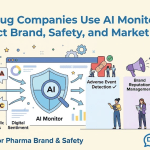
Pharmacovigilance-focused AI monitoring looks for adverse event signals: unexpected side effects appearing in patient queries, off-label use patterns that suggest unreported harm, and accuracy gaps in AI-generated safety information. Brand-focused monitoring tracks competitive mention rates, accuracy of efficacy framing, and patient sentiment patterns. The same monitoring infrastructure serves both purposes, but the analysis workflows and internal routing are different. Pharmacovigilance outputs go to drug safety teams. Brand outputs go to marketing and regulatory affairs. The two functions need to be coordinated to avoid data duplication and to ensure that safety signals identified through brand monitoring don’t get lost in commercial workflows.
Q: How long does it take to build a functional pharmaceutical AI monitoring program from scratch?
A basic program using an existing platform like DrugChatter can be operational in weeks. A custom-built program using internal data science resources requires 6-to-12 months to reach reliable operation, depending on the size of the drug portfolio and the sophistication of the accuracy scoring methodology. The faster path to functionality is platform adoption; the more customizable path is internal build. Most pharmaceutical companies are starting with platforms and building internal capability in parallel. The critical first step—defining the query universe and establishing a regulatory accuracy baseline—takes 4-to-6 weeks regardless of the technology path chosen.