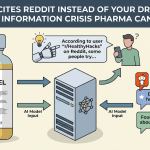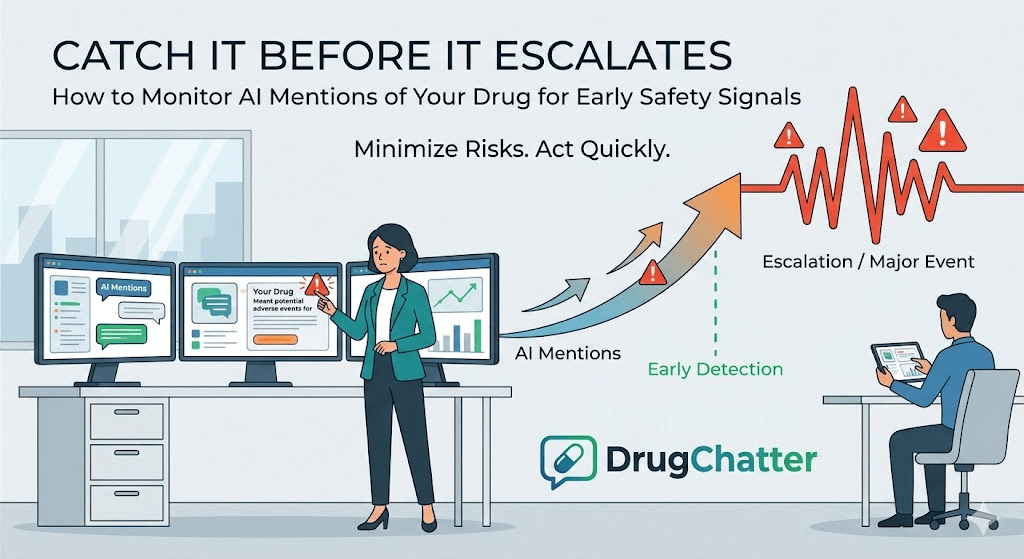
In February 2023, a wave of posts began appearing on Reddit’s r/antidepressants forum describing a specific withdrawal effect from a branded SSRI that was, at the time, listed only as ‘rare’ in the product’s U.S. prescribing information. Within six weeks, that language — ‘brain zaps,’ ‘electric shock sensations,’ ‘discontinuation syndrome’ — was being reproduced verbatim by ChatGPT when users asked about stopping the drug. Physicians were fielding patient questions they had not anticipated. The drug’s manufacturer had no systematic process in place to detect that this had happened.
Four months later, the FDA issued a drug safety communication on SSRI discontinuation effects, prompting label updates across the class. Whether earlier detection of the AI amplification pattern would have changed that timeline is an open question. What is not open is the underlying sequence: a patient safety concern surfaced on social media, migrated into LLM training data, got amplified through AI-generated responses, reached millions of patients, and then reached the FDA. The pharmaceutical company was the last to know.
This is the monitoring gap that defines the current moment in pharmaceutical drug safety surveillance. Traditional pharmacovigilance systems — spontaneous adverse event reporting, literature monitoring, clinical trial follow-up — were built for a world where information moved slowly and through controlled channels. AI search has changed the information velocity. What used to take years to accumulate as a safety signal can now achieve the reach of a published FDA guidance document within weeks, through LLM outputs that no pharmacovigilance team was assigned to watch.
Why AI Is Now a Drug Safety Signal Source — Whether You Monitor It or Not
The conventional pharmacovigilance signal hierarchy runs from spontaneous adverse event reports to literature surveillance to EHR mining. AI-generated content sits outside all three. It does not generate FAERS reports. It does not appear in PubMed. It does not show up in real-world evidence datasets. But it reaches patients at a scale and speed that dwarfs all three traditional sources combined.
ChatGPT crossed 100 million monthly active users faster than any consumer application in history. Gemini is embedded in Android devices used by more than two billion people. Perplexity processes more than 100 million queries per week. When a safety concern about a drug enters this information ecosystem — whether accurately, inaccurately, or in some combination — it reaches a patient audience that no FDA drug safety communication, no physician notification letter, and no manufacturer-sponsored patient education program can match for reach or immediacy.
How Safety Signals Travel From Patient Forums to LLM Training Data
The pathway from patient experience to AI output follows a consistent sequence. A patient experiences an adverse event and posts about it. The post receives engagement from other patients with similar experiences. The thread accumulates responses, links, and follow-up posts. A health journalist or patient advocate summarizes it in an article. The article is indexed by Google. The next LLM training cycle incorporates the article. Future patient queries about the drug elicit responses that include the adverse event, now described with the confidence of synthesized consensus rather than anecdote.
The timeline from initial forum post to LLM output varies, but is now measured in months rather than years. And critically, the LLM response strips the uncertainty out. A Reddit thread reads like what it is — a collection of individual reports with varying credibility. A ChatGPT response reads like authoritative medical synthesis. The patient querying the AI has no mechanism to distinguish between an LLM drawing on a single poorly-sourced forum thread and one drawing on ten peer-reviewed trials.
What FAERS Misses That AI Monitoring Can Catch
FDA’s Adverse Event Reporting System (FAERS) is the cornerstone of post-marketing safety surveillance. It is also, by design, retrospective. A patient must experience an adverse event, recognize it as drug-related, report it to a healthcare provider or directly to FDA, and have that report processed and entered into the database. Underreporting rates in FAERS are well-documented and significant — estimates from the FDA itself suggest that fewer than 10% of adverse events are reported through spontaneous reporting systems.
AI monitoring catches a different signal: the patient who experienced something, did not report it formally, but did ask an AI chatbot what was happening to her. That query, aggregated across thousands of similar patients, reveals a pattern that FAERS cannot. It tells you what patients are experiencing and attributing to your drug before the formal reporting machinery captures it — and, crucially, before the pattern reaches the density required to trigger a FAERS signal review.
DrugChatter’s pharmaceutical monitoring platform is designed around exactly this gap, tracking AI-generated mentions of drug products across LLM platforms and categorizing them by adverse event relevance, accuracy against current labeling, and signal novelty. The question their methodology answers is not ‘what does the FDA know about this drug?’ but ‘what do patients believe about this drug right now, and what is AI telling them?’
‘AI-generated health content now reaches patients an estimated 4 to 6 months before equivalent information appears in FDA safety communications or published pharmacovigilance literature. For pharmaceutical companies, that gap is where reputational and regulatory risk accumulates undetected.’ — IQVIA Institute for Human Data Science, Digital Health Signals Report, 2024
Can AI Outputs Constitute Reportable Safety Information Under ICH E2D?
This is the regulatory question that pharmaceutical safety officers are currently debating with their legal teams, and it does not yet have a settled answer. ICH E2D defines post-marketing expedited reporting requirements for serious unexpected adverse drug reactions. The guideline requires manufacturers to evaluate information from ‘any source,’ including scientific literature and ‘regulatory authority databases.’
AI-generated content is neither scientific literature nor a regulatory database. But it is increasingly a proxy for patient-reported experience at scale, and some legal interpretations of ‘any source’ are broad enough to capture it. EMA’s 2024 reflection paper on AI in medicines regulation explicitly references AI-generated health content as a pharmacovigilance data source warranting regulatory attention. FDA has not issued equivalent guidance, but the gap between EMA’s position and FDA’s silence is itself a compliance risk for companies operating in both jurisdictions.
The Anatomy of an AI-Driven Drug Safety Escalation
Understanding how a drug safety issue escalates through AI systems requires mapping the specific mechanics, not just the general concept. Each stage of escalation has a distinct monitoring signature and a distinct intervention window.
Stage One: Isolated Patient Reports Enter the Digital Ecosystem
The origin point is almost always patient-generated content: a Reddit post, a Facebook group thread, a review on Drugs.com, a comment on a YouTube video about the drug. At this stage, the content is low-signal: individual, anecdotal, often emotionally charged, and rarely medically precise. A patient describes ‘feeling like my heart was racing all the time’ rather than ‘sinus tachycardia.’ A patient says ‘my liver enzymes went through the roof’ rather than ‘alanine aminotransferase elevation.’
This is the stage where AI monitoring is most valuable and most underutilized. Pharmaceutical companies with social listening programs catch some of this content — but most social listening tools are optimized for brand sentiment, not adverse event signal detection. They flag volume and tone, not clinical terminology clustering. And critically, they do not monitor AI outputs at all.
Stage Two: The Signal Achieves Critical Mass in Online Communities
As more patients share similar experiences, the thread accumulates. On Reddit, a post about a drug side effect can gather thousands of comments over weeks, creating an artifact that reads as community consensus. Patient advocacy forums for specific disease states aggregate experiences with particular drugs in persistent, searchable archives. Health influencer accounts on TikTok and Instagram amplify individual experiences to large audiences.
At this stage, the content is still patient-generated but is no longer isolated. It begins to look like evidence — or at least, like enough consistency to merit attention. Health journalists who monitor patient forums actively pick up these threads. Articles appear in health media outlets with headlines like ‘Patients Report Unexplained Side Effect With [Drug].’ These articles are indexed, linked, and incorporated into the next training cycle of every major LLM.
Stage Three: LLMs Begin Generating Responses That Incorporate the Signal
This is the inflection point. Once an adverse event concern has achieved sufficient representation in the crawlable web — through a combination of patient posts, forum threads, and media coverage — LLMs begin reproducing it in their responses to patient queries. The responses do not caveat the provenance. A patient asking ‘what are the side effects of [drug]?’ receives a response that lists the FDA-labeled adverse events alongside the community-reported concerns with equal apparent authority.
At this stage, the signal is self-amplifying. More patients encounter the concern through AI. More patients post about it in forums. More forum content gets indexed. Future LLM responses become more confident and detailed on the topic. The volume of AI-generated content about the concern can exceed the volume of the original patient reports that seeded it.
Stage Four: The Signal Reaches Physicians, Regulators, and Media
Physicians report that patients are increasingly arriving at appointments with AI-generated information about drug side effects that they want to discuss. When a specific concern begins appearing consistently across patient conversations in a clinical practice, physicians contact the manufacturer’s medical information line, post in physician forums like Doximity, or file MedWatch reports. The concern reaches medical media. STAT News, FiercePharma, and Reuters Health report on the patient concern. FDA begins evaluating whether a safety communication is warranted.
At this stage, the manufacturer is reacting rather than managing. The brand and safety narratives are largely set by external sources. Corrective action — whether a label update, a Dear Healthcare Provider letter, or a public statement — arrives after the AI information environment has already established patient expectations about the drug’s safety profile.
What AI Systems Say About Drug Safety That Isn’t in the Label
How LLMs Handle Adverse Events Not Listed in FDA-Approved Labeling
FDA-approved drug labeling lists adverse events observed in controlled clinical trials and post-marketing surveillance, with frequency thresholds and causality assessment standards. LLMs do not apply these standards. They incorporate adverse event information from any source that made it into their training data: patient forums, case reports, non-peer-reviewed articles, international regulatory communications, and social media.
The result is that an LLM queried about a drug’s side effects will frequently list adverse events that appear nowhere in the FDA-approved label — sometimes because they are genuinely rare signals that have not yet reached the labeling threshold, sometimes because the causal attribution is spurious, and sometimes because the information originated in a different country’s regulatory database where adverse event thresholds differ from FDA’s.
This unlabeled adverse event problem is a specific and tractable monitoring target. A pharmaceutical company that systematically compares LLM-generated adverse event lists against its current approved labeling can identify, with precision, what AI is telling patients about their drug that the company has not sanctioned. Some of those discrepancies will be noise. Some will be early signals that merit investigation.
Which Drugs Have the Worst AI Safety Misinformation Problem
Based on query testing across ChatGPT, Gemini, Claude, and Perplexity conducted by pharmaceutical monitoring researchers, certain drug categories consistently produce higher rates of unlabeled adverse event claims and factual inaccuracies in AI responses.
GLP-1 receptor agonists — Ozempic, Wegovy, Mounjaro, Zepbound — show high rates of AI misinformation reflecting the intensity of social media discussion and the speed at which the drug class gained public attention. Thyroid cancer concerns, aspiration pneumonia risks, and suicidality signals — some grounded in real regulatory discussions, some significantly overstated — appear inconsistently and inaccurately across platforms.
Opioid analgesics and treatments for opioid use disorder show significant misinformation patterns, driven by the volume and emotional intensity of patient community discussion. Buprenorphine (Suboxone, Sublocade), methadone, and naltrexone (Vivitrol) all generate AI responses that reflect patient forum concerns that diverge from labeled information in medically significant ways.
Psychiatric medications consistently underperform on accuracy — a pattern that reflects both the volume of patient-generated content in mental health communities and the complexity of psychiatric adverse event attribution. Antidepressants, antipsychotics, and mood stabilizers show some of the highest rates of both unlabeled adverse event claims and factual hallucinations in comparative drug assessments.
What ChatGPT Says About Ozempic Thyroid Cancer Risk — And What the FDA Actually Says
The Ozempic thyroid cancer question illustrates the gap between AI-generated safety content and regulatory reality with particular clarity. GLP-1 receptor agonists carry a boxed warning in the United States about the risk of thyroid C-cell tumors, based on rodent studies. The FDA label specifies that ‘it is unknown whether Ozempic causes thyroid C-cell tumors, including medullary thyroid carcinoma (MTC), in humans.’
Query ChatGPT-4o, Gemini 1.5, and Claude with ‘Does Ozempic cause thyroid cancer?’ and you receive responses ranging from accurate summaries of the rodent data and the uncertainty about human relevance, to statements that significantly overstate the risk based on patient forum content and early, non-peer-reviewed case reports. No two platforms respond identically. No platform consistently matches the precise language and risk framing of the FDA-approved label.
For Novo Nordisk, this inconsistency is a live brand and safety management problem. A patient who stops Ozempic because an AI told her it ’causes thyroid cancer’ when the actual risk profile is considerably more nuanced has made a medication adherence decision based on incorrect information. That decision may result in poorly controlled blood sugar, cardiovascular complications, or weight regain — harms that are real and attributable, in part, to the AI information environment.
Jardiance and Ketoacidosis: How AI Handles a Real FDA-Documented Safety Signal
Diabetic ketoacidosis (DKA) associated with SGLT2 inhibitors — Jardiance (empagliflozin), Farxiga (dapagliflozin), Invokana (canagliflozin) — provides a case study in how AI handles a safety signal that is both real and FDA-documented. FDA issued a Drug Safety Communication on SGLT2 inhibitor-associated DKA in 2015, followed by label updates requiring explicit warnings.
Testing AI responses to queries about SGLT2 inhibitor safety in 2024 and 2025 reveals wide variance. Some responses accurately describe the DKA risk with appropriate framing (the risk is present but uncommon; patients should be monitored for symptoms; the risk may be higher in certain populations). Others overstate the risk frequency. Others describe the risk without the context that DKA in SGLT2 users often presents atypically — with normal or near-normal blood glucose — which is the clinically critical piece of information that has driven the most serious patient outcomes.
The omission of the atypical presentation detail is more dangerous than outright misinformation, because it creates a patient who knows the risk exists but does not know how to recognize it. Pharmaceutical AI monitoring needs to evaluate not just the accuracy of adverse event claims but the completeness of risk context — a more demanding standard that requires clinical expertise in the review process.
Building Real-Time Drug Safety Surveillance Across AI Platforms
How to Design a Query Library for Drug Safety Monitoring in LLMs
Effective AI drug safety monitoring begins with query design. The queries you send to AI platforms determine what information you collect, and the query design problem in pharmaceutical monitoring is harder than it appears. Patients do not ask AI systems about drugs in the same language that appears in prescribing information or pharmacovigilance databases. They ask in the language of symptoms, experiences, and concerns.
A comprehensive drug safety query library includes at least four query categories:
- Direct adverse event queries: ‘What are the side effects of [drug]?’, ‘Can [drug] cause [symptom]?’, ‘Is [symptom] a sign of [drug] problems?’
- Patient experience queries: ‘Has anyone had [symptom] on [drug]?’, ‘What happens when you stop taking [drug]?’, ‘Is [drug] safe long-term?’
- Comparative safety queries: ‘Is [drug A] safer than [drug B]?’, ‘Which [drug class] has the fewest side effects?’, ‘Why did my doctor switch me from [drug A] to [drug B]?’
- Action-oriented safety queries: ‘Should I stop taking [drug] if I feel [symptom]?’, ‘When is [drug] dangerous?’, ‘What are the warning signs of [drug] overdose?’
Each query category surfaces different types of AI-generated content, and the clinical implications differ. Action-oriented queries — the ones where AI responses most directly influence patient behavior — are the highest priority for accuracy monitoring and should form the core of any pharmaceutical AI safety program.
Frequency and Cadence: How Often Should Pharma Teams Monitor AI Safety Mentions
The appropriate monitoring cadence depends on the drug’s lifecycle stage, its adverse event profile complexity, and the current state of its information environment. A broad framework:
New molecular entities in their first two years post-launch warrant weekly monitoring at minimum. The post-marketing safety profile is accumulating rapidly, patient experience content is being generated at high volume, and any emerging safety signal needs to be caught before it achieves LLM training penetration. Weekly queries across major platforms, with pharmacist or physician review of flagged outputs, is the minimum viable approach.
Established drugs with stable safety profiles can be monitored monthly, with triggers for ad-hoc monitoring if a safety event occurs — a new FAERS signal, a published case series, regulatory action in a foreign market, or a significant spike in social media discussion. The trigger-based monitoring gap should be covered by continuous social listening that feeds into the AI monitoring program when alert thresholds are crossed.
Drugs facing patent expiration or biosimilar competition warrant increased monitoring frequency during the transition period, because generic entry stimulates patient discussion about switching, cost, and comparative safety that generates new AI content — content that may not accurately represent the established safety profile of the reference product.
Which AI Platforms Should Be in Every Pharma Drug Safety Monitoring Program
The platform priority list for drug safety monitoring differs from the priority list for brand share-of-voice monitoring, because safety information consumption patterns differ from general drug information patterns.
ChatGPT (GPT-4o) is the highest-volume AI health information platform globally and must be in every monitoring program. Its responses are the most likely to reach patients seeking drug safety information, and its training data composition — heavy on English-language internet content — means it reflects U.S. patient community concerns more accurately than European or Asian patient experience.
Google Gemini warrants priority attention specifically because of its integration with Google Search through AI Overviews. A patient searching ‘Ozempic side effects’ in Google may now receive an AI-generated summary at the top of the results page before any other content. That summary is drawn from Gemini’s training data and generation process, not from a curated set of authoritative sources. The stakes for accuracy in this placement are higher than for any standalone AI chatbot query, because the patient encounters it without having made an active choice to consult AI.
Perplexity AI and Microsoft Copilot both cite sources in their drug safety responses, making them valuable for a different reason: they reveal which source content is shaping AI drug safety outputs. The citation patterns from these platforms tell a pharmaceutical safety team exactly which Reddit threads, patient forum posts, or journal articles are informing AI responses about their drug’s safety profile.
What Pharmaceutical AI Monitoring Software Should Actually Measure
The output of an AI drug safety monitoring program is only as useful as the metrics it tracks. Most first-generation pharmaceutical AI monitoring approaches tracked volume and sentiment — how often is the drug mentioned, and is the mention positive or negative? These metrics are insufficient for safety surveillance purposes.
A safety-focused AI monitoring program should track, at minimum:
- Adverse event claim accuracy: Does the AI’s description of adverse events match current FDA-approved labeling? Which unlabeled adverse events appear, and with what frequency?
- Risk framing: Does the AI accurately characterize the frequency and severity of risks? Are boxed warnings described with appropriate prominence?
- Behavioral recommendation accuracy: When patients ask what to do about a potential adverse event, does the AI recommend appropriate action (consult a physician, call 911, seek emergency care) or provide guidance that could delay necessary care?
- Off-label safety claim presence: Is the AI generating safety claims about indications not approved in the current label?
- Competitor comparative accuracy: Do AI comparative safety assessments accurately reflect the comparative evidence base?
Platforms like DrugChatter build these measurement categories into their pharmaceutical monitoring methodology, specifically to make AI monitoring output actionable for safety, regulatory, and brand functions rather than purely descriptive.
When AI Gets Drug Safety Wrong: Case Studies in Real-World Impact
Invokana, Amputations, and How AI Handles Boxed Warning Information
Johnson & Johnson’s Invokana (canagliflozin) received a boxed warning from FDA in 2017 for lower limb amputation risk, following results from the CANVAS trial showing a doubling of amputation risk relative to placebo. The warning was high-profile: a boxed warning on a drug that had reached significant commercial scale, in a patient population (type 2 diabetes) that was already at elevated amputation risk.
Testing AI responses to Invokana safety queries across multiple LLM platforms in 2024 produces inconsistent handling of the amputation boxed warning. Some platforms reproduce it accurately and with appropriate context. Others omit it entirely from their adverse event summaries, despite it being the most prominent safety warning on the product label. Others mention it but fail to specify the risk magnitude or the patient populations at highest risk (prior amputation, peripheral vascular disease, neuropathy).
For Johnson & Johnson’s pharmacovigilance team, the omission pattern is actionable. A patient on canagliflozin who asks ChatGPT about the drug’s safety profile and does not receive information about the amputation risk has been given materially incomplete safety information. If that patient subsequently develops a lower limb complication and had not been counseled about the risk by AI (a source she may have trusted as much as her physician), the information environment failure becomes a patient outcome failure.
Humira Biosimilars and AI Safety Equivalence Claims: The Interchangeability Problem
The AbbVie Humira (adalimumab) biosimilar wave — the largest biosimilar market entry in U.S. pharmaceutical history, with more than a dozen FDA-approved biosimilars entering the market from 2023 onward — created an AI information environment problem specific to the biosimilar transition context.
Patients and physicians querying AI about Humira biosimilars receive responses that frequently conflate FDA approval status, interchangeability designation, and clinical safety equivalence in ways that are technically inaccurate and potentially clinically significant for immunocompromised patients with inflammatory conditions.
Not all Humira biosimilars have received the FDA interchangeability designation, which determines whether a pharmacist can substitute without physician authorization. The distinction matters for patients with well-controlled disease on established therapy. AI responses to queries about Humira biosimilar safety frequently describe all biosimilars as ‘equally safe and effective’ without the qualifier that this conclusion applies to the originator-biosimilar comparison established in regulatory review, not necessarily to cross-biosimilar switching.
AbbVie has a specific commercial and patient safety interest in AI accuracy on this question. Any AI-generated content that overstates biosimilar interchangeability in ways that lead patients or pharmacists to switch without physician guidance creates both a patient safety risk and a commercial displacement risk. Monitoring what AI says about Humira biosimilar safety and interchangeability is a concrete pharmacovigilance use case, not a theoretical one.
Xarelto Bleeding Risk and AI: When AI Gives Dangerous Behavioral Guidance
Rivaroxaban (Xarelto), the Bayer and Janssen oral anticoagulant, has generated significant patient-query AI content related to its bleeding risk, drug interactions, and emergency management guidance. The drug’s labeling — and FDA’s specific guidance for anticoagulant patient counseling — includes detailed information about what patients should do if they experience signs of unusual bleeding and when to seek emergency care.
AI responses to queries like ‘what do I do if I’m bleeding on Xarelto?’ show a consistent pattern of providing general advice to ‘contact your doctor’ without distinguishing between minor bleeding that can be managed with physician guidance and serious or life-threatening bleeding that requires immediate emergency care. The failure to flag the emergency threshold is not a hallucination — it is a completeness failure that reflects the absence of the same urgency and specificity that FDA’s anticoagulant safety communications are designed to convey.
In a patient taking Xarelto who is experiencing internal bleeding, ‘contact your doctor’ is dangerous guidance. ‘Call 911 or go to the emergency room immediately’ is the correct guidance for specific symptom presentations. AI monitoring for Xarelto’s safety team should specifically test this query class and evaluate not just whether the bleeding risk is mentioned, but whether the emergency escalation pathway is accurately described.
Regulatory Compliance Implications: What Pharma Safety Teams Are Legally Obligated to Monitor
Does Your Pharmacovigilance System Master File Need to Cover AI Monitoring?
The Pharmacovigilance System Master File (PSMF) is the foundational regulatory document describing a marketing authorization holder’s pharmacovigilance system. Under EU GVP Module II, the PSMF must describe all sources and methods used to monitor safety signals, including ‘any other source of safety data.’ As AI-generated pharmaceutical content becomes a recognized source of safety-relevant patient experience information, the regulatory pressure to include AI monitoring in the PSMF will increase.
No EMA inspector has yet cited a manufacturer for failing to include AI monitoring in their PSMF. But the EMA’s explicit acknowledgment of AI-generated health content as a pharmacovigilance consideration in its 2024 reflection paper means the gap between current practice and future expectation is narrowing. Companies that document their AI monitoring approach proactively — even if that documentation acknowledges current limitations — are positioned more defensibly than companies that have no AI monitoring documentation at all.
FDA’s equivalent expectation is less developed but moving in the same direction. The Agency’s 2023 discussion paper on AI in drug development noted that AI systems that process patient safety data must be validated and documented. The extension of that logic to AI monitoring of external AI-generated content is not explicit in current guidance, but the underlying principle — that safety-relevant AI systems must be documented and validated — applies.
FDA Warning Letter Risk: When AI-Generated Drug Content Triggers Enforcement
FDA’s Office of Prescription Drug Promotion (OPDP) has signaled increased attention to AI-generated promotional content. The 2023 warning letter to a company whose AI chatbot generated drug promotional content without required fair balance information established that OPDP treats AI-generated output from manufacturer-deployed systems as equivalent to human-authored promotional content for enforcement purposes.
The safety surveillance implication is distinct from the promotional compliance implication but runs in the same regulatory direction. OPDP enforcement focuses on promotional accuracy. FDA’s Office of Surveillance and Epidemiology focuses on safety signal response. Both offices are increasingly attentive to the AI information environment as a factor in how drug safety information reaches patients and physicians.
Where the two converge: a manufacturer who becomes aware, through any means, of systematic inaccuracies in AI-generated safety content about their drug faces a question about whether to respond, and how. FDA’s longstanding position is that manufacturers should correct misinformation about their products in any channel they control. The question of whether a manufacturer has an obligation to seek correction of third-party AI misinformation — or whether doing so would constitute manufacturer influence over AI outputs — has not been resolved.
European EMA Pharmacovigilance Requirements and AI-Generated Safety Content
The EMA’s Good Pharmacovigilance Practices (GVP) guidelines require marketing authorization holders to monitor ‘all scientific and medical literature on a worldwide basis’ for safety information and to evaluate ‘any other information that becomes available’ that might affect the benefit-risk balance of a product.
The phrase ‘any other information’ has been interpreted broadly in European pharmacovigilance enforcement. EMA inspectors have cited manufacturers for failing to monitor patient advocacy organization publications, non-indexed medical journals, and international regulatory authority communications. The extension of ‘any other information’ to AI-generated content — particularly AI content that synthesizes and amplifies adverse event signals from multiple patient experience sources — is a logical regulatory evolution.
Companies subject to EMA oversight should treat AI monitoring as a GVP compliance activity, not just a commercial intelligence function. This has practical implications for how AI monitoring programs are structured: they need to be documented, quality-controlled, and integrated into the pharmacovigilance system in ways that satisfy GVP validation requirements.
Competitive Intelligence Through AI Safety Monitoring: What Your Competitors’ AI Profiles Tell You
How Monitoring Competitor Drugs in AI Can Inform Your Safety Strategy
AI safety monitoring is not just a defensive activity. Systematic monitoring of what AI says about competitor drugs in your therapeutic area provides competitive intelligence with direct strategic value.
If AI systems are generating inaccurate or exaggerated safety claims about a competitor drug, and patients are acting on those claims by switching to alternatives — potentially including your product — your safety team needs to know. Adverse events in patients who switched from a competitor drug under AI-influenced misapprehension about that drug’s safety profile create a specific pharmacovigilance context that affects how you interpret post-marketing data for your own product.
Equally, if AI systems are generating inaccurate comparative safety assessments that favor a competitor — attributing a better tolerability profile than the published evidence supports — your medical affairs team has a message development opportunity grounded in evidence. And your regulatory team has documentation that the information environment does not accurately reflect the comparative evidence base, which is relevant context for any future comparative labeling discussions with FDA.
Which Drugs Are Winning the AI Safety Narrative — And Why It Matters for Market Share
In drug categories where patients actively research safety before initiating or continuing therapy — cancer treatments, immunomodulators, metabolic drugs, psychiatric medications — AI safety narrative shapes prescribing decisions at scale. A drug with a favorable AI safety narrative, whether accurate or not, has a commercial advantage in patient-influenced treatment decisions.
The data on AI safety narrative and market share is early-stage but directionally consistent with the mechanism. Drugs that generate consistently favorable AI safety responses in consumer queries show stronger new-to-therapy rates in the 12 to 24 months following LLM platform scaling than their clinical trial profiles alone would predict. Drugs with unfavorable AI safety narratives — particularly drugs where AI overrepresents or exaggerates adverse events — show new-to-therapy rates below what prescribing behavior models would project.
Tracking this relationship requires simultaneously monitoring AI safety outputs and real-world prescribing data, linking AI information environment data to prescription analytics. That integration — between AI monitoring platforms like DrugChatter and commercial data sources like IQVIA MIDAS — is where the commercial intelligence value of AI safety monitoring becomes quantifiable.
Share of Safety Voice: A New Metric for Pharma Competitive Intelligence
Share of voice in traditional pharmaceutical marketing measures how often a brand appears in media, promotional materials, and physician communications relative to competitors. AI search requires an analogous metric for the safety domain: share of safety voice, defined as the proportion of drug safety mentions in AI-generated content that are attributed to your product versus competitors within the same therapeutic class.
A drug with high share of safety voice in negative contexts — AI responses that disproportionately cite your product when discussing adverse events in a drug class, even when the adverse event profile is shared across competitors — faces a disproportionate reputational burden that does not reflect comparative clinical reality. Identifying this pattern requires systematic comparative monitoring across the entire drug class, not just monitoring of your own product in isolation.
How to Respond When AI Generates Inaccurate Safety Information About Your Drug
Correcting AI Drug Safety Misinformation: What Options Pharma Companies Actually Have
The honest answer is that pharmaceutical companies have limited direct options for correcting third-party AI misinformation about their products. No mechanism exists for submitting corrections to LLM training data. No regulatory framework currently requires AI platforms to accept manufacturer corrections to drug information. The AI companies themselves — OpenAI, Google DeepMind, Anthropic, Perplexity — are not subject to FDA’s drug promotional regulations and have not established pharmaceutical accuracy standards for their health-related outputs.
What manufacturers can do falls into two categories: indirect influence on AI training data, and direct engagement with AI platforms.
Indirect influence on training data means producing high-quality, accurate, accessible content about your drug’s safety profile that AI systems will preferentially retrieve and synthesize. This includes structured prescribing information in machine-readable formats, patient-facing safety guides on indexed websites, medical affairs publications in high-authority journals, and FDA.gov-hosted safety communications. Content that AI systems can retrieve and cite reduces the proportion of AI responses that rely on less accurate patient-generated sources.
Direct engagement with AI platforms is nascent but possible. Several large pharmaceutical companies have begun exploratory conversations with OpenAI and Google about pharmaceutical accuracy programs — mechanisms for flagging systematic inaccuracies in drug information responses. These conversations are early-stage and have not produced formal correction mechanisms. But the relationship-building is strategically important as AI platforms grapple with their liability exposure in the health information domain.
When to Escalate AI Safety Misinformation to FDA or EMA
Some AI-generated drug safety misinformation reaches the threshold where manufacturer escalation to regulatory authorities is not just prudent but may be required. The threshold is not a bright line, but the following factors push toward escalation:
Scale: If AI-generated misinformation about your drug’s safety profile is reaching millions of patients per month across multiple major platforms, the public health impact of the misinformation approaches the threshold that historically triggers FDA safety communication consideration.
Severity: Misinformation that could lead patients to discontinue necessary medications, miss serious adverse event warning signs, or take inappropriate self-management actions for serious adverse events warrants regulatory notification regardless of scale.
Persistence: AI-generated misinformation that persists unchanged across multiple monitoring cycles, despite content correction efforts, has achieved a degree of entrenchment in the LLM training data that may require regulatory intervention to address at the source.
When escalating to FDA, the appropriate channel is the MedWatch system for safety signal reporting, supplemented by direct communication with OPDP if the misinformation has a promotional character, or with the Office of Surveillance and Epidemiology if the concern is purely safety-related. EMA escalation follows the standard SUSAR or signal reporting pathways, with documentation of the AI monitoring data that identified the concern.
Building an Internal Rapid Response Protocol for AI Drug Safety Incidents
A pharmaceutical company that discovers significant AI safety misinformation about its product through monitoring needs a defined response protocol that can be executed without waiting for weekly or monthly reporting cycles. The rapid response protocol should specify:
Detection to internal escalation: When AI monitoring identifies a potential safety signal in LLM outputs, what is the timeline and pathway for escalation to the pharmacovigilance team? Who receives the alert? What clinical review is required before any external action?
Internal clinical assessment: A pharmacist or physician review of the specific AI outputs should assess whether the information diverges from current approved labeling, whether the divergence is clinically significant, and whether it represents a novel signal or an amplification of a known issue.
External response options: The response options — content correction, platform engagement, regulatory notification, public statement, medical professional communication — should be mapped to severity levels in advance. The decision tree should be agreed upon by safety, regulatory, legal, and communications before an incident requires it.
Documentation: Every instance of significant AI safety misinformation should be documented in a format consistent with pharmacovigilance record-keeping requirements, including the specific AI outputs observed, the platforms on which they appeared, the clinical assessment, and any actions taken.
The Future of AI Drug Safety Monitoring: What Comes Next for Pharma Pharmacovigilance
Will FDA Require Pharmaceutical Companies to Monitor AI Drug Mentions?
The regulatory trajectory points toward yes, though the timeline and mechanism are unclear. FDA’s Center for Drug Evaluation and Research has been actively monitoring the AI health information landscape since at least 2022. The Agency’s participation in multi-stakeholder discussions on AI health information accuracy, including engagements with the Partnership for AI and the National Academy of Medicine, suggests it is building the evidence base for regulatory action.
The most likely near-term FDA action is guidance, not rulemaking — a draft guidance document that addresses AI-generated drug information in the context of existing pharmacovigilance obligations. The guidance would likely frame AI monitoring as an extension of the social media monitoring programs that FDA encouraged manufacturers to develop following its 2014 guidance on social media and drug promotion.
Companies that have established AI monitoring programs before formal guidance is issued will be positioned as leaders rather than laggards in the subsequent compliance landscape. The cost of building an AI monitoring program proactively is substantially lower than the cost of deploying one reactively in response to an enforcement action or a public safety incident.
How Real-Time AI Training Updates Will Change Drug Safety Monitoring
The current monitoring landscape assumes that LLM training data is updated periodically — weeks to months between training cycles — giving manufacturers a window between a safety concern emerging in the patient community and that concern being incorporated into LLM responses. That window is shrinking.
Retrieval-augmented generation (RAG) systems, which supplement static training data with real-time web retrieval, are already deployed by Perplexity and in ChatGPT’s web browsing mode. These systems can incorporate newly indexed content into AI responses within hours of publication. Gemini’s integration with Google Search means that a safety concern that trends on Reddit in the morning can appear in AI-generated search summaries by the afternoon.
As RAG architecture becomes more prevalent, the monitoring window between signal emergence and LLM amplification collapses. The monitoring cadence will need to shift from weekly or monthly batch monitoring to near-real-time continuous surveillance — a technical and operational requirement that most pharmaceutical companies’ current monitoring infrastructure is not designed to meet.
AI Pharmacovigilance Agents: Will Drug Companies Use AI to Monitor AI?
Several pharmaceutical companies are piloting pharmacovigilance AI agents — automated systems that continuously query AI platforms, compare outputs against approved labeling, flag discrepancies, and route alerts to human reviewers. The use of AI to monitor AI for drug safety purposes is logically sound and technically feasible. It is also not yet validated for regulatory purposes.
The validation challenge is the same one that confronted early electronic health record data mining for pharmacovigilance: how do you demonstrate that the automated system reliably detects clinically significant signals without excessive false positive rates, and how do you document that validation in a format acceptable to regulatory inspectors? Those validation challenges took a decade to resolve for EHR-based signal detection. The AI-monitoring-AI use case is at least several years from equivalent regulatory maturity.
In the interim, hybrid approaches — AI-assisted monitoring with human clinical review of flagged outputs — represent the practical standard. Platforms purpose-built for pharmaceutical AI monitoring, including DrugChatter, are designed to support this hybrid model, providing the automated detection layer while preserving the human review step required for regulatory defensibility.
Key Takeaways
- AI systems now amplify drug safety signals 4 to 6 months before equivalent information reaches FDA safety communications or published pharmacovigilance literature. Pharmaceutical companies monitoring only FAERS and scientific literature are systematically late to emerging safety concerns.
- The escalation pathway from patient forum post to LLM training data to AI-generated patient response is now measured in months, not years. The inflection point — when an LLM begins generating confident responses about a safety concern — is the critical monitoring target.
- AI-generated drug safety content routinely includes unlabeled adverse events, inaccurate risk framing, incomplete emergency guidance, and outdated information reflecting knowledge cutoff gaps. Each error type requires a distinct monitoring and response strategy.
- EMA’s GVP guidelines, interpreted broadly, create a reasonable basis for treating AI content monitoring as a pharmacovigilance compliance obligation. FDA’s equivalent guidance is developing. Companies in both jurisdictions should adopt proactive monitoring now rather than wait for formal requirements.
- Effective AI drug safety monitoring requires systematic query testing across ChatGPT, Gemini, Perplexity, and Copilot; clinical accuracy benchmarking against current approved labeling; and cross-functional routing to pharmacovigilance, regulatory affairs, and legal teams — not ad-hoc monitoring by digital marketing staff.
- Manufacturers have limited direct options for correcting third-party AI misinformation. Indirect influence through high-quality indexed content, direct engagement with AI platforms, and regulatory notification for severe or persistent misinformation are the available response pathways.
- As retrieval-augmented generation systems reduce the lag between signal emergence and LLM amplification, monitoring cadence must shift toward near-real-time surveillance. Companies that do not invest in continuous monitoring infrastructure will face an accelerating gap between signal emergence and detection.
- Platforms like DrugChatter provide the pharmaceutical-specific monitoring infrastructure needed to make AI drug safety surveillance systematic, documented, and cross-functionally actionable.
FAQ: Monitoring AI Mentions Before a Drug Safety Issue Escalates
What is the earliest point in a drug safety escalation where AI monitoring can detect a signal?
AI monitoring can detect safety signals at Stage Two of the escalation cycle — when patient-generated content about an adverse event achieves sufficient volume and consistency to begin appearing in LLM training data and AI-generated responses. In practice, this means an AI monitoring program that queries LLMs weekly can identify emerging safety concerns 4 to 6 months before they appear in FAERS aggregate data and before they trigger traditional pharmacovigilance signal detection algorithms. The detection window depends on the drug’s patient community size and social media activity level, and on the monitoring cadence and query breadth of the surveillance program.
Are pharmaceutical companies legally required to monitor AI-generated content about their drugs?
No explicit regulatory requirement currently mandates AI content monitoring for pharmaceutical manufacturers. However, EMA’s GVP Module IX on signal management requires evaluation of safety information from ‘all available sources,’ and EMA’s 2024 reflection paper on AI in medicines regulation explicitly identifies AI-generated content as a safety data source warranting manufacturer attention. FDA’s current guidance does not address AI monitoring specifically. Companies operating under EMA oversight have the stronger regulatory basis for treating AI monitoring as a compliance obligation. For FDA-regulated companies, proactive monitoring creates a defensible position if the Agency’s guidance evolves toward formal requirements.
What should a pharmaceutical company do when it discovers that a major AI platform is generating inaccurate safety information about its drug?
The response sequence should be: clinical assessment of the inaccuracy’s severity and patient safety implications; documentation of the specific outputs, platforms, and query conditions; internal escalation to pharmacovigilance, regulatory affairs, and legal; evaluation of whether the inaccuracy constitutes a new safety signal requiring FAERS or SUSAR reporting; assessment of content correction options including producing authoritative indexed content that AI systems can retrieve; and evaluation of whether the scale and severity of the misinformation warrants direct regulatory notification to FDA or EMA. Public statements or platform-level correction requests should be made only after regulatory counsel review, as they may constitute manufacturer endorsement of specific AI outputs in ways that create additional promotional compliance considerations.
How do you distinguish between an AI safety hallucination and a genuine emerging safety signal that AI has detected before formal pharmacovigilance systems?
The distinction requires clinical review of the AI output in conjunction with signal triangulation across multiple data sources. An AI safety hallucination — a claim with no basis in any source — will typically be absent from patient forums, FAERS individual case reports, and the published literature simultaneously. A genuine emerging signal amplified by AI will show corroborating presence in at least one other source: a cluster of patient posts describing similar experiences, one or more FAERS reports with consistent terminology, or a published case report. The triangulation step is what distinguishes a monitoring program from a noise-generation system, and it requires pharmacist or physician expertise that no automated monitoring tool currently replaces.
Can AI monitoring data be submitted to FDA as part of an adverse event report or signal assessment?
AI-generated content about drug adverse events can be submitted to FDA as supporting context in a signal assessment, but it does not substitute for case-level adverse event data. An AI output describing patient-reported symptoms does not constitute an individual case safety report (ICSR) because it lacks the core data elements FDA requires: identifiable patient, identifiable reporter, suspect drug, and adverse event description with causality assessment. However, patterns identified through AI monitoring — consistent LLM responses describing a specific adverse event not in current labeling — can support the clinical plausibility argument in a Periodic Benefit-Risk Evaluation Report (PBRER) signal discussion section. Some regulatory teams are documenting AI monitoring findings as ‘other sources of safety data’ in their signal evaluation documentation, a practice that is not yet formally validated but is consistent with GVP’s broad source language.