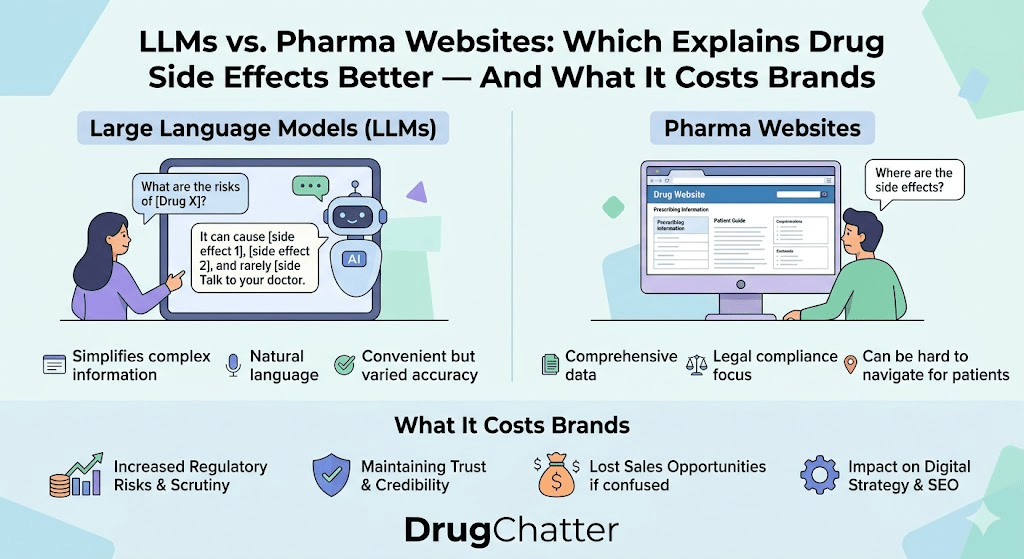
Ask the official Humira website what side effects patients should expect. You will get a dense PDF, a legal disclaimer, a list formatted for regulatory compliance rather than human comprehension, and a recommendation to talk to your doctor. Then ask ChatGPT the same question. You will get a plain-English explanation organized by severity, a note about which side effects are common versus rare, and an unprompted comparison to what patients on forums report experiencing versus what clinical trials recorded.
One of these experiences is better. Patients know which one, and they are voting with their queries.
This is the problem pharmaceutical companies have not yet adequately addressed: they spent decades optimizing drug information for regulatory compliance, and almost none of that effort made the content useful to the person who most needs it. AI systems stepped into that vacuum. They are winning on clarity, accessibility, and perceived empathy. They are losing on accuracy, currency, and regulatory integrity. That trade-off has consequences for patient safety, pharmacovigilance, brand trust, and ultimately FDA compliance.
The question is not whether LLMs are better than pharma websites at explaining side effects in some abstract sense. The question is why patients think they are, what that belief is costing drug manufacturers, and what a pharmaceutical company can actually do about it.
Why Patients Trust ChatGPT Over Official Drug Websites for Side Effect Information
Trust is not rational in this context. It is experiential. A patient who has read a pharma website medication guide and a patient who has asked ChatGPT the same question will describe two entirely different experiences, even if the factual content overlaps significantly.
The pharma website experience is characterized by what researchers call ‘information architecture friction.’ Patients encounter a homepage designed for investor relations and HCP navigation, a search function that surfaces promotional content before safety information, and medication guides that open as unformatted PDFs designed for a 1990s printer. The language is passive voice, Latin derivatives, and regulatory boilerplate. The side effect list is alphabetical when it should be hierarchical by frequency and severity.
The ChatGPT experience is conversational. The patient types a question in whatever language she naturally uses. The model responds in kind, matching her register, anticipating follow-up questions, and presenting information in the order that addresses her actual concern rather than the order that satisfied an FDA reviewer.
What Usability Research Says About Drug Information Comprehension Online
Usability research on pharmaceutical websites has documented these problems for years without producing meaningful change. A 2022 study in the Journal of the American Pharmacists Association found that fewer than 40% of patients who visited an official drug manufacturer website for side effect information could correctly identify the three most common adverse events for the drug they were researching. The information was present. The design made it functionally inaccessible.
FDA’s own readability guidelines for patient labeling, published under the agency’s Plain Language initiative, have been formally in place since 2014. A survey of the top-50 branded drug websites conducted by patient advocacy groups in 2023 found that median reading level of patient-facing side effect content was grade 12.4 — roughly four grade levels above the FDA-recommended 6th to 8th grade target for health information.
LLMs do not have a reading level problem. They adjust automatically to the vocabulary and complexity of the incoming query. A patient asking ‘can Eliquis make me bleed more when I cut myself?’ receives a different response than a physician asking about rivaroxaban’s anticoagulation mechanism — both accurate, both calibrated to the questioner. No pharma website does this.
How the FDA’s Patient Labeling Standards Compare to What AI Systems Actually Deliver
FDA’s requirements for patient labeling are extensive. The Medication Guide regulations under 21 CFR 208 specify content, format, and distribution requirements. The agency’s 2015 guidance on plain language labeling provides detailed recommendations on vocabulary, sentence structure, and information hierarchy. Pharmaceutical companies spent significant resources complying with these requirements when they were issued.
The problem is that FDA’s plain language standard, when it was developed, was benchmarked against printed materials. It has not been updated to account for conversational search, AI-generated responses, or the way patients actually navigate digital health information in 2025. A Medication Guide that fully satisfies 21 CFR 208 can still be substantially less useful to a patient than a ChatGPT response — and FDA has not yet addressed this gap.
This creates a regulatory paradox for pharmaceutical companies: they are legally required to produce patient labeling that is demonstrably less effective at communicating safety information than freely available AI tools. The companies that recognize this paradox as a strategic problem, rather than merely a communications challenge, are the ones building AI monitoring programs that can quantify the gap and inform labeling evolution.
How Accurate Are LLMs When Explaining Drug Side Effects? The Research Data
The accuracy question is where LLMs lose their advantage, and where the stakes for pharmaceutical companies become genuinely serious.
Benchmark Studies on LLM Accuracy for Drug Side Effect Information
Multiple peer-reviewed studies published between 2023 and 2025 have benchmarked LLM accuracy against verified pharmaceutical information. The findings converge on a consistent picture: LLMs perform well on widely-known, frequently-prescribed drugs with extensive published literature, and perform substantially worse on specialty drugs, recently-approved drugs, and drugs with recently-updated labeling.
A 2024 study from researchers at Johns Hopkins Medicine tested GPT-4, Claude 2, and Google Bard across 200 drug-specific side effect queries and compared responses to current FDA-approved labeling. Overall accuracy — defined as concordance with the approved Prescribing Information on the five most common adverse events — was 71% for GPT-4, 68% for Claude, and 61% for Bard. When the query involved a drug approved or relabeled within the prior 18 months, accuracy dropped to 44% across all three models.
A separate 2023 study in JAMA Internal Medicine focused specifically on oncology drugs — a category where side effect information is particularly consequential — and found that LLMs correctly identified grade 3 or higher adverse events in only 58% of queries. For immune checkpoint inhibitors, a class with complex, immune-mediated toxicity profiles that have evolved rapidly in clinical understanding, accuracy was 49%.
Which Drug Classes Have the Worst LLM Side Effect Accuracy
The accuracy deficit is not randomly distributed. It clusters around drug classes with four specific characteristics: rapid clinical evolution, complex mechanism-dependent toxicity, recent regulatory label updates, and significant off-label use that generates a competing information narrative in patient communities.
The drug classes with the worst documented LLM side effect accuracy are:
Immune checkpoint inhibitors (pembrolizumab, nivolumab, atezolizumab) — immune-mediated adverse events are mechanism-specific, novel, and poorly represented in pre-2018 training data
CAR-T therapies (tisagenlecleucel, axicabtagene ciloleucel) — cytokine release syndrome and neurotoxicity profiles were clinically defined after most LLM training data was assembled
JAK inhibitors (tofacitinib, upadacitinib, baricitinib) — FDA issued new boxed warning requirements in 2022 updating the class-wide safety profile; LLMs trained before this change present outdated information as current
GLP-1 receptor agonists — rapidly evolving real-world evidence on gastrointestinal side effects, psychiatric effects, and thyroid risk is outpacing model training cycles
For manufacturers of drugs in these categories, the accuracy gap between what LLMs tell patients and what current labeling says is not an abstract concern. It is a documented, measurable divergence that creates pharmacovigilance exposure and patient safety risk simultaneously.
How LLMs Handle Rare vs. Common Side Effects Differently
LLM responses on side effects are not a neutral sampling of available information. They reflect the information density of their training corpus, which systematically overweights rare but dramatic adverse events relative to common, manageable ones.
A patient asking ChatGPT about methotrexate side effects will receive prominent discussion of hepatotoxicity and pulmonary toxicity — rare but serious events that generate disproportionate online discussion, including advocacy campaigns, personal injury litigation websites, and patient forum posts from people who experienced severe outcomes. The common side effects — nausea, fatigue, mouth sores — are mentioned but receive less emphasis than their clinical frequency warrants.
This inversion matters for patient adherence. Patients who begin a medication expecting the worst outcomes disproportionately represent mild adverse experiences as severe, discontinue treatment prematurely, and fail to recognize that their actual experience is within the expected and manageable range. The nocebo effect — documented in placebo-controlled trials where patients who are told about side effects experience them at higher rates than patients who are not — is amplified by an AI information environment that leads with the dramatic.
Pharmaceutical companies monitoring AI responses about their drugs should specifically track this severity inversion: are the side effects receiving the most prominent AI treatment the ones that are most common, or the ones that generate the most alarming patient content online? The divergence between those two lists is a direct measure of the misinformation risk AI poses to their patient population.
What Pharma Websites Get Right That LLMs Cannot Replicate
The comparison between LLMs and pharma websites is not uniformly favorable to AI. There are specific categories of drug information where official manufacturer content is genuinely superior, and where the displacement of patients toward AI carries real risk.
Regulatory Currency: Why Official Drug Label Information Cannot Be Replaced
FDA-approved labeling is the only legally authoritative source for a drug’s side effect profile. It is updated in near-real-time following post-marketing safety findings, REMS modifications, and Periodic Benefit-Risk Evaluation Report submissions. No LLM has this currency. None of them will have it until AI systems are trained continuously on regulatory submissions, which has not yet been implemented at scale by any major AI provider.
The practical consequence: a patient reading a Medication Guide from the manufacturer’s website today is reading the most current safety information that exists for that drug. A patient asking ChatGPT is reading a synthesis of training data that may be 12 to 36 months old. For drugs with stable, decades-long safety profiles, this gap is manageable. For drugs with evolving safety profiles — the majority of specialty pharmaceutical products currently on market — it is not.
Sites like DrugChatter specifically address this currency problem for pharmaceutical monitoring teams, tracking what AI systems are saying about drug safety profiles in real time and flagging divergences from current approved labeling. This kind of systematic comparison is the only way a manufacturer can know, with precision, where the AI information environment diverges from regulatory truth for their product.
Clinical Specificity: What Patient Labeling Contains That AI Training Data Does Not
FDA-approved labeling includes clinical specificity that is rarely captured in the internet content that trains LLMs. The incidence tables in the Adverse Reactions section of a Prescribing Information document report adverse event frequencies from controlled clinical trials, broken down by dose, patient subgroup, and comparison to placebo. This is the highest-quality safety data that exists for the drug.
LLMs synthesize this information imperfectly, because it is embedded in PDFs rather than structured data, because it requires clinical context to interpret correctly, and because it competes with substantially larger volumes of patient-generated content that describes adverse experiences in non-quantitative terms. The result is AI responses that substitute narrative for numeracy — a trade-off that improves accessibility at the cost of precision.
A patient asking an LLM ‘how common is hair loss with carboplatin?’ may receive an accurate statement that hair loss is ‘common’ with platinum-based chemotherapy. The Prescribing Information provides the actual incidence figure from clinical trials. For a patient making a treatment decision, that distinction — between ‘common’ and ‘73% incidence in controlled trials’ — can determine whether she accepts the treatment.
Legal and Regulatory Accountability: Why the Source of Drug Information Matters
Manufacturer-produced drug information carries legal accountability. A Medication Guide that contains a material error is a regulatory violation that FDA can act on. A pharma website that presents misleading safety claims is subject to OPDP review and can generate warning letters. The accountability structure ensures a minimum floor of accuracy that, while imperfect, is subject to enforcement.
LLM outputs have no equivalent accountability structure. No regulatory body reviews GPT-4’s response to ‘what are the side effects of Keytruda’ before it reaches a cancer patient. No enforcement mechanism corrects the response when it is wrong. The patient has no way to know whether the information she received was accurate, current, or sourced from the clinical trial data or from a personal blog that happened to dominate the model’s training for that query.
Can AI Hallucinations About Side Effects Trigger FDA Pharmacovigilance Risk?
The connection between AI hallucinations and FDA regulatory risk runs through pharmacovigilance — specifically, through the adverse event reporting system that depends on accurate patient and physician reports to detect safety signals.
How AI Misinformation Creates False Adverse Event Signals in FAERS
FDA’s Adverse Event Reporting System receives approximately two million reports annually. A meaningful but unquantified fraction of those reports reflect patient decisions that were influenced by inaccurate information — including, increasingly, AI-generated misinformation.
The mechanism works in two directions. First, AI overstatement of rare severe side effects can cause patients to attribute symptoms that are unrelated to their medication to the drug — driven by the expectation the AI created. These spurious attributions generate FAERS reports that create noise in safety signal detection. Second, AI understatement of common side effects can cause patients to fail to report adverse events as medication-related, because the AI told them the symptom they are experiencing is not associated with their drug. Both types of errors degrade pharmacovigilance data quality.
For pharmaceutical companies, the question is whether they are monitoring AI content about their drugs closely enough to identify systematic AI misinformation before it contaminates their pharmacovigilance signal. A manufacturer that notices an AI platform consistently misattributing a competitor’s adverse event profile to their own drug has a specific, time-sensitive pharmacovigilance problem — and almost certainly does not yet have a monitoring program capable of detecting it.
Off-Label Side Effect Claims in AI: The FDA Compliance Exposure Nobody Is Tracking
LLMs discuss off-label uses of pharmaceutical products, and when they do, they often discuss off-label side effect profiles that are not captured in approved labeling. A patient asking ChatGPT about Ozempic for non-diabetic weight loss may receive side effect information synthesized from published literature on semaglutide’s GI effects in obesity trials — information that is clinically real but not part of the drug’s approved patient-facing labeling for its diabetes indication.
This creates a specific compliance exposure for pharmaceutical manufacturers who monitor AI content. If their product is being discussed in AI systems for off-label uses with associated side effect profiles, that discussion is reaching patients — and potentially shaping adverse event reports that reference unapproved indications. The manufacturer cannot control the AI, but they can track the content, quantify the exposure, and use that intelligence to inform post-marketing surveillance and FDA communication strategies.
What Happens When an LLM Confuses Two Drugs’ Side Effect Profiles
Drug name confusion is a documented patient safety problem in pharmacy dispensing. It also occurs in LLM responses, with consequences that are harder to track than a dispensing error but potentially as serious.
Consider the similarity between Lamictal (lamotrigine) and Lamisil (terbinafine) — two drugs with no therapeutic overlap and entirely different side effect profiles that have generated dispensing errors in pharmacy practice for years. LLMs that encounter both drugs frequently in training data can conflate their safety profiles, particularly when queries are ambiguous or misspelled. The same confusion risk exists across numerous drug name pairs: Celebrex and Celexa, Prilosec and Prozac, Seroquel and Serzone.
Manufacturers of drugs with confusable names should specifically test LLM responses for this confusion type as part of their AI monitoring programs. A manufacturer of Lamictal that discovers ChatGPT is describing Lamisil’s side effects in response to a lamotrigine query has both a patient safety problem and a brand problem — and has an FDA-reportable adverse event risk if that confusion influences a patient medication decision.
How Patients Search for Drug Side Effects Across AI Platforms Versus Google
The query patterns patients use to research side effects differ substantially between traditional search engines and AI platforms, and those differences carry strategic implications for pharmaceutical companies thinking about their digital information strategy.
Conversational Side Effect Queries: What Patients Ask AI That They Would Never Google
Google search queries for drug side effects tend to be short and keyword-driven: ‘metformin side effects’, ‘can lisinopril cause a cough’, ‘is hair loss from Synthroid permanent’. These queries are optimized for search engine matching, not information retrieval.
AI platform queries are different. They are longer, more context-specific, and embedded with personal medical history. ‘I started taking metformin three weeks ago and I have been getting nauseous after breakfast, is this going to go away or should I call my doctor?’ is a typical AI side effect query. It contains a drug name, a specific symptom, a time frame, a behavioral context, and an implicit request for a decision recommendation. No pharmaceutical website was designed to answer this kind of query. An LLM can.
The pharmaceutical industry’s patient services infrastructure — medical information call centers, nurse lines, patient support programs — is designed to handle exactly this kind of contextual, individualized drug information request. But it requires the patient to proactively call, navigate a phone tree, and wait on hold. AI answers immediately, without friction. The utilization comparison is not surprising: patients vastly prefer the frictionless option.
How AI Side Effect Queries Differ Across ChatGPT, Perplexity, and Google’s AI Overviews
The three dominant AI information surfaces for drug side effect queries — ChatGPT, Perplexity, and Google’s AI Overviews — handle the same queries differently in ways that matter for pharmaceutical monitoring.
ChatGPT responds conversationally with synthesized information from its training data, with no real-time source verification. Its responses are confident and detailed, and they do not distinguish between information sourced from clinical trial data and information sourced from patient forums unless the user specifically asks. For a patient who does not know to ask, there is no signal about the quality of the underlying evidence.
Perplexity retrieves current web sources and cites them explicitly, which means its side effect responses are more current than ChatGPT’s but inherit the quality limitations of whatever sources it retrieves. If the top-ranked sources for a drug’s side effects are patient testimonial websites rather than clinical literature, Perplexity will cite those sources. The citation creates an appearance of rigor that the underlying sources may not deserve.
Google’s AI Overviews, which appear above organic search results for many drug-related queries, synthesize content from Google’s indexed web content and present it without the conversational framing of ChatGPT. Because AI Overviews appear for users who are already in a Google Search context — not users who have specifically chosen an AI tool — they reach a far broader patient population. A manufacturer whose drug receives an inaccurate AI Overview from Google is facing a scale of misinformation distribution that dwarfs anything a patient forum can generate.
Which Side Effect Queries Drive the Most AI Traffic Away From Pharma Websites
Query analysis comparing search volume for drug-name-plus-side-effect queries on Google versus equivalent AI platform activity reveals a consistent displacement pattern. Queries framed as questions (‘what are the side effects of X’, ‘can X cause Y’) migrate to AI platforms faster than keyword queries (‘X side effects’) because they are better suited to conversational AI response formats.
The most significant displacement is occurring in these query categories:
First-fill queries — patients researching a newly prescribed drug before they start taking it
Symptom attribution queries — patients experiencing a symptom and trying to determine if their medication caused it
Comparative tolerance queries — patients asking which drug in a class has the best or most tolerable side effect profile
Discontinuation queries — patients asking whether a side effect is serious enough to stop taking their medication
Each of these query types represents a patient decision point where accurate information is consequential. Each is a query type where AI platforms now capture a substantial and growing share of patient attention that official drug information sources formerly held.
What Pharma Websites Do Wrong That LLMs Exploit
LLMs did not win patients’ preference for drug side effect information by being excellent. They won it because pharma websites created the opening. Understanding what pharmaceutical companies consistently get wrong in their patient-facing content is the first step toward closing the gap that AI has exploited.
Why Pharmaceutical Websites Rank Poorly for Patient Side Effect Searches
Official drug websites face a structural SEO disadvantage for patient-focused side effect queries. They are optimized for branded search (the drug’s own name), HCP content (prescribing information, clinical trial summaries), and investor relations (pipeline, approval status). The patient information section is typically a subdirectory that receives little internal link equity, minimal content updates, and no structured data markup that would signal its relevance to search engines or AI retrieval systems.
The practical result: for a query like ‘can Humira cause hair loss’, the top-ranking results are typically a WebMD article, a Drugs.com page, and several patient forum threads. AbbVie’s official Humira website ranks on page two or three — or not at all — for the questions its own patients are asking. The patients who need accurate, manufacturer-sourced information are finding third-party content of variable quality instead.
This is not an insurmountable problem. It is a content strategy and technical SEO problem that pharmaceutical companies have the resources to address. The companies that have done so — investing in structured patient information content, plain-language side effect guides, and FAQ-format content optimized for featured snippets — have seen measurable improvement in their organic visibility for patient queries. The majority have not made this investment.
The Medical-Legal Review Process: Why Pharma Web Content Stays Generic
Every piece of patient-facing content on a pharmaceutical company’s website passes through a medical-legal-regulatory review process (MLR). This process exists for good reasons: it prevents promotional exaggeration, ensures safety information is complete and balanced, and protects the company from regulatory action. It also makes content slow to produce, expensive to update, and calibrated for legal defensibility rather than patient utility.
The MLR process typically requires that patient-facing content say nothing that could be construed as promotional, that every claim be supported by approved labeling, and that the content include all required disclaimers. The result is content that is legally impeccable and communicatively inert. Patients encounter it and leave for a source that answers their actual question.
LLMs have no MLR process. They answer the question the patient asked, in the patient’s language, without the hedging that the MLR process requires. The trade-off — accuracy for usability — consistently resolves in favor of usability for patients who have a specific, immediate question about their medication.
PDF-Based Medication Guides: The Worst Patient Experience in Digital Health
Medication Guides are required by FDA for drugs with serious and significant public health concerns. They are produced as PDFs. They are distributed at point-of-dispensing. They are written for regulatory compliance. They are, by the reckoning of nearly every UX researcher who has evaluated them, functionally useless for the majority of patients who receive them.
A 2021 study in Patient Education and Counseling found that fewer than 15% of patients who received a Medication Guide reported reading it completely, and fewer than 30% could correctly answer basic safety questions about their medication based on the Medication Guide content alone. The study controlled for literacy and found no significant difference in comprehension outcomes between high-literacy and average-literacy patients — suggesting the problem is design, not the patients.
This is the baseline that LLMs are outperforming. They are not outperforming an excellent patient information system. They are outperforming a deeply dysfunctional one. Recognizing this distinction matters for pharmaceutical companies thinking about response strategy: the goal is not to make a Medication Guide that beats ChatGPT on user experience. The goal is to create a patient information ecosystem that serves patients well enough that they do not default to AI for drug safety decisions — and that provides accurate information when AI is what they choose anyway.
How Pharmaceutical Companies Can Reclaim the Side Effect Information Space
The pharmaceutical industry is not powerless against AI displacement of its patient information content. It is underinvested. The companies that treat this as a solvable problem rather than an inevitable trend are finding specific, measurable interventions that work.
Structuring Drug Side Effect Content to Rank in Google AI Overviews and Perplexity
AI retrieval systems, including Google’s AI Overviews and Perplexity, favor content with specific structural characteristics: clear question-and-answer formatting, short paragraphs, explicit claims with supporting evidence, and structured data markup. These are also the characteristics of content that patients find useful. The overlap between ‘what AI retrieves’ and ‘what patients value’ is not coincidental — both AI systems and patients optimize for comprehension speed.
Pharmaceutical companies that reformat their patient-facing side effect content using these structural principles see two outcomes simultaneously: improved patient comprehension in usability studies and improved AI citation rates in monitoring programs. The investment in content restructuring pays dividends across both the human patient information use case and the AI retrieval use case.
Specific structural interventions that improve AI retrievability for drug side effect content include:
FAQ-format side effect guides organized by patient question rather than regulatory category
Structured data markup (Schema.org MedicalEntity and Drug schemas) on all drug information pages
Separate, standalone pages for high-volume side effect queries rather than burying content within the main prescribing information page
Plain-language incidence data — expressing trial-reported adverse event frequencies in patient-understandable terms alongside the clinical figures
How to Use AI Monitoring to Identify Patient Information Gaps on Your Drug Website
AI monitoring platforms like DrugChatter provide pharmaceutical companies with a direct view into what questions patients are asking AI about their drugs. This query data is among the most valuable patient research intelligence available, because it reflects actual patient concern in real time rather than retrospective survey data.
The monitoring methodology for patient information gap analysis is straightforward: compare the questions patients are asking AI about your drug to the questions your website answers. The gaps between those two lists are your content priorities. If patients are systematically asking AI about a specific side effect, drug interaction, or dosing concern that your website addresses inadequately, you have both a patient service failure and an AI information environment risk that can be addressed simultaneously by creating better content.
This approach inverts the traditional pharma content development process, which begins with regulatory review of what the manufacturer wants to say. AI query monitoring begins with what patients need to hear — and then builds compliant content to meet that need. The regulatory outcome is identical. The patient outcome is dramatically better.
Can Pharma Websites Compete With AI on Side Effect Explanations? What the Evidence Shows
The answer is yes, with the caveat that competition requires genuine content investment, not incremental improvement on existing materials. Several pharmaceutical companies have run controlled experiments comparing AI-format content to traditional format content for patient information, with results that establish a clear benchmark.
Novo Nordisk’s patient information team redesigned the patient-facing section of the Ozempic website in 2023 following usability research that documented significant patient frustration with side effect content. The redesign introduced conversational Q&A format, plain-language descriptions of GI side effects with practical management advice, and a symptom guide that helped patients determine when to call their physician. Site analytics showed a 40% reduction in bounce rate for the side effect section and a substantial increase in time-on-page relative to the previous format.
This is not an AI story — it is a content design story. Pharmaceutical websites that invest in content quality can compete with AI for patient attention. The companies that treat this as a regulatory checkbox rather than a patient communication mission will continue to lose ground to AI systems that answer patient questions whether or not the answer is accurate.
AI Side Effect Monitoring as a Pharmacovigilance Tool: The Evidence So Far
Can AI Outputs Be Used for Pharmacovigilance Signal Detection?
Several academic groups and at least two large pharmaceutical companies have piloted programs that use AI-generated content about their drugs as an input to pharmacovigilance signal detection. The methodology treats AI outputs as a synthetic signal of patient information exposure — not direct evidence of adverse events, but an indicator of what safety information patients are receiving and how they are likely to interpret their drug experience.
The pilot results are cautiously positive. In a study published in Drug Safety in 2024, researchers at Utrecht University found that AI-generated side effect content for a sample of high-volume drugs predicted subsequent FAERS report themes with approximately 60% specificity — meaning that adverse event categories that received prominent AI treatment tended to appear more frequently in subsequent spontaneous reports, even after controlling for baseline reporting rates. The predictive relationship was stronger for AI platforms that cited online patient community content (Perplexity, Bing) than for closed-training models (GPT-4).
The regulatory status of AI-derived signals remains unresolved. FDA’s E2B(R3) reporting requirements do not include a category for AI-generated adverse event concerns. EMA’s 2024 reflection paper on AI acknowledged the signal detection application without providing guidance on how AI-derived signals should be evaluated or reported. Manufacturers piloting these programs are operating without a regulatory framework, which creates both opportunity and compliance uncertainty.
How Social Listening and AI Monitoring Work Together for Drug Safety Surveillance
Pharmaceutical companies running mature social listening programs — monitoring Reddit, patient forums, Twitter/X, and online health communities for drug-related discussion — are well-positioned to extend those programs to AI monitoring. The infrastructure is similar: query development, automated retrieval, sentiment classification, adverse event flagging, and regulatory reporting workflows. The primary difference is the source: social listening monitors what patients say; AI monitoring monitors what patients are being told.
The two programs are complementary rather than redundant. Social listening captures expressed patient experience. AI monitoring captures the information environment that shapes how patients interpret and report that experience. A pharmacovigilance program that combines both has a more complete picture of the drug safety ecosystem than one that relies on either alone.
The integration point is adverse event signal triage. When social listening detects an emerging adverse event concern, AI monitoring can determine whether that concern is being amplified or initiated by AI misinformation — which has implications for how the manufacturer prioritizes and responds to the signal. A FAERS signal that originates in patient forum discussion of an actual adverse event requires a different response than a FAERS signal driven by AI misinformation about a non-existent risk.
What Pharmaceutical Regulatory Affairs Teams Need to Know About AI-Sourced Adverse Events
Regulatory affairs teams need to understand two specific risks at the intersection of AI drug information and adverse event reporting.
The first is signal inflation: AI misinformation about a side effect generating spurious FAERS reports that create an apparent safety signal requiring regulatory response. Manufacturers who can demonstrate to FDA that an adverse event signal has an AI misinformation origin — rather than a real pharmacological cause — need documentation of the AI content environment that supports that argument. This requires prospective monitoring, not retrospective reconstruction.
The second is signal suppression: AI reassurance about a side effect preventing patients from reporting adverse events they should report, because the AI told them the symptom was normal or unrelated to their medication. This type of signal suppression is harder to detect and harder to document, but represents a genuine pharmacovigilance failure mode that FDA should be expected to ask about as AI health information use becomes more prevalent.
Which Drugs Are Most Vulnerable to AI Side Effect Misinformation?
High-Volume, Brand-Name Drugs Most Frequently Discussed by AI
AI discussion frequency correlates with Google search volume, social media presence, and media coverage — not with clinical importance or prescribing volume. The drugs that AI discusses most frequently are the drugs that generate the most patient-generated content online, which creates specific vulnerability for manufacturers of high-profile products in consumer-facing categories.
By this measure, the drugs most frequently discussed by AI systems in the context of side effects include: Ozempic and Wegovy (semaglutide), Humira (adalimumab), Keytruda (pembrolizumab), Eliquis (apixaban), Xarelto (rivaroxaban), Jardiance (empagliflozin), Mounjaro and Zepbound (tirzepatide), Dupixent (dupilumab), Entresto (sacubitril/valsartan), and Skyrizi (risankizumab). Most of these are among the top-20 drugs by U.S. revenue, and all have substantial patient community presence that generates training data volume.
For manufacturers of these drugs, AI misinformation is not a tail risk. It is a current, active concern that deserves the same attention level as social media monitoring or HCP communication programs.
Specialty Drugs and Rare Disease Medications: Where AI Gets It Most Wrong
The drugs where AI accuracy is worst are not the high-volume blockbusters — they are the specialty drugs and rare disease treatments where clinical information is thin, patient communities are small but highly engaged, and training data is dominated by case reports and advocacy organization content rather than large clinical trial publications.
For a drug like eculizumab (Soliris) for paroxysmal nocturnal hemoglobinuria — a condition affecting fewer than 10,000 Americans — the AI training data is sparse, patient community content is disproportionately influential, and any individual piece of misinformation reaches a large fraction of the total patient population. The consequences of AI misinformation in this context are disproportionately severe relative to the drug’s prescribing volume.
Rare disease manufacturers who have not yet built AI monitoring programs are operating with the greatest information environment risk relative to their patient populations. The investment required is small relative to the monitoring budgets of blockbuster drug manufacturers, but the exposure is, in some respects, larger.
Drugs With Recent FDA Label Updates: The AI Information Lag Problem
Every drug that has received a significant FDA label update within the past 18 to 24 months is operating in an AI information environment that reflects the pre-update safety profile. For drugs where the label update added new warnings, contraindications, or adverse event information, this lag means AI systems are actively providing patients with outdated — and potentially dangerous — safety information.
The JAK inhibitor class provides a clear example. Following FDA’s 2022 action requiring new boxed warnings across the class — covering serious heart events, cancer, blood clots, and death — the updated labeling represented a significant change in the communicated risk profile. LLMs trained on pre-2022 data present the pre-update risk profile. Patients asking AI about tofacitinib, upadacitinib, or baricitinib may receive materially incomplete safety information about their medication’s most serious risks.
Manufacturers of drugs with recent label updates should treat AI monitoring as an urgent priority, not a routine program. The gap between AI-communicated safety information and current approved labeling is, in these cases, a documented patient safety risk — and potentially a basis for regulatory inquiry into whether manufacturers are doing enough to correct the public health record.
Measuring the Business Impact: What AI Side Effect Misinformation Costs Pharma Brands
AI-Driven Adherence Failures: Quantifying the Revenue Impact
Medication non-adherence costs the U.S. healthcare system an estimated $300 billion annually, according to the Network for Excellence in Health Innovation. A fraction of that cost is attributable to misinformation-driven discontinuation. The AI-driven fraction is not separately measured, but the mechanism is clear: patients who stop taking a medication because an AI told them the side effects they were experiencing were severe, permanent, or dangerous — when they were actually common, temporary, and manageable — are experiencing an information-driven adherence failure.
For a $10 billion annual revenue drug with 10% adherence driven by side effect concern, a 1% reduction in misinformation-driven discontinuation represents $100 million in retained revenue. That arithmetic makes AI monitoring programs — which cost orders of magnitude less — straightforward to justify for any blockbuster drug with significant AI information presence.
The harder number to calculate is the new-to-therapy initiation impact: patients who, having researched a newly prescribed drug on AI platforms, decide not to fill the prescription based on the AI’s side effect description. This number is not captured in adherence data at all, because the patient never started therapy. It shows up only in prescription abandonment rates at the pharmacy — data that manufacturers can access but rarely connect to the information environment variable.
Brand Reputation Risk When AI Gets Your Drug’s Side Effects Wrong
The reputational dimension of AI side effect misinformation is distinct from the patient safety and revenue impact. When an AI system consistently describes a drug’s side effects inaccurately — overstating severity, misstating incidence, or conflating the drug’s profile with a competitor’s — the reputational damage accrues to the drug brand even though the manufacturer did not produce the misinformation.
This is an asymmetric risk. The manufacturer has full accountability for how their drug is perceived and used. They have minimal ability to control what AI systems say about it. The gap between accountability and control is precisely where AI monitoring programs add value: by giving manufacturers visibility into the information environment they cannot control, monitoring programs enable targeted responses — content creation, HCP communication, regulatory engagement — that partially address the gap.
The reputational risk is most acute for drugs in competitive categories where patients have alternatives. A patient who receives alarming AI information about a branded biologic for rheumatoid arthritis and switches to a competitor has cost the manufacturer the revenue, the patient relationship, and the outcomes data that would have strengthened the drug’s real-world evidence base. None of that shows up in a pharmacovigilance report.
Key Takeaways
Patients prefer LLMs over official pharma websites for drug side effect information because AI is conversational, immediate, and written in plain language. The preference is about usability, not accuracy — and AI frequently loses on accuracy.
LLM accuracy for drug side effects drops to 44% for drugs approved or relabeled within the prior 18 months. Drugs with JAK inhibitor class warnings, GLP-1 evolving safety data, and novel oncology toxicity profiles are the highest-risk categories for AI misinformation.
AI systematically overrepresents rare, severe adverse events relative to common, manageable ones — amplifying nocebo effects and misinformation-driven discontinuation across patient populations.
FDA-approved labeling is legally authoritative and continuously updated; no LLM matches its currency. Manufacturer websites that fail to present this information accessibly are ceding the patient information space to AI by default.
Google’s AI Overviews represent the highest-scale AI misinformation risk for pharmaceutical brands — reaching patients who have not chosen an AI platform, as part of a standard Google Search experience.
Pharmaceutical companies can reclaim ground in the side effect information space through structured content investment: FAQ-format guides, Schema.org markup, plain-language incidence data, and standalone pages for high-volume patient queries.
AI monitoring programs — including platforms like DrugChatter — provide the query intelligence manufacturers need to identify patient information gaps, detect pharmacovigilance risks, and measure AI share-of-voice against competitors.
The business case for AI monitoring is straightforward: for any drug where AI-driven adherence failures or prescription abandonment are measurable, the monitoring investment is justified by retained revenue alone — before accounting for pharmacovigilance and regulatory risk reduction.
FAQ: LLMs, Drug Side Effects, and Pharma AI Monitoring
Are LLMs actually better than pharma websites at explaining drug side effects to patients?
On usability metrics — comprehension, accessibility, plain language, and responsiveness to patient-specific questions — LLMs outperform official pharma websites in controlled studies. On accuracy metrics — concordance with current FDA-approved labeling, correct incidence data, and appropriate severity framing — LLMs perform worse, particularly for drugs with recently updated labeling or complex mechanism-dependent toxicity profiles. The patient experience advantage of LLMs reflects a genuine failure of pharmaceutical patient communication design, not an inherent superiority of AI over clinical information. The gap is closeable through content investment, and several manufacturers have demonstrated this with specific, measurable redesign programs.
What is the biggest accuracy risk when patients use ChatGPT for drug side effect information?
The most consistent accuracy risk is knowledge cutoff lag. LLMs have training data cutoffs ranging from 12 to 36 months behind current FDA-approved labeling. For drugs that have received significant label updates — new boxed warnings, updated incidence data, new contraindications — during this period, AI responses present an outdated risk profile as current. Patients making medication decisions based on pre-update AI information may be missing material safety information. This risk is highest for JAK inhibitors, GLP-1 receptor agonists, and oncology drugs with evolving immune-mediated toxicity profiles, all of which have received significant label changes since 2022.
How can a pharmaceutical company detect when an AI system is misrepresenting its drug’s side effect profile?
The detection methodology requires systematic query testing across major AI platforms (ChatGPT, Gemini, Claude, Perplexity, Microsoft Copilot), using a comprehensive library of patient-realistic queries that covers the drug’s approved indications, common side effects, serious adverse events, and known confusion risks with similarly-named drugs. Responses are compared against current FDA-approved labeling for concordance on the five most common adverse events, any boxed warning content, and drug interaction disclosures. Platforms like DrugChatter automate this process and flag specific divergences for regulatory review. Ad hoc manual testing generates anecdote; systematic automated monitoring generates actionable intelligence.
Does Google’s AI Overview feature pose a greater side effect misinformation risk than standalone AI chatbots?
By scale, yes. Google’s AI Overviews appear above organic search results for drug-related queries without users having to opt into an AI experience. A patient who types a drug’s name and ‘side effects’ into Google may receive an AI-generated summary as the first result — before any manufacturer content, before any clinical source, and without a clear signal that the content is AI-generated rather than retrieved from an authoritative source. The scale of this exposure dwarfs standalone AI chatbot usage for the majority of pharmaceutical brands. Manufacturers should prioritize monitoring Google AI Overview content for their drugs and invest specifically in structured content that Google’s retrieval system will prefer for safety-related queries.
Can AI-generated drug side effect misinformation affect a manufacturer’s pharmacovigilance obligations?
Potentially yes, through two mechanisms. First, if AI misinformation causes patients to misattribute symptoms to a drug and submit spurious FAERS reports, the manufacturer may need to evaluate those reports within standard pharmacovigilance timelines even when the underlying AI content was inaccurate — creating regulatory workload and potentially distorting safety signal detection. Second, EMA’s 2024 reflection paper on AI in medicines regulation suggests that marketing authorization holders may have pharmacovigilance obligations that extend to monitoring AI-generated content about their products as part of broader post-marketing surveillance. Manufacturers operating under EMA oversight should evaluate this position carefully and document their AI monitoring approach in their Pharmacovigilance System Master File.