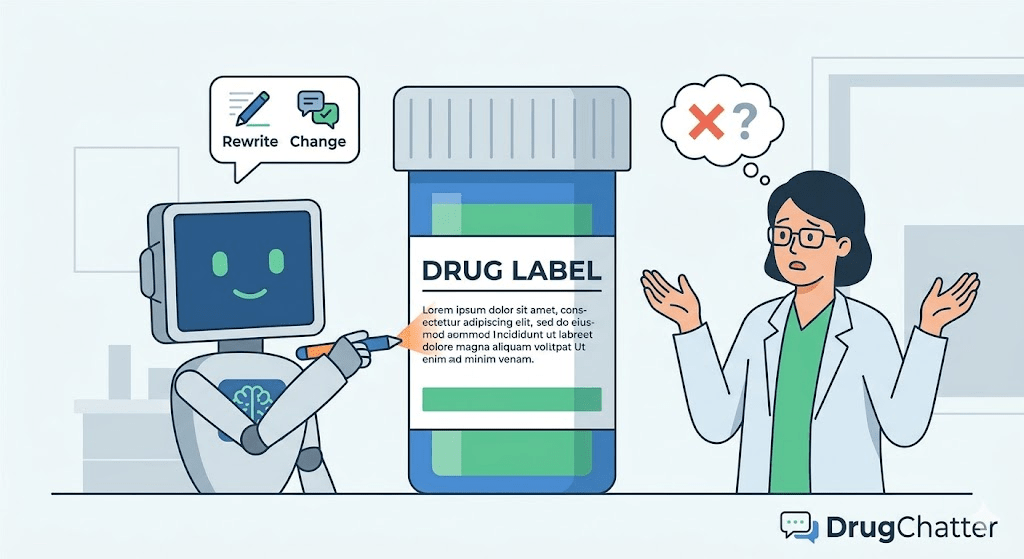
Every day, tens of millions of patients and physicians type drug questions into ChatGPT, Gemini, Claude, and Perplexity. They get answers. Those answers describe dosing windows, contraindications, side effect profiles, and comparative efficacy — often with a confidence that resembles an FDA-approved label. Except it isn’t one.
Nobody at the pharmaceutical manufacturer reviewed those answers. Nobody from medical affairs approved them. No regulatory team vetted them against current labeling. The AI generated them from a weighted average of everything ever written about the drug — clinical literature, Reddit threads, patient forum posts, outdated news coverage, and adverse event reports — and delivered them as authoritative guidance to anyone who asked.
That is the central problem. AI has become a primary drug information channel, and pharmaceutical companies have almost no visibility into what it says.
This article covers what AI actually gets wrong about drugs, why the regulatory exposure is real and growing, what the first FDA warning letter citing AI misuse signals for the industry, and how brand teams, medical affairs functions, and pharmacovigilance units can build the monitoring infrastructure they need before the gap becomes a liability.
Why AI Gets Drug Information Wrong — and Why That Matters
The problem is not that AI is trying to mislead anyone. The problem is structural. Large language models are trained on text, and text about drugs is not a neutral corpus. It is skewed toward volume, recency, and engagement — not accuracy or label compliance.
A drug with a long commercial history, extensive patient forum activity, and high media salience will be described by an LLM with more confidence and more detail than a newer drug, regardless of which one has the better safety profile or clearer clinical data. The model’s implicit confidence correlates with how much has been written, not with how accurate the writing is.
How Often Does ChatGPT Get Drug Facts Wrong?
Often enough to worry about. A Stanford Health Care study tested ChatGPT-3.5 against FDA boxed warning data for 41 commonly used antibiotics. Of the 32 antibiotics without an FDA boxed warning, ChatGPT reported that 23 — or 72% — had one. For the nine antibiotics that genuinely carry boxed warnings, ChatGPT correctly matched the adverse events in only three cases, or 33%.
Those are not rounding errors. They are the kind of inaccuracies that change prescribing decisions and patient behavior. A physician asking an AI assistant about the safety profile of a drug before prescribing it to a patient at elevated bleeding risk does not benefit from an answer that is 67% wrong on the details that matter most.
Are Gemini, Claude, and Perplexity Any Better?
The performance varies by platform, but no major LLM is clean. A physician-led red-teaming study evaluated Claude, Gemini, GPT-4o, and Llama3-70B across 888 responses to 222 patient-posed medical questions. The rate of problematic responses ranged from 21.6% for Claude to 43.2% for Llama. Unsafe responses specifically — those with potential to cause patient harm — ranged from 5% for Claude to 13% for GPT-4o and Llama.
That variance matters for pharmaceutical companies. Different platforms carry different risk profiles for different drug categories, and a monitoring program needs to cover all of them systematically, not spot-check one occasionally.
Why LLMs Hallucinate Drug Safety Data
The technical explanation for pharmaceutical hallucinations differs from the standard hallucination description. LLMs do not just fabricate information at random. The errors tend to cluster around situations where label guidance conflicts with emerging clinical practice — precisely where an AI trained on recent literature would diverge from the formal FDA label. The model has ingested newer research that points in a different direction from the approved indication, and it synthesizes a confident-sounding answer that reflects the literature rather than the label.
That is a pharmacovigilance problem of a specific type: not random noise, but systematically biased deviation from approved labeling in the direction of real-world clinical use and emerging evidence. Off-label territory, in other words.
What the First FDA Warning Letter Citing AI Misuse Actually Means
In April 2026, the FDA issued a warning letter to Purolea Cosmetics Lab, a Michigan-based homeopathic drug product manufacturer, following an October 2025 inspection. The letter identified multiple violations of Current Good Manufacturing Practice regulations under 21 CFR parts 210 and 211, and included a dedicated section titled ‘Inappropriate Use of Artificial Intelligence in Pharmaceutical Manufacturing’ — which sets this case apart from every previous FDA enforcement action.
The firm told FDA investigators it used AI agents to create drug product specifications, procedures, and master production or control records in an effort to comply with FDA requirements. When investigators pointed out that the firm had not conducted process validation before distributing its drug products, the firm responded that it was not aware of the legal requirement because the AI agent it used never told it that validation was required.
The FDA was not sympathetic.
Can AI Hallucinations Trigger FDA Regulatory Risk?
“AI does not excuse the failure to implement fundamental controls. Companies remain responsible for AI-generated outputs and compliance failures.” — FDA enforcement position, as summarized in the Purolea warning letter, April 2026.
The FDA’s response is consistent with its broader framework on AI use, reflecting the principle that AI used for GxP or to support other product development functions must be validated for those purposes, and that appropriate AI validation documentation should be integrated into quality system records and standard operating procedures.
The manufacturer argued it relied on AI. The FDA’s position: that reliance does not transfer legal responsibility. The company distributes the drug. The company owns the compliance obligation. The AI is a tool, not a co-signatory on the label.
Does FDA Manufacturer Liability Extend to Third-Party AI Outputs?
This is the next question the industry needs to answer, and the answer is developing in real time. No direct precedent exists as of 2025. The FDA has statutory authority under Section 301 of the FDCA to prohibit false or misleading labeling, but that authority runs to labeling the manufacturer controls or disseminates. Third-party AI outputs are not manufacturer labeling in the traditional sense. However, if a manufacturer provides drug information to an AI platform through a licensed data relationship, and that platform uses the information in ways the manufacturer knows to be inaccurate, FDA could theoretically characterize the manufacturer’s continued participation in that relationship as contributing to misbranding.
That theory has not been tested. But pharmaceutical companies that document active monitoring efforts — and responses to identified inaccuracies — will be in a different position than those that document nothing.
How FDA Is Using AI to Monitor Drug Advertising
FDA’s Center for Prescription Drug Promotion issued 40 untitled letters in September 2025, followed by approximately 80 warning letters a week later. The agency’s press release stated FDA had already deployed AI and other technology-enabled tools to surveil drug ads — indicating the FDA is using AI to police pharmaceutical marketing at the same time it is scrutinizing industry’s AI use.
The direction of that trend is clear. If the FDA uses AI to find violations in drug advertising, it will eventually use AI to find violations in how drug manufacturers interact with AI platforms that are distributing inaccurate safety information. Getting ahead of that means building monitoring programs now.
Tracking AI Share of Voice: ChatGPT vs. Gemini vs. Claude for Pharmaceutical Brands
Share of voice is not a new concept in pharmaceutical marketing. Brand teams measure it across earned media, social platforms, physician networks, and payer communications. Most have never measured it across AI platforms — which is now where a significant portion of first-touch drug information happens.
How Different AI Platforms Describe the Same Drug
The same query asked to ChatGPT, Gemini, Claude, and Perplexity can produce substantially different answers in terms of which drugs are mentioned first, what side effects are emphasized, and how comparative claims are framed. Those differences are not random. They reflect differences in training data, post-training alignment, system prompts, and retrieval mechanisms. A drug that leads in ChatGPT responses may appear third or fourth in Claude responses to identical queries, and that ordering shapes both physician and patient perception.
How Often Does Claude Mention Ozempic vs. Wegovy?
The competitive framing question in GLP-1 receptor agonists is an instructive case. Ozempic (semaglutide 0.5–2 mg injection, approved for Type 2 diabetes) and Wegovy (semaglutide 2.4 mg injection, approved for chronic weight management) are the same molecule at different doses with different approved indications. A study accessed Google Trends to identify the top 25 keywords related to GLP-1 receptor agonist therapy for obesity, using the specific search terms ‘Ozempic,’ ‘Wegovy,’ ‘Semaglutide,’ and ‘weight loss injection.’ The volume of patient search activity around Ozempic for weight loss — an off-label use — vastly exceeds that around Wegovy for the same indication, despite Wegovy being the FDA-approved product for that indication.
That public search pattern flows into AI training data. An AI asked ‘What is the best injection for weight loss?’ may recommend Ozempic based on its training corpus — a response that technically describes off-label use of one product while ignoring the on-label option. Novo Nordisk has a direct competitive interest in knowing which answer each major platform gives, at what frequency, and with what framing.
Do LLMs Recommend Generic Drugs More Often Than Branded Alternatives?
The generic substitution question is emerging as a distinct monitoring need. LLMs trained on cost-effectiveness literature, payer publications, and consumer health sites may systematically favor generic alternatives in their recommendations, particularly when responding to cost-related queries. A patient asking ‘Is there a cheaper alternative to [branded drug]?’ will almost always receive a generic recommendation. A physician asking ‘What are the options for [indication]?’ may receive a list that ranks generics higher based on cost-effectiveness evidence in the training corpus.
For a branded drug manufacturer, that is a share-of-voice loss that happens invisibly and continuously across every AI platform, with no mechanism for the brand team to detect it unless they are running systematic queries.
Which Drugs Are Most Frequently Mentioned by AI?
A sample audit of twenty branded drugs conducted by DrugChatter in 2024 found that 65% had at least one material factual error in AI-generated descriptions across four major platforms — wrong dosing information, incorrect indication language, outdated contraindication lists, or mislabeled routes of administration.
Drugs with longer commercial histories and higher media salience tended to appear more frequently and with greater apparent confidence. That confidence does not track with accuracy. AI models describe drugs with longer commercial histories, more extensive publication records, and higher media salience more confidently and favorably than newer drugs, regardless of relative clinical merit.
How Patients Ask About Drug Interactions in AI Search — and What They’re Being Told
Patient queries to AI chatbots are structurally different from physician queries. Patients describe symptoms, mention multiple drugs they are taking, and ask questions that combine clinical and logistical concerns: ‘Can I take ibuprofen with metformin?’ or ‘What happens if I miss a Jardiance dose?’ The conversational nature of those queries makes them harder to answer accurately than discrete clinical questions.
What Patients Are Actually Asking AI About Their Prescriptions
In the United States, 43 million patients ask chatbots medical questions at least once per month. This generates a massive quantity of chatbot-generated medical advice from tools that were not specifically optimized to safely answer clinical questions. The implications are direct: the largest drug information channel by query volume is one that pharmaceutical companies have never controlled and are only beginning to monitor.
Patient queries cluster around four categories: dosing and missed doses, drug interactions, side effect interpretation, and comparative efficacy (‘Is drug A better than drug B for my condition?’). All four categories carry real risk of harm from inaccurate AI responses. Dosing questions affect blood levels. Drug interaction questions affect adverse event risk. Side effect interpretation affects adherence. Comparative efficacy questions affect treatment decisions that should involve physicians.
Why Patients Trust AI Drug Answers — Even When They’re Wrong
LLM-powered chatbots like ChatGPT have gained prominence among the general public, and laypeople with no healthcare background increasingly seek health-related advice from these models. Unconditional trust makes them vulnerable to hallucinated information generated by LLMs.
The language models produce fluent, confident, detailed answers. They do not typically flag uncertainty. They do not say ‘I am not sure about the interaction between these two drugs.’ They say: ‘Regarding the interaction between drug X and drug Y, the primary concern is…’ — and then sometimes describe an interaction that is incorrect, incomplete, or applies to a different drug in the same class.
Do Physicians Use AI to Look Up Drug Information During Clinical Practice?
Yes, and the rate is growing. Physicians use ChatGPT, Claude, and Gemini to look up dosing, check interactions, and compare options in clinical workflows — often because the speed of AI response outpaces looking up a label in prescribing information databases. Physicians are increasingly asking AI chatbots how to dose drugs, manage contraindications, and choose between therapies. The AI answers. The FDA label sits elsewhere.
A separate analysis published in Annals of Pharmacotherapy evaluated AI responses to questions about anticoagulation management — a domain where dosing errors carry severe bleeding risk. The authors found that Claude, GPT-4, and Gemini all produced at least one clinically dangerous recommendation when tested against 40 scenarios derived from real hospital cases. The errors clustered around situations where label guidance conflicted with emerging clinical practice.
What Pharma Brand Teams Can Learn From AI-Generated Drug Descriptions
The monitoring gap is large, but the intelligence opportunity is also large. Systematic AI monitoring reveals not just what is wrong about how an AI describes a drug — it reveals how patients and physicians conceptualize the drug, what they are most concerned about, and where competitive pressure is emerging from sources that traditional market research never captures.
Four Categories of AI Drug Information Risk Worth Monitoring
The four categories of AI drug information risk that warrant systematic monitoring are factual inaccuracy versus approved labeling, off-label recommendations, competitive framing bias, and patient safety messaging gaps.
Each of these operates differently across platforms and query types:
Factual inaccuracy includes wrong dosing information, outdated indication language, incorrect contraindication lists, and mislabeled routes of administration. This is the most directly measurable category.
Off-label recommendations occur when an AI responds to a query with a drug recommendation for an indication not in the approved label — either because the training data included clinical literature on emerging uses, or because patient forum discussions of off-label use shaped the model’s associations.
Competitive framing bias determines whether your drug is mentioned first, in what context, with what caveats, and alongside which competitors — shaping perception before a patient or physician makes a decision.
Patient safety messaging gaps include situations where an AI describes a drug without mentioning its black box warning, fails to recommend consulting a physician before use, or provides incomplete information about serious adverse events.
How to Detect Emerging Patient Concerns Before They Trend
One underused application of AI monitoring is early signal detection for patient sentiment that has not yet surfaced in formal adverse event reports. Traditional pharmacovigilance systems grapple with a 94% median underreporting rate for adverse drug reactions, meaning the vast majority of safety events are never formally captured. Patient conversations with AI chatbots represent an alternative signal source — not because the AI outputs the signals, but because the queries patients submit to AI systems reveal what concerns are spreading through patient communities before they appear in FAERS.
A pharmaceutical brand team monitoring patient queries about its drug — via tools that track what questions patients are asking AI systems — can detect emerging adverse event patterns weeks or months before they appear in formal reports. That early warning has direct pharmacovigilance value.
Can AI Outputs Be Used for Pharmacovigilance?
The direct use of AI outputs as pharmacovigilance signals is being explored but requires careful design. In contexts where inaccuracies can result in severe consequences, particularly in decision-making processes affecting patient safety, the issue of LLM hallucinations and omission of key information becomes acutely significant. One critical domain is drug safety, also known as pharmacovigilance, which involves the ongoing surveillance for adverse events linked to pharmaceutical medicines and vaccines.
The regulatory framework for AI-generated pharmacovigilance signals is still developing. The CIOMS Working Group XIV released a Consensus Report on AI in Pharmacovigilance in 2024, explicitly addressing AI use cases, risk management, and the need for human oversight. The French National Agency for Medicines integrated an AI tool into their vaccine safety monitoring workflow in early 2021, allowing rapid pre-coding of incoming reports and enabling pharmacovigilance experts to focus on more complex tasks while still meeting EU submission timelines. That model — AI as a triage and pre-coding layer, human expert as the decision point — is likely the near-term template for industry.
Tracking Off-Label Drug Discussions in LLMs: A Growing Liability
Off-label use is legal. Off-label promotion by manufacturers is not. The distinction matters enormously when an AI system that has ingested clinical literature, patient forum content, and physician commentary starts describing a drug’s off-label applications in response to patient queries.
What Happens When ChatGPT Promotes Your Drug Off-Label
The scenario plays out like this: a patient asks ChatGPT about treatment options for a condition for which their drug has emerging but not approved evidence. The AI, trained on recent clinical papers and patient forum discussions, includes the manufacturer’s branded drug on its list of options — possibly with dosing suggestions drawn from investigational protocols that are not reflected in the approved label.
The manufacturer did not cause this. The manufacturer did not approve it. The manufacturer did not know it was happening. None of that insulates the manufacturer from the questions it will be asked if a patient experiences a serious adverse event following a treatment decision influenced by that AI response.
Documenting that the manufacturer did not know — and more importantly, documenting that the manufacturer had a systematic program to detect and respond to such occurrences — is the difference between a defensible position and an indefensible one.
How AI Handles Black Box Warnings — and Why It Often Gets Them Wrong
Black box warnings exist because the FDA determined that the risk in question is serious enough to require the most prominent possible disclosure. An AI that describes a drug without mentioning its black box warning is not technically violating anything — it is a third-party tool, not a manufacturer label — but it creates a patient safety problem and a reputational problem for the manufacturer whose drug is being described incompletely.
The Stanford antibiotic study documented this specific failure: ChatGPT reported that 23 of 32 antibiotics without boxed warnings did in fact have them, while providing incomplete or incorrect content for five of the nine that genuinely carry them. The direction of error is unpredictable. An AI may tell a patient a drug has a warning it lacks, causing unnecessary anxiety and non-adherence. Or it may tell a patient a drug is clean when it carries a serious safety disclosure, leading to underestimation of risk.
Does Perplexity Cite Medical Sources When Answering Drug Questions?
Perplexity’s citation model makes it distinct from ChatGPT and Claude in one practical way: it typically surfaces links to the sources it draws on. That transparency cuts both ways. It allows users to verify the underlying source, but it also reveals when an AI drug answer is sourced primarily from patient forums, news articles, or Wikipedia rather than peer-reviewed literature or FDA labeling. Pharmaceutical brand teams monitoring Perplexity should audit not just the answer content, but the source mix that the platform cites — because that source mix reflects what is shaping the answer and where content strategy interventions could shift it.
How Eli Lilly, Novo Nordisk, and Other Large Pharma Companies Are Approaching AI Monitoring
A small number of large pharmaceutical companies have begun treating AI monitoring as a medical affairs function rather than a digital marketing experiment. The approach differs meaningfully from social listening programs.
What a Pharmaceutical AI Monitoring Program Actually Looks Like
The practical approach involves three components. First, systematic querying of major AI platforms — ChatGPT, Gemini, Claude, Copilot, and specialty clinical tools like Doximity’s AI and Epic’s AI assistant — with standardized prompts designed to elicit drug descriptions, dosing guidance, and competitive comparisons.
Second, structured scoring of those outputs against the approved label — checking for factual accuracy, completeness of safety information, presence or absence of black box warning disclosure, and competitive framing. Third, a workflow that routes identified anomalies to medical affairs or regulatory teams for response decisions.
What that response looks like varies. In some cases, it means publishing corrective content through authoritative sources that the AI’s retrieval mechanisms will surface. In others, it means submitting corrections directly to AI platform operators through their medical accuracy feedback channels — which several major platforms have established, though with varying responsiveness. In a small number of cases where a manufacturer has a licensed data relationship with an AI platform, it may involve direct negotiation over the information the platform uses.
How DrugChatter Helps Pharma Companies Monitor AI Drug Mentions
DrugChatter is purpose-built for pharmaceutical AI monitoring. Rather than requiring a brand team to manually query multiple AI systems with a handful of prompts, it runs structured query batteries across ChatGPT, Gemini, Claude, Copilot, and Perplexity simultaneously, logs the outputs, scores them for accuracy, regulatory alignment, sentiment, and competitive framing, and surfaces anomalies for review. The platform gives pharmaceutical brand and medical affairs teams the same kind of visibility into AI channel performance that they already have for paid search, social, and earned media.
DrugPatentWatch offers complementary intelligence on competitive pipeline positioning within AI outputs — useful when the competitive framing dimension of monitoring reveals that an AI is recommending a competitor’s drug for an indication where your drug holds the stronger clinical evidence.
How Often Should Pharma Companies Run AI Monitoring Queries?
For drugs in competitive therapeutic areas or with complex safety profiles, weekly monitoring is the appropriate cadence. Major AI platforms update their models on irregular schedules, and a model update can shift outputs materially within days. Monthly monitoring is a minimum baseline for any commercially important brand. Quarterly monitoring is too slow to detect changes in time to mount an effective response.
That cadence guidance has operational implications. Weekly monitoring across five major platforms with standardized query sets covering dosing, safety, competitive positioning, off-label use, and patient-facing language requires either significant manual labor or automated tooling. Manual monitoring at weekly cadence is not sustainable for a brand team managing multiple products. Automated tooling — with human review of flagged anomalies — is the practical approach.
AI Citation Sources and What They Signal About Drug Brand Authority
When an AI system generates a response about a drug, it draws on sources. In retrieval-augmented generation architectures, those sources are more explicit — the AI retrieves documents and uses them to generate an answer. In pure language model architectures, the sources are implicit in the training data. Either way, the sources that shape AI drug answers are largely the same sources that shape SEO — and some of the same interventions that improve organic search visibility also improve AI citation frequency.
What Sources Does AI Prefer When Answering Drug Questions?
Pharmaceutical brands that want more accurate AI representation of their drugs need to think about source authority across the entire ecosystem that AI systems draw on. That means published peer-reviewed literature, manufacturer-operated medical information resources (which AI systems may or may not index), FDA approval documents, clinical guideline publications from NCCN, ACC, ADA, and other specialty societies, and patient-facing authoritative sources like MedlinePlus and the manufacturer’s FDA-registered prescribing information.
Brands in the top 25% for web mentions earn 10 times more AI Overview mentions than everyone else. In AI search, brand authority matters heavily. The same principle applies to drug information: a drug with thin independent documentation will be described with less confidence and less accuracy than one with extensive authoritative third-party coverage.
How Reddit and Patient Forums Shape AI Drug Answers
Patient forums — Reddit’s r/diabetes, r/loseit, r/chronicpain, r/bipolarreddit, and dozens of condition-specific communities — are high-volume, high-engagement sources of drug information that AI training pipelines have ingested extensively. The result is that patient-generated characterizations of drug experiences, which may reflect outlier experiences, incorrect drug attributions, or off-label use cases, shape how AI systems describe those drugs to future patients who ask about them.
A patient who had a severe adverse event and posted about it extensively on Reddit does not represent the safety profile of the drug across the population. But if their post is one of 500 documents an AI’s training corpus contains about that drug, it has a disproportionate influence on the AI’s safety messaging — particularly if the formal clinical literature uses technical language that the AI’s response generation system favors less when talking to a lay audience.
Can Pharmaceutical Companies Influence What AI Says About Their Drugs?
Directly instructing an AI what to say about a drug would raise serious questions about promotional compliance, independence, and accuracy. But pharmaceutical companies can and should create more authoritative, accessible, accurate content about their drugs — content that AI systems can cite. Medical information resources, peer-reviewed publications, patient education materials, and physician-facing resources all contribute to the corpus that shapes AI outputs. The quality and accessibility of that content affects how accurately AI describes the drug.
Several AI platforms have established channels for medical accuracy corrections. Those channels are worth using when systematic monitoring identifies material inaccuracies — with documentation of both the inaccuracy identified and the correction submitted.
Building a Pharmaceutical AI Monitoring Program: A Practical Framework
Most pharmaceutical companies approach AI monitoring one of two ways: they do not do it at all, or they have a junior digital team manually querying ChatGPT once a month and noting anything unusual in a spreadsheet. Neither approach is adequate for the risk environment that currently exists.
What a Minimum Viable AI Monitoring Program Looks Like
A minimum viable program has four components. A structured query library that covers the drug’s primary indication, secondary indications, key safety concerns, black box warnings if applicable, and major competitor comparisons. A defined cadence — weekly for priority brands, monthly at minimum for all commercial brands. A scoring rubric that checks outputs against approved labeling. A routing workflow that sends flagged outputs to medical affairs or regulatory review.
That program does not require a large team or a large budget. It requires discipline and a documented process — because if a regulatory question later arises about what the manufacturer knew and when, documentation of a systematic monitoring program is a very different answer than ‘we checked sometimes.’
How to Track AI Share of Voice Across Platforms
Share of voice measurement in AI requires prompt-level tracking rather than keyword-level tracking. The query ‘What is the best GLP-1 drug for Type 2 diabetes?’ will produce a different share-of-voice result than ‘What GLP-1 drugs are approved in the US?’ — and both differ from ‘My doctor mentioned semaglutide — what do I need to know?’ Each query type reflects a different patient or physician intent, and share of voice across those intents provides a more complete picture than any single metric.
The infrastructure to track this across ChatGPT, Gemini, Claude, Copilot, and Perplexity at meaningful scale requires automation. DrugChatter provides pharmaceutical-specific infrastructure for this tracking. General-purpose AI visibility tools like those from Ahrefs, Semrush, and HubSpot can complement pharmaceutical monitoring but are not built for the regulatory and safety scoring dimensions that pharma-specific monitoring requires.
Integrating AI Monitoring Into Pharmacovigilance Workflows
The connection between AI monitoring and pharmacovigilance is not theoretical. NLP achieves 70–82% accuracy in extracting adverse drug reactions from unstructured data. Automated case processing through NLP extracts and codes adverse events, reducing manual workload by up to two-thirds. Applying that infrastructure to the queries patients submit to AI systems — which are unstructured text about drug experiences — extends pharmacovigilance reach into a channel that currently produces no formal signal at all.
The regulatory status of AI-query-derived pharmacovigilance signals is unsettled. The FDA has not yet provided guidance on whether patient queries submitted to AI systems constitute reportable adverse event data. But the direction of regulatory travel — toward more signal sources, more real-time data, more proactive surveillance — suggests that early movers who build this infrastructure will have an advantage when the guidance arrives.
The Physician Perception Problem: How AI Shapes Prescriber Attitudes Before the Detail Visit
Pharmaceutical sales forces operate on the assumption that they shape physician perception through detail visits, speaker programs, and peer-reviewed publications. That model assumed that the physician’s information environment between detail visits was relatively static — whatever they remembered from the last visit, plus whatever they read.
AI has changed that assumption. A physician who queries Claude or ChatGPT about a drug after a detail visit, before a prescribing decision, or while managing a patient in clinic may receive information that directly contradicts or undercuts what the detail visit communicated. They receive that information with no brand team present to clarify, contextualize, or correct it.
What Physicians Ask AI About Competing Drugs
Physician queries to AI systems about drugs tend to cluster around differential diagnosis support, dosing in special populations, drug interaction checking, and comparative efficacy across therapeutic options. All four are areas where AI responses can systematically favor or disfavor specific drugs based on training data composition rather than clinical evidence quality.
A drug that is prominently covered in recent high-impact clinical trials will be described favorably by AI systems that indexed those trials. A drug with an older evidence base — even a larger one — may be described with less specificity and less confidence. The recency bias in LLM training data has real competitive implications for pharmaceutical brand positioning.
Can AI Mentions of a Drug Correlate With Prescribing Trends?
This is the next empirical question the field needs to answer. The hypothesis is that AI share of voice in physician-facing queries correlates with prescribing behavior — because if physicians are using AI to inform treatment decisions, then what AI says about a drug should affect how often they prescribe it. Establishing that correlation would transform AI monitoring from a compliance function into a leading indicator for commercial performance.
Some pharmaceutical companies are beginning to track the relationship between AI output changes and prescribing trend shifts. The data is still accumulating, but the analytical framework — compare AI share of voice changes over time against prescribing data from IQVIA or claims sources — is straightforward to implement for companies that are already monitoring AI outputs systematically.
The EMA, International Regulators, and AI Drug Misinformation: A Global Problem
The FDA’s emerging posture on AI drug information is the most developed regulatory framework, but it is not the only one. The European Medicines Agency has been developing its own approach to AI in drug regulation, and international pharmaceutical companies face a patchwork of regulatory expectations.
How the EMA Approaches AI Drug Misinformation
The EMA has taken a more collaborative approach to AI in drug regulation than the FDA’s enforcement-first posture. The CIOMS Working Group XIV’s 2024 Consensus Report on AI in Pharmacovigilance explicitly addresses use cases and risk management frameworks, providing guidance that the EMA has incorporated into its thinking. European pharmaceutical companies operating under both FDA and EMA oversight need monitoring programs that can evaluate AI outputs for compliance with two regulatory frameworks that use different labeling conventions, different risk communication standards, and different standards for what constitutes adequate safety disclosure.
What Happens When AI Provides Internationally Inconsistent Drug Information
A drug that is approved in the US with one indication and in the EU with a different or narrower indication presents a particular AI monitoring challenge. An AI trained on global medical literature may describe uses that are approved in one jurisdiction but not another. A US patient asking about a drug may receive information based partly on EU clinical practice, and vice versa. Monitoring for jurisdictional consistency is a dimension that single-country programs often miss.
AI Drug Safety Monitoring: The Build vs. Buy Decision
Pharmaceutical companies building AI monitoring programs face a build-vs-buy decision that has no clean answer. Building internally gives full control over query design, scoring rubrics, and data governance — but requires significant investment in infrastructure and expertise that most pharma companies lack. Buying from a vendor like DrugChatter provides faster deployment and pharmaceutical-specific scoring methodologies, but requires trust in the vendor’s methodology and access to outputs that meet internal data governance requirements.
What a Mature AI Monitoring Tech Stack Looks Like for a Large Pharmaceutical Company
A mature program at a large pharmaceutical company combines several capabilities: automated query execution across major AI platforms on defined cadences, NLP-based scoring against approved labeling, sentiment analysis for patient-facing language, competitive framing analysis, alert routing for material anomalies, and trend reporting that shows how AI outputs about a drug change over time and correlates those changes with model update timing.
The data governance layer is nontrivial. Query outputs that capture AI responses about drugs need to be stored in systems that can support regulatory review if needed. The documentation value of a monitoring program depends on the integrity of the records it produces.
Key Takeaways
AI platforms — ChatGPT, Gemini, Claude, Perplexity — are now primary drug information channels for both patients and physicians, fielding tens of millions of health queries daily. Most pharmaceutical companies have no systematic visibility into what those platforms say about their drugs.
The accuracy problem is documented and material. Studies find that LLMs provide problematic responses to medical questions at rates ranging from 21% to 43% across major platforms, and that drug-specific hallucinations cluster around off-label territory and areas where clinical practice diverges from formal labeling.
The first FDA warning letter explicitly citing AI misuse in pharmaceutical manufacturing — issued to Purolea Cosmetics Lab in April 2026 — established that AI-generated outputs do not excuse regulatory non-compliance. Manufacturers remain fully responsible for what AI says when they rely on it.
Competitive framing in AI outputs — which drug gets mentioned first, in what context, with what caveats — constitutes a new dimension of share-of-voice competition that traditional brand monitoring does not capture. Different platforms produce meaningfully different answers to identical queries about the same drugs.
Patient queries to AI systems represent an untapped pharmacovigilance signal source. The patterns of what patients ask AI about a drug reveal emerging safety concerns before they appear in formal adverse event reports — and monitoring those patterns at scale requires the same AI infrastructure that AI monitoring programs use.
Weekly monitoring cadence is appropriate for drugs in competitive therapeutic areas or with complex safety profiles. Monthly is the minimum acceptable baseline. Quarterly monitoring, which is what most companies default to if they monitor at all, is too slow for a channel where model updates can shift outputs materially within days.
Building a defensible monitoring program now — with documented query methodologies, scoring rubrics, anomaly routing workflows, and response records — positions pharmaceutical companies well for the regulatory guidance that is likely coming as AI becomes a more formal part of the drug information landscape.
Frequently Asked Questions
What is AI drug safety monitoring, and why do pharmaceutical companies need it?
AI drug safety monitoring is a systematic program for querying major AI platforms — ChatGPT, Gemini, Claude, Copilot, Perplexity — with standardized prompts about a manufacturer’s drugs, then scoring the outputs for accuracy against approved labeling, completeness of safety information, competitive framing, and off-label content. Pharmaceutical companies need it because AI has become a primary drug information channel for patients and physicians, and most AI descriptions of branded drugs contain material inaccuracies that manufacturers are unaware of and not actively correcting. Monitoring creates visibility; visibility creates the ability to respond.
Can an AI hallucination about a drug create FDA regulatory liability for the manufacturer?
Not automatically. The FDA’s current regulatory authority under Section 301 of the FDCA covers labeling that manufacturers control or disseminate. Third-party AI outputs are not manufacturer labeling. However, regulatory exposure exists in two scenarios: if a manufacturer has a licensed data relationship with an AI platform and knows the platform is using that data inaccurately without taking corrective action, or if a manufacturer relies on AI for regulatory compliance functions and that reliance causes compliance failures — as the Purolea warning letter illustrates. Documenting a systematic monitoring program and its response activities is the primary risk mitigation strategy.
How do ChatGPT, Gemini, and Claude differ in how they describe drugs?
Meaningfully and consistently. The same drug query submitted to all three platforms will typically produce answers that differ in which drugs they mention first, which side effects they emphasize, how they frame comparative efficacy, and whether they include complete safety disclosure. Those differences reflect differences in training data, post-training alignment, and response generation architecture. Claude tends to produce fewer unsafe responses than Llama but more than some specialty clinical tools. ChatGPT has the largest user base and the most influence on patient information behavior. Gemini has strong retrieval from current indexed content. A complete monitoring program covers all three, plus Copilot and Perplexity.
What is the relationship between AI monitoring and pharmacovigilance?
There are two relationships. The first is defensive: monitoring what AI says about a drug’s safety profile, detecting cases where AI omits or misrepresents critical safety information, and correcting those gaps through authoritative content and platform feedback channels. The second is offensive: treating the patient queries that flow into AI systems as a real-world signal source for emerging adverse event patterns. Patients describe drug experiences to AI chatbots in natural language — the same way they would to a pharmacist — and those descriptions contain pharmacovigilance-relevant information that systematic NLP analysis can surface. Traditional FAERS reporting captures roughly 6% of actual adverse events. AI-query-derived signals could substantially expand that coverage.
How should a pharmaceutical company prioritize which drugs to monitor in AI?
Four factors should drive prioritization: competitive intensity (drugs in crowded therapeutic areas with active generic competition or multiple branded alternatives face the most share-of-voice pressure), safety complexity (drugs with black box warnings, REMS programs, or narrow therapeutic indices face the highest risk from AI inaccuracies), commercial importance (revenue-generating drugs warrant monitoring investment proportional to their contribution), and label recency (recently updated labels create a window during which AI systems trained on pre-update data are systematically out of date). Drugs that score high on two or more of these factors warrant weekly monitoring. Drugs that score on one factor warrant monthly monitoring. All commercial brands warrant at least quarterly monitoring as a baseline.
For pharmaceutical companies building AI monitoring programs, DrugChatter provides purpose-built infrastructure for tracking AI drug mentions, scoring outputs against approved labeling, and generating competitive share-of-voice analysis across major AI platforms.