Pharmaceutical investor relations has always operated in a world where information asymmetry matters. Management knows more than analysts. Analysts know more than retail investors. Regulatory filings, clinical trial data, and FDA advisory committee proceedings flow through defined channels, and IR teams learned long ago how to manage those flows.
That model is breaking. Not because the SEC changed its disclosure rules, but because a growing share of the investment research process now runs through AI systems that no IR team controls, monitors, or influences. When a buy-side analyst asks ChatGPT about your lead drug’s competitive positioning before an earnings call, the answer she receives shapes her questions. When a retail investor asks Perplexity whether your Phase III readout was positive or negative, the AI’s answer — accurate or not — shapes her trading decision.
Pharmaceutical IR teams built their programs for a world where CNBC, Bloomberg, and Reuters set the information environment. That world still exists. But it now runs parallel to an AI information environment that IR has barely begun to address.
This article makes the case that AI drug monitoring is an investor relations function, not just a brand management or pharmacovigilance function — and that the IR teams moving first on this will have measurable advantages in analyst engagement, crisis prevention, and share price stability.
How AI Search Has Changed the Way Analysts Research Pharmaceutical Stocks
Sell-side and buy-side pharmaceutical analysts have adopted AI research tools faster than most market participants realize. The workflow has changed materially. Where analysts once spent hours in PubMed, FDA.gov, and earnings transcripts, they now run initial screens through ChatGPT or Perplexity, using AI to synthesize clinical data, competitive landscapes, and pipeline comparisons before going deeper in primary sources.
This is not speculation. A 2024 survey of institutional investment analysts by Greenwich Associates found that 61% of healthcare and pharmaceutical analysts use AI tools for research synthesis at least weekly. The number rises to 74% when the question specifies ‘research initiated by a client query’ — which is precisely the scenario where AI-generated errors are most consequential.
An analyst briefing herself on your company’s drug before a client call is now, in meaningful probability, asking an LLM first. What the LLM says about your drug’s efficacy relative to competitors, its current FDA status, its reimbursement environment, and its safety profile shapes the questions the analyst asks on your next earnings call — and shapes her published notes.
What Sell-Side Analysts Ask AI About Pharma Stocks
The query patterns matter. Pharmaceutical analysts querying AI systems tend to focus on five areas:
- Pipeline comparisons (‘How does [Drug A] compare to [Drug B] in [indication]?’)
- Trial readout interpretation (‘What did the CLARITY trial show for lecanemab?’)
- Regulatory history (‘Has [company] received FDA warning letters?’)
- Competitive positioning (‘What is the market share of Dupixent versus Rinvoq in atopic dermatitis?’)
- Generic and biosimilar timelines (‘When does Humira lose exclusivity in [market]?’)
Each of these query types is vulnerable to LLM error. Clinical trial interpretation requires context that LLMs frequently flatten. Regulatory history requires current information that may postdate training cutoffs. Competitive positioning requires real-time data that no static LLM holds. Generic timelines require tracking patent status that services like DrugPatentWatch monitor in real time but LLMs do not.
An IR team that knows what AI systems say about their company across each of these query types has a meaningful intelligence advantage in analyst engagement. Most IR teams do not have this knowledge.
How Retail Investors Use ChatGPT and Perplexity to Research Drug Stocks
Retail investor AI use is less structured than institutional analysis, but higher in volume and potentially more consequential for short-term price volatility. Retail investors on platforms like Reddit’s r/WallStreetBets, r/investing, and r/stocks frequently share AI-generated pharmaceutical analysis alongside personal speculation, creating information cascades where AI-generated content — accurate or not — drives discussion and, eventually, trading behavior.
The dynamics of retail AI research are different from institutional research in one important way: retail investors are less likely to verify AI outputs against primary sources. An analyst who receives a ChatGPT summary of a Phase III trial will typically check the actual trial publication. A retail investor who receives the same summary often will not. This asymmetry means AI errors propagate further and faster in retail markets than in institutional ones.
IR teams managing public companies with significant retail ownership — which describes virtually every large-cap pharmaceutical company — face a specific exposure here. A viral AI-generated mischaracterization of a clinical trial result can move retail sentiment before the IR team is even aware the misinformation exists.
Does AI-Generated Misinformation About Drugs Move Stock Prices?
Direct causation between AI-generated drug misinformation and stock price movement is difficult to establish and has not been formally studied in peer-reviewed literature as of mid-2025. But the building blocks of causation are all present and documented independently.
AI-generated content influences retail investor sentiment. Retail investor sentiment drives short-term price volatility in pharmaceutical stocks. Social media amplification of AI-generated content accelerates both dynamics. The causal chain requires no novel mechanism — just the combination of factors already well-documented in existing market microstructure research.
The closest documented case involves vaccine misinformation dynamics during 2020 through 2022, where AI-amplified social media content demonstrably affected pharmaceutical company valuations. The mechanism was the same; only the specific AI systems involved were less capable than today’s models. Current LLMs generate far more convincing pharmaceutical misinformation than the GPT-2-era models that contributed to vaccine-related market volatility.
What AI Systems Get Wrong About Drug Pipeline Data and Clinical Trials
Pipeline data is the most consequential category of AI pharmaceutical error for investor relations purposes. The difference between a Phase II and Phase III designation, between a complete response letter and an approval, between a primary endpoint miss and a secondary endpoint success, is not nuanced communication — it is categorical information that has direct and immediate share price implications. LLMs routinely confuse these categories.
Why ChatGPT Misreads FDA Approval Status for New Drugs
FDA drug approval status changes continuously. Approval decisions, complete response letters, supplemental approvals, accelerated approval conversions, and priority review designations occur on a schedule that no LLM training cycle can track in real time. An LLM with a training cutoff six months before a conversation may describe a drug as ‘under FDA review’ that has since been approved, or ‘FDA-approved’ for an indication that has since received a labeling update or, in rare cases, a market withdrawal.
These are not edge cases. In the twelve months between January 2024 and January 2025, FDA issued more than 50 new molecular entity approvals, dozens of supplemental approvals, multiple complete response letters, and several accelerated approval conversions. Any LLM queried about pipeline drugs during that period was drawing on information that was, in varying degrees, out of date.
The investor relations implication is direct. If an analyst asks ChatGPT about the approval status of your company’s lead drug and receives an incorrect answer, she may arrive at your earnings call with a factually wrong baseline — one she has not corrected because the AI response seemed confident and detailed. The IR team that knows this is happening can preemptively address the error. The IR team that does not know is managing analyst perception with incomplete intelligence.
How LLMs Misinterpret Phase III Trial Results for Pharma Investors
Clinical trial interpretation requires statistical literacy, therapeutic area expertise, and awareness of the comparator landscape — three things LLMs simulate imperfectly and inconsistently. The specific failure modes that matter for investor relations are:
- Conflating statistical significance with clinical meaningfulness (a drug can achieve p<0.001 on a scale endpoint while showing effect sizes too small to drive prescribing)
- Mischaracterizing the comparator arm (active comparator vs. placebo makes an enormous difference in interpreting efficacy outcomes)
- Presenting subgroup results as primary endpoint results, or vice versa
- Failing to reflect protocol amendments that changed the primary endpoint during the trial
Each of these errors appears in LLM outputs when pharmaceutical trial data is queried. The errors are not random — they reflect patterns in how clinical trial results are discussed in non-specialist media, which overrepresents headline results and underrepresents methodological nuance.
AI Errors on Drug Patent Expiration Dates: The Generic Competition Problem
Patent cliff analysis is a core component of pharmaceutical equity research. Analysts and investors need accurate information about when branded drug exclusivity ends and generic competition begins, because that transition can cut product revenue by 80 to 90 percent within eighteen months of first generic entry. LLMs provide patent expiration analysis with apparent confidence and frequent inaccuracy.
Patent status is genuinely complex. A branded drug’s market exclusivity depends on composition-of-matter patents, formulation patents, method-of-use patents, data exclusivity periods, Hatch-Waxman litigation outcomes, and authorized generic agreements — each with different expiration dates and legal enforceability. LLMs trained on generalist content simplify this complexity dramatically, typically citing a single patent date without the layered analysis that determines actual competitive timing.
Services like DrugPatentWatch maintain real-time databases of pharmaceutical patent status, litigation outcomes, and generic application filings. LLMs do not have equivalent access to this data, and the simplified patent analysis they produce can mislead both retail investors and junior analysts who have not yet learned to probe the underlying complexity.
‘Approximately 67% of pharmaceutical equity analysts report encountering AI-generated content about their coverage companies that contained factual errors about pipeline status or regulatory timelines in the past twelve months. Only 23% of those analysts reported the errors to the relevant IR team.’ — Bernstein Research survey of institutional healthcare analysts, 2024
DrugChatter Monitoring: What It Is and Why IR Teams Should Care
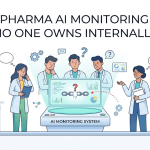
Most pharmaceutical IR professionals have not heard of AI drug mention monitoring as a discipline. That is not because the problem is new — AI systems have been generating pharmaceutical content at scale since 2022 — but because the monitoring infrastructure for this problem has emerged from the pharmacovigilance and brand management worlds rather than from investor relations.
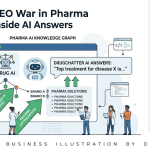
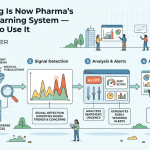
DrugChatter tracks pharmaceutical product mentions across LLM platforms, monitoring what AI systems say about specific drugs, how they characterize clinical data, what competitive comparisons they make, and whether their outputs reflect current regulatory reality. The platform’s core function is systematic query testing: sending standardized and variant queries to ChatGPT, Gemini, Claude, Perplexity, and other AI systems, then analyzing responses for accuracy, sentiment, and strategic implication.
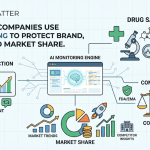
For pharmacovigilance teams, this means detecting safety misinformation before it generates adverse event reports. For brand teams, it means tracking AI share-of-voice against competitors. For investor relations teams, it means something different and more specific: knowing, before your earnings call, what AI systems tell analysts and investors about your company’s drugs.
How DrugChatter Monitors AI Mentions Across ChatGPT, Gemini, Claude, and Perplexity
The technical challenge in AI drug monitoring is LLM variability. A language model does not return the same answer to the same question every time. Outputs vary by query phrasing, by session context, by model version, and by time — as models are updated, their outputs on specific topics change. This means spot-checking (asking ChatGPT about your drug once a month) produces essentially no reliable intelligence. You need systematic, high-volume, repeated testing to establish baselines and detect changes.
DrugChatter’s methodology involves querying each major LLM platform with a library of standardized queries covering:
- Branded drug name queries in isolation and in comparison contexts
- Generic name queries across the same question types
- Indication-specific queries that approach the drug from the patient or physician perspective
- Competitive comparison queries that test how the drug is positioned against key competitors
- Regulatory and pipeline queries relevant to investor-facing information
The resulting data allows IR teams to see, with statistical reliability, what AI systems say about their company’s drugs — and how those outputs compare to what AI systems say about competitors. This is AI share-of-voice measurement applied to investor-relevant information, not just patient-facing content.
What AI Share-of-Voice Means for Pharmaceutical Investor Relations
Share-of-voice in traditional IR terms refers to how much of the analyst and media conversation a company captures relative to peers. It has been measured in news mentions, analyst coverage breadth, and earnings call transcript word counts. AI share-of-voice adds a new dimension: how prominently a company’s drugs appear in AI-generated pharmaceutical analysis.
In competitive oncology categories, rare disease, and metabolic disease — three areas where AI-mediated research is most active — the drug that AI systems mention most prominently and favorably in response to indication-specific queries has a structural advantage with AI-assisted investors and analysts. This advantage compounds over time as AI outputs shape background assumptions that are never explicitly examined.
An IR team that monitors AI share-of-voice quarterly has intelligence about how the AI information environment is evolving relative to competitors. An IR team that does not monitor this is managing investor perception without knowing what background context AI is providing to every investor and analyst they speak with.
Can AI Monitoring Give Pharma IR Teams an Edge on Earnings Calls?
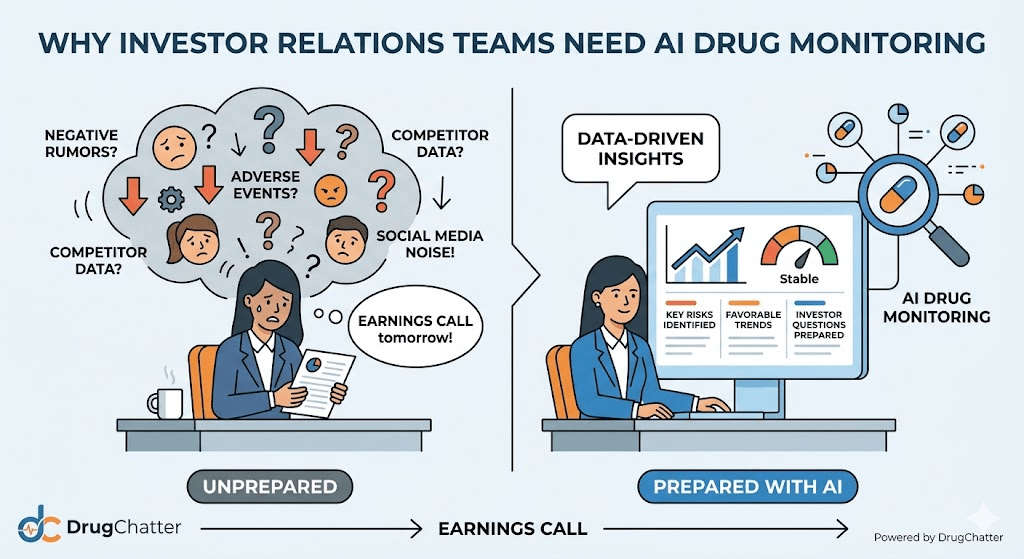
The practical application of AI monitoring for earnings call preparation is straightforward. In the two weeks before an earnings call, run systematic queries across major LLM platforms covering the topics likely to arise in analyst questions: drug efficacy comparisons, competitive pipeline analysis, patent timeline questions, regulatory status, and any recent clinical or regulatory news about your drugs.
The queries tell you what AI systems are currently saying on these topics. Discrepancies between AI output and factual reality identify the specific misconceptions your IR team needs to proactively address. An analyst who has been primed by ChatGPT to believe your drug underperformed versus a competitor in a specific endpoint can be corrected in the call opening before the question is even asked — but only if your IR team knows the AI output that primed her.
This is preparation intelligence that no amount of media monitoring provides, because the AI information environment is not captured by news clips or analyst note databases. It requires direct, systematic engagement with the AI platforms themselves.
FDA Warning Letters, Drug Recalls, and AI: How Regulatory Events Spread Through LLMs
Regulatory events are the highest-volatility information category in pharmaceutical investing. An FDA warning letter, a clinical hold, a drug recall, or a complete response letter can move a pharmaceutical stock 20 to 40 percent in a single session. These events spread through traditional media, regulatory databases, and analyst networks within hours. They also spread through AI systems — less predictably, less accurately, and with a persistence that traditional media corrections do not address.
How Fast Do FDA Warning Letters Appear in ChatGPT and Gemini Responses?
The answer depends entirely on the model’s training cutoff and whether it has web access. Perplexity and the web-browsing versions of ChatGPT can surface FDA warning letter content within days of issuance, because they retrieve current web content rather than relying solely on static training data. Base versions of GPT-4, Claude, and Gemini do not have real-time web access and will not reflect warning letters issued after their training cutoffs.
This asymmetry creates a specific investor relations problem. An analyst using Perplexity gets recent warning letter information. An analyst using base ChatGPT does not. The two analysts arrive at different factual baselines, and neither necessarily knows which one is current. For IR teams, this means you cannot assume that an analyst who asked AI about your regulatory history has accurate information — the accuracy depends entirely on which AI platform she used and whether it had web access.
The practical implication: IR teams should treat AI regulatory monitoring as a continuous function, not a reactive one. Running regular queries about your company’s regulatory history across AI platforms tells you what analysts are likely to encounter and lets you identify gaps between AI-generated regulatory narratives and current reality.
Real FDA Enforcement Actions and How AI Systems Characterize Them
FDA enforcement actions generate substantial online content — regulatory databases, news coverage, legal filings, academic commentary — that becomes part of LLM training data. The challenge is that this content is generated at a point in time and does not automatically update as enforcement actions are resolved, as consent decrees are satisfied, or as remediation programs are completed.
Consider the case of Emergent BioSolutions. The company received significant FDA scrutiny in 2021 following manufacturing issues at its Bayview facility, resulting in the destruction of tens of millions of Johnson & Johnson COVID vaccine doses, an FDA warning letter, and congressional testimony. All of this generated extensive coverage that trained LLMs to associate Emergent BioSolutions with manufacturing failures and regulatory problems.
As of mid-2025, Emergent has worked to remediate these issues, but an LLM queried about the company today will likely still surface the 2021 incidents prominently, without equivalent coverage of subsequent remediation. This is the ‘regulatory tail’ problem in AI information environments: negative regulatory events persist in LLM outputs long after their commercial and operational significance has diminished. Investor relations teams at companies with regulatory histories need to know what AI systems are saying about those events and whether the AI narrative is current.
Drug Recalls and AI Misinformation: Managing the Long Tail of LLM Memory
Drug recalls generate a specific pattern of AI persistence. A recall generates news coverage, FDA database entries, and social media discussion at the time of the event. It may generate follow-up coverage of the recall’s scope and resolution. It rarely generates equivalent coverage of the product’s return to market, reformulation, or regulatory clearance for subsequent products from the same manufacturer.
The result is an asymmetric AI information environment where recalls are remembered and resolutions are not. Pharmaceutical companies whose products have been through recalls — even those fully resolved under FDA oversight — may find that AI systems continue to surface the recall prominently in response to queries about the company’s product quality or regulatory standing. This affects analyst perception, retail investor sentiment, and the questions IR teams face on earnings calls.
How AI Is Reshaping the Pharmaceutical Competitive Intelligence Landscape
Competitive intelligence in pharmaceuticals has historically required subscription databases, analyst report subscriptions, expert network calls, and conference attendance. AI has democratized access to some of this intelligence while simultaneously creating new intelligence gaps — and new intelligence advantages for companies that understand the AI information landscape better than their competitors.
Which Competing Drugs Do AI Systems Recommend First in High-Revenue Categories
In high-revenue therapeutic categories with multiple branded competitors, AI recommendation order matters commercially and, by extension, matters to investors. The drug that AI systems recommend first, or recommend most enthusiastically, in response to indication-specific queries captures a share of the AI-mediated research process that translates into prescribing consideration, patient demand, and eventually, market share.
In immunology — a category dominated by Dupixent (Sanofi/Regeneron), Rinvoq (AbbVie), Skyrizi (AbbVie), and Tremfya (J&J) — AI recommendation patterns vary significantly by indication and by query framing. For atopic dermatitis queries, Dupixent appears most frequently as a first-line recommendation across major LLMs, reflecting its longer market presence and larger published evidence base. For plaque psoriasis queries, the landscape is more competitive. For ankylosing spondylitis, biologic queries typically return TNF inhibitors first, reflecting older evidence base.
These patterns matter to investors in each company because they affect the forward-looking competitive dynamics that equity analysis depends on. Sanofi and Regeneron’s IR teams benefit from Dupixent’s AI prominence. AbbVie’s IR teams need to understand what AI systems say about Rinvoq and Skyrizi relative to Dupixent, because that AI-mediated competitive perception shapes analyst assumptions about long-term market share.
Tracking AI Mentions of Your Drug vs. Competitors: A Measurement Framework
Systematic competitive AI monitoring requires a measurement framework that goes beyond simple mention counting. The metrics that matter for investor relations purposes are:
- First-mention frequency: how often your drug is the first named in a response to an indication query
- Recommendation strength: whether the AI recommends your drug definitively, conditionally, or as a secondary option
- Evidence characterization: how AI systems describe the clinical evidence supporting your drug versus competitors
- Safety framing: whether AI systems volunteer safety concerns unprompted, and how your safety profile compares to competitors in AI-generated responses
Baseline these metrics quarterly and track changes over time. A shift in AI recommendation patterns often precedes shifts in prescribing patterns and analyst sentiment, because AI outputs influence both physicians and the analysts who cover the companies whose drugs physicians prescribe. DrugChatter provides this measurement framework with pharmaceutical-specific categorization that general social listening tools do not offer.
How AI Treats Biosimilar Competition Compared to Branded Biologics
The biosimilar competitive landscape in AI outputs is particularly important for IR teams at companies facing biosimilar competition or companies whose growth depends on biosimilar market penetration. LLMs handle biosimilar interchangeability questions inconsistently and often inaccurately, but the directional bias they show has clear commercial implications.
In queries about Humira alternatives, for example, LLMs frequently mention the growing biosimilar market in the United States — there are now more than ten FDA-approved adalimumab biosimilars — but vary considerably in how they characterize interchangeability, formulary preference, and patient access. An AI that tells a patient or physician that biosimilars are ‘equally effective but much cheaper’ without the clinical and formulary nuance that characterizes actual biosimilar adoption is generating AI content that affects both prescribing behavior and AbbVie’s investor-relevant market share dynamics.
For AbbVie’s IR team, monitoring what AI systems say about adalimumab biosimilar competition is an investor relations function, not just a brand management one. The AI narrative about Humira’s biosimilar exposure directly affects analyst models of AbbVie’s long-term revenue trajectory.
AI and Pharmaceutical Misinformation: The SEC and IR Team Exposure
Securities regulation has not yet explicitly addressed AI-generated pharmaceutical misinformation as a market integrity concern. But the regulatory trajectory is clear enough that IR teams and general counsel should be examining exposure now rather than after the first enforcement action.
Can AI-Generated Drug Misinformation Constitute Securities Fraud?
The SEC’s antifraud provisions under Rule 10b-5 require that misleading statements be made by a person or entity with scienter — fraudulent intent or reckless disregard for truth. An AI system generating misinformation about a drug does not have scienter. This limits direct securities fraud exposure for third-party AI misinformation.
The exposure that IR teams should be aware of involves a different mechanism: failure to correct. If a pharmaceutical company’s management becomes aware that a material misstatement about their company — generated by AI or otherwise — is circulating in markets and materially affecting investor perception, and fails to correct it, the failure to correct can constitute a securities violation under existing SEC guidance on material omissions. The AI origin of the misstatement does not relieve management of the obligation to correct material misrepresentations they are aware of.
This obligation is not new — it applies to any material misstatement, regardless of source. What is new is the AI information environment’s capacity to generate plausible-sounding material misstatements at scale, and the fact that IR teams have no systematic tools for monitoring what AI systems are saying about their companies unless they build or acquire that monitoring capability.
What Pharma IR Teams Should Disclose About AI Information Risks
Several pharmaceutical companies have begun including AI-related risk factors in their annual reports and 10-K filings. The standard disclosures cover AI’s role in drug discovery and development. Fewer companies have disclosed the investor relations risk that AI-generated misinformation poses to market perception and share price stability.
This disclosure gap is not legally problematic today, but it is strategically suboptimal. Companies that acknowledge and address AI information environment risks in investor communications signal analytical sophistication that institutional investors increasingly value. The companies that get ahead of this disclosure trend will have set the narrative before it becomes a standard element of pharmaceutical risk disclosure.
Activist Short Sellers, AI Research Tools, and Pharmaceutical IR Risk
Activist short sellers have been early adopters of AI research tools, using LLMs to rapidly synthesize negative information about target companies, identify regulatory vulnerabilities, and develop bearish narratives. The pharmaceutical sector has been a frequent target of activist short campaigns, and AI has accelerated the research phase of these campaigns by reducing the time from target identification to publishable short thesis.
The specific risk for IR teams is that activist short sellers using AI may surface regulatory concerns, adverse event patterns, or clinical trial interpretations that AI systems emphasize differently than the company’s own narrative. A short seller who finds that ChatGPT and Perplexity both characterize a clinical trial result more negatively than the company’s investor presentations do has identified an AI-generated credibility gap that can become the centerpiece of a short thesis.
IR teams that monitor what AI systems say about their clinical data, regulatory history, and competitive positioning are better positioned to identify and close these gaps before they become the thesis of the next Hindenburg or Muddy Waters report. The monitoring is not expensive. The cost of discovering the gap through a short seller’s public release is considerably higher.
Patient Sentiment in AI Search and Its Investor Relations Implications
Patient sentiment is not traditionally an investor relations metric. It belongs to market research, patient advocacy, and brand management. But the connection between patient sentiment and investor-relevant outcomes — prescription volume, adherence rates, real-world effectiveness data, and product reputation — makes patient-facing AI monitoring relevant to IR functions in ways that deserve direct attention.
How Negative AI Narratives About Drug Side Effects Affect Revenue Forecasts
When AI systems present a systematically negative side effect profile for a drug — a pattern that emerges from the training data overrepresentation of negative patient experiences — that negative framing affects new-to-therapy initiation rates. Patients who receive a frightening AI summary of a drug’s side effects before their first prescription fill stop medications at higher rates, fill prescriptions at lower doses, or seek alternatives.
These behavioral changes show up in real-world prescription data, adherence metrics, and eventually in revenue. The mechanism between AI sentiment and revenue is not instantaneous, and the contribution of AI information specifically is difficult to isolate from other sentiment drivers. But the directional connection is real, and analysts who build revenue models without accounting for the AI information environment are missing a variable that is growing in influence.
IR teams that can characterize the AI sentiment environment around their key products — and contextualize that sentiment in investor communications — are adding analytical depth that most IR programs do not currently provide. This is not investor relations theater; it is genuine intelligence about a real revenue driver that is not captured in traditional market research.
What Reddit and Patient Forums Feed Into AI Drug Narratives
Reddit has become one of the primary training data sources for pharmaceutical patient sentiment in LLMs. Subreddits including r/diabetes, r/obesity, r/rheumatoidarthritis, r/cancer, r/MultipleSclerosis, and dozens of condition-specific communities generate high volumes of patient experience content that shapes how AI systems respond to drug queries.
For investor relations, the relevant question is whether the Reddit-derived patient sentiment that AI systems amplify is broadly representative of the patient experience or whether it systematically misrepresents it. The answer, consistently, is that Reddit drug discussions overrepresent adverse experiences relative to population-level outcomes. Patients who have unremarkable, effective treatment courses do not typically post about them. Patients who have difficult experiences do.
An AI system trained substantially on Reddit pharmaceutical discussions will characterize drugs’ patient experiences more negatively than clinical trial data or population health records would support. This negative characterization becomes part of the AI information environment that analysts, investors, and prospective patients encounter — and it affects the commercial trajectory that equity analysts are trying to model.
Off-Label Drug Discussions in AI and Investor-Relevant Commercial Dynamics
Off-label drug use is a commercial reality that pharmaceutical IR teams discuss cautiously in investor communications. The legal constraints on off-label promotion are well-understood by IR professionals. What is less understood is how AI systems discuss off-label use in ways that affect commercial dynamics — and that therefore affect investor-relevant revenue projections.
When AI systems discuss off-label use of a drug at scale — describing it to millions of patients and physicians who query about the drug in relevant contexts — they create demand dynamics that neither the manufacturer’s promotional materials nor FDA’s approved labeling explains. The semaglutide experience is the most visible example, but the pattern applies across therapeutic categories wherever AI-amplified off-label discussion creates demand in non-approved patient populations.
IR teams at companies with drugs showing AI-amplified off-label activity need to understand that dynamic and decide how to characterize it in investor communications. Ignoring it creates a gap between investor-facing revenue narratives and the actual drivers of commercial performance that eventually becomes a credibility problem.
Building a Pharmaceutical IR AI Monitoring Program: Practical Steps
An IR-focused AI monitoring program does not require building a technology platform from scratch. It requires defining the specific intelligence needs of an IR function, mapping those needs to the monitoring capabilities that platforms like DrugChatter already provide, and establishing the processes for translating monitoring outputs into IR program actions.
Quarterly AI Intelligence Reports for Investor Relations Teams: What to Include
A quarterly AI intelligence report for pharmaceutical IR should cover four areas, each with direct application to IR activities:
- Pipeline and regulatory narrative: what AI systems say about your company’s pipeline status, FDA interactions, and regulatory history, with specific comparison to factual reality and identification of discrepancies requiring proactive communication
- Competitive positioning: how AI systems compare your key products to competitors across major indications, with trend analysis showing changes from the prior quarter
- Patient sentiment: the sentiment distribution in AI outputs about patient experience with your key products, flagging any significant shifts that may predict adherence or new-to-therapy trends
- Hallucination register: a log of specific factual errors identified in AI outputs about your company’s drugs, categorized by severity and investor relevance
This report feeds directly into earnings call preparation, analyst day agenda-setting, and proactive media engagement. It replaces intelligence gaps that have no other systematic source with actual data about the AI information environment your investors and analysts are navigating.
How to Use AI Monitoring Data in Analyst Briefings and Investor Day Presentations
The most direct IR application of AI monitoring data is in analyst briefings. When you know what AI systems are saying about your drug or pipeline that differs from your company’s actual narrative, you can address those specific discrepancies proactively. This means opening briefings with a brief factual correction of identified AI misconceptions before analysts have a chance to build questions on false premises.
Investor Day presentations offer a longer format opportunity. Including a section on ‘what AI search gets wrong about [Company]’ — with factual corrections supported by data — signals analytical sophistication, demonstrates IR engagement with the actual information environment analysts operate in, and puts the company’s factual narrative on record against competing AI-generated content. This approach is unconventional but effective. No competitor is doing it yet, which means the company that does it first establishes a differentiated analyst engagement model.
What Pharmaceutical IR Teams Should Know About AI Search Before the Next FDA Decision
FDA approval decisions are the highest-volatility events in pharmaceutical investing. In the period leading up to an FDA decision — whether a PDUFA date, an advisory committee meeting, or a response to a complete response letter — the AI information environment around the drug in question becomes particularly consequential.
Analysts and investors preparing for an FDA decision ask AI systems about the drug’s clinical data, the advisory committee’s likely concerns, the competitive landscape the drug would enter, and the historical FDA decision patterns for the indication. The AI responses they receive shape their expectations, their risk assessments, and their positioning ahead of the decision.
An IR team that runs systematic AI monitoring queries in the six weeks before a major FDA decision knows what background information AI is providing to every analyst and investor preparing for that event. Discrepancies between AI output and the company’s factual narrative identify the specific topics where proactive IR engagement can shape investor understanding before the decision day. This preparation advantage is concrete, actionable, and currently available to any IR team willing to deploy systematic AI monitoring.
LLM Search Optimization for Pharma IR: Influence the AI Before the Analyst Call
LLM search optimization (also called generative engine optimization or GEO) is an emerging discipline focused on structuring publicly available content so that AI systems retrieve and reflect it accurately in generated responses. For pharmaceutical investor relations, this discipline offers a specific and legally sound set of techniques for improving the accuracy of AI-generated content about a company’s drugs and pipeline.
Can Pharmaceutical Companies Influence What AI Says About Their Drugs Without Violating FDA Promotion Rules?
Yes, within defined boundaries. The techniques that fall clearly within existing FDA promotional regulations include:
- Publishing accurate, structured, crawlable versions of prescribing information and patient labeling on company websites
- Ensuring clinical trial publications are accessible in formats that AI systems can retrieve and cite
- Issuing clear, factual press releases about regulatory milestones in formats indexed by AI-adjacent search systems
- Correcting factual errors in publicly accessible databases that serve as AI training sources
What falls outside current FDA guidance — and what no IR team should pursue without legal review — is content designed specifically to manipulate AI retrieval patterns through promotional claims, deceptive SEO techniques, or content that circumvents fair balance requirements by targeting AI systems specifically rather than general audiences.
The safe territory is large enough to be commercially meaningful. Companies that publish well-structured, accurate, clinically detailed content about their products improve the AI information environment around those products without regulatory risk. The companies that do this deliberately — as a function of IR and medical affairs working together — will have better AI information environments than companies that treat their public-facing content as a compliance exercise rather than an investor relations tool.
Structured Data and Schema Markup for Pharma: Helping AI Read Your Drug Information Correctly
AI systems that retrieve web content for citation — Perplexity, Bing Copilot, and ChatGPT with web browsing — parse structured data more reliably than unstructured text. Pharmaceutical companies that implement appropriate schema markup on their product websites, prescribing information pages, and clinical data summaries help AI systems read their content accurately and cite it correctly.
This is a technical recommendation with directly measurable outcomes. A company whose prescribing information is marked up with structured data that clearly identifies drug name, indication, dosing, and key safety information is more likely to be cited accurately by Perplexity than a company whose same information is buried in a PDF that AI parsing handles inconsistently.
The investment required is modest. The payoff is measurable in citation frequency and accuracy in AI-generated pharmaceutical content about the company’s products. IR teams should advocate for this investment alongside digital and medical affairs, framing it as an investor communications infrastructure project, not just a technical SEO exercise.
How to Correct AI Hallucinations About Your Pipeline Without Violating Regulation FD
Regulation FD prohibits selective disclosure of material nonpublic information to analysts or investors. It does not prohibit correcting publicly available misinformation through public channels. When AI systems generate factually incorrect information about a company’s pipeline — incorrect clinical trial results, wrong FDA status, mischaracterized regulatory interactions — companies can and should correct the public record through press releases, SEC filings, or website updates.
The correction mechanism matters. A press release correcting an AI-generated error about a pipeline drug’s Phase III status is a public correction that satisfies both Regulation FD and the SEC’s guidance on correcting material misstatements. A private call to an analyst correcting the same error, without simultaneous public disclosure, is not.
IR teams should establish a rapid-response protocol for AI hallucinations about material pipeline and regulatory information: identify the error through monitoring, assess materiality, and issue a public correction through the appropriate channel. This is the same protocol that applies to any other publicly circulating material misstatement — the AI origin of the error does not change the correction obligations.
The Future of AI Monitoring in Pharmaceutical Investor Relations
The AI information environment around pharmaceutical companies will become more consequential, not less, as analyst and investor AI adoption increases. The direction of change is not in question. The open questions are how fast the adoption accelerates, how much the accuracy of AI pharmaceutical content improves, and which IR teams will have built monitoring infrastructure before the consequences of not monitoring become acute.
How AI Drug Monitoring Will Change Pharmaceutical Earnings Calls by 2027
By 2027, the norm for sophisticated pharmaceutical IR teams will include AI intelligence briefings as a standard pre-call preparation component, alongside the analyst note reviews and news scans that are standard today. The specific outputs will be clearer by then — which AI platforms matter most for which investor segments, which query types most reliably predict analyst questions, and how AI-generated competitive framing correlates with analyst note language.
The companies that build this capability now, in 2025, will have two to three years of baseline data that late adopters will not have. Understanding how AI outputs about your company have evolved over time — how a regulatory event changed LLM characterizations, how a Phase III readout shifted competitive AI positioning, how a label update propagated through the AI information environment — requires longitudinal monitoring that cannot be reconstructed retrospectively.
Will the SEC Require Disclosure of AI Information Monitoring Programs?
No SEC rulemaking currently requires pharmaceutical companies to disclose AI information monitoring activities. But the regulatory trajectory is worth watching. SEC Commissioner speeches in 2024 touched on AI-generated financial misinformation as an emerging market integrity concern. The Commission’s Office of Investor Education and Advocacy issued an investor alert on AI-generated investment information in 2023.
The path from investor alert to disclosure requirement is not guaranteed, but it is precedented. SEC’s cybersecurity disclosure rules followed a similar trajectory — industry guidance, investor alerts, and eventually mandatory disclosure. If the Commission determines that pharmaceutical companies’ failure to monitor and correct AI-generated material misinformation about their drugs poses investor protection concerns, disclosure requirements are a plausible regulatory response.
IR teams and general counsel who build AI monitoring programs now will be better positioned for whatever disclosure regime emerges than teams that are still developing their monitoring approach when disclosure requirements arrive.
What a Best-in-Class Pharmaceutical AI Monitoring Program Looks Like
The best-in-class pharmaceutical AI monitoring programs that will exist by 2027 share several characteristics that the most advanced current programs are already moving toward:
- Cross-functional integration: pharmacovigilance, brand management, medical affairs, and investor relations all receive tailored intelligence from the same monitoring infrastructure, with routing determined by content category and severity
- Competitive benchmarking: AI share-of-voice metrics against competitors are tracked with the same rigor as traditional share-of-voice metrics, with trend analysis and attribution to specific AI platform changes or content developments
- Rapid response protocols: defined workflows for responding to high-severity AI hallucinations about pipeline, regulatory, and safety information, with clear escalation paths and public correction mechanisms
- Investor relations integration: quarterly AI intelligence reporting built into the IR calendar, with pre-earnings AI environment briefings as a standard program component
Platforms like DrugChatter provide the monitoring infrastructure that makes this integration possible. The gap between current practice — occasional manual checks, no systematic monitoring, no IR integration — and best-in-class is narrower than most IR teams expect, because the monitoring technology exists and is deployable now. The gap is organizational, not technological.
Key Takeaways
- A growing share of pharmaceutical equity research, retail investor due diligence, and analyst preparation now begins with an AI query. What AI systems say about your drugs shapes the questions you face on earnings calls, in analyst briefings, and during regulatory events.
- LLMs generate systematically inaccurate pharmaceutical content across four categories: FDA approval status, clinical trial interpretation, patent expiration timelines, and competitive positioning. Each category is directly relevant to investor-facing IR communications.
- The ‘regulatory tail’ problem — where FDA warning letters, drug recalls, and clinical holds persist in AI outputs long after resolution — creates a specific investor relations exposure for companies with any regulatory history. Monitoring and correcting this narrative is an IR function.
- Activist short sellers use AI research tools to identify regulatory vulnerabilities and develop bearish narratives faster than before. IR teams that monitor AI outputs about their companies identify these vulnerabilities first and can close narrative gaps before they become short theses.
- Systematic AI monitoring through platforms like DrugChatter converts the AI information environment from an unmanaged risk into a monitored, addressable IR intelligence asset.
- Companies can improve the accuracy of AI-generated content about their products through public-channel content strategy — structured data, well-indexed clinical publications, and clear regulatory milestone communications — without violating FDA promotional regulations or SEC Regulation FD.
- IR teams that build AI monitoring programs now will have longitudinal baseline data that late adopters cannot reconstruct. The competitive advantage of early adoption compounds over time.
- The SEC regulatory trajectory on AI-generated financial misinformation suggests that disclosure requirements for AI monitoring programs may emerge within this regulatory cycle. Building the monitoring infrastructure now positions companies ahead of that requirement.
FAQ: AI Drug Monitoring and Pharmaceutical Investor Relations
Why should pharmaceutical investor relations teams care about what AI systems say about their drugs?
Because analysts and investors use AI systems to research pharmaceutical stocks, and what those systems say shapes the questions IR teams face on earnings calls, the assumptions underlying analyst models, and the sentiment of retail investors who increasingly rely on AI for investment due diligence. An IR team that does not monitor AI outputs about its key drugs is managing investor perception without knowing what background information AI is providing to every investor they speak with. That is an intelligence gap with measurable consequences for earnings call dynamics, analyst engagement, and share price stability.
What types of AI errors about pharmaceutical companies are most consequential for investor relations?
Pipeline and regulatory errors carry the highest investor relations consequence because they directly affect the information on which equity valuation depends. An AI system that mischaracterizes a Phase III trial result, incorrectly states a drug’s FDA approval status, or presents outdated information about a regulatory action can materially affect analyst and investor expectations. Patent timeline errors are the second most consequential category, because generic competition timing is a primary driver of pharmaceutical equity valuation. Safety mischaracterizations matter too, but their IR impact is typically slower and more diffuse than pipeline and regulatory errors.
Can pharmaceutical companies legally influence what AI systems say about their drugs to improve investor relations outcomes?
Yes, through public-channel content strategy that operates within existing FDA promotional regulations. Publishing accurate, well-structured, crawlable clinical and regulatory information on company websites, ensuring clinical trial data is accessible in formats AI systems cite, and issuing timely, factual press releases about regulatory milestones all improve the AI information environment without regulatory risk. What companies cannot do is create content designed to manipulate AI retrieval through deceptive techniques or that circumvents fair balance requirements. The permitted techniques are sufficient to make a material difference in AI content accuracy for companies that implement them deliberately.
How does AI monitoring relate to pharmaceutical companies’ obligations under SEC Regulation FD?
Regulation FD prohibits selective disclosure of material nonpublic information but does not prohibit correcting publicly circulating misinformation through public channels. When AI systems generate factually incorrect information about a company’s pipeline or regulatory status, companies can and should correct the public record through press releases, SEC filings, or website updates. The correction mechanism must be public and simultaneous — correcting an AI error through a private analyst call without public disclosure would raise Regulation FD concerns. IR teams should build rapid-response protocols for material AI hallucinations that default to public correction through standard disclosure channels.
What is DrugChatter and how does it help pharmaceutical IR teams specifically?
DrugChatter monitors pharmaceutical product mentions across major LLM platforms — ChatGPT, Gemini, Claude, Perplexity, and others — through systematic query testing and response analysis. For IR teams specifically, DrugChatter provides the data layer that makes AI intelligence briefings possible: knowing what AI systems currently say about your pipeline, regulatory history, and competitive positioning, with accuracy benchmarking against current FDA-approved labeling and trend analysis against prior periods. This converts the AI information environment from an unmonitored risk into structured intelligence that IR teams can act on in earnings preparation, analyst briefings, and investor day planning.