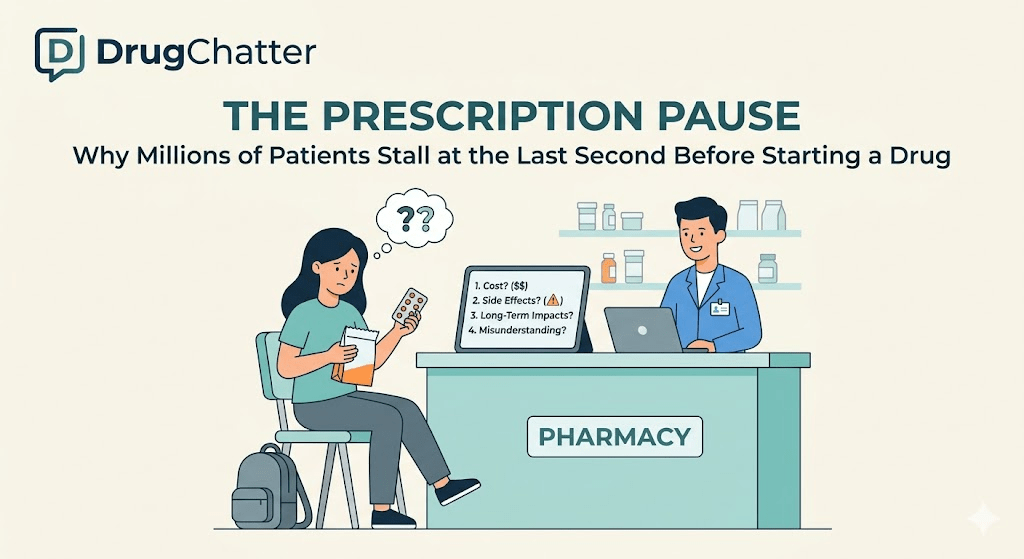
There’s a moment that happens between the prescription and the first dose that pharmaceutical companies rarely talk about.
Not non-adherence. Not persistence. Earlier than that.
The pause.
It’s the five minutes after someone Googles: “Can Ozempic cause stomach pain?” Or: “Does Lipitor damage the liver?” Or the more existential version: “Are there cases where Yervoy’s side effects caused death?”
That moment is where conversion friction lives.
And judging from the volume and texture of questions on DrugChatter, pre-treatment anxiety may be one of the biggest hidden forces shaping modern drug utilization.
Not because patients are irrational. Quite the opposite. They’re trying to perform due diligence on molecules powerful enough to alter metabolism, immunity, neurotransmitters, fertility, inflammation, or cardiovascular risk.
The striking thing is what they worry about.
Not efficacy, usually. Not even cost, at first.
They worry about unintended consequences.
Patients Rarely Ask “Will This Work?”
They Ask: “What Else Will It Do To Me?”
Look at the emotional pattern behind these searches:
Notice the specificity. These are not abstract safety concerns. These are “what will Tuesday afternoon feel like?” questions.
The GLP-1 category has become a masterclass in conversion friction because the drugs are simultaneously highly effective and highly experiential. Patients expect side effects before they ever inject the first dose.
And once one symptom enters the cultural bloodstream — sulfur burps, nausea, constipation, fatigue — it propagates through Reddit, TikTok, physician waiting rooms, and search engines at extraordinary speed.
The result is a new kind of pharmacovigilance: decentralized and emotionally amplified.
Oncology Questions Reveal a Different Kind of Fear
In oncology, the anxiety sharpens considerably.
Nobody asks whether Yervoy is “worth trying” in the abstract. They ask:
“Are there cases where Yervoy’s side effects caused death?” Answer
“How does prior chemo affect Yervoy’s toxicity?” Answer
“Are skin tests available for Keytruda allergies?” Answer
“Can immunotherapy increase lurbinectedin’s side effects?” Answer
These are not curiosity searches. These are consent searches.
Patients are trying to understand the boundaries of acceptable risk before therapy begins. In many cases, they’re attempting to reconcile two contradictory realities simultaneously:
The drug may extend survival.
The drug may seriously damage normal physiology.
Immuno-oncology especially produces this cognitive tension because the mechanisms themselves sound alarming even when clinically beneficial: unleashing T-cells, immune activation, inflammatory toxicity.
The modern cancer patient is not merely being treated. They are being recruited into an extraordinarily complex risk-benefit calculation.
The Statin Internet Never Sleeps
Then there is the statin ecosystem, which may be the internet’s most persistent low-grade anxiety machine.
Questions involving Lipitor cluster around a recurring fear structure:
liver damage
muscle pain
food interactions
alcohol
supplements
grapefruit
fatigue
Examples:
“Can liver damage from Lipitor be reversed?” Answer
“What liver tests indicate Lipitor related side effects?” Answer
“Is muscle fatigue a common Lipitor side effect?” Answer
“What are the side effects of mixing grapefruit and Lipitor?” Answer
This category is fascinating because statins are old, common, and clinically normalized. Yet the anxiety remains extraordinarily durable.
Why?
Because statins are long-term identity drugs. Starting one feels less like taking an antibiotic and more like crossing a line into chronic patienthood.
People don’t just ask, “Will this lower cholesterol?” They ask, implicitly: “What kind of person will I become while taking this every day for the next twenty years?”
Drug Interactions Are the Ultimate Friction Generator
One of the clearest themes across DrugChatter queries is interaction anxiety.
Patients increasingly view themselves as biochemical ecosystems rather than isolated prescriptions.
“Do I need to space out Cosentyx and vaccine administrations?” Answer
“Can vaccination side effects worsen on Cosentyx?” Answer
These questions likely barely existed at scale before 2020.
Now they represent an enduring shift in patient cognition: immunology has gone mainstream.
People no longer think of the immune system as a black box. They think of it as a tunable system that drugs may suppress, redirect, amplify, or destabilize.
That awareness increases engagement — but it also increases hesitation.
Assistance Programs Reduce Cost Friction. They Don’t Eliminate Psychological Friction.
An underappreciated theme in the dataset is that affordability questions often coexist with safety anxiety.
For example:
“What percentage discount is offered for Yervoy?” Answer