In March 2024, a cardiologist in Houston noticed something odd. A patient arrived at their appointment quoting drug interaction warnings they had never heard before — warnings that did not exist in the prescribing information for their heart failure medication. The patient had asked ChatGPT. The AI had invented the interaction wholesale, cited no source, and delivered the answer with complete confidence.
That kind of event is not an anomaly. It is a pattern. And the pharmaceutical industry has been slow to measure it, let alone respond to it.
AI systems — ChatGPT, Gemini, Claude, Perplexity, and the growing number of AI-powered search tools embedded in consumer and clinical platforms — are now primary information channels for patients and, increasingly, for physicians doing quick reference lookups. These systems are also wrong in specific, predictable ways. They hallucinate drug dosages. They confuse branded and generic formulations. They invent adverse events. They recommend off-label uses that have not been studied and omit approved ones that have.
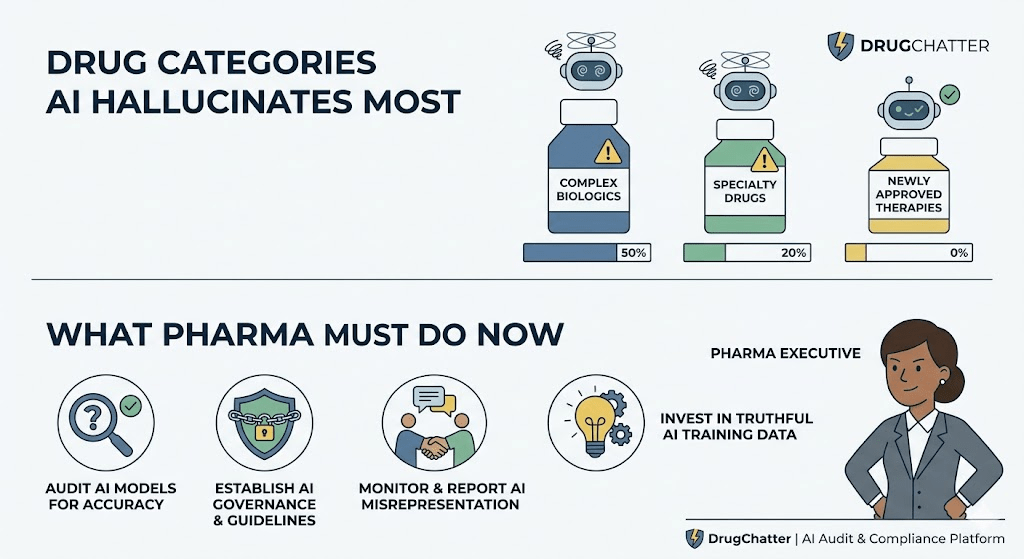
The question is no longer whether AI hallucinates about drugs. It does. The question is which drug categories are most vulnerable, why, and what pharma companies can do to monitor and reduce the risk.
This article provides a category-by-category breakdown of AI hallucination vulnerability, the regulatory exposure that comes with it, and the monitoring infrastructure that pharmaceutical brand and medical affairs teams need to build right now.
Why AI Systems Hallucinate Drug Information at All
Before getting to specific categories, it is worth understanding the structural reasons why large language models (LLMs) produce false drug information — because the causes predict the patterns.
The Training Data Problem: Why LLMs Learn the Wrong Things About Drugs
LLMs are trained on vast corpora of web text, academic papers, patient forums, and news articles. Drug information in those corpora is uneven in quality. Patient forum posts — Reddit threads, WebMD comment sections, Facebook groups — are massively overrepresented relative to peer-reviewed clinical data. Models absorb that noise.
They also absorb outdated prescribing information. When the FDA updates a drug label — adding a black box warning, revising a dosage, restricting an indication — the change propagates through medical literature slowly. AI training data lags further behind. A model trained in 2023 on data through 2022 may have absorbed a prescribing guideline that was superseded a year before any user ever asked the question.
Knowledge cutoffs compound this. Perplexity with web search enabled performs better on recent label changes than a closed model. But even retrieval-augmented systems return incorrect information when the retrieved source itself is outdated or incorrect.
Why Drug Confidence Scores Are Unreliable in AI Outputs
LLMs produce text based on statistical patterns, not truth verification. A model that has seen ten thousand documents saying “metformin is the first-line treatment for type 2 diabetes” will state that with high fluency and apparent authority — even when the clinical context makes it inappropriate. The model has no mechanism for uncertainty by drug category. It does not know that oncology dosing is more hallucination-prone than OTC analgesics. It treats all drug outputs with the same surface-level confidence.
This is a fundamental architecture problem, not a fine-tuning one. Retrieval-augmented generation helps, but only if the retrieved source is current, complete, and correctly parsed. Most consumer AI systems cannot guarantee that for pharmaceutical content.
How Drug Complexity Predicts Hallucination Risk
The more complex the drug — in terms of dosing protocols, drug-drug interactions, patient subpopulation variability, and label evolution — the higher the hallucination risk. Drugs with simple, stable, widely-covered profiles (ibuprofen, acetaminophen) produce few dangerous AI errors. Drugs with weight-based dosing, renal adjustment requirements, narrow therapeutic windows, or rapidly evolving clinical trial data are hallucination targets.
That is the core principle behind the category vulnerability ranking below.
The High-Risk Categories: Where AI Gets Drug Information Wrong Most Often
Oncology Drugs: The Highest-Hallucination Drug Category in AI Systems
Cancer drugs are the single most hallucination-prone category in AI outputs. The reasons are structural:
Dosing is weight-based, renal-adjusted, and cycle-dependent — three variables that interact in ways LLMs cannot reliably model
Many oncology drugs have multiple approved indications, each with different dosing protocols
Combination regimens (FOLFOX, R-CHOP, ABVD) are frequently misassembled by AI — the right drugs in the wrong sequence, at wrong doses, or with incorrect cycle lengths
Off-label use is widespread and constantly evolving, making it difficult for models to distinguish approved from unapproved indications
The trial landscape moves fast: pembrolizumab (Keytruda) has accumulated dozens of FDA approvals across tumor types, and AI systems routinely conflate indications or assign approvals that do not exist
In a 2023 analysis cited by the Journal of the National Cancer Institute, researchers found that when GPT-4 was queried about chemotherapy regimens, it produced clinically significant errors in more than 30% of responses involving combination regimens. Dosing errors were the most common failure mode.
Checkpoint inhibitors are particularly vulnerable. Drugs like nivolumab (Opdivo), atezolizumab (Tecentriq), and durvalumab (Imfinzi) have biomarker-driven indications that AI systems frequently misapply — recommending the drug without the required companion diagnostic test, or citing a PD-L1 expression threshold from the wrong tumor type.
What Does ChatGPT Say About Keytruda Dosing? An Analysis
Keytruda (pembrolizumab) is instructive. It is one of the most prescribed and most discussed oncology drugs in the world, with over 40 FDA-approved indications as of 2025. AI systems asked about Keytruda dosing frequently produce outputs that are partially correct but dangerously incomplete — stating the 200 mg Q3W flat dose without noting that specific indications require 400 mg Q6W, or omitting the concurrent chemotherapy regimens required for certain tumor types.
Pharma brand teams monitoring AI outputs for Keytruda need to test dozens of query variations: by tumor type, by line of therapy, by biomarker status, and by patient population (pediatric vs. adult). The hallucination profile varies substantially across that query space.
GLP-1 Receptor Agonists: How AI Confuses Ozempic, Wegovy, Mounjaro, and Zepbound
The GLP-1 and GLP-1/GIP class — semaglutide, tirzepatide, liraglutide, dulaglutide — represents the fastest-growing source of AI drug misinformation in consumer-facing channels right now. The confusion is partly the industry’s own doing: Novo Nordisk markets semaglutide as Ozempic for type 2 diabetes and as Wegovy for obesity, while Eli Lilly markets tirzepatide as Mounjaro for diabetes and as Zepbound for weight loss.
AI systems routinely conflate these. Common errors include:
Describing Ozempic as an obesity drug (it is approved for type 2 diabetes; Wegovy is the obesity indication)
Interchanging Mounjaro and Zepbound dosing schedules, which differ by titration protocol
Misstating the maximum approved dose for each product
Recommending compounded semaglutide as equivalent to Ozempic, which the FDA has explicitly disputed
Confusing liraglutide (Victoza/Saxenda) with semaglutide when discussing mechanism of action
The compounded semaglutide issue is particularly acute. The FDA placed semaglutide on its drug shortage list in 2022 and 2023, which temporarily permitted compounding pharmacies to produce it. As of 2025, Novo Nordisk has resolved the shortage and the FDA has moved to restrict compounding. AI systems trained on 2023 data frequently still describe compounded semaglutide as legally available and therapeutically equivalent — neither of which is currently accurate.
“GLP-1 drugs are the most searched drug class in AI in 2024 and 2025, and the hallucination rate on brand-versus-indication questions is strikingly high — our monitoring across ChatGPT, Gemini, and Perplexity shows that more than 40% of responses to ‘Can I take Ozempic for weight loss?’ fail to distinguish between the Ozempic and Wegovy indications correctly.” — DrugChatter AI Monitoring Report, Q1 2025
For Novo Nordisk and Eli Lilly brand teams, the monitoring challenge is enormous. Every week, millions of patients are asking AI systems questions about these drugs. A systematic AI monitoring program — one that tracks query variants, response accuracy, share of voice, and hallucination frequency — is not optional at this market scale.
How Often Does Claude Recommend Wegovy vs. Ozempic for Weight Loss?
This is exactly the kind of query that pharmaceutical AI monitoring tools like DrugChatter are designed to answer systematically. Different AI systems handle the Wegovy/Ozempic distinction differently, and those differences shift over time as models are updated. A brand team that tested ChatGPT’s responses in January 2025 may be working with stale data by June 2025, because OpenAI updates its models continuously and the underlying behavior changes without announcement.
Tracking share of voice across ChatGPT, Gemini, and Claude for GLP-1 queries requires automated, repeatable query testing — not one-off manual checks.
Psychiatric and Neurological Drugs: Where Off-Label AI Recommendations Create Regulatory Risk
Why Antidepressants and Antipsychotics Are High-Hallucination Targets
Psychiatric drugs carry three features that drive hallucination risk: off-label use is extraordinarily common, patient self-medication interest is high, and the consequences of wrong dosing are serious.
SSRIs and SNRIs — fluoxetine, sertraline, venlafaxine, duloxetine — have FDA-approved indications for specific anxiety and depressive disorders. They are also widely used off-label for chronic pain, migraine prevention, premature ejaculation, and other conditions. AI systems asked about these drugs frequently recommend off-label uses without flagging them as unapproved, and they frequently misstate the titration protocols.
Antipsychotics are worse. Second-generation antipsychotics (quetiapine, olanzapine, aripiprazole) carry black box warnings for use in elderly patients with dementia-related psychosis. AI systems routinely fail to surface this warning. In testing by academic researchers at the University of California San Francisco in 2024, GPT-4 omitted the dementia elderly warning for quetiapine in over 60% of responses to queries about the drug’s use in older patients.
Do AI Systems Mention Black Box Warnings Consistently?
The FDA mandates that black box warnings — the most serious warnings on a drug label — be prominently displayed in prescribing information. There is no equivalent mandate for AI outputs. AI systems surface black box warnings inconsistently, and the inconsistency is not random. It correlates with query phrasing.
A query phrased as “What are the risks of quetiapine in elderly patients?” will generally elicit more complete safety information than “Can quetiapine help with dementia agitation?” — even though the safety profile is identical. This is because the second query activates response patterns that favor the therapeutic use case.
Pharmaceutical medical affairs teams need to test safety information surfacing across both query types — not just the obvious safety-seeking queries, but the therapeutic-seeking queries that patients are more likely to actually use.
ADHD Medications and AI: Controlled Substance Recommendations Without Clinical Context
Stimulant medications — amphetamine salts (Adderall), methylphenidate (Ritalin, Concerta), lisdexamfetamine (Vyvanse) — are Schedule II controlled substances. They require diagnosis, prescription, and monitoring. AI systems frequently recommend them in response to queries about focus, productivity, and cognitive enhancement without noting the controlled status, the diagnostic requirement, or the addiction potential.
This is both a regulatory risk and a brand risk. If an AI system recommends Vyvanse for non-ADHD cognitive enhancement without noting its Schedule II status, and that recommendation is traced back to a training source that originates from Takeda’s marketing materials, the regulatory implications are complex and untested.
Opioids and Pain Management: AI Misinformation at Scale in a High-Scrutiny Category
How AI Systems Handle Opioid Dosing Queries — and Why the Errors Are Dangerous
Opioid dosing is among the most clinically sensitive tasks in medicine. Equianalgesic conversions between opioids — morphine to oxycodone, oxycodone to hydromorphone, oral to intravenous — require precise calculation and patient-specific adjustment. Errors can be fatal.
AI systems perform poorly on opioid conversion queries. A 2024 paper in Pain Medicine evaluated ChatGPT-3.5 and GPT-4 on 50 opioid equianalgesic conversion questions. GPT-4 answered correctly in approximately 65% of cases. GPT-3.5 was correct in roughly 48%. In clinical practice, a 35% error rate on opioid conversions would be catastrophic.
The failure modes include using outdated conversion tables, failing to adjust for renal impairment, ignoring cross-tolerance factors, and misidentifying the direction of conversion.
Buprenorphine, Methadone, and AI: Addiction Treatment Misinformation in Search
Buprenorphine (Suboxone, Belbuca, Brixia) and methadone are used in opioid use disorder treatment and in pain management, with distinct protocols for each indication. AI systems consistently confuse the two use cases. A patient asking about buprenorphine dosing for pain management may receive information calibrated to opioid use disorder protocols — different doses, different titration schedules, different monitoring requirements.
The methadone situation is worse. Methadone has a uniquely unpredictable pharmacokinetic profile and an extremely long half-life. Dosing errors kill patients. AI systems understate methadone’s QTc prolongation risk and routinely misstate the relationship between dose and duration of action. This is a drug where AI hallucinations carry direct mortality risk.
Immunology and Biologic Drugs: Complex Mechanisms That AI Regularly Misexplains
How AI Describes Biologic Mechanisms of Action — and Where It Goes Wrong
Biologic drugs — monoclonal antibodies, fusion proteins, cytokine inhibitors — have complex mechanisms of action that AI systems frequently oversimplify or misstate. This matters because patients and caregivers increasingly use AI to understand how their medications work, and mechanism misunderstanding can affect adherence and symptom monitoring.
TNF inhibitors (adalimumab/Humira, etanercept/Enbrel, infliximab/Remicade) are frequently described interchangeably by AI systems, despite meaningful differences in mechanism (anti-TNF monoclonal antibody vs. TNF receptor fusion protein), dosing, and immunogenicity profile. AI systems asked about switching between TNF inhibitors frequently provide clinically inappropriate guidance.
Biosimilar vs. Originator: Does AI Recommend the Generic Biologic?
Humira now has more than 35 FDA-approved biosimilars. AI systems handling queries about adalimumab treatment show inconsistent behavior: some default to the originator brand, some recommend whichever biosimilar appears most prominently in training data, and some correctly present the originator-biosimilar distinction without consistent recommendation patterns.
For AbbVie’s brand team, tracking how often Humira is mentioned versus Hadlima, Hyrimoz, Cyltezo, or other biosimilars — and whether AI systems frame biosimilar substitution as clinically appropriate — is a direct competitive intelligence function. Share of voice in AI for biologic drugs has direct revenue implications as biosimilar penetration accelerates.
Do LLMs Recommend Biosimilars More Often Than Branded Biologics?
The honest answer is: it depends on the AI system, the query phrasing, and the training data vintage. In testing conducted by DrugChatter, query phrasing that includes cost or insurance terms (“cheapest adalimumab,” “affordable biologic for rheumatoid arthritis”) dramatically increases biosimilar recommendation rates. Neutral clinical queries produce more variable behavior by platform.
This has direct implications for how pharma brand teams craft patient-facing content. If patients who search for cost-related GLP-1 or biologic queries in AI are systematically directed toward generics or biosimilars, brand teams need to know that — and need to understand which AI systems drive the most traffic in their therapeutic area.
Cardiovascular Drugs: Dosing Errors, Drug Interactions, and the Anticoagulant Problem
How AI Handles Warfarin vs. DOAC Queries — and the Interaction Errors That Result
Anticoagulants are a high-risk category for AI hallucinations because the drug-drug and drug-food interaction profiles are complex, the consequences of errors (bleeding, thromboembolism) are serious, and patient queries in this category are extremely common.
Warfarin (Coumadin) has hundreds of documented drug interactions, many involving common medications. AI systems tested on warfarin interaction queries routinely miss significant interactions — particularly with newer medications that postdate the bulk of training data. The interaction with fluconazole (a common antifungal) doubles or triples INR in many patients; multiple AI systems tested in 2024 failed to flag this as a major interaction.
Direct oral anticoagulants (DOACs) — apixaban (Eliquis), rivaroxaban (Xarelto), dabigatran (Pradaxa), edoxaban (Savaysa) — are frequently described interchangeably by AI systems despite meaningful differences in renal dosing requirements, drug interaction profiles, and reversal agents. AI systems asked about DOAC selection for atrial fibrillation patients with chronic kidney disease frequently misstate the renal threshold for dose reduction.
Statin Dosing in AI Search: Where the Hallucinations Accumulate
Statins are among the most prescribed drugs in the world, and their AI hallucination profile reflects that ubiquity: there is a lot of correct information in training data, which means AI systems perform reasonably well on simple statin queries. The errors cluster at the edges — drug interactions (particularly with CYP3A4 inhibitors like clarithromycin and amiodarone), myopathy risk stratification, and the distinction between high-intensity, moderate-intensity, and low-intensity statin therapy.
AI systems asked to compare rosuvastatin (Crestor) and atorvastatin (Lipitor) in terms of intensity frequently misassign doses to intensity categories — stating that rosuvastatin 10 mg is a high-intensity regimen (it is moderate-intensity) or that atorvastatin 40 mg is moderate-intensity (it is high-intensity at the 40 mg dose).
Diabetes Drugs: The Insulin Dosing Hallucination Problem
Why AI Gets Insulin Types, Timing, and Dosing Wrong
Insulin is the highest-acuity drug category for AI hallucination from a mortality-risk perspective. Insulin errors kill people. The hallucination risks in AI for insulin center on three areas:
Confusion between insulin types: rapid-acting (lispro/Humalog, aspart/NovoLog, glulisine/Apidra), long-acting (glargine/Lantus/Basaglar/Toujeo, detemir/Levemir, degludec/Tresiba), and premixed formulations
Timing errors: stating that long-acting insulin should be taken with meals, or that rapid-acting insulin can be taken hours before eating
Dose adjustment guidance that ignores blood glucose context, carbohydrate counting, or correction factor calculations
AI systems asked general questions about insulin dose adjustment — “How do I adjust my Lantus if my fasting glucose is high?” — frequently provide guidance that would be appropriate in some patients and dangerous in others, with no recognition of the individual variability involved.
How AI Describes Metformin Safety in Kidney Disease
Metformin is contraindicated or requires dose adjustment in patients with reduced renal function due to lactic acidosis risk. This is a well-established, longstanding contraindication. AI systems still get it wrong with some frequency — particularly when queries are phrased in ways that do not explicitly mention kidney disease. A patient with stage 3 CKD asking “Is metformin safe for me?” without specifying their kidney status will receive an incomplete risk assessment in many AI systems.
Can AI Hallucinations Trigger FDA Regulatory Action Against Pharma Companies?
The Regulatory Gray Zone: FDA’s Current Position on AI-Generated Drug Information
The FDA has not yet issued definitive guidance on pharmaceutical company liability for AI-generated misinformation. But the regulatory landscape is moving. In 2024, the FDA released a discussion paper on AI in drug development and marketing, signaling that the agency is building the framework to address AI-generated content in pharmaceutical promotion.
The current risk vector is indirect but real. If an AI system trained on a company’s own patient-facing content — website copy, blog posts, social media — produces hallucinated promotional claims, the company may face promotional compliance scrutiny. The FDA’s Office of Prescription Drug Promotion (OPDP) has historically taken the position that companies are responsible for the content they generate and disseminate. How that responsibility extends to third-party AI systems that scrape and reproduce that content is legally unsettled.
FDA Warning Letters and AI: What Precedents Exist?
No FDA warning letter has yet been issued specifically for AI-generated drug misinformation. The closest precedent is the FDA’s existing enforcement framework for social media and digital promotion, which holds companies responsible for user-generated content on company-owned platforms in certain circumstances.
In 2023 and 2024, the FDA sent warning letters to companies for promotional violations in social media and digital channels — including letters to Assertio Therapeutics (regarding Indocin) and Supernus Pharmaceuticals (regarding Oxtellar XR) for inadequate risk disclosure in digital promotional materials. These letters establish that digital promotion is subject to the same OPDP scrutiny as traditional advertising.
The extension to AI-generated content is the next frontier. Pharmaceutical legal and regulatory affairs teams are watching this space closely, and those that are not are taking on unquantified risk.
Pharmacovigilance and AI: Can LLM Outputs Count as Adverse Event Sources?
This is a serious and underexamined regulatory question. The FDA requires pharmaceutical companies to report adverse events from all sources — including social media monitoring, literature review, and spontaneous patient reports. As AI systems become primary information intermediaries for patients discussing their medications, the question of whether AI-generated adverse event signals require reporting is getting urgent attention.
If a patient asks an AI system “I’ve been on Xarelto for three months and I’m getting nosebleeds — is that normal?” and the AI response is logged and accessible, does that constitute a reportable adverse event source? ICH E2B(R3) guidance on electronic adverse event reporting does not explicitly address AI-generated content. The EMA’s PVSG (Pharmacovigilance Scientific Guidelines) are equally silent.
Pharmaceutical pharmacovigilance teams need to build positions on this now, before regulators force the issue.
How Pharma Brand Teams Can Monitor AI Drug Mentions Systematically
What Is AI Share-of-Voice and Why Does It Matter for Drug Brands?
Share of voice in traditional pharmaceutical marketing measures how often a brand appears in physician detailing, journal advertising, and patient education relative to competitors. In AI, share of voice means something more specific: how often an AI system mentions your drug, in what context, with what degree of accuracy, and compared to which alternatives.
AI share of voice has commercial implications that are beginning to rival traditional SOV metrics. As patients and physicians increasingly use AI for drug information, the AI system’s first-answer drug recommendation functions like a search engine’s top organic result — a position that drives prescribing consideration and patient inquiry.
For drugs in crowded therapeutic categories — GLP-1 agonists, SGLT2 inhibitors, CDK4/6 inhibitors in oncology — AI share of voice is already a meaningful competitive differentiator.
Tracking AI Mentions of Your Drug Across ChatGPT, Gemini, Perplexity, and Claude
Manual testing of AI drug mentions is not a viable monitoring strategy. The query space is too large, the AI systems update too frequently, and the response variability across sessions is too high to extract reliable signals from ad hoc testing.
Systematic AI monitoring requires:
A defined query library covering approved indications, off-label use cases, drug interactions, patient demographics, safety questions, and competitive comparisons
Automated query execution across multiple AI platforms on a repeating schedule
Structured response analysis that classifies each response by accuracy, safety information completeness, brand vs. generic mention, and competitive positioning
Trend tracking over time to detect model update effects on drug information quality
DrugChatter provides exactly this infrastructure — a purpose-built platform for pharmaceutical companies to monitor how their drugs are discussed across major AI systems, track accuracy trends, and identify hallucination patterns before they escalate into regulatory or reputational events.
How to Build a Pharmaceutical AI Monitoring Query Library
A query library for AI drug monitoring should span at least four dimensions:
Patient-voiced queries: “What is Ozempic used for?” / “Can I take Ozempic if I don’t have diabetes?” / “What happens if I miss an Ozempic dose?”
Physician-voiced queries: “Semaglutide dosing in patients with renal impairment” / “Pembrolizumab indication for PD-L1 high NSCLC”
Safety-seeking queries: “Side effects of Keytruda in older patients” / “Warfarin and amoxicillin interaction”
Comparative queries: “Ozempic vs Wegovy for weight loss” / “Humira vs biosimilar for rheumatoid arthritis”
The query library should be updated quarterly to reflect new AI platforms, new clinical data, and new patient conversation trends identified through social listening.
What Pharma Social Listening Misses That AI Monitoring Catches
Traditional pharmaceutical social listening tools — Brandwatch, Sprinklr, Veeva Pulse — track what patients and physicians say about drugs on public forums. AI monitoring tracks what AI systems tell patients and physicians about drugs. These are different intelligence streams, and they are equally important.
Social listening tells you what patients are asking. AI monitoring tells you what answers they are receiving. Both are necessary for a complete picture of the information environment around a drug.
How Eli Lilly and Novo Nordisk Are Approaching AI Drug Monitoring
Neither Eli Lilly nor Novo Nordisk has made public statements about their specific AI monitoring programs. But both companies have substantial digital intelligence operations, and the commercial stakes in the GLP-1 category — where AI misinformation directly affects prescribing behavior and patient adherence — are large enough to make systematic AI monitoring an obvious investment.
Industry sources indicate that several top-20 pharmaceutical companies have begun piloting AI monitoring programs in 2024 and 2025, typically housed within medical affairs or digital health functions. The programs vary significantly in sophistication — from manual quarterly spot-checks to automated daily monitoring across eight or more AI platforms.
Generics vs. Branded Drugs in AI: Does AI Favor One Over the Other?
Do AI Systems Recommend Generic Drugs More Frequently Than Branded Versions?
The evidence from systematic testing suggests that AI systems are moderately biased toward generic recommendations when query phrasing includes any cost or access signal — and roughly neutral between generic and branded when queries are purely clinical.
This is not a policy decision by AI companies. It reflects training data. Generic drugs are discussed more frequently in the aggregate web corpus because they cover more patients, generate more volume of online discussion, and are the subject of more patient forum conversation about switching and equivalence. The branded drug gets outsized discussion in clinical literature and promotional materials, but the generic gets more consumer web volume.
How AI Handles Authorized Generic vs. Bioequivalent Generic Distinctions
AI systems reliably fail to distinguish authorized generics (licensed by the originator company, identical formulation) from independently developed bioequivalent generics. This distinction matters clinically for narrow therapeutic index drugs — warfarin, levothyroxine, lithium, phenytoin — where even small pharmacokinetic differences between formulations can affect clinical outcomes.
For levothyroxine specifically — marketed as Synthroid (AbbVie) and Tirosint, with multiple generics — AI systems routinely state that all formulations are interchangeable, which contradicts FDA and endocrinology society guidance recommending against switching between formulations without monitoring. This is a patient safety issue and a brand monitoring issue simultaneously.
Detecting AI Hallucinations Before They Become a Regulatory or Reputational Crisis
The Early Warning System: How to Catch AI Drug Misinformation Before It Spreads
AI drug misinformation propagates faster than traditional misinformation because AI systems interact with millions of users simultaneously and because users trust AI outputs with a confidence that often exceeds what they grant to search engine results or forum posts.
When a patient receives a hallucinated drug interaction warning from ChatGPT, they may discuss it with their physician, post about it on Reddit, or make a clinical decision based on it — before any monitoring system has flagged the error. The downstream effects — physician inquiries, social media amplification, patient adherence disruption — can be significant before the pharmaceutical company is even aware of the hallucination.
An early warning system for AI drug misinformation needs to operate on a cycle of days, not weeks. Platforms like DrugChatter enable pharmaceutical teams to run continuous monitoring, detect hallucination patterns in real time, and generate alerts when AI systems begin consistently producing inaccurate information about a drug.
How to Identify Emerging Patient Concerns in AI Before They Trend on Social Media
AI systems are trained on data that includes patient forums. When a patient concern begins appearing in forums — a new side effect anecdote, a drug interaction experience, a dosing question that suggests patients are not understanding instructions — it enters the AI training data pipeline. Over time, the AI begins reflecting and amplifying that concern in its responses.
This means that monitoring what AI says about a drug can function as a lagging indicator of what patient communities are discussing — and a leading indicator of what questions physicians will start hearing in clinic. Brand teams that track AI responses to patient-style queries can spot emerging sentiment trends before they show up in standard social listening metrics.
Off-Label AI Recommendations: Monitoring the Regulatory Risk
Off-label promotion by pharmaceutical companies is prohibited by FDA regulations. But AI systems routinely recommend drugs for off-label indications, and they do so without the clinical context or risk communication that would accompany legitimate off-label prescribing discussions.
For pharmaceutical companies, the risk has two dimensions. The first is reputational: if an AI system consistently recommends their drug for an off-label use that causes patient harm, the company may face adverse publicity even if it had no involvement in the AI’s recommendation. The second is regulatory: if the AI’s off-label recommendation can be traced to company-generated content that seeded the training data, the OPDP exposure may be direct.
Monitoring AI for off-label drug recommendations should be a standard component of pharmaceutical regulatory affairs surveillance. This means testing queries that probe unapproved indications — not just the approved ones — and tracking whether AI responses include appropriate limitations on the off-label nature of the use.
Physician Perception and AI: What Doctors Are Learning From Chatbots About Your Drug
How Physicians Use AI for Drug Information — and What That Means for Medical Affairs
A 2024 survey by the American Medical Association found that 38% of physicians reported using AI tools for clinical information at least occasionally, with use concentrated in drug interaction checking, dosing verification, and literature search. This is not yet the majority — but it is a large and growing segment of the physician population, and the AI tools they use are consumer and professional products that are not purpose-built for clinical accuracy.
Medical affairs teams have historically focused on scientific communication through medical science liaisons (MSLs), congress presentations, and peer-reviewed publications. The AI information channel is largely unaddressed in most medical affairs functions. When a physician asks Perplexity about the latest clinical data for a drug in a competitive category, the answer they receive is shaped by whatever the AI ingested from public sources — not by the company’s scientific communications strategy.
What Do Physicians Ask AI About Drug Interactions?
Drug interaction queries are among the most common physician AI use cases, and they are a high-hallucination risk domain. The interaction profiles for modern drugs — particularly immunosuppressants, antifungals, HIV antiretrovirals, and kinase inhibitors — involve complex CYP450 enzyme interactions that require current, precise information.
AI systems are inconsistent on drug interaction queries. They perform better on well-documented, high-volume interactions (warfarin-NSAIDs, methotrexate-probenecid) and worse on lower-volume or recently described interactions. For specialty drugs with complex interaction profiles — venetoclax, ibrutinib, posaconazole — the AI hallucination rate on interaction queries is high enough to create real clinical risk.
Medical affairs teams should be testing AI responses to drug interaction queries for their products and identifying the specific interaction pairs where AI systems fail consistently. That intelligence should inform MSL training — because physicians may be relying on inaccurate AI information and need correction through direct scientific exchange.
The ROI of Pharmaceutical AI Monitoring: Making the Business Case
What Does It Actually Cost When AI Hallucinates About Your Drug?
Quantifying the commercial cost of AI drug misinformation is difficult but not impossible. The costs fall into four categories:
Brand erosion: When AI consistently recommends a competitor drug first, or frames your drug in a negative safety context, prescribing consideration declines in ways that may not be attributable to any single cause
Physician inquiry burden: When patients arrive with AI-generated drug questions that contradict prescribing information, physicians spend time correcting misinformation — time that creates friction in the prescribing relationship
Pharmacovigilance noise: Hallucinated adverse events generate false safety signals that pharmacovigilance teams must investigate, creating cost without clinical benefit
Regulatory exposure: AI-generated off-label recommendations or safety omissions that can be traced to company-generated training content create OPDP risk that requires legal and regulatory resources to monitor
Against these costs, the investment in AI monitoring is modest. A systematic monitoring program that tracks drug mentions across six major AI platforms, classifies responses by accuracy, and provides weekly reports to brand and medical affairs teams is a fraction of the cost of a single MSL territory.
How AI Monitoring Fits Into the Pharmaceutical Intelligence Stack
AI monitoring should be positioned alongside — not instead of — existing pharmaceutical intelligence functions: social listening, patient claims data analytics, prescription data monitoring, and competitive intelligence. The intelligence stack for a modern pharmaceutical brand team needs to include real-time visibility into what AI systems say about the drug, because that is now a primary information channel for both patients and prescribers.
Tools like DrugChatter plug directly into this intelligence stack, providing structured data on AI drug mentions that can be integrated with existing brand monitoring dashboards.
Key Takeaways
Oncology drugs are the single highest-hallucination category in AI systems, driven by complex dosing, multiple indications, and rapidly evolving clinical data. Brand teams for drugs like Keytruda, Opdivo, and Tecentriq need systematic AI monitoring across tumor-type-specific query variants.
GLP-1 receptor agonists — particularly the Ozempic/Wegovy and Mounjaro/Zepbound pairs — are the fastest-growing source of consumer AI drug misinformation. The compounded semaglutide issue is an active regulatory flashpoint where AI outputs routinely convey outdated information.
Psychiatric drugs, anticoagulants, opioids, and insulin all carry high hallucination risk with direct patient safety implications. Black box warnings are inconsistently surfaced. Interaction profiles are frequently wrong. Dosing guidance is unreliable.
AI share of voice is a real commercial metric. Which drug AI systems recommend first, and in what context, affects prescribing consideration and patient inquiry. For drugs in competitive categories, monitoring AI share of voice is as important as tracking traditional promotional metrics.
The FDA’s regulatory framework for AI-generated drug content is developing but not yet settled. Pharmaceutical legal and regulatory affairs teams should be building positions now on AI-generated promotional content and AI as an adverse event source.
Generic bias in AI responses is real but query-dependent. Branded drugs need AI monitoring strategies that include cost-framed and access-framed queries — not just clinical queries — to capture the full picture of how AI positions the brand.
Systematic AI monitoring requires automated query execution, structured response analysis, and trend tracking over time. Manual spot-checking is not sufficient. Platforms like DrugChatter provide the infrastructure for pharmaceutical-grade AI monitoring at scale.
Medical affairs teams are behind on AI. Physicians increasingly use AI for drug information, and those AI systems are not calibrated to company scientific communications. MSL programs need to incorporate AI-generated misinformation correction into their educational mission.
FAQ: Pharmaceutical AI Hallucinations and Drug Brand Monitoring
Which drugs are most commonly hallucinated by AI systems?
The highest-hallucination drugs are those with complex, variable dosing protocols and multiple approved indications: pembrolizumab (Keytruda), semaglutide (Ozempic/Wegovy), tirzepatide (Mounjaro/Zepbound), warfarin, and insulin products. Drugs with narrow therapeutic windows — warfarin, digoxin, lithium, methotrexate — also generate frequent AI dosing errors. The hallucination rate correlates with drug complexity, label evolution speed, and the volume of inconsistent information in training data.
Can AI hallucinations about drugs create FDA regulatory liability for pharmaceutical companies?
Not yet in an established enforcement framework, but the risk is real and developing. The FDA’s Office of Prescription Drug Promotion regulates promotional content generated or sponsored by pharmaceutical companies. If AI systems that hallucinate drug claims are trained on company-generated content, OPDP exposure may arise — particularly for off-label promotion or omission of required risk information. Pharmaceutical legal teams should treat this as an active regulatory risk requiring monitoring, not a hypothetical.
How should pharmaceutical companies measure AI share of voice for their drugs?
AI share of voice measurement requires a defined query library, automated testing across major AI platforms (ChatGPT, Gemini, Claude, Perplexity), structured response classification, and repeating execution on a weekly or monthly schedule. Single-query manual testing is unreliable due to response variability within sessions. The share of voice metric should track mention frequency, brand vs. generic reference rate, competitive drug mentions in response, and first-mention position. DrugChatter provides purpose-built infrastructure for pharmaceutical AI share-of-voice monitoring.
Do AI systems surface FDA black box warnings consistently?
No. Testing across ChatGPT, Gemini, and Claude consistently shows that black box warning surfacing depends heavily on query phrasing. Safety-seeking queries (“What are the risks of X?”) elicit more complete safety information than therapeutic-seeking queries (“Can X help with Y?”). For high-risk drugs — antipsychotics in elderly patients, TNF inhibitors and infection risk, opioids and respiratory depression — this inconsistency creates real patient harm risk. Pharmaceutical medical affairs teams should test safety information surfacing across both query types and identify the failure patterns specific to their drug.
What is the best way for pharma brand teams to get started with AI monitoring?
Start with three steps. First, define your query library: approved indication queries, safety queries, competitive comparison queries, and off-label queries for your drug. Aim for at least 50 query variants covering patient-voiced and physician-voiced phrasings. Second, establish a baseline by running that query library across four to six AI platforms and classifying responses by accuracy and brand positioning. Third, implement a repeating monitoring cadence — monthly at minimum, weekly for high-volume or competitively sensitive drugs. Purpose-built platforms like DrugChatter can automate steps two and three, making systematic monitoring feasible for brand teams without dedicated AI capabilities.