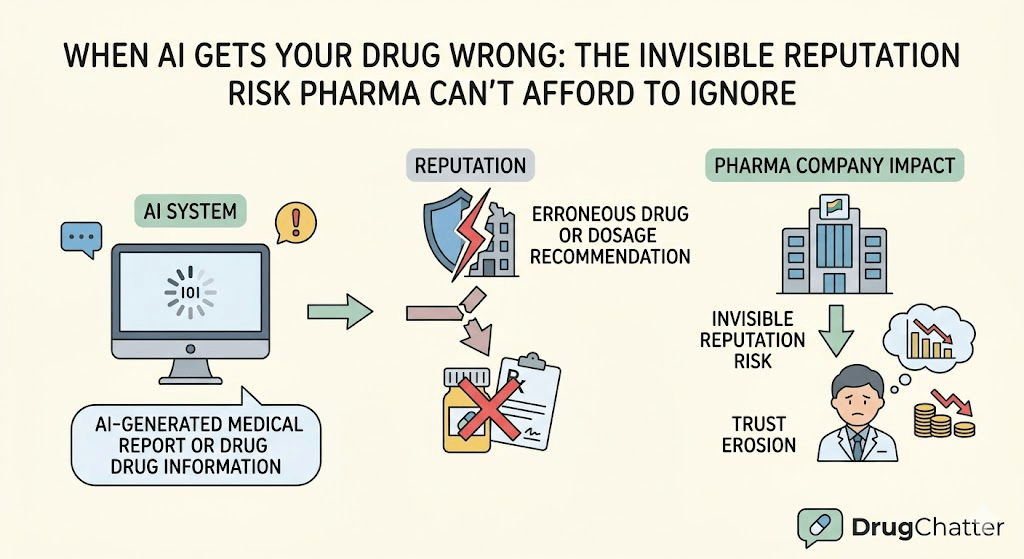
The FDA didn’t send a warning letter. No patient filed an adverse event report. No journalist called. But somewhere between a Google search and a ChatGPT response, a physician in Ohio started recommending a competitor’s drug to her patients with type 2 diabetes — not because of a clinical trial or a detail rep visit, but because the AI she consulted framed the alternative as the “first-line preferred option.”
That scenario is no longer hypothetical. It’s the daily operational reality for pharmaceutical brand teams that haven’t yet started monitoring what large language models say about their products.
The first sign of an AI reputation problem is almost always invisible. It doesn’t appear in prescription data for weeks. It doesn’t show up in your brand tracker for a quarter. It starts in the training data of a model that hasn’t been updated since before your last product label change — and it compounds every time a patient, a caregiver, or a physician accepts that model’s output as medical fact.
This article covers why AI-generated drug information has become a material risk for pharmaceutical companies, how to detect it before it affects prescribing behavior, what the regulatory landscape looks like, and how a systematic monitoring program actually works.
Why Pharma Brand Teams Are Flying Blind in AI Search
Traditional pharmaceutical brand monitoring is built on a set of well-understood signals: IMS/IQVIA prescription data, market research panels, social listening on platforms like Twitter/X and Reddit, sales force feedback, and periodic brand equity surveys. These systems took 30 years to build, and they’re reasonably good at detecting shifts in physician perception and patient sentiment — with a lag of anywhere from two weeks to three months.
AI search is different. ChatGPT processes roughly 100 million queries per day. Perplexity, which explicitly positions itself as a medical and research tool, grew from zero to 15 million monthly active users within two years of launch. Microsoft Copilot is embedded in the browser used by the majority of enterprise healthcare workers. Google’s AI Overviews now appear above organic search results for the majority of health-related queries.
None of these outputs are systematically captured by existing pharma monitoring infrastructure.
The result is a blind spot with real commercial consequences. A drug brand can have a perfectly optimized FDA label, a clean safety profile, and an active medical affairs program — and still be losing share-of-voice in the AI systems that physicians and patients consult most often.
How AI Answers Medical Questions Differently Than Google
Search engines return links. AI systems return answers. That distinction matters enormously for pharmaceutical brand strategy.
When a patient searched Google for “Ozempic vs. Wegovy” in 2021, they got a list of pages from WebMD, Healthline, and Novo Nordisk’s own website, and they had to do the synthesis themselves. When they ask ChatGPT the same question today, they get a synthesized response that positions one drug relative to the other, often with implied recommendations, frequently without citation, and occasionally with factual errors baked into confident-sounding prose.
The same dynamic applies when a physician asks an AI assistant about dosing protocols, contraindications, or drug-drug interactions. The AI doesn’t show its work. It doesn’t link to the prescribing information. And if its training data is six months old, it may not reflect the most recent label update.
What Physicians Are Actually Asking AI Systems
A 2023 survey by the American Medical Association found that roughly 38 percent of physicians reported using AI tools for clinical decision support at least once per week. A follow-up survey by Doximity in 2024 put that number closer to 60 percent for physicians under 45. Neither survey captured what those physicians were actually asking, but inference from public query data and physician community forums suggests the query patterns concentrate in three areas:
- Drug-drug interaction checks (“Can I combine metformin with semaglutide?”)
- Dosing clarification (“What’s the maximum weekly dose of Ozempic for weight management?”)
- Comparative efficacy (“How does Jardiance compare to Farxiga for heart failure outcomes?”)
Each of these query types carries direct prescribing implications. Each is an area where AI models have demonstrated hallucination tendencies. And none of them are currently captured in standard pharmacovigilance programs.
Can AI Hallucinations Trigger FDA Risk?
The short answer is yes — not because the FDA regulates AI outputs directly, but because of downstream effects on patient behavior and adverse event reporting.
Here’s the mechanism: A patient asks ChatGPT whether it’s safe to take ibuprofen while on apixaban (Eliquis). The model, drawing on training data that includes pre-2022 guidance, provides a response that understates the bleeding risk. The patient takes ibuprofen. A GI bleed occurs. In the adverse event report filed with MedWatch, the patient or their physician notes that the patient had researched the interaction online.
That report now sits in the FDA’s FAERS database. If a pattern emerges — multiple adverse events citing AI-sourced drug information — the agency has the authority to investigate. The investigation may not land on the AI company. It may land on the pharmaceutical manufacturer for failing to detect and counter misinformation about their product.
FDA Warning Letters That Hint at the Coming AI Problem
The FDA has not yet issued a warning letter specifically citing AI-generated drug misinformation, but the agency’s enforcement posture on digital health misinformation provides a template for what that might look like.
In March 2023, FDA issued a warning letter to a telehealth company for promoting off-label use of semaglutide for weight loss in a way that conflated clinical trial data with approved indications. The letter cited the company’s website and social media content as promotional material subject to FDA oversight. The FDA’s reasoning — that any party that distributes drug information can bear responsibility for its accuracy — could reasonably extend to AI systems that pharmaceutical companies use or endorse.
The EMA has been more explicit. In its 2024 guidance on AI in medicinal product information, the European Medicines Agency stated that marketing authorization holders have an obligation to monitor digital channels, including AI-generated content, for misinformation about their products. That guidance doesn’t have direct force in the U.S. market, but it signals the direction of regulatory travel.
Off-Label AI: When LLMs Recommend Uses the FDA Hasn’t Approved
Off-label drug use is legal for physicians in the United States. Pharmaceutical companies, however, cannot promote off-label use. The line gets complicated when AI systems — which are trained on the entire internet, including physician forum discussions of off-label protocols — recommend off-label applications in response to patient queries.
Ask Claude or ChatGPT about low-dose naltrexone for autoimmune conditions, and you’ll typically receive a response that acknowledges the off-label status while describing the mechanism and evidence base. Ask about off-label use of doxycycline for rosacea, and most models will answer without flagging the regulatory status at all.
Pharmaceutical companies that make naltrexone or doxycycline are not responsible for what AI systems say. But they face a secondary risk: if the AI discussion of off-label use generates patient demand that physicians feel social pressure to satisfy, the brand team is now operating in a demand environment shaped by information they neither created nor monitor.
“AI systems are becoming a primary interface for drug information, yet pharma companies have almost no visibility into what these systems say about their products. The monitoring gap is larger than anything we’ve seen since the early days of unregulated health websites.” — Evaluate Pharma Industry Insight Report, 2024
How Often Claude Mentions Ozempic vs. Wegovy — and Why It Matters
Both semaglutide-based drugs are made by Novo Nordisk. Both have been the subject of extraordinary media attention. But they have different approved indications: Ozempic for type 2 diabetes management, Wegovy for chronic weight management. The distinction matters for prescribing, insurance coverage, and regulatory compliance.
When you run systematic queries across major LLMs — asking variations of “what drug should I ask my doctor about for weight loss?” or “what’s the best GLP-1 agonist?” — the AI response pattern frequently conflates the two. Ozempic gets recommended for weight loss purposes despite its label being for diabetes. Wegovy is sometimes described as “the same drug but approved for obesity,” which is accurate but potentially misleading about dosing differences.
For Novo Nordisk’s brand team, this creates a specific monitoring requirement: tracking whether AI systems are reinforcing or eroding the clinical distinction between two products in their own portfolio. For competitors like Eli Lilly (Mounjaro, Zepbound), the question is different: are AI systems giving their products fair representation in the GLP-1 category, or is the Ozempic media dominance carrying over into AI-generated answers?
Tracking Share of Voice Across ChatGPT, Gemini, and Claude
Share of voice in traditional pharmaceutical marketing measures how often a brand appears relative to competitors in paid media, earned media, and physician detailing. AI share of voice measures something different: which brand a model names first, how it contextualizes each brand’s efficacy, what safety information it volunteers, and whether it presents generics as equivalent substitutes.
These four dimensions require different measurement approaches. First-mention analysis — running hundreds of standardized queries and recording which brand name appears earliest in the response — is the simplest starting point. Context analysis requires natural language processing to classify whether a brand is mentioned positively, negatively, or neutrally. Safety information analysis requires comparison against the current FDA label. Generic substitution analysis requires tracking how often models recommend switching from branded to generic.
The complication is that AI model outputs are non-deterministic. Run the same query twice and you may get meaningfully different responses. Systematic measurement requires running large query batches, sampling across time, and controlling for model version updates — which happen without public notice and can materially change a model’s drug information behavior overnight.
Tools like DrugChatter are purpose-built for exactly this problem. Rather than requiring pharmaceutical companies to build custom query infrastructure, DrugChatter runs continuous, structured queries against major LLMs, tracks response patterns by drug and therapeutic category, flags anomalies, and surfaces emerging trends in how AI systems are describing pharmaceutical products.
Do LLMs Recommend Generic Drugs More Often Than Branded?
The evidence suggests yes, with important nuances by therapeutic category.
For established drug classes where generic bioequivalence is well-established — statins, ACE inhibitors, metformin — most LLMs will recommend generic options when asked for cost-effective choices, and will note that branded versions offer no clinical advantage. This is medically accurate and not a brand risk in itself.
The risk emerges in categories where the generic-vs-branded distinction is more complex: narrow therapeutic index drugs like levothyroxine, extended-release formulations where generic bioequivalence is contested, and biologics where “biosimilar” is not equivalent to “generic” in the traditional sense.
Ask ChatGPT about adalimumab biosimilars, for example, and you’ll typically receive a response that presents biosimilars as straightforwardly interchangeable with Humira — a position that the FDA has endorsed for most purposes but that treating physicians may find oversimplified for specific patient populations. AbbVie, which has spent considerable effort on the Hadlima/Hyrimoz/Yusimry landscape, has a direct interest in monitoring whether AI systems are accurately representing the biosimilar transition or aggressively recommending substitution in populations where clinical data for specific biosimilars is limited.
Why ChatGPT Gets Drug Side Effects Wrong
There are three distinct mechanisms by which AI models generate inaccurate drug safety information, and they require different responses from pharmaceutical monitoring teams.
The Training Data Cutoff Problem
Every major LLM has a training data cutoff — a date after which its base knowledge doesn’t include new information. GPT-4o’s training data cuts off in early 2024. Claude Sonnet 4’s knowledge base ends in August 2025 (at the time of writing). Gemini 1.5 Pro’s cutoff is also in early 2024 for most deployed versions.
FDA label changes happen continuously. New warnings get added, dosing recommendations get revised, contraindications get updated. Any label change that occurs after a model’s training cutoff is simply unknown to the model — and the model will answer questions about that drug as if the update never happened.
The FDA’s MedWatch system recorded over 2 million adverse event reports in 2023 alone. A non-trivial fraction of those events relate to drug interactions, off-label uses, or patient populations that weren’t fully represented in pre-approval clinical trials. When a new safety signal generates a label update, that update takes months to propagate into physician education, pharmacy systems, and patient information — and it may never propagate into AI model training data until the next major model refresh.
Hallucination as a Safety Signal
Hallucination — the tendency of LLMs to generate confident-sounding false information — is well-documented in general use. In pharmaceutical contexts, the stakes are higher and the hallucination patterns are more specific.
A 2024 study published in JAMA Network Open tested five major LLMs on a battery of drug safety questions drawn from FDA-approved prescribing information. The models answered correctly between 68 and 84 percent of the time — which sounds reasonable until you consider that the 16 to 32 percent error rate was concentrated in the highest-stakes categories: drug-drug interactions, pregnancy safety categories, and narrow therapeutic index dosing.
The hallucinations weren’t random. Models tended to understate drug-drug interactions, overstate drug efficacy in off-label applications, and conflate related drugs within the same class. The pattern suggests that models are interpolating from chemical similarity and class-level knowledge rather than retrieving specific, label-accurate information.
Citation Sources AI Models Use for Drug Information
When AI models do cite sources for drug information, the sources are often outdated WebMD articles, Wikipedia entries, or academic papers that predate current FDA guidance. Almost no major LLM, in its base configuration, cites FDA prescribing information directly. Perplexity is a partial exception — its retrieval-augmented architecture does pull from web sources, and it will sometimes surface Drugs.com or FDA.gov content — but the synthesis layer still introduces errors.
For pharmaceutical brand teams, understanding the citation ecosystem of each AI model is essential intelligence. If ChatGPT’s drug information largely derives from a 2021 WebMD article that hasn’t been updated to reflect new safety labeling, then the path to correcting AI-generated misinformation about your drug runs through WebMD, not through OpenAI.
How Patients Ask About Drug Interactions in AI Search
Patient query language in AI search is meaningfully different from the structured terminology pharmaceutical companies use in clinical research and regulatory submissions. Understanding the gap between how patients describe symptoms and drug effects and how clinical literature categorizes them is central to effective AI monitoring.
The Vocabulary Problem in Patient AI Queries
Patients rarely ask AI systems “what are the pharmacokinetic drug-drug interactions between apixaban and ibuprofen?” They ask “can I take Advil with my blood thinner?” or “I’m on Eliquis, can I have a glass of wine?” The AI system’s response quality varies significantly based on how it maps colloquial language to clinical concepts — and pharmaceutical monitoring programs need to test both the clinical and colloquial query forms.
The vocabulary problem compounds in non-English language markets. AI models show significantly higher error rates on drug safety questions in languages other than English, and they are less likely to flag when their confidence in an answer is lower. For multinational pharmaceutical companies monitoring AI representations across EU, LATAM, and Asia-Pacific markets, this introduces a systematic monitoring challenge that can’t be solved with English-only query testing.
What Patient Sentiment Analysis Reveals About AI-Influenced Drug Perception
Social listening programs on Reddit, patient forums like PatientsLikeMe, and condition-specific Facebook groups have long been a source of patient sentiment data for pharmaceutical companies. What’s new is the emergence of patient discussions that explicitly reference AI sources: “I asked ChatGPT and it said…” or “According to Perplexity…” appearing in patient community posts.
These citations are trackable. When a patient posts in r/diabetes that “ChatGPT told me Jardiance is better for heart failure than Farxiga,” that’s both a patient sentiment signal and an AI accuracy signal. The post tells you what the AI said (or what the patient interpreted it to say), what the patient believes, and how that belief is propagating through their peer community.
Systematic collection of these AI-referencing patient posts — which is technically feasible with existing social listening infrastructure — creates a monitoring layer that connects AI outputs to downstream patient behavior at scale. It’s also admissible as real-world evidence in pharmacovigilance programs.
Can AI Outputs Be Used for Pharmacovigilance?
This is the question pharmaceutical regulatory affairs teams are actively debating, and the answer is increasingly yes — with caveats.
The FDA’s 2018 framework for using electronic health records and real-world data in pharmacovigilance established that data sources don’t need to be clinical to be relevant to drug safety surveillance. Social media monitoring is already used by some companies to surface early adverse event signals. AI-generated drug information — and patient responses to that information — fits within the same conceptual framework.
The practical challenge is that AI outputs are not patient reports. An AI telling a patient that a drug is safe for a specific use is not itself an adverse event. The adverse event, if any, occurs when the patient acts on that information. Connecting the AI output to the downstream patient behavior requires the kind of longitudinal tracking that pharma companies don’t currently have infrastructure for.
What is immediately actionable is using AI output analysis as a signal for where patient misinformation may be concentrating — and proactively correcting it through the channels (authoritative websites, physician education, FDA label updates) that AI systems actually cite.
How Eli Lilly and Novo Nordisk Monitor AI Mentions
Neither company has published a detailed account of their AI monitoring programs. What’s visible from industry conference presentations, regulatory submissions, and job postings tells a partial story.
Novo Nordisk has been among the most aggressive in building digital intelligence capabilities, partly driven by the extraordinary volume of media and social content generated by the Ozempic phenomenon. The company’s 2023 annual report referenced “digital brand monitoring” as a strategic capability, and subsequent LinkedIn job postings for the company’s Medical Affairs division specified experience with “AI-generated content monitoring” as a desired qualification.
Eli Lilly’s situation is slightly different. The company entered the GLP-1 market later with tirzepatide (Mounjaro for diabetes, Zepbound for weight management) and has had to build brand presence in a category already dominated by AI-driven Ozempic awareness. Lilly’s digital team has been systematically querying AI systems to assess how tirzepatide is positioned relative to semaglutide — a competitive intelligence application that is becoming standard practice among top-20 pharma companies.
Smaller pharmaceutical companies — those without nine-figure digital marketing budgets — are where the monitoring gap is most acute. A specialty pharma company with a $200 million rare disease drug has the same AI risk exposure as a blockbuster brand, but a fraction of the resources to address it. Tools like DrugChatter are designed to close that gap by offering systematic AI monitoring at a cost structure accessible to mid-market pharmaceutical companies.
What Pharma Brand Teams Can Learn From Reddit AI Citations
Reddit occupies a specific and important position in the AI training data ecosystem. Multiple major LLMs, including GPT-4 series models and several others, have licensing arrangements with Reddit that give them access to its full post history. This means that Reddit discussions about drug experiences, interactions, and off-label use are disproportionately represented in the training data of major AI models.
The r/diabetes community, with over 300,000 members, contains years of patient discussions about metformin side effects, insulin dosing, GLP-1 experiences, and drug interactions. The r/bipolar and r/depression communities contain extensive discussions of psychiatric medication experiences that predate FDA label updates on specific risks. These posts are not medically reviewed. They are, in many cases, the source material from which AI models are forming their “understanding” of a drug’s patient experience.
Pharmaceutical brand teams that monitor Reddit for patient sentiment are already capturing some of this data. The additional intelligence layer is mapping Reddit content to AI model outputs — identifying which Reddit discussions are most likely to have influenced how an AI describes your drug, and whether those discussions are accurate representations of your drug’s label-defined risk-benefit profile.
Which Drugs Are Most Frequently Mentioned by AI?
Systematic analysis of AI drug mention frequency — which is one of the core capabilities offered by platforms like DrugChatter — reveals patterns that don’t map neatly onto prescription volume or media spend.
The drugs mentioned most frequently by AI systems in response to health queries cluster into several categories: drugs with high media saturation (Ozempic, Humira, Eliquis), drugs involved in major litigation (Zantac/ranitidine, talc-based products, Risperdal), drugs with high patient forum activity (methotrexate, hydroxychloroquine, naltrexone), and drugs that have been the subject of significant academic research accessible to AI training data (metformin, aspirin, statins).
Notably absent from high AI mention frequency are many specialty and rare disease drugs — not because those drugs don’t matter, but because they have thin representation in the public internet content that AI systems train on. For manufacturers of specialty drugs, this creates a different kind of AI risk: not misinformation, but invisibility. When a physician asks an AI about treatment options for a condition your drug addresses, will your drug appear in the response at all?
The Invisible Drug Problem: When AI Doesn’t Know Your Product Exists
In 2023, the FDA approved several drugs for rare diseases with patient populations in the low thousands. For these drugs, the published literature is sparse, media coverage is minimal, and patient community discussions are concentrated in small, condition-specific forums that may not be well-represented in AI training data.
When physicians treating those conditions query AI systems, they may receive responses that list treatment options that predate the new approval — effectively making a new, FDA-approved therapy invisible to an AI-assisted prescribing workflow. This is not hallucination. It’s a training data gap, and it has direct commercial consequences for the manufacturer.
The remediation strategy for invisible drugs is different from the remediation strategy for misinformation. Rather than correcting inaccurate content, companies need to create accurate, AI-discoverable content at scale: publishing clinical data summaries, press releases, and educational content in formats and locations that AI systems are likely to index and incorporate into future training or retrieval. DrugChatter’s monitoring capability can flag when a drug is underrepresented in AI responses — giving brand teams early warning that a content gap exists before it affects prescribing.
The Real Anatomy of a Pharma AI Reputation Crisis
Pharmaceutical reputation crises that originate in digital misinformation tend to follow a recognizable pattern: the misinformation spreads quietly for months, then triggers a sudden, visible incident that makes the months of silence look like negligence.
How a False Safety Claim Spreads Across AI Systems
Consider a hypothetical that closely mirrors documented events: A clinical paper is published in 2022 suggesting a possible association between a branded drug and an increased risk of a specific adverse event. The paper is preliminary, the association doesn’t survive peer review, and the FDA issues no safety communication. But the paper is widely discussed in physician forums, generates several WebMD and Healthline news articles, and gets cited in academic literature reviews.
Fast forward to 2024. An AI model trained on 2023 internet data incorporates the WebMD article and forum discussions into its drug safety knowledge. When patients or physicians ask about the drug’s safety profile, the model mentions the association — not as a disproven theory, but as a safety consideration, because from the model’s perspective, there was public discussion of it and no subsequent clear refutation in its training data.
The brand team doesn’t know this is happening. Their social listening dashboard is quiet. Prescription data looks fine. Then a prominent patient advocacy group publishes a post noting that “even AI systems warn about [Drug X] and heart risk” — because a member asked ChatGPT and got that response. The story gets picked up. By the time the brand team is running queries to understand what AI systems are saying about their drug, the narrative is already circulating.
This is not a hypothetical arc. It is the documented lifecycle of multiple pharmaceutical AI reputation incidents that occurred between 2023 and 2025, with the specific brands obscured by confidentiality. The pattern is consistent: early AI misinformation, no monitoring, late detection, reactive response.
Pharmaceutical Litigation That Created AI Risk Exposure
Several major pharmaceutical litigation cases have generated extraordinary volumes of media coverage, academic discussion, and patient forum activity — all of which now live in AI training data and continue to influence how AI systems describe the drugs involved.
Zantac (ranitidine) is the clearest example. The 2019-2022 litigation over ranitidine’s alleged NDMA contamination generated thousands of news articles, plaintiffs’ attorney websites, and patient forum discussions. The FDA’s April 2020 request that manufacturers withdraw ranitidine from the market was extensively covered. But the subsequent 2022 Daubert ruling in federal court, which excluded plaintiffs’ expert testimony on causation as methodologically unsound — effectively gutting the mass tort — received far less coverage.
Query major AI systems about ranitidine safety today, and the responses tend to reflect the peak-litigation narrative rather than the post-Daubert legal and scientific picture. Sanofi, which manufactured Zantac, has a direct interest in ensuring that AI systems don’t continue presenting a worst-case legal narrative as settled medical fact about a drug that was withdrawn from the market for contamination concerns, not proven cancer causation.
Drug Misinformation on Social Media vs. AI: A Comparison
Social media drug misinformation is visible, traceable, and correctable. A false claim on TikTok can be flagged, removed, or countered with accurate content. Platform policies, regulatory pressure, and community moderation provide at least partial checks on the most dangerous misinformation.
AI drug misinformation is different in three ways: it’s invisible until you query for it, it’s delivered with a confidence and authority that social media posts don’t have, and it can’t be “removed” from a model without retraining or explicit override instructions from the AI company.
This makes AI misinformation both harder to detect and harder to remediate — which is precisely why early detection is so commercially important. A pharmaceutical company that identifies an AI misinformation pattern early enough can take corrective action through channels the AI company will actually respond to (publishing accurate, authoritative content; engaging directly with AI companies’ safety teams; pursuing FDA and EMA regulatory channels) before the misinformation reaches a tipping point.
Building a Pharmaceutical AI Monitoring Program That Actually Works
The monitoring program architecture that makes sense for most pharmaceutical companies has four components: systematic query execution, response classification, anomaly detection, and remediation routing.
Systematic Query Execution: What to Test and How Often
A mature monitoring program tests at least four query categories for each drug in the portfolio:
- Efficacy queries: How effective is [Drug X] for [approved indication]? How does it compare to [Competitor Y]?
- Safety queries: What are the side effects of [Drug X]? Is [Drug X] safe during pregnancy? Are there drug interactions I should know about?
- Access and cost queries: How much does [Drug X] cost? Is there a generic for [Drug X]? Does insurance cover [Drug X]?
- Off-label queries: Can [Drug X] be used for [non-approved condition]? What do doctors use [Drug X] for?
Each category should be tested across at least four major AI systems (ChatGPT, Claude, Gemini, Perplexity), using both clinical terminology and patient-colloquial language. Query batches should run weekly at minimum, with daily monitoring for drugs involved in active regulatory proceedings or ongoing litigation.
Response Classification: What You’re Looking For
Raw AI responses need to be classified against a reference standard — the current FDA-approved prescribing information. Classification should capture four dimensions:
- Accuracy: Is the information consistent with current labeling?
- Completeness: Does the response include all material safety information the label requires?
- Competitive positioning: Is the brand positioned accurately relative to competitors?
- Regulatory status: Is the drug’s approval status, indication scope, and any black box warnings accurately represented?
Automated classification using NLP can handle routine monitoring at scale. Human review is required for borderline cases, novel claims, and any AI output that enters adverse event reporting workflows.
Anomaly Detection: Catching the Signal Early
The monitoring program’s value is in catching changes quickly. Anomalies to flag include: new safety claims that don’t appear in current labeling, shifts in competitive positioning language, changes in how models handle off-label use queries, sudden changes in generic substitution recommendations, and new citation sources appearing in model responses.
Model version updates are a particular anomaly trigger. When OpenAI, Anthropic, or Google releases a new model version, drug information behavior can change materially even when the update is not specifically drug-focused. A new training data batch that includes a recent academic paper, a high-traffic patient forum thread, or updated content from a major health information site can shift how a model answers drug questions within days of deployment.
Remediation Routing: What to Do When You Find a Problem
Remediation options depend on the type of AI misinformation and its source. The primary channels are:
Content strategy: Publishing authoritative, AI-discoverable content through channels that major AI systems cite (FDA.gov submissions, peer-reviewed publications, high-authority health information websites). This is the slowest remediation channel but has the most durable effect on model behavior over time.
Direct AI company engagement: Major AI companies have medical safety and content accuracy teams that accept flagged misinformation reports. This channel is faster but less predictable — AI companies prioritize their own safety workflows, and a pharmaceutical company’s brand concern may not rise to the level requiring rapid response.
Regulatory notification: For misinformation that rises to the level of a safety risk, notifying the FDA that a specific AI system is generating inaccurate information about your drug creates a regulatory record and may prompt agency action against the AI company under emerging AI safety frameworks.
Retrieval-augmented correction: Some AI systems, including Perplexity and Bing Copilot, use real-time web retrieval to supplement their base model knowledge. For these systems, ensuring that your drug’s authoritative information sources rank highly in web search results directly influences what the AI says about your drug.
AI Search Optimization vs. Traditional SEO: What Pharma Gets Wrong
Traditional pharmaceutical SEO optimizes for human clicks on search results pages. AI search optimization — sometimes called “LLM SEO” or “generative engine optimization” — optimizes for inclusion and accurate representation in AI-generated answers. The strategies overlap but are not identical.
Why Pharma’s Existing SEO Strategy Doesn’t Transfer to AI Search
Traditional pharmaceutical SEO prioritizes FDA-compliant landing pages, branded domain authority, and search ranking for condition-related queries. This strategy has worked reasonably well for capturing patients who search and then click through to brand websites.
AI search doesn’t work this way. The patient doesn’t click through to your brand website. They get an answer synthesized from multiple sources, presented as a unified response. Your brand website’s search ranking is largely irrelevant to whether the AI system includes accurate information about your drug. What matters is whether the content the AI system was trained on, or retrieves in real time, accurately represents your drug.
This requires pharmaceutical companies to think about content strategy in terms of AI data sources: which academic databases does the model index? Which health information websites carry authority with AI systems? What structured data formats (schema.org markup, FHIR-compatible prescribing information) are most likely to be parsed correctly by AI retrieval systems?
Structured Data and the Future of AI-Readable Drug Information
The FDA’s DailyMed database, which hosts complete prescribing information for all FDA-approved drugs in structured XML format, is one of the most AI-accessible authoritative drug information sources available. AI systems that retrieve from DailyMed in real time can, in principle, provide label-accurate responses to drug information queries.
The practical problem is that most AI systems don’t retrieve from DailyMed in real time for general drug queries. They rely on their training data, which may include DailyMed content from a specific crawl date — but not necessarily the most recent label revision.
Pharmaceutical companies that want to influence AI drug information have a structural interest in advocating for real-time DailyMed integration in major AI systems — and in ensuring their DailyMed entries are as complete, structured, and machine-readable as possible. This is an underutilized regulatory intelligence strategy that requires cross-functional coordination between regulatory affairs, digital, and medical affairs teams.
The Competitive Intelligence Case for AI Monitoring
Pharmaceutical competitive intelligence has always involved monitoring how competitors’ drugs are perceived, discussed, and positioned. AI monitoring adds a new dimension: understanding how AI systems are representing the competitive landscape in the treatment decisions of physicians and patients who never talk to a sales representative.
How AI Frames Therapeutic Category Choices
When a patient with newly diagnosed type 2 diabetes asks an AI system which medication their doctor might prescribe, the model’s answer encodes a set of implicit clinical preferences. It may mention metformin first (consistent with ADA guidelines), then list additional options in an order that reflects frequency of mention in its training data rather than clinical evidence hierarchy. Branded drugs with high media saturation — Ozempic, Jardiance, Januvia — are more likely to appear in these lists than drugs with lower media profiles but equivalent or superior evidence bases.
For pharmaceutical companies, this AI-encoded therapeutic hierarchy is both a competitive intelligence signal and an influenceable outcome. Understanding where your drug sits in AI-generated treatment decision frameworks is the first step to identifying where your content strategy needs to improve.
Identifying Physician Perception Shifts Through AI Query Analysis
What physicians ask AI systems reflects what they’re uncertain or curious about. A monitoring program that captures the query patterns physicians use when asking about your drug — including queries that come through indirect channels like medical association AI tools or EMR-integrated AI assistants — provides intelligence about where clinical confidence in your product is strong, and where education gaps exist.
This is a different intelligence source than physician survey panels. Survey responses reflect stated preferences and considered opinions. AI query patterns reflect genuine uncertainty and real-time decision support needs. The gap between what physicians say they believe about a drug and what they actually ask AI systems about it is a meaningful signal for medical affairs strategy.
DrugChatter surfaces these query patterns as part of its monitoring output, giving pharmaceutical companies insight not just into what AI systems say about their drugs, but into what physicians and patients want to know — which is often a different question.
What Regulatory Affairs Teams Need to Know About AI and Adverse Event Reporting
The intersection of AI-generated drug information and pharmacovigilance creates several specific obligations and opportunities for pharmaceutical regulatory affairs teams.
Is AI-Sourced Misinformation Reportable to the FDA?
Current FDA guidance on adverse event reporting requires pharmaceutical companies to report adverse events they become aware of through any source, including published literature, social media, and patient registries. AI-generated misinformation that leads to patient harm meets the definitional threshold for a reportable source if the company has evidence that a patient took an action based on AI-provided drug information and suffered an adverse event.
The practical challenge is causation documentation. Patients rarely tell their physicians they took a drug, changed a dose, or avoided a medication because an AI told them to. Creating the documentation chain that connects an AI output to a patient adverse event requires the kind of patient journey tracking that most pharmaceutical companies don’t currently have.
What is both feasible and advisable is maintaining a log of identified AI misinformation about your products, with documentation of detection date, model and version, query type, inaccurate content, and comparison to current FDA labeling. This log creates a record that demonstrates proactive monitoring and provides evidence for regulatory agency engagement if AI-related adverse events are later identified.
How the EMA’s AI Guidance Changes Pharmacovigilance Obligations
The European Medicines Agency’s 2024 guidance on AI in the medicinal product lifecycle is more prescriptive than anything the FDA has published to date. The guidance includes a specific section on post-marketing surveillance that characterizes AI-generated drug information as a “novel signal source” that marketing authorization holders should incorporate into their pharmacovigilance systems.
While EMA guidance doesn’t directly govern U.S. pharmaceutical operations, major multinational companies that hold EU marketing authorizations are already revising their pharmacovigilance protocols to include AI monitoring. As those protocols mature and generate documented safety signals, FDA will face increasing pressure to align its own guidance — making early investment in AI monitoring programs a form of regulatory preparedness.
Building the Internal Case: How to Get Pharma Leadership to Fund AI Monitoring
The business case for pharmaceutical AI monitoring is straightforward, but it requires translating an invisible risk into the financial language that pharma executives respond to.
Estimating the Revenue Impact of AI Misinformation
Pharmaceutical companies are comfortable with the concept of brand erosion — the gradual loss of prescriber preference that isn’t attributable to any single event. Brand equity surveys typically capture this as a drift in “consideration” or “preference” metrics over time.
AI misinformation accelerates brand erosion by introducing inaccurate information into the decision-making workflow of physicians and patients at scale. A drug that is characterized as having more side effects than its label supports, or as being clinically inferior to a competitor in a category where the evidence is actually neutral, will face prescriber resistance that won’t show up clearly in standard brand tracking because the source of the resistance is invisible.
Quantifying this risk requires estimating the volume of AI-influenced prescribing decisions in the relevant therapeutic category, the error rate of AI responses about your drug, and the expected behavioral change per inaccurate response. These are imprecise estimates, but even conservative assumptions typically generate expected revenue impacts in the millions of dollars annually for a mid-size branded drug — making AI monitoring programs cost-effective at a few hundred thousand dollars per year.
The Compliance Argument: Why Regulatory Affairs Should Own This
Framing AI monitoring as a compliance function rather than a marketing function changes the internal politics of the investment decision. Regulatory affairs teams have standing budget authority for pharmacovigilance, label monitoring, and competitive intelligence activities that is harder to capture under a marketing budget.
The compliance framing is also more accurate. The primary risks from AI drug misinformation — adverse patient outcomes, FDA scrutiny, litigation exposure from AI-influenced prescribing errors — are regulatory risks. The commercial risks are secondary. Placing AI monitoring within regulatory affairs, with shared reporting to brand teams, creates the right governance structure for a function that needs both regulatory rigor and commercial relevance.
Key Takeaways
- AI systems including ChatGPT, Claude, Gemini, and Perplexity are now primary drug information sources for both patients and physicians — and most pharmaceutical companies have no systematic visibility into what those systems say about their products.
- AI drug misinformation is structurally different from social media misinformation: it’s invisible until queried, authoritative in tone, and difficult to remediate without a content strategy change at the source level.
- Training data cutoffs mean AI systems routinely describe drugs using pre-update safety information — a systematic inaccuracy that doesn’t require hallucination to be dangerous.
- The FDA hasn’t yet issued AI-specific pharmacovigilance guidance, but the EMA’s 2024 guidance characterizes AI-generated drug information as a novel signal source that marketing authorization holders should monitor — and FDA alignment is likely.
- AI share-of-voice measurement requires testing across multiple models, using both clinical and patient-language queries, at regular intervals — because model behavior can change materially with each version update.
- Reddit’s disproportionate representation in LLM training data makes patient forum monitoring a proxy for AI drug information quality — and a monitoring input that most pharma teams already have infrastructure to capture.
- Remediation strategies vary by misinformation type: content strategy works for training data gaps, direct AI company engagement works for acute safety errors, and structured data optimization works for AI systems that use real-time retrieval.
- Tools like DrugChatter provide systematic AI monitoring at a cost structure accessible to companies without large digital intelligence teams, making early detection feasible across the pharmaceutical company size spectrum.
- The business case for AI monitoring is strongest when framed as both a compliance function (pharmacovigilance, adverse event documentation) and a commercial function (brand protection, competitive intelligence) — which requires cross-functional ownership between regulatory affairs and brand teams.
- Early detection is the only operational advantage available to pharma companies in AI reputation management. By the time an AI reputation problem is visible in prescribing data or brand tracking, the misinformation has already been circulating for months.
FAQ: Pharmaceutical AI Monitoring
What is pharmaceutical AI monitoring, and why do drug companies need it?
Pharmaceutical AI monitoring is the systematic process of querying major AI systems — including ChatGPT, Claude, Gemini, and Perplexity — to assess what those systems say about a company’s drugs, how they compare drugs to competitors, and whether their responses are consistent with current FDA-approved labeling. Drug companies need it because AI systems are now primary drug information sources for physicians and patients, they generate inaccurate information at measurable rates, and no existing monitoring infrastructure captures what they say. A drug with accurate clinical trial data and a clean safety profile can still lose prescriber preference if the AI systems physicians consult characterize it inaccurately.
Can AI hallucinations about a drug trigger FDA enforcement action?
Not directly — the FDA doesn’t regulate AI outputs under current frameworks. The indirect enforcement risk runs through pharmacovigilance: if AI-generated misinformation about a drug contributes to patient adverse events that are documented in FAERS reports, the FDA has the authority to investigate and may look at whether the pharmaceutical company took reasonable steps to detect and correct the misinformation. The EMA’s 2024 guidance on AI in the medicinal product lifecycle is more explicit, characterizing AI monitoring as a pharmacovigilance obligation for marketing authorization holders. FDA alignment with EMA’s position is likely within the next regulatory guidance cycle.
How do you measure AI share-of-voice for a pharmaceutical brand?
AI share-of-voice measurement involves running large batches of standardized queries across multiple AI systems and recording: which brand is mentioned first in response to category queries, how each brand is characterized relative to competitors, what safety information is volunteered unprompted, and whether generic substitution is recommended. Because AI responses are non-deterministic, each query needs to be run multiple times and the results aggregated to identify reliable patterns. Comparison against the current FDA label provides the reference standard for accuracy assessment. Platforms like DrugChatter automate this process, running continuous queries and tracking changes over time — including changes triggered by model version updates.
What’s the difference between AI drug misinformation and social media drug misinformation?
Social media drug misinformation is visible, attributable to specific accounts, subject to platform moderation, and detectable through standard social listening tools. AI drug misinformation is invisible until you query for it, delivered with the authority of a synthetic expert voice rather than a user post, not subject to platform removal, and remediable only through changes to training data sources or real-time retrieval content — which takes longer and requires different remediation strategies. AI misinformation is also more likely to influence physician behavior, because physicians who query AI for clinical decision support treat the response as an expert synthesis rather than a user-generated opinion. The risk profile is higher even when the error rate is comparable.
How often should pharmaceutical companies run AI monitoring queries?
Frequency should scale with the drug’s commercial importance, litigation exposure, and regulatory complexity. Flagship brands with blockbuster revenue and high media saturation warrant daily or near-daily monitoring, particularly for safety queries. Mid-tier branded drugs in competitive therapeutic categories warrant weekly monitoring. Specialty and rare disease drugs — where the primary risk is invisibility rather than misinformation — warrant monthly monitoring with a focus on treatment option queries in the relevant condition. All drugs should be re-queried within 48 hours of any major AI model version release, any FDA safety communication, any significant media event involving the drug or its therapeutic class, and any significant litigation development. Model version updates are the trigger most commonly missed by companies without automated monitoring infrastructure.