A physician types “best GLP-1 for weight loss” into ChatGPT. A patient asks Claude which SGLT2 inhibitor has the fewest side effects. A caregiver queries Perplexity about whether their relative’s statin interacts with a new antibiotic.
None of those queries produce a list of blue links. None of them send traffic to your brand website. None of them pass through the keyword funnel your agency built in 2019. They produce a synthesized, confident prose answer—and your drug either appears in it or it doesn’t.
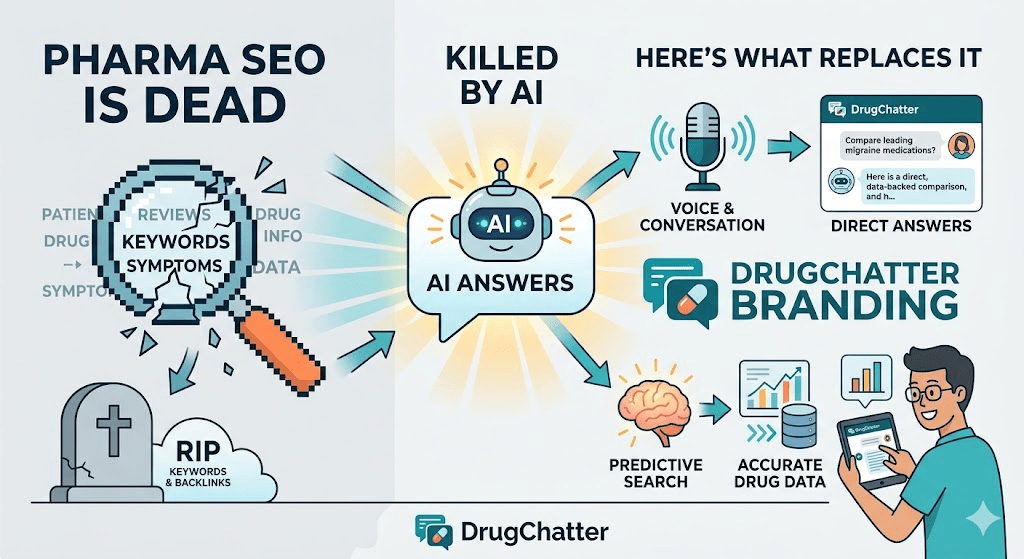
That shift is the most consequential change in pharmaceutical marketing since the FDA allowed direct-to-consumer advertising in 1997. Pharma SEO teams built their entire discipline around a single assumption: people who want health information click links. That assumption is now false for a growing and measurable share of queries.
This article explains what’s actually happening inside AI search systems when users ask about drugs, what risks accumulate when those answers are wrong, and what pharmaceutical companies can do right now to monitor, measure, and influence how their products appear in LLM-generated answers.
What Pharma SEO Actually Measured—and Why Those Metrics No Longer Work
Traditional pharmaceutical SEO produced a clean, auditable chain. A user queried Google for “Humira biosimilar alternatives.” Google returned ten blue links. The user clicked one. You measured impressions, clicks, click-through rate, and organic sessions in Search Console. You compared branded versus non-branded traffic. You tracked rank position for 200 target keywords. You knew exactly where you stood relative to AbbVie, Pfizer, and the patient advocacy groups that Google consistently elevated.
That chain no longer holds for a significant and growing category of queries. Google’s AI Overviews, which now appear on an estimated 47 percent of health-related searches according to internal testing published by Semrush in late 2024, generate a synthesized answer above the organic results. The user reads the answer. The user does not click.
The rest of the ecosystem compounds this. Perplexity, which positions itself explicitly as a research-grade alternative to Google, reports more than 100 million monthly active users as of early 2025. ChatGPT’s search-enabled mode, released broadly in late 2024, now handles health queries that previously flowed to WebMD, Drugs.com, and Mayo Clinic. Apple Intelligence summarizes health articles before users reach the page. Microsoft Copilot answers drug interaction questions inside Windows and Edge.
Your drug can rank number one on Google and still be invisible to a substantial cohort of patients and physicians who never see that result because they got their answer from a system that never passed your URL through a click.
How AI Overviews Have Reduced Health Query Click-Through Rates
Semrush published click-through data in Q4 2024 showing that queries triggering AI Overviews saw organic CTR decline by 34 percent on average, with health and medical queries showing steeper drops. This aligns with a separate Ahrefs study that found zero-click searches now account for roughly 65 percent of all Google searches across categories. For health queries specifically—which AI systems treat as high-value, high-confidence territory—the number is likely higher.
The practical implication for pharma brand teams: the search ranking you paid to achieve delivers fewer visitors than it did 24 months ago, and the gap is widening each time Google expands AI Overview coverage.
Which Drug Queries Are Most Likely to Trigger AI Answers Instead of Links
Not every pharmaceutical query gets an AI answer. The queries that do tend to cluster in predictable categories. Mechanism-of-action questions (“how does Keytruda work”) almost always produce AI answers. Drug comparison questions (“Ozempic vs Wegovy for weight loss”) produce AI answers that synthesize clinical data. Side-effect questions (“semaglutide nausea how long does it last”) produce AI answers that cite multiple sources without linking through. Dosing questions, drug interaction questions, and “is this drug right for me” questions all trend toward AI-generated synthesis.
Branded product pages and prescribing information documents rank well in traditional SEO for these queries. In AI answers, those same documents may be cited as sources without producing a click—or they may not be cited at all, with the AI system drawing on training data instead of live search results.
How LLMs Actually Learn What They Know About Your Drug
To understand why AI mentions of drugs are often wrong—and why they matter so much—you need a working model of how large language models acquire pharmaceutical knowledge.
LLMs like GPT-4o, Claude, and Gemini are trained on massive corpora of text scraped from the internet, academic journals, books, and forums. That training data has a cutoff date. GPT-4o’s knowledge was frozen in early 2024. Claude 3.5 Sonnet’s cutoff is April 2024. Gemini 1.5 Pro’s is November 2023. Any drug approved after those dates—or any safety update issued after those dates—does not exist in the model’s base knowledge. The model will still answer confidently. It will just be wrong.
For drugs that were in training data, the model’s knowledge reflects whatever the internet said about that drug at training time. This is a problem because the internet said a lot of things about drugs that were incorrect, anecdotal, off-label, or superseded by later clinical data. Patient forums on Reddit, early-phase clinical trial reports, advocacy group websites, and pre-approval news articles all fed into these models. The model cannot discriminate between a peer-reviewed New England Journal of Medicine study and a Facebook group post by someone who had a bad experience with your drug. Both are data.
Why Training Cutoffs Create Silent Drug Safety Gaps in AI Answers
The FDA issued a drug safety communication about Jardiance (empagliflozin) and Farxiga (dapagliflozin) related to rare but serious genitourinary infections in 2018. Any model trained after that will likely know about it. But consider a more recent scenario: the FDA updated the boxed warning for Invokana (canagliflozin) with additional cardiovascular data in 2020. A model trained in 2019 would not reflect that warning. If a patient today asks that model whether Invokana is safe for someone with existing heart disease, the model’s answer will be based on incomplete safety information—and it will not flag that it is incomplete.
This is not a hypothetical edge case. It is the structural reality of every AI system that uses base model knowledge for drug answers. Retrieval-augmented generation (RAG) systems, which pull live data before answering, partially mitigate this—but only partially, and only when the retrieved documents are current and accurate.
How Reddit and Patient Forums Distort LLM Drug Knowledge
OpenAI, Anthropic, and Google all trained on Reddit data. Reddit hosts active pharmaceutical communities: r/diabetes, r/Ozempic, r/MultipleSclerosis, r/ChronicPain, and hundreds of condition-specific subreddits where patients discuss their drug experiences in detail. That content is not peer-reviewed, not filtered, and not representative of the average clinical outcome. A user who had a severe side effect is far more likely to post about it than a user whose treatment is proceeding normally. This creates a systematic negativity bias in patient forum data.
When a model trained on this data answers a question about side effect frequency, it may overestimate the prevalence of adverse events because the training data was populated by people motivated to describe problems. Conversely, for drugs with vocal patient advocate communities—certain biologic therapies, for instance—the training data may overstate effectiveness relative to clinical trial outcomes.
Neither error is benign from a pharmacovigilance standpoint.
Can AI Hallucinations About Drugs Trigger FDA Regulatory Risk?
This is the question pharma legal and regulatory teams are beginning to ask seriously, and the answer is more complicated than either “yes” or “no.”
The FDA’s current regulatory framework was built around a simple premise: pharmaceutical companies control the promotional content associated with their drugs. They write it, approve it, and are held responsible for it. An AI system that generates inaccurate promotional-style claims about a drug occupies territory the FDA has not yet formally addressed.
But consider the specific scenarios where AI hallucinations could create regulatory exposure for pharma companies:
- An AI system recommends a drug for an off-label indication with confident clinical language. A patient takes that recommendation to their physician. The physician prescribes off-label. The patient has an adverse event.
- An AI system describes a drug as having fewer contraindications than its current label reflects. A patient with a listed contraindication uses the drug. The patient is harmed.
- An AI system states that a drug’s boxed warning has been removed, when it has not. A prescriber who relies on AI for clinical decision support adjusts their prescribing practice.
In each scenario, the pharmaceutical company did not generate the content. But the content features their drug, their brand name, and their clinical indication. Whether regulatory agencies or plaintiffs’ attorneys will eventually draw a line between the company and the AI output is an open question. Several product liability attorneys contacted for this article said the question of third-party AI-generated drug misinformation is “not on the radar yet, but it will be.”
FDA Warning Letters and AI-Adjacent Promotional Risk
The FDA issued more than 60 warning letters related to pharmaceutical promotional materials in 2023. The recurring violations: misleading efficacy claims, failure to present risk information with equal prominence, and off-label promotion. All three categories describe outputs that AI systems generate routinely when answering drug queries—not because the AI companies intend to violate FDA regulations, but because their training data contains web content that did.
Pharma companies that know their drug is being described inaccurately by AI systems and take no action to correct the record face a novel kind of reputational exposure. If a journalist or regulator later asks “did you know ChatGPT was telling patients your drug had no cardiovascular risk?”—the answer “we didn’t monitor that” is not a defense. It is an admission.
Off-Label AI Mentions: How to Detect Them Before the FDA Does
One of the most actionable intelligence outputs from systematic AI monitoring is the detection of off-label use patterns. When patients and physicians ask AI systems about a drug—and when those queries cluster around an indication the drug is not approved for—that is a real-world signal that off-label use is occurring or being considered.
Tools like DrugChatter query multiple AI systems at scale, capturing not just what AI says about your drug but what questions are being asked about it. A spike in queries pairing your branded drug with an unapproved indication can surface three to six months before that usage pattern appears in claims data or adverse event reports. That is a meaningful head start for pharmacovigilance and medical affairs teams.
“AI search is now generating more than 13% of health-related query responses without a single organic click, a figure Gartner projects will reach 25% by 2026 as AI Overviews, Perplexity, and standalone LLM interfaces continue to take share from traditional web search.” —Gartner, Future of Search 2025
Tracking AI Share of Voice: ChatGPT vs Gemini vs Claude vs Perplexity
Brand teams in pharma are familiar with share of voice as a concept. In traditional media and digital advertising, SOV measures how much of the total conversation or ad inventory your brand occupies relative to competitors. The concept translates directly to AI search—but the measurement methodology requires a different toolkit.
AI SOV measures how often your drug is mentioned, recommended, or cited in AI-generated responses to relevant clinical and patient queries, relative to competing drugs in the same class. If a user asks ChatGPT “what are the options for treating type 2 diabetes with a low hypoglycemia risk,” the drugs that appear in that answer—and their order and framing—constitute a share-of-voice event.
How Often Does ChatGPT Recommend Ozempic vs Wegovy vs Mounjaro?
This is exactly the kind of query that AI monitoring systems run systematically. The answer is not static—it changes as OpenAI updates GPT models, adjusts safety layers, or the retrieval system pulls different sources. As of mid-2024 testing by multiple pharma monitoring firms, Ozempic and Mounjaro (tirzepatide) appeared most frequently in ChatGPT responses to general GLP-1 queries, while Wegovy appeared more reliably in responses to weight management-specific queries. Rybelsus appeared rarely in AI answers despite being an oral semaglutide with the same active molecule as Ozempic, likely because its web presence and training data density are lower.
For Novo Nordisk, this data matters commercially. Wegovy and Ozempic are different products with different approved indications and different price points. If AI is consistently recommending Ozempic to users who would qualify for Wegovy—a drug with a dedicated obesity approval—that has real implications for prescribing behavior and market access.
Do LLMs Recommend Generic Drugs More Often Than Branded Versions?
Yes, in many therapeutic classes, and systematically so. When a user asks an LLM “what is the cheapest effective treatment for hypertension,” the model will almost universally recommend generic ACE inhibitors, ARBs, and thiazide diuretics—not branded entrants in those classes. This is appropriate clinical guidance. But the pattern extends into therapeutic areas where branded drugs offer meaningful clinical differentiation.
In the SGLT2 inhibitor class, for example, branded drugs like Jardiance, Farxiga, and Invokana have distinct cardiovascular and renal outcomes data. A query about heart failure treatment in a diabetic patient should produce a nuanced answer referencing specific trial data (EMPEROR-Reduced for Jardiance, DAPA-HF for Farxiga). In practice, many LLMs default to generic class-level guidance without differentiating on outcomes data—or they default to whichever branded drug had the highest web presence in their training data, regardless of clinical appropriateness.
Pharmaceutical companies with strong outcomes data have a specific interest in ensuring LLMs surface that data when relevant queries are asked. That requires both monitoring current AI output and understanding how to feed better clinical evidence into the systems that will influence future outputs.
Which AI Platform Has the Most Accurate Pharmaceutical Information?
Independent testing by pharmacists and clinical pharmacologists has found meaningful variation. Perplexity, which retrieves live web results before answering, tends to produce more current safety information but is more vulnerable to errors introduced by unreliable web sources. Claude has demonstrated stronger resistance to hallucinating drug dosing information in several informal studies, likely reflecting Anthropic’s Constitutional AI training approach. ChatGPT-4o with search enabled performs well on queries for which reliable web sources exist; it struggles on queries where the training data and retrieved sources conflict. Gemini tends to perform well on queries where Google’s Knowledge Graph has reliable pharmaceutical data, which skews toward major branded drugs with significant search volume.
None of these systems have undergone FDA evaluation for clinical decision support. None carry the validation that a clinical DSS product would require. But clinicians are using them anyway.
Can AI Search Outputs Be Used for Pharmacovigilance?
Traditional pharmacovigilance relies on spontaneous adverse event reports submitted to the FDA’s MedWatch system, EMA’s EudraVigilance, and company-operated safety databases. These systems have known limitations: significant underreporting (estimates suggest fewer than 10 percent of adverse events are formally reported), reporting lag, and limited patient voice. They were designed for a world where patients told their doctors about side effects, and doctors filed reports.
That world is changing. Patients now describe their drug experiences in real time on Reddit, Facebook groups, Twitter/X, TikTok, and—increasingly—in queries to AI systems. AI monitoring creates a new pharmacovigilance signal source: the aggregate of what patients are asking AI about your drug.
How Patient Queries to AI Reveal Adverse Events Before MedWatch Reports
Consider what happens when a new signal emerges. Patients experience an unexpected effect. Before they call their doctor, before they file a report, many of them search. If AI search handles that query, the query itself is a data point. Monitoring the pattern of queries—not just AI answers—surfaces the signal early.
In 2023, social listening companies tracking Reddit and patient forums identified a cluster of posts describing unexpected hair loss among patients on GLP-1 receptor agonists. The signal appeared in social data months before a formal pharmacovigilance signal was documented. AI query monitoring would surface the same signal, and potentially earlier, because patients ask AI systems the questions they are embarrassed to ask their doctors.
Tools like DrugChatter are built specifically for this use case: systematically querying AI systems, logging responses, tagging safety-relevant language, and flagging patterns that warrant medical affairs review. The output is not a substitute for formal adverse event reporting—but it is a leading indicator that changes the timeline for signal detection.
What Pharma Medical Affairs Teams Should Monitor in AI Outputs
Medical affairs teams focused on AI monitoring should prioritize four query categories: safety-adjacent questions (side effects, drug interactions, contraindications), efficacy questions (how well does this drug work for X), comparison questions (this drug vs that drug), and access questions (is this drug covered, what are the alternatives). These four categories map to the decisions patients and physicians are actually making, and they are the categories where AI error has the most clinical consequence.
How Patients Ask About Drug Interactions in AI Search—and What They Actually Get Back
Drug interaction queries are among the most clinically consequential categories in AI health search, and they are among the most poorly handled. The core problem: drug interactions require current, comprehensive database access. Major interaction databases like Lexicomp, Micromedex, and Clinical Pharmacology are not free, not indexed by Google, and not part of any LLM training corpus. LLMs learned drug interactions from whatever interaction data happened to appear on public websites—which is inconsistent, often outdated, and sometimes wrong.
A 2024 preprint from researchers at UCSF tested ChatGPT-4, Gemini Pro, and Claude 2 on 100 clinically significant drug interaction queries. The models correctly identified the interaction in 61–74 percent of cases. For the interactions they missed, the rate of confident incorrect answers (stating no interaction exists when one does) ranged from 14 to 23 percent depending on the model. A confident incorrect answer about drug interaction is not a neutral outcome.
The Gap Between Patient-Facing AI and Clinical Decision Support Standards
FDA-cleared clinical decision support software for drug interactions must meet specific performance standards. The tools physicians use at the point of care—Epic’s integrated drug interaction checker, Cerner’s drug knowledge system—are validated against Lexicomp or similar databases and updated in near-real-time. The AI tools patients use on their phones are not. They are trained on static data and consulted by people making real medication decisions.
This gap is not well understood by the public, and AI systems do not consistently disclose it. Perplexity will often append a disclaimer noting users should consult a healthcare provider. ChatGPT typically includes a similar hedge. But the answer appears before the hedge, and research on consumer health information behavior consistently shows that people retain the answer and filter out the disclaimer.
What Eli Lilly and Novo Nordisk Can Teach the Industry About AI Brand Monitoring
Eli Lilly and Novo Nordisk are the two pharmaceutical companies with the most to gain and lose in the current AI search environment. Their GLP-1 drugs—Mounjaro and Zepbound for Lilly, Ozempic and Wegovy for Novo Nordisk—are the most queried pharmaceutical brands in AI systems globally. The volume of patient and physician questions about these drugs in AI search likely exceeds the total organic search volume for most specialty pharmaceutical brands combined.
Both companies have invested heavily in branded digital presence, patient support infrastructure, and social listening. Neither has publicly disclosed a systematic AI monitoring program, but multiple medical affairs consultants interviewed for this article described what they characterized as “ongoing conversations” at both companies about structuring an AI brand monitoring function.
Why Ozempic Dominates AI Answers Even When Wegovy Is More Clinically Appropriate
Ozempic launched in 2018. Wegovy launched in 2021. By the time any LLM’s training data was assembled, Ozempic had three additional years of web content, forum discussion, news coverage, and medical publication activity. LLMs trained on that data have a disproportionate Ozempic signal. When a user asks about “semaglutide for weight loss,” models often default to Ozempic despite the fact that Wegovy is the FDA-approved indication for chronic weight management and carries a higher approved dose (2.4 mg vs 1.0 mg for Ozempic).
For Novo Nordisk, this is a concrete commercial problem. A physician who gets their initial framing from AI may reach for Ozempic out of familiarity when Wegovy is the appropriate product. Monitoring this pattern—and understanding which AI platforms are most likely to produce it—is actionable intelligence for a medical affairs team.
How Competitive Intelligence From AI Search Differs From Traditional IMS Data
IQVIA (formerly IMS) data tells you what was prescribed and dispensed. AI monitoring tells you what was considered before the prescription was written. These are different points in the decision process, and both matter. AI monitoring captures the consideration phase—the set of options a physician or patient believes exist before they make a decision. If a competitor consistently appears in AI consideration-phase answers and your drug does not, IQVIA data will eventually reflect that in market share—but AI monitoring surfaces it months earlier.
Detecting Hallucinated Safety Claims in AI Drug Answers
A hallucinated safety claim is not merely an inaccurate answer. It is an answer that directly contradicts documented clinical evidence or current FDA-approved labeling, delivered with apparent confidence, to a user who has no mechanism to detect the error.
Common hallucination patterns in pharmaceutical AI answers include: stating that a drug’s black box warning has been removed when it has not; asserting that a drug is safe in pregnancy when it is categorized Pregnancy Category D or X; citing a clinical trial that does not exist or misquoting the outcomes of one that does; stating that a generic equivalent is bioequivalent when the FDA has not approved one; and describing off-label uses as approved indications.
Real Examples of Drug Misinformation Generated by AI Systems
Research published in JAMA Internal Medicine in late 2023 found that ChatGPT (at the time, GPT-3.5) generated misinformation in approximately 26 percent of answers to common patient questions about cancer treatments. A separate analysis by researchers at Beth Israel Deaconess Medical Center found that AI systems consistently underestimated the risk of opioid interaction with benzodiazepines, a combination the FDA has specifically labeled with a boxed warning since 2016.
DrugPatentWatch, which tracks pharmaceutical patent data and competitive intelligence, has documented cases where AI systems incorrectly described patent expiration timelines for branded drugs—potentially affecting formulary decisions and payer conversations if relied upon by non-clinical stakeholders.
How to Build a Systematic Hallucination Detection Protocol for Your Drug
A practical hallucination detection protocol for a pharmaceutical brand team has four components. First: define the ground truth. Compile the current FDA-approved label, current boxed warnings, approved indications, contraindicated populations, and clinically validated efficacy data. This becomes your reference document against which AI outputs are measured.
Second: define the query set. Identify the 50–100 queries most likely to be asked about your drug by patients, caregivers, and physicians. These should span safety, efficacy, dosing, interaction, and comparison categories.
Third: run those queries across AI platforms on a defined cadence—at minimum monthly, ideally weekly for high-priority drugs. Log responses, compare against ground truth, and flag discrepancies.
Fourth: when discrepancies involve safety information, escalate to medical affairs and regulatory for evaluation. The question of whether and how to respond—through feedback mechanisms to AI providers, through publication of corrective content, or through other channels—requires regulatory input.
DrugChatter automates steps two and three, running systematic query sets across multiple AI platforms and returning structured data on AI outputs, discrepancies, and trends over time. For pharmaceutical companies running this monitoring manually, the resource investment is significant; at scale, it is not feasible without purpose-built tooling.
How AI Search Changes Physician Information-Seeking Behavior
Physicians have always used informal information sources alongside clinical databases. They asked colleagues. They read UpToDate. They scanned the abstracts of relevant journals. The average physician does not read every prescribing information document for every drug they prescribe; they rely on synthesized sources.
AI is becoming one of those synthesized sources. A 2024 survey by Doceree of 800 U.S. physicians found that 38 percent reported using an AI assistant (ChatGPT, Perplexity, or similar) for at least one clinical information query per week. Among physicians under 40, the figure was 54 percent. These physicians are not using AI instead of clinical judgment—they are using it the way they once used Google: as a first-pass synthesis tool before consulting more authoritative sources.
That usage pattern has direct implications for pharmaceutical brand teams. If AI is the first-pass synthesis layer for a physician’s initial question about a drug class, then AI share of voice in that synthesis directly influences which drugs make it to the physician’s shortlist for consideration.
What Questions Physicians Ask AI About Drugs vs What They Ask About Patients
Physician AI queries tend to cluster in two categories: class-level clinical questions (“what are the SGLT2 inhibitors with the most cardiovascular outcomes data”) and patient-specific application questions (“I have a patient with CKD stage 3 and type 2 diabetes, what are the GFR thresholds for empagliflozin”). Both categories are commercially significant. Class-level queries influence formulary thinking. Patient-specific queries influence individual prescribing decisions.
Pharmaceutical companies that understand which clinical questions drive AI queries can structure their medical publication activity, website content, and KOL communication to ensure authoritative answers exist in the web ecosystem that AI systems retrieve from.
How Medical Education and KOL Programs Influence AI Training Data
One underappreciated mechanism for influencing AI outputs is publication volume and quality. LLMs that use retrieval-augmented generation pull from web content at query time. The sources they pull from preferentially are high-authority domains: major medical journals, FDA.gov, ClinicalTrials.gov, medical society guidelines, and major academic medical centers. Content published in peer-reviewed journals, presented at major medical meetings, and posted on authoritative medical platforms is more likely to surface in retrieved contexts than content on brand websites.
This means that a robust medical publication strategy—particularly for Phase IV data, real-world evidence, and comparative effectiveness research—is also, functionally, an AI content strategy. The publications that used to influence physicians through journal reach now also influence the AI systems those physicians use to get synthesized answers.
Monitoring Brand Sentiment Across AI Systems: A Practical Framework
Brand sentiment in AI is distinct from brand sentiment in social media listening. Social listening captures what people say about a drug. AI brand monitoring captures what an AI system says about a drug in response to what people ask. The AI answer is the mediated output that reaches the user—it may reflect many original sources, positive and negative, but it is the synthesis that matters because the synthesis is what the user receives.
AI sentiment analysis for pharmaceutical brands should track four dimensions: recommendation frequency (how often the AI recommends your drug in relevant clinical contexts); framing sentiment (when the AI mentions your drug, is the language positive, neutral, or cautionary); accuracy (is the AI’s description factually correct against current labeling); and competitive position (where does your drug appear relative to competitors in comparative queries).
Tracking Patient Sentiment in AI-Mediated Health Conversations
When patients ask AI systems about their experiences with a drug, the AI’s answer reflects the aggregate of patient sentiment in its training and retrieved data. If Reddit’s r/Ozempic community was predominantly negative about gastrointestinal side effects at training time, the model’s response to “is Ozempic hard to tolerate” will reflect that negativity. Monitoring what AI says in response to patient experience queries tells you what your drug’s community reputation looks like through the AI lens.
This is different from reading Reddit yourself. AI mediates and synthesizes. The synthesis can amplify certain sentiments and suppress others based on patterns in the training data. Understanding how your drug’s patient experience is synthesized by AI gives you a picture of the narrative that is being served at scale to people who are just beginning to research your drug.
How to Build a Competitive AI Monitoring Dashboard for a Drug Brand Team
A functioning AI monitoring dashboard for a pharmaceutical brand team needs to answer four questions on a rolling basis: What are AI systems saying about our drug right now? How does that compare to what they said last month? How does our AI representation compare to our competitors’? Where are the factual discrepancies between AI output and current label?
The technical infrastructure to answer these questions requires automated query execution across multiple AI platforms, structured output logging, comparison against a ground truth database, and a trending layer to surface changes over time. DrugChatter provides this infrastructure as a purpose-built pharmaceutical AI monitoring platform, with query libraries specific to therapeutic areas, automated discrepancy flagging, and competitive SOV reporting.
For brands without dedicated tooling, a manual monitoring protocol using a defined query set run weekly across ChatGPT, Gemini, Perplexity, and Claude provides a baseline—but the manual approach cannot scale to the query volume needed for statistically meaningful SOV measurement.
What Replacing Clicks With Answers Means for Pharma Brand Websites
The most direct commercial question is this: if AI answers replace clicks, what is the role of a pharmaceutical brand website?
The answer is not that brand websites are obsolete. They remain essential for several functions that AI cannot replace: regulatory-compliant full prescribing information, patient support program enrollment, copay assistance tools, and the FDA-required safety information that accompanies any promotional communication. These are not functions AI systems can substitute for—in part because they require regulatory approval, not synthesis.
What changes is the discovery function. Brand websites once relied on organic search to bring patients and physicians who were in the consideration phase—people who had heard about a drug and wanted to learn more. That consideration-phase traffic is increasingly intercepted by AI. Users arrive at brand websites later in their journey, already having formed an initial opinion from AI answers, and the website’s job shifts from introduction to confirmation and enrollment.
How to Optimize Drug Brand Content for AI Citation
Being cited by AI systems is the new rank position one. When Perplexity or ChatGPT retrieves sources to support a drug answer, the domains it pulls from are not random. They preferentially retrieve content from authoritative, highly cited, clearly structured sources. Optimizing for AI citation requires different decisions than optimizing for Google rank.
Specifically: AI systems retrieve content that answers questions directly and completely. A brand website that buries the mechanism of action five pages deep, behind a cookie consent wall, behind a patient-vs-HCP gateway, is not retrieval-friendly. A medical information page structured as clear question-and-answer content, on a fast-loading domain, with explicit authorship from credentialed clinicians, is retrieval-friendly.
Structured data markup (schema.org MedicalCondition, Drug, and MedicalStudy schemas) helps both traditional search engines and AI retrieval systems understand and classify pharmaceutical content. Most brand websites do not use these schemas. That is a gap that SEO and digital teams can close with relatively low engineering effort.
Why Drug Safety Pages Need to Change for AI Search Readability
The safety section of most pharmaceutical brand websites is formatted for legal compliance, not for readability. Long paragraphs of legal language, reference tables, and complex conditional statements are not structured in a way that AI systems can reliably retrieve and synthesize. The result: AI systems describing your drug’s safety profile often draw on other sources—clinical publications, formulary documents, patient forums—rather than your official safety page, because those other sources are more retrieval-friendly.
Rewriting safety content for AI readability does not require compromising regulatory compliance. It requires structuring compliant content in a format that is actually retrievable: clear headers, direct statements, explicit source attribution, and structured markup. Medical regulatory teams and digital teams rarely collaborate on this specific optimization—but the AI search environment makes that collaboration commercially necessary.
Generics, Biosimilars, and AI: Who Wins the AI Recommendation War?
The introduction of biosimilars to the U.S. market has created a new competitive dynamic that AI search amplifies. When a biosimilar to Humira (adalimumab) launches—and more than a dozen have—physicians and patients begin asking AI which adalimumab product to use. AI systems trained on general internet data will often default to generic or biosimilar recommendations based on cost language in their training corpus, regardless of clinical context.
This is not necessarily wrong from a formulary management standpoint—payers actively prefer biosimilars, and for many patients they are clinically appropriate. But for specific patient populations, reference biologic use may be clinically preferred. If AI systems do not have access to current biosimilar interchangeability designations and payer coverage data, their recommendations may not reflect the actual access landscape.
How Biosimilar Manufacturers Can Use AI Monitoring Competitively
Biosimilar manufacturers face the same AI monitoring problem as branded manufacturers, with an additional dimension: establishing AI visibility for products that have less training data history than the reference biologic. A biosimilar with limited web presence at the time of LLM training will simply not appear in AI answers with the same frequency as the reference product.
Strategies for biosimilar AI visibility are similar to those for new branded drugs: rapid publication of clinical and real-world evidence, structured content on high-authority domains, and engagement with medical societies to include biosimilar guidance in clinical practice documents that AI systems retrieve. The timeline matters: content published today feeds into the training data of models that will be trained or fine-tuned over the next 12–24 months.
How to Embed AI Monitoring Into Pharma Brand Planning Cycles
AI monitoring is not a one-time audit. It is an ongoing intelligence function that needs to be embedded in the same planning cycles as market research, competitive intelligence, and social listening.
In practical terms, this means defining AI monitoring KPIs at the brand level: SOV score across target AI platforms, accuracy rate against current label, competitor mention rate in comparative queries, and off-label mention frequency. These KPIs should be reviewed in quarterly brand reviews alongside traditional digital metrics.
The organizational question of where AI monitoring lives is still being resolved at most pharmaceutical companies. Some companies are placing it within digital marketing, where the SEO and digital analytics teams already own the measurement infrastructure. Others are placing it in medical affairs, where the focus on safety and accuracy aligns better with the pharmacovigilance applications. The most comprehensive programs integrate both perspectives: digital for SOV and brand metrics, medical for accuracy and safety signal detection.
Building the Business Case for AI Brand Monitoring Investment
The ROI case for AI brand monitoring draws on three value drivers. First, risk avoidance: detecting hallucinated safety claims before they become a patient harm event or a regulatory inquiry is a risk management function with asymmetric value. The cost of monitoring is predictable; the cost of a safety communication failure is not.
Second, competitive intelligence value: AI SOV data provides a leading indicator of market share dynamics that IQVIA and prescription data provide only with a lag. Brands that understand their AI competitive position can adjust medical affairs and content strategies before market share movement becomes visible in lagging indicators.
Third, content strategy optimization: AI monitoring data reveals exactly which clinical questions patients and physicians are asking about your drug. That is primary research for free. Medical communications teams that use AI query data to prioritize content creation are building assets aligned with real-world information needs, not assumptions.
The Future of Pharma Search: AI Agents, Voice Queries, and Multimodal Drug Information
The current state of AI search—text query, text answer, optional citation—is the first iteration of a technology that is changing rapidly. Several developments on the horizon will intensify the need for pharmaceutical AI monitoring.
AI agents capable of multi-step reasoning are beginning to handle healthcare tasks. OpenAI’s Operator and Anthropic’s computer-use capabilities allow AI systems to navigate websites, fill forms, and execute tasks on behalf of users. An AI agent asked to research a drug for a patient could visit your brand website, your prescribing information, three clinical publications, and two patient forum threads—and synthesize them into a recommendation. Each step in that agent’s research is an opportunity for accurate or inaccurate information to enter the synthesis.
Voice-based AI, embedded in Amazon Alexa, Google Home, Apple Siri with enhanced AI capabilities, and dedicated medical voice tools, brings another dimension. Voice queries about drugs tend to be shorter, more conversational, and more action-oriented (“Is it safe to take Eliquis with ibuprofen?”) than text queries. Voice answers are typically single-response—there is no list of alternatives to evaluate. The drug the AI names is the answer. SOV in voice AI is binary in a way that text AI is not.
Multimodal AI, which processes images and documents alongside text, adds a further layer. Patients who photograph their prescription bottles and ask AI to explain the drug, dosage, and interactions are using a drug information pathway that bypasses every traditional pharma digital touchpoint. Ensuring accurate pharmaceutical information in multimodal AI contexts requires that the information those models retrieve—from drug labels, package inserts, and clinical documents—is current and accurate.
Key Takeaways
- AI search is replacing clicks, not augmenting them. Google AI Overviews, Perplexity, ChatGPT, and Claude now answer a growing share of health queries without generating a visit to your brand website. Traditional SEO metrics measure traffic that is no longer the full picture.
- LLMs have training cutoffs. Any drug safety update, new approval, or label change issued after a model’s training cutoff does not exist in that model’s knowledge base. The model will still answer—with outdated information, at scale.
- Hallucinated drug information is a regulatory and safety risk. Confident incorrect answers about dosing, contraindications, or boxed warnings have real patient implications. Pharmaceutical companies have an interest in detecting and tracking these errors even when they did not create them.
- AI share of voice is a measurable, actionable metric. Systematic query testing across ChatGPT, Gemini, Claude, and Perplexity produces SOV data that is comparable to traditional media SOV—and provides a 3–6 month leading indicator of prescription market share dynamics.
- Reddit and patient forums are inside your LLM. The patient sentiment that trained AI models is not representative of average clinical outcomes. Understanding the bias in AI drug descriptions requires understanding the bias in the training data that produced them.
- Off-label AI mentions surface before claims data does. Query pattern monitoring reveals off-label use consideration earlier than any lagging commercial data source.
- Publication strategy is AI content strategy. Peer-reviewed clinical evidence on high-authority domains is preferentially retrieved by AI systems. A robust medical publication program is now also a mechanism for accurate AI representation.
- Purpose-built tools exist for pharmaceutical AI monitoring. DrugChatter provides automated query execution, discrepancy detection, competitive SOV, and safety signal identification across major AI platforms.
Frequently Asked Questions
What is pharma AI monitoring and why does it matter in 2025?
Pharma AI monitoring is the systematic practice of querying AI search systems—ChatGPT, Gemini, Claude, Perplexity, and others—to capture how those systems describe, recommend, or discuss specific drugs. It matters because AI answers are replacing web search clicks for a growing share of health queries, meaning the information AI provides is reaching patients and physicians who will never visit a brand website. Inaccurate AI answers about drug safety, efficacy, or indication are a patient safety risk and a brand reputation risk that exists outside the pharmaceutical company’s traditional content control.
How do LLM hallucinations about drugs create FDA compliance risk?
LLMs occasionally generate confident, incorrect statements about drugs—including statements that directly contradict current FDA-approved labeling. If an AI system states that a boxed warning has been removed, that a drug is safe in pregnancy when it is not, or that a drug is approved for an indication it is not, users who act on that information may be harmed. While the FDA has not yet issued guidance specifically addressing third-party AI-generated pharmaceutical misinformation, the regulatory direction of travel—particularly around digital health tools and AI in clinical decision support—suggests this gap will narrow. Pharmaceutical companies that monitor and document AI inaccuracies about their drugs are building a record that demonstrates due diligence.
How do you measure share of voice for a drug in AI search?
AI share of voice is measured by running a defined set of clinically and commercially relevant queries across target AI platforms, then analyzing output to determine how frequently your drug is mentioned, in what context, and in what competitive position relative to drugs in the same class. SOV metrics include mention frequency, first-mention rate (your drug appears before competitors in the answer), recommendation rate (AI explicitly recommends your drug), and framing sentiment. Automated platforms like DrugChatter execute this at scale across multiple AI platforms on a recurring basis, enabling trend analysis over time.
Can monitoring AI outputs improve traditional pharmacovigilance?
Yes, as a supplementary signal source. Patients ask AI systems the questions they do not ask their doctors—about side effects they find embarrassing, about combinations they are taking without disclosing, about experiences that do not fit their expected treatment trajectory. The aggregate of those queries is a real-world signal source that precedes formal adverse event reporting. Monitoring AI query patterns for emerging safety themes provides an early warning layer that complements—but does not replace—formal pharmacovigilance systems like MedWatch and EudraVigilance.
What content changes make a drug brand website more likely to be cited by AI systems?
AI retrieval systems preferentially cite content that is structured clearly, answers questions directly, appears on high-authority domains, and uses explicit semantic markup. Practical changes that improve AI citation likelihood: restructure medical information pages as explicit Q&A pairs; implement schema.org Drug and MedicalCondition markup; ensure fast page load times and accessibility; publish clinical content under explicit authorship from credentialed clinicians; remove unnecessary navigation barriers (patient vs. HCP gates, cookie walls) from pages containing medical information. Content published in indexed medical journals and posted on authoritative medical society websites carries higher citation weight than content on brand-owned .com domains, making medical publication strategy a direct lever for AI citation quality.