When a patient types ‘Can I take Ozempic if I have pancreatitis?’ into ChatGPT at 11 p.m., they are not reading a label. They are trusting a large language model to synthesize everything it learned during training into a confident, conversational answer. That answer may be correct. It may be dangerously incomplete. It may cite a contraindication that no longer applies. Or it may invent one that never existed.
Pharmaceutical companies have spent decades building pharmacovigilance systems designed to capture adverse event signals from clinical trials, spontaneous reports, published literature, and patient registries. None of those systems was designed to capture what GPT-4o told 180 million monthly users about their drug last Tuesday.
That gap is now a regulatory and reputational problem. And it is getting larger every quarter.
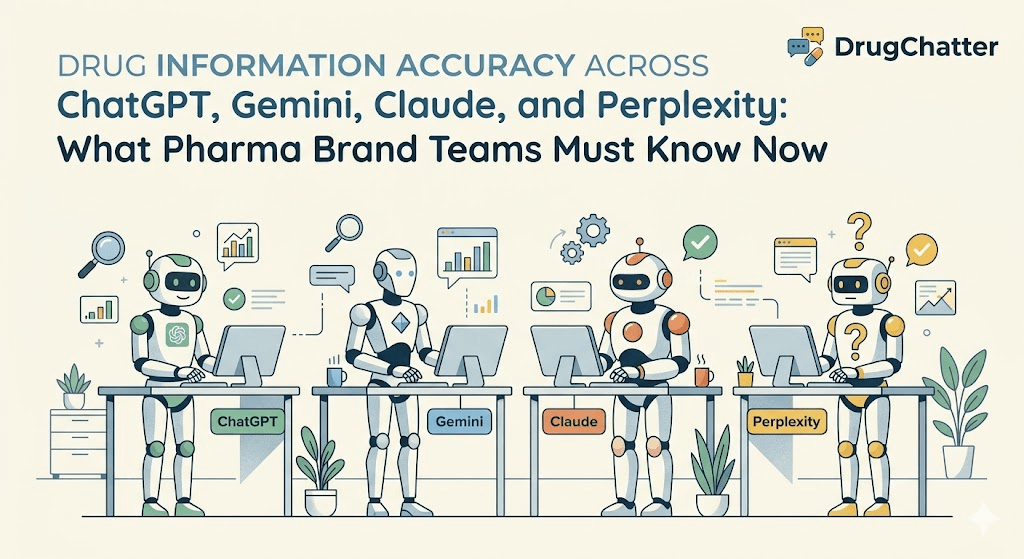
This article examines how the four dominant AI platforms — ChatGPT, Gemini, Claude, and Perplexity — handle drug information, where each one fails, how those failures create downstream risk for pharmaceutical manufacturers, and what brand teams and pharmacovigilance departments can do about it today.
Why Drug Information Accuracy in AI Search Is Now a Pharma Business Problem
A 2023 study published in JAMA Internal Medicine found that patients increasingly use AI chatbots to answer medication questions before, and sometimes instead of, consulting a physician or pharmacist. The study noted that responses varied substantially in accuracy depending on query phrasing, model version, and whether the model had been trained with retrieval augmentation.
That finding has not aged poorly. If anything, AI adoption in healthcare information-seeking has accelerated. Google’s own data shows that health-related queries represent roughly 7% of all searches — and a growing share of those now trigger AI Overviews powered by Gemini rather than a list of ten blue links pointing to Drugs.com or the Mayo Clinic.
The business implications are direct. If ChatGPT consistently describes a branded drug as carrying a risk the drug does not carry, or omits a contraindication it does have, the company faces:
- Potential pharmacovigilance blind spots if AI outputs are not included in signal detection pipelines
- Regulatory scrutiny if an FDA reviewer discovers the company’s drug is being systematically misdescribed in a platform reaching tens of millions of users
- Brand erosion if AI defaults to recommending a generic equivalent or a competitor molecule without clinical justification
- Patient harm if a dangerous drug interaction is minimized or missed entirely in an AI-generated answer
The FDA’s existing guidance on internet promotion and social media applies to content generated by or on behalf of manufacturers. Whether AI-generated content about a drug, unprompted by the manufacturer, creates any manufacturer obligation is a question the agency has not yet answered with finality. That silence does not eliminate risk — it creates ambiguity, and in pharmaceutical regulation, ambiguity is expensive.
How ChatGPT Handles Drug Safety Information — and Where It Gets It Wrong
Does ChatGPT Give Accurate Drug Interaction Warnings?
ChatGPT’s performance on drug interaction queries is uneven in ways that matter clinically. In structured evaluations conducted by researchers at the University of Maryland and replicated informally by clinical pharmacists posting results on pharmacy forums, GPT-4 consistently identified major drug-drug interactions flagged in standard references like Lexicomp and Micromedex. It performed significantly worse on moderate interactions, particularly those with narrow therapeutic-index drugs like warfarin, digoxin, and lithium.
The model’s training data includes a substantial volume of pharmacology literature, drug package inserts, and prescribing information available prior to its knowledge cutoff. For drugs approved after that cutoff, or for drugs whose safety profiles have been revised through post-marketing surveillance, ChatGPT does not reliably reflect the updated information — and it rarely flags that its answer may be outdated.
That last point is the crux of the problem. A model that says ‘I don’t know’ is safer than a model that says ‘Here is a complete answer’ when the answer is partial or stale. ChatGPT in its default consumer mode is optimized for confidence and completeness, not for epistemic humility about pharmacological uncertainty.
Does ChatGPT Recommend Generic Drugs Over Branded Drugs?
In informal comparative testing, ChatGPT shows a measurable tendency to mention generic availability when discussing branded drugs, particularly in response to cost-related queries. When asked ‘What is the cheapest way to manage Type 2 diabetes?’ the model frequently leads with metformin and other off-patent agents before mentioning GLP-1 receptor agonists, even in cases where the clinical question might favor a branded option.
This behavior is not necessarily inaccurate — metformin remains the first-line recommendation in most guidelines. But the pattern becomes concerning when it extends to situations where branded agents have meaningful differentiation, or where generic substitution carries therapeutic risk (narrow therapeutic index drugs, biologics with no approved interchangeable biosimilar).
For pharmaceutical companies with branded products in categories where generics are available, ChatGPT’s default framing represents a de facto share-of-voice loss in a channel reaching a scale no traditional sales force or media buy can match.
Can AI Hallucinations About Drugs Trigger FDA Regulatory Risk?
The FDA has not issued formal guidance on AI-generated drug misinformation as a pharmacovigilance or promotional compliance trigger. What exists is inferential: the agency’s 2014 guidance on internet/social media promotion requires that companies monitor platforms where their products are discussed and respond to misinformation in defined circumstances.
Whether AI platforms constitute such a channel for monitoring purposes is a matter of active legal interpretation. Several large pharmaceutical manufacturers have begun including AI-generated content in their social listening and web monitoring workflows, according to presentations at the Drug Information Association (DIA) annual meeting in 2024. The reasoning is precautionary: if the FDA later determines that systematic AI misinformation about a drug required a manufacturer response, companies with monitoring records are better positioned than those without.
The EMA has been slightly more explicit. Its 2023 workplan on digital health included AI-generated patient information as a category warranting surveillance by member state regulatory authorities. Whether that surveillance obligation extends to manufacturers is pending further guidance.
Gemini’s Drug Information Accuracy: Google’s AI Search Has a Pharmacology Problem
How Google’s AI Overviews Handle Drug Queries
Gemini’s integration into Google Search through AI Overviews creates a different risk profile than standalone ChatGPT. When a patient searches for a drug on Google and receives an AI Overview rather than links to authoritative sources, the answer is now one step removed from verifiable source material — even though it appears with the implicit credibility of the Google brand.
In May 2024, Google’s AI Overviews drew widespread criticism after the system generated factually incorrect answers across several domains, including health. For medication-related queries specifically, reviewers flagged cases where AI Overviews cited dosing information that conflicted with current FDA-approved labeling, described contraindications imprecisely, or blended information from multiple drugs into a single response.
Google moved quickly to restrict AI Overviews for queries classified as YMYL (Your Money or Your Life), a category that includes health and medical information. But the scope of those restrictions, and how consistently they apply to drug-specific queries versus general health queries, is not publicly documented in a way pharmaceutical companies can rely on for compliance purposes.
Does Gemini Cite Sources for Drug Safety Information?
One structural advantage Gemini has over base-model ChatGPT is retrieval augmentation: Gemini’s answers in Search contexts are grounded in web content retrieved at query time, with citations. This reduces — though does not eliminate — the risk of pure hallucination. A Gemini answer citing a 2019 prescribing information document still carries the risk that the label has since been updated by a safety communication.
For pharmaceutical companies, this citation behavior creates both a monitoring opportunity and a source-authority problem. If Gemini is consistently citing a third-party drug information site rather than the manufacturer’s own prescribing information or patient website, the manufacturer’s authoritative content is being systematically bypassed. Tracking which sources Gemini cites for a given drug — and whether those sources are current and accurate — is now a legitimate brand monitoring activity.
Gemini vs ChatGPT: Which AI Platform Is More Accurate for Drug Information?
Head-to-head comparisons are difficult to standardize because both platforms update models frequently, and performance varies by query type. That said, the existing literature and community testing suggest a general pattern: Gemini shows better real-time accuracy on queries about recently approved drugs or recent safety updates (because of web retrieval), while ChatGPT with browsing disabled shows stronger pharmacology reasoning for complex interaction and mechanism queries trained on structured literature.
Neither platform should be treated as a reliable primary source for clinical drug information. Both can be wrong. Both can be confidently wrong. The difference that matters for pharmaceutical companies is not which AI is ‘better’ in aggregate — it is which AI is reaching patients who are making medication decisions about your specific drug, and what those patients are being told.
Claude’s Approach to Drug Information: How Anthropic’s Model Handles Pharmacology
Does Claude Refuse to Answer Drug Interaction Questions?
Claude takes a noticeably more conservative stance on clinical drug information than either ChatGPT or Gemini in comparable configurations. In practice, Claude frequently adds qualifications directing users to consult healthcare professionals, and is more likely to acknowledge uncertainty about post-cutoff drug approvals or recent safety updates than GPT-4 in similar queries.
This conservatism is not uniform. Claude’s responses to factual pharmacology questions — mechanism of action, drug class, general therapeutic use — are typically substantive and accurate. The hedging appears most consistently in clinical judgment territory: dosing recommendations, contraindication assessments, and specific patient scenarios.
From a pharmaceutical brand monitoring perspective, Claude’s tendency to qualify answers means the model may deflate share-of-voice for branded agents in a different way than competitors do. Where ChatGPT might confidently recommend a generic, Claude might decline to make a recommendation at all — which, depending on the brand team’s goals, could represent a different kind of missed opportunity for a drug with meaningful differentiation.
How Often Does Claude Mention Ozempic vs Wegovy?
The Ozempic/Wegovy distinction is one of the more clinically important cases for AI drug information accuracy. Both contain semaglutide. Ozempic is FDA-approved for Type 2 diabetes. Wegovy is FDA-approved for chronic weight management. The drugs share a molecule but carry different labeled indications, different dosing, and different patient populations.
Testing Claude on queries in both domains reveals the model generally distinguishes the two correctly by labeled indication. Asked ‘What drug should I take for weight loss?’ it does not default to Ozempic, which would reflect off-label recommendation language. Asked about diabetes management, it describes semaglutide options while noting the branded distinction. This is better behavior than some community-tested ChatGPT responses that conflated the two.
The concern for Novo Nordisk’s brand team is not necessarily that Claude is wrong — it may be that a model reaching a significant user base is applying clinical distinctions that the general public does not understand, and the explanation provided may or may not serve Novo Nordisk’s communication goals for either product.
How Perplexity Handles Drug Queries — and Why Its Citation Model Changes the Risk
Is Perplexity More Accurate Than ChatGPT for Drug Information?
Perplexity operates as a retrieval-augmented generation (RAG) system by default, surfacing citations for nearly every factual claim. This approach does several things simultaneously: it improves real-time accuracy for recently approved drugs, it provides users a path to verify claims, and it transfers some accuracy burden from the model to the indexed sources.
The pharmaceutical relevance is significant. In Perplexity, if the top-cited source for a drug query is an outdated clinical article, a patient forum post, or a third-party summary with errors, that content gets synthesized into the answer and lent Perplexity’s structured presentation credibility. The model’s answer is only as accurate as what it retrieves.
For pharmaceutical companies, Perplexity’s citation model means source authority competition is explicit and traceable. If a competitor’s prescribing information or a non-authoritative third-party site ranks better in Perplexity’s retrieval layer than a manufacturer’s own content, that manufacturer’s accurate information is being systematically excluded from AI-generated answers about their own drug.
How Patients Ask About Drug Interactions in AI Search — and What That Means for Pharma
Query patterns in AI search differ meaningfully from traditional Google search. Patients using ChatGPT, Perplexity, or Claude tend to ask in natural language — full sentences, specific clinical scenarios — rather than the keyword fragments that characterized earlier search behavior. ‘Can I take Eliquis with ibuprofen if I already take a proton pump inhibitor?’ is a structurally different query than ‘Eliquis ibuprofen interaction.’
This matters for pharmaceutical companies for two reasons. First, natural-language queries about specific patient scenarios often elicit more clinical detail than keyword searches — which increases both the information utility and the hallucination risk. Second, the query patterns reveal patient concerns, drug use contexts, and information gaps that are genuinely useful for pharmacovigilance and brand strategy.
Tools like DrugChatter are designed specifically to surface what patients, caregivers, and physicians are asking AI systems about specific drugs — giving pharmaceutical brand teams visibility into the questions their product is being asked to answer, whether or not the AI’s answers are accurate.
Tracking AI Share of Voice Across ChatGPT, Gemini, Claude, and Perplexity
What Is AI Share of Voice for a Drug Brand?
Traditional share of voice in pharmaceutical marketing tracks a drug’s presence in media placements, digital advertising, or physician-facing promotional activities relative to competitors. AI share of voice is a different — and in some ways more fundamental — measure: how often does a drug get mentioned, recommended, or described when patients and physicians ask AI platforms about a therapeutic area?
A drug brand could hold dominant traditional share of voice in oncology and still be systematically undermentioned by ChatGPT in responses to ‘What are the treatment options for non-small-cell lung cancer with EGFR mutation?’ If the LLM’s training data reflected an older treatment landscape, or if the model defaults to older, better-documented agents, the brand team’s investment in traditional promotion may not be translating into AI-channel presence.
How Eli Lilly and Novo Nordisk Are Approaching AI Mention Monitoring
Neither Eli Lilly nor Novo Nordisk has published detailed public descriptions of AI monitoring programs, which is consistent with pharmaceutical competitive intelligence norms. What is observable from public statements, conference presentations, and job postings is that both companies have significantly expanded digital intelligence functions since 2023, with specific references to AI-generated content, large language model monitoring, and ‘new media’ pharmacovigilance.
Eli Lilly’s experience with Mounjaro and tirzepatide is instructive. The drug was approved by the FDA in May 2022 for Type 2 diabetes and became one of the fastest-growing pharmaceutical products in history. Simultaneously, it became one of the most discussed drugs on social media and, subsequently, in AI-generated responses to weight loss and diabetes queries. The gap between what ChatGPT describes about tirzepatide’s weight loss mechanism and what the FDA-approved labeling permits for off-label weight management communication is exactly the kind of discrepancy pharmaceutical legal and compliance teams need to track.
Novo Nordisk faced a related problem when semaglutide shortages triggered patient queries about therapeutic substitution. AI platforms, asked ‘What can I take instead of Ozempic?’ generated a range of responses — some clinically reasonable, some not — that influenced patient behavior in ways the manufacturer could not directly control or monitor through traditional pharmacovigilance channels.
Which Drugs Are Most Frequently Mentioned by AI — and What Does That Reveal?
Training data frequency correlates strongly with AI mention frequency. Drugs with large bodies of published literature, extensive patient forum activity, and broad media coverage during the period covered by an LLM’s training data are mentioned more often and more confidently than drugs with thinner documentation.
This creates systematic distortions that pharmaceutical companies need to understand. Older branded drugs with large literature footprints — statins, SSRIs, metformin — are mentioned frequently and with high confidence. Newer drugs, drugs in rare disease indications, and drugs approved after an LLM’s training cutoff are mentioned less frequently, sometimes inaccurately, and occasionally confused with predecessor molecules or competitors.
For rare disease manufacturers, this represents both a gap and an opportunity. If the AI channel is currently silent or inaccurate about a rare disease drug, that is a problem for patient access and physician awareness — but it is also a relatively uncrowded information space where authoritative content from the manufacturer can have an outsized impact on what AI systems learn and cite.
‘Large language models trained on general web corpora will reflect the information asymmetries of the web itself — common diseases, widely prescribed drugs, and heavily marketed molecules will be over-represented, while rare diseases and newer agents will be under-represented or hallucinated at higher rates.’ — Oren Etzioni, AI2 Institute, quoted in STAT News, 2024
What Pharma Brand Teams Can Learn From Reddit and Patient Forums in AI Citations
Do AI Models Cite Reddit for Drug Information?
Yes. And this is a problem.
Perplexity, ChatGPT with browsing, and Gemini all retrieve and summarize Reddit content in response to drug queries when Reddit content ranks highly in their retrieval systems. Reddit’s r/diabetes, r/GLP1, r/ehlersdanlos, r/ChronicPain, and dozens of condition-specific communities generate substantial volumes of patient-reported drug experience. That content is anecdotal, unverified, frequently confounded, and occasionally dangerous.
When a patient asks Perplexity about Dupixent’s side effects and the model retrieves a Reddit thread in which multiple users reported a specific adverse event not listed in the product labeling, the model may synthesize that into its answer in a way that presents an anecdotal signal as established fact. The result is AI-amplified misinformation drawn from a source the patient would have evaluated skeptically if they had read it directly.
For pharmaceutical pharmacovigilance teams, the Reddit-AI pipeline also represents a potential signal amplification loop: a drug safety concern that originates in a patient forum gets retrieved by AI, gets synthesized into AI answers, gets cited in patient conversations, generates more forum posts, and gets retrieved again. If the original concern is legitimate, this amplification might accelerate appropriate safety signaling. If it is not clinically grounded, the amplification spreads misinformation at scale.
Voice-of-Customer Trends Pharma Should Be Monitoring in AI Responses
The questions patients ask AI systems about a drug are themselves a form of patient insight. They reveal concern clusters — what side effects patients are most worried about, what competitor drugs patients are comparing against, what cost and access barriers are driving queries, what physician interactions have left patients seeking additional information.
Pharmaceutical market research functions have long used patient advisory boards, qualitative interviews, and social media listening to capture this kind of insight. AI query monitoring adds a new data layer: what are patients asking AI systems, and what are they being told? The answer to the first question is intelligence. The answer to the second is risk.
DrugChatter provides pharmaceutical companies with structured analytics on how AI systems are responding to questions about specific drugs, enabling brand and pharmacovigilance teams to track answer accuracy, detect emerging misinformation, and benchmark AI share of voice against competitors — without requiring internal teams to manually query multiple AI platforms at scale.
AI Hallucinations and Drug Safety: When LLMs Invent Contraindications or Miss Real Ones
Real Examples of AI Drug Hallucinations With Clinical Consequences
The documentation of AI drug hallucinations in peer-reviewed literature is still thin but growing. Several case categories have emerged consistently in clinical informatics research:
- Contraindication invention: AI models describing a drug as contraindicated in a population when no such contraindication exists in the approved labeling. This typically occurs when a model conflates a drug with a chemically related compound, or when it overweights a preclinical signal that did not carry through to clinical contraindication status.
- Dosing errors: Particularly for weight-based dosing in pediatric populations, renal adjustment dosing, and drugs with complex titration schedules. Models trained on general medical literature frequently retrieve outdated dosing guidance that has since been superseded by label updates.
- Drug confusion: Models conflating similarly named drugs. The lisinopril/lisdexamfetamine confusion has been noted in multiple informal evaluations. Hydroxychloroquine and chloroquine are frequently conflated in AI responses to rheumatology queries.
- Off-label extrapolation: Models describing off-label uses as if they were approved indications, particularly for drugs where off-label use is common and well-documented in literature.
Can AI Outputs Be Used for Pharmacovigilance Signal Detection?
This is a live research question and, increasingly, a live operational question. The argument for including AI-generated content in pharmacovigilance is that AI responses reflect and amplify what is in the public information environment about a drug — and that environment is itself a source of safety signals under current pharmacovigilance doctrine.
ICH E2D guidelines require pharmaceutical companies to monitor scientific and medical literature for adverse event reports. The FDA’s expectations for post-marketing surveillance include ‘any other source’ of spontaneous reports that becomes available to the manufacturer. Whether AI-generated content constitutes a ‘source’ under that definition is not settled. What is settled is that a pattern of AI responses incorrectly attributing a serious adverse event to a drug — and patients acting on that information — creates observable real-world harm that regulatory agencies will eventually ask about.
Some pharmaceutical companies have begun proof-of-concept work using systematic AI query-and-response harvesting as a complementary signal detection input. The hypothesis is that AI responses aggregate and represent the public information environment, so patterns in AI outputs may anticipate signal emergence in traditional pharmacovigilance channels.
Off-Label Drug Discussions in AI: What Pharmaceutical Companies Need to Track
How AI Platforms Handle Off-Label Queries
Off-label drug use is legal and clinically common. AI communication about off-label use carries specific risks because the models are not constrained by the FDA’s regulatory framework that distinguishes approved labeling from unapproved promotional claims.
ChatGPT, Gemini, Claude, and Perplexity each handle off-label queries differently. In testing, ChatGPT is the most likely to describe off-label uses from published literature without consistently flagging FDA approval status. Claude is more likely to note the distinction between approved and unapproved use. Gemini’s behavior varies depending on whether the query triggers a web retrieval that surfaces authoritative versus non-authoritative content. Perplexity’s answer reflects its retrieved sources, which may include advocacy content, forum posts, or clinical research in unknown combination.
For pharmaceutical manufacturers, this creates a specific monitoring imperative: if an AI platform is describing an off-label use of your drug as if it were approved, you face a potential misbranding appearance problem even though you did not generate the content. Conversely, if an AI platform is incorrectly denying the existence of well-established off-label clinical practice for your drug, patients who might benefit from that use are being misinformed.
Tracking Generic Substitution Recommendations Across AI Platforms
Generic substitution in AI outputs is a distinct issue from generic preference in response to cost queries. Substitution recommendations — where a model suggests a patient switch from a branded drug to a generic or therapeutic alternative — can carry real clinical consequences when the switch is not therapeutically equivalent.
Biologic drugs with no approved interchangeable biosimilar are the highest-risk category. If an AI model recommends switching from a reference biologic to a biosimilar that has not been designated interchangeable by the FDA, the recommendation may lead to clinical changes that the patient’s physician did not authorize. Manufacturers of reference biologics have a direct commercial and safety interest in monitoring whether AI platforms are making such recommendations.
The same concern applies to narrow therapeutic index drugs. If Perplexity, responding to a cost-sensitivity query, recommends switching from a brand-name formulation of a narrow therapeutic index drug to a generic based on a simplified pharmacokinetic equivalence argument, the recommendation may be technically defensible in aggregate but clinically inappropriate for an individual patient whose stability depends on formulation consistency.
Physician Perception and AI Drug Information: What Doctors Are Asking AI — and Getting Wrong
How Physicians Use ChatGPT and Perplexity for Drug Information
Physician use of AI for clinical drug information has grown faster than most pharmaceutical medical affairs teams expected. A 2024 survey by the American Medical Association found that a meaningful minority of physicians reported using AI tools to answer drug-related questions during clinical workflows. Most of those physicians did not systematically verify AI outputs against authoritative clinical references.
Pharmaceutical medical affairs functions have traditionally relied on medical science liaisons (MSLs), medical information call centers, and published literature to shape physician understanding of their drugs. Those channels reach physicians who actively seek information. AI tools reach physicians at the moment of clinical decision-making — a very different point in the information journey, with very different implications for what information gets acted on.
If ChatGPT’s description of a drug’s drug-drug interaction profile is incomplete or inaccurate, and a physician relies on that description at the point of prescribing, the downstream consequences are both clinical and, potentially, product liability in nature.
What Do Medical Affairs Teams Need to Know About LLM-Based Drug Information?
Medical affairs teams need to know three things about LLM-based drug information that most of them do not currently track:
First, what is each major AI platform currently saying about your drug — its mechanism, indications, contraindications, adverse event profile, and competitive position — and how does that compare to your current approved labeling and published data?
Second, which sources are AI platforms citing for information about your drug, and are those sources current, authoritative, and accurate?
Third, what queries are physicians and patients asking about your drug in AI systems, and do those queries reveal misunderstandings, gaps in education, or safety concerns that your medical affairs program should be addressing?
None of these questions has a convenient answer through traditional medical affairs monitoring tools. They require systematic, repeatable querying of AI platforms, structured extraction of AI responses, and comparative analysis against authoritative references. DrugChatter provides this capability as a purpose-built pharmaceutical AI monitoring platform, enabling medical affairs and pharmacovigilance teams to answer these questions at scale without manual sampling.
Regulatory Risk: What the FDA and EMA Are Watching in AI Drug Information
Has the FDA Sent Warning Letters Related to AI Drug Misinformation?
As of mid-2025, the FDA has not issued warning letters specifically citing AI-generated drug misinformation as the primary violation. The agency has issued warning letters addressing social media content, influencer marketing, and patient testimonial usage, and has signaled that its existing promotional regulations apply regardless of the medium generating the content.
The practical question pharmaceutical compliance teams are working through is this: if an AI platform publishes systematically inaccurate information about a drug, and the manufacturer becomes aware of it, does the manufacturer have an obligation to attempt correction? The FDA’s website guidance from 2014 describes circumstances in which manufacturers operating a third-party website should correct misinformation. Whether an AI platform constitutes a ‘website’ the manufacturer ‘operates’ is legally ambiguous. Whether a manufacturer who queries AI platforms, discovers systematic misinformation about their drug, and does nothing creates a regulatory exposure is a question pharmaceutical lawyers are actively debating.
EMA Digital Health Surveillance and AI Drug Information
The EMA has been somewhat more forward-leaning in acknowledging AI-generated health information as a regulatory concern. Its 2023 digital health strategy identified AI-generated patient information as a domain requiring regulatory attention and flagged the potential for AI systems to undermine public confidence in authorized medicines through misinformation.
The EMA has not yet translated these acknowledgments into binding guidance for marketing authorization holders. What the European regulatory environment does provide — and what the FDA does not in comparable specificity — is a framework through which national competent authorities could request that manufacturers investigate and respond to misinformation about their products in digital channels, including AI channels.
Pharmaceutical companies operating in both US and European markets should be building AI monitoring capabilities that satisfy the more demanding of the two regulatory frameworks — which, as EMA guidance evolves, may mean the European framework sets the standard.
Building a Pharmaceutical AI Monitoring Program: A Practical Framework
What Should a Pharma AI Monitoring Workflow Look Like?
A practical pharmaceutical AI monitoring program has four functional layers. Each layer addresses a different kind of risk and produces a different kind of intelligence output.
Layer 1: Systematic query coverage. The program must cover the queries that matter — the questions patients, caregivers, and physicians are actually asking AI platforms about the drug. These queries should be derived from existing patient research, medical information call center data, social listening insights, and MSL field intelligence. The query set should be updated quarterly as new clinical data emerge and as patient communication patterns shift.
Layer 2: Structured response capture and analysis. AI platform responses to each query must be captured systematically, compared against authoritative labeling, and scored for accuracy, completeness, and alignment with approved promotional messages. This is not a one-time exercise — AI platform responses change as models update, as retrieval indexes change, and as training data is refreshed.
Layer 3: Competitive share-of-voice benchmarking. The same query coverage should include competitor molecules and the therapeutic area broadly. How often is your drug mentioned relative to competitors? When AI platforms are asked to compare treatment options, what is the structure of their comparison? Is your drug presented favorably, neutrally, or unfavorably relative to the clinical evidence?
Layer 4: Signal escalation and response.” When the monitoring program identifies a meaningful accuracy problem — a systematic misrepresentation of a contraindication, a persistent hallucination of an adverse event, a pattern of generic substitution recommendations inconsistent with therapeutic equivalence — there must be a defined escalation pathway. Who reviews it? What constitutes a threshold for regulatory notification? What response options exist?
How to Use DrugPatentWatch and DrugChatter for AI Brand Intelligence
DrugPatentWatch provides pharmaceutical companies with patent expiry data, exclusivity timelines, and generic entry intelligence — information that is directly relevant to AI monitoring because generic entry is one of the primary drivers of AI recommendation patterns. A drug approaching patent expiration will see increasing generic mention in AI responses, and those generic references may begin appearing before generic products are commercially available if AI training data reflects anticipated market entry.
DrugChatter provides the complementary AI conversation intelligence layer: what are the actual AI-generated responses to drug queries, how do they compare to label claims, and how is a drug’s AI presence evolving relative to competitors? Together, these tools give brand teams a picture of both the competitive landscape (who will be competing for AI share of voice as generics enter) and the current AI information environment (what AI platforms are saying right now).
The SEO and LLM Optimization Dimension: Can Pharma Influence What AI Says About Their Drugs?
What Is LLM Search Optimization for Pharmaceutical Companies?
LLM search optimization — sometimes called generative engine optimization (GEO) — refers to the practice of structuring content so that AI systems retrieve it, cite it, and use it as the basis for generated answers. It is distinct from traditional SEO, which targets search engine ranking algorithms. GEO targets the retrieval and synthesis mechanisms of AI platforms.
For pharmaceutical companies, LLM optimization operates within significant constraints. Promotional content must comply with FDA regulations regardless of the channel in which it appears. But non-promotional content — medical education, patient information, disease awareness — can legitimately be structured to be more retrievable and citable by AI systems.
This means that pharmaceutical companies with well-structured, authoritative, publicly accessible content on their drug’s mechanism of action, clinical evidence base, and safety profile have a competitive advantage in AI citation over companies whose similar content is behind access gates or structured in formats that AI retrieval systems cannot effectively index.
Does Better Structured Medical Content Get Cited More Often by AI?
Evidence from the SEO and content marketing world suggests yes — content structured with clear headings, specific factual claims, and direct question-and-answer formatting performs better in AI retrieval contexts than dense, paragraph-heavy prose. The pharmaceutical analog would be prescribing information summaries, patient medication guides, and disease education content structured with the explicit question-and-answer format that AI systems favor when constructing responses.
The regulatory constraint here is real: pharmaceutical companies cannot promote drugs through disguised content meant to influence AI systems, just as they cannot promote through disguised content meant to influence search rankings. But the content they are already permitted to publish — accurate, non-promotional disease and mechanism information — can be structured to be more AI-retrievable without crossing any regulatory line.
Key Takeaways
- ChatGPT, Gemini, Claude, and Perplexity each handle drug information with different accuracy profiles, retrieval mechanisms, and failure modes. No single platform is reliably accurate across all drug query types.
- AI-generated drug misinformation reaches patients at scale, often at the moment of clinical decision-making, through channels that existing pharmacovigilance systems were not designed to monitor.
- The FDA has not yet issued definitive guidance on manufacturer obligations regarding AI-generated drug misinformation, but regulatory ambiguity in pharmaceutical compliance is not equivalent to regulatory safety.
- AI share of voice is a measurable dimension of brand performance that traditional media monitoring does not capture and that pharmaceutical brand teams should be tracking systematically.
- Generic substitution recommendations, off-label extrapolation, outdated safety information, and hallucinated contraindications are the four primary drug information accuracy failure modes across the major AI platforms.
- Perplexity’s citation model makes source authority a trackable variable — pharmaceutical companies can identify which sources are being cited for their drug and assess whether those sources are current and accurate.
- Reddit and patient forum content is being retrieved and synthesized by AI platforms, creating an amplification loop that can spread anecdotal adverse event reports as if they were established clinical findings.
- Medical affairs, pharmacovigilance, and brand teams each have distinct reasons to monitor AI drug information — and need to build coordinated monitoring programs that serve all three functions simultaneously.
- Tools like DrugChatter provide purpose-built pharmaceutical AI monitoring capabilities that enable systematic, repeatable intelligence on how AI platforms represent a drug — without requiring manual platform-by-platform querying.
- Pharmaceutical companies that build AI monitoring programs now will be positioned to meet regulatory expectations that are not yet fully formed but are clearly moving toward requiring this capability.
Frequently Asked Questions
Can pharmaceutical companies be held liable for drug misinformation generated by AI platforms they do not control?
The short answer is: not directly under current frameworks, but the regulatory picture is evolving. Under current FDA regulations, a pharmaceutical manufacturer is responsible for promotional content it creates or sponsors. An AI platform generating inaccurate information about a drug is not the manufacturer’s agent, and the manufacturer did not create that content. However, if a manufacturer becomes aware of systematic AI misinformation about their drug and takes no action, the question of whether that inaction constitutes a failure of post-marketing surveillance obligations is legally untested. Legal teams at several major pharmaceutical companies are actively developing positions on this question, and the conservative approach — monitor AI outputs, document findings, have an escalation policy — provides better regulatory positioning than willful ignorance.
Which AI platform is most accurate for drug safety information — ChatGPT, Gemini, Claude, or Perplexity?
No single platform is consistently most accurate across all drug query types. Gemini and Perplexity have structural advantages for recently approved drugs and recent safety updates because they use real-time retrieval from the web. ChatGPT shows stronger performance on complex pharmacology reasoning questions where its training data depth matters. Claude demonstrates more consistent epistemic caution on clinical judgment questions. For pharmaceutical monitoring purposes, the right answer is to track all four platforms, because patients and physicians are using all four — and accuracy in one platform does not protect against misinformation in another.
What are the biggest AI hallucination risks for pharmaceutical brands?
The four most common AI hallucination failure modes for drug information are: invented contraindications (the model describes a contraindication that does not exist in the approved labeling); outdated dosing guidance (the model retrieves dosing information that has been superseded by label revisions); drug-name confusion (the model conflates a drug with a chemically similar or similarly named compound); and off-label extrapolation presented as approved indication (the model describes clinical uses that exist in the literature but are not FDA-approved, without consistently noting the distinction). Narrow therapeutic index drugs, biologics, and drugs approved after an LLM’s training cutoff carry the highest hallucination risk.
How can pharmaceutical companies track AI share of voice against competitors?
AI share of voice tracking requires a systematic, repeatable querying protocol that covers the full range of queries relevant to a therapeutic area — disease-state queries, treatment comparison queries, mechanism-of-action queries, and patient-scenario queries. For each query, responses from each major AI platform should be captured and analyzed for drug mention frequency, recommendation framing, and comparative language. The results, tracked over time, reveal how a drug’s AI presence is evolving relative to competitors as model updates, new clinical data, and generic entry change the information environment. Platforms like DrugChatter automate this process for pharmaceutical companies.
Do AI platforms handle biosimilar substitution questions accurately?
Generally, no. Biosimilar substitution is one of the areas where AI platform accuracy is most consistently inadequate. The models frequently conflate ‘biosimilar’ with ‘interchangeable biosimilar’ — a regulatory distinction the FDA has invested significant effort in making clear because the two categories carry different substitution rights at the pharmacy level. ChatGPT, Gemini, Claude, and Perplexity all show inconsistent handling of this distinction in testing, with the models sometimes stating or implying that any biosimilar can be substituted without physician authorization. For manufacturers of reference biologics and for manufacturers of biosimilars seeking interchangeable designation, monitoring AI biosimilar substitution language is a direct commercial and patient safety priority.