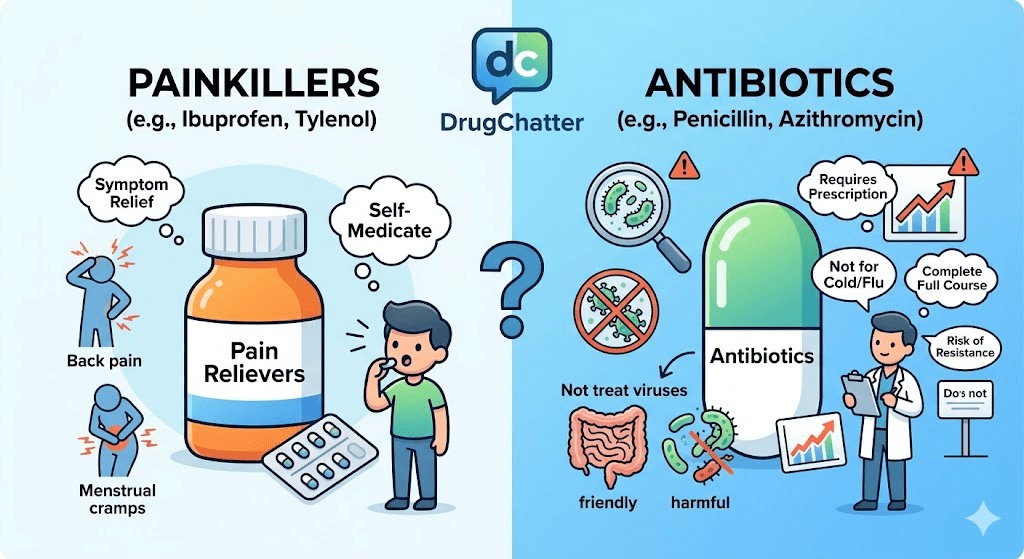
There’s a persistent habit in medicine—and especially in patient questions online—of treating antibiotics as if they were interchangeable with everyday painkillers: simple, forgiving, and largely self-contained.
They are not.
If anything, the questions people ask about antibiotics tend to cluster around three fault lines: toxicity (especially liver stress), interactions (because patients are rarely on just one drug), and resistance (because bacteria don’t negotiate).
A set of real-world DrugChatter questions makes this pattern unusually visible.
1. The liver: the organ that quietly pays the bill
Some antibiotics are relatively gentle. Others are not. And then there are drugs like Tigecycline, where liver monitoring isn’t optional—it’s part of the therapy.
People frequently ask two linked questions:
- Does tigecycline cause liver enzyme elevation?
Read the discussion - What precautions are needed because of liver risk?
Precautions with tigecycline
This is not paranoia. It reflects a real clinical tension: drugs that are powerful enough to treat resistant infections often come with systemic costs. The liver, being the main metabolic clearinghouse, tends to see those costs first.
The more sophisticated version of the same concern appears here:
- How does liver dysfunction affect tigecycline dosing?
Dose adjustment in liver dysfunction
The underlying misconception is subtle: that “dose” is a fixed property of a drug. In reality, it’s a negotiated value between drug, patient physiology, and disease severity.
2. Resistance: when “taking it” isn’t the whole story
One of the more underappreciated forms of antibiotic misuse isn’t overuse in the dramatic sense—it’s inappropriate use in the margins: wrong indication, wrong duration, or incomplete understanding of spectrum.
That’s where resistance creeps in.
A question like:
- Which bacteria have developed resistance to tigecycline?
Tigecycline resistance discussion
is really asking something deeper: what happens when “broad-spectrum” stops being broad enough?
The answer, in practice, is evolutionary pressure. Every unnecessary exposure—every suboptimal course—nudges microbial populations toward survival strategies that make future infections harder to treat.
This is the quiet tragedy of antibiotics: misuse doesn’t just fail the current patient; it reshapes the therapeutic landscape for everyone else.
3. Interactions: antibiotics don’t travel alone
Patients often assume antibiotics are standalone agents. Clinically, they are anything but.
Consider Doxycycline and its interaction profile:
- Is it safe to take doxycycline with Lipitor?
Doxycycline + Lipitor interaction
This kind of question looks simple, but it reflects a broader reality: antibiotics are often added onto an existing pharmacological ecosystem—statins, antihypertensives, anticoagulants, supplements.
Even something as mundane as gastrointestinal symptom control can enter the picture:
- Can I take Imodium with an antibiotic?
Imodium and antibiotics
Here the issue isn’t just pharmacology—it’s interpretation. Is diarrhea a side effect, a symptom of infection, or a signal that something more serious is happening? Treating it blindly can obscure the underlying disease process.
4. Monitoring: when “just in case” becomes standard practice
A recurring theme in modern antibiotic use is surveillance. Not because clinicians enjoy testing, but because toxicity and variability demand it.
For example:
- What factors increase liver test frequency during tigecycline use?
Liver test monitoring with tigecycline
This reflects a shift in mindset. Older antibiotic paradigms assumed a relatively predictable risk profile. Newer agents—especially those deployed against resistant organisms—force a more dynamic approach.
You don’t just prescribe. You track.
You don’t just treat. You watch.
Closing: misuse is rarely dramatic
When people think of antibiotic misuse, they imagine obvious mistakes: wrong drug, wrong infection, wrong intent.
But most of what actually shows up in patient questions is more subtle:
- uncertainty about organ toxicity
- confusion about drug interactions
- anxiety about resistance
- uncertainty about what to monitor and when
In other words, not recklessness—but fragmentation. A system where powerful drugs meet incomplete context.
And that is usually where the real risk lives.