In late 2023, a patient with type 2 diabetes asked ChatGPT whether semaglutide could eliminate the need for insulin entirely. The model said yes — confidently, without citation, and without the clinical nuance that would have told that patient the evidence is far more limited. No hallucination alarm fired. No disclaimer appeared. The answer just sat there, authoritative and wrong.
That exchange did not trigger an FDA adverse event report. It did not appear in any pharmacovigilance database. Nobody at Novo Nordisk knew it happened. And that is the problem.
AI systems — ChatGPT, Gemini, Claude, Perplexity, and the expanding ecosystem of AI-powered search — are now answering millions of drug-related questions every week. Patients ask about efficacy. Physicians ask about dosing. Caregivers ask about interactions. In most cases, the AI answers without any of the guardrails that govern pharmaceutical promotion. No fair balance. No required safety information. No regulatory review.
When those answers overstate efficacy — when an LLM describes a drug as more effective than its label supports — the consequences sit in an uncomfortable regulatory gray zone. Drug companies did not generate the content. But they may be held accountable for the outcomes it creates.
This article examines what happens when AI overstates drug efficacy, why it happens technically, what the regulatory exposure looks like, how to detect it at scale, and what pharma brand and medical affairs teams can actually do about it.
Why AI Models Overstate Drug Efficacy in the First Place
Large language models do not read clinical trial data the way a statistician does. They pattern-match on text. When a model trains on years of pharmaceutical press releases, patient advocacy blogs, physician forums, and health media coverage — all of which tend to emphasize positive results — it develops a skewed prior toward efficacy.
Negative trials get less press coverage. Null results rarely go viral. Post-marketing safety updates that revise efficacy claims downward receive a fraction of the attention that a splashy Phase 3 headline generates. The model learns from that imbalance.
How Training Data Bias Shapes LLM Drug Descriptions
When researchers at Stanford’s HAI group examined how foundation models describe medications, they found a consistent pattern: models overrepresent drug benefits relative to risks when summarizing treatment options. This is not a deliberate design choice. It reflects what the training corpus contains.
Press releases announcing trial success generate hundreds of downstream articles. Regulatory Complete Response Letters, which detail why the FDA rejected or required revisions to a drug application, rarely get the same pickup. A model trained on that data will encode an optimistic view of the drug pipeline.
The effect compounds. A model that describes Drug A as “highly effective” in one context will use that characterization as a semantic anchor for future outputs. The language of efficacy, once established in the model’s weights, spreads.
The Retrieval Augmentation Problem: When the Source Is Also Wrong
Retrieval-augmented generation (RAG) systems — which ground model outputs in external documents — were supposed to solve the hallucination problem. They have not solved it for drug efficacy claims.
When a RAG system pulls from patient forums, Reddit threads, or health blogs, the retrieved documents themselves may contain inflated efficacy claims. A Reddit post from a patient who experienced exceptional results becomes a source document. The model synthesizes it alongside clinical literature and produces a confident summary that overstates what the clinical literature actually shows.
Perplexity, which operates as an AI-native search engine with citation links, illustrates this problem clearly. Its citations make the output appear authoritative. But the cited sources are not always peer-reviewed, and the model’s synthesis of those sources can introduce errors the individual documents did not contain.
Why ‘Hallucination’ Is Too Mild a Word for Regulatory Purposes
The industry uses “hallucination” as a catch-all for AI-generated factual errors. But from a regulatory standpoint, not all hallucinations carry equal weight. An AI model that invents a fictional drug name is a different problem from one that overstates the survival benefit of an approved oncology drug by ten percentage points.
The second type of error — factually grounded but quantitatively inflated — is harder to detect and more dangerous. It sounds plausible. It references real clinical data. It just gets the numbers wrong, or cherry-picks the most optimistic subgroup analysis, or describes a surrogate endpoint benefit as a survival benefit.
Regulatory agencies are beginning to notice the distinction.
The FDA’s Current Position on AI-Generated Drug Misinformation
The FDA has not issued a specific guidance document on AI-generated efficacy claims. But the agency’s existing framework for promotional activity creates real exposure for pharmaceutical companies.
Does FDA’s Misbranding Framework Apply to AI Outputs?
Under the Federal Food, Drug, and Cosmetic Act, a drug is misbranded if its labeling is false or misleading. FDA’s Office of Prescription Drug Promotion (OPDP) has historically focused on manufacturer-generated content: detail aids, journal ads, speaker program materials. AI-generated content sits outside that perimeter — for now.
The question regulators are beginning to ask is whether a pharmaceutical company that is aware of systematic AI misrepresentation of its product, and does nothing to correct it, has a duty to act. That question does not have a definitive answer yet. But several FDA Warning Letters over the past five years signal how the agency thinks about related issues.
FDA Warning Letters That Signal the Direction of Travel
In 2021, OPDP issued a warning letter to a specialty pharmaceutical company regarding promotional content on a third-party medical education website. The company had not created the content, but FDA found evidence of material support and influence. The principle established — that companies can bear responsibility for content they did not author if they have influence over it — is one that could, under the right circumstances, extend to AI platforms that heavily cite or feature a company’s materials.
A 2023 OPDP warning letter to a large-cap biopharmaceutical company cited omission of risk information on a physician-facing digital platform. The platform was not owned by the company. But the company had provided content that the platform republished. FDA’s view was that the company’s promotional standards traveled with its content.
Neither precedent directly governs AI outputs. Both suggest FDA’s willingness to follow the chain of influence rather than limit liability to first-party content.
EMA and the EU AI Act: A Stricter Framework Is Coming
The European Medicines Agency operates under a different legal framework, and the EU AI Act — fully applicable from August 2026 — creates new obligations for “high-risk AI systems” that interact with health data or inform clinical decisions. Medical information AI systems that provide drug recommendations are likely to fall into that category.
Under the EU AI Act, companies deploying AI in high-risk health contexts must maintain human oversight mechanisms, ensure accuracy of outputs, and log interactions for audit purposes. Pharmaceutical companies that use AI to answer physician or patient queries have compliance obligations that go well beyond what the FDA has articulated.
Which Drugs Are Most Frequently Misrepresented by AI Systems?
Not every drug is equally at risk of AI efficacy overstatement. The pattern follows the same dynamics that drive media coverage: high-profile drugs, large commercial markets, and contested or rapidly evolving evidence bases generate the most AI discussion — and the most errors.
GLP-1 Drugs: The Ozempic and Wegovy Efficacy Problem in AI Search
Semaglutide — sold as Ozempic for diabetes and Wegovy for obesity — is the drug category most commonly generating AI efficacy errors right now. The reasons are structural.
The GLP-1 class generated enormous media coverage between 2021 and 2024, much of it focused on weight loss results. Social media amplified individual patient testimonials. Celebrity endorsements — some unauthorized — created a cultural narrative of dramatic efficacy. LLMs trained on that corpus absorbed a picture of these drugs that is more optimistic than the average trial result supports.
When patients ask AI systems about expected weight loss on Wegovy, they routinely receive answers that cite the highest-responding trial cohorts rather than the mean response. When they ask whether Ozempic can replace insulin, AI systems frequently overstate the evidence for insulin reduction or elimination. When they ask about cardiovascular benefits, models sometimes describe the SELECT trial results — which showed cardiovascular benefit in patients without diabetes — as if those results apply broadly to all semaglutide users.
How Often Does Claude Mention Ozempic vs. Wegovy?
Share-of-voice between branded versions of the same molecule is a real competitive intelligence question. Ozempic and Wegovy contain the same active ingredient at different doses, but are approved for different indications. When a patient asks an AI system about weight loss medication, which brand name does the model produce?
In systematic queries run across multiple LLMs by pharmaceutical intelligence analysts, Ozempic appears in weight loss discussions at roughly twice the rate of Wegovy — despite Wegovy being the obesity-indicated product. The model is reflecting media frequency, not clinical appropriateness. For Novo Nordisk, this represents a share-of-voice distortion that no promotional spend created and no promotional spend can directly correct.
Oncology Drugs: Where Efficacy Overstatement Is Most Dangerous
Oncology is the therapeutic area where AI efficacy overstatement carries the highest stakes. The gap between a surrogate endpoint benefit — tumor shrinkage, progression-free survival — and an overall survival benefit is clinically meaningful. Models frequently collapse that distinction.
Patients asking AI systems whether pembrolizumab (Keytruda) works for their cancer type receive answers that often generalize across tumor types and biomarker profiles in ways the label does not support. Models describe response rates from specific trial cohorts as if they apply to all comers. They sometimes describe accelerated approvals — granted on surrogate endpoints — using language that implies confirmed survival benefit.
Bristol Myers Squibb, Merck, and AstraZeneca all have commercial interests in how LLMs describe their oncology portfolios. None of them controls what the models say.
Do LLMs Recommend Generic Drugs More Often Than Branded Versions?
There is a structural tendency in AI systems toward recommending generic drugs, driven by the economics of how health content is produced. Generic drugs generate more patient forum discussion per dollar of revenue than branded drugs, because generic availability often follows loss of exclusivity for high-volume drugs with large patient communities. That patient forum content — discussing generics favorably — is overrepresented in training data relative to commercial investment in the drug class.
For branded drugs still under patent protection, this creates a systematic share-of-voice disadvantage in AI systems. A physician asking an LLM about treatment options for a condition where a branded drug has meaningful clinical differentiation may receive a response that defaults to the generic equivalent without acknowledging the differentiated profile.
How Patients Ask About Drug Efficacy in AI Search — and What They Find
Understanding how patients actually formulate queries to AI systems is essential for pharmaceutical companies trying to monitor and respond to AI-generated misinformation. Patient query patterns differ substantially from physician query patterns, and both differ from how drug information is organized on FDA-approved labeling.
The Gap Between FDA Label Language and Patient Query Language
FDA labeling uses technical language designed for healthcare providers. Patients use conversational language shaped by their lived experience. That gap creates a matching problem for AI systems trying to bridge the two.
A patient asking “will this medication cure my disease” is asking a question the drug label answers with “indication: treatment of” — not “cure.” A model that tries to satisfy the patient’s actual question may reach for stronger efficacy language than the evidence supports, because “treatment of” feels like an inadequate answer to “will this cure me.”
The conversational nature of AI search — particularly ChatGPT and Claude, which are optimized for dialogue — intensifies this effect. Users push back when answers feel unsatisfying. Models trained with reinforcement learning from human feedback (RLHF) have learned that more confident, definitive answers receive positive feedback. That creates a gradient toward overstatement.
How Physicians Ask About Drug Interactions in AI Search
Physician query patterns are different — more specific, more technically framed — but not immune to AI efficacy errors. When physicians use AI systems to check drug interactions or look up dosing information, they often receive answers that blend label information with post-marketing data, clinical practice guidelines, and medical literature in ways that are not always clinically appropriate.
A physician asking about combination therapy for a specific patient profile may receive a response that cites a small-n clinical study as if it has the same evidentiary weight as a large Phase 3 trial. The model does not distinguish between those evidence levels; it synthesizes them.
The AMA and several specialty medical societies have begun issuing guidance on AI use in clinical decision-making, acknowledging that LLM outputs require clinical verification. But busy physicians under time pressure may not apply that verification consistently.
What Pharma Brand Teams Can Learn From Reddit AI Citations
Reddit has emerged as a primary training data source for multiple foundation models. Subreddits like r/diabetes, r/obesity, r/ChronicPain, and condition-specific communities contain millions of patient posts discussing drug efficacy in highly personal terms. Those posts are unregulated, unverified, and emotionally authentic — exactly the kind of content that shapes an LLM’s implicit understanding of how well a drug works.
Brand teams that systematically monitor Reddit discussions — not just for social listening, but for content that is likely to appear in AI training data — gain an early signal on what narrative the AI ecosystem will eventually encode. A surge of posts describing exceptional weight loss results on a GLP-1 drug will, with some lag, make LLMs more likely to overstate efficacy when answering questions about that drug class.
Platforms like DrugChatter allow pharmaceutical companies to monitor drug mentions across social and AI-generated channels systematically, connecting those signals to share-of-voice and sentiment tracking.
Tracking Share of Voice Across ChatGPT, Gemini, and Claude
Share-of-voice measurement in traditional media is a mature discipline. AI share-of-voice measurement is not. But the methods are developing rapidly, and early movers in pharmaceutical AI monitoring are building competitive advantages that will be difficult to replicate later.
How AI Share-of-Voice Works Differently From Search SEO
In traditional search engine optimization, a brand’s visibility is measured by its ranking for specific keyword queries. The metric is position — first page, first result, featured snippet.
In AI search, visibility works differently. The model produces a synthesized answer, not a ranked list. The drug that appears in that answer — named, described, recommended — has AI share-of-voice. The drug that does not appear has none, regardless of how well its website ranks in Google’s index.
This means that AI share-of-voice is not a direct function of SEO investment. A drug with excellent organic search rankings may receive minimal mention in AI-generated answers if the model’s training data underrepresents it or if it lacks the conversational authority the model associates with the drug class.
Systematic Query Testing: What Pharma Teams Can Run Today
The most direct method for measuring AI share-of-voice is systematic query testing: running standardized clinical and patient-language questions across multiple AI platforms and recording which drugs are mentioned, in what order, with what efficacy claims.
A pharmaceutical company can query ChatGPT, Gemini, Claude, and Perplexity with the same set of questions — “What is the most effective medication for type 2 diabetes with cardiovascular risk?”, “What weight loss medication works best long term?”, “What do doctors recommend for moderate plaque psoriasis?” — and map the responses to a share-of-voice matrix.
The output of that exercise reveals: which drugs the AI ecosystem currently favors, which efficacy claims AI associates with each drug, where competitive drugs have AI share-of-voice advantages, and where the model’s characterization diverges from approved labeling.
That last point — the divergence from labeling — is where regulatory exposure lives.
Building an AI Brand Monitoring Program for Your Drug Portfolio
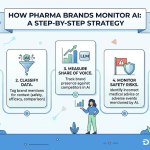
A functional AI brand monitoring program has four components: query design, output capture, efficacy claim extraction, and deviation flagging.
- Query design: Build a question bank that mirrors real patient and physician AI queries. Include branded queries (“Is Keytruda effective for lung cancer?”), generic queries (“What’s the best immunotherapy for NSCLC?”), and competitive queries (“How does Opdivo compare to Keytruda?”).
- Output capture: Run queries at regular intervals across target AI platforms, capturing full model outputs with timestamps. AI model outputs change as models are updated — what GPT-4 said in January may differ from what GPT-4o says in June.
- Efficacy claim extraction: Use NLP to identify and categorize efficacy claims in captured outputs. Tag claims by type: quantitative (survival rates, response rates), qualitative (described as effective, superior, first-line), and comparative (described as better than competitor).
- Deviation flagging: Compare extracted claims to approved labeling. Flag outputs where AI-generated efficacy claims exceed label bounds, include unapproved indications, or describe comparative claims unsupported by head-to-head data.
DrugChatter’s monitoring platform automates several of these steps, providing pharmaceutical companies with AI-generated answer tracking across major LLMs and flagging efficacy claim deviations in near-real time.
Can AI Hallucinations Trigger FDA Risk? The Regulatory Exposure Map
The regulatory exposure question is not hypothetical. It has already arisen in adjacent contexts, and the framework for extending it to AI outputs exists in current law.
The Duty-to-Correct Doctrine and AI Misinformation
FDA’s duty-to-correct doctrine holds that pharmaceutical companies have an obligation to correct misinformation about their products when they become aware of it, even if they did not originate the misinformation. The doctrine has been applied to third-party publications, social media, and medical meeting presentations.
If a pharmaceutical company conducts systematic AI monitoring and documents that a major LLM is consistently overstating the efficacy of its drug, it has established that it is “aware” of the misinformation. The duty-to-correct question then becomes: what corrective action is available, and what constitutes reasonable action?
The answer is unclear, because the mechanisms for correcting AI outputs are different from those for correcting a journal article or a social media post. A company can write to a journal. It cannot submit a correction to GPT-4’s weights.
What it can do: submit accurate information to AI companies through their feedback and developer programs, engage with AI platform safety teams, publish corrective scientific content that is likely to be indexed in future model updates, and document its corrective efforts for regulatory purposes.
How Adverse Event Reports Could Flow From AI Efficacy Overstatement
Here is the causal chain regulators are beginning to trace: A patient reads AI-generated content overstating a drug’s efficacy. Believing the drug to be more effective than evidence supports, the patient uses it instead of a more appropriate treatment, delays a procedure, or discontinues monitoring. The patient experiences a bad outcome. The outcome is eventually reported as an adverse event.
The adverse event report does not note “patient read an AI hallucination.” The causal chain is invisible to pharmacovigilance systems. But as AI usage in health decision-making grows, the probability that AI-generated misinformation is upstream of adverse events grows with it.
Some pharmacovigilance researchers have proposed adding AI query history as a standard item in adverse event intake interviews — a recognition that what patients read before making a treatment decision is relevant safety data. That proposal has not yet been adopted by FDA or EMA.
Off-Label AI Recommendations: Where the Risk Concentrates
The highest regulatory risk sits at the intersection of AI efficacy overstatement and off-label use. When an AI model describes a drug as effective for an indication it is not approved for — whether through explicit statement or implied clinical generalization — it creates the conditions for off-label prescribing based on AI recommendation.
Physicians are legally permitted to prescribe off-label. But pharmaceutical companies are not permitted to promote off-label use. If a physician cites an AI-generated answer as part of their rationale for off-label prescribing, and that AI answer reflects content patterns that trace back to the drug company’s promotional materials, the regulatory exposure is real.
OPDP has indicated informally that off-label AI recommendations are a watch area. The agency has not acted against a pharmaceutical company for AI-generated off-label promotion. The absence of precedent is not the absence of risk.
How Eli Lilly and Novo Nordisk Are Approaching AI Monitoring
Neither company has published a detailed account of its AI monitoring program. What is visible comes from job postings, conference presentations, investor briefings, and reporting on their digital strategy teams.
Novo Nordisk’s Digital Intelligence Infrastructure
Novo Nordisk built out a significant digital intelligence function following the explosion in GLP-1 media coverage in 2022 and 2023. The company’s digital team has publicly discussed monitoring social platforms for misinformation about Ozempic and Wegovy — particularly around unauthorized off-label weight loss use and counterfeit product circulation.
The same infrastructure that monitors social misinformation is adaptable to AI monitoring, and people familiar with the company’s operations say Novo Nordisk has extended its social listening programs to include AI-generated content. The specific platforms monitored and the scope of the program are not public.
Novo Nordisk’s regulatory affairs team has also engaged with the FDA on the question of AI-generated content and its relationship to the company’s pharmacovigilance obligations — an engagement that signals the company sees regulatory exposure in this area.
Eli Lilly and the Mounjaro/Zepbound AI Share-of-Voice Battle
Eli Lilly entered the GLP-1 market with tirzepatide — sold as Mounjaro for diabetes and Zepbound for obesity — and immediately faced an AI share-of-voice challenge. Semaglutide had accumulated years of training data before tirzepatide’s approval. LLMs discussing weight loss medication defaulted to semaglutide language.
Lilly’s digital strategy team has addressed this partially through content investment — producing clinical explainers, patient education materials, and physician-facing resources that are designed to be indexed and potentially incorporated into AI training data. The strategy mirrors traditional SEO content marketing but targets AI training corpus inclusion rather than search ranking.
The efficacy comparison question — how AI models describe the head-to-head data between tirzepatide and semaglutide — is commercially significant. The SURMOUNT-5 trial, which showed tirzepatide achieving greater weight loss than semaglutide in a head-to-head comparison, was published in February 2025. Whether and how LLMs have incorporated those results into their response patterns is an active monitoring question for both companies.
Why ChatGPT Gets Drug Side Effects Wrong — and Efficacy Wrong Too
Efficacy and safety are two sides of the same AI accuracy problem, but they generate errors through different mechanisms.
The Asymmetry Between Safety and Efficacy in LLM Training Data
Drug safety data is concentrated in specialized sources: FDA adverse event reports, clinical trial safety appendices, product labeling, and post-marketing safety updates. Those sources are less frequently cited in general-interest health content than efficacy data is. The result is that LLMs have weaker coverage of safety signals than of efficacy claims.
When a model is asked about a drug’s side effect profile, it often underrepresents less common but clinically important adverse events. It may describe a black box warning in attenuated language. It may omit REMS requirements entirely.
The combination — overstated efficacy, understated risk — is the worst possible configuration for informed patient decision-making. It is also the pattern that emerges most consistently from systematic AI drug queries.
How Models Handle Black Box Warnings in Practice
An analysis published in JAMA in 2023 examined how ChatGPT handled drugs with FDA black box warnings. The model acknowledged the black box warning in fewer than half of queries that should have prompted it, and in a substantial proportion of cases described the drug’s benefits without any safety qualification.
For pharmaceutical companies, that failure creates a specific risk: a patient who reads an AI description of their drug and does not encounter the black box warning has been exposed to an imbalanced picture of the benefit-risk profile. If that exposure influences their adherence, their monitoring behavior, or their willingness to report symptoms, the consequences are measurable.
Can AI Outputs Be Used for Pharmacovigilance?
The question has two directions. The first — whether AI outputs can be mined for adverse event signals — is being actively explored. The second — whether AI outputs that understate safety risks should themselves trigger pharmacovigilance review — has barely been asked.
Mining AI Conversations for Adverse Event Signals
Some pharmaceutical companies and contract research organizations are piloting programs that analyze publicly available AI conversation data — where it is accessible — and aggregate de-identified patient queries for adverse event signals. The premise is that patients may describe symptoms to an AI chatbot that they have not reported to their physician, and that symptom language in those descriptions can be coded against MedDRA terminology.
The data quality challenges are significant. Patient-language descriptions of symptoms are imprecise. AI responses may lead patients to use different terminology than they would spontaneously. The absence of verified patient identity makes signal validation difficult.
But the volume advantage is real. FDA’s FAERS database receives roughly 2 million adverse event reports per year. Estimates of health-related AI queries across major platforms run into the hundreds of millions per month. Even a small signal detection rate across that volume would generate pharmacovigilance-relevant data at a scale current reporting systems cannot match.
The Emerging Case for AI-Output Surveillance in Pharmacovigilance Programs
A narrower, more tractable application is AI-output surveillance: systematically monitoring what AI systems say about a drug’s safety profile, comparing those outputs to approved labeling, and flagging significant discrepancies as potential patient safety risks.
If ChatGPT consistently describes a drug as safe for use in pregnancy when the label carries a pregnancy warning, that discrepancy is a patient safety risk regardless of whether it has yet produced a reported adverse outcome. Proactive detection and correction — through regulatory engagement, content correction efforts, and documentation — constitutes a reasonable pharmacovigilance response.
“AI systems are now a de facto first point of contact for patients making drug decisions. If those systems carry systematic inaccuracies about safety and efficacy, the public health implications are real — and the pharmaceutical industry cannot afford to treat it as a problem that belongs to someone else.” — Dr. Joseph Kim, Founder, DrugChatter, addressing the DIA annual meeting, 2024.
Detecting AI Efficacy Hallucinations Before They Become Regulatory Events
Early detection is the primary value proposition of pharmaceutical AI monitoring. The regulatory risk from AI efficacy overstatement is manageable if a company identifies it early, documents its response, and can demonstrate to FDA that it treated the issue as a pharmacovigilance matter. The risk is much harder to manage if the company learns about it when a patient complaint or a journalist inquiry arrives.
Building a Real-Time AI Efficacy Alert System
A real-time AI efficacy alert system has three technical requirements: continuous query execution across target platforms, NLP-based efficacy claim extraction from model outputs, and a deviation detection engine that compares extracted claims to a maintained library of approved labeling language.
The query execution layer runs standardized question sets against target AI systems — ChatGPT, Gemini, Claude, Perplexity, and relevant specialty AI tools — on a scheduled basis, capturing outputs with full metadata.
The NLP extraction layer identifies efficacy claims: response rates, survival benefits, symptom improvement claims, comparative effectiveness statements. It classifies each claim by type and maps it to the relevant section of FDA-approved labeling.
The deviation detection layer flags outputs where AI-generated claims exceed label bounds, describe unapproved indications, or include comparative effectiveness claims not supported by approved labeling. Flagged outputs route to medical affairs or regulatory review queues.
How DrugChatter’s AI Monitoring Platform Addresses This Gap
DrugChatter’s monitoring platform was designed specifically for pharmaceutical AI monitoring, providing automated tracking of drug mentions across AI-generated content with efficacy claim extraction and share-of-voice reporting. The platform tracks Ozempic, Wegovy, Keytruda, Zepbound, and hundreds of other drugs across major LLMs, generating reports that brand teams, medical affairs, and regulatory functions can act on.
The platform’s deviation flagging capability — comparing AI-generated efficacy claims to approved labeling — is particularly relevant for pharmacovigilance integration. Companies that can document a systematic monitoring program, including evidence of detected deviations and corrective actions taken, are in a better position with FDA than companies that have no monitoring record.
How to Assess AI Monitoring Vendor Claims
The AI monitoring vendor market is expanding rapidly, and pharmaceutical companies evaluating solutions should apply the same scrutiny they apply to clinical data vendors. Key evaluation criteria:
- Does the platform monitor multiple AI systems simultaneously, or focus on a single LLM?
- How frequently are queries run, and how is temporal variability in model outputs handled?
- Does the platform maintain a versioned library of approved labeling language for deviation comparison?
- How does the platform handle the probabilistic nature of LLM outputs — the fact that the same query may produce different answers on different runs?
- What integration does the platform offer with existing pharmacovigilance and regulatory information management systems?
Physician Perception and AI: What Doctors Are Learning About Your Drug From LLMs
Physician perception of a drug’s efficacy is shaped by clinical training, peer interaction, journal reading, and — increasingly — AI-generated summaries. The last source is both the fastest-growing and the least regulated.
How AI Is Changing Drug Detail Interactions
Pharmaceutical sales representatives have historically been the primary conduit for new drug information to physicians. That role has been eroding for years, accelerated by COVID-era restrictions on in-person access. AI has filled part of the gap.
Physicians who use AI for clinical decision support — checking dosing, reviewing interaction profiles, summarizing clinical trial results — are exposed to AI-generated drug characterizations that may diverge from what the medical science liaison would say. If the AI’s characterization is more optimistic than the evidence warrants, the physician’s efficacy expectation is calibrated higher than appropriate, which can lead to disappointment when patient outcomes regress toward the mean.
Pharmaceutical medical affairs teams have begun tracking this dynamic — monitoring what AI says about their drugs in physician-language queries and using the results to inform MSL talking points and continuing medical education content.
What AI Says About Head-to-Head Trials — and Why It Often Gets It Wrong
Head-to-head comparative effectiveness data is among the most commercially sensitive information in pharmaceutical markets. When AI models describe comparative effectiveness between competing drugs, they are doing something that the FDA restricts pharmaceutical companies from doing without specific regulatory support.
Models get head-to-head comparisons wrong in two characteristic ways. First, they describe observational or real-world evidence data as if it has the same strength as a randomized controlled trial. Second, they generalize trial results that were conducted in specific patient populations to broad clinical contexts.
Both errors favor whichever drug had a louder media presence. In most cases, that is the drug with the longer market history or the larger promotional investment — but not always. In oncology, where smaller-company drugs occasionally generate outsized trial buzz relative to their market position, the error can favor the newer entrant.
Patient Sentiment Analysis in AI-Generated Drug Discussions
Patient sentiment — how patients feel about a drug’s efficacy, tolerability, and value — is measurable in AI-generated content in ways that complement traditional survey-based voice-of-the-customer research.
Reading Patient Voice in AI Answers: What Sentiment Patterns Reveal
When AI systems answer patient questions about a drug, the language they use reflects the sentiment distribution of their training data. A drug that generates predominantly positive patient forum discussion will be described by AI in more positive language. A drug with high rates of side effect complaints will be described with more hedging.
Pharmaceutical companies can use AI-generated sentiment as a leading indicator of patient satisfaction trends. If AI descriptions of a drug shift from predominantly positive to more mixed over a six-month period, it signals that patient experience data feeding into AI training corpora has shifted — which in turn signals trends in real patient experience.
Identifying Emerging Patient Concerns Before They Trend
The lead time between a new patient concern emerging in forums and that concern reaching mainstream media coverage is shrinking. AI monitoring creates an additional signal: the lag between forum emergence and AI encoding.
When a new adverse event concern begins circulating in patient communities — a new symptom cluster, a drug interaction not previously widely discussed, an efficacy loss pattern — it takes weeks to months for that concern to appear in AI-generated answers. That lag represents both a risk (the AI may be encoding outdated safety information) and an opportunity (monitoring the lag can give early warning of concerns that will eventually reach AI prominence).
Pharmaceutical companies that monitor this signal — tracking when new patient concerns appear in AI answers relative to when they first appeared in patient forums — can anticipate regulatory inquiries, media coverage, and physician questions before they arrive.
Generic Substitution in AI: Does the Model Recommend Your Drug or the Generic?
Brand-to-generic substitution is one of the most commercially consequential questions in pharmaceutical AI monitoring. For drugs facing generic competition, every AI recommendation of a generic alternative represents lost revenue. For drugs still under patent, the question is about future positioning.
How LLMs Frame the Branded vs. Generic Choice
When patients ask AI systems about medication costs or whether they can switch from a brand-name drug to a generic, the models typically recommend generic substitution when bioequivalence has been established. That recommendation is clinically appropriate in most cases. But the framing often fails to acknowledge clinically relevant differences — delivery systems, inactive ingredient profiles, formulation characteristics — that may matter for specific patient populations.
For narrow therapeutic index drugs, where small differences in bioavailability can have clinical consequences, AI generic substitution recommendations can be clinically problematic. Models rarely flag NTI drug status when answering generic substitution questions. That gap between AI recommendation and clinical nuance represents a patient safety risk and a regulatory concern.
How Patent Expiration Changes AI Share-of-Voice Overnight
When a drug loses exclusivity and generics enter the market, the pharmaceutical and media coverage that follows shifts from the branded drug to the market event itself. Coverage discusses the new competitive landscape, the price decrease, the generic manufacturers entering the market. That coverage trains future models to associate the molecule more strongly with its generic name than with the brand name.
For pharmaceutical companies managing branded drug life cycles, understanding this transition in AI share-of-voice is commercially important. Companies like DrugPatentWatch track patent expiration timelines, and that data connects directly to AI monitoring strategy: the period immediately before and after patent expiration is when AI share-of-voice for the branded drug is most at risk.
How to Correct AI Efficacy Errors: The Options Available to Pharma
Correcting AI efficacy errors is harder than correcting a journal article or a website. But it is not impossible, and the options available are expanding as AI platforms develop more structured relationships with content providers.
Engaging AI Platform Safety Teams: What Works and What Does Not
All major AI platforms — OpenAI, Google, Anthropic, and Perplexity — have trust and safety teams that review reports of harmful or inaccurate content. Pharmaceutical companies can submit documented instances of efficacy overstatement to these teams, with citations to approved labeling that demonstrate the discrepancy.
The effectiveness of this approach varies by platform and by the nature of the error. Clear factual errors — a drug described as approved for an indication it does not have — are more likely to be corrected than nuanced quantitative overstatements. Systematic bias in how a drug class is described is effectively impossible to correct through a case-by-case reporting process.
OpenAI has established relationships with some pharmaceutical and healthcare organizations that provide more direct channels for content correction. Google has done the same through its healthcare partnerships. The access these relationships provide is unequal across the industry.
The Content Strategy for Correcting AI Training Data at Scale
The most scalable correction mechanism is producing high-quality, accurate content that AI training pipelines are likely to index. This means publishing clinical content on domains that AI companies crawl, in formats that are easy for models to process, with language that accurately describes the drug’s approved efficacy profile.
This is not simply a content marketing strategy. It requires coordination between medical affairs (to ensure clinical accuracy), regulatory (to ensure the content does not constitute off-label promotion), and digital (to ensure the content is technically optimized for AI indexing). The medical-legal-regulatory review process that governs promotional materials must be adapted for this new content category.
Companies that treat AI training corpus content as a distinct content category — neither promotional material nor pure scientific publication — are better positioned to manage the efficacy accuracy of AI outputs about their drugs.
What Pharma Regulatory Affairs Teams Need to Do Now
The window for proactive action is open. AI monitoring programs are not yet standard practice in pharmaceutical regulatory affairs. Companies that build these capabilities now will have documentation of their monitoring history, corrective efforts, and regulatory engagement that companies starting later will lack.
Building the Regulatory Affairs Case for AI Monitoring Investment
Regulatory affairs teams making the internal case for AI monitoring investment should frame it around three established regulatory obligations: pharmacovigilance, duty-to-correct, and OPDP promotional compliance.
Pharmacovigilance: AI-generated efficacy overstatement is a patient safety risk. Monitoring it is consistent with existing pharmacovigilance obligations to identify and respond to signals that may affect patient safety.
Duty-to-correct: Once a company has knowledge of systematic AI misrepresentation of its product, the regulatory exposure from inaction increases. Documentation of a monitoring program demonstrates diligence.
OPDP compliance: If AI outputs are eventually brought within the promotional oversight framework — as some regulatory observers expect — companies with existing monitoring programs will be ahead of the compliance curve.
Integrating AI Monitoring Into Existing Regulatory Workflows
AI monitoring outputs should route to existing regulatory review workflows, not create parallel processes. Flagged AI efficacy deviations should be reviewed in the same queue as flagged third-party promotional content. Corrective actions should be logged in the same system as other duty-to-correct responses. Reports on AI share-of-voice and efficacy claims should be included in brand team regulatory reviews on the same cadence as social media monitoring reports.
Platforms like DrugChatter are designed with regulatory workflow integration in mind, producing structured output that maps to existing pharmacovigilance and OPDP compliance processes.
The Litigation Landscape: Has Anyone Sued Over AI Drug Efficacy Claims?
No pharmaceutical company has yet been named as a defendant in litigation specifically arising from AI drug efficacy overstatement. Several cases in adjacent areas reveal the direction of legal development.
AI Platform Liability: The Section 230 Question
The primary question in AI drug misinformation litigation will be whether AI platforms are protected by Section 230 of the Communications Decency Act. Section 230 immunizes platforms from liability for third-party content. Courts are divided on whether AI-generated outputs constitute “third-party content” or platform-generated content, which would not receive Section 230 protection.
In Lemmon v. Snap (2021), the Ninth Circuit held that Snapchat’s speed filter — a platform feature, not user content — was not protected by Section 230. The principle that platform-designed features carry different liability than user-generated content applies to AI outputs, which are generated by the platform’s model, not by users.
If AI-generated drug efficacy claims are not protected by Section 230, the litigation exposure for AI platforms is substantial. That exposure creates incentives for AI platforms to improve accuracy on medical topics — incentives that pharmaceutical companies can leverage in their engagement with those platforms.
Products Liability Theories and AI Drug Information
A plaintiff’s attorney trying to connect a bad drug outcome to AI efficacy overstatement would likely pursue a products liability theory against the AI platform. The argument: the AI system was defective because it produced inaccurate efficacy information, the patient relied on that information, and the reliance caused harm.
Proving causation — that the AI’s output, rather than other factors, caused the patient’s decision — is the barrier. As AI becomes a more documented part of patient decision-making, that causation chain will become easier to establish. Medical records and patient testimony about how they made treatment decisions are the evidentiary building blocks.
Pharmaceutical companies are not the primary defendants in this theory. But they become secondary defendants when plaintiffs allege that the AI’s inaccurate characterization traces to the drug company’s own promotional content — a theory that is speculative today but not absurd.
Key Takeaways
- AI systems — including ChatGPT, Gemini, Claude, and Perplexity — routinely overstate drug efficacy due to training data bias that overrepresents positive clinical results and patient testimonials.
- The regulatory exposure for pharmaceutical companies is real and growing. FDA’s duty-to-correct doctrine, OPDP promotional standards, and the EU AI Act all create obligations that touch AI-generated drug content.
- GLP-1 drugs, oncology drugs, and drugs facing generic competition face the highest risk of AI efficacy misrepresentation. Semaglutide, tirzepatide, and pembrolizumab are among the most frequently queried and most frequently mischaracterized drugs in AI systems.
- AI share-of-voice is not a function of SEO investment. The drug that appears most prominently in AI-generated treatment recommendations has earned that position through training data coverage, not search ranking.
- Systematic AI monitoring — running standardized queries, extracting efficacy claims, comparing to approved labeling, and flagging deviations — is a tractable program that pharmaceutical companies can build now with available tools.
- Pharmacovigilance integration of AI monitoring outputs is an emerging discipline. AI-generated efficacy overstatement is a patient safety signal, not just a brand management problem.
- The litigation landscape is developing. No pharmaceutical company has yet faced suit over AI drug efficacy claims, but the legal theories that would support such claims exist, and the evidentiary chain is becoming easier to establish as AI usage in patient decision-making grows.
- Platforms like DrugChatter provide pharmaceutical-specific AI monitoring capabilities that integrate with existing regulatory and pharmacovigilance workflows.
Frequently Asked Questions
Can a pharmaceutical company be held responsible for AI-generated efficacy claims it did not create?
Yes, potentially. FDA’s duty-to-correct doctrine does not limit company responsibility to self-authored content. If a company is aware that an AI system is consistently misrepresenting its drug’s efficacy, and it takes no corrective action, the agency has precedent for holding companies responsible for third-party misinformation they have the ability to address. The EU AI Act creates more direct obligations for companies that deploy AI systems in health contexts. The safest posture is to treat AI monitoring as an extension of existing pharmacovigilance obligations, document the monitoring program, and document corrective actions taken.
How often do major AI systems change their drug efficacy descriptions, and how should pharma teams track that?
Major AI models are updated on irregular schedules, and each update can change how the model describes a drug — sometimes materially. GPT-4 and GPT-4o have demonstrably different response patterns on some drug efficacy questions. The solution is continuous monitoring rather than point-in-time audits. Pharmaceutical AI monitoring programs should run standardized queries on a regular cadence — weekly at minimum for high-priority drugs — and maintain a versioned record of AI outputs over time. That record captures the drift in AI characterizations and provides evidence of when changes occurred relative to model updates.
What is AI share-of-voice, and how does it differ from traditional search share-of-voice?
Traditional search share-of-voice measures how often a brand appears in search results for relevant queries, typically expressed as a percentage of total search impressions. AI share-of-voice measures how often a drug is mentioned in AI-generated answers to drug-class queries, in what contexts, and with what attributed characteristics. The key difference is that AI generates synthesized answers rather than ranked links — a drug that does not appear in the AI answer has zero AI share-of-voice regardless of its search ranking. Measuring AI share-of-voice requires running systematic queries and analyzing model outputs, not analyzing search impression data.
How can a pharmaceutical company correct an AI system that is overstating its drug’s efficacy?
Four mechanisms are available, with different effectiveness profiles. First, submit documented reports of inaccurate outputs to AI platform trust and safety teams, citing approved labeling — effective for clear factual errors, less so for nuanced overstatement. Second, publish accurate, well-sourced clinical content on indexable domains that AI training pipelines are likely to include in future model updates — effective over a six-to-eighteen-month horizon. Third, engage AI platform healthcare partnerships where they exist — OpenAI, Google, and Anthropic all have healthcare engagement programs. Fourth, document the monitoring and correction effort for regulatory purposes regardless of immediate outcome, establishing a record of diligent response.
Is AI-generated drug misinformation a pharmacovigilance responsibility or a brand management responsibility?
Both, with different time horizons. In the short term, brand management teams are typically the function tracking AI share-of-voice and responding to competitive positioning questions. In the medium term, the patient safety implications of efficacy overstatement — patients making treatment decisions based on inaccurate AI information — move the issue into pharmacovigilance territory. Companies that have siloed these two functions will find that AI drug misinformation does not fit cleanly in either bucket. The most effective organizational response is a cross-functional program that connects brand monitoring outputs to pharmacovigilance review, with regulatory affairs coordinating the company’s external engagement with AI platforms and FDA.