When a patient types “is Ozempic safe for people with a history of pancreatitis?” into ChatGPT, the answer they receive wasn’t written by a physician, reviewed by a pharmacist, or cleared by a regulatory affairs team. It was generated in under two seconds by a large language model trained on a corpus of internet text, clinical literature, and patient forum discussions — none of which was curated for safety, accuracy, or therapeutic appropriateness.
That answer is now shaping patient behavior. It influences whether someone calls their prescribing physician to ask about switching drugs, whether they stop a medication mid-course, or whether they believe a generic substitute is “exactly the same” as the branded therapy their oncologist chose for a reason.
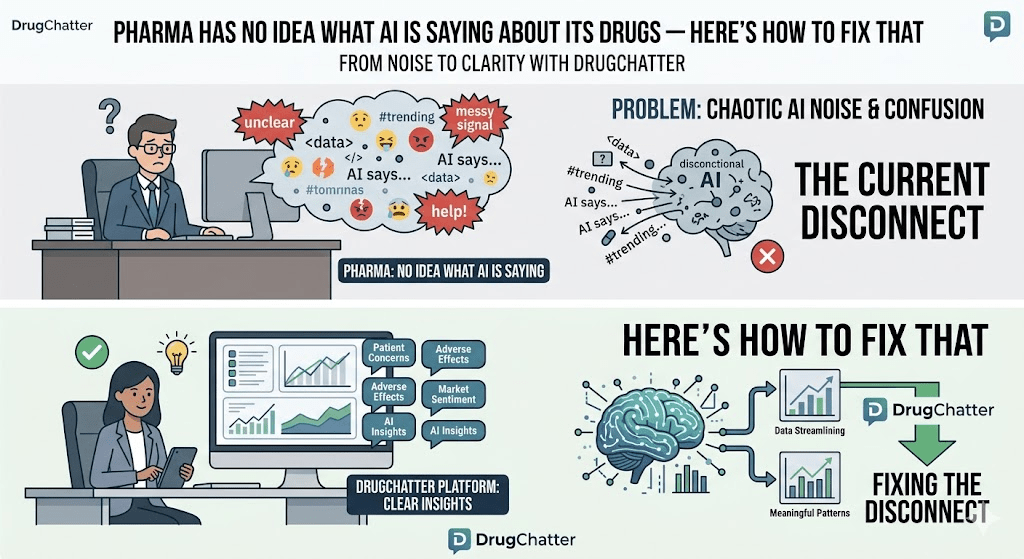
Most pharmaceutical companies are not watching any of this happen.
The industry has spent two decades building social listening programs to track Reddit threads, patient forums, and Twitter conversations. It has invested in adverse event monitoring software, brand perception surveys, and physician detailing analytics. What it has not done, with very few exceptions, is build any systematic capability to monitor what AI systems say about their products — or how those outputs travel, mutate, and influence downstream medical decisions.
That gap is now a regulatory, reputational, and commercial risk.
AI Search Has Quietly Become a Primary Medical Information Channel
How Many Patients Are Using ChatGPT for Medical Questions?
The data here is no longer speculative. A 2024 survey published in the Journal of Medical Internet Research found that approximately 38% of adults in the United States had used a generative AI tool — ChatGPT, Google Gemini, or a similar product — to answer a health or medication question in the prior 12 months. Among adults aged 18 to 34, that figure was closer to 55%.
ChatGPT alone crossed 100 million weekly active users in early 2023 and has continued growing. Google’s AI Overviews, which now appear at the top of search results for a broad class of health queries, reaches a substantially larger audience — effectively anyone who runs a health-related search on Google. Perplexity, which positions itself explicitly as an AI answer engine, has seen rapid adoption among younger, tech-forward demographics who previously would have turned to WebMD or Mayo Clinic.
The practical effect is that generative AI has inserted itself between patients and the primary sources pharma companies have traditionally relied on to shape medical information: physician conversations, branded patient support sites, and FDA-approved prescribing information.
What Types of Drug Questions Do Patients Ask AI Systems?
The query patterns that emerge from AI usage research reveal something pharma brand teams should read carefully. Patients are not asking AI systems for general health information. They are asking highly specific, clinically loaded questions:
“Can I take Eliquis if I also take ibuprofen?”
“What happens if I miss a dose of Keytruda?”
“Is there a cheaper alternative to Humira that works the same way?”
“Why did my doctor switch me from Lantus to Toujeo?”
“Does Jardiance cause weight loss or just lower blood sugar?”
These aren’t vanity searches. They reflect patients actively managing their conditions, trying to understand clinical tradeoffs, and seeking information that should come from a healthcare provider but frequently doesn’t — because appointment times are short, physicians are overloaded, and a question that occurs to a patient at 11 PM on a Tuesday has no good answer channel other than the phone in their hand.
How Physicians Are Using AI for Drug Information
Physicians are not immune to this pattern. A 2024 report from the American Medical Association found that nearly one in five physicians had used a generative AI tool to check drug interactions, review prescribing guidelines, or research off-label uses in the prior six months. Among residents and fellows — the cohort that will define prescribing patterns for the next three decades — that number was closer to one in three.
When a physician asks ChatGPT whether a GLP-1 agonist is appropriate for a patient with a BMI under 27, the answer they receive has no pharmaceutical company brand team behind it. It has no medical affairs review. It may or may not reflect the most current clinical evidence. And it may favor a competitor’s drug for reasons that have nothing to do with clinical superiority — but everything to do with which training data the model was exposed to and how it weighted those sources.
Why ChatGPT Gets Drug Information Wrong — and Why It Matters for Pharma
How LLM Hallucinations Create Drug Safety Misinformation
The term “hallucination” in AI refers to outputs where a model generates confident, fluent text that is factually incorrect. In most domains, this is an inconvenience. In pharmaceutical information, it is a patient safety issue.
Documented cases are not hard to find. In 2023, researchers at Stanford tested multiple LLMs on drug interaction queries and found that models confidently described interactions between drug pairs that have no known interaction — while simultaneously missing well-documented interactions that appear in FDA labeling. A separate study published in JAMA Internal Medicine found that when asked about maximum safe acetaminophen doses, ChatGPT-3.5 produced answers that were inconsistent with FDA guidance in a meaningful percentage of queries.
The mechanism is worth understanding. LLMs do not retrieve information from a curated database. They predict the next token in a sequence based on patterns in training data. When training data contains conflicting information about a drug — which it almost always does, given the volume of patient forums, preprint servers, case reports, and lay press articles the models ingest — the model’s output reflects a probabilistic blend of those sources, not a carefully adjudicated clinical answer.
Can AI Hallucinations Trigger FDA Adverse Event Reporting Obligations?
This is the question that pharmaceutical regulatory affairs teams are beginning to grapple with, and the answer is not settled.
Under FDA regulations, pharmaceutical companies are required to report adverse events they become aware of through any source — including social media, published literature, and patient complaints. The regulatory question is whether a pharmaceutical company that becomes aware of an AI system generating false safety information about its product has an obligation to act on that information.
The FDA has not issued specific guidance on AI-generated medical misinformation. But the underlying logic of pharmacovigilance — that companies are responsible for monitoring the information environment around their products — does not stop at the boundary of AI-generated content.
Legal scholars and regulatory consultants are increasingly arguing that if a drug company becomes aware that a major AI system is systematically telling patients that a drug is safe to use with a contraindicated substance, the company has exposure. Whether that exposure takes the form of an FDA enforcement action, civil litigation, or reputational damage depends on the specifics. But the exposure exists.
Off-Label Use Discussions in AI: What Compliance Teams Need to Know
Off-label use is one of the most legally sensitive topics in pharmaceutical marketing and communications. A pharmaceutical company cannot promote a drug for uses not approved by the FDA. It can, under certain conditions, respond to unsolicited requests for off-label information. What it cannot do is actively distribute off-label promotional content.
AI systems are not bound by any of these rules. When a patient asks ChatGPT whether Ozempic can be used for weight loss (an off-label use at the time the drug was originally approved, before Wegovy received its separate indication), the AI provides an answer with no regard for promotional compliance. When Perplexity is asked about using low-dose naltrexone for autoimmune conditions — a use that has generated significant patient community interest but lacks formal FDA approval — it provides detailed information drawn from the medical literature.
Pharmaceutical companies have no systematic way of knowing which off-label uses their drugs are being discussed in, how frequently those discussions occur, or whether the information being provided is accurate. That knowledge gap is a compliance risk, because if a company is unaware of the off-label conversation landscape, it cannot take appropriate steps to ensure its own communications are properly calibrated.
The AI Share-of-Voice Problem: How Branded Drugs Fare Against Generics and Competitors
How Often Does Claude Mention Ozempic vs. Wegovy vs. Mounjaro?
Share-of-voice monitoring — tracking how frequently your brand appears in media, search, and conversation relative to competitors — is a standard function of pharmaceutical marketing. Almost no company has extended this discipline to AI systems.
When you run structured queries across ChatGPT, Claude, and Gemini asking about GLP-1 medications for weight management, the brand mention patterns are not identical across systems. Claude shows different frequency distributions than ChatGPT. Gemini’s AI Overviews pull from different citation sources than Perplexity’s cited answers. The drug that appears first in a list, the drug that receives the most detailed explanation, and the drug framed as the “standard” or “most common” option — these vary by system and query phrasing.
For the brand teams at Novo Nordisk and Eli Lilly, these are not abstract distinctions. When a patient or physician asks an AI system which GLP-1 is right for them and receives an answer that frames a competitor product as the default, that is a commercial event. It influences prescribing consideration. It shapes how patients advocate for themselves in physician offices. And it happens at scale, across millions of queries, with no pharmaceutical marketing team anywhere near the conversation.
Do LLMs Recommend Generic Drugs More Often Than Branded Alternatives?
This question deserves systematic study that the industry has not yet conducted. What’s observable from ad hoc testing is that LLMs trained on internet text will have been heavily exposed to content about drug pricing, generic substitution, and pharmacy benefit management — topics that generate significant consumer and policy discussion. This exposure plausibly biases models toward recommending generics when cost is mentioned as a factor, which patients frequently raise.
The practical concern for branded drug manufacturers is straightforward. If ChatGPT tells a patient that their branded biologic has a biosimilar that is “just as effective,” the clinical nuances around biosimilar substitution — interchangeability designations, immunogenicity considerations, formulary dynamics — are almost certainly not being conveyed accurately. The patient may not raise the biosimilar question with their physician. They may simply request the switch, or ask their pharmacist to substitute.
Tracking how frequently this pattern occurs, and whether it is more or less common for specific drugs or drug classes, requires systematic AI monitoring that virtually no pharmaceutical company currently performs.
Tracking Share of Voice Across ChatGPT, Gemini, and Claude
The methodology for AI share-of-voice monitoring differs meaningfully from traditional media monitoring. You cannot track impressions or clickthrough rates. The outputs are probabilistic — the same query produces different answers across sessions. And the question of what constitutes a “mention” is more complex when a drug appears in a comparison table, a side-effect list, a recommendation, or a safety warning.
Tools designed specifically for pharmaceutical AI monitoring — including DrugChatter — address this by running structured query sets across multiple AI systems on a recurring basis, capturing the full output, and applying classification frameworks to categorize how a drug is mentioned, in what clinical context, alongside which competitors, and with what safety framing.
This approach generates the kind of data that brand teams and medical affairs departments can actually act on: frequency trends, sentiment changes, competitive position shifts, and safety framing alerts that would not surface through any other monitoring channel.
Pharmacovigilance in the Age of AI: New Sources, New Obligations
Can AI Outputs Be Used for Pharmacovigilance?
Pharmacovigilance — the systematic collection and analysis of drug safety information — has always required pharma companies to monitor sources beyond clinical trials. Spontaneous adverse event reports, published case studies, and patient forum discussions all count as sources that companies must monitor under ICH E2D and related guidelines.
AI-generated content presents a novel version of this challenge. When an AI system tells a patient that a drug causes a side effect that isn’t in the FDA label, and that patient acts on that information — adjusting their dose, stopping the drug, combining it with something they shouldn’t — there is a downstream safety event that can occur. The AI output is not itself the adverse event. But it is a contributing factor, and it is a signal in the information environment that pharmacovigilance teams should be capturing.
The more direct pharmacovigilance application is using AI systems as a signal source for what patients are worried about. When ChatGPT receives a high volume of queries asking whether a specific drug causes a specific adverse effect — and that effect is not in the current labeling — that query volume is a signal. It may reflect genuine patient experiences that haven’t yet made it into formal adverse event reporting. It may reflect misinformation spreading through social channels. Either way, it is information that safety teams need.
“Spontaneous reporting captures perhaps 5 to 10 percent of actual adverse events. Digital signal sources — social media, patient forums, and increasingly AI query patterns — represent an opportunity to close that gap significantly.” —Pharmacovigilance Executive Survey, Drug Safety Alliance, 2024
What Pharma Brand Teams Can Learn From Reddit AI Citations
Reddit has become one of the most influential sources of patient-generated medical information on the internet. Subreddits like r/diabetes, r/MultipleSclerosis, r/ChronicPain, and dozens of disease-specific communities contain millions of posts from patients discussing their experiences with specific drugs — dosing strategies, side effects, insurance navigation, and physician relationships.
This content appears in LLM training data. When a patient asks ChatGPT about the lived experience of taking a drug, the model draws substantially on Reddit content because that’s where candid, first-person patient testimony exists at scale. The clinical literature doesn’t contain it. Patient advocacy sites don’t capture it with the same granularity.
The implication is that monitoring Reddit for drug discussions is not just a social listening function — it is an input into understanding what AI systems will say about your drug. If a specific adverse effect is being discussed extensively on Reddit in a way that overstates its frequency or severity, that narrative will influence how LLMs respond to queries about that drug. Tracking it early gives pharma companies the ability to introduce corrective information into the medical literature and public discourse before it calcifies into AI output.
How AI Systems Cite Drug Safety Information — and What Gets Left Out
The citation behavior of different AI systems matters for pharmaceutical companies because citations determine where patients go next. When Perplexity answers a drug safety question with citations, those citations shape the patient’s subsequent research pathway. If the citations are to patient forums, advocacy organizations, or old clinical studies, the information quality and recency may be poor.
When AI systems don’t cite sources — as ChatGPT’s default behavior in most configurations — patients receive confident assertions with no traceability. They cannot verify whether the information comes from the current FDA label, a 2019 clinical study, or a patient blog post. This is a fundamental difference from WebMD or Mayo Clinic, where at least the editorial source is identifiable.
The practical monitoring implication: pharmaceutical companies should track not just what AI systems say about their drugs, but what sources they cite when they say it. A shift toward citing less reliable sources, or a pattern of not citing the FDA label for safety-critical information, is itself a risk signal.
How the FDA Is Approaching AI-Generated Drug Information
FDA Warning Letters, AI, and the Emerging Regulatory Landscape
The FDA has not yet issued a warning letter specifically targeting AI-generated pharmaceutical misinformation. But the agency has issued guidance documents and draft frameworks that make the regulatory direction clear.
In 2023, FDA issued a discussion paper on AI and machine learning in drug manufacturing and clinical development. In 2024, the agency began internal work on frameworks for evaluating AI tools used in drug information contexts. The agency’s Oncology Center of Excellence has been particularly active in evaluating AI tools used by patients and caregivers to understand cancer treatment options.
What regulators have signaled, though not yet formalized, is that pharmaceutical companies bear some responsibility for the information environment around their products — including AI-generated information that patients and physicians encounter. The precise scope of that responsibility is being worked out in regulatory guidance development processes that will take years to complete. Companies that wait for final guidance before building monitoring capabilities will be years behind.
EMA and International Regulatory Perspectives on AI Drug Information
The European Medicines Agency has moved somewhat faster than FDA on AI oversight frameworks, in part because the EU AI Act — which came into force in 2024 — creates a broader regulatory infrastructure for high-risk AI systems that the pharmaceutical context falls within.
The EMA’s 2023 reflection paper on AI in medicines regulation explicitly addresses the challenge of AI systems generating drug information outside of pharmaceutical company oversight. The paper notes that “the boundary between authorized and unauthorized medicinal product information is becoming increasingly difficult to maintain in AI-mediated information environments” — a diplomatically phrased acknowledgment that AI systems are functioning as drug information channels that no one has approved.
Can Pharmaceutical Companies Be Liable for AI Misinformation About Their Drugs?
Litigation in this space is early-stage, but the legal theories are being constructed. The most direct liability pathway is a failure-to-warn theory: if a pharmaceutical company becomes aware that patients are receiving systematically incorrect safety information about their drug from AI systems, and takes no action to correct it, that inaction could be characterized as a failure to adequately warn patients.
A second pathway runs through FTC regulations on deceptive marketing. If a pharmaceutical company’s own communications emphasize safety data that is being contradicted by widely-used AI systems, and the company doesn’t address that contradiction, there is a potential argument that patient-facing communications are materially incomplete.
Neither theory has been tested in court. Both are being discussed in pharmaceutical legal circles, and both create incentives for companies to build systematic AI monitoring capabilities rather than remain willfully unaware of what AI systems are saying.
Which Drugs Are Most Frequently Mentioned by AI — and Why It Matters
The Most Discussed Drug Classes in AI Health Queries
From available research on AI health query patterns, several drug classes consistently generate disproportionate AI query volume:
GLP-1 receptor agonists (semaglutide, tirzepatide, liraglutide) — driven by the cultural moment around weight loss medications
Immunosuppressants and biologics (adalimumab, dupilumab, ustekinumab) — driven by the complexity of dosing and monitoring regimens
Anticoagulants (apixaban, rivaroxaban, warfarin) — driven by patient anxiety about bleeding risk and drug interactions
ADHD medications (amphetamine salts, methylphenidate, atomoxetine) — driven by widespread adult ADHD diagnosis and medication management questions
For drugs in these categories, the AI information environment is particularly active and particularly high-stakes. A newly diagnosed cancer patient researching checkpoint inhibitor therapy in ChatGPT the night before their oncology appointment will have their appointment-day questions shaped by what AI told them. If those AI outputs are inaccurate, the downstream clinical conversation starts from a compromised baseline.
How Eli Lilly and Novo Nordisk Monitor Competitive AI Mentions
Neither Eli Lilly nor Novo Nordisk has publicly disclosed the specifics of their AI monitoring programs, if they have formalized ones. What is publicly known is that both companies have made substantial investments in digital health analytics and competitive intelligence, and both have been visible in industry discussions about AI-driven patient engagement.
What sophisticated monitoring looks like in practice involves running systematic, recurring queries across AI systems on topics related to GLP-1 therapy — including queries that patients actually submit, derived from search trend data and patient community monitoring. The outputs are captured, analyzed for brand mention frequency, sentiment, competitive framing, and safety information accuracy, and fed into brand team reporting cycles.
Companies that have built this capability are able to detect, for example, when a specific AI system shifts from recommending semaglutide as a primary GLP-1 option to recommending tirzepatide — a shift that might reflect updated training data, a change in citation sourcing, or simply model updates. Without systematic monitoring, that shift is invisible until it shows up in prescribing data months later.
What Drug Queries Look Like in AI vs. Traditional Search
Traditional search queries tend to be short and navigational: “Humira side effects,” “Keytruda cost,” “metformin and alcohol.” AI queries are longer, more conversational, and more clinically specific. A patient who would have typed “Eliquis side effects” into Google in 2020 is now more likely to ask ChatGPT “I’m 68 years old with atrial fibrillation and my doctor put me on Eliquis — what are the most serious risks I should know about and what should I watch for?”
That shift in query structure has important implications for pharma monitoring. The longer, more specific queries reveal patient concerns that short keyword searches obscure. They carry clinical context — age, condition, concurrent medications — that makes the query more meaningful. And they elicit more detailed AI responses that are harder to evaluate for accuracy using simple keyword-matching approaches.
Monitoring tools designed for traditional search SEO are not equipped to handle this query structure. The monitoring frameworks required for AI search require natural language processing, clinical knowledge graph integration, and the ability to evaluate response quality against authoritative sources — not just keyword presence.
Building an AI Drug Monitoring Program: A Practical Framework
What a Pharmaceutical AI Monitoring Strategy Actually Looks Like
For pharmaceutical brand teams and medical affairs departments that want to move from awareness to action, the monitoring challenge has four distinct components.
The first is query coverage — systematically identifying the queries that patients, caregivers, and physicians are running about your drug across AI systems. This requires integration with search trend data, patient community monitoring, and structured query development processes that mirror actual user behavior.
The second is cross-platform output capture — running those queries across ChatGPT, Claude, Gemini, Perplexity, and AI-enhanced search platforms on a recurring basis, capturing full outputs rather than just keywords or summary statistics.
The third is clinical accuracy evaluation — assessing captured outputs against authoritative sources: FDA labeling, current clinical guidelines, and peer-reviewed literature. This evaluation needs to be drug-specific enough to catch the nuanced errors that generic text quality assessments miss.
The fourth is signal routing — connecting what the monitoring program finds to the right internal functions. A hallucinated drug interaction belongs with pharmacovigilance. A competitor gaining AI share-of-voice belongs with brand strategy. An off-label use discussion that could create regulatory exposure belongs with regulatory affairs and legal. A pattern of patients expressing confusion about dosing belongs with patient education.
How DrugChatter Approaches AI Monitoring for Pharmaceutical Companies
DrugChatter was built specifically for this monitoring problem. The platform tracks AI mentions of pharmaceutical products across major AI systems, compares brand mentions against competitors, flags clinical accuracy issues in AI outputs, and surfaces patient query patterns that reveal emerging concerns before they appear in adverse event databases or social media trends.
The platform’s approach to clinical accuracy evaluation draws on structured comparisons against FDA labeling and clinical literature, making it possible to identify not just when a drug is mentioned but whether it’s being described accurately — whether its labeled indications are being represented correctly, whether contraindications are surfacing, and whether competitors are being framed more favorably in ways that aren’t supported by clinical evidence.
For pharmaceutical companies trying to understand their AI share-of-voice, DrugChatter provides competitive benchmarking across drug classes — showing how frequently your drug appears in AI responses relative to competitors, in what context, and with what clinical framing.
How to Detect AI Hallucinations About Your Drug: A Practical Checklist
Pharmaceutical teams that want to do basic AI monitoring before implementing a dedicated platform can start with a structured manual process:
Develop a query set that mirrors real patient and physician questions about your drug — drug interactions, dosing, side effects, comparisons to competitors, cost and generic availability.
Run queries across at least three AI platforms (ChatGPT, Claude, Gemini) on a monthly cadence, capturing full outputs.
Evaluate outputs against current FDA labeling for factual accuracy on safety-critical claims.
Flag any claim about drug interactions, contraindications, or adverse effects that isn’t supported by or directly contradicts the label.
Note how frequently your drug appears first, appears in direct comparison to competitors, and is recommended vs. mentioned as an alternative.
Escalate material safety inaccuracies to pharmacovigilance and regulatory affairs.
This manual process is not scalable for a large portfolio. But it establishes the institutional practice of treating AI systems as a monitored information channel rather than an external phenomenon that happens to patients without pharmaceutical company awareness.
Patient Sentiment in AI: What Patients Are Asking and What They’re Being Told
How Patients Ask About Drug Side Effects in AI Search
Patient query patterns in AI carry emotional content that traditional keyword searches don’t convey. A patient asking “why does Keytruda make me feel so exhausted all the time” is not just requesting clinical information — they’re expressing distress and looking for validation or explanation. The AI response they receive shapes whether they think their experience is normal, whether they call their oncologist, and whether they continue treatment.
Monitoring these query patterns gives pharmaceutical companies access to patient sentiment data that no survey instrument captures as authentically. Patients don’t ask ChatGPT what they think researchers want to hear. They ask what they’re actually worried about, confused by, or experiencing. The query itself is the signal.
Pharmaceutical companies that build the capability to monitor AI query patterns — even in aggregate, without individual patient identification — gain access to a continuous, unprompted voice-of-the-customer data stream that can inform patient support programs, label update priorities, and medical education initiatives.
What AI Gets Wrong About Drug Adherence and Patient Support
One of the most consequential categories of AI drug information involves adherence-related questions. Patients ask AI systems whether it’s okay to skip doses, what to do if they can’t afford their medication, how long they need to stay on a drug, and what happens if they stop abruptly.
The answers they receive vary considerably in quality. For drugs where abrupt discontinuation carries significant clinical risk — certain antidepressants, corticosteroids, beta-blockers — AI systems sometimes provide insufficiently urgent guidance. For drugs with complex titration schedules, AI outputs have been observed providing oversimplified dosing advice that doesn’t account for individual patient factors.
For pharmaceutical companies, these patterns represent both a patient safety concern and a commercial concern. Incorrect adherence guidance can lead to treatment discontinuation, adverse events, and negative patient experience — all of which affect both patient outcomes and the product’s real-world effectiveness reputation.
Physician Perception of AI Drug Recommendations: What the Research Shows
Physician attitudes toward AI-generated drug information are shifting in ways that pharmaceutical medical affairs teams should track. Early research suggested physicians were broadly skeptical of AI drug recommendations. More recent survey data from 2024 shows a more complicated picture: physicians are skeptical of AI for primary clinical decision-making but are increasingly using it for background research, drug interaction checking, and rapid literature review.
The practical implication is that physicians who use AI for background research may arrive at patient conversations having been primed by AI outputs about specific drugs — framing effects that pharma medical science liaisons and account managers are unlikely to know about or be equipped to counter.
The Competitive Intelligence Dimension: AI as a Battlefield for Brand Positioning
How Competitors Gain AI Share-of-Voice Without Saying a Word
AI share-of-voice shifts don’t require active competitor intervention. They emerge from the underlying training data and citation sourcing of AI systems, which change as models are updated, retrained, and adjusted through reinforcement learning from human feedback.
A competitor that publishes more clinical data, generates more media coverage, or has a more active patient community — all legitimate commercial activities — may see their AI share-of-voice increase simply because the information environment around their drug is richer and more accessible to training data scrapers. A drug that goes through a period of negative media coverage may see a long-tail decline in AI mention sentiment that persists well after the underlying issue is resolved, because the negative coverage becomes part of the training data.
These dynamics are invisible without systematic monitoring. And by the time they show up in sales data or market research, the AI-level shift has been running for months.
AI Citation Analysis: How to Track What Sources LLMs Use for Drug Information
In AI systems that provide citations — Perplexity, Bing AI, and Google AI Overviews with sources — pharmaceutical companies can run a form of citation analysis that tracks what sources the AI draws on to answer drug questions. This analysis can reveal:
Whether current FDA labeling is being cited for safety-critical claims
Whether competitor-authored clinical studies are appearing more frequently than your own
Whether patient advocacy organizations with specific positions on your drug are being cited as authorities
Whether outdated sources are being presented as current information
Citation analysis is a more tractable problem than evaluating non-cited AI outputs, because it produces concrete, checkable data. A pharmaceutical company that knows Perplexity is consistently citing a 2018 meta-analysis that has since been superseded by better evidence has a specific, actionable problem: it needs to ensure the more current evidence is accessible and indexable by AI citation systems.
What Pharma Can Learn From Consumer Brand AI Monitoring
Consumer brands — particularly those in financial services, consumer electronics, and retail — have been monitoring AI mentions for longer than pharmaceutical companies, in part because their regulatory environment is less complex and experimentation is easier. Their experience offers useful lessons.
The most consistent finding from consumer AI brand monitoring is that share-of-voice in AI correlates imperfectly with traditional search visibility. A brand that ranks number one on Google does not necessarily appear first, most often, or most favorably in AI responses. The factors that influence AI mention frequency and sentiment — training data composition, citation sourcing, query framing — are different from the factors that drive traditional SEO rankings.
For pharmaceutical companies, this means that existing SEO and digital media investments don’t automatically translate into favorable AI share-of-voice. A separate, AI-specific monitoring and optimization strategy is required.
Medical Misinformation at Scale: When AI Becomes a Public Health Problem
How AI Drug Misinformation Spreads Beyond the Initial Query
The reach of a single AI drug misinformation output extends well beyond the individual who receives it. Patients share AI responses with family members, caregivers, and other patients in condition-specific communities. Screenshots of AI answers circulate on Facebook groups and WhatsApp chains. Patient advocates quote AI outputs in letters to insurance companies and appeals for coverage.
This amplification pattern means that a systematically incorrect AI response about a drug — say, an AI system that consistently underestimates the severity of an interaction between a specific drug and a common over-the-counter medication — reaches a much larger population than the direct query count would suggest.
Public health authorities have recognized this dynamic in the context of vaccine misinformation and COVID-19 treatment misinformation. The pharmaceutical drug information context has the same structural vulnerability, but it has received less attention because the harms are less visible — they manifest as individual clinical events rather than population-level outbreaks.
The Data Gap: Why Pharma Doesn’t Know What AI Is Saying
The absence of pharmaceutical AI monitoring at most companies isn’t a product of indifference. It reflects the fact that no established workflow for AI monitoring exists in most pharma organizations, the regulatory obligation isn’t yet clearly defined, and the tools designed specifically for pharmaceutical AI monitoring are recent enough that awareness of them is limited.
The parallel to social media monitoring in the early 2010s is instructive. In 2010, most pharmaceutical companies didn’t have social media listening programs. By 2015, after a series of adverse event cases where social media discussions surfaced safety signals before formal reporting systems did, social media monitoring became a standard pharmacovigilance function. The trajectory from awareness to regulatory pressure to standard practice took roughly five years.
AI monitoring is at the 2010 moment of that trajectory. The companies that build the capability now will have a significant data advantage when the regulatory expectations formalize.
Drug Patent Watch Data and AI Mentions: Generic Pressure in the Information Space
Drug patent expirations create a predictable shift in the commercial information environment — generic manufacturers and pharmacy benefit managers have strong incentives to promote generic substitution, and they have become sophisticated at using digital channels to drive that message. DrugPatentWatch provides pharmaceutical companies with visibility into patent status and generic entry timelines that can be integrated into AI monitoring strategy.
In the period approaching patent expiration, AI monitoring becomes particularly important. Generic manufacturers and their clinical partners publish studies, press releases, and educational content that increases the volume of pro-generic information in the data environments that LLMs draw on. Monitoring AI outputs during this period gives branded drug manufacturers early visibility into how the generic narrative is penetrating AI information channels and what questions patients are being primed to ask.
What a Pharmaceutical Company Should Do This Quarter
A 90-Day AI Monitoring Launch Plan for Pharma Brand Teams
For pharmaceutical teams that want to move from zero to a functioning AI monitoring baseline in 90 days, the practical path involves four parallel workstreams.
The first workstream is internal alignment. Someone in medical affairs, pharmacovigilance, or brand strategy needs to own the AI monitoring function. Without ownership, the outputs from monitoring won’t route to the right internal functions. The owner doesn’t need to be technical, but they need to have the authority to escalate findings to regulatory affairs, legal, and brand leadership.
The second workstream is query development. Work with patient community data, search trend analysis, and medical affairs input to develop a set of 50 to 100 queries that represent how patients and physicians actually ask questions about your drug. These queries should cover efficacy, safety, dosing, drug interactions, comparison to competitors, generic alternatives, and off-label use.
The third workstream is platform selection. Evaluate whether to build internal monitoring capacity, use a dedicated pharmaceutical AI monitoring platform like DrugChatter, or start with a hybrid of manual monitoring and off-the-shelf tools. For companies with large portfolios, a dedicated platform is almost certainly more cost-effective than manual monitoring at scale.
The fourth workstream is process integration. Define in advance what happens when the monitoring program surfaces something: a hallucinated drug interaction, a competitor gaining share-of-voice, an off-label use discussion, a patient sentiment pattern. The value of monitoring is zero if the outputs sit in a spreadsheet without routing to decision-makers.
How to Build the Business Case for AI Monitoring Investment
The business case for pharmaceutical AI monitoring has four distinct value pillars.
Regulatory risk mitigation: the cost of an FDA enforcement action for failure to monitor a known safety information problem is orders of magnitude higher than the cost of a monitoring program. Even a modest reduction in regulatory risk probability justifies substantial investment.
Competitive intelligence: understanding AI share-of-voice shifts before they appear in prescribing data gives brand teams weeks or months of lead time to respond. At the revenue scale of major pharmaceutical brands, that lead time has measurable commercial value.
Pharmacovigilance enhancement: AI query pattern monitoring can surface adverse event signals earlier than traditional spontaneous reporting. Earlier signal detection means earlier response, which reduces patient harm and reduces liability exposure.
Patient education ROI: understanding what patients are being told by AI systems, and where those outputs are inaccurate, allows patient support programs to be targeted at exactly the misconceptions that are most prevalent — rather than guessing based on call center data.
Key Takeaways
AI systems including ChatGPT, Gemini, Claude, and Perplexity have become primary medical information channels for patients and, increasingly, physicians — with no pharmaceutical oversight of the information being provided.
LLM hallucinations in drug information contexts create patient safety risk, potential pharmacovigilance obligations, and exposure to FDA regulatory action — none of which can be managed without systematic monitoring.
AI share-of-voice does not correlate directly with traditional search visibility. A separate AI-specific monitoring strategy is required to track how frequently and favorably your drug appears relative to competitors across major AI systems.
AI query patterns from patients represent a continuous, unprompted voice-of-the-customer data stream that can surface emerging safety concerns, adherence issues, and patient sentiment shifts earlier than any traditional research instrument.
Off-label use discussions, generic substitution recommendations, and competitive framing in AI outputs all carry regulatory, compliance, and commercial implications that pharmaceutical companies cannot manage if they are unaware of them.
The regulatory environment around pharmaceutical companies’ responsibility for AI-generated drug information is forming now. Companies that build monitoring capabilities before regulatory expectations formalize will have a structural advantage.
Tools designed specifically for pharmaceutical AI monitoring — including DrugChatter — address the clinical accuracy evaluation, competitive benchmarking, and signal routing requirements that generic social listening tools don’t meet.
Frequently Asked Questions
What is pharmaceutical AI monitoring, and why does it matter now?
Pharmaceutical AI monitoring is the systematic process of tracking what AI systems — ChatGPT, Gemini, Claude, Perplexity, and others — say about prescription drugs, including branded and generic mentions, clinical accuracy, safety claims, competitive framing, and off-label use discussions. It matters now because AI has become a primary medical information channel for patients and physicians, and the information being provided operates completely outside of pharmaceutical company oversight, FDA review, or medical affairs control. The gap between what AI systems say about drugs and what pharmaceutical companies know about those outputs is a regulatory, commercial, and patient safety problem that is growing with AI adoption.
Can an AI hallucination about a drug create FDA adverse event reporting obligations for a pharma company?
The FDA has not issued definitive guidance on this question, but the underlying regulatory logic of pharmacovigilance — that pharmaceutical companies are responsible for monitoring all information sources relevant to product safety — doesn’t have a clear carve-out for AI-generated content. Legal and regulatory consultants are increasingly advising pharmaceutical companies that becoming aware of systematic AI misinformation about a drug’s safety profile and taking no action creates exposure, even if the precise form of that exposure hasn’t been tested through enforcement. Companies that monitor AI outputs proactively are better positioned to document their awareness and response processes than companies that remain unaware.
How is AI share-of-voice different from traditional search share-of-voice for pharmaceutical brands?
Traditional search share-of-voice measures how often a brand appears in search results for relevant queries. AI share-of-voice measures how often, how prominently, and in what clinical context a drug appears in AI-generated responses. The two metrics don’t correlate reliably — a drug that ranks number one on Google may appear third or fourth in AI responses, or may be framed less favorably than competitors, based on training data patterns that have nothing to do with SEO. AI share-of-voice also captures qualitative dimensions — clinical framing, comparative positioning, safety context — that keyword-based search monitoring doesn’t address.
What is the most common type of drug misinformation found in AI outputs?
Research to date suggests that drug interaction misinformation is both the most common category and the highest-risk one. AI systems show consistent patterns of both false positive interactions — describing interactions between drugs that have no known interaction — and false negative failures — missing well-documented, clinically significant interactions. Dosing misinformation is a close second, particularly for drugs with complex titration schedules or weight-based dosing. Safety framing errors — presenting a drug’s risk profile as more or less serious than the FDA label indicates — are also common, particularly for drugs that have generated significant patient community discussion where lay descriptions of side effects don’t align precisely with clinical terminology.
Which pharmaceutical companies are currently most advanced in AI drug monitoring?
No pharmaceutical company has publicly disclosed a formalized AI drug monitoring program with specifics. Informally, the companies most likely to be furthest along are those with large digital health teams, significant social listening programs, and drugs in highly competitive categories where real-time competitive intelligence has clear commercial value — companies like Novo Nordisk, Eli Lilly, AbbVie, and Pfizer. Academic medical centers and specialty pharmacy organizations have published more in this space than pharmaceutical companies themselves. Dedicated platforms like DrugChatter represent the leading edge of purpose-built tooling for pharmaceutical AI monitoring.