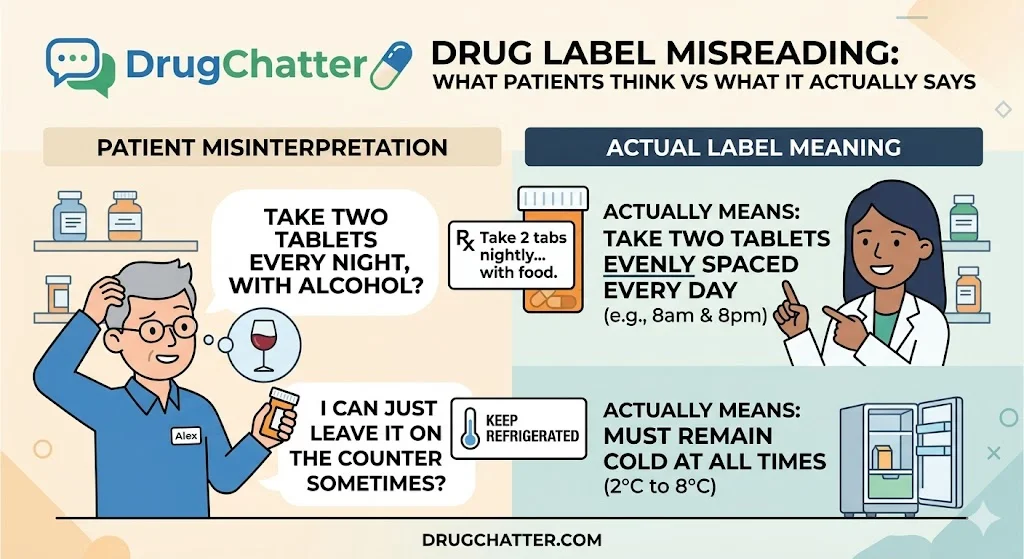
There’s a special kind of quiet chaos that happens when a medicine label is misread. It’s rarely malicious. More often it’s hopeful—patients reading the part that seems to fit their problem, then acting on that interpretation because the label looked clear enough at 11:47 p.m. on a pharmacy trip home.
The DrugChatter question pages linked below aren’t “label-reading failures” in the cinematic sense. They’re the everyday versions: confusing brand vs. generic, guessing at what the drug is used for, misinterpreting timing with other therapies, and—most commonly—assuming the price you see is the price you’ll pay.
1) The classic mix-up: brand, generic, and “what is this even?”
When people can’t immediately map a label to a known drug name, the next step is usually guesswork: is it a substitute? a synonym? a new product with the same effect? The questions below show the range of uncertainty—from generic identities to what a drug name even means.
2) “Take it with something” misread as “take it however”
Labels often provide timing and interaction warnings, but those lines are easy to treat like optional trivia—especially when patients are juggling other meds, supplements, and daily routines. The result is a predictable story: someone reads the label as permission rather than instruction.
- What’s the recommended time gap between lipitor and antacids?
- Can lipitor and red yeast rice supplements be taken together?
- Can lipitor supplements affect lipitor’s efficacy?
- Can lipitor’s effectiveness be reduced by lemon water?
- What’s the recommended fish oil intake alongside lipitor?
- Do i need a doctor’s approval for lipitor turmeric combination?
3) The timing myth: “It takes effect right away” vs. the label’s slow reality
A lot of label language is about what you should expect over time. Patients, understandably, want immediate payoff. But many drugs—especially chronic ones—don’t behave like a switch. Misreading the “how long until…” part can turn patience into nonadherence.
- What’s the typical timeline for lipitor’s full impact?
- Is liver function monitoring necessary with lipitor?
- Is there a maximum duration for lipitor use in liver disease patients?
4) Price labels: the “sticker shock” that looks like misunderstanding (because it is)
In the modern world, “label misreading” isn’t just about what the drug is. It’s also about what you think the cost will be. Patients see a number—then generalize it. Insurance coverage, manufacturer programs, and eligibility rules turn that one number into a guessing game.
- Zonisamide cost without insurance?
- How much does xeloda cost?
- Ranexa cost?
- Bezlotoxumab cost
- Macrilen cost?
- Secuado cost
- Lytgobi price?
- Obinutuzumab brand name?
5) Assistance programs: the label that doesn’t mean what you hope it means
Patient assistance programs can be lifelines—or they can be bureaucratic puzzles. The “misreading” happens when eligibility rules are treated like informal suggestions.
- Biktarvy patient assistance program?
- Empaveli financial assistance?
- What are vascepa’s discount requirements?
- Are insurances limited in vascepa rebates?
- Tavalisse discount?
6) “Generic” doesn’t always read as “equivalent”
Patients often assume generic = identical experience. But differences in formulation, interchangeability rules, and dosing schedules can make “the same medicine” feel anything but.
7) Patent and market questions: the label patients interpret as “what’s next”
Sometimes a patient doesn’t misread the pharmacy label at all—they misread the future. Patents, expirations, and market entry timelines can sound like promises, not projections.
- When does ngenla patent expiration?
- Will entresto’s generic version be available soon?
- Obinutuzumab loss of patent?
- What’s the estimated timeline for canakinumab’s biosimilars?
What to do when the label isn’t enough
Drug labels are written for safety, billing, and standardization—not for eliminating every confusion a human being might have in real life. If anything in a label feels unclear, the safest move is not to “interpret harder,” but to ask.
For patients: bring the exact label text or photo and ask the pharmacist or prescriber to confirm what it means for you (timing, interactions, and what to expect). For everyone: remember that “I thought it said…” is usually the start of the conversation you actually need.