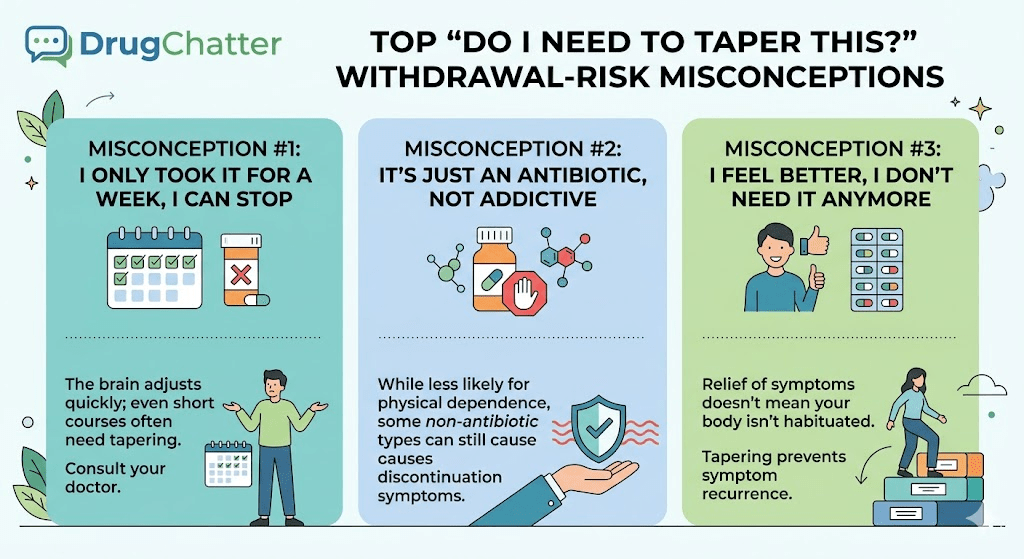
There’s a particular kind of confidence that shows up right when someone is feeling better—then decides it’s time to “just quit” a medication. And if they happen to land on a question that begins with “Do I need to taper this?”, the answers people search for tend to fall into a few persistent misconceptions.
Myth #1: If it doesn’t feel dangerous, it can’t cause withdrawal
Withdrawal doesn’t need drama to be real. Lots of problems are slow-burn: sleep gets weird, mood shifts, pain tolerance changes, or you just feel “off.” The drug doesn’t have to be an obvious villain like an opioid for the body to notice that it’s missing something.
Here’s the basic misconception: people treat “I’m not dying” as “I’m safe.” But medication discontinuation can still trigger physiologic adjustments that your brain and body made while you were taking the drug regularly.
Myth #2: Only certain drugs cause withdrawal—everything else is benign
Withdrawal-risk isn’t limited to one famous class. Even medication categories that don’t sound like they “belong” to withdrawal conversations can still cause discontinuation symptoms or rebound phenomena depending on how long you’ve been taking them and at what dose.
So the mistake is relying on vibes or reputation rather than on pharmacology and dosing history.
Myth #3: Tapering is just a courtesy, not a safety issue
There’s a difference between tapering to reduce discomfort and tapering to prevent bigger swings—like rebound symptoms or abrupt physiologic shifts. If the body is used to a certain level of receptor stimulation, neurotransmitter tone, or hormonal signaling, removing that quickly can create a temporary but miserable gap.
And yes: sometimes the right move really is no taper. The point is that you can’t know which situation you’re in by assuming “tapering sounds harder, so it must be optional.”
Myth #4: You can use “how you feel” to decide the taper schedule
Self-tracking is good; improvisation is not. Discontinuation symptoms may show up quickly—or after a delay. Meanwhile, the original condition may also fluctuate on its own. That makes it easy to misread the cause of symptoms and either (a) taper too fast or (b) stay stuck when a structured plan would help.
A safer approach is to treat “how you feel” as information to share with your clinician, not as a substitute for a discontinuation plan.
Myth #5: The “right” answer is one-size-fits-all (“taper everything” vs “never taper”)
That binary mindset is comforting, but it’s wrong. Withdrawal risk depends on at least:
- Which medication you’re stopping
- Dose and duration of use
- How regularly you’ve been taking it
- Your underlying condition (the disease can mimic withdrawal)
- Prior history of stopping or tapering
So the real question isn’t “taper or don’t taper,” it’s “what discontinuation strategy matches this drug and this person.”
Myth #6: People conflate side effects with withdrawal (or vice versa)
Side effects and withdrawal symptoms can overlap—especially around mood, sleep, GI upset, or headache. But they’re not the same, and they don’t follow the same logic.
The risk here is taking the wrong action—treating withdrawal as side effects (or stopping supportive care too early) rather than addressing the discontinuation process.
Where to look instead of guessing
If you’re trying to make sense of medication decisions and avoid jumping to conclusions, it helps to read the specific Q&A context for the drug in question. DrugChatter threads can be a starting point for clarifying issues like mechanisms, interactions, and practical discontinuation considerations.
For example, if you’re navigating how meds work (and why abrupt changes can be consequential), you might find relevant background here:
- Eplontersen mechanism of action?
- Sensipar mechanism of action?
- How does lipitor’s mechanism aid in muscle recovery?
- How does lipitor’s plaque buildup prevention compare to antibiotics action?
- Can ace inhibitors increase or decrease lipitor’s benefits?
And if your concern is practical—timing, regimen behavior, or the kind of “will this still work if I drink/eat/stop?” uncertainty that leads people to self-adjust—these are the kinds of threads people often use to ground their questions:
- How often can alcohol be consumed with lipitor?
- Does alcohol consumption reduce lipitor’s effectiveness?
- Can fiber impact lipitor’s medication efficiency?
The bottom line
If you’re staring at a pill bottle and asking “Do I need to taper this?”, don’t let the common misconceptions decide. Don’t rely on reputation, anecdotes, or how you feel in the moment. Instead, match the discontinuation approach to the specific drug, dose, and timeframe—and ask for a plan rather than improvising one.
Practical next step: bring the exact medication name, dose, and how long you’ve taken it to your prescriber or pharmacist and ask for a discontinuation/taper schedule if one is indicated.