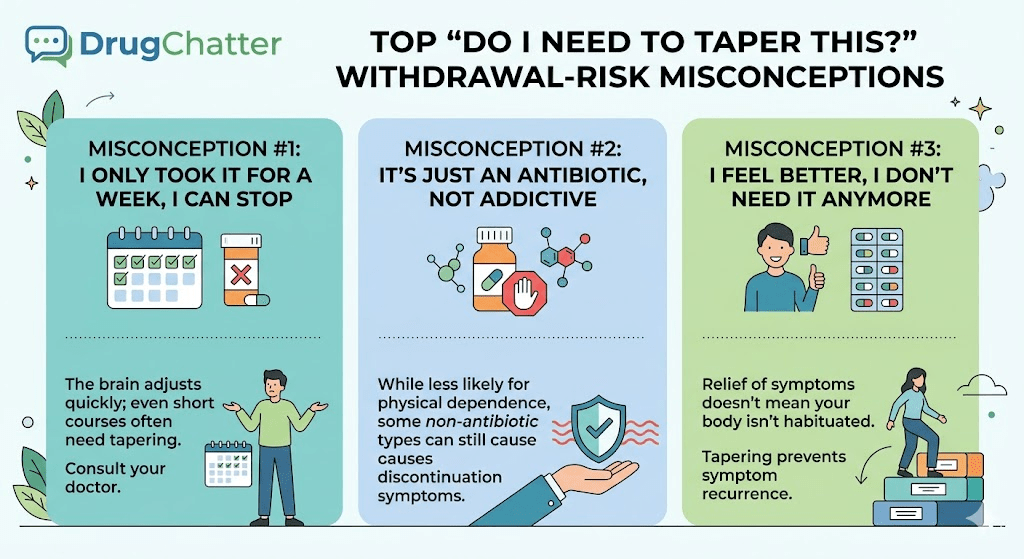
There are two kinds of medication advice people trade in the wild: the kind that’s grounded in pharmacology, and the kind that’s grounded in optimism. Withdrawal-risk misconceptions belong firmly to the second category—especially the comforting idea that tapering is only for the “obviously addictive” drugs, or that your body will simply shrug off abrupt changes because you feel fine today.
To be clear: I can’t tell you whether you personally need to taper. But I can tell you what the most common misconceptions look like, why they’re seductive, and what to do instead—using the same practical, question-driven lens you’d use when checking drug interactions, dosing timing, and metabolism questions.
Misconception #1: “If I’m not addicted, I won’t get withdrawal.”
Withdrawal isn’t a moral category. It’s a biology category. Your nervous system and endocrine system adapt to steady drug exposure; when you remove that exposure suddenly, adaptation can show up as symptoms that feel like “withdrawal” even when the medication wasn’t used for recreation or addiction.
That’s why the safest approach is to treat any long-term medication change as a physiology problem, not a vibes problem—especially when the drug affects brain signaling, sleep, pain pathways, or stress hormones.
Misconception #2: “Tapering is only about comfort—so if I can tolerate it, it’s fine.”
Comfort is not the only variable. Some withdrawal syndromes are not just unpleasant; they can be dangerous, destabilizing, or simply harder to reverse once they start. The fact that you can “push through” early symptoms doesn’t mean the plan is safe—it may just mean you’re delaying the part where your body stops cooperating.
Think of it like dosing and absorption: timing and context matter. For example, even with a well-studied drug like Lipitor, meal timing and food effects can change how much you absorb and how you feel. If that’s true for absorption, it’s also true that abrupt changes can change what your body is doing internally—sometimes in ways you don’t notice until later.
Misconception #3: “Withdrawal risk is the same for everyone.”
It isn’t. Risk varies with dose, duration, your baseline physiology, and how your body has adapted. Even for drugs that people assume are “standard,” effectiveness and risk can vary by patient factors—like liver disease severity for Lipitor.
Withdrawal risk works the same way: the “one-size-fits-all” stopping plan is usually the one that fails.
Misconception #4: “I can just stop and restart if it gets bad.”
Restarting can help, but it’s not a reset button. The timing of symptoms, the half-life of the drug, and how quickly your system re-adapts can make “stop-and-go” a roller coaster. If you’re going to change a regimen, you want a plan that anticipates symptoms rather than reacting to them.
That’s why people obsess over pharmacology details like metabolism and interactions—because the body doesn’t negotiate. For instance, exercise can change how certain drugs behave in the body, and alcohol can change how the liver metabolizes drugs.
Withdrawal is similarly time-dependent and physiology-dependent.
Misconception #5: “If the drug is ‘just for sleep’ or ‘just for pain,’ tapering doesn’t matter.”
Those are exactly the situations where people underestimate risk. Sleep and pain pathways are tightly linked to brain signaling and stress regulation. If a medication changes those systems, stopping abruptly can produce rebound symptoms—sometimes worse than the original problem.
Even side effects can vary by context; withdrawal can too.
Misconception #6: “Tapering is only necessary if you’ve been on the drug for years.”
Not necessarily. Some people adapt quickly; others don’t. Dose matters, too. The safest assumption is that any sustained regimen can create adaptation, and adaptation can create symptoms when you remove the drug.
Again, this is where the “ask a clinician” part matters. Not because clinicians are magical, but because they can look at your specific dose, duration, and history and propose a taper schedule that matches your risk.
What to do instead (the boring, correct plan)
- Don’t decide taper vs. stop based on how you feel today. Symptoms can be delayed.
- Ask for a taper plan that matches your drug, dose, and timeline.
- Use the same mindset you use for interactions and dosing questions: context changes outcomes.
- If you’re unsure, ask your prescriber or pharmacist. That’s what they’re for.
If you want a practical reminder that “talk to your doctor” isn’t just a slogan, here are two DrugChatter questions that point to the same theme—checking effectiveness and consulting appropriately.
- Have you consulted with your doctor about lipitor’s effectiveness?
- Why are check ups important during advil and antidepressant use?
The bottom line
The most common tapering misconception is also the most dangerous: that withdrawal risk is rare, uniform, or obvious. It isn’t. Your body adapts to medication exposure, and abrupt changes can trigger rebound or withdrawal-like symptoms even when you don’t “feel addicted.”
If you’re considering stopping or reducing a medication, treat it like a dosing and interaction problem: gather facts, ask the right questions, and—when in doubt—get a taper plan rather than improvising one.