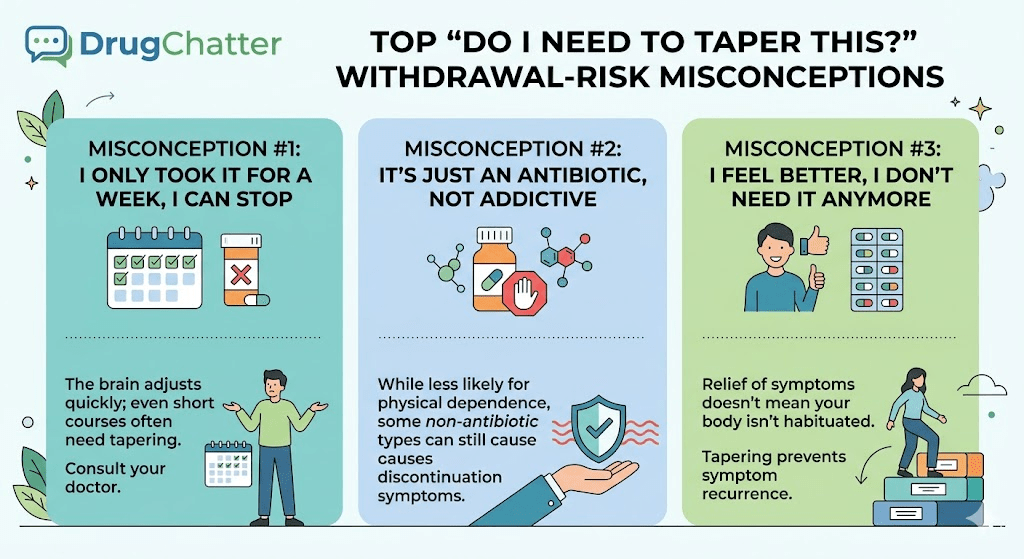
There are two kinds of medication questions that reliably start the same way: “I’m stopping—do I need to taper?” and “I didn’t taper—am I going to be okay?” The trouble is that many of the answers people carry around in their heads are half-true, or true only for a narrow set of drugs, or true in a way that’s easy to misapply.
Below are the most common withdrawal-risk misconceptions—plus the practical way to think about them. (Not medical advice; if you’re stopping or changing a prescription, your prescriber/pharmacist should be the ones doing the taper math.)
1) “If it’s not an opioid, it can’t cause withdrawal.”
Withdrawal isn’t a synonym for “opioid.” Plenty of non-opioid drugs can produce discontinuation symptoms—sometimes dramatic, sometimes subtle, sometimes delayed. The mechanism matters: receptor adaptation, neurotransmitter changes, and physiologic counter-regulation can all create a “your body noticed” response.
Misconception: people assume only drugs with the word “withdrawal” in the popular imagination can do this.
Reality: many classes can—especially those that act on the brain or endocrine systems, or that have physiologic effects your body compensates for.
2) “If I feel fine today, I don’t need to worry.”
Discontinuation symptoms can be time-lagged. Some show up within days; others creep in later, after your body has had time to “re-balance” without the drug.
Misconception: symptom timing is immediate and obvious.
Reality: the absence of symptoms on day one is not proof you’re safe.
3) “Tapering is only for people who already had withdrawal once.”
That’s like saying you only need a seatbelt after you’ve already been in a crash. The first attempt at stopping can be the one that teaches you the hard lesson.
Misconception: withdrawal risk is only personal and only history-based.
Reality: risk can be predicted from the drug, dose, duration, and individual factors—even if you’ve never had symptoms before.
4) “Tapering means ‘go slow’—so any schedule is fine.”
Yes, tapering is about reducing exposure gradually. But “gradually” isn’t the same as “randomly.” The taper should reflect the drug’s pharmacology (half-life, active metabolites), the dose form, and your clinical situation.
Misconception: you can wing it as long as you reduce something.
Reality: some drugs require more careful step-downs than others; some benefit from slower tapers at the end; some shouldn’t be stopped abruptly even if the patient feels stable.
5) “If the drug is short-acting, tapering is unnecessary.”
Short-acting drugs can sometimes produce faster-onset discontinuation symptoms because drug levels fall quickly. That can make abrupt stopping feel worse, sooner.
Misconception: short half-life automatically equals “less dependence.”
Reality: rapid level changes can increase symptom likelihood.
6) “Withdrawal symptoms are always dangerous—so any symptoms mean emergency.”
Some discontinuation syndromes are uncomfortable but not life-threatening. Others can be serious depending on the drug and the patient. The key is not to panic, but also not to ignore red flags.
Misconception: either “it’s nothing” or “it’s an emergency” with no middle ground.
Reality: you should treat discontinuation symptoms as a clinical communication problem—call your prescriber, especially if symptoms are severe, escalating, or include dangerous features (e.g., severe agitation, confusion, suicidal thoughts, seizures, or chest pain).
7) “I can stop because I’m switching to another drug in the same ‘general area.’”
Switching can help, but it can also create a gap where neither drug fully covers the adapted physiology. Cross-tapering is a strategy; “stop one and start another whenever” is not.
Misconception: therapeutic class similarity guarantees continuity.
Reality: dose, receptor profile, and timing still matter.
8) “Benzodiazepines are the only meds people taper.”
Benzodiazepines are famous for withdrawal risk, but they’re not the only category where abrupt cessation can be a bad idea. Still, if you’re dealing with a benzodiazepine, the taper conversation should be taken seriously.
If you’re asking about benzodiazepine timelines, this DrugChatter Q&A is one example of the kind of specificity people often need:
(That link is about patent timing, not tapering—but it illustrates how often people need precise, drug-specific information rather than generic assumptions.)
9) “If it’s over-the-counter or ‘natural,’ it can’t cause discontinuation.”
“Natural” doesn’t mean “no physiologic adaptation.” Supplements can still affect neurotransmitters, hormones, or sleep architecture. And OTC products can still be pharmacologically active.
Misconception: only prescription drugs can create withdrawal.
Reality: the body doesn’t care where the pill came from; it cares what it’s been exposed to.
10) “The right answer is always ‘yes, taper’.”
Sometimes the correct answer is “no taper needed.” Some medications can be stopped without a taper, depending on the drug and the patient. The problem is that people often don’t know which bucket their medication is in.
Misconception: one-size-fits-all caution.
Reality: the correct approach is drug-specific and patient-specific.
So what should you do?
When you’re considering stopping or reducing a medication, the safest workflow is:
- Identify the exact drug and formulation (brand vs generic, immediate vs extended release).
- Confirm the dose and how long you’ve been taking it.
- Ask your prescriber/pharmacist whether tapering is recommended and, if so, what schedule they want.
- Don’t improvise a taper without guidance—especially for CNS-active drugs.
Bottom line
The “do I need to taper this?” question isn’t a superstition. It’s a pharmacology question. And the most expensive misconception is assuming that withdrawal risk is either obvious, limited to a single drug class, or predictable from how you feel on the first day.
If you want to keep reading in the same spirit—drug-specific, detail-oriented questions—DrugChatter has plenty of examples of how precision matters across medication topics, even when the question isn’t about tapering.