Some questions arrive wearing a lab coat and a clipboard. Others arrive wearing a hoodie and a panic attack. The “do I need to taper this?” question is usually the second kind—because it’s asked at the exact moment someone is already feeling unwell, already improvising, and already trying to decide whether their body is “just being dramatic” or “actually in trouble.”
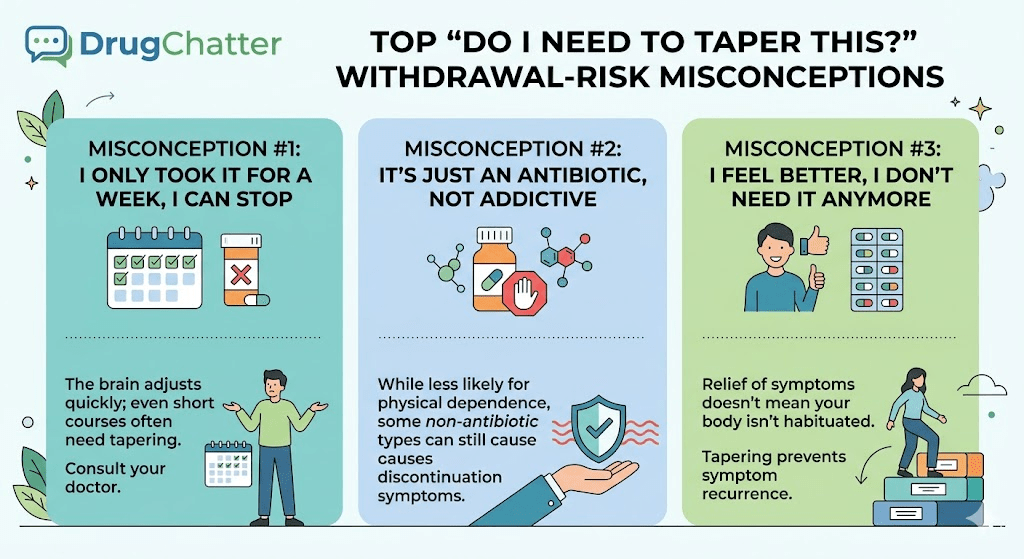
Here’s the trouble: a handful of withdrawal-risk misconceptions are sticky. They survive bad timing, incomplete information, and the human urge to treat medication like a light switch. Let’s knock down the most common myths—using the DrugChatter answers as signposts—so you can stop guessing and start planning.
Myth #1: If the drug is “not that strong,” withdrawal can’t be serious
Withdrawal risk doesn’t care about your intuition. It cares about pharmacology, exposure duration, and how the nervous system adapted while you were taking the medication. A classic example is benzodiazepines: people often assume tolerance means “I’m fine,” when it can actually mean the opposite—your body has adjusted, and stopping can be rough.
DrugChatter’s discussion of how increased Ativan tolerance impacts withdrawal symptoms is a reminder that tolerance can change the withdrawal landscape. Translation: “I’ve been on it a while” and “it doesn’t feel that intense” are not reliable safety metrics.
Myth #2: Tapering is only for long-term users
People hear “taper” and picture years of use. But the nervous system can adapt faster than our common sense. The real question isn’t just “how long,” it’s “what has your body been doing while you were taking it?”
Even when the medication is used for anxiety, the dose and the severity of the underlying condition can influence how adjustments are handled. See how anxiety disorder severity influences Ativan dose adjustments. That’s the point: tapering decisions are clinical, not calendar-based.
Myth #3: If you feel bad, that’s proof you should stop immediately
This is the “pain means progress” fallacy, applied to withdrawal. Feeling worse can be a sign you’re already in the middle of a physiologic adjustment. In that moment, the impulse is to yank the cord harder—when what you often need is a structured plan.
DrugChatter’s answer on withdrawal symptoms in the setting of increased tolerance underscores why “stop harder” is not a strategy. It’s a gamble.
Myth #4: You can taper by vibes—skipping doses and “seeing what happens”
Skipping doses is not tapering; it’s random exposure. Random exposure can make symptoms harder to interpret and can prolong the period where you feel awful.
DrugChatter’s broader medication-misuse theme shows up in questions like what happens if you skip aspirin doses. Different drug, different mechanism—but the same behavioral lesson: dose changes should be deliberate, not improvised.
Myth #5: “Tolerance” means “withdrawal won’t happen”
Tolerance is often misunderstood as protection. But tolerance can mean your body has learned to function under a certain level of drug effect. When that level drops, the system has to re-balance.
Again, the most direct pointer here is increased Ativan tolerance and withdrawal symptoms. If you’re tolerating the drug, you may also be tolerating the absence of the drug less well than you think.
Myth #6: Withdrawal risk is the same for everyone
It isn’t. People differ in metabolism, duration of use, dose, comorbid conditions, and—crucially—how the medication interacts with the rest of their life (sleep, stress, other meds).
DrugChatter’s answer on how anxiety severity influences Ativan dose adjustments is a good example of why “one-size tapering” is fantasy. The plan has to fit the person.
So… do you need to taper?
If you’re asking the question, you’re already in the zone where you should slow down and get a plan. The safest default is: don’t decide tapering by symptom panic and don’t decide it by internet confidence.
Use the “taper” question as a prompt to contact your prescriber or pharmacist and ask for a taper schedule tailored to you—especially if the medication is one where tolerance and withdrawal are known concerns, like benzodiazepines (see this DrugChatter answer).
Bottom line
The “do I need to taper this?” question is not a moral test or a trivia question. It’s a safety question. The myths—“it’s not strong,” “I haven’t been on it long,” “feeling bad means stop,” “tolerance protects me,” “skipping is tapering,” “everyone’s the same”—are the kind of stories that sound plausible right up until they aren’t.
Get the plan. Then follow it. Your nervous system will thank you for the predictability.