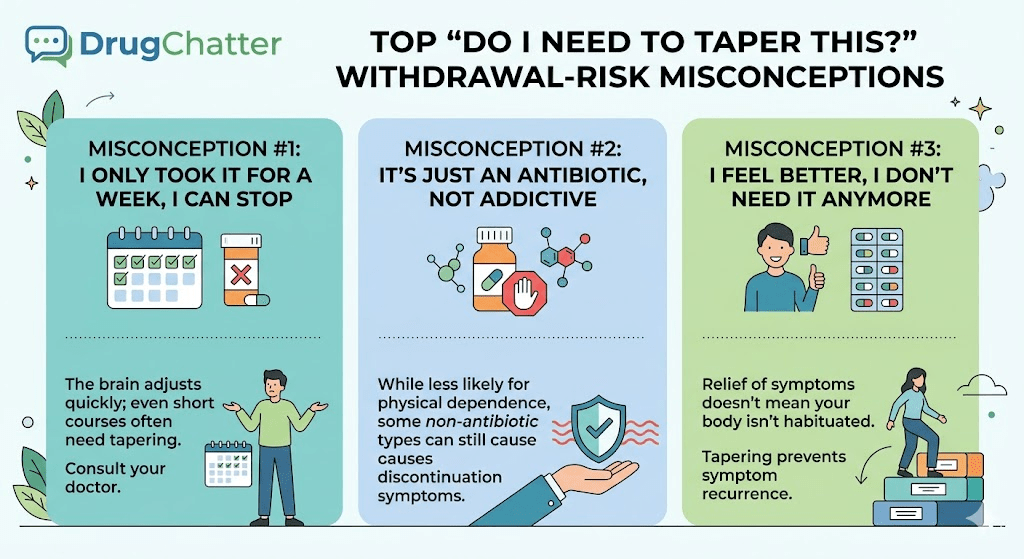
There are two kinds of people when it comes to stopping a medication: the ones who assume withdrawal is a rare, dramatic event—and the ones who assume it is inevitable, always severe, and always the same. Both groups miss the point.
Withdrawal risk is real, but it is not a single switch labeled “taper” or “no taper.” It depends on the drug, the dose, how long you’ve been taking it, your physiology, and—crucially—how abruptly you stop. The most common misconception is that withdrawal is either (a) obvious and immediate, or (b) impossible unless you’ve been on the drug forever.
Let’s clear up the top “do I need to taper this?” misconceptions, using the kinds of questions people ask when they’re trying to make a safe decision quickly.
1) Misconception: “If I don’t feel bad right away, I’m in the clear.”
Withdrawal isn’t always a fireworks show. Some symptoms lag. Others show up after your body has already adjusted to the absence of the drug. So “no immediate reaction” is not the same thing as “no withdrawal risk.”
That’s why it’s smart to treat discontinuation like a process, not a single moment. If you’re unsure, the safest move is to ask about the specific discontinuation profile of your medication rather than relying on your short-term experience.
2) Misconception: “Tapering is only for people who were on the drug for years.”
Time matters, but it’s not the only variable. Dose and pharmacology matter too. A medication can produce withdrawal symptoms even when someone hasn’t been on it for a decade. The question isn’t “how long have I been taking it?”—it’s “what does this drug do to the nervous system (or other systems) and what happens when you remove it quickly?”
3) Misconception: “If it’s a generic, withdrawal risk is the same as the brand.”
Generics are designed to be equivalent in active ingredient and overall exposure, but people still experience discontinuation differently due to formulation differences, dosing schedules, and individual sensitivity. The practical takeaway: don’t assume “generic = identical stop behavior.”
For example, people often ask about potency and effect comparisons between brand and generic versions of drugs like atorvastatin (Lipitor) and how those differences might translate into real-world outcomes:
- How does potency of atorvastatin’s hmg coa reductase inhibition compare to lipitor’s generic version?
- How do the effects of atorvastatin on hmg coa reductase compare to lipitor’s generic in terms of potency?
Even when the active ingredient is the same, the “stop” question is still about your body’s adaptation—not just label equivalence.
4) Misconception: “Withdrawal is only physical—so if I’m mentally okay, I’m fine.”
Withdrawal can include mood, sleep, irritability, anxiety, and cognitive fog. People sometimes interpret these as stress or “life stuff,” then miss the connection to stopping medication. If you’re changing meds, it’s worth tracking symptoms and timing.
And if you’re thinking about how quickly side effects reverse after recovery, that question comes up often in other contexts—like with statins:
Withdrawal and side effects aren’t identical, but the broader lesson is the same: timing can be misleading.
5) Misconception: “I can stop and restart later if it gets bad.”
Restarting can be harder than people expect. Symptoms can change, and the “reset” may not be clean. Also, repeated stop-start cycles can make it harder to predict what your body will do next time.
So the right question isn’t “can I bail out if it’s rough?” It’s “what is the safest discontinuation plan for this specific medication?”
6) Misconception: “Tapering is always slow and always miserable.”
Not every taper has to be a long, suffering marathon. Some medications require only modest dose reductions; others require careful, stepwise schedules. The goal is not to endure discomfort—it’s to reduce risk.
That’s why “tapering” should be individualized rather than treated like a one-size-fits-all ritual.
7) Misconception: “Drug interactions don’t matter for withdrawal risk.”
Interactions can change drug levels, metabolism, and how your body responds during discontinuation. If you’re taking other medications or supplements, it’s not just about whether they affect the drug while you’re on it—it’s also about what happens when you remove it.
People ask interaction questions all the time, for instance with atorvastatin and alcohol, supplements, and other agents:
- Will alcohol affect lipitor’s efficacy for high cholesterol?
- Will taking lipitor and st john’s wort affect my cholesterol levels?
- How does vitamin c affect lipitor’s recommended dosage?
- Can concurrent aspirin intake impact lipitor’s potency?
Even though these examples aren’t “taper” questions, they illustrate the same principle: the body doesn’t live in a vacuum.
8) Misconception: “If my friend tapered successfully, my situation will be identical.”
Withdrawal risk is personal. Two people can take the same medication and have different experiences due to dose, duration, metabolism, and comorbidities. A plan that worked for someone else may be too fast—or unnecessarily slow—for you.
So what should you do?
If you’re asking yourself “do I need to taper this?”, the best answer is usually: ask about the discontinuation profile of your exact medication and your exact dose. Don’t rely on general rules, anecdotes, or the absence of immediate symptoms.
And if you’re dealing with a medication where withdrawal is a known concern, treat the decision like a clinical plan—not a willpower test.
Bottom line: The most dangerous misconception is thinking withdrawal risk is either obvious or impossible. It’s neither. It’s a drug-specific, dose-specific, time-specific risk—and the safest path is a tailored taper plan when appropriate.