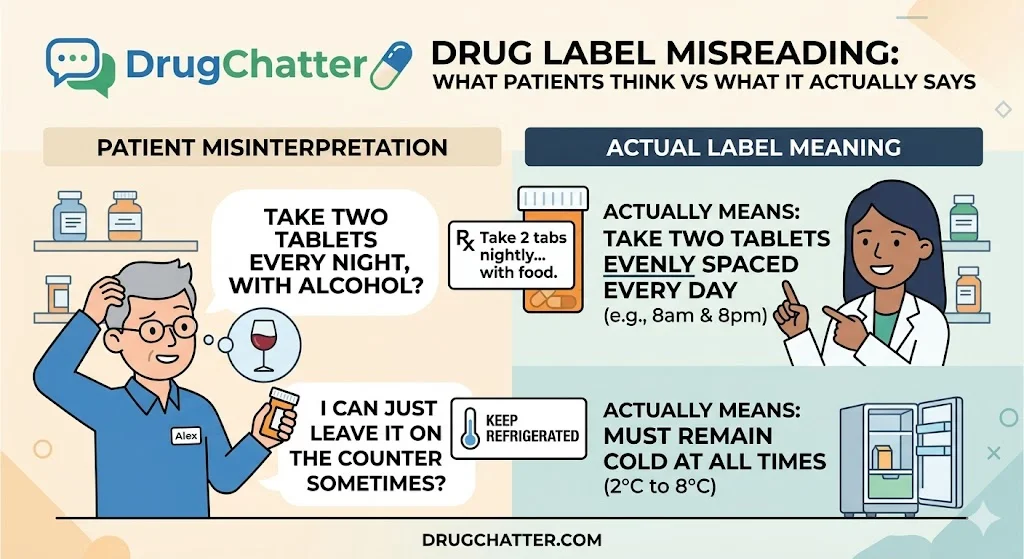
There’s a particular kind of confusion that shows up again and again in the real world: not the dramatic, movie-scene kind—just the everyday, human kind. A patient scans a label, hears a name in the pharmacy line, sees a brand on a box, and assumes the rest is obvious.
But drug labels are full of traps: similar-sounding names, brand-versus-generic mismatches, dosing-unit misunderstandings, and “free trial” or “coupon” language that can be read as a promise rather than a marketing arrangement. The result is predictable: people end up paying for the wrong thing, asking for the wrong version, or expecting a benefit that the label never actually guaranteed.
Below are some of the most common “what it looks like it says” moments—paired with the DrugChatter answers that clarify what’s really going on.
1) “Free trial” that isn’t what you think
Patients see “free trial” and assume it’s a straightforward, universal offer. In practice, these programs can be limited by eligibility, timing, and distribution rules—so the label language can feel like certainty when it’s actually conditional.
2) Brand name vs. generic name: the label’s biggest sleight of hand
One of the most frequent misreadings is simply the name itself. Patients may believe they’re asking for “the drug,” when they’re actually asking for a brand. Or they may assume a generic exists because the brand is familiar.
3) “Cost” questions that hide the real variable: which version?
When people ask about price, they often mean “the drug.” But labels (and pharmacy systems) mean “the specific product configuration”—strength, package size, and sometimes even the formulation. That’s why “price” can swing wildly depending on what’s actually being dispensed.
4) Coupons and “discounts” that don’t equal “free”
Coupons can look like a guarantee on the label or in the marketing copy. But the fine print matters: eligibility, stacking rules, and whether the discount applies to the exact product you’re holding.
5) “Ingredients” questions that reveal a mismatch in what people think they’re buying
Sometimes the confusion isn’t about price at all—it’s about identity. Patients ask what’s inside because they’re trying to confirm they have the right medication, the right formulation, or the right active ingredient.
6) “Is there a generic?”—the question that exposes how labels can mislead
Generic availability is not a universal constant. It depends on patent status, approvals, and market entry. So a label that says “brand” can make patients assume a generic must exist—until they find out it doesn’t (or not yet).
7) The “trade name” problem: same drug, different name, different expectations
Patients often treat the trade name as the drug’s identity. But trade names are just labels—useful, but not the whole story. When people ask for “the trade name,” they’re usually trying to connect the dots between what they were prescribed and what they can find.
Some patients are really asking for the underlying medication, not the brand wrapper. That’s why questions like “what is carboprost?” show up—because the label may be familiar, but the meaning isn’t.
9) Availability and timing: the label says “now,” the market says “later”
Even when the label is correct, the patient’s assumption can be wrong: “available” doesn’t always mean “available everywhere, immediately.” Timing and region matter.
10) “Buy it online” questions that are really about legitimacy and substitution
When patients ask where to buy, they’re often trying to avoid the mismatch between what they were prescribed and what they can actually obtain. That can lead to substitution questions—sometimes with the wrong assumptions about equivalence.
11) The EpiPen family: same concept, different package, different cost
Patients see “EpiPen” and assume the cost and dosing are interchangeable. They’re not. Package size and specific product version change the price and sometimes the clinical details.
12) “Ingredients” and “mechanism” questions: when patients want certainty the label can’t provide
Some patients read the label and want to know what’s really happening—how the drug works, how it’s made, and whether the “same drug” is truly the same drug. That’s where mechanism and patent/process questions come in.
13) When “patch,” “ointment,” and “products” are treated like the same thing
Patients sometimes assume that different dosage forms are interchangeable. They’re not. A patch is not an ointment is not a tablet, even if the active ingredient is related.
14) The “cost” of injections and biologics: the label can’t show your bill
For injectables, the label tells you what you’re taking; it doesn’t tell you what your payer will do. Patients often read the label and expect the cost to be straightforward. It isn’t.
15) “Patent expiry” and “sales” questions: the label can’t predict the market
Patients sometimes read a label and assume it implies future availability or pricing. But patents, approvals, and market dynamics decide whether the next version shows up—and when.
If there’s a moral here, it’s not “don’t trust labels.” It’s “don’t stop at the label.” When something feels off—price, name, dosing form, or availability—patients should verify the exact product (strength and package size), ask whether a generic substitution is truly equivalent, and confirm whether a coupon or trial is conditional.
And if you’re trying to decode the label language, these DrugChatter threads are a good place to start—because they’re built around the exact moment when a patient thinks they know what the label says, and the answer turns out to be more complicated.