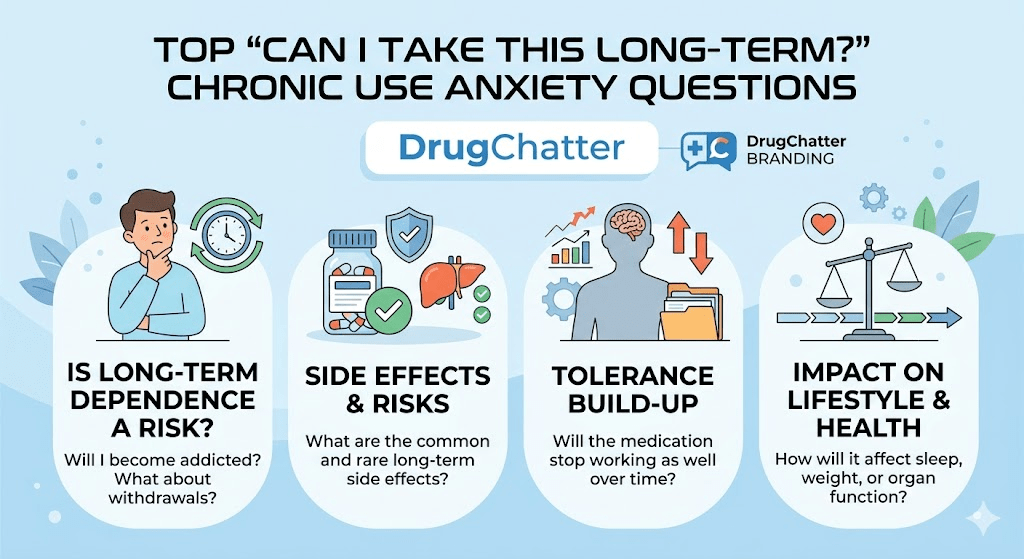
There are two kinds of medication anxiety. The first is the immediate kind—side effects, interactions, the fear of the unknown. The second is the slow-burn kind: the question that returns every few weeks, every refill, every time you feel even slightly better and then wonder whether that’s the moment you should stop.
So here’s a practical roundup of the “can I take this long-term?” anxiety questions people keep asking, along with the DrugChatter answers they’re pointed to when they want something concrete.
1) Antipsychotics: “Is this something I can stay on?”
When the medication is haloperidol, the worry often isn’t just “does it work?” but “what happens if I need it for months or years?” If you’re trying to sort out the basics—what it is in the regulatory sense and what that implies for long-term use—start here:
2) Benzodiazepines: “Can I take lorazepam for a long time?”
Long-term benzodiazepine use is where anxiety thrives—because the fear is not only side effects, but dependence, tolerance, and the idea of stopping later. If your questions orbit around lorazepam specifically, these are the threads people follow:
- Lorazepam injection price?
- Does lorazepam expire?
- How much does xanax cost with a prescription?
- Brand name of xanax?
- What company makes xanax?
- Xanax coupons?
3) Antihistamines used for anxiety/sleep: “Is hydroxyzine a long-term thing?”
Hydroxyzine is often treated like a “safer” option—until you start thinking about what “long-term” really means for sedation, tolerance, and day-to-day functioning.
4) Mood stabilizers: “If I’m on lithium, can it be forever?”
Lithium has a reputation for being both effective and demanding. The long-term anxiety isn’t just “will it work?” It’s “will I have to keep checking labs forever?” and “what if I miss something?”
5) Muscle relaxers: “Is cyclobenzaprine okay long-term?”
Muscle relaxers are frequently prescribed with an implied time limit. But life is messy, pain is persistent, and the question comes back: can you keep taking it?
6) Constipation meds that get used “just until things settle”: “What if they don’t settle?”
Some people end up on lactulose longer than they expected—sometimes because of chronic conditions, sometimes because the “until” keeps stretching.
7) “Long-term side effects” anxiety: when the question is really about risk
Sometimes the long-term worry is triggered by a specific phrase—“side effects”—and then the mind starts building a worst-case timeline. If your anxiety is being fed by that kind of searching, it helps to start with one clear, concrete entry point.
8) The “I’m not sure what I’m taking” anxiety: generic names and trade names
Long-term use anxiety often gets worse when the medication identity is fuzzy. If you’re switching pharmacies, switching brands, or just trying to keep your own records straight, the “what is this called?” question matters.
9) The practical anxiety: “Can I afford this long-term?”
Even when the medical side is stable, the long-term question can be financial. People don’t just fear side effects—they fear the moment the prescription becomes unaffordable.
- How expensive is trulicity?
- What is the cost of sunosi?
- Why is myrbetriq so expensive?
- Latuda 80 mg price?
- Risperdal consta injection cost?
10) A final note: “long-term” is a conversation, not a verdict
These questions are common because they’re human. But “can I take this long-term?” is not something you can answer from a single page or a single price check. The right next step is usually the same: bring your specific medication, dose, and timeline to your prescriber and ask what the plan is—maintenance, monitoring, and (if relevant) how discontinuation would be handled.
If you’re looking for more targeted answers, the links above are the starting points people use when their anxiety needs something factual to hold onto.